
Judge, 1912-10-12 · page 16 of 28
Judge — October 12, 1912 — page 16: what you’re looking at
What you’re looking at
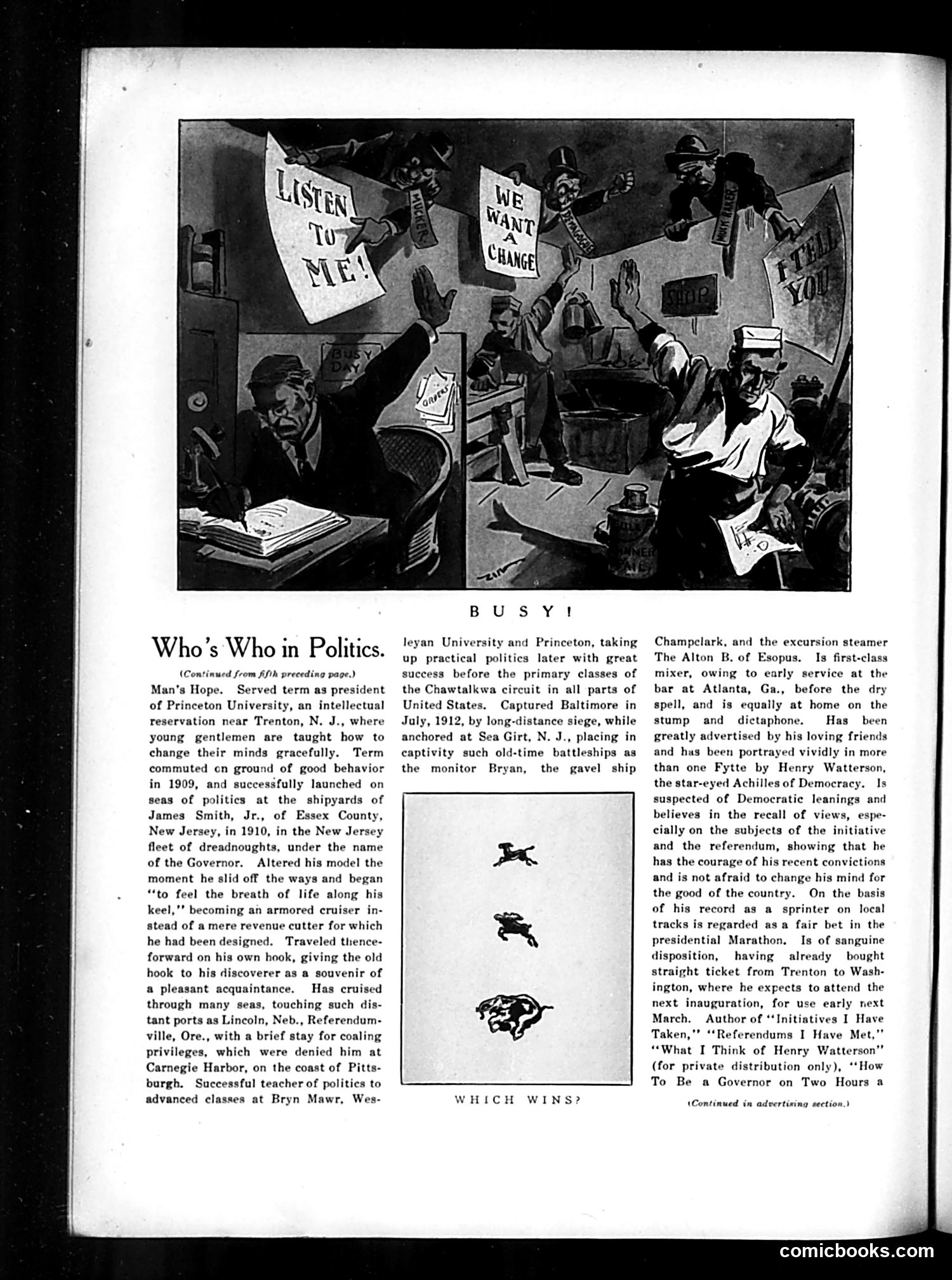
This Judge magazine page satirizes Woodrow Wilson, then a presidential candidate. The text mockingly describes Wilson's career trajectory using naval metaphors—he's a "ship" that altered course once launched into politics, abandoning his Princeton presidency and his political patron James Smith Jr. The satire targets Wilson's political inconsistency: he's accused of changing his positions on progressive issues (initiative, referendum) based on convenience rather than conviction. The reference to Henry Watterson (a prominent Democratic editor) and "star-eyed Achilles of Democracy" is ironic praise masking criticism. The cartoon's "WHICH WINS?" panel appears to show competing political forces—likely depicting the Democratic primary battle of 1912. The text mentions Wilson "captured Baltimore in July, 1912," referencing the Democratic Convention where he secured the nomination. Overall, Judge presents Wilson as an ambitious opportunist who shifts positions like a naval vessel changing course, having no fixed principles beyond personal advancement.
📄 Transcribed text from this page (OCR, searchable)
Machine-transcribed from the original scan — historical spelling and the odd misread are preserved.
Who’s Who in Politics. (Continued from fifth preceding page.) Man's Hope. Served term as president of Princeton Univers: an intellectual reservation near Trenton, N. J., where young gentlemen are taught how to change their minds gracefully. Term commuted on ground of good behavior in 1909, and successfully launched on seas of politics at the shipyards of James Smith, Jr., of Essex County, New Jersey, in 1910, in the New Jersey fleet of dreadnoughts, under the name of the Governor. Altered his model the moment he slid off the ways and began “to feel the breath of life along his keel,’’ becoming an armored cruiser in- stead of a mere revenue cutter for which he had been designed. Traveled thence- forward on his own hook, giving the old hook to his discoverer as a souvenir of a pleasant acquaintance. Has cruised through many seas, touching such dis- tant ports as Lincoln, Neb., Referendum- ville, Ore., with a brief stay for coaling privileges, which were denied him at Carnegie Harbor, on the coast of Pitts- burgh. Successful teacher of politics to advanced classes at Bryn Mawr, Wes- leyan University and Princeton, taking up practical politics later with great success before the primary classes of the Chawtalkwa circuit in all parts of United States. Captured Baltimore in July, 1912, by long-distance siege, while anchored at Sea Girt, N. J., placing in captivity such old-time battleships as the the gavel ship monitor Bryan, ye r 4 WHICH WINS? Champclark, and the excursion steamer The Alton B. of Esopus. Is first-class mixer, owing to early service at the bar at Atlanta, Ga., before the dry spell, and is equally at home on the stump and dictaphone. Has been greatly advertised by his loving friends and has been portrayed vividly in more than one Fytte by Henry Watterson, the star-eyed Achilles of Democracy. Is suspected of Democratic leanings and believes in the recall of views, e: cially on the subjects of the initiative and the referendum, showing that he has the courage of his recent convictions and is not afraid to change his mind for the good of the country. On the basis of his record as a sprinter on local tracks is regarded asa fair bet in the presidential Marathon, Is of sanguine disposition, having already bought straight ticket from Trenton to Wash- ington, where he expects to attend the next inauguration, for use early next March. Author of ‘Initiatives I Have Taken,"’ ‘‘Referendums I Have Met,"’ “What I Think of Henry Watterson” (for private distribution only), ‘‘How To Be a Governor on Two Hours a (Continued in advertising section.) comicbooks.com