
Judge, 1912-10-12 · page 8 of 28
Judge — October 12, 1912 — page 8: what you’re looking at
What you’re looking at
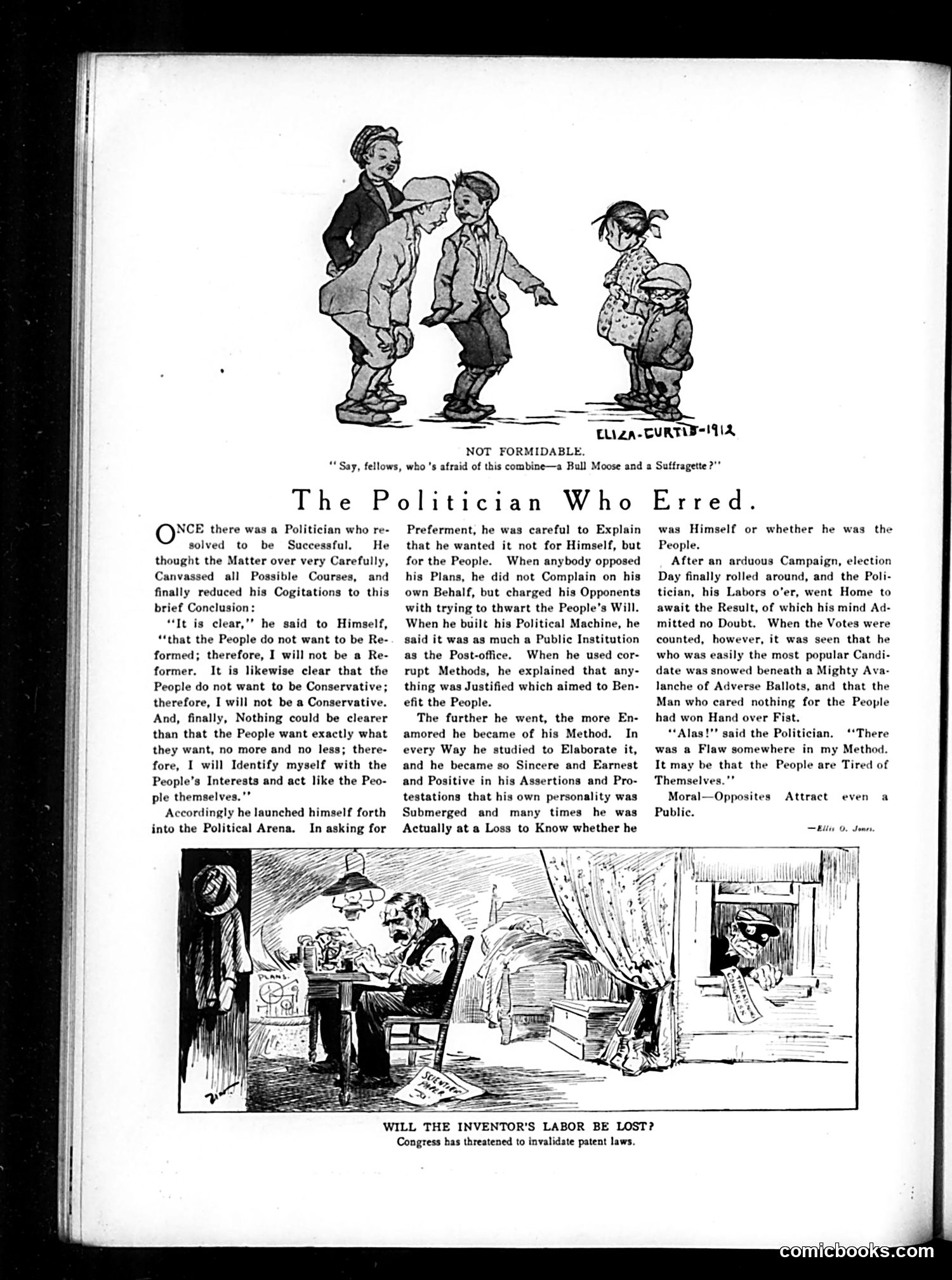
This 1912 *Judge* page satirizes a politician who cynically claims to represent "the People" while abandoning all principles. The story mocks his calculation: he adopts no reform or conservative position, instead claiming total identification with popular will—using "the People" as cover for corrupt methods and self-interest. The irony: despite his elaborate manipulation, he loses decisively while his opponent (who ignores the People) wins easily. The politician's conclusion—that the People are "tired of themselves"—is the joke's punchline: his strategy backfired because voters saw through the phoniness. **Top cartoon**: References the "Bull Moose" (Theodore Roosevelt's 1912 Progressive Party) and women's suffrage as non-threatening political forces, mocking politicians who fear them. **Bottom cartoon**: Separate editorial item warning that Congress threatens patent law invalidation, potentially harming inventors' interests. The page critiques hollow populist rhetoric and suggests authenticity matters in politics.
📄 Transcribed text from this page (OCR, searchable)
Machine-transcribed from the original scan — historical spelling and the odd misread are preserved.
NOT FORMIDABLE. “* Say, fellows, who's afraid of this combine—a Bull Moose and a Suffragette ?"" The Politician Who Erred. NCE there was a Politician who re- solved to be Successful. He thought the Matter over very Carefully, Canvassed all Possible Courses, and finally reduced his Cogitations to this brief Conclusion: “It is clear,"’ he said to Himself, “‘that the People do not want to be Re- formed; therefore, I will not be a Re- former. It is likewise clear that the People do not want to be Conservative; therefore, I will not be a Conservative. And, finally, Nothing could be clearer than that the People want exactly what they want, no more and no less; there- fore, I will Identify myself with the People’s Interests and act like the Peo- ple themselves."” Accordingly he launched himself forth into the Political Arena. In asking for Preferment, he was careful to Explain that he wanted it not for Himself, but for the People. When anybody opposed his Plans, he did not Complain on his own Behalf, but charged his Opponents with trying to thwart the People’s Will. When he built his Political Machine, he said it was as much a Public Institution as the Post-office. When he used cor- rupt Methods, he explained that any- thing was Justified which aimed to Ben- efit the People. The further he went, the more En- amored he became of his Method. In every Way he studied to Elaborate it, and he became so Sincere and Earnest and Positive in his Assertions and Pro- testations that his own personality was Submerged and many times he was Actually at a Loss to Know whether he was Himself or whether he was the People. After an arduous Campaign, election Day finally rolled around, and the Poli- tician, his Labors o’er, went Home to await the Result, of which his mind Ad- mitted no Doubt. When the Votes were counted, however, it was seen that he who was easily the most popular Candi- date was snowed beneath a Mighty Ava- lanche of Adverse Ballots, and that the Man who cared nothing for the People had won Hand over Fist. **Alas!"’ said the Politician. ‘There was a Flaw somewhere in my Method. It may be that the People are Tired of Themselves.”” Moral—Opposites Public. Attract even a WILL THE INVENTOR'S LABOR BE LOST? Congress has threatened to invalidate patent laws.