
Judge, 1912-10-12 · page 2 of 28
Judge — October 12, 1912 — page 2: what you’re looking at
What you’re looking at
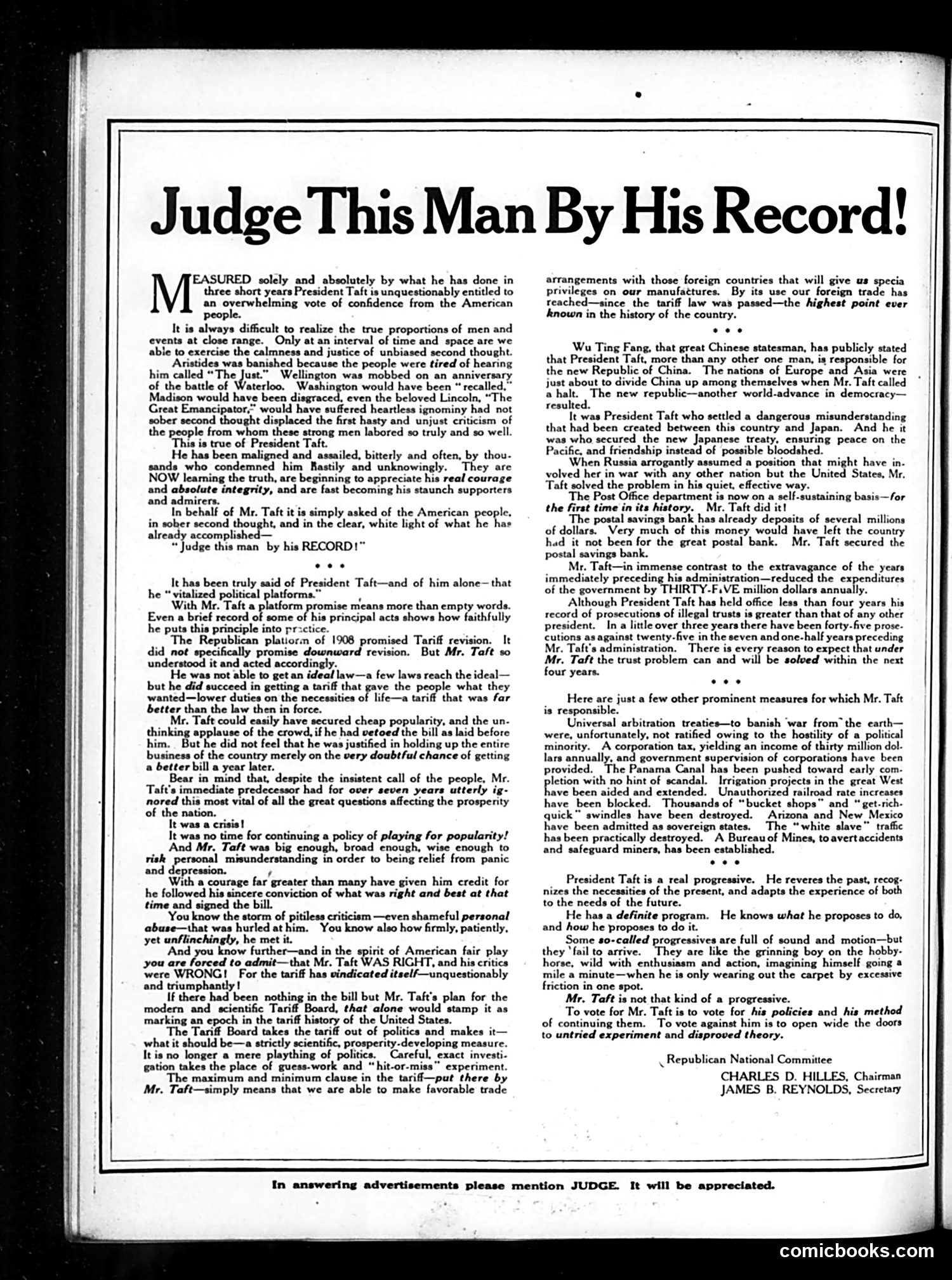
This is a **political advertisement**, not a cartoon. The page is a pro-Taft endorsement published by the Republican National Committee (signed by Charles D. Hilles, Chairman, and James B. Reynolds, Secretary). The text defends President **William Howard Taft** against criticism, arguing readers should "judge this man by his record." It praises his accomplishments in three years, including postal savings banks, conservation efforts, and trust-busting, while defending his tariff policies. The piece addresses **Wu Ting Fang** (Chinese statesman) and contrasts Taft favorably with predecessors, suggesting Taft prevented war and advanced democracy. It attacks critics as practicing "playing for popularity" and argues for voting based on Taft's "policies and his method" rather than "untried experiment and disapproved theory." This reflects **1912 election** Republican messaging.
📄 Transcribed text from this page (OCR, searchable)
Machine-transcribed from the original scan — historical spelling and the odd misread are preserved.
Judge This Man By His Record! EASURED solely and absolutely by what he has done in three short years President Taft is unquestionably entitled to an overwhelming vote of confidence from the American People. It is always difficult to realize the true proportions of men and events at close range. Only at an interval of time and space are we able to exercise the calmness and justice of unbiased second thought. Aristides was banished because the people were tired of hearing him called fTbs Jest Wellington was mobbed on an anniversary of the battle of Waterloo. Washington would have been “recalled,” Madison would have been disgraced, even the beloved Lincoln, “The Great Emancipator,” would have suffered heartless ignominy had not sober second thought displaced the first hasty and unjust criticism of the people from whom these strong men labored so truly and so well. This is true of President Taft. He has been maligned and assailed, bitterly and often, by thou- sands who condemned him Rastily and unknowingly. They are NOW leaming the truth, are beginning to appreciate his real courage and absolute integrity, and are fast becoming his staunch supporters and admirers. In behalf of Mr. Taft it is simply asked of the American people, sober second thought, and in the clear, white light of what Ke ha ready accomplished— * Judge this man by his RECORD!” eee It has been truly said of President Taft—and of him alone—that he “vitalized political platforms.” With Mr. Taft a platform promise means more than empty words. Even a brief record of some of his principal acts shows how faithfully he Puts this principle into pr=ctice. The Republican platiorm of 1908 promised Tariff revision. It did not specifically promise downward revision. But Mr. Taft so understood it and acted accordingly. He was not able to get an ideal law—a few laws reach the ideal— but he did succeed in getting a tariff that gave the people what they |—lower duties on the necessities of life—a tariff that was far Better than the law then in foree. Ir. Taft could easily have secured cheap popularity, and the un- thinking applause of the crowd, if he had vetoed the bill as laid before him. But he did not feel that he was justified in holding up the entire business of the country merely on the very doubtful chance of getting a better bill a year later. Bear in mind that, despite the insistent call of the people, Mr. Taft's immediate predecessor had for over seven years utterly ig- nored this most vital of all the great questions affecting the prosperity of the nation. It was a crisis! It was no time for continuing a policy of playing for popularity! And Mr. Taft was big enough, broad enough, wise enough to risk personal misunderstanding in order to being relief from panic and depression. With a courage far greater than many have given him credit for he followed his sincere conviction of what was right and best at that time and signed the bill. You know the storm of pitiless criticism —even shameful personal abuse—that was hurled athim. You know also how firmly, patiently, yet unflinchingly, he met it. And you know further—and in the spirit of American fair play you are forced to admit—that Mr. Taft WAS RIGHT, and his critics were WRONG! For the tariff has vindicated itself—unquestionably and triumphantly! if there had been nothing in the bill but Mr. Taft's plan for the modern and scientific Tariff Board, that alone would stamp it as marking an epoch in the tariff history of the United States. The Tariff Board takes the tariff out of politics and makes it— what it shoul a strictly scientific, prosperity-developing measure. It is no longer a mere plaything of politics. Careful, exact investi- gation takes the place of guess-work and “hit-or-miss” experiment. The maximum and minimum clause in the tariff—put there by Mr. Taft—simply means that we are able to make favorable trade arrangements with those foreign countries that will give us specia privileges on our manufactures. By its use our foreign trade has reached—since the tariff law was passed—the highest point ever known in the history of the country. eee Wu Ting Fang, that great Chinese statesman, has publicly stated that President Taft, more than any other one man, is responsible for the new Republic of China. ‘The nations of Europe and Asia were just about to divide China up among themselves ‘whe Mr. Taft called it. The new republic—another world-advance in democracy— resulted. It was President Taft who settled a dangerous misunderstanding that had been created between this country and Japan. And he it was who secured the new Japanese treaty, ensuring peace on the Pacific, and friendship instead of possible bloodshed. When Russia arrogantly assumed a position that might have in- volved her in war with any other nation but the United States, Mr. Taft solved the problem in his quiet, effective way. The Post Office department is now on a self-sustaining basis—for the first time in its history. Mr. Taft did it! The postal savings bank has already deposits of several millions of dollars. Very much of this money would have left the country had it not been for the great postal bank. Mr. Taft secured the postal savings bank. Mr. Taft—in immense contrast to the extravagance of the years immediately preceding his administration—reduced the expenditures of the government by THIRTY-F.VE million dollars annually Although President Taft has held office less than four years his record of prosecutions of illegal trusts is greater than that of any other president. In a little over three years there have been forty-five prose- cutions as against twenty-five in the seven and one-half years preceding Mr. Taft's administration. There is every reason to expect hat under Mr. Taft the trust problem can and will be solved within the next four years. eee Here are just a few other prominent measures for which Mr. Taft is responsible. Universal arbitration treaties—to banish ‘war from” the earth— were, unfortunately, not ratified owing to the hostility of a political minority. A corporation tax, yielding an income of thirty million dol- lars annually, and government supervision of corporations have been provided. The Panama Canal has been pushed toward early com- letion with no hint of scandal. Irrigation projects in the great West ave been aided and extended. Unauthorized railroad rate increases have been blocked. Thousands of “bucket shops” and “ get-rich- quick” swindles have been destroyed. Arizona and New Mexico have been admitted as sovereign states. The “white slave” traffic has been practically destroyed. A Bureau of Mines, to avertaccidents and safeguard miners, has been established. President Taft is a real progressive. He reveres the past, recog- nizes the necessities of the present, and adapts the experience of both to the needs of the future. He has a definite program. He knows what he proposes to do, and how he proposes to do it. Some so-called progressives are full of sound and motion—but they ‘fail to arrive. They are like the grinning boy on the hobby- horse, wild with enthusiasm and action, imagining himself going a mile a minute—when he is only wearing out the carpet by excessive friction in one spot. Mr. Taft is not that kind of a progressive. To vote for Mr. Taft is to vote for his policies and his method of continuing them. To vote against him is to open wide the doors to untried experiment and disproved theory. Republican National Committee CHARLES D. HILLES, Chairman JAMES B. REYNOLDS, Secretary In answering advertisements please mention JUDGE. It will be appreciated. comicbooks.com