
A complete issue · 24 pages · 1911
Judge — December 23, 1911
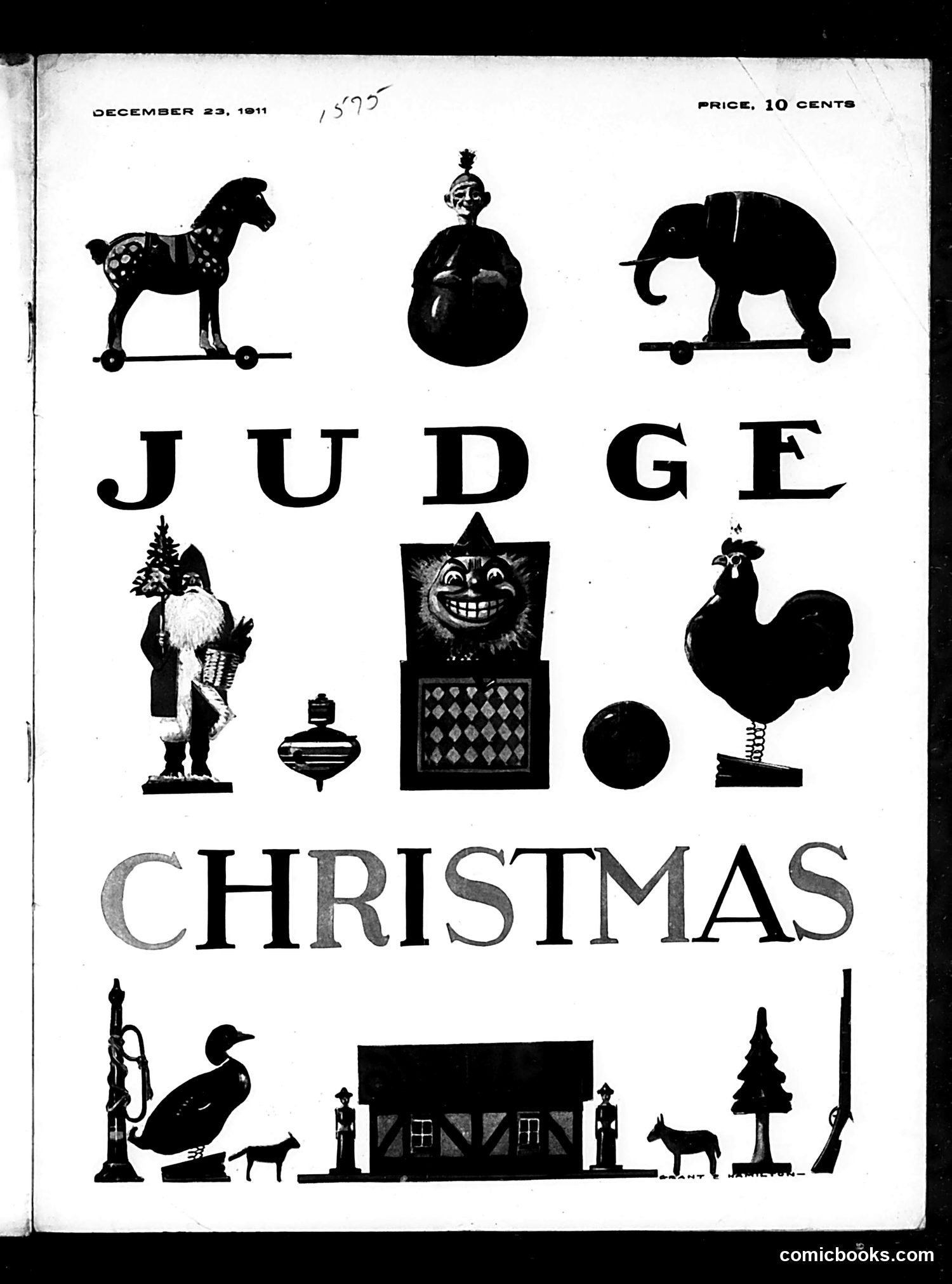
This is a Christmas-themed cover page using silhouettes of toys and festive imagery to spell out "JUDGE CHRISTMAS." The design arranges various objects—a rocking horse, toy elephant, spinning top, Santa figure, jack-in-the-box, rooster, nativity scene, duck, evergreen tree, and rifle—in decorative patterns. Without accompanying article text, this appears to be primarily a **festive cover design rather than political satire**. Judge magazine typically featured satirical commentary on current events, but this particular page emphasizes seasonal aesthetics and holiday gift-giving culture. The silhouette style was visually striking for magazine covers of the era. The price of 10 cents reflects typical periodical pricing for 1911.
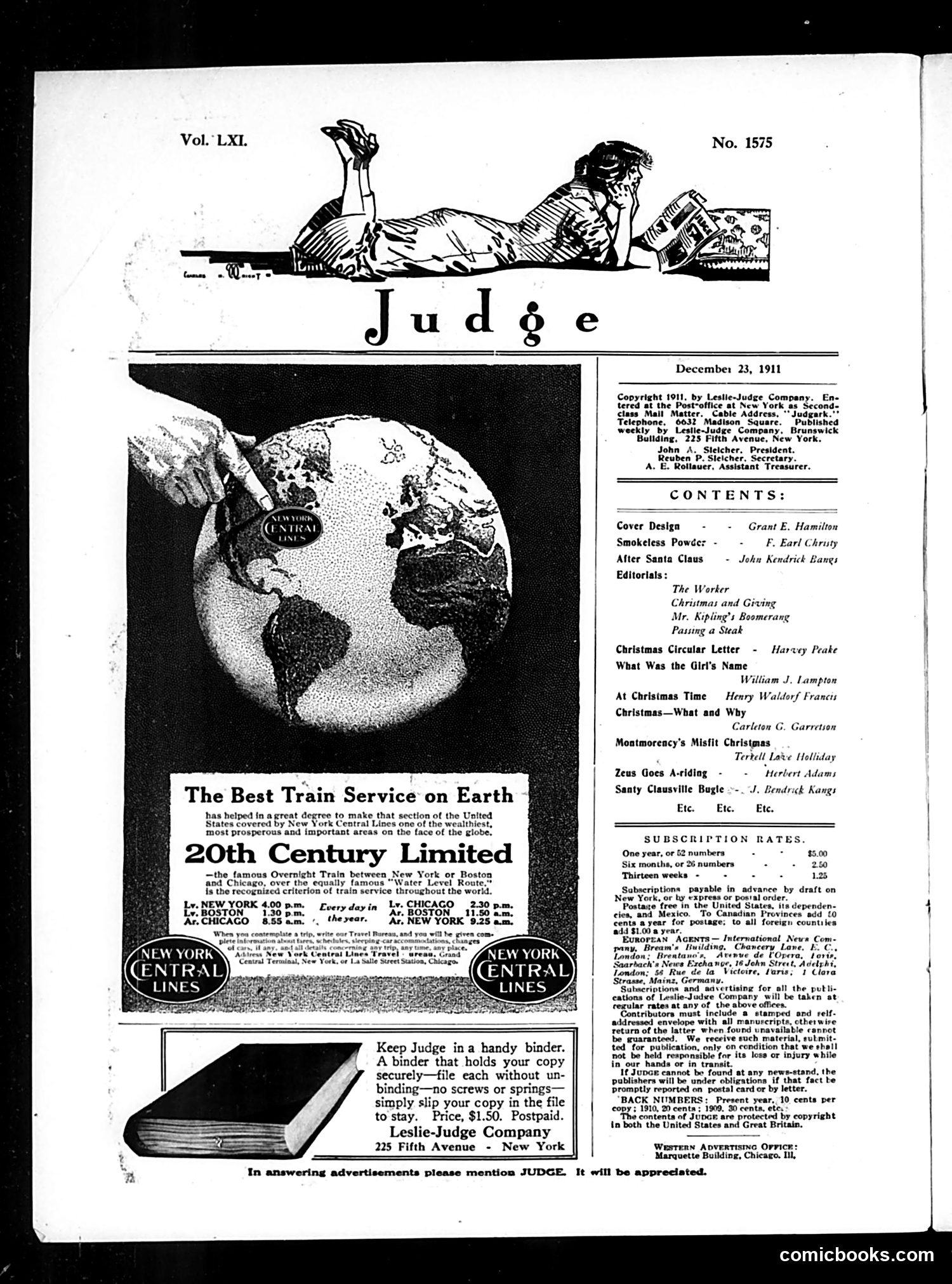
This page is primarily **advertising and masthead** rather than political satire. The dominant feature is an advertisement for the "20th Century Limited," a prestigious New York Central railroad train running between New York and Boston. The globe imagery emphasizes the train's importance to commerce and travel. The cover design by Grant E. Hamilton shows a reclining figure reading, suggesting leisure during train travel. The contents list references typical Judge fare: Christmas-themed pieces, editorials on current topics (Mr. Kipling's Boomerang, Monomychy's Misfit Christmas), and humor pieces. A secondary advertisement promotes Judge's own binder for organizing copies of the magazine. The page captures early 20th-century American commercial culture and the magazine's position as both satirist and consumer-oriented publication.
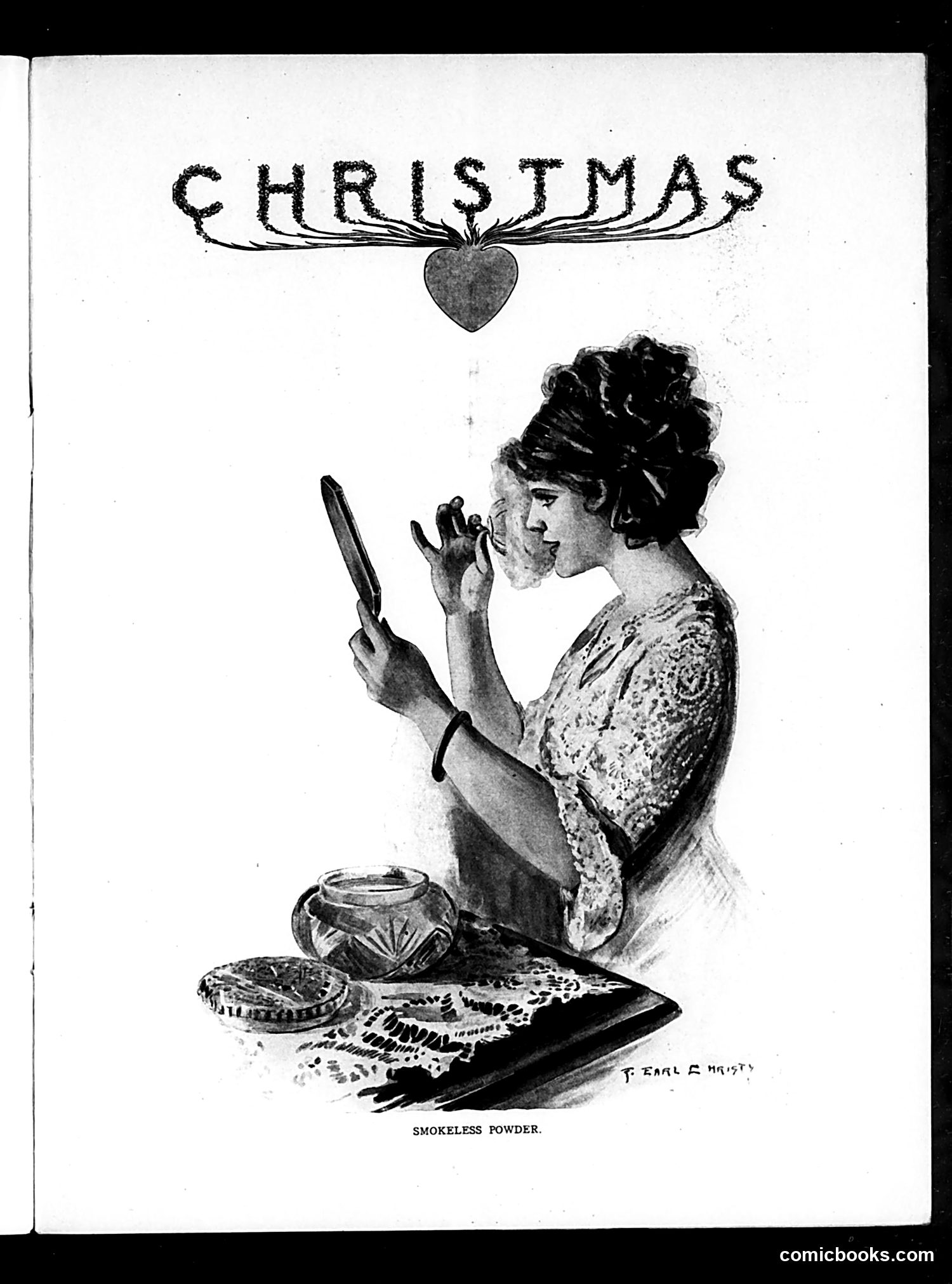
This is a Christmas advertisement for smokeless powder, a relatively new propellant technology in the late 19th/early 20th century. The image shows an elegant woman applying cosmetic powder to her face, using a hand mirror and powder puff. The visual pun plays on "smokeless powder" — the woman's cosmetic powder produces no smoke, unlike traditional gunpowder formulations. The decorative "CHRISTMAS" header with heart motif frames this as holiday advertising. The artist signature appears to be "F. Earl E. Hasty." This represents Judge magazine's blend of commercial advertising with visual wordplay—a common marketing strategy of the era that appealed to readers through clever illustration rather than direct product description.
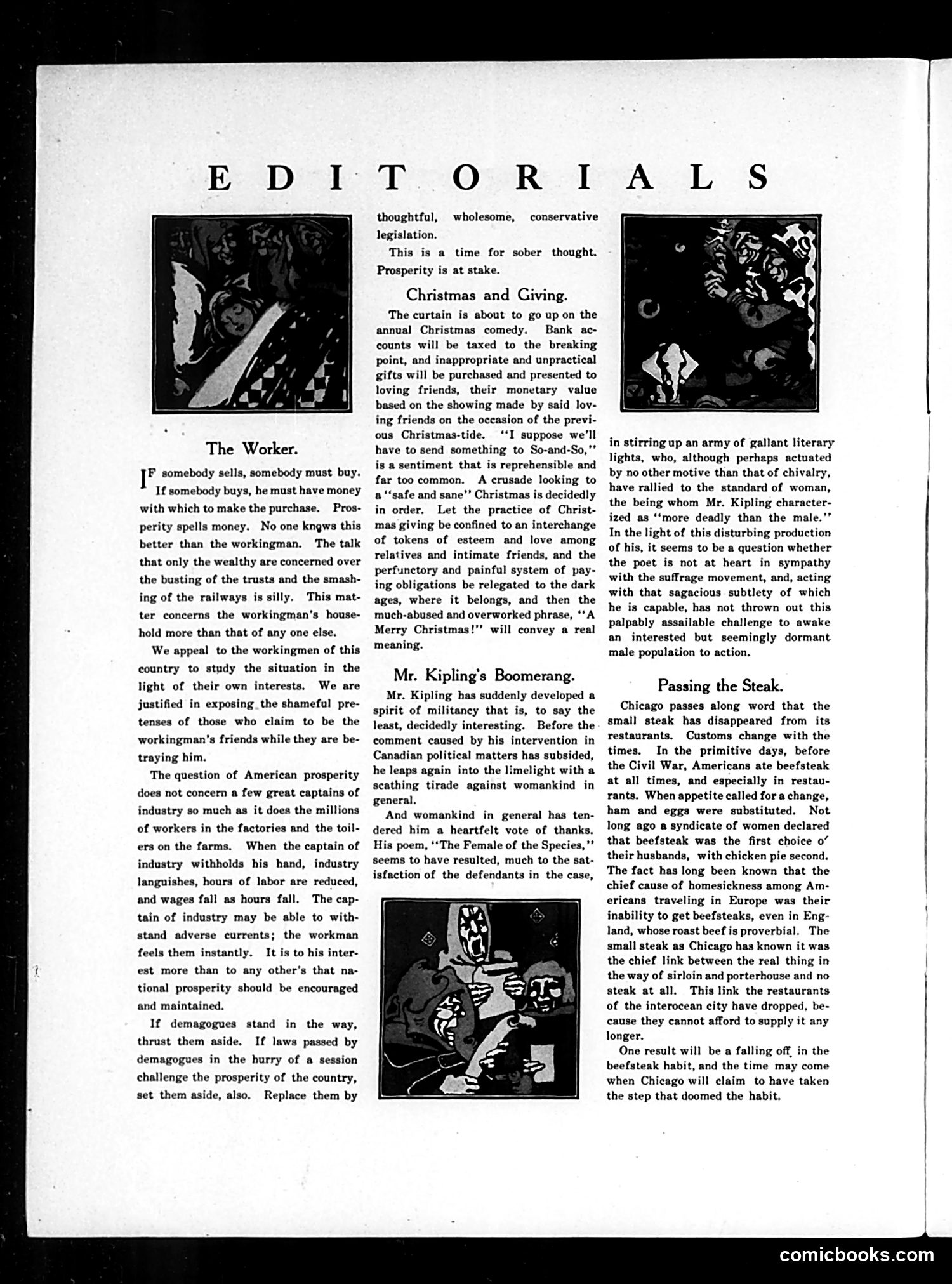
This page contains four editorials with accompanying illustrations addressing early 20th-century American social issues: **"The Worker"** criticizes wealthy industrialists' indifference to working-class hardship, arguing that workers' interests deserve equal consideration to capitalists' profits. **"Christmas and Giving"** satirizes ostentatious holiday gift-giving among the wealthy, suggesting Christmas charity should be more meaningful than displays of monetary value. **"Mr. Kipling's Boomerang"** appears to criticize author Rudyard Kipling's recent militaristic statements regarding "womankind," suggesting such views will backfire against him. **"Passing the Steak"** humorously notes Chicago's restaurants have stopped serving small steaks, attributing this to changing American tastes since the Civil War—a lighthearted commentary on culinary and cultural shifts. The illustrations use caricature and social commentary typical of Judge's satirical approach to contemporary issues.
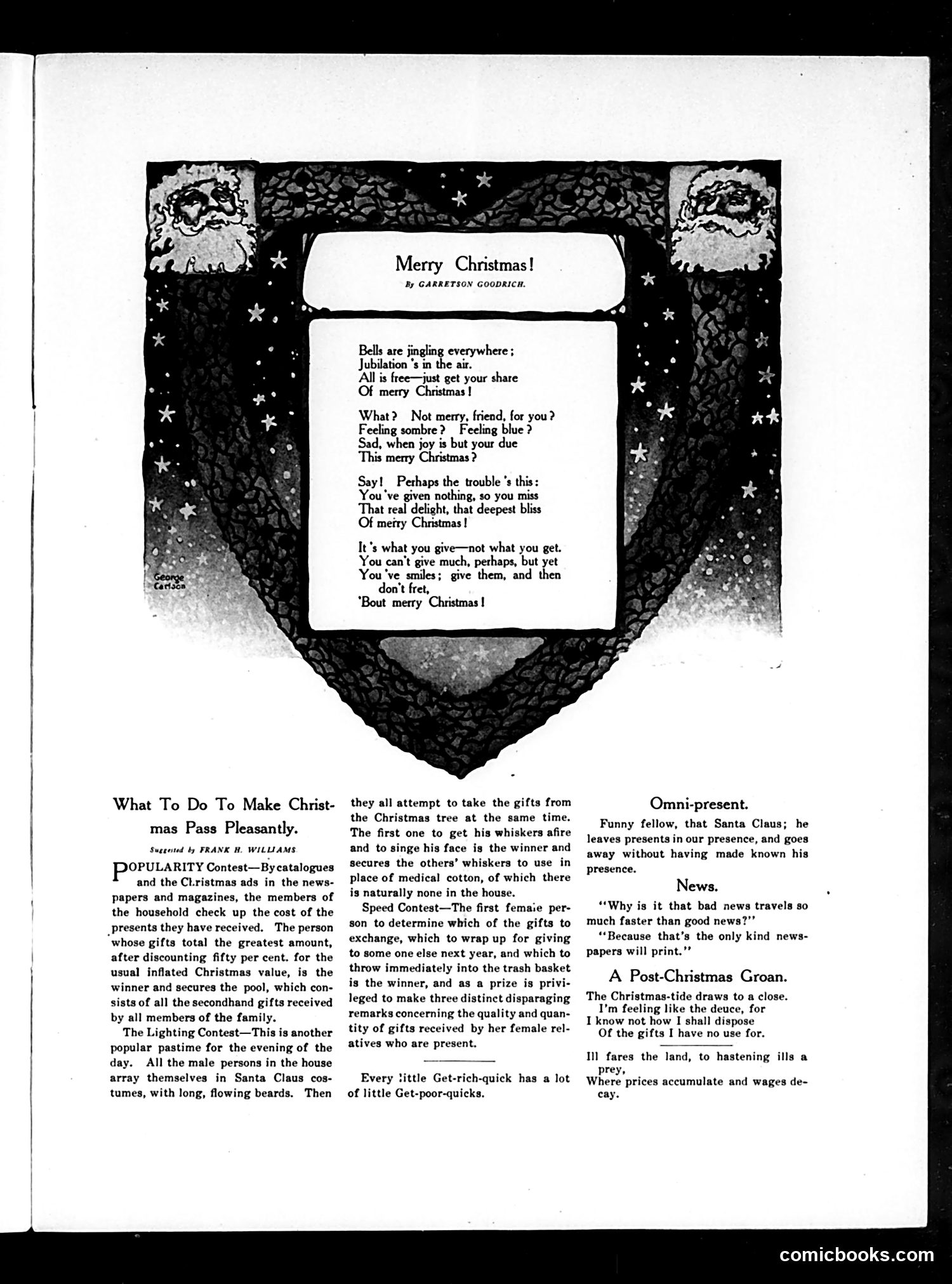
The main feature is a Christmas poem by Garretson Goodrich titled "Merry Christmas!" with decorative Santa Claus heads in the corners. The poem's central message advises readers that true Christmas joy comes from *giving* rather than receiving—"It's what you give—not what you get." Below, a section titled "What To Do To Make Christmas Pass Pleasantly" describes humorous holiday contests for households: a popularity contest where family members rank gift quality, a "Lighting Contest" featuring men in Santa costumes with flowing beards, and a "Spread Contest" determining which gifts to exchange or discard. The satirical intent mocks consumer materialism and competitive family dynamics during Christmas, suggesting that holiday gift-giving often creates tension rather than genuine joy.
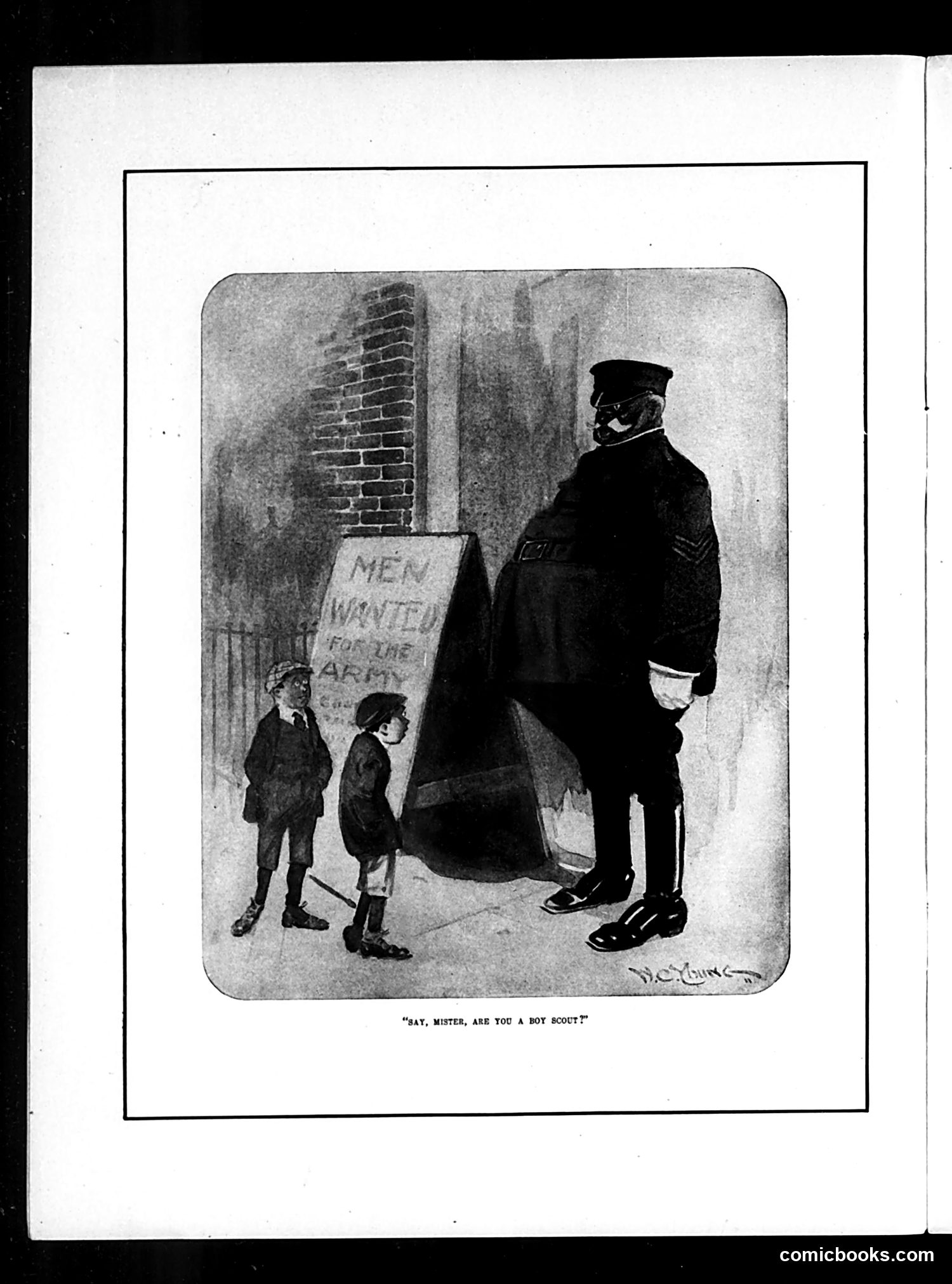
This cartoon satirizes military recruitment during wartime. An Army recruiter in uniform stands before two young boys on a street corner, where a sign reads "MEN WANTED FOR THE ARMY." The humor derives from the recruiter's question to the boys: "Say, mister, are you a boy scout?" The irony is deliberate—the recruiter is so desperate for manpower that he's approaching children, essentially asking if they're young enough to qualify as boy scouts. The boys' presence suggests recruitment has become indiscriminate, targeting even those too young for service. The cartoon criticizes the Army's manpower shortage and aggressive recruiting tactics, likely from World War I era. It mocks both the military's desperation and the absurdity of seeking soldiers among children.
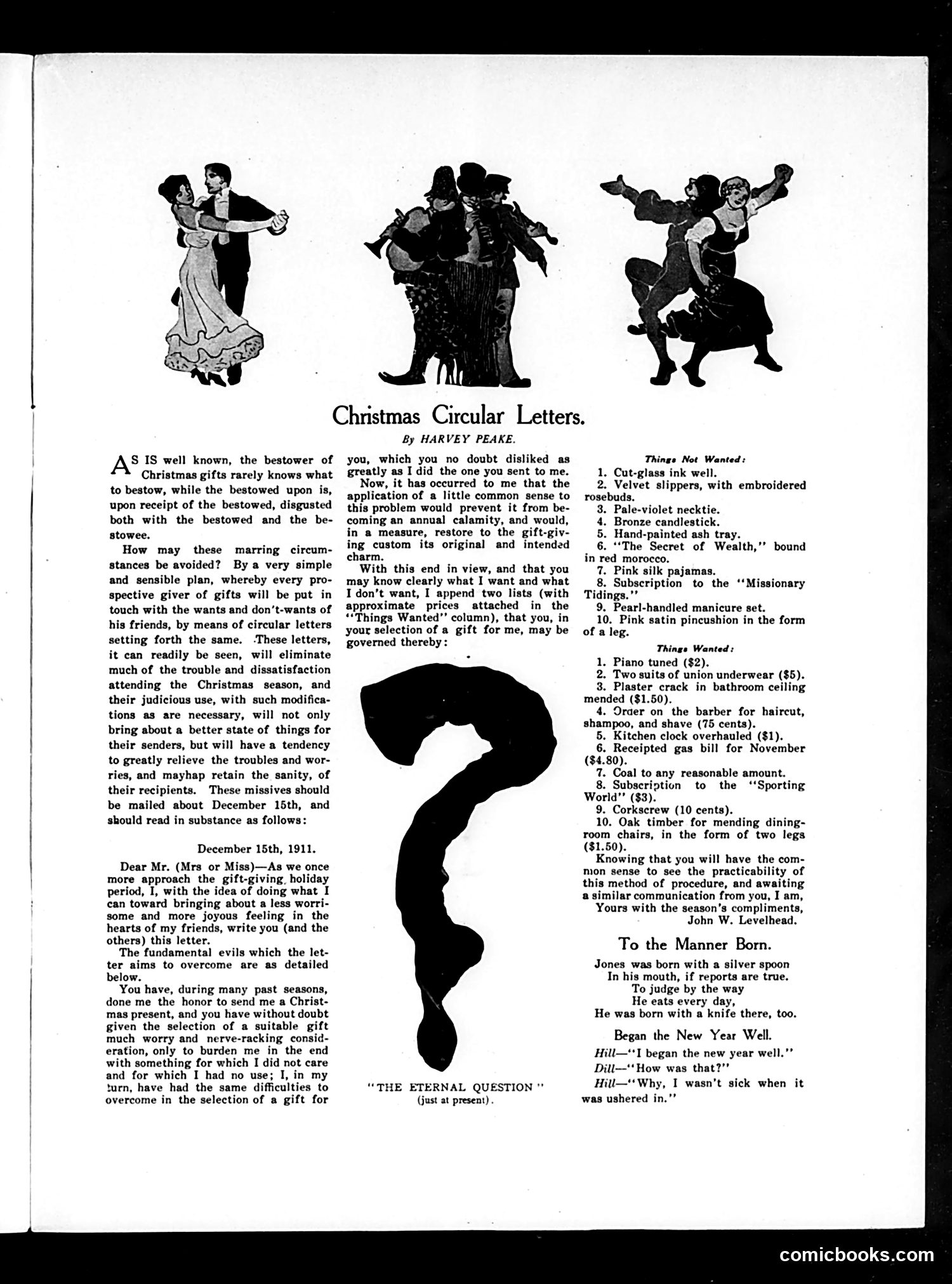
This 1911 satirical piece by Harvey Peake mocks the anxiety of Christmas gift-giving through a humorous "circular letter" proposing that gift-givers and recipients exchange lists of wants and don't-wants. The satire operates on two levels: First, it critiques the awkwardness of gift selection—how givers waste effort on unwanted items while recipients receive unsuitable presents. The proposed "solution" of detailed lists is presented as sensible but is inherently unromantic, reducing gift-giving to transactional practicality. More cutting is the contrast between "Things Not Wanted" (frivolous luxuries like silk pajamas and decorative items) and "Things Wanted" (practical household repairs, services, and utilities like plaster repair and coal). The author sardonically suggests he'd prefer mundane necessities to ornamental gifts—a commentary on either actual economic hardship or the absurdity of wealthy people exchanging expensive trinkets. The accompanying verse "To the Manner Born" continues this theme, joking that a silver-spoon-born Jones apparently uses a knife (not utensil) to eat, suggesting crude materialism beneath wealthy pretense.
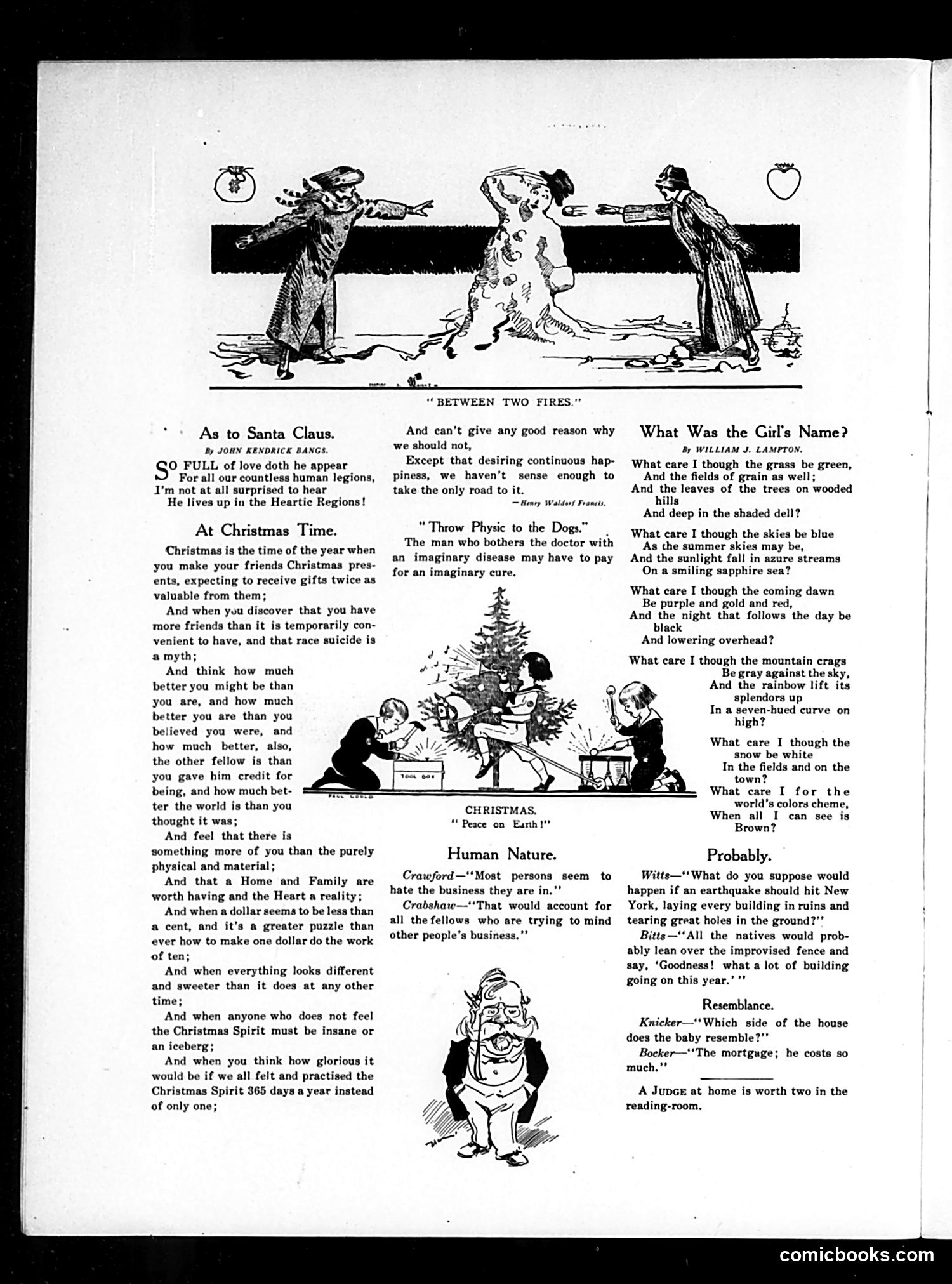
This is a Christmas-themed satirical page from *Judge* magazine featuring multiple humor pieces and illustrations. The top cartoon, "Between Two Fires," depicts a snowman being threatened by two men with torches—a visual pun on the expression meaning to be caught in a dangerous predicament. The text pieces employ characteristic *Judge* satire: John Kendrick Bangs's "At Christmas Time" offers cynical commentary on how Christmas reveals human hypocrisy—we're generous only seasonally, contradicting year-round selfishness. "Throw Physic to the Dogs" mocks doctors treating imaginary ailments. The humor pieces use comedic dialogue. "Human Nature" suggests meddlesome people justify their nosiness by claiming to help. "Probably" jokes that New Yorkers would ignore even catastrophic earthquakes, continuing their obsession with construction. The final quip equates a baby's expense to a mortgage. These pieces exemplify *Judge's* style: witty social criticism targeting human nature, vanity, and urban American attitudes, wrapped in brief, pithy formats suitable for a satirical weekly magazine.
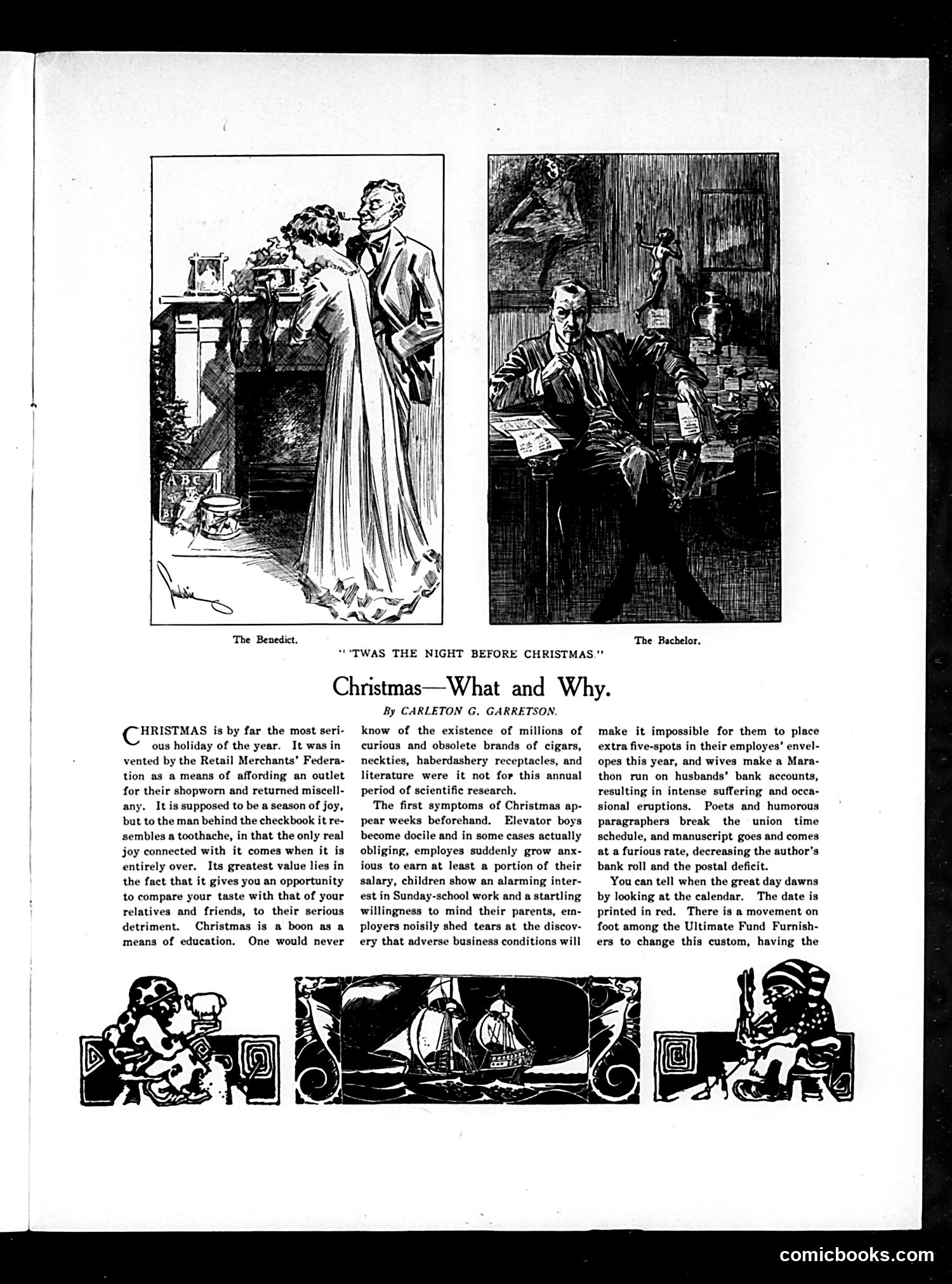
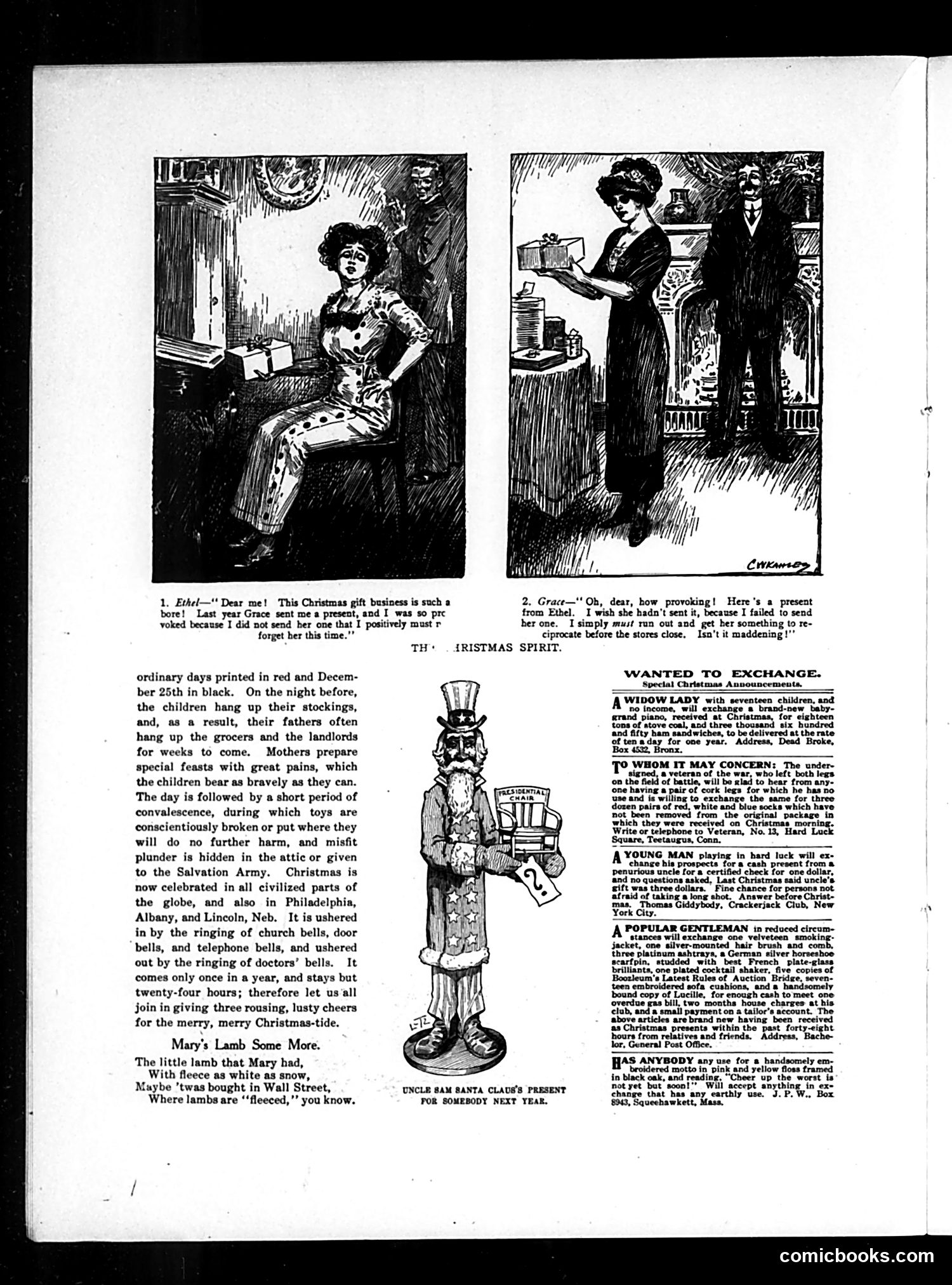
This page satirizes the commercialized anxiety surrounding Christmas gift-giving among the middle class. The two cartoon panels at top show women trapped in obligatory gift exchanges: Ethel feels compelled to reciprocate Grace's present, and Grace feels equally pressured to reciprocate Ethel's—creating mutual resentment despite the supposed spirit of generosity. The accompanying text mocks Christmas as an exhausting, expensive tradition involving forced spending on "special feasts" and gifts, with children's toys inevitably broken and given to charity. The "Wanted to Exchange" section extends this satire through humorous classified ads where people desperately try to pawn off unwanted Christmas gifts—from cork legs to velveteen jackets to embroidered mottos—revealing how gift-giving has become burdensome rather than joyful. The central image of "Uncle Sam Santa Claus's Present for Somebody Next Year" appears to reference political or economic concerns, though specifics are unclear without additional context.
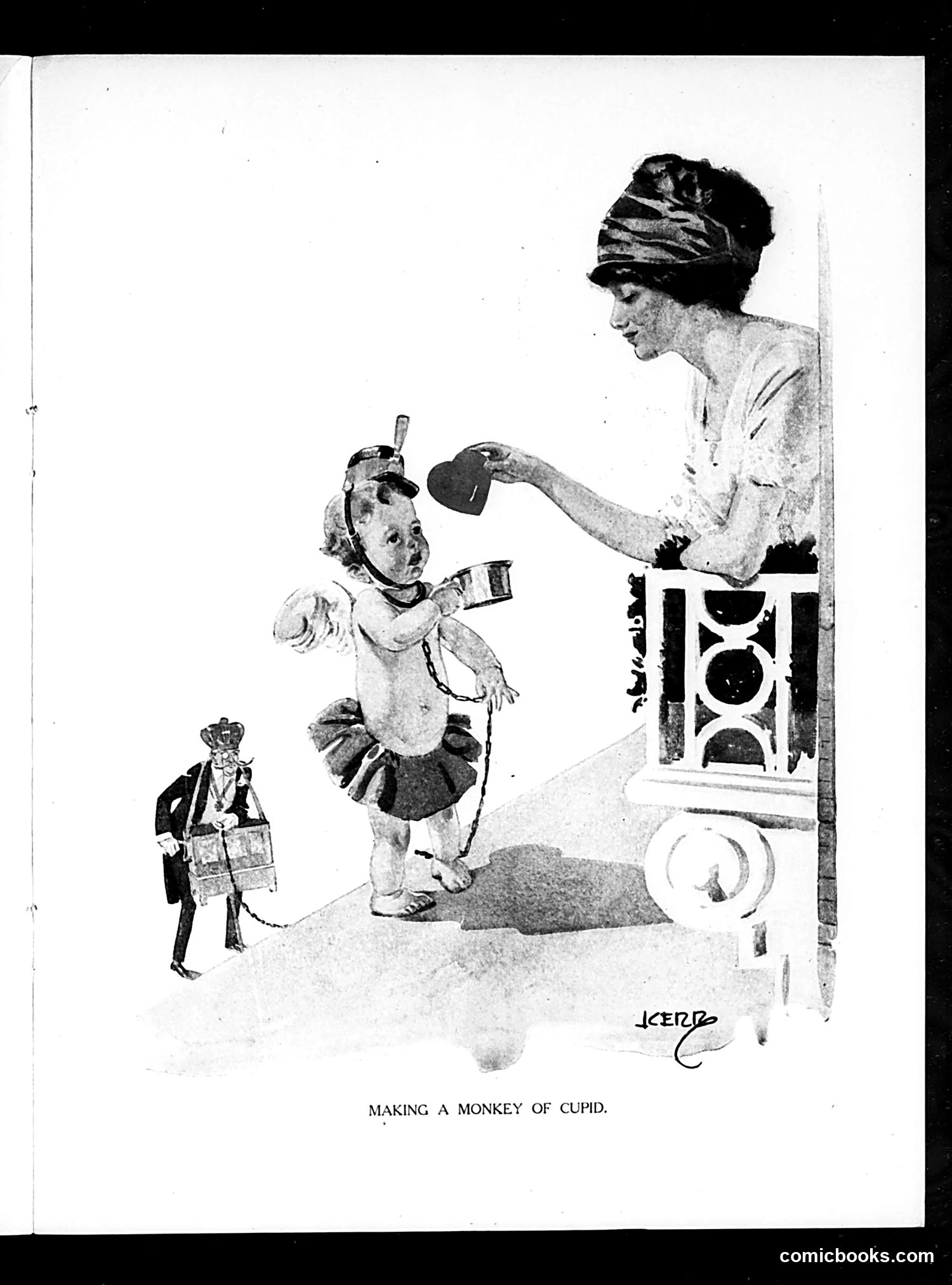
This cartoon satirizes romantic love and courtship through visual absurdism. A blindfolded woman (representing Cupid, the Roman god of love) holds a hammer, appearing to strike or "make a monkey of" a small figure dressed as a formal gentleman—likely representing Cupid himself or romantic ideals personified. The central figure is a baby/cherub dressed incongruously in formal attire with a crown, being presented with various implements, suggesting that romantic pursuits are being treated as foolish or absurd games. The joke critiques the folly of love and romance, suggesting that Cupid (traditionally a source of romantic enchantment) has been reduced to mockery—hence "making a monkey of" him. The formal gentleman figure on the left appears to witness this comic deflation of romantic ideals.
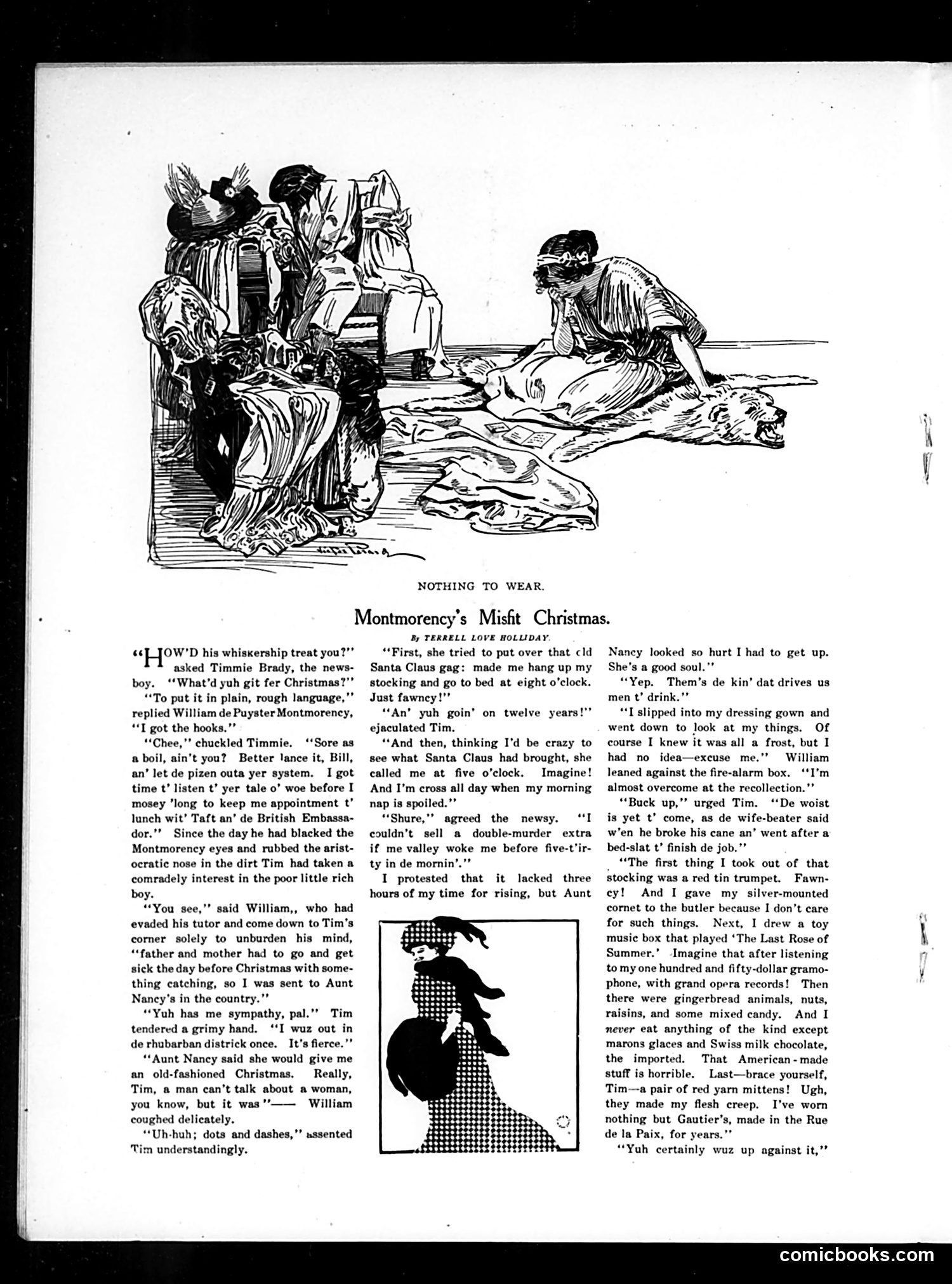
This satirical story mocks wealthy, snobbish youth disconnected from reality. William de Puyster Montmorency—a spoiled rich boy—complains to newsboy Timmie Brady about his "ruined" Christmas at his aunt's house. His grievances are absurdly trivial: a tin trumpet instead of a silver cornet, gingerbread instead of imported macarons glacés, and yarn mittens instead of French Gautier gloves. The humor derives from dramatic irony: Montmorency treats these gifts as genuine hardships while Timmie (representing working-class perspective) listens with knowing sympathy. The title "Nothing to Wear" likely references the famous satirical poem about wealthy women's fashion complaints, here applied to privileged complaints generally. The reference to "Taft and the British Ambassador" dates this to the Taft presidency (1909-1913). The satire targets aristocratic entitlement and the absurd disparity between real poverty and wealthy people's manufactured suffering.
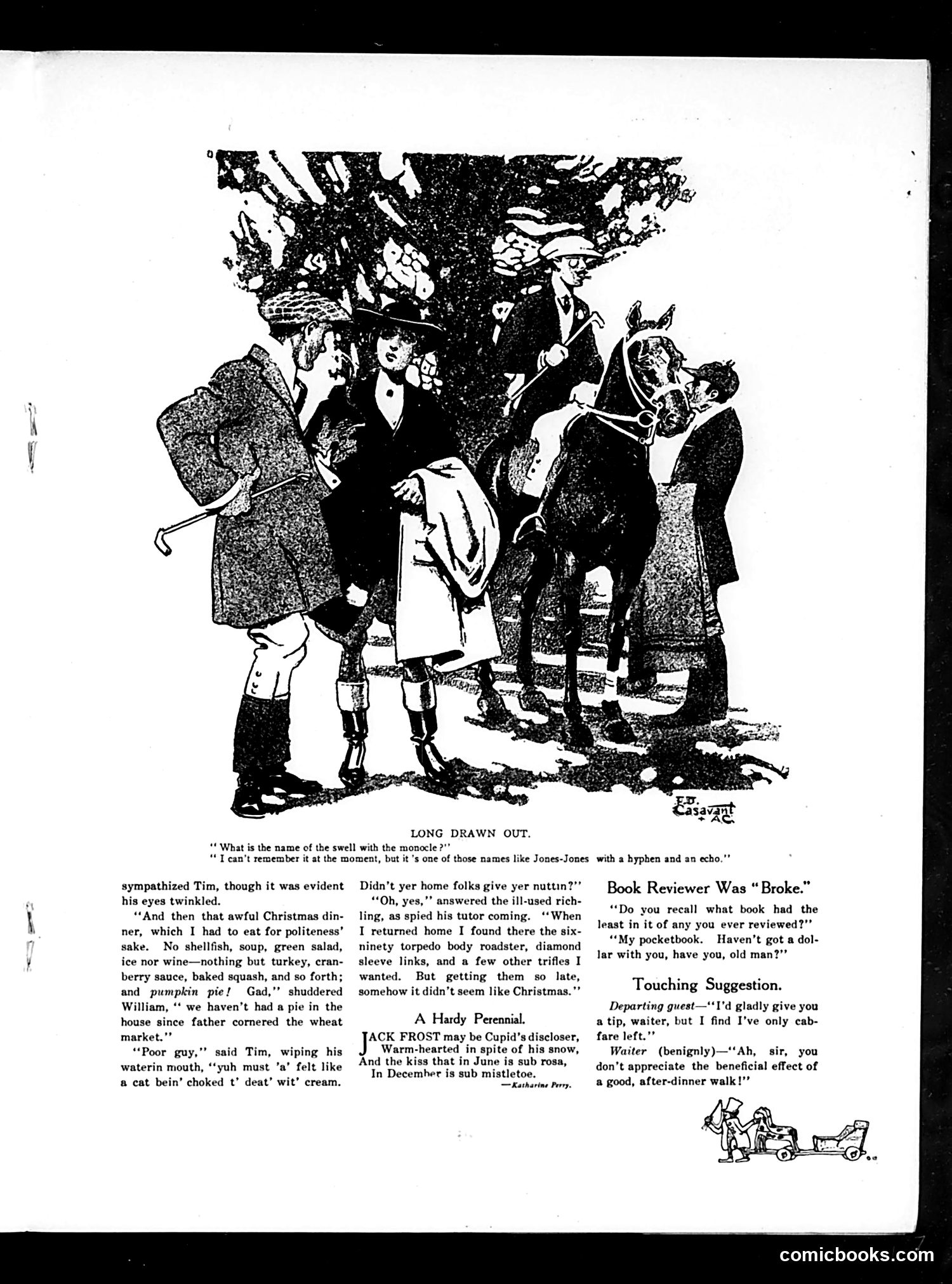
This page contains several satirical pieces mocking wealthy pretension and social hardship. **"Long Drawn Out"** depicts two men discussing a third—an ostentatiously wealthy figure with a monocle bearing a hyphenated name (satirizing upper-class affectation). The wealthy character complains about his Christmas: lacking luxuries, receiving only a luxury car and diamond cufflinks "so late" they didn't feel festive. His tutor listens as he whines about modest home fare. The satire targets the entitled rich disconnected from actual deprivation—he considers a torpedo roadster a mere "trifle." **"A Hardy Perennial"** is a brief poem about Jack Frost and winter romance. **"Book Reviewer Was Broke"** jokes that a reviewer's most honest criticism was of his own empty pocketbook. **"Touching Suggestion"** shows a departing guest unable to tip; the waiter sarcastically suggests a "beneficial" walk, implying the guest needs exercise rather than money. These pieces collectively satirize class disparity and financial strain during what appears to be an economically difficult period.
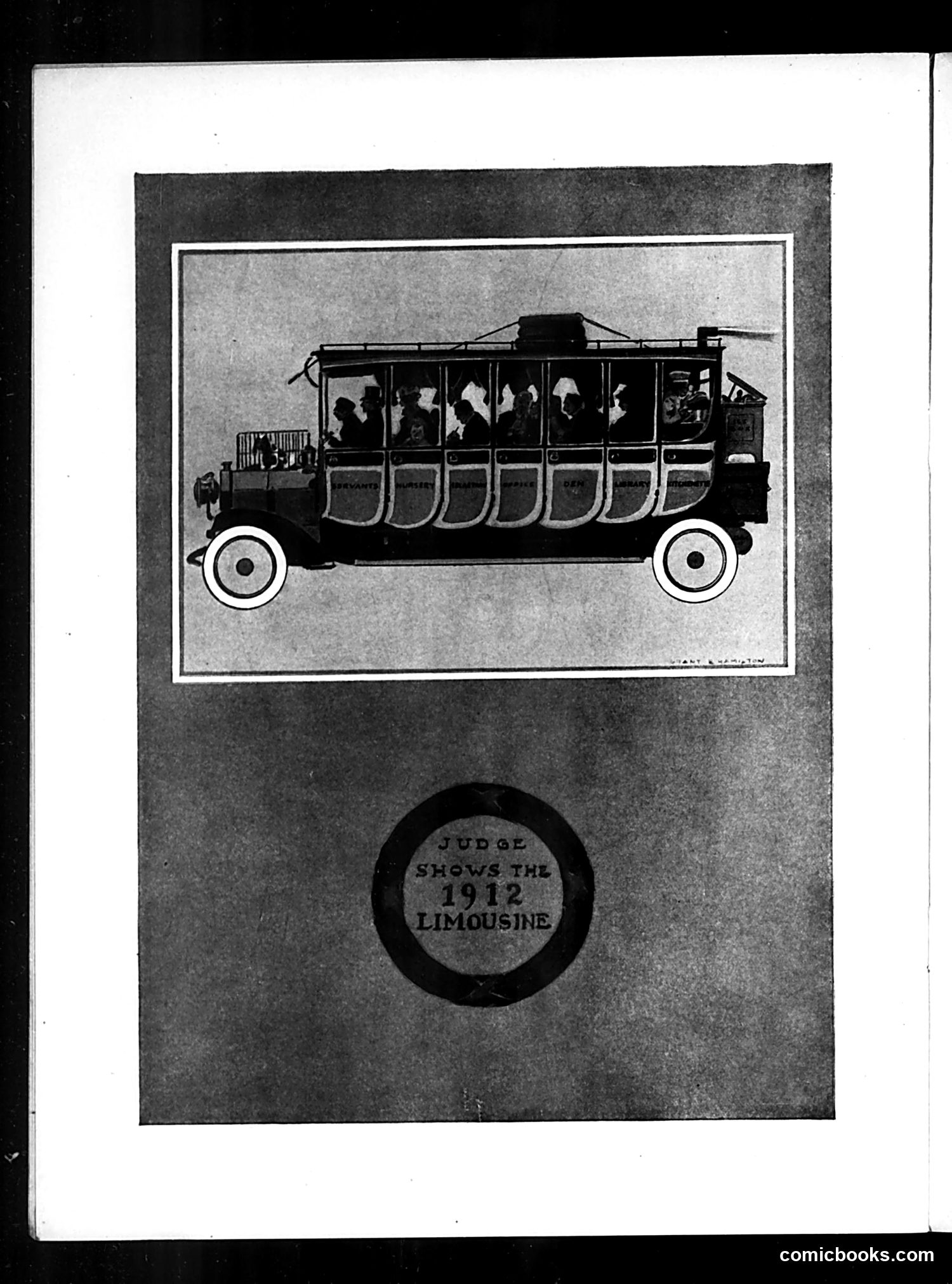
This page shows a single illustration titled "Judge Shows the 1912 Limousine." The image depicts a large, enclosed automobile carrying multiple silhouetted passengers visible through windows. The vehicle appears designed as a social commentary on the 1912 election period. Without additional context from the magazine's text, the specific satire is unclear. However, given the title and Judge's political focus, this likely mocks either: - A candidate's campaign vehicle or entourage - The growing use of automobiles by political figures - Public perception of wealthy politicians during the 1912 election (which featured Roosevelt, Taft, and Wilson) The crowded, enclosed design suggests commentary on political figures being insulated from public view or surrounded by supporters/handlers. The exact target figure or event requires additional OCR text or historical context to confirm.
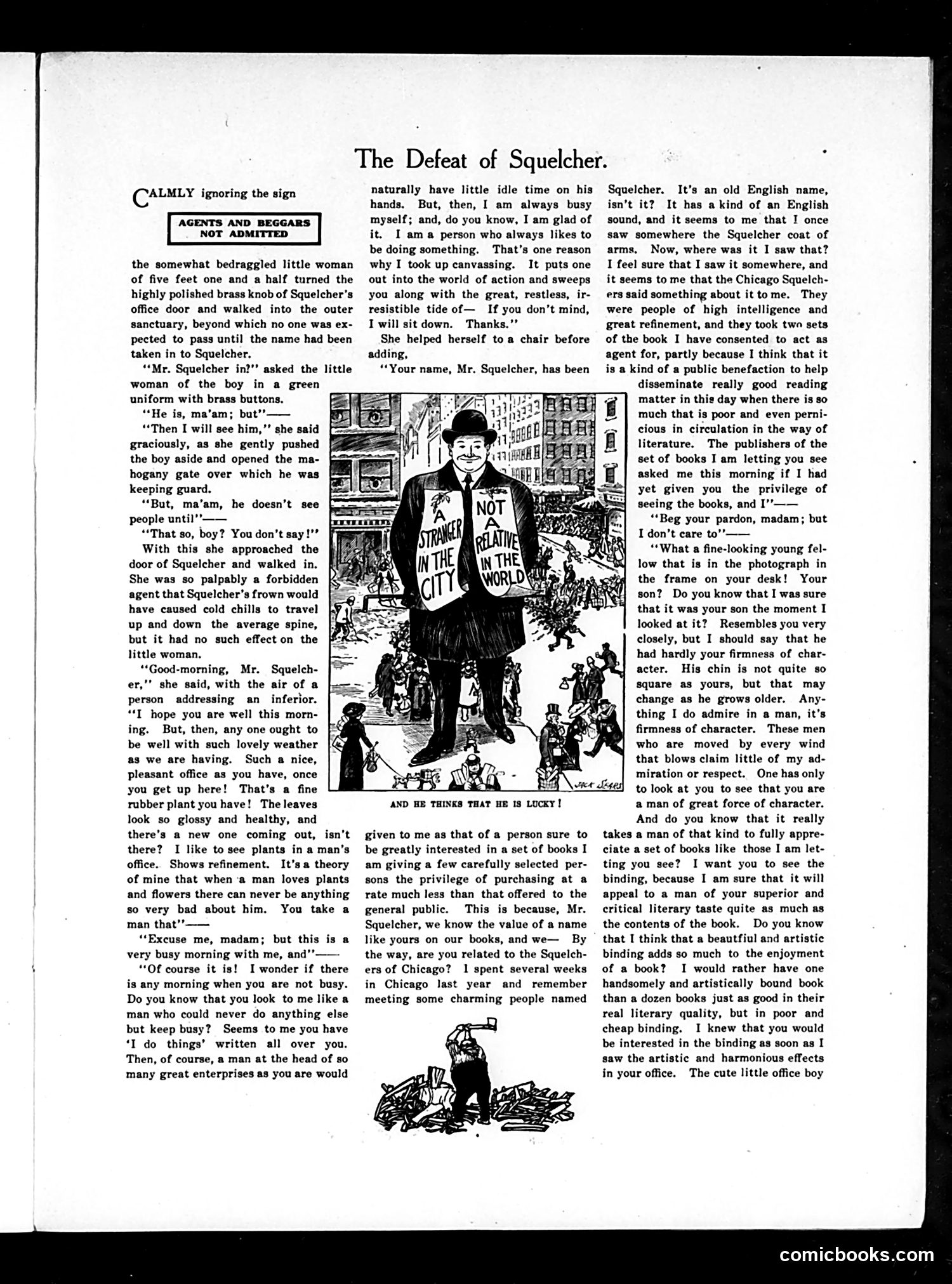
This satirical piece depicts a pushy **book saleswoman** invading the office of a businessman named Squelcher, who clearly wants to work. The humor lies in her unstoppable chattiness and shameless sales tactics. The cartoon mocks **aggressive door-to-door salesmen and canvassers**—a common nuisance in the early 20th century. Despite Squelcher's obvious attempts to dismiss her (saying he's busy), she barges past his secretary, ignores his hints, and launches into an endless monologue mixing flattery, personal observations, and sales pitch. The satire targets how such salespeople exploit politeness and use manipulative techniques: mentioning she knows people like him, asking about his family name, praising his office plants, and draping her pitch as a "public benefaction." The title "The Defeat of Squelcher" suggests that even this apparently stern, busy man cannot resist or escape her relentless charm offensive—a humorous commentary on the vulnerability of businessmen to persistent saleswomen of her era.
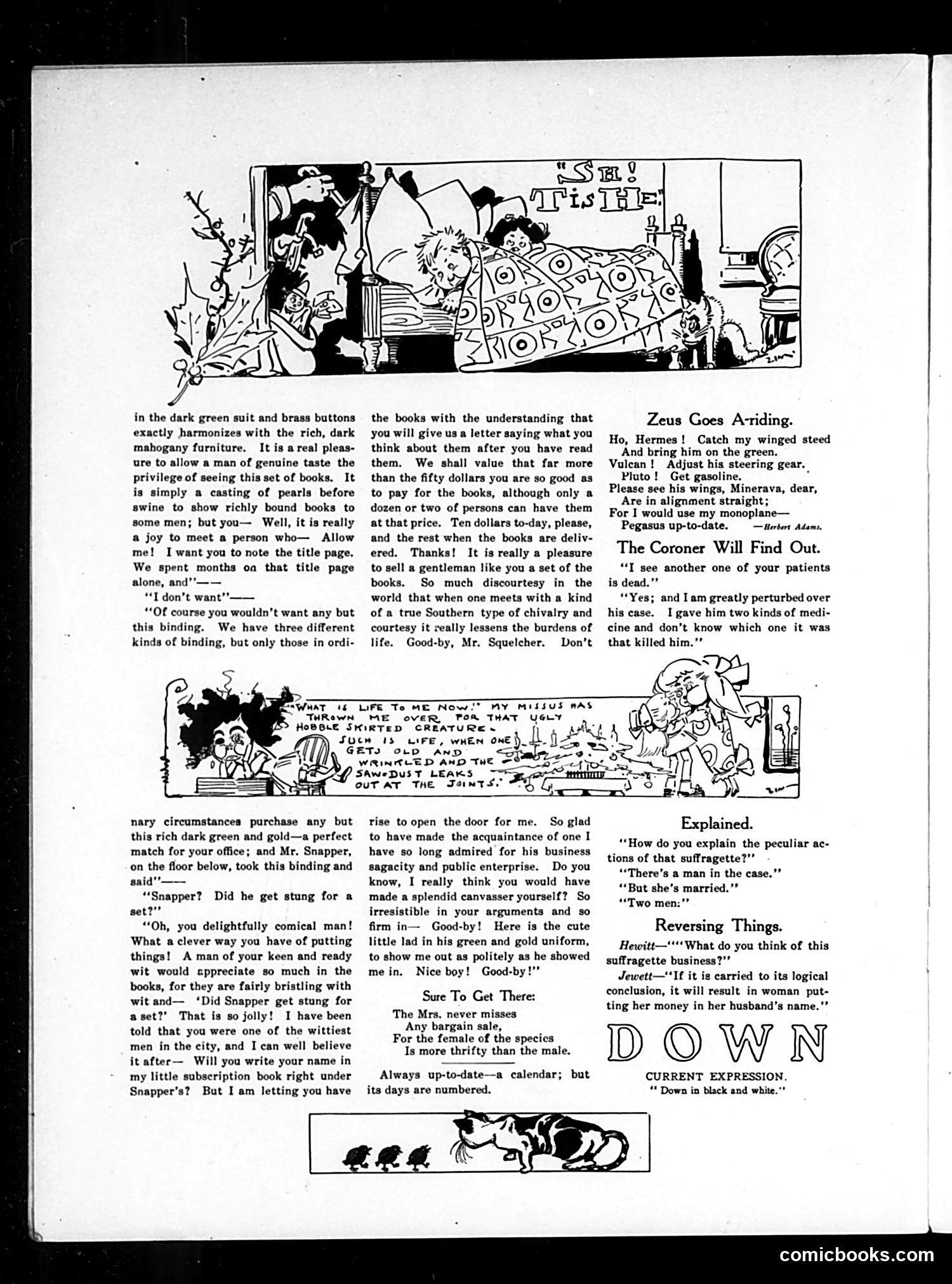
This page contains multiple satirical pieces typical of early 20th-century Judge magazine: **Main Content:** A lengthy dialogue mocking pretentious book salesmen. A salesman uses excessive flattery and Southern gentility to pressure a reluctant buyer into purchasing an expensive leather-bound set, emphasizing the binding's aesthetic value over content. The satire targets obsequious salesmanship and the buyer's vanity. **"Zeus Goes A-riding":** A humorous poem updating classical mythology—Zeus trades his winged horse Pegasus for a modern monoplane, with other gods helping prepare it. This jokes about contemporary aviation technology replacing ancient imagery. **"The Coroner Will Find Out":** Dark humor about a doctor admitting he gave a patient two medicines but doesn't know which one killed him—satirizing medical incompetence. **Shorter pieces** mock suffragettes, bargain-hunting wives, and various social types. The overall tone reflects Judge's characteristic blend of class-conscious satire and contemporary social commentary.
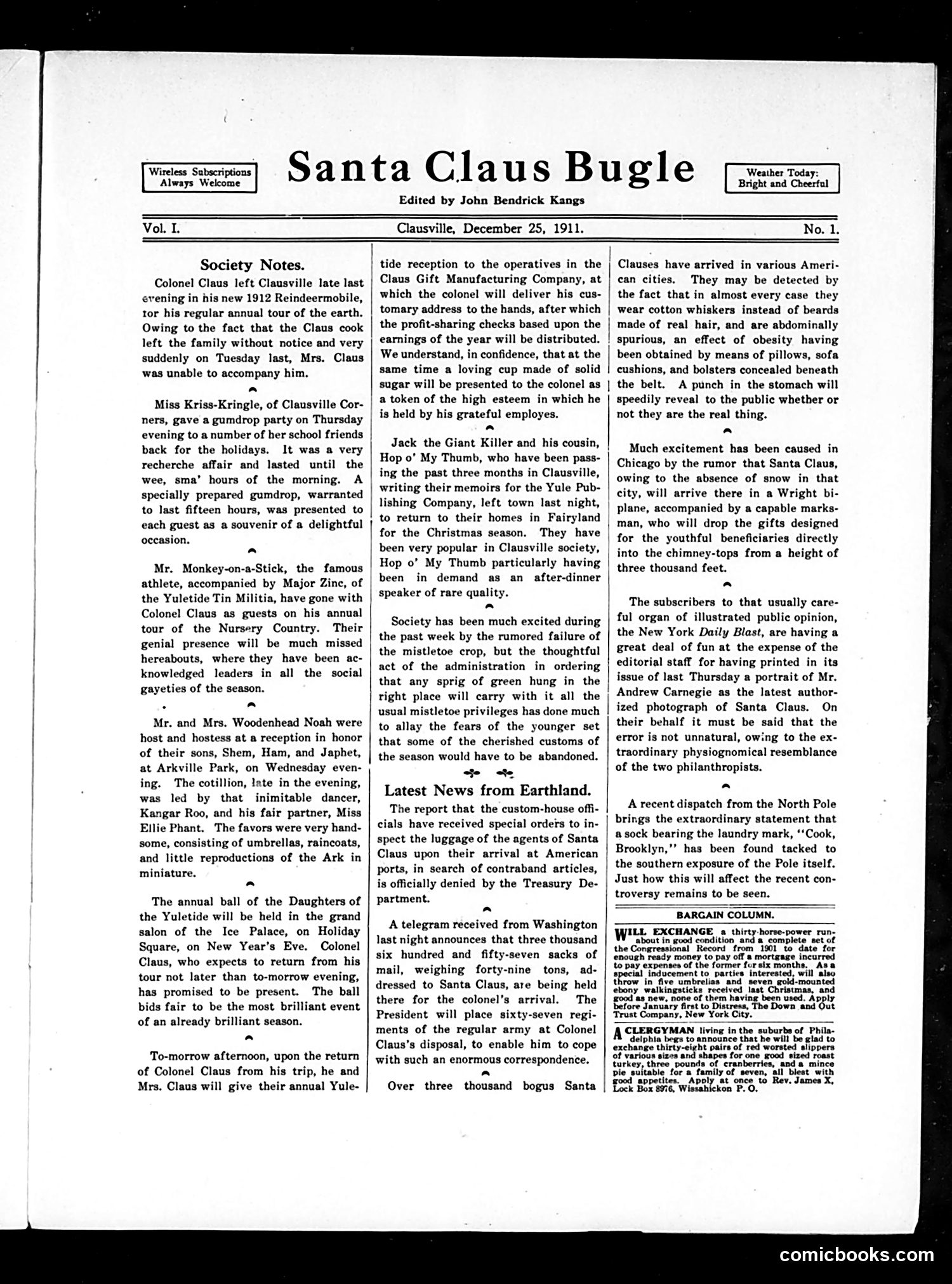
This is the front page of a whimsical fictional newspaper set in "Clausville"—a magical town where Santa Claus and nursery-rhyme characters live as ordinary citizens. Published December 25, 1911, it's a humorous parody of society pages and local news. The satire works through incongruity: familiar storybook figures (Jack the Giant Killer, Noah, Miss Ellie Phant the elephant, Kangaroo Roo, etc.) are treated as real residents attending parties and galas. Their activities—gumdrop parties, cotillions, receptions—are reported in earnest society-page language. The joke relies on readers recognizing these fictional characters and enjoying the collision between fantasy worlds and mundane social reporting. References like the "Reindeermobile" and "Yuletide Tin Militia" further blend Christmas lore with contemporary 1911 details (automobiles, military terminology). This appears to be pure entertainment—whimsy rather than political satire—aimed at holiday amusement.
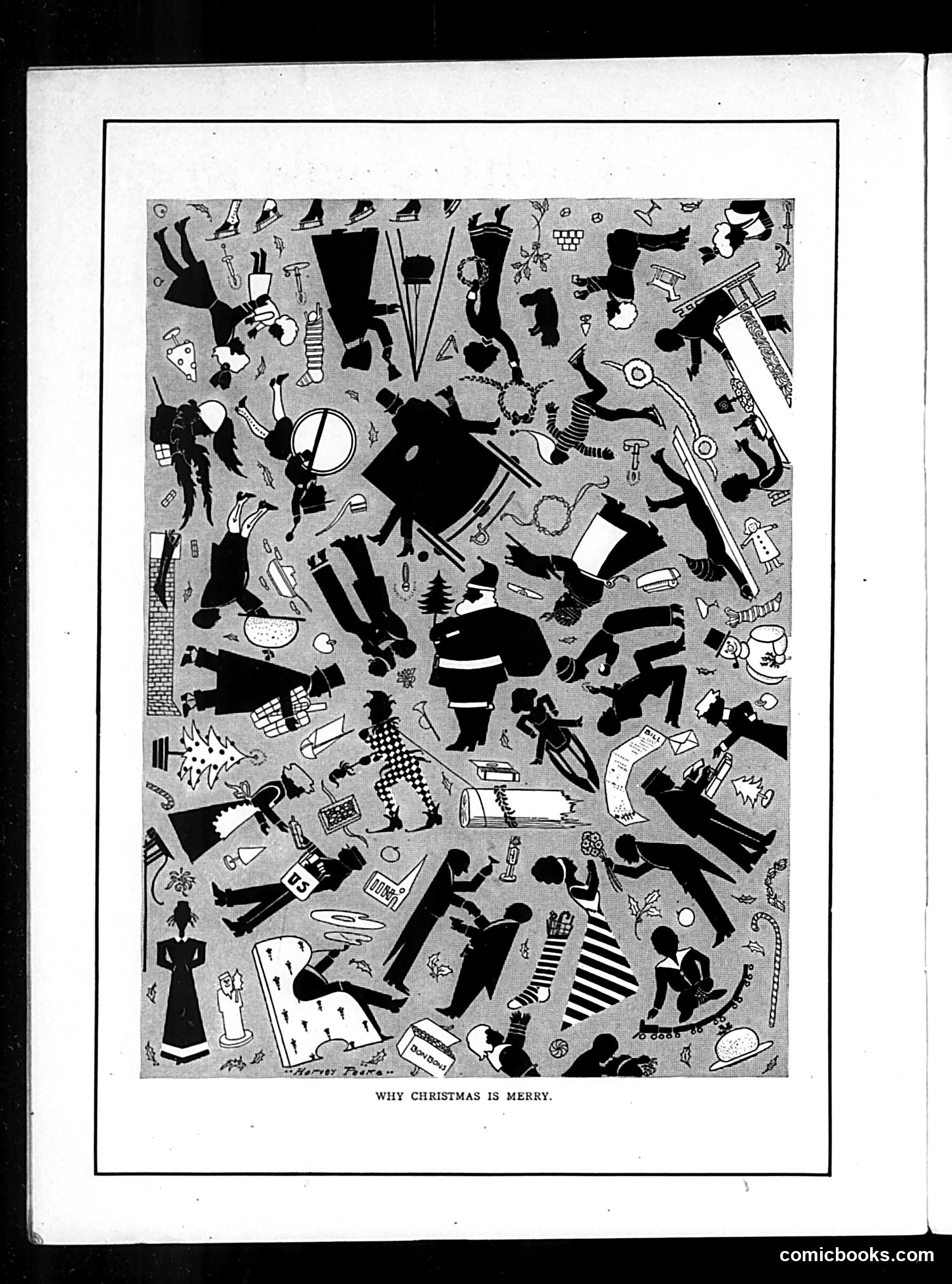
This chaotic, densely-packed illustration depicts Christmas chaos as joyful pandemonium. The composition shows numerous silhouetted figures engaged in various holiday activities—dancing, playing instruments, eating, opening presents, and general revelry. Tools, toys, food items, and decorative objects scatter throughout. The satire appears to celebrate Christmas excess and commercial merriment: the frantic activity, abundance of goods, dining, and uninhibited celebration represent why the holiday is "merry." Rather than critiquing materialism or excess (as might be expected from a satirical magazine), Judge here seems to embrace the frenetic, overwhelming nature of Victorian-era Christmas festivities as inherently funny and desirable. The cartoon's humor relies on visual overload rather than specific political commentary.
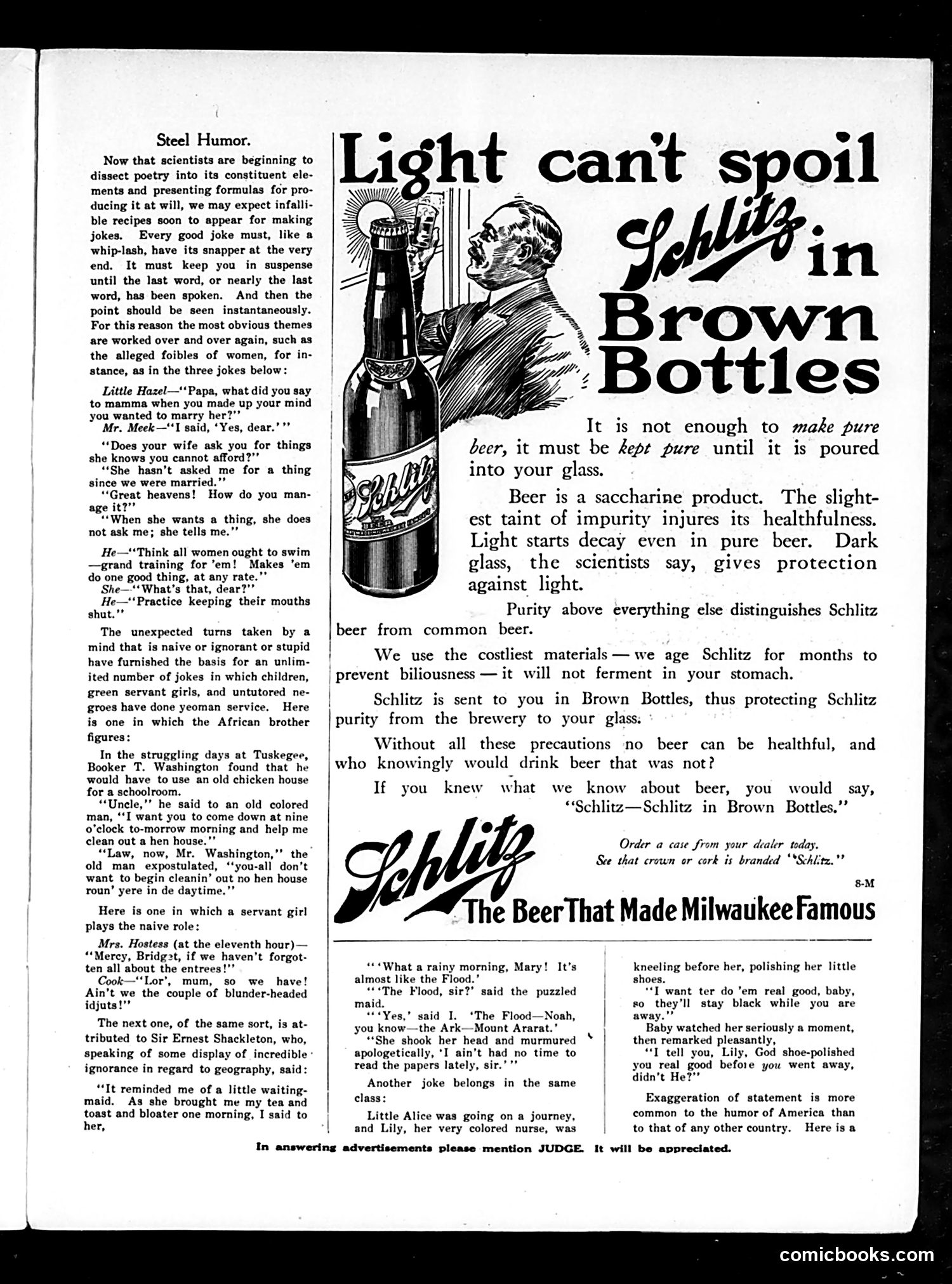
This page combines satirical humor with a Schlitz beer advertisement. The "Steel Humor" section presents three jokes exemplifying a particular comedic formula—the "snapper" ending where the punchline delivers unexpected reversal. These jokes rely on stereotypes: confused servants, naive women, and African Americans portrayed as ignorant. The centerpiece is a Schlitz advertisement claiming brown bottles protect beer from light damage, ensuring purity. The ad emphasizes scientific reasoning and healthfulness—marketing strategies common in early 20th-century beer advertising, when purity claims competed heavily in the marketplace. The page reflects Judge's typical format: satirical commentary on contemporary life alongside advertising. The inclusion of a Booker T. Washington reference suggests the publication's era (Washington founded Tuskegee Institute). The stereotypical humor now appears offensive, but represented mainstream American comedy conventions at the time.
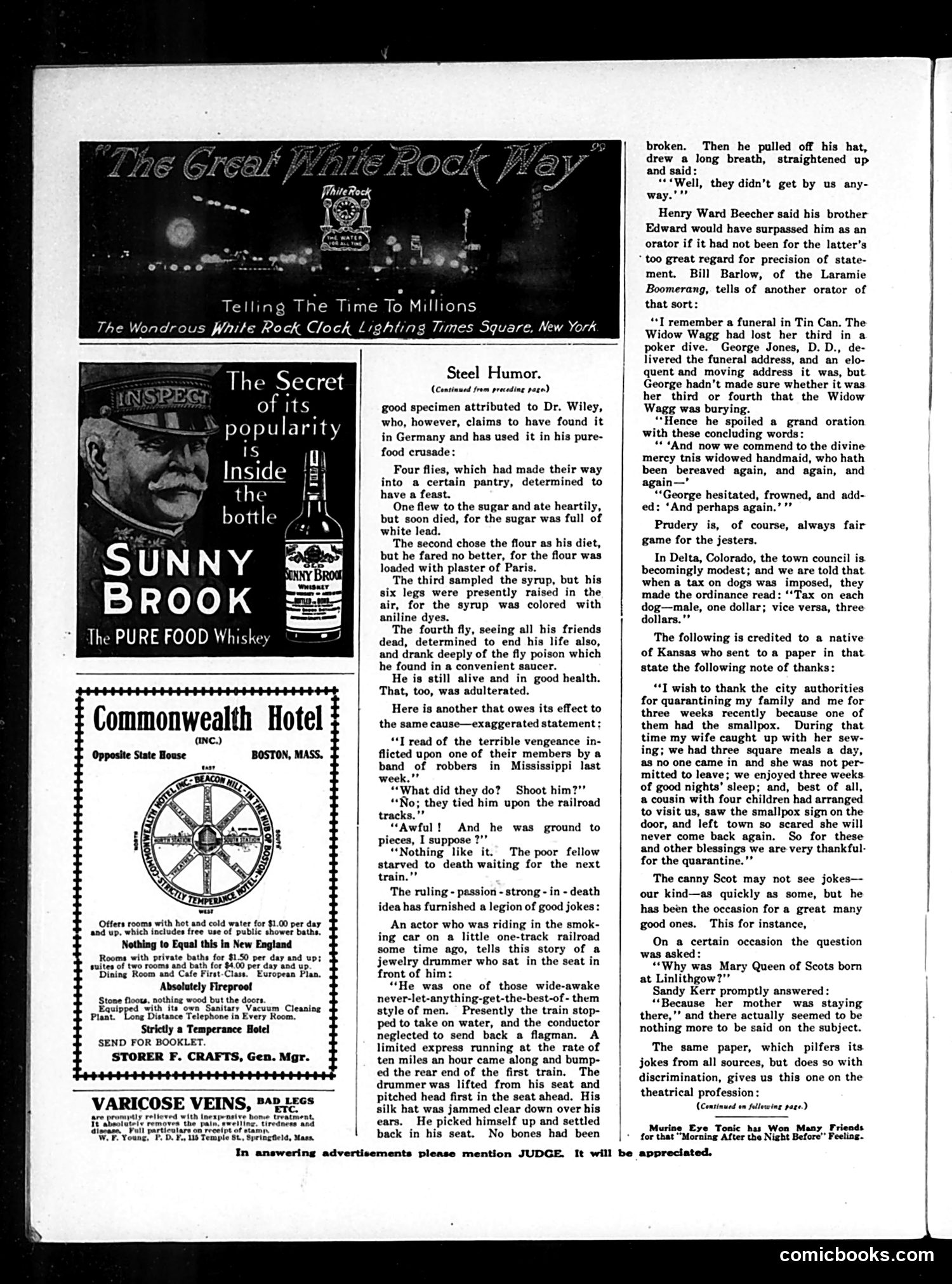
This page is primarily **advertising and humor content**, not political cartoons. The main visual elements are: 1. **"The Great White Rock Way"** — an advertisement for a novelty clock in Times Square, New York, showcasing the clock's ability to tell time to millions of people. 2. **"Steel Humor"** — a humor column featuring anecdotes about food safety (referencing Dr. Wiley's pure-food crusade), including a satirical story about flies dying from adulterated foods, and jokes about narrow-gauge railroads and traveling salesmen. 3. **Multiple advertisements** for Sunny Brook Whiskey, Commonwealth Hotel, and varicose vein treatments — typical of Judge's revenue model. The "Steel Humor" content reflects Progressive-era concerns about **food adulteration** and railroad safety, popular topics for jokes in early-20th-century publications. The humor relies on exaggeration and irony rather than identifying specific political figures.
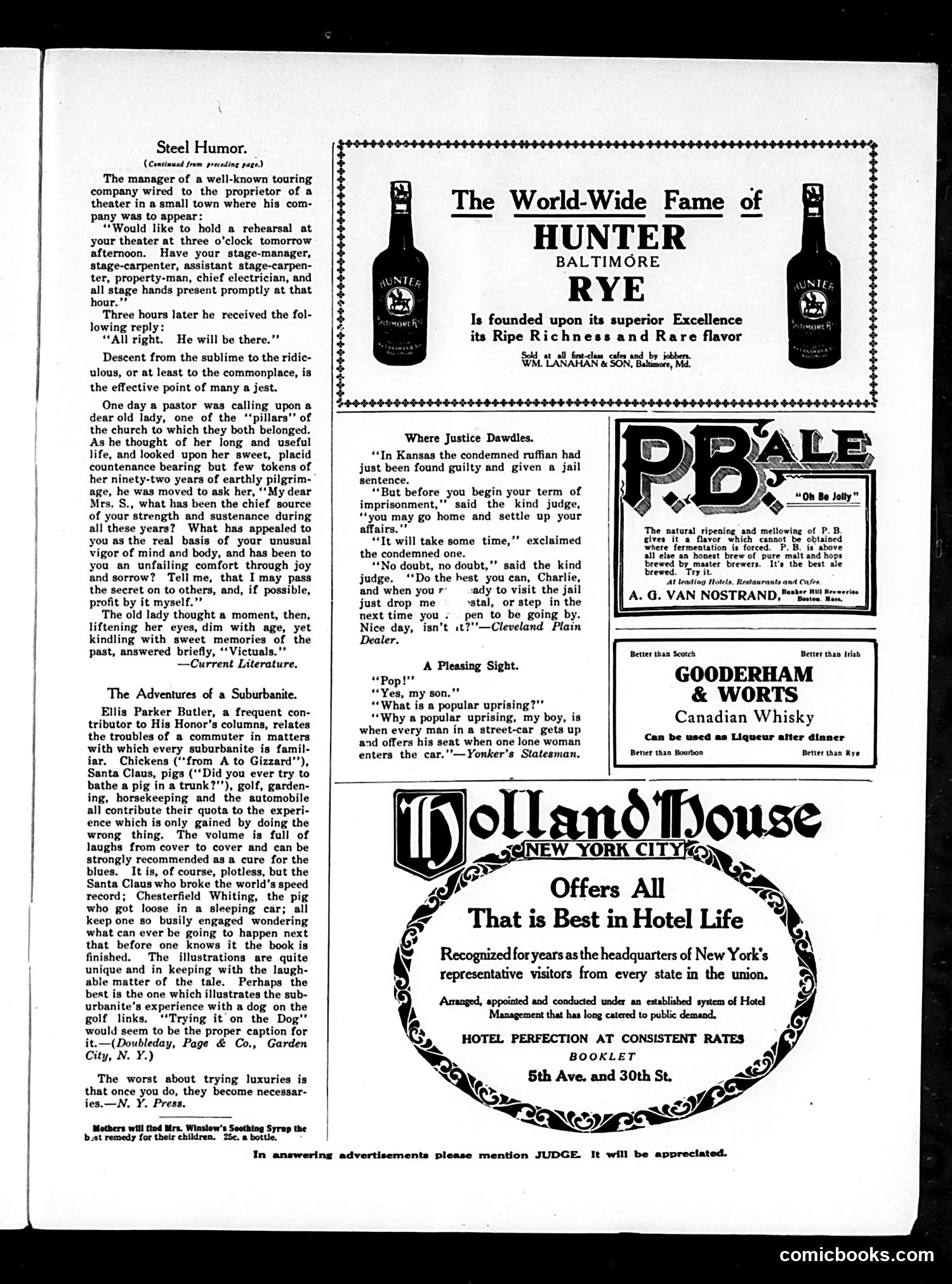
This is primarily a **humor and literary page** from Judge magazine, not a political cartoon page. The content consists of three humorous anecdotes: 1. **"Steel Humor"** — A joke about a theater manager's wire being misunderstood: he requests multiple stagehands; the theater owner replies "All right. He will be there"—implying the small town has only one employee. 2. **"Where Justice Dawdles"** — A satirical piece mocking slow judicial systems, depicting a Kansas judge casually telling a condemned man to go home and settle affairs, then "drop by" when ready to serve his sentence. 3. **"The Adventures of a Suburbanite"** — A book review of Ellis Parker Butler's work about suburban life's absurdities (chickens, pigs, golf). The page also contains **period advertisements** for Hunter Baltimore Rye whiskey, P.B. Ale, Gooderham & Worts Canadian Whisky, and Holland House Hotel in New York City—typical of Judge's revenue model.
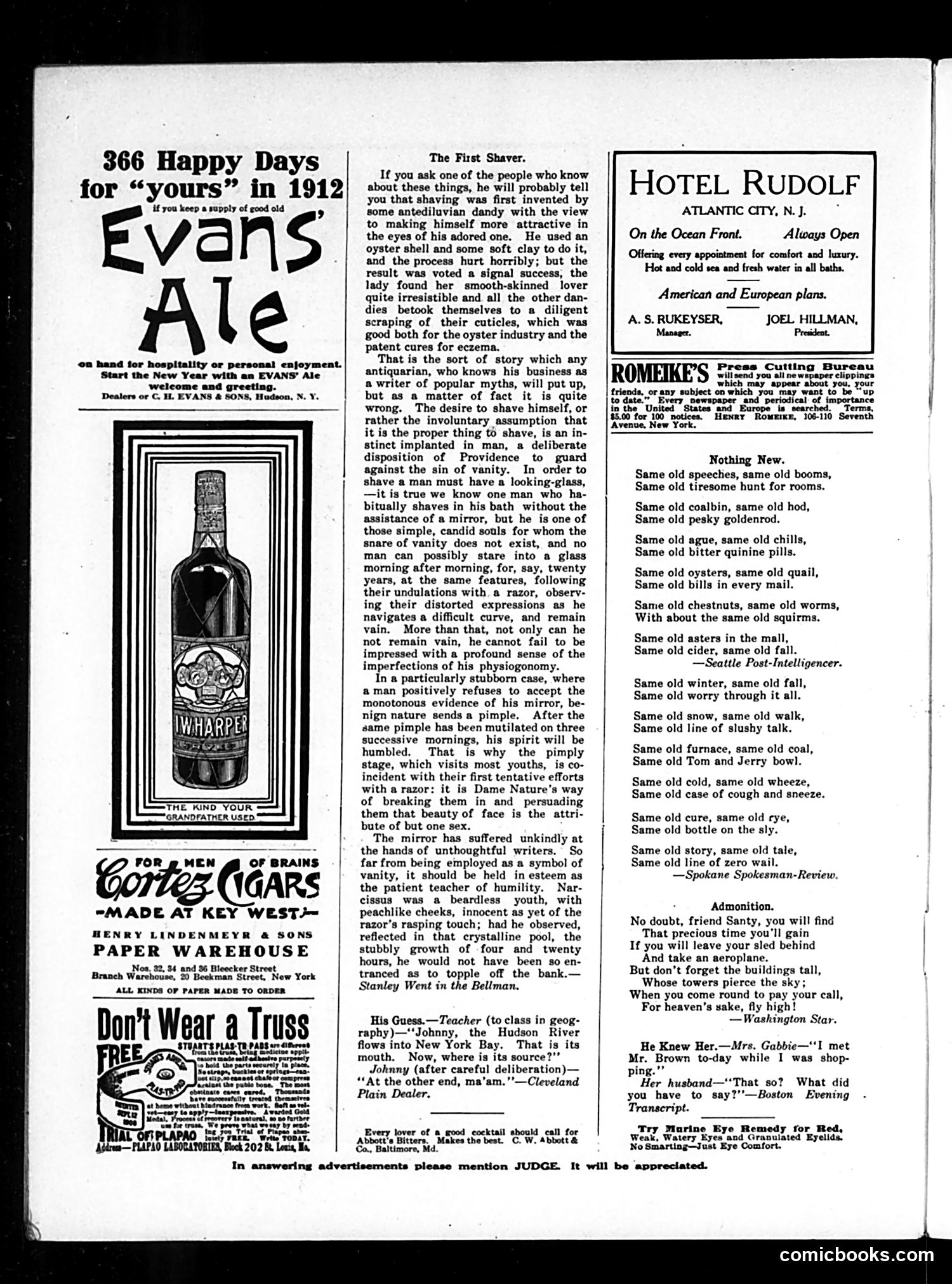
This page is primarily **advertisements and light humor pieces** rather than political satire. The main content includes: **"The First Shaver"** is a humorous essay arguing that shaving exists not from vanity but as Divine Providence's tool for teaching humility. The author claims men cannot stare at their imperfect reflections daily without developing humility—mirrors are thus "patient teachers" rather than symbols of vanity. The piece references the Narcissus myth, suggesting a beardless youth observing stubble growth would abandon his self-admiration. The remaining items are joke fillers: a geography teacher's exchange where a student quips the Hudson River's source is "at the other end," and brief comic observations titled "Nothing New" and "He Knew Her." The page is dominated by **period advertisements** for Evans Ale, Cortez Cigars, a truss company, Hotel Rudolf, and other products—typical of Judge magazine's revenue model. No significant political commentary or identifiable caricatures appear on this page.
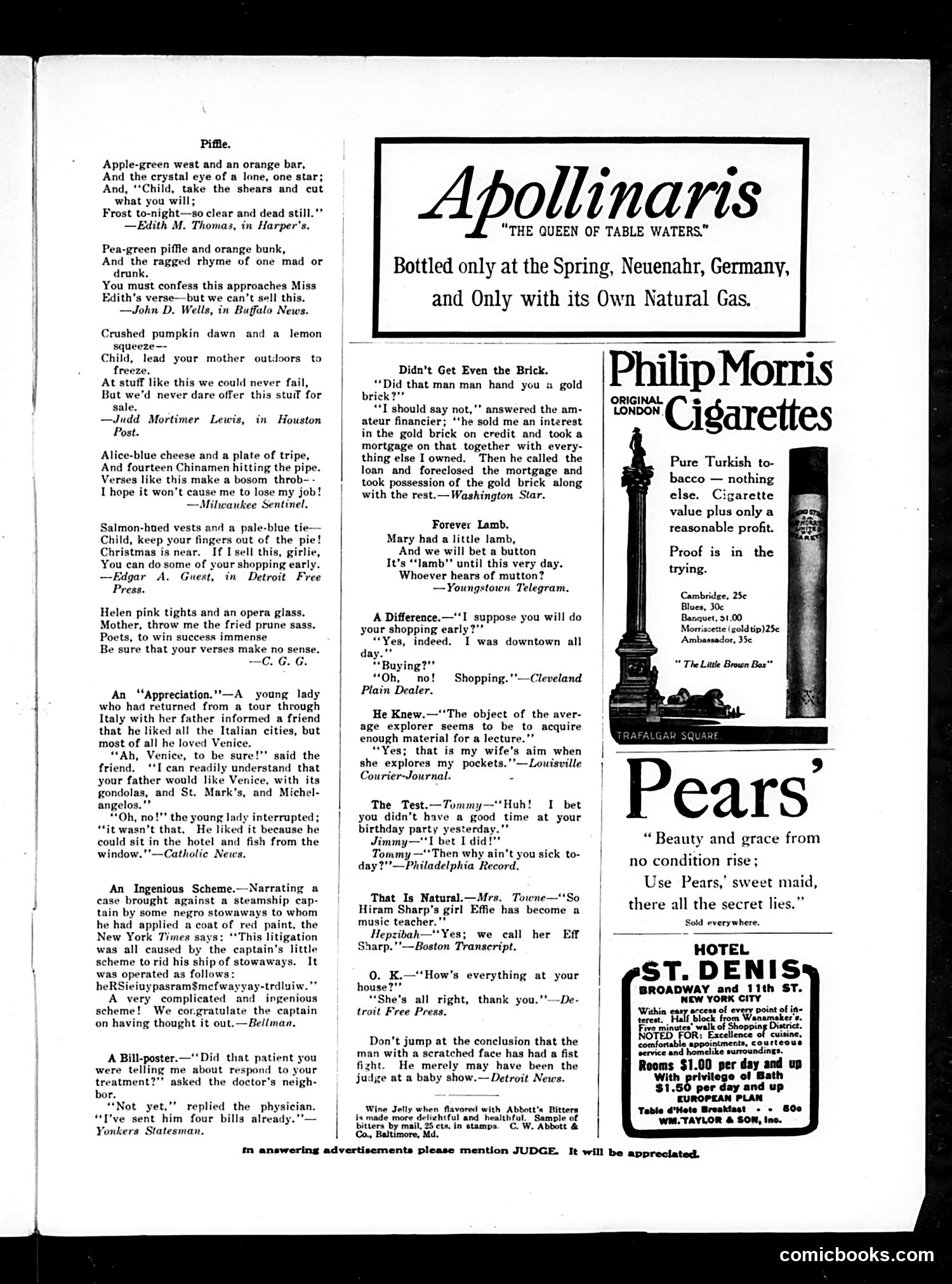
This page is primarily **advertising and humor columns**, not political cartoons. The content consists of: **Humorous Verse Sections:** Multiple short comedic poems mock pretentious poetry by parodying a Edith M. Thomas poem about nature. Writers from various newspapers (Buffalo News, Houston Post, Detroit Free Press) submit deliberately absurd verses—mixing random imagery like "Alice-blue cheese," "pea-green piffle," and "fourteen Chinamen"—to satirize both bad poetry and the original poem's aesthetics. **Short Jokes:** Scattered anecdotes mock financial schemes (the "gold brick" con), consumerism (shopping vs. buying), and human nature (a doctor collecting bills as payment). **Advertisements:** The page features prominent ads for Apollinaris water, Philip Morris cigarettes, Pears soap, and Hotel Denis. The satirical point: Judge ridicules literary pretension and demonstrates how easily nonsensical verse can mimic serious poetry. The page reflects early 1900s attitudes toward consumer goods, immigrant labor (the "negro stowaways" reference), and financial schemes.
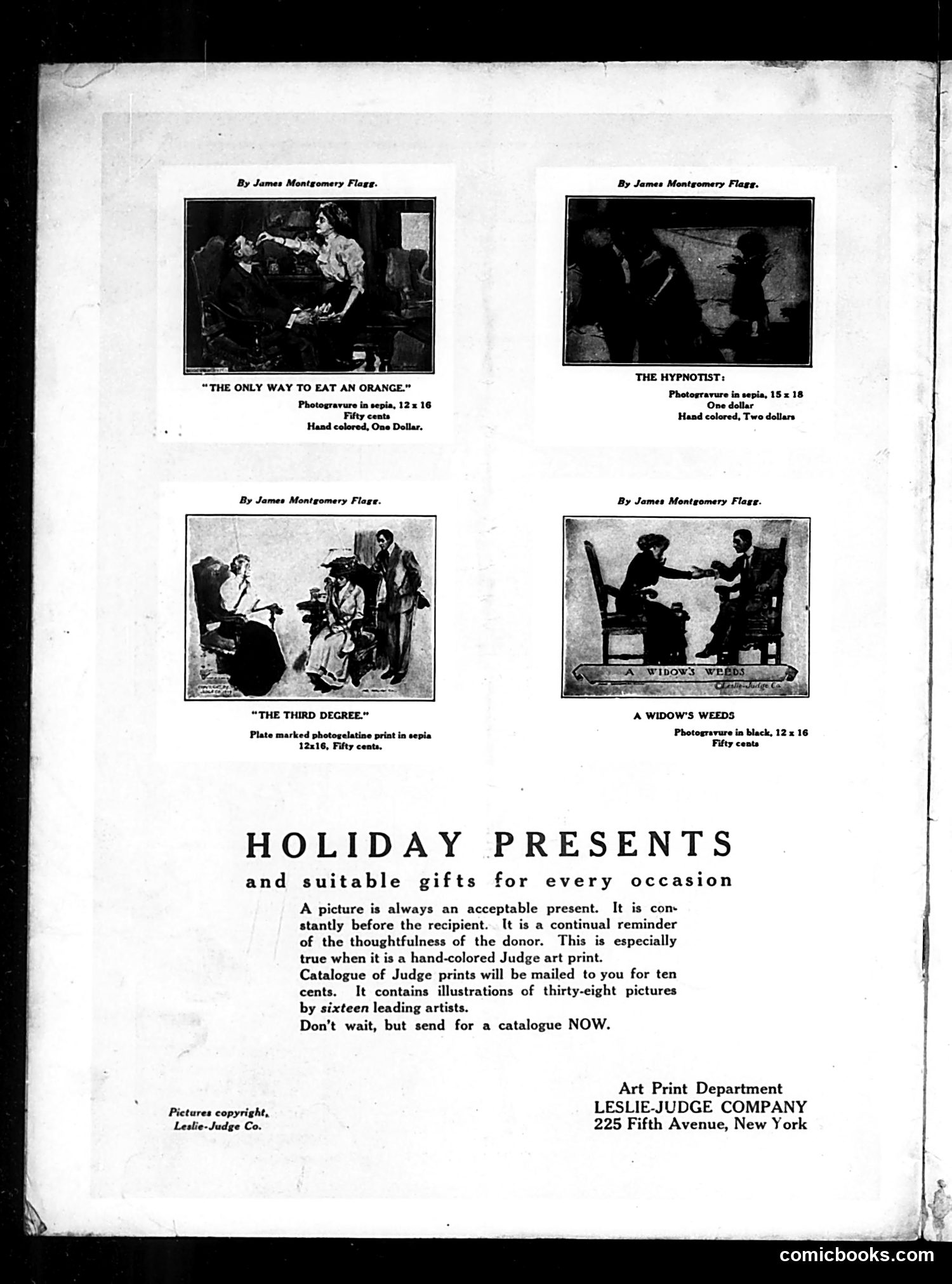
This page advertises art prints from Judge magazine's publishing arm, the Leslie-Judge Company. It displays four works by prominent illustrator James Montgomery Flagg: 1. **"The Only Way to Eat an Orange"** — appears to show a humorous domestic scene 2. **"The Hypnotist"** — depicts what seems to be a hypnosis performance or illusion 3. **"The Third Degree"** — likely references police interrogation tactics 4. **"A Widow's Weeds"** — shows figures in mourning attire The advertisement below promotes these prints as holiday gifts, emphasizing their decorative and sentimental value. It promises a catalog of thirty-eight pictures by sixteen artists for ten cents—appealing to early 20th-century consumers seeking affordable home decoration. The pricing structure (50 cents to two dollars) and emphasis on hand-coloring reflects the period's print culture, where Judge's satirical artwork was commodified as consumer goods for the middle class.