
Judge, 1911-12-23 · page 19 of 24
Judge — December 23, 1911 — page 19: what you’re looking at
What you’re looking at
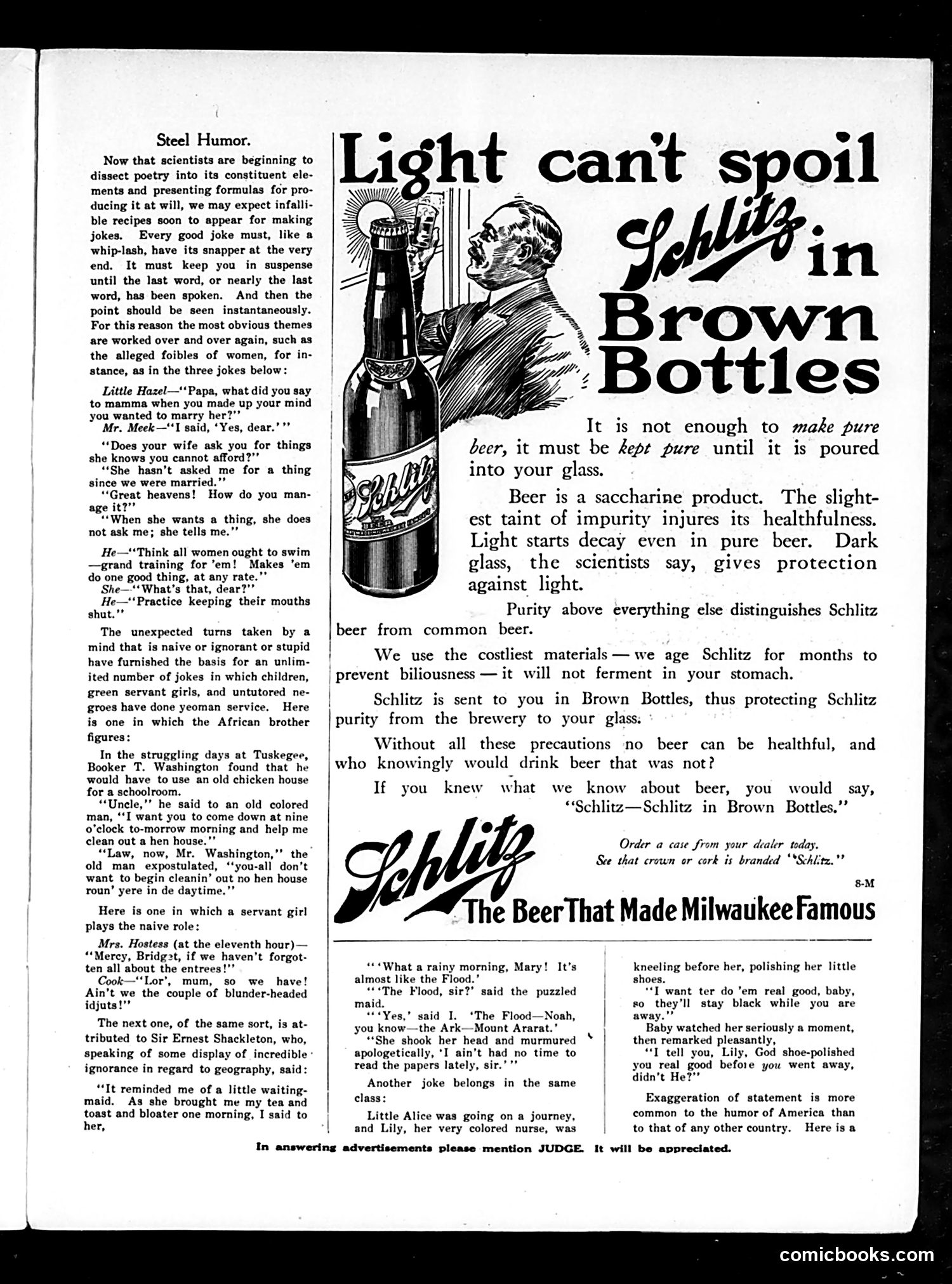
This page combines satirical humor with a Schlitz beer advertisement. The "Steel Humor" section presents three jokes exemplifying a particular comedic formula—the "snapper" ending where the punchline delivers unexpected reversal. These jokes rely on stereotypes: confused servants, naive women, and African Americans portrayed as ignorant. The centerpiece is a Schlitz advertisement claiming brown bottles protect beer from light damage, ensuring purity. The ad emphasizes scientific reasoning and healthfulness—marketing strategies common in early 20th-century beer advertising, when purity claims competed heavily in the marketplace. The page reflects Judge's typical format: satirical commentary on contemporary life alongside advertising. The inclusion of a Booker T. Washington reference suggests the publication's era (Washington founded Tuskegee Institute). The stereotypical humor now appears offensive, but represented mainstream American comedy conventions at the time.
📄 Transcribed text from this page (OCR, searchable)
Machine-transcribed from the original scan — historical spelling and the odd misread are preserved.
| | | Steel Humor. Now that scientists are beginning to dissect poetry into its constituent ele- ments and presenting formulas for pro- ducing it at will, we may expect infalli- ble recipes soon to appear for making jokes. Every good joke must, like a whip-lash, have its snapper at the very end. It must keep you in suspense until the last word, or nearly the last word, has been spoken. And then the point should be seen instantaneously. For this reason the most obvious themes are worked over and over again, such as the alleged foibles of women, for in- stance, as in the three jokes below: Little Hazel—‘Papa, what did you say to mamma when you made up your mind you wanted to marry her?” Mr. Meek—'‘I said, ‘Yes, dear.’”” “Does your wife ask you for things she knows you cannot afford?” “She hasn’t asked me for a thing since we were married.” “Great heavens! How do you man- age it?” “When she wants a thing, she does not ask me; she tells me.”” He—Think all women ought to swim —grand training for’em! Makes 'em do one good thing, at any rate.’" She—-‘What’s that, dear?”” He—Practice keeping their mouths shut.’” The unexpected turns taken by a mind that is naive or ignorant or stupid have furnished the basis for an unlim- ited number of jokes in which children, green servant girls, and untutored ne- groes have done yeoman service. Here is one in which the African brother figures: In the struggling days at Tuskegee, Booker T. Washington found that he would have to use an old chicken house for a schoolroom. “Uncle,” he said to an old colored man, ‘‘I want you to come down at nine o'clock to-morrow morning and help me clean out a hen house."’ “Law, now, Mr. Washington,’’ the old man expostulated, ‘‘you-all don’t want to begin cleanin’ out no hen house roun’ yere in de daytime.” Here is one in which a servant girl plays the naive role: Mrs. Hostess (at the eleventh hour)— “Mercy, Bridg2t, if we haven't forgot- ten all about the entrees!"’ Cook—‘‘Lor’, mum, so we have! Ain’t we the couple of blunder-headed idjuts!"” The next one, of the same sort, is at- tributed to Sir Ernest Shackleton, who, speaking of some display of incredible: ignorance in regard to geography, said: “It reminded me of a little waiting- maid. As she brought me my tea and toast and bloater one morning, I said to her, | Pie rown ‘Bottles It is not enough to make pure beer, it must be ept pure until it is poured into your glass. Beer is a saccharine product. The slight- est taint of impurity injures its healthfulness. Light starts decay even in pure beer. Dark glass, the scientists say, gives protection against light. Purity above everything else distinguishes Schlitz beer from common beer. We use the costliest materials — we age Schlitz for months to prevent biliousness — it will not ferment in your stomach. Schlitz is sent to you in Brown Bottles, thus protecting Schlitz purity from the brewery to your glass: Without all these precautions no beer can be healthful, and who knowingly would drink beer that was not? If you knew what we know about beer, you would say, “Schlitz—Schlitz in Brown Bottles.” @. Order a case from your dealer today. See that crown or cork is branded ‘*Schlitz."” 8-M The Beer That Made Milwaukee Famous kneeling before her, polishing her little shoes. “I want ter do ’em real good, baby, so they'll stay black while you are away.” “**What a rainy morning, Mary! It's almost like the Flood.’ “*The Flood, sir?’ said the puzzled maid. “**Yes,’ said I. ‘The Flood—Noah, you know—the Ark—Mount Ararat.’ “She shook her head and murmured apologetically, ‘I ain’t had no time to read the papers lately, sir.’’” Another joke belongs in the same class: Little Alice was going on a journey, and Lily, her very colored nurse, was In answering advertisements please mention JUDGE. It will be appreciated. Baby watched her seriously a moment, then remarked pleasantly, “T tell you, Lily, God shoe-polished you real good before you went away, didn’t He?” Exaggeration of statement is more common to the humor of America than to that of any other country. Here is a comicbooks.com