
Judge, 1911-12-23 · page 4 of 24
Judge — December 23, 1911 — page 4: what you’re looking at
What you’re looking at
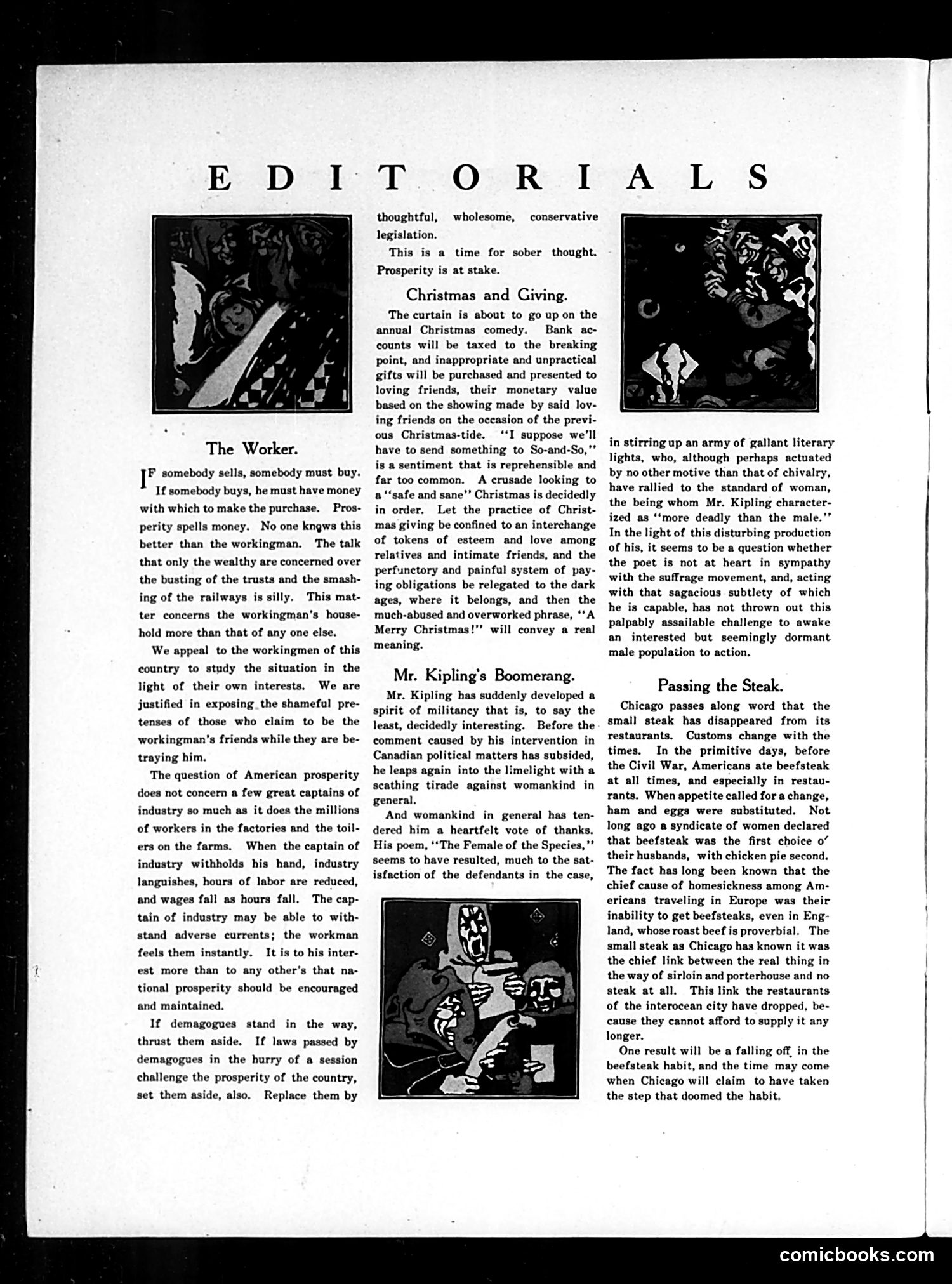
This page contains four editorials with accompanying illustrations addressing early 20th-century American social issues: **"The Worker"** criticizes wealthy industrialists' indifference to working-class hardship, arguing that workers' interests deserve equal consideration to capitalists' profits. **"Christmas and Giving"** satirizes ostentatious holiday gift-giving among the wealthy, suggesting Christmas charity should be more meaningful than displays of monetary value. **"Mr. Kipling's Boomerang"** appears to criticize author Rudyard Kipling's recent militaristic statements regarding "womankind," suggesting such views will backfire against him. **"Passing the Steak"** humorously notes Chicago's restaurants have stopped serving small steaks, attributing this to changing American tastes since the Civil War—a lighthearted commentary on culinary and cultural shifts. The illustrations use caricature and social commentary typical of Judge's satirical approach to contemporary issues.
📄 Transcribed text from this page (OCR, searchable)
Machine-transcribed from the original scan — historical spelling and the odd misread are preserved.
The Worker. F somebody sells, somebody must buy. If somebody buys, he must have money with which to make the purchase. Pros- perity spells money. No one kngws this better than the workingman. The talk that only the wealthy are concerned over the busting of the trusts and the smash- ing of the railways is silly. This mat- ter concerns the workingman’s house- hold more than that of any one else. We appeal to the workingmen of this country to study the situation in the light of their own interests. We are justified in exposing the shameful pre- tenses of those who claim to be the workingman's friends while they are be- traying him. The question of American prosperity does not concern a few great captains of industry so much as it does the millions of workers in the factories and the toil- ers on the farms. When the captain of industry withholds his hand, industry languishes, hours of labor are reduced, and wages fall as hours fall. The cap- tain of industry may be able to with- stand adverse currents; the workman feels them instantly. It is to his inter- est more than to any other's that na- tional prosperity should be encouraged and maintained. If demagogues stand in the way, thrust them aside. If laws passed by demagogues in the hurry of a session challenge the prosperity of the country, set them aside, also. Replace them by ED Tt OrPR lA. L S thoughtful, wholesome, conservative legislation. This a time for sober thought. Prosperity is at stake. Christmas and Giving. The curtain is about to go up on the annual Christmas comedy. Bank ac- counts will be taxed to the breaking point, and inappropriate and unpractical gifts will be purchased and presented to loving friends, their monetary value based on the showing made by said lov- ing friends on the occasion of the previ- ous Christmas-tide. ‘‘I suppose we'll have to send something to So-and-So,”’ is a sentiment that is reprehensible and far toocommon. A crusade looking to a ‘‘safe and sane’’ Christmas is decidedly in order. Let the practice of Christ- mas giving be confined to an interchange of tokens of esteem and love among relatives and intimate friends, and the perfunctory and painful system of pay- ing obligations be relegated to the dark ages, where it belongs, and then the much-abused and overworked phrase, ‘‘A Merry Christmas!” will convey a real meaning. Mr. Kipling’s Boomerang. Mr. Kipling has suddenly developed a spirit of militancy that is, to say the least, decidedly interesting. Before the comment caused by his intervention in Canadian political matters has subsided, he leaps again into the limelight with a scathing tirade against womankind in general. And womankind in general has ten- dered him a heartfelt vote of thanks. His poem, ‘‘The Female of the Species,’’ seems to have resulted, much to the sat- isfaction of the defendants in the case, in stirring up an army of gallant literary lights, who, although perhaps actuated by no other motive than that of chivalry, have rallied to the standard of woman, the being whom Mr. Kipling character- ized as ‘‘more deadly than the male.’” In the light of this disturbing production of his, it seems to be a question whether the poet is not at heart in sympathy with the suffrage movement, and, acting with that sagacious subtlety of which he is capable, has not thrown out this palpably assailable challenge to awake an interested but seemingly dormant male population to action. Passing the Steak. Chicago passes along word that the small steak has disappeared from its restaurants. Customs change with the times. In the primitive days, before the Civil War, Americans ate beefsteak at all times, and especially in restau- rants. When appetite called for a change, ham and eggs were substituted. Not long ago a syndicate of women declared that beefsteak was the first choice 0” their husbands, with chicken pie second. The fact has long been known that the chief cause of homesickness among Am- ericans traveling in Europe was their inability to get beefsteaks, even in Eng- land, whose roast beef is proverbial. The small steak as Chicago has known it was the chief link between the real thing in the way of sirloin and porterhouse and no steak at all. This link the restaurants of the interocean city have dropped, be- cause they cannot afford to supply it any longer. One result will be a falling off, in the beefsteak habit, and the time may come when Chicago will claim to have taken the step that doomed the habit. i} comicbooks.com