
A complete issue · 52 pages · 1890
Judge — December 6, 1890
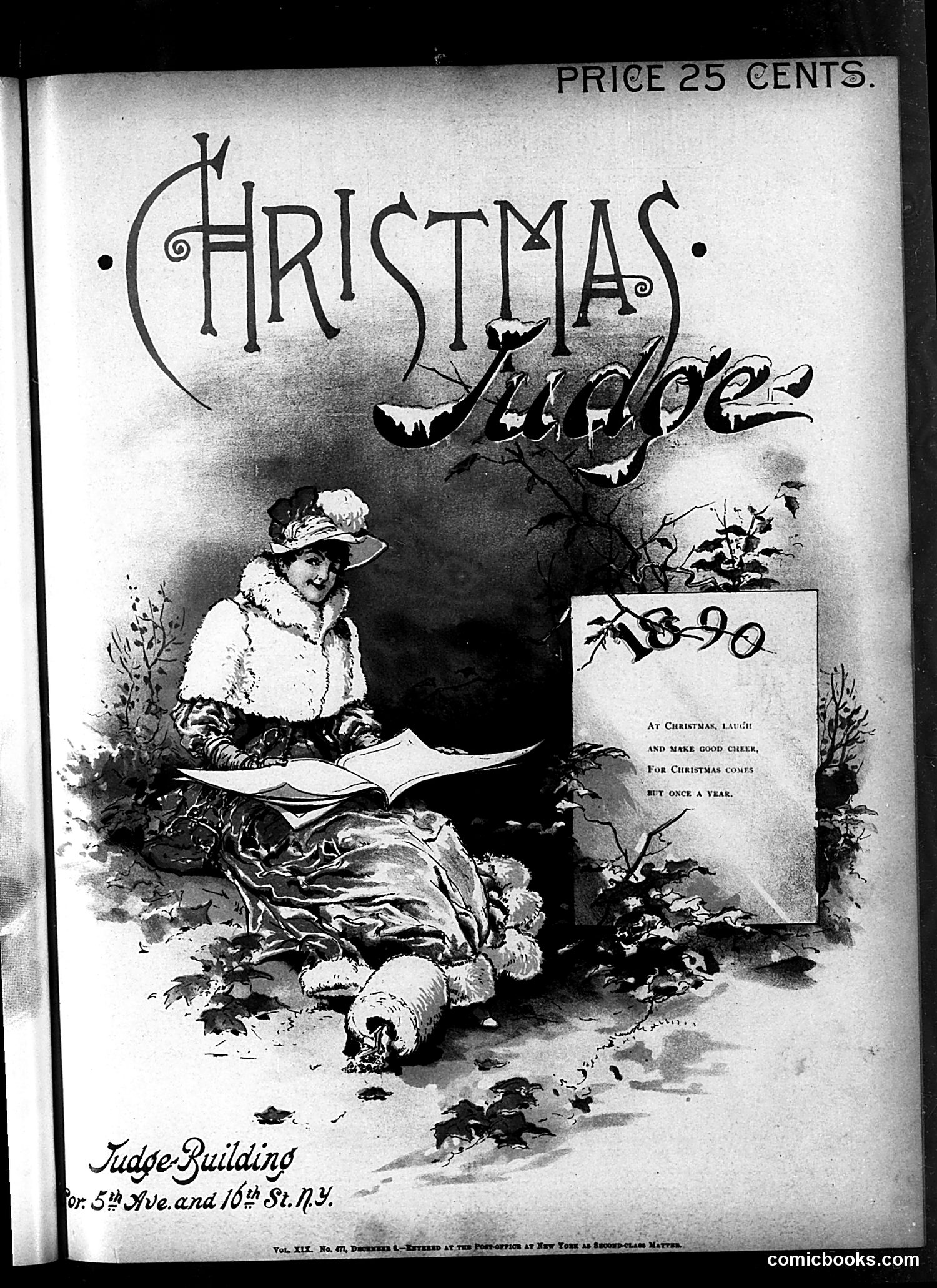
This is the cover of Judge magazine's Christmas 1890 issue (price 25 cents). The main illustration shows a fashionably dressed woman in winter clothing reading a large book by candlelight, surrounded by snowy winter scenery and bare branches. The accompanying text reads: "At Christmas, laugh and make good cheer, for Christmas comes but once a year." This appears to be primarily a holiday-themed cover celebrating Christmas leisure and reading rather than political satire. The woman's genteel appearance and the cozy reading scene reflect late Victorian sensibilities about refined Christmas celebration. The address "Judge Building, 54 Ave. and 16th St. N.Y." indicates this is from the magazine's New York offices.
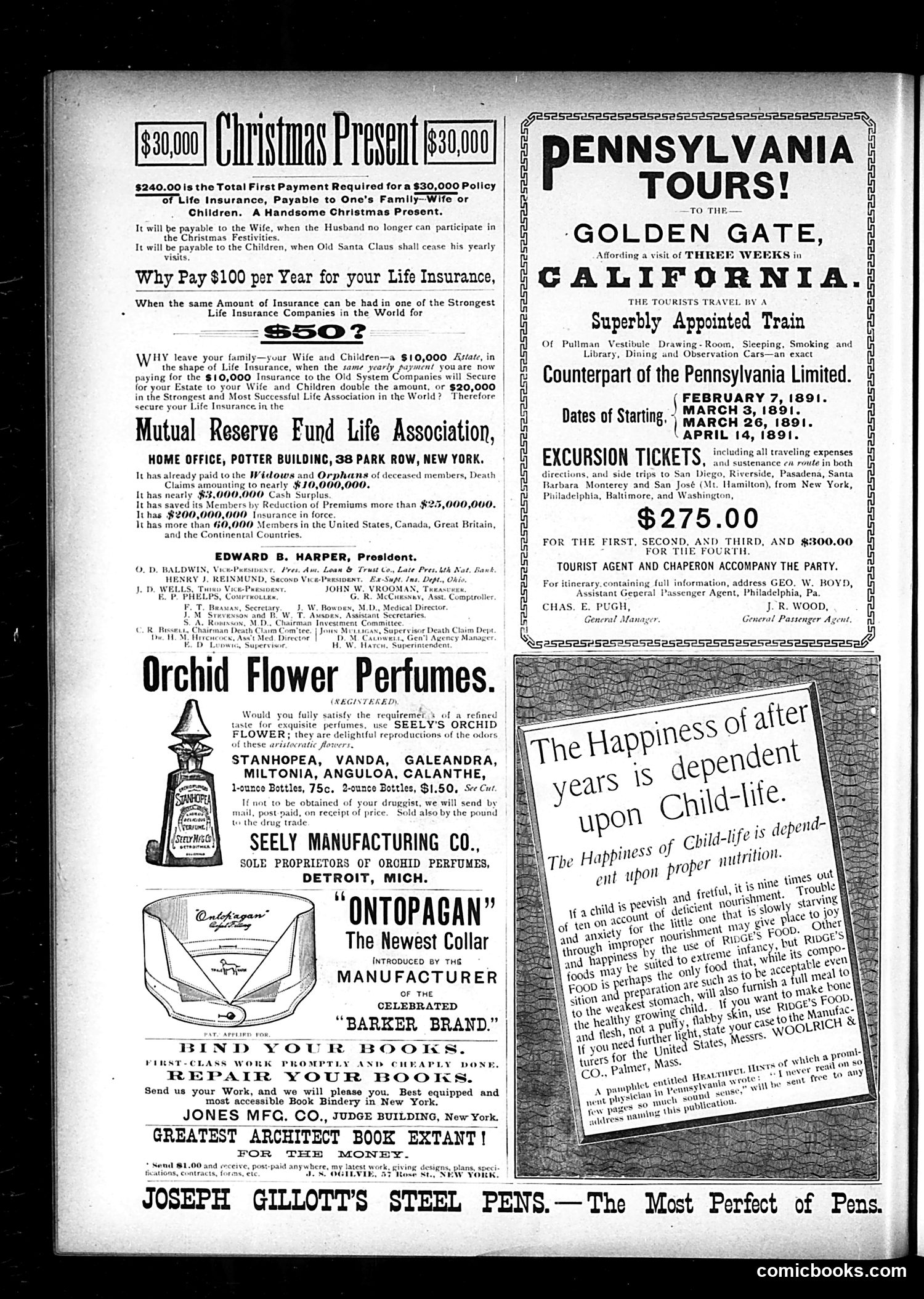
This page is **primarily advertising**, not political satire. It contains multiple commercial advertisements from the 1891 era: - A $30,000 life insurance policy offer - A Pennsylvania tour to California via train ($275) - Orchid flower perfumes by Seely Manufacturing - The "Ontopagan" collar by Barber Brand - Book binding services - Joseph Gillott's steel pens The only non-advertising content is a text block titled "The Happiness of after years is dependent upon Child-life," which argues that proper child nutrition (promoted by a manufacturer of children's food) ensures adult well-being. No political cartoons or satirical commentary appear on this page. It represents typical late-19th-century magazine advertising and promotional content.
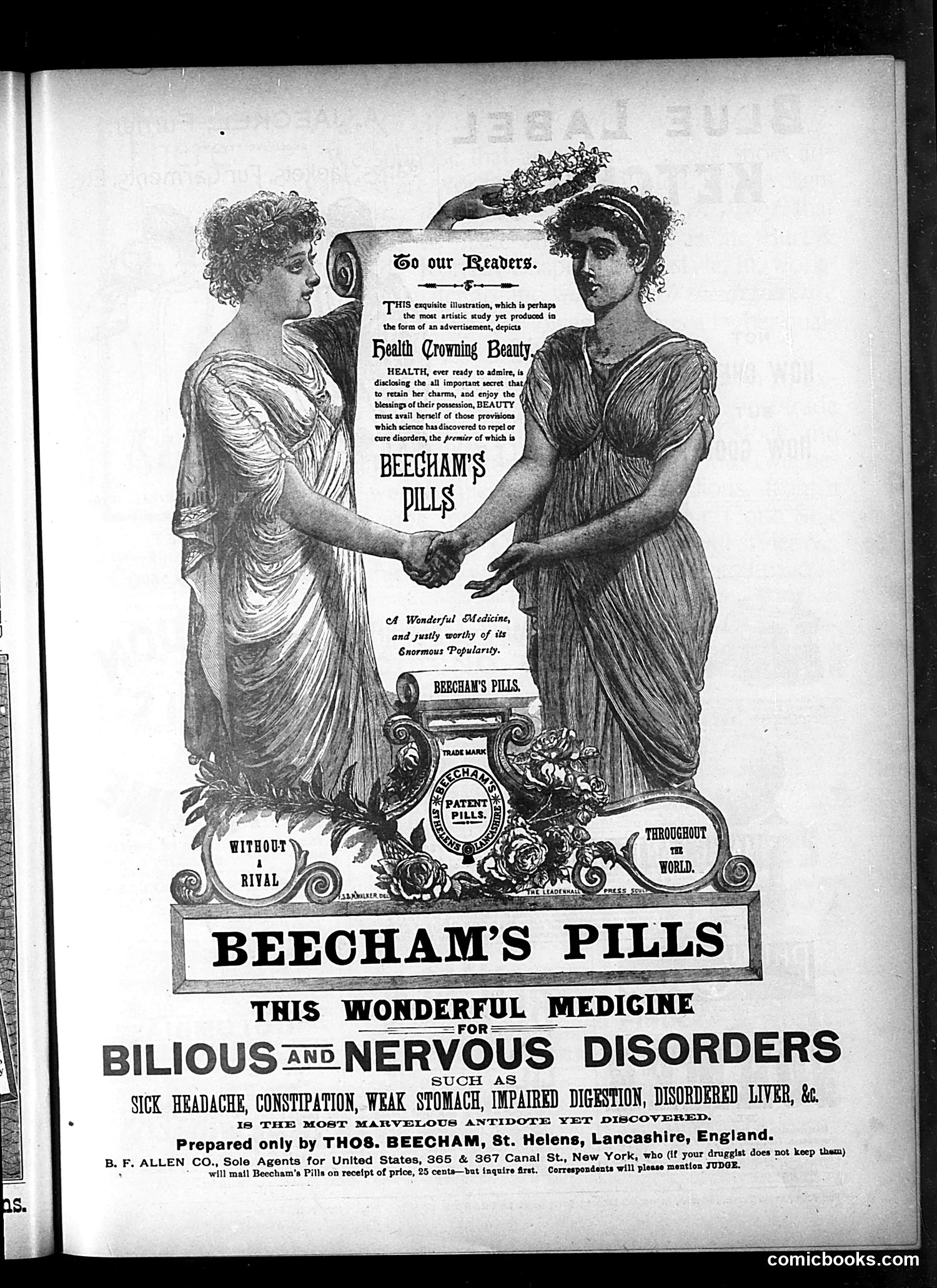
This page is primarily a **patent medicine advertisement**, not political satire. It advertises Beecham's Pills, a British laxative that was heavily marketed in America during the late 19th/early 20th century. The image shows two classical female figures (likely representing Health and Beauty) shaking hands in endorsement. The ad promises the pills cure "bilious and nervous disorders" including headache, constipation, and indigestion. The satirical angle—evident from its placement in *Judge*—likely mocks the **extravagant medical claims** of patent medicines. The grandiose classical imagery and promises of curing multiple ailments through one pill exemplify the dubious advertising practices that magazines like *Judge* regularly ridiculed. Beecham's Pills were real but notoriously overhyped as cure-alls.
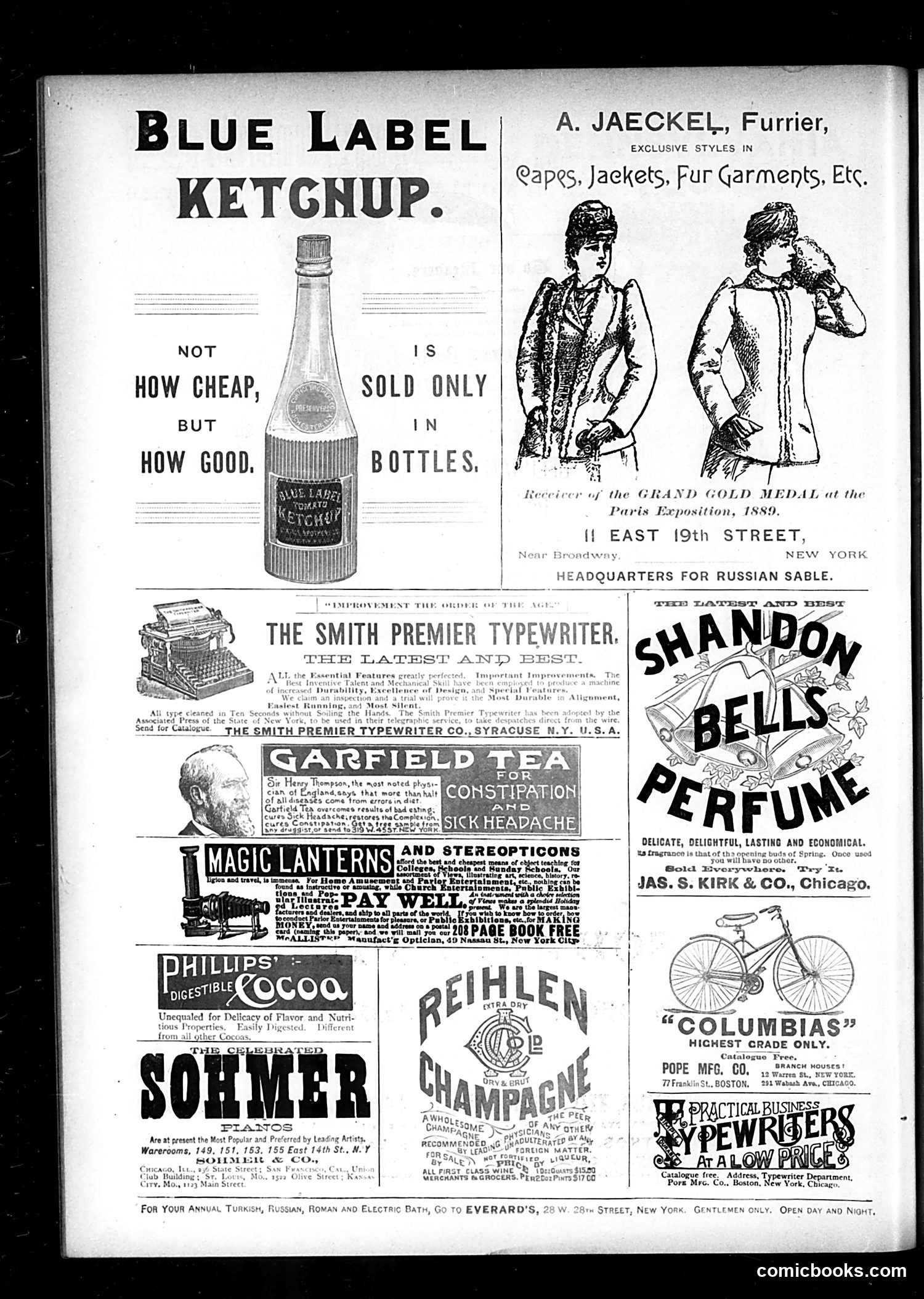
This page is primarily **advertising**, not editorial cartooning or satire. It contains roughly a dozen commercial advertisements for late 19th-century products: ketchup, fur garments, typewriters, tea, cocoa, magic lanterns, perfume, bicycles, and bath services. The only potentially satirical element is the ketchup ad's slogan—"NOT HOW CHEAP, BUT HOW GOOD"—which appears to mock competitors' emphasis on affordability, asserting quality instead. This reflects late-1800s marketing debates about product value. The page offers little political commentary. Instead, it documents period consumer culture: the prominence of typewriter advertisements suggests the technology's novelty; "Russian sable" furs indicate luxury trade; and gender-segregated bathhouses ("GENTLEMEN ONLY") reflect contemporary social norms. For modern readers, the primary interest is **historical documentation** of what Gilded Age Americans bought and how they were marketed to.
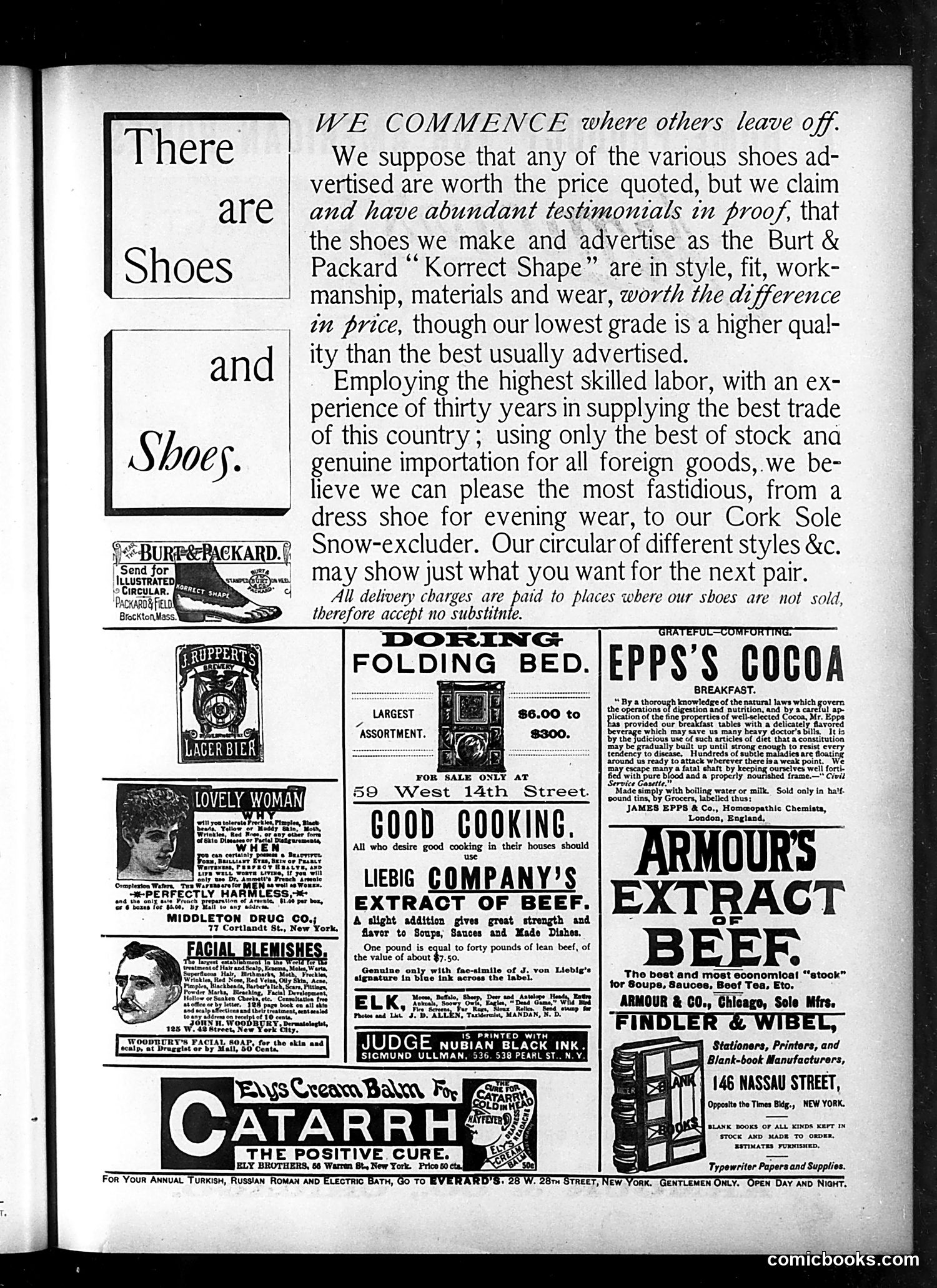
This page is primarily filled with Victorian-era advertisements rather than political satire. The main content is a lengthy advertisement from Burt & Packard shoes, claiming their "Korrect Shape" design justifies higher prices through superior craftsmanship, materials, and durability compared to competitors. The page illustrates period consumer marketing: manufacturers asserting product superiority via testimonials and emphasizing skilled labor and imported materials—appeals targeting wealthy, "fastidious" customers. Supporting advertisements promote Liebig's beef extract, Armour's beef extract, Epps's cocoa, facial treatments, and office supplies. These collectively reflect late-nineteenth-century concerns: efficiency, health tonics, personal grooming standards, and the growth of commercial/business culture. The ads reveal contemporary assumptions about product quality signaling class status and wealth.
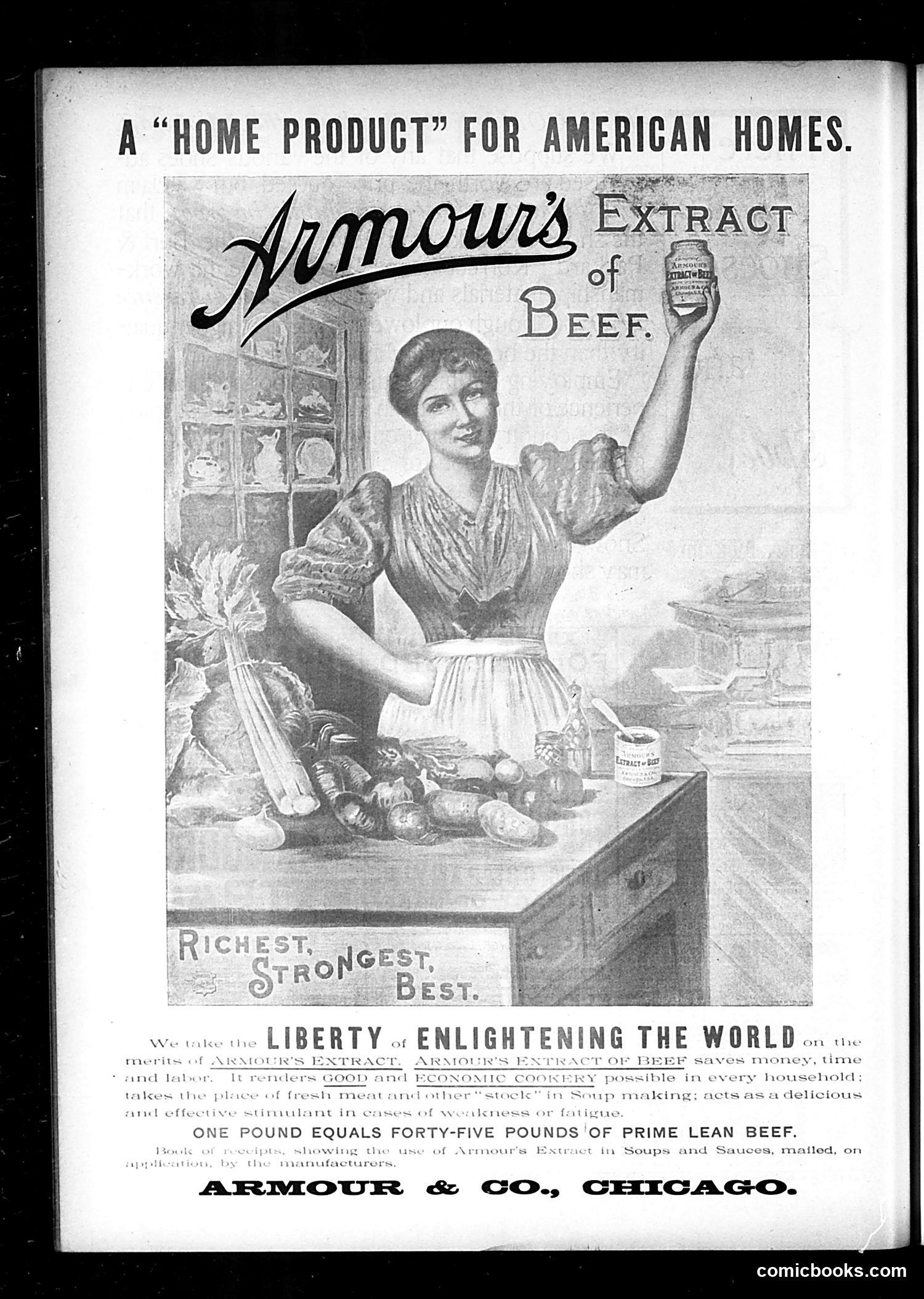
This page is **primarily an advertisement**, not political satire. It's a full-page ad for Armour & Co.'s beef extract product from Chicago. The imagery uses allegorical patriotism: a classical female figure (representing Liberty, echoing the Statue of Liberty) holds aloft a bottle of extract, surrounded by vegetables and cooking implements. The tagline "A 'Home Product' for American Homes" emphasizes American manufacturing. The sales pitch claims the extract is economical and nutritious—one pound equals forty-five pounds of prime beef—making it affordable for households while saving time and money in cooking. The reference to "Liberty Enlightening the World" is corporate patriotism, suggesting American products benefit both home and global markets. There's no clear political cartoon or satire here; this is straightforward commercial messaging dressed in nationalist imagery, typical of late 19th-century American advertising.
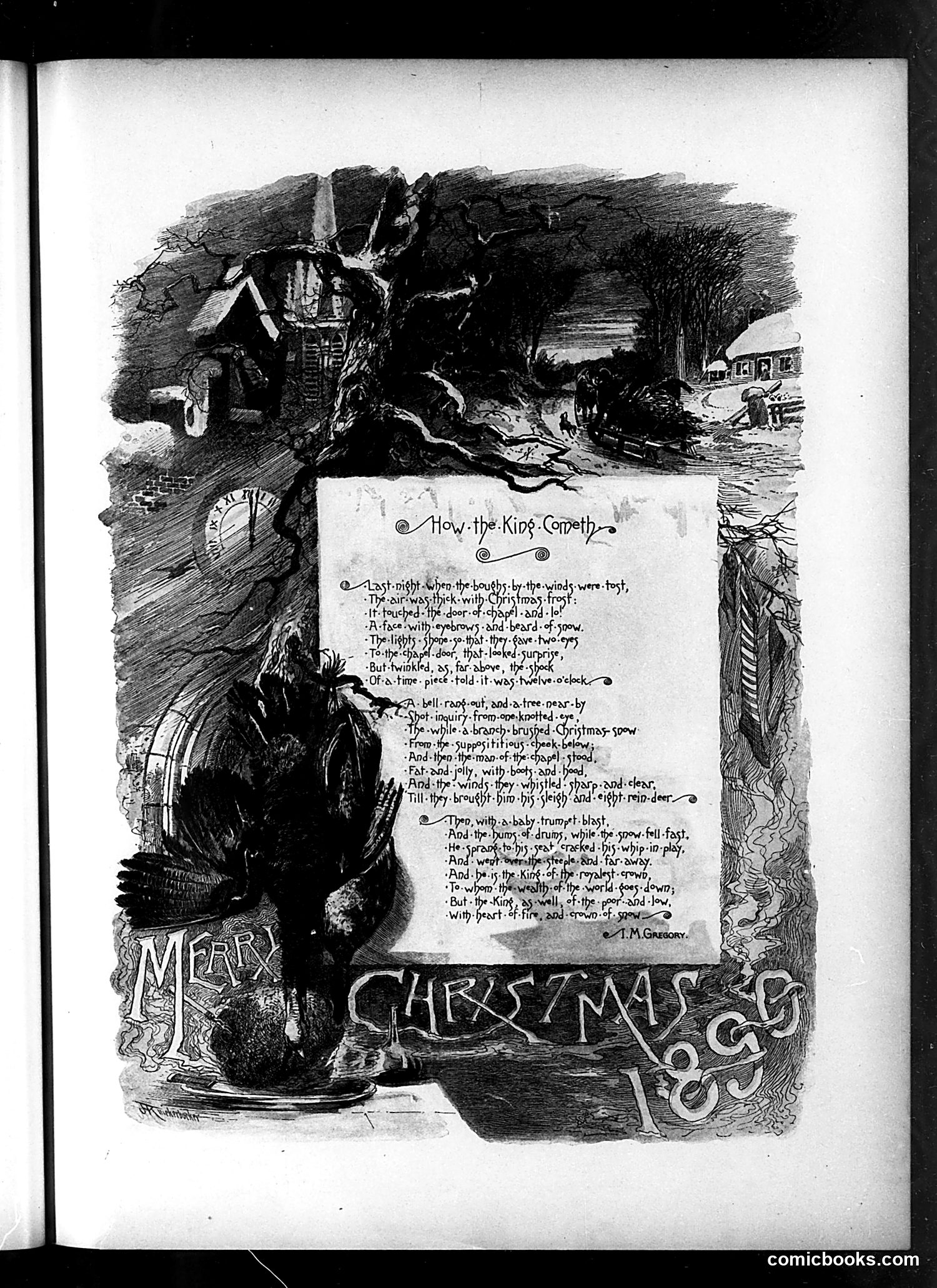
This is a Victorian-era Christmas poem illustrated with elaborate engravings, not political satire. The title "How the Kips Cometh" appears to be a whimsical play on religious language ("How the King Cometh"), reimagining Santa's arrival as a humble, working-class event rather than a grand one. The narrative describes Santa visiting a poor household on Christmas Eve—arriving with a bell, brandy-brush, and snow—to bring gifts to children. The poem emphasizes Santa's generosity toward "the poor and low," suggesting a sentimental, moralistic Christmas message about charity and kindness across class lines, typical of 1880s American holiday literature. The elaborate decorative border and old-fashioned typography suggest this was premium holiday content for Judge magazine's readers.
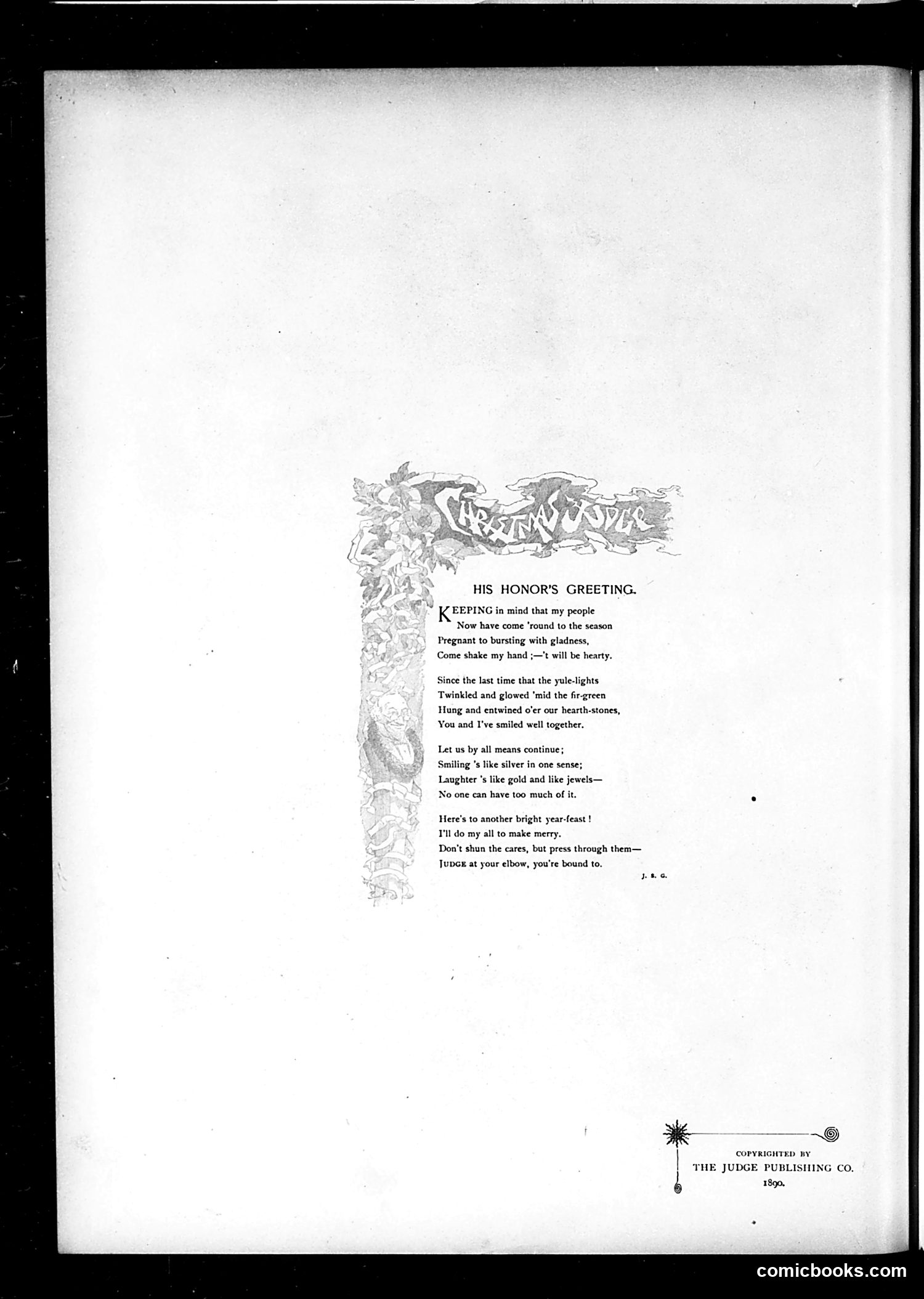
This is a New Year's greeting poem attributed to "His Honor" (likely a mayor or civic official), presented with decorative border illustration. Rather than a political cartoon, it's a seasonal sentiment piece common in satirical magazines of the era. The poem addresses the speaker's constituents warmly, urging continued goodwill and shared joy as the new year begins. References to "yule-lights" and "hearth-stones" invoke holiday imagery, while the speaker promises to maintain cheerful relations and encourage citizens to persevere through difficulties. The mild satire lies in the conventional, somewhat saccharine nature of such official greetings—the generic goodwill expressed by civic leaders during holiday season. The tone is gently mocking rather than scathing, capturing how such pronouncements, while well-intentioned, offer platitudes about shared happiness and mutual support without addressing specific governance issues.
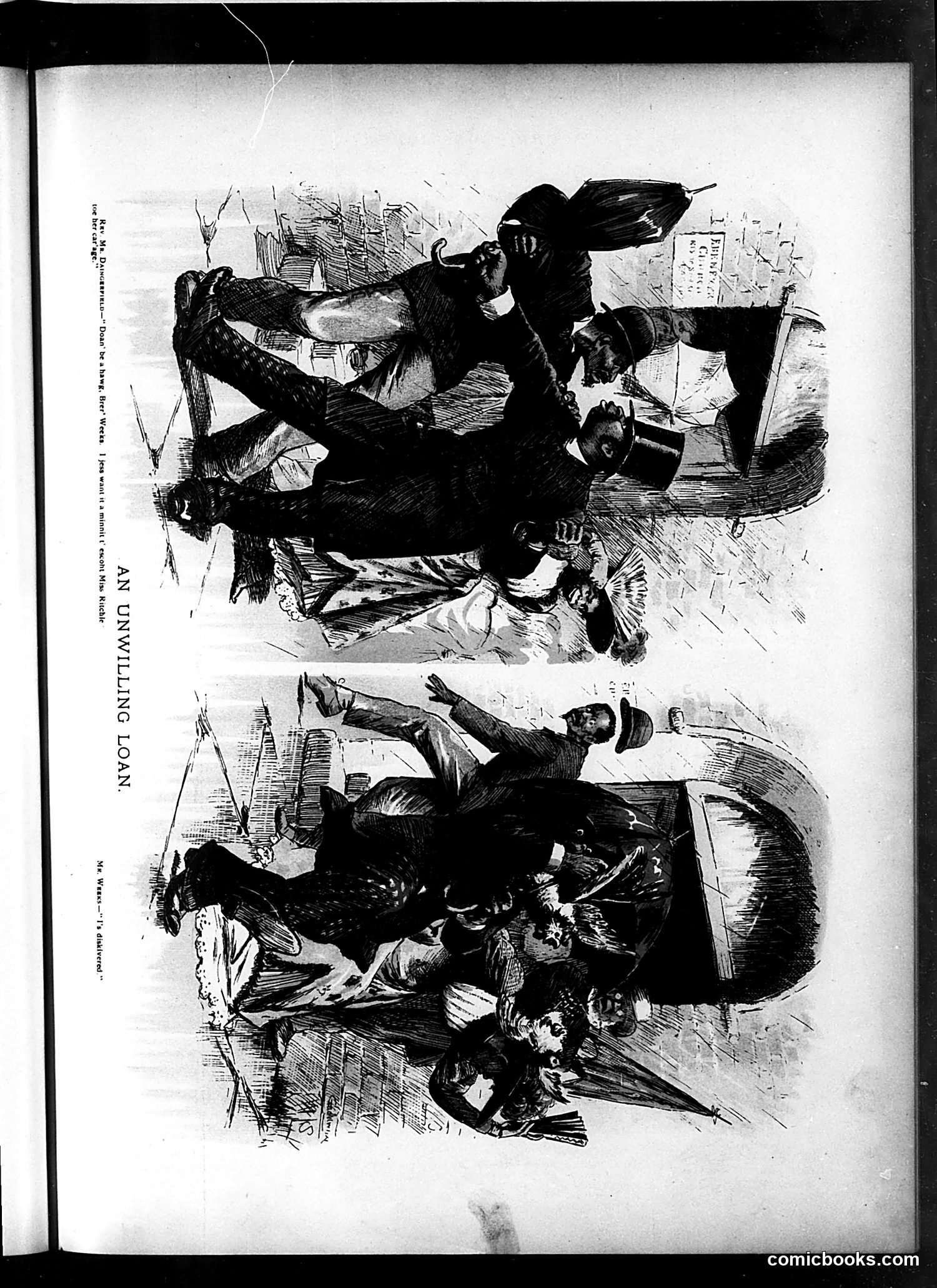
This cartoon depicts two Black men in a humorous dispute over escorting a woman named Miss Ritchie. The figure labeled "Wauring" requests to borrow "Weeks" for just a minute to escort the lady, while "Weeks" refuses, declaring he's "discovered" (presumably claiming he's found her first or has prior claim). The satire plays on gentlemanly courtship conventions by applying them to working-class Black characters, likely mocking the formality of the era's social rituals. The title "An Unwilling Loan" suggests one man views his companion's time as something to be borrowed—a comedic exaggeration of male competition for female attention. This reflects Judge magazine's frequent use of racial caricature for comedic effect, typical of late 19th-century American humor.
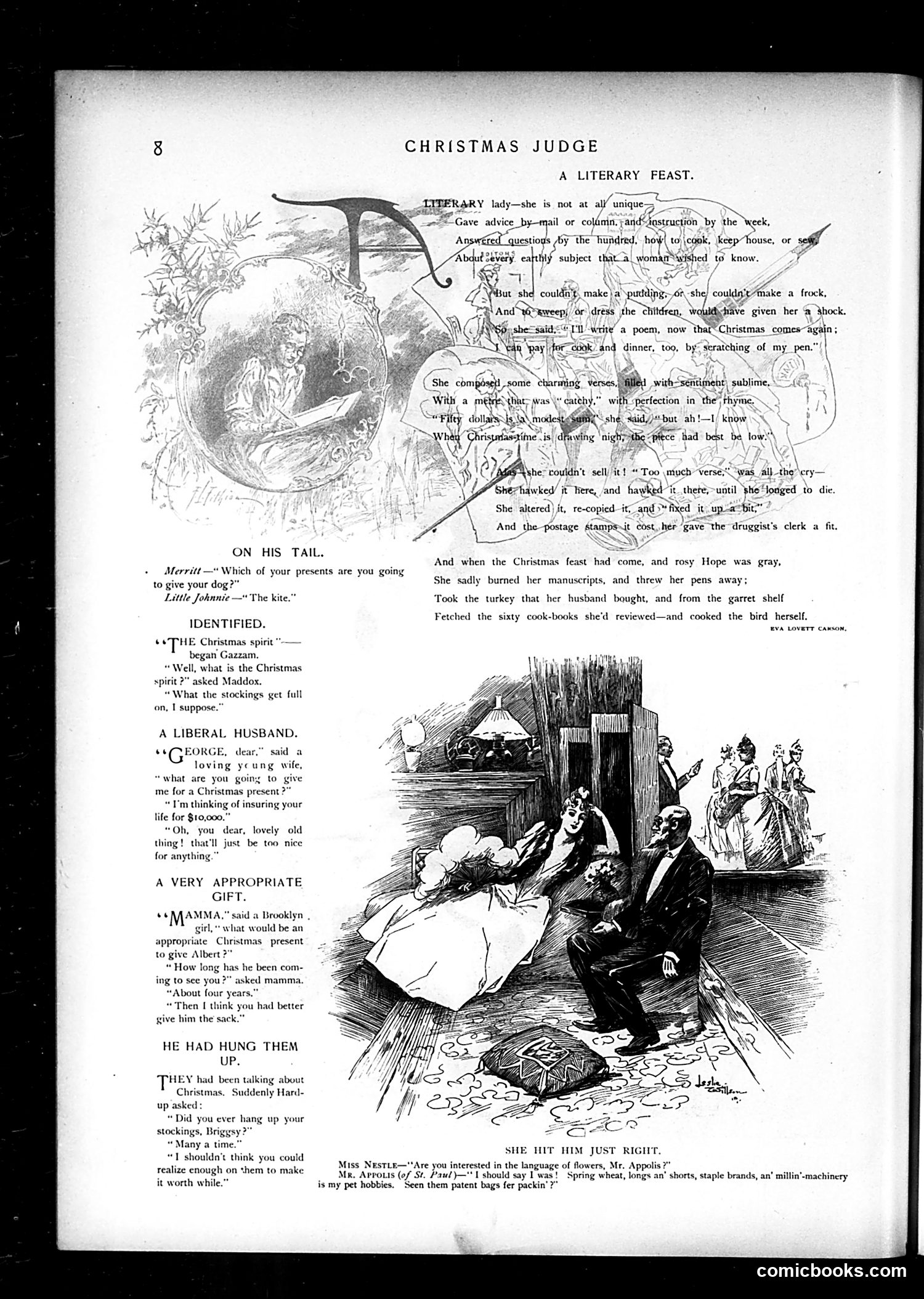
This page satirizes the "literary lady"—a educated woman who aspires to be a published writer but fails. The main narrative (top right) mocks a woman who composes sentimental Christmas verses with "perfection in the rhyme" but cannot sell them. She repeatedly rewrites and resubmits her work, hawking it everywhere until she dies. Ultimately, she abandons her literary ambitions, burns her manuscripts, and simply cooks Christmas dinner herself. The surrounding brief jokes ridicule holiday gift-giving: a husband insures his wife's life for $10,000; a woman should give her four-year suitor "the sack" (dismissal); and a poor man's stockings aren't worth pawning. The satire targets women's pretensions to serious literary careers while reinforcing that their "proper" role is domestic—cooking and homemaking. It's genteel mockery of female ambition common to Gilded Age publications.
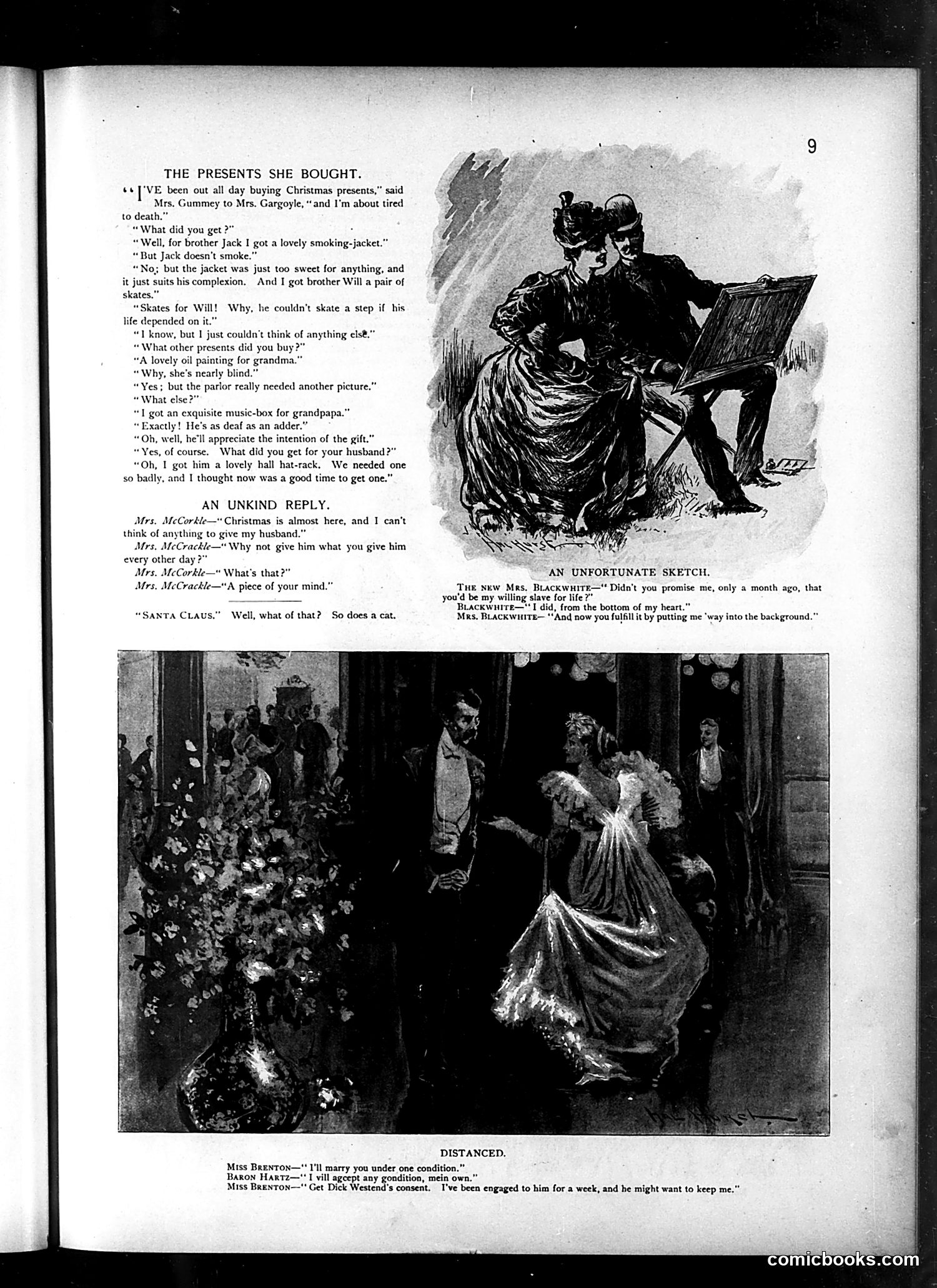
This page contains three separate satirical sketches mocking domestic relationships and marriage customs of the era. **"The Presents She Bought"** ridicules wives who buy impractical gifts—a smoking jacket for a non-smoker, skates for someone who can't skate, a painting for a nearly-blind grandmother, a music box for a deaf grandfather, and a hat-rack for her husband. The satire targets both women's poor gift-giving judgment and the performative nature of gift-giving divorced from actual utility. **"An Unkind Reply"** is a brief jab at nagging wives: when Mrs. McCorkle can't think what to give her husband, Mrs. McCrackle suggests "a piece of your mind"—implying the wife constantly complains. **"Distanced"** and the accompanying illustration depict a woman who agrees to marry a baron only if he gets permission from her current fiancé, sarcastically suggesting she values her prior engagement commitment while accepting a new proposal. The humor lies in the absurdity and the woman's apparent lack of commitment. All three sketches stereotype women as frivolous, nagging, or duplicitous in relationships.
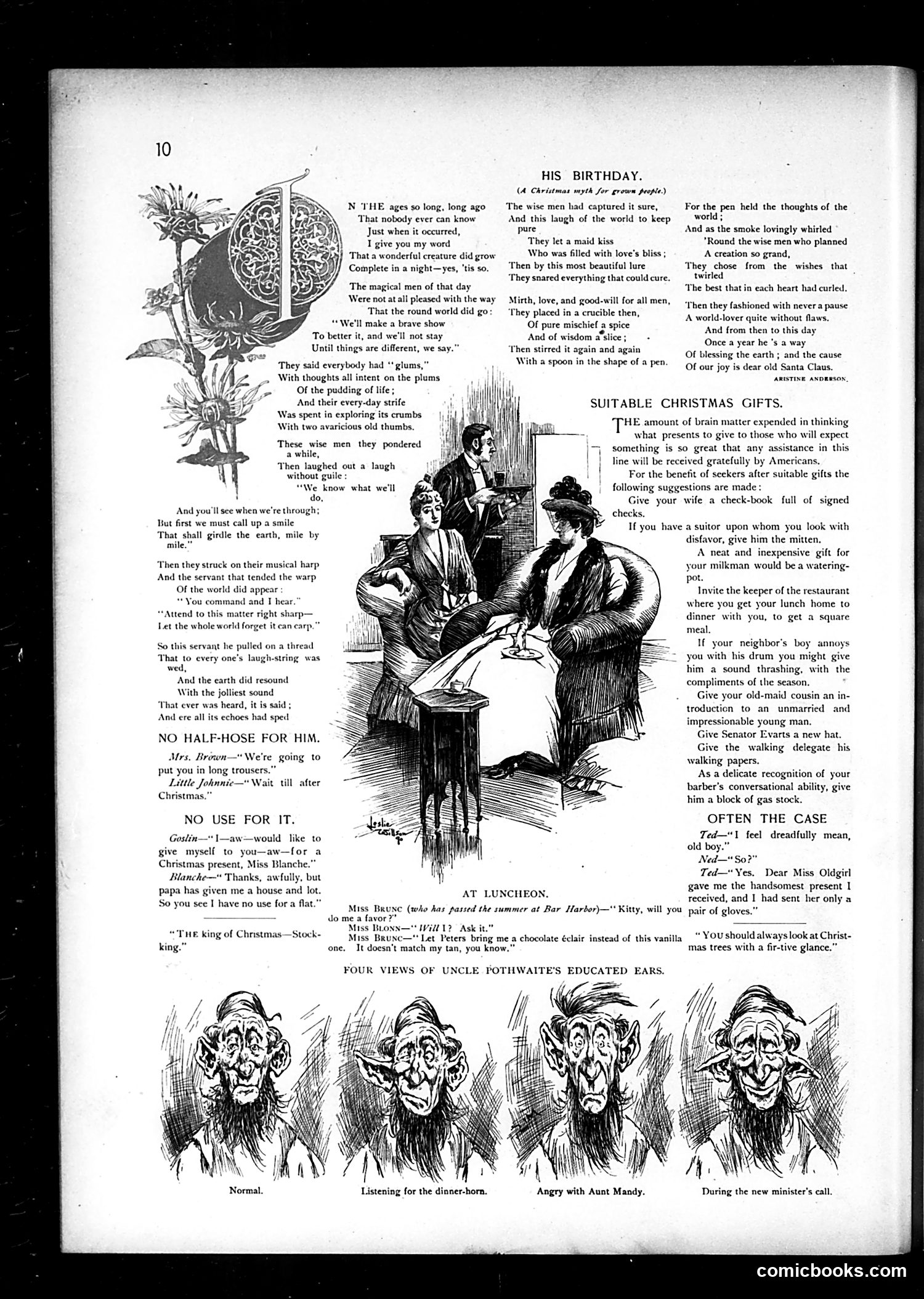
This page contains several distinct satirical pieces typical of late 19th-century American humor: **"His Birthday"** (top): A whimsical poem celebrating Santa Claus's creation by ancient "wise men" who captured worldly laughter, mirth, and love in a crucible to create the perfect gift-giver. It's a sentimentalized origin myth for Santa, presented in mock-serious verse. **"Suitable Christmas Gifts"** (center-right): A humorous advice column offering deliberately absurd gift suggestions—giving a mitten to a disliked suitor, a watering-pot to a milkman, inviting a restaurant owner to dinner for "a square meal." The jokes mock both gift-giving conventions and class relationships. **Lower cartoon**: Four crude caricatures labeled "Four Views of Uncle Potthwaite's Educated Ears" showing an elderly man's expressions: normal, listening for dinner, angry, and during a minister's call. It's broad physical comedy about vanity and selective hearing. The page's humor relies on sentimental satire, social observation, and crude caricature—typical Judge content targeting middle-class readers' pretensions and family dynamics.
I can see this is a page from *Judge* magazine, but the image quality is too degraded for me to read the OCR text reliably or discern specific cartoon illustrations, captions, or other content details. The page appears mostly blank or extremely faded, with some shadowing visible but no clearly legible text or distinct imagery that would allow me to identify specific figures, political references, or satirical points. To provide accurate historical analysis as requested, I would need a clearer image where the cartoons, caricatures, and text are actually readable. I cannot responsibly invent details about what the content depicts or references when I cannot see it clearly.
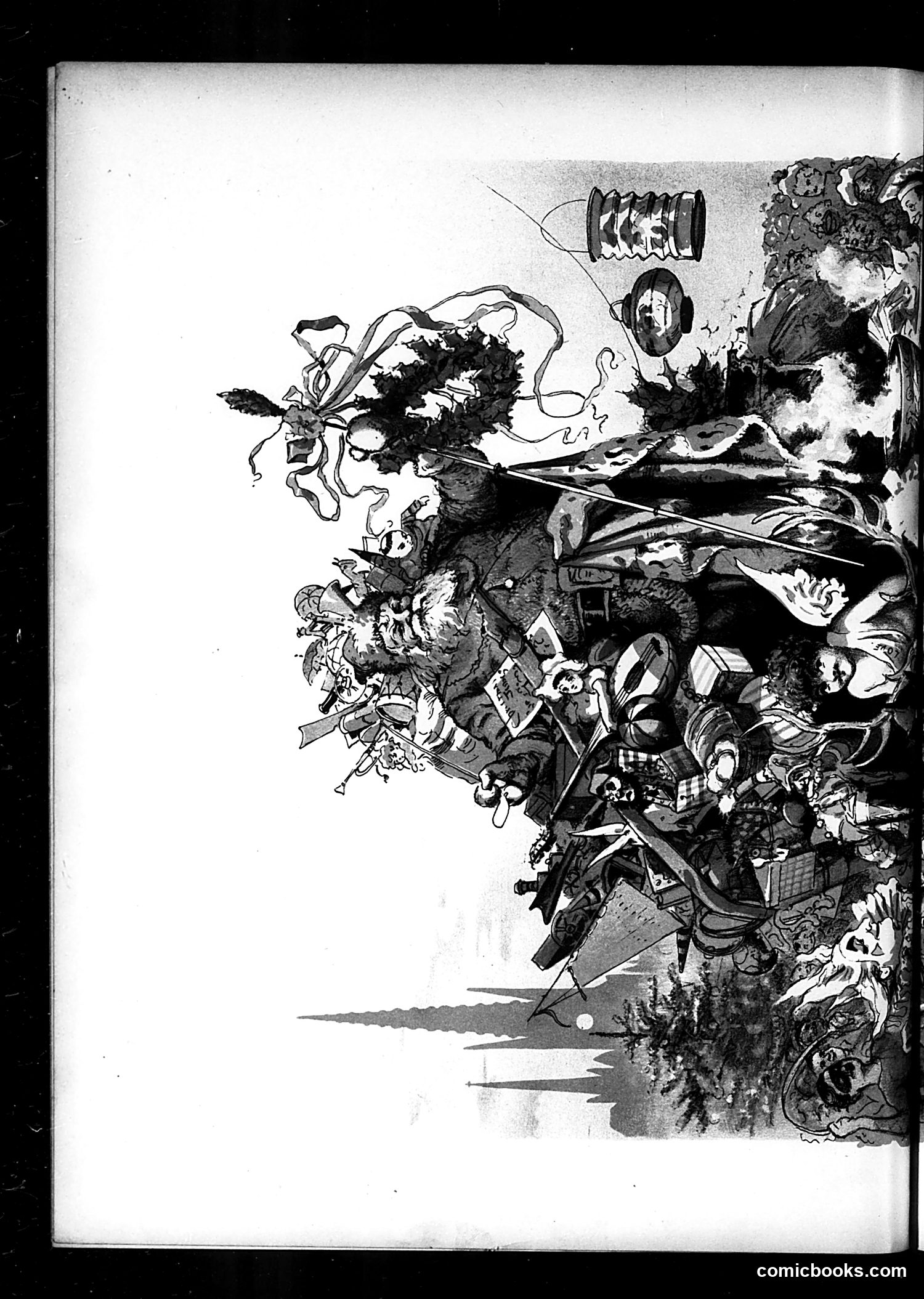
The OCR text provided is essentially unreadable—it appears to contain only scattered letters and symbols without coherent words or context. While the **image itself** shows an elaborate satirical illustration in Judge magazine's style, featuring numerous caricatured figures, mechanical elements, and ornate detail typical of late 19th/early 20th-century political cartoons, **without legible text I cannot reliably identify**: - Which specific political figures or events are referenced - What the central satirical message is - Historical context necessary for interpretation To properly analyze this cartoon, a clearer OCR transcription or the original publication date would be essential. The artistic style suggests commentary on contemporary politics or society, but specifics cannot be determined from the corrupted text alone.
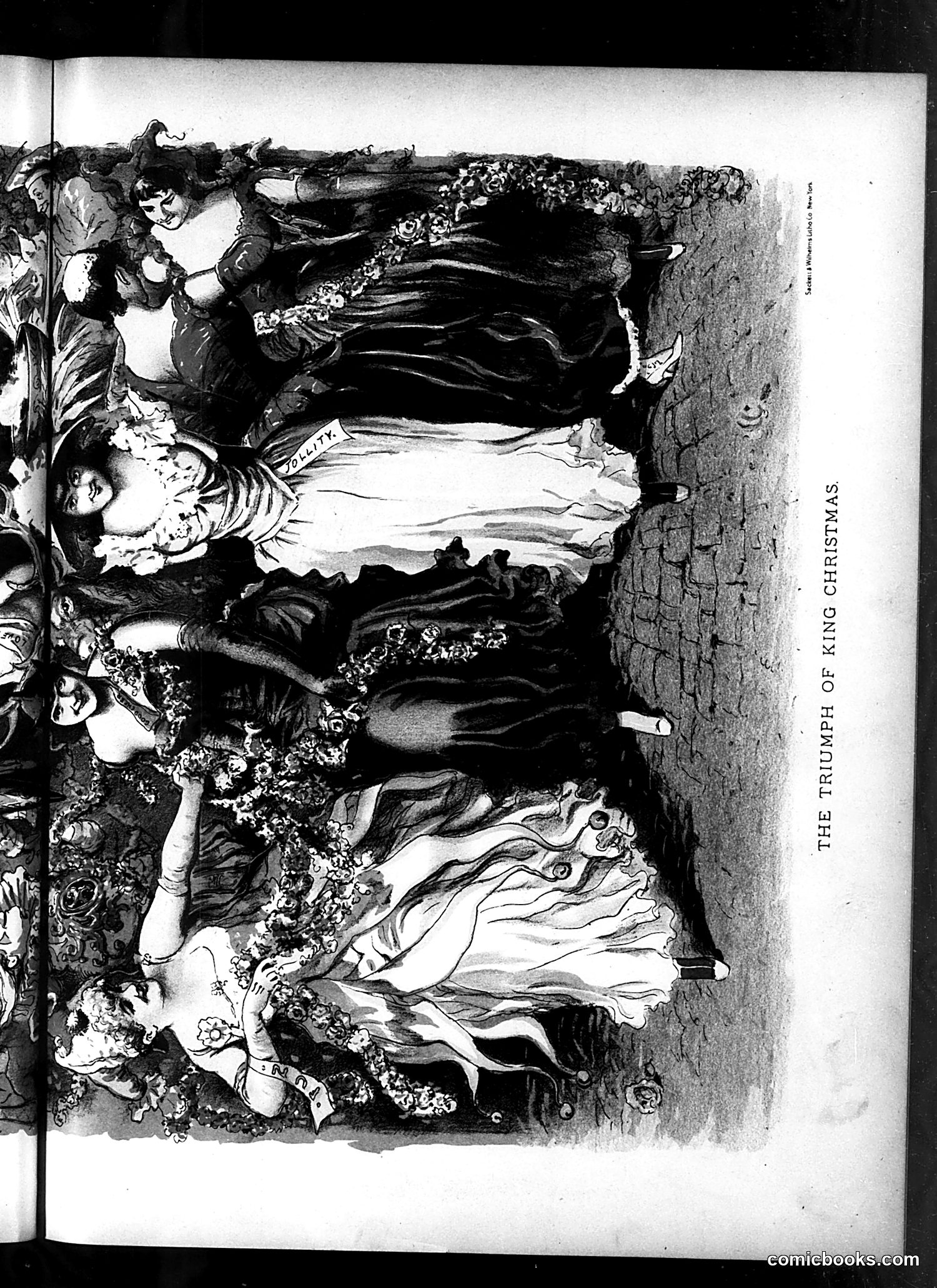

I can see this is a mostly blank or very faded page from Judge magazine. The image shows what appears to be a nearly empty white page with minimal visible content - just some faint marks and the "comicbooks.com" watermark at the bottom. Without discernible text, illustrations, or cartoon content visible in the image, I cannot identify specific figures, political references, or satirical points. This may be a title page, advertising page, or a page that has significantly degraded or faded over time, making the original content illegible in this scan. To provide meaningful historical and satirical context, I would need a page with clearer, visible cartoon illustrations and readable text.
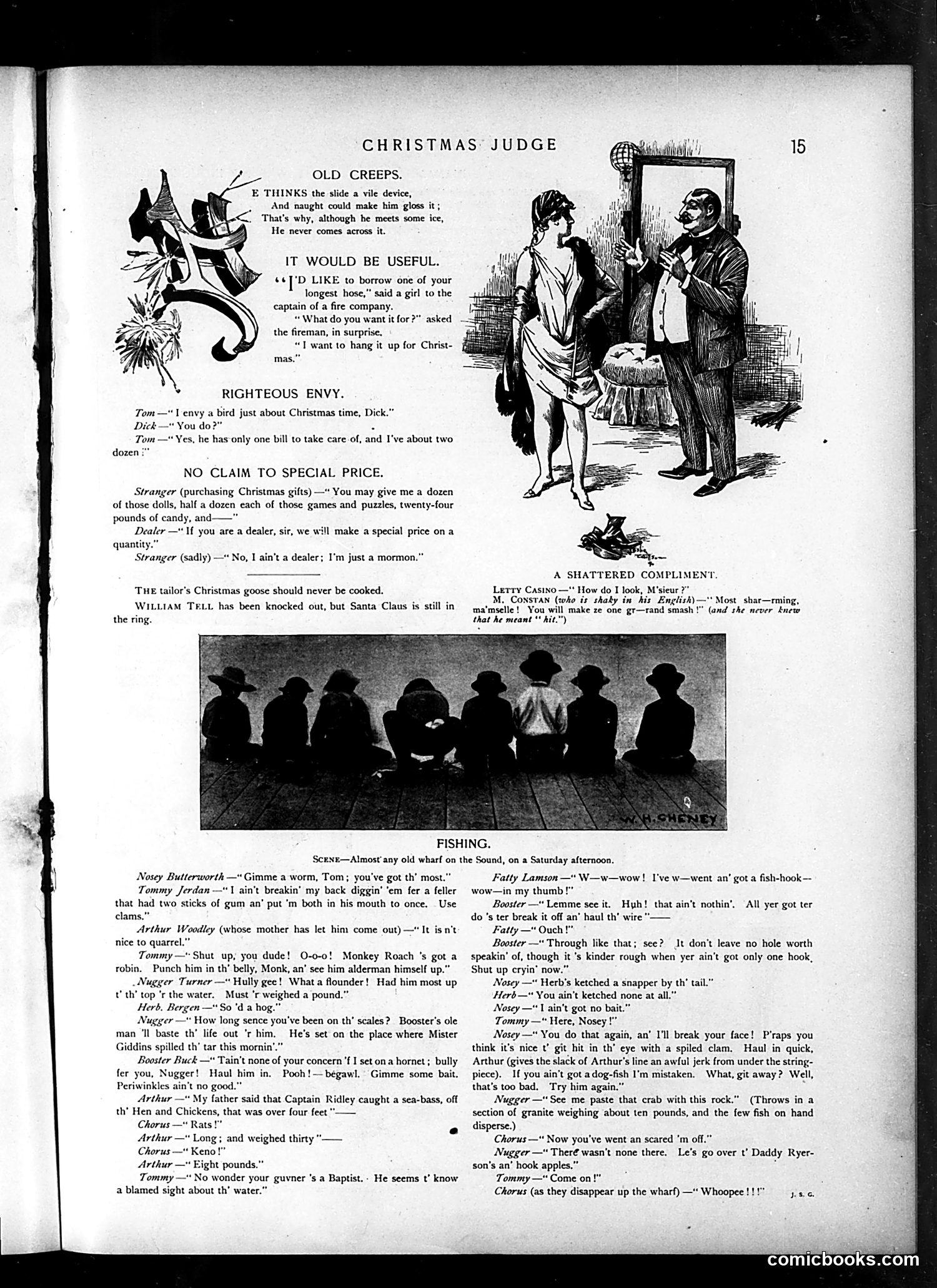
This page contains several brief humorous sketches typical of Judge magazine's satirical style, centered on Christmas themes and a longer comedic dialogue about boys fishing. The **Christmas jokes** mock contemporary social issues: one mocks Mormonism (the "stranger" buying excessive quantities of gifts); another jokes about bill collectors at Christmas; a third puns on Santa Claus remaining popular while William Tell (likely referencing a currently-popular theatrical production) has "been knocked out." The **"Fishing" section**—the page's centerpiece—is a naturalistic sketch of working-class boys fishing from a wharf. The dialogue captures their dialect and behavior: they quarrel over bait, boast about catches, play rough pranks on each other, and generally misbehave under minimal adult supervision. The humor derives from their crude language, petty conflicts, and the implicit social commentary that these unsupervised children represent a particular class. The illustration below shows silhouettes of these boys lined up at the wharf, reinforcing the documentary-style observation of urban youth culture.
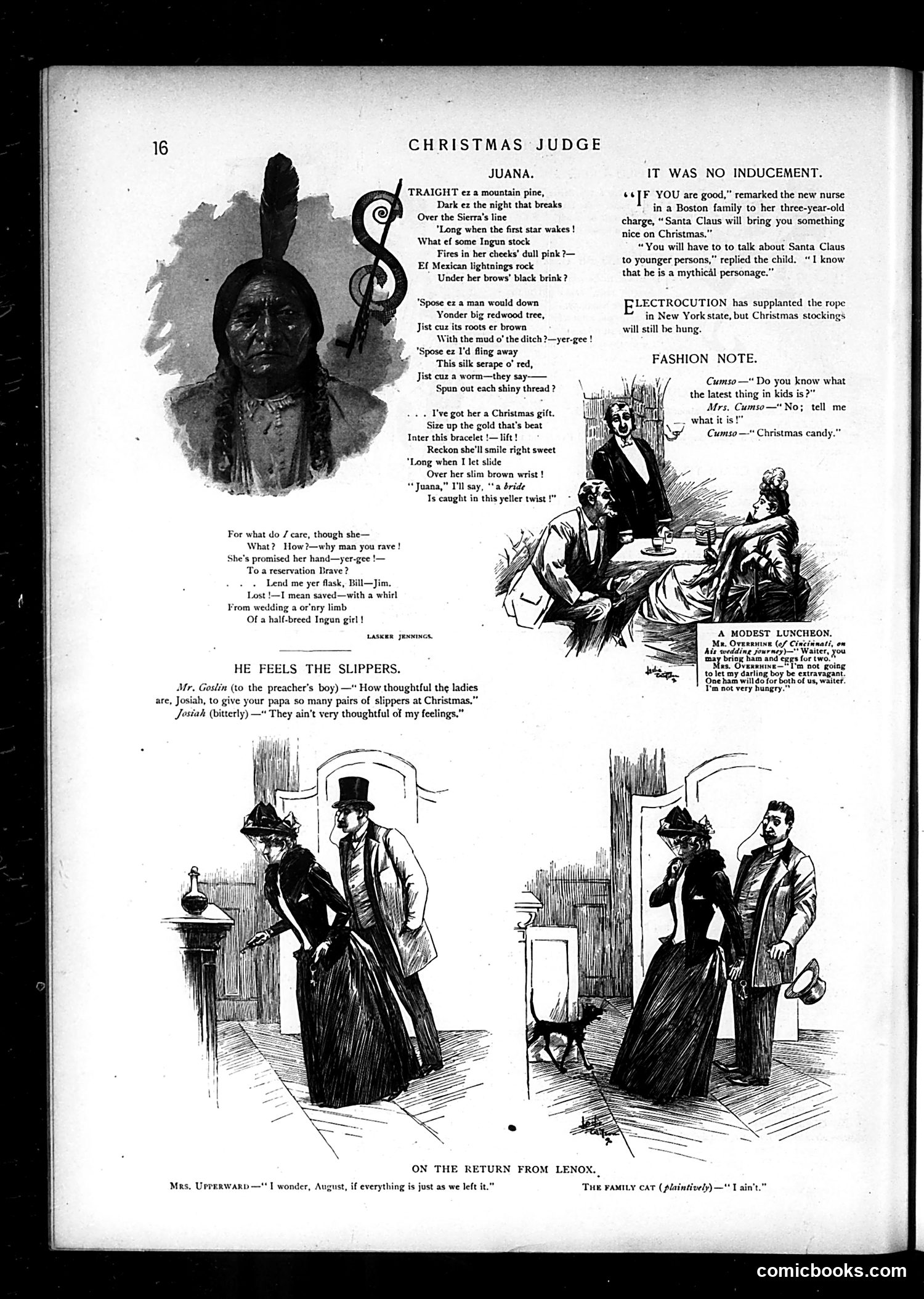
This Christmas-themed page from Judge magazine contains period social satire typical of late 19th/early 20th-century American humor. **Main Content:** The poem "Juana" depicts a romantic narrative about a man giving a bracelet to a Native American woman ("reservation Brave"), expressing frustration that she's marrying a "half-breed Ingun girl" rather than him. This reflects the era's casual racism and romanticization of Native Americans. **Smaller Cartoons:** - "He Feels the Slippers" jokes about a preacher receiving multiple slipper gifts—the boy resents the implication his father needs them (suggesting age/infirmity). - "Fashion Note" quips that "Christmas candy" is the latest trend among children. - "On the Return from Lenox" shows wealthy urbanites returning from summer vacation; the family cat plaintively notes it hasn't fared well in their absence. **Overall Tone:** The page mixes domestic humor with casual ethnic stereotyping typical of the era's satirical publications. References to electrocution and Lenox (a wealthy Massachusetts retreat) indicate an affluent audience.
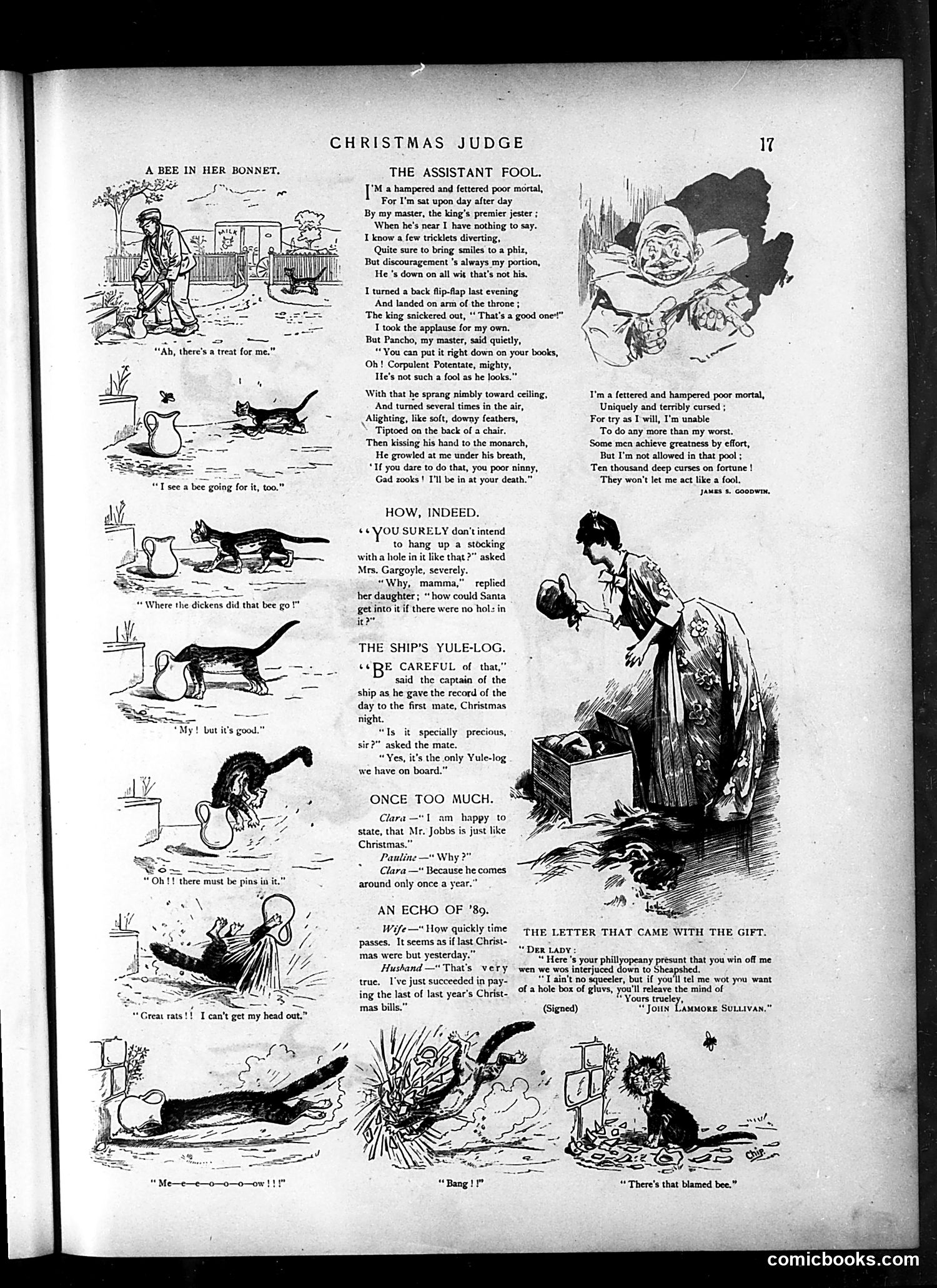
This Christmas-themed page contains several short humorous pieces satirizing everyday life and social pretensions. **"A Bee in Her Bonnet"** depicts a woman comically distressed by a bee, using the familiar phrase as literal comedy. **"The Assistant Fool"** presents a court jester complaining that his master monopolizes humor and credit for jokes—a satire on workplace dynamics and creative theft that transcends its royal setting. **"How, Indeed"** plays on a child's innocent logic about stockings needing holes for Santa to enter—simple family humor. **"The Ship's Yule-Log"** and other brief pieces offer gentle seasonal wordplay and domestic comedy. **"The Letter That Came with the Gift"** (from "John Lammore Sullivan") appears to mock sentimental gift-giving pretense through crude dialect. Overall, the page mixes light domestic satire with social commentary on hierarchy and credit-taking, using Christmas as the framing device. The humor relies on puns, irony, and relatable situations rather than explicit political critique.
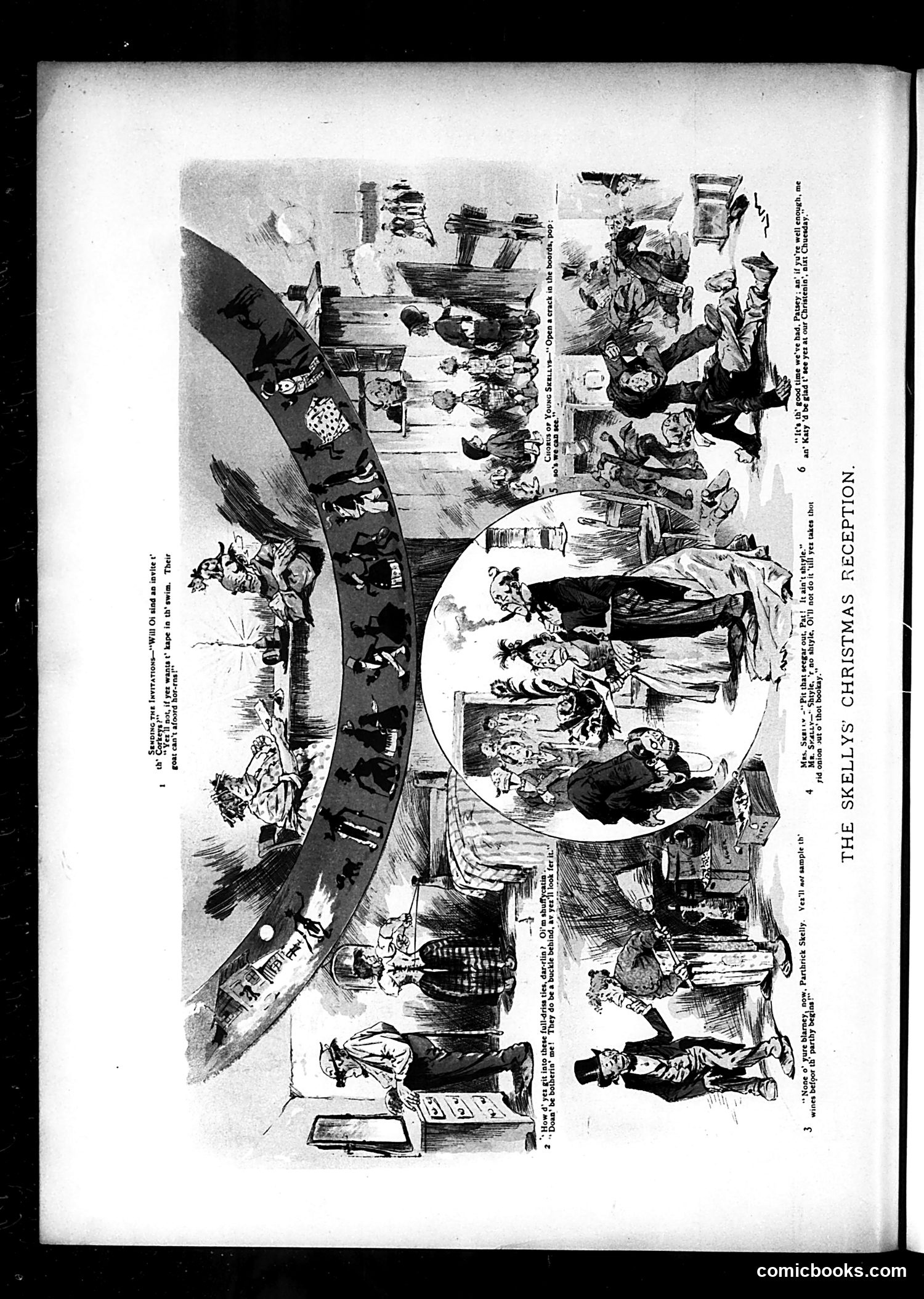
I cannot reliably read the OCR text on this page—it appears corrupted or inverted. While the image shows what appears to be a satirical engraving titled "The Skellys Christmas Reception," depicting a crowded indoor scene with multiple figures in Victorian-era dress, without legible text identifying the specific political figures, events, or satirical targets, I cannot accurately explain the cartoon's meaning to a modern reader. To properly interpret this Judge magazine page, I would need either clearer text or additional historical context about the "Skellys" referenced and the time period of publication. I apologize that I cannot provide the specific explanation you've requested.
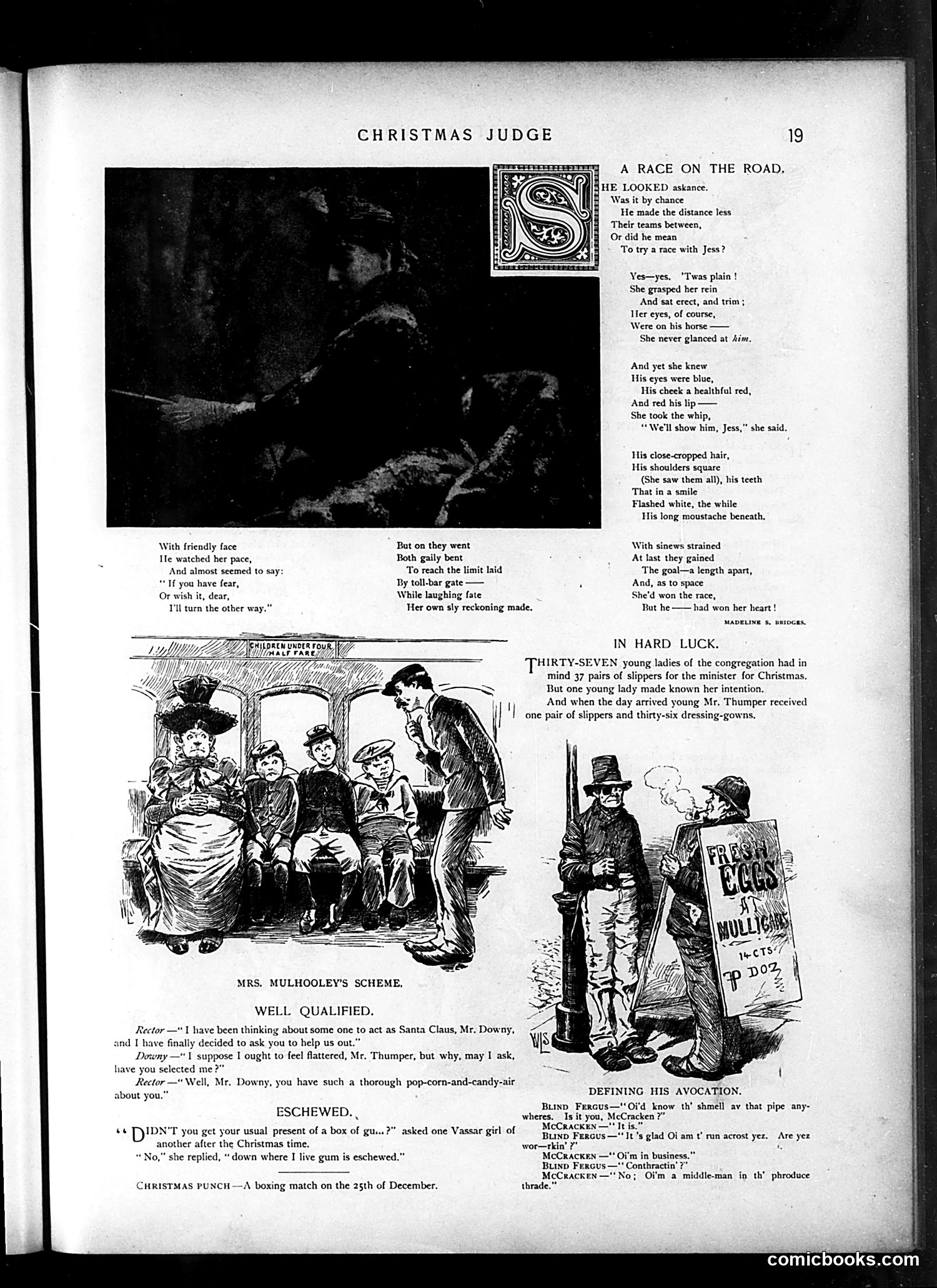
This page contains several brief satirical pieces typical of Judge magazine's humor: **"A Race on the Road"**: A romantic poem with accompanying illustration about a woman and man racing their horses. She's focused on winning but actually captures his heart—satirizing the contradiction between women's stated competitive ambitions and their romantic interests. **"Well Qualified"**: A clergyman asks a wealthy man ("Mr. Downy") to play Santa Claus, praising his "thorough pop-corn-and-candy-air"—mocking how superficial materialism was associated with Christmas celebration and wealth. **"Eschewed"**: A Vassar girl explains she doesn't receive gum as a gift because "where I live gum is eschewed"—likely satirizing both upper-class affectation and the pretentiousness of college women. **"Defining His Avocation"**: Two working-class Irish characters (indicated by dialect) discuss business; one claims to be a "middle-man in th' produce trade"—appearing to mock vague or dubious employment claims. The page reflects Judge's typical blend of social satire targeting class differences, gender roles, and consumer culture.
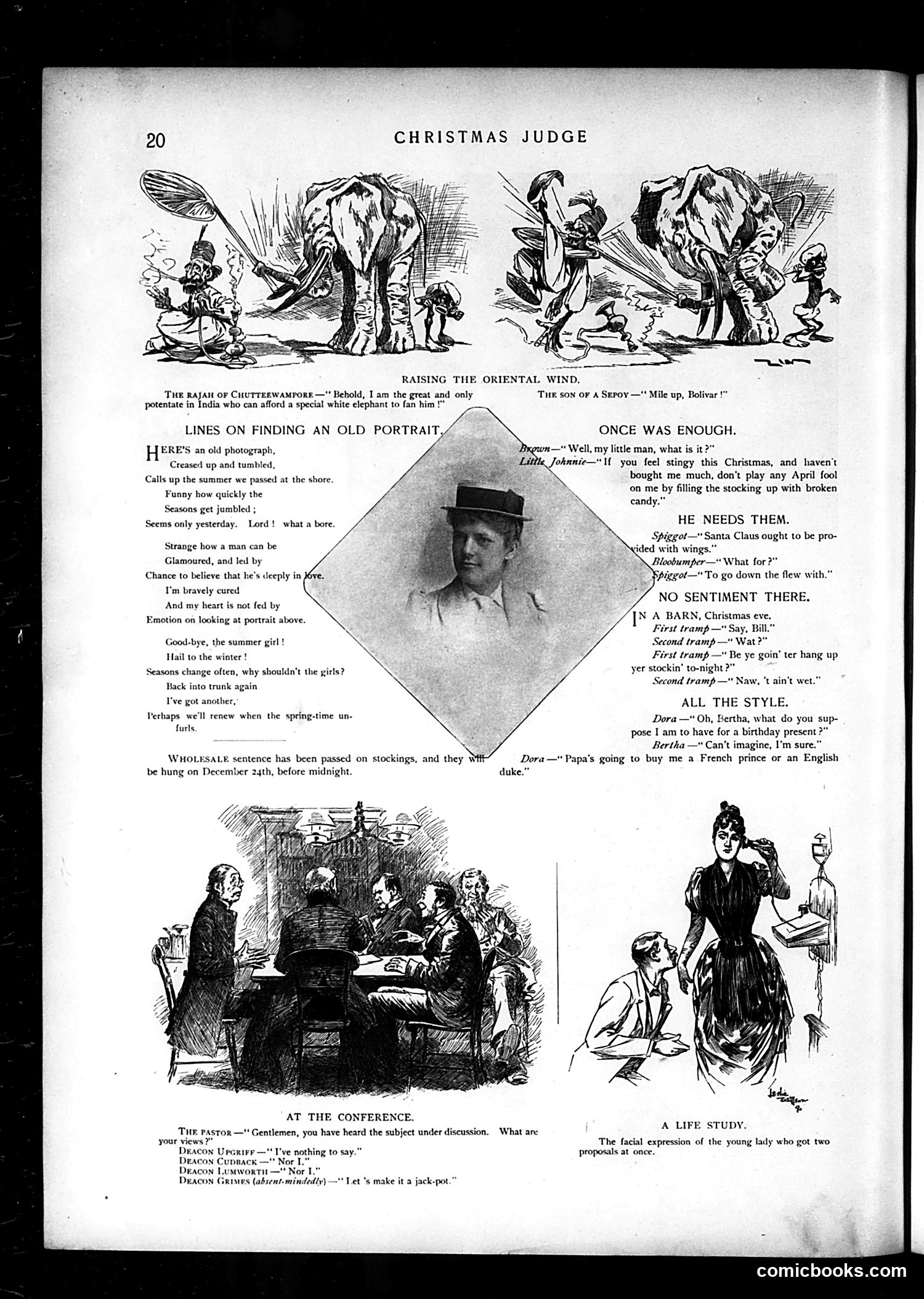
This page contains satirical humor typical of late 19th-century American magazines: **"Raising the Oriental Wind"** mocks British colonial India, depicting an Indian ruler ("Rajah of Chitterawampore") with exaggerated stereotypes—the elephant-fan and absurd name suggest condescension toward colonial subjects. **"Lines on Finding an Old Portrait"** is nostalgic verse about discovering an old photograph, reflecting on lost youth and romantic summers—a sentimental piece common to the era. The remaining items are brief comic skits: children's Christmas greed ("stocking up with broken candy"), practical jokes, impoverished tramps without sentimental attachments to Christmas, and social humor about young women receiving marriage proposals. "All the Style" mocks wealthy girls' expectations of extravagant gifts (French princes or English dukes). The drawings illustrate these domestic and social scenarios with period-typical pen-and-ink style. The humor relies on class commentary, romantic nostalgia, and gentle mockery of Christmas customs and social pretension.
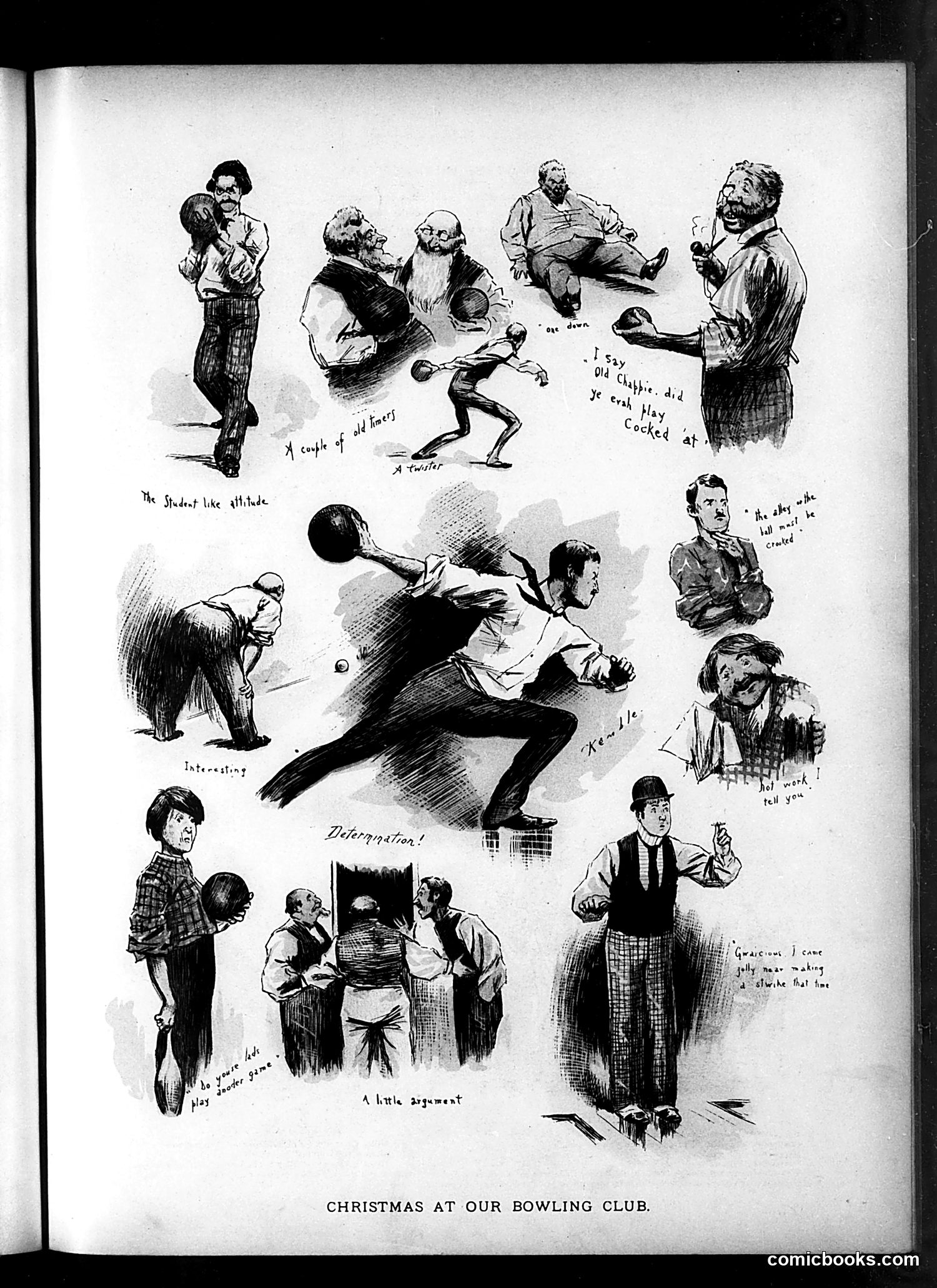
This page depicts various humorous scenes from a bowling club's Christmas celebration. The sketches show men engaged in bowling and socializing, with captions capturing comedic moments: "The Student like Attitude," "A couple of old fogeys," "Determination," and "A little argument." The humor appears to rest on class and character types—elderly men, younger men, various personalities colliding during recreational bowling. One prominent sketch labeled "Determination" shows an exaggerated figure straining dramatically while bowling, suggesting satirical commentary on competitive enthusiasm or masculine posturing during holiday leisure activities. The overall satire gently mocks how different social types and ages behave at such venues, presenting familiar character archetypes (the serious student, the determined competitor, the argumentative types) in this recreational context. It's lighthearted social observation rather than political commentary.
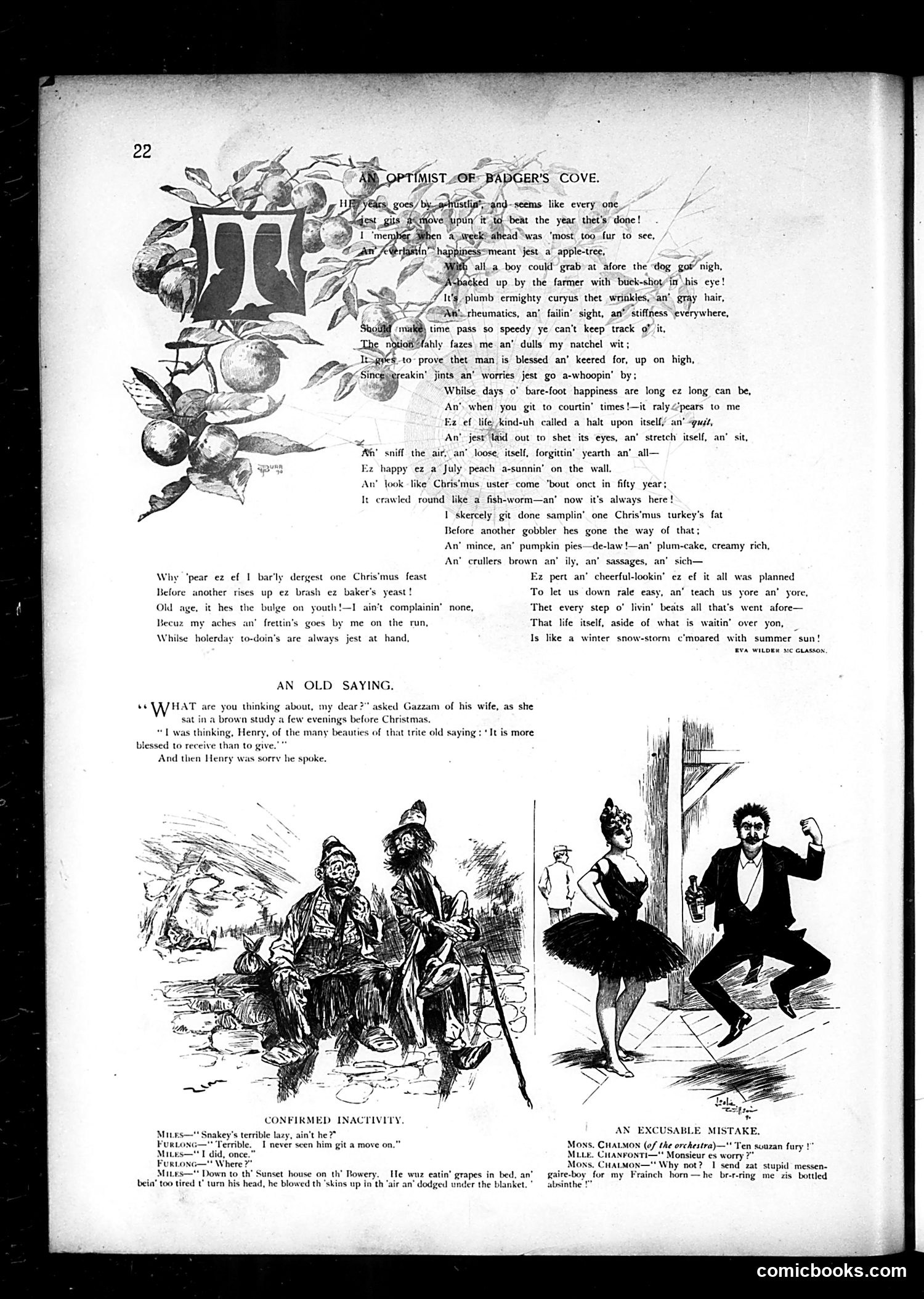
This page contains three distinct pieces. The upper section is a lengthy rural dialect poem about aging and life's passage, celebrating simple country pleasures (barefoot happiness, Christmas) while accepting mortality philosophically. Below, "An Old Saying" presents a domestic joke: a wife reflects on the blessing "it is more blessed to give than receive," prompting her husband's regret at having spoken—satirizing wives' materialistic expectations or their manipulation of such platitudes. The two cartoon sketches depict vaudeville or theatrical scenes: "Confirmed Inactivity" shows men lounging lazily, while "An Excusable Mistake" depicts a dancer and musician in apparent confusion, likely illustrating miscommunication or incompetence in entertainment venues. The satire targets leisiness, spousal dynamics, and theatrical incompetence—common Judge magazine subjects mocking working-class and entertainment-world figures.
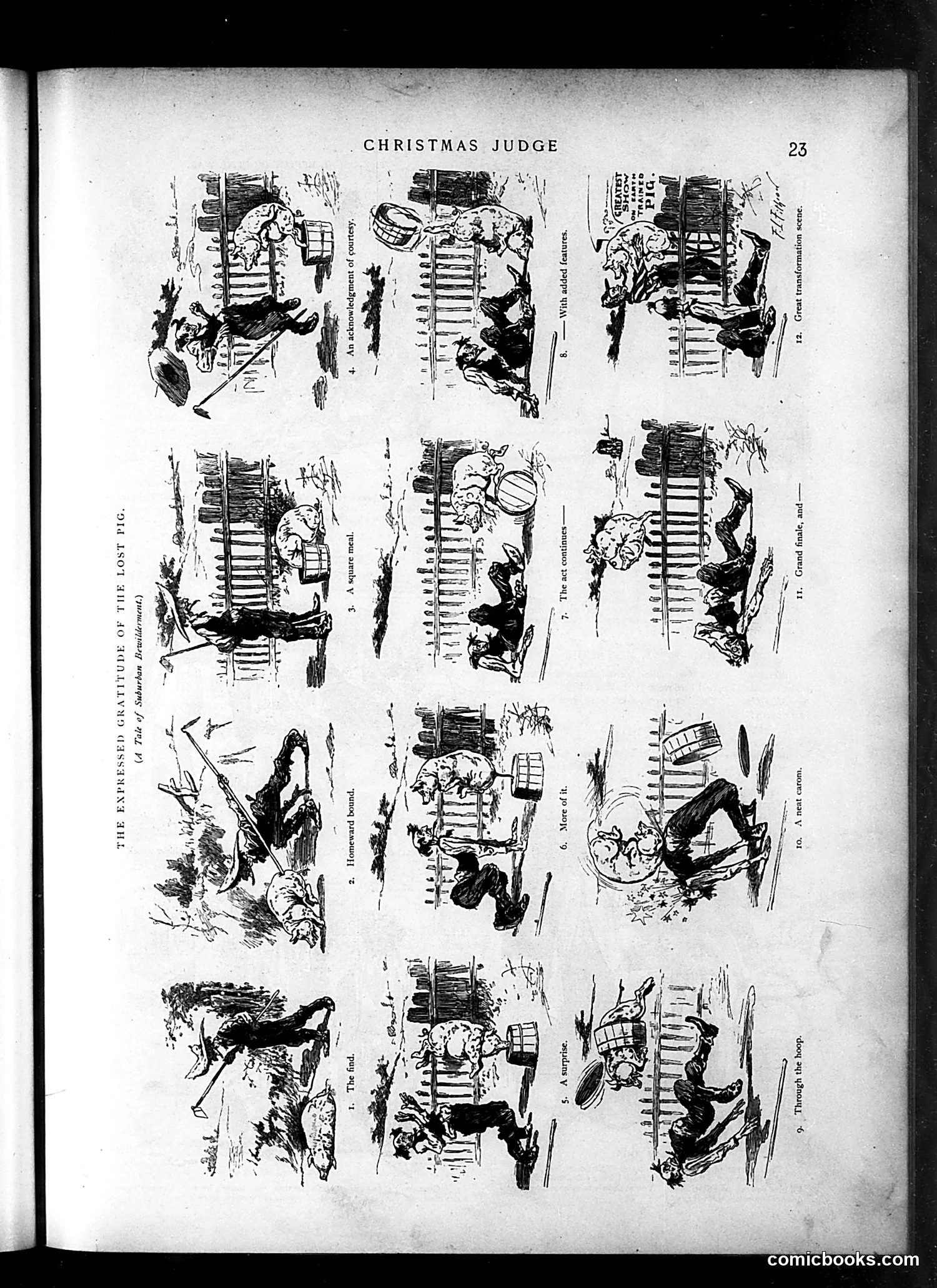
I cannot reliably read the OCR text on this page—it appears garbled or corrupted. While I can see this is a page from *Judge* magazine (page 23) containing multiple small cartoon panels arranged in a grid, the image quality and resolution make it difficult to identify specific figures, read captions clearly, or determine the precise satirical subjects and political references with confidence. To accurately explain what these cartoons mean to a modern reader, I would need either clearer source material or additional context about the publication date and issue. Without being able to read the captions reliably or identify the figures depicted, I cannot responsibly assert specific interpretations.
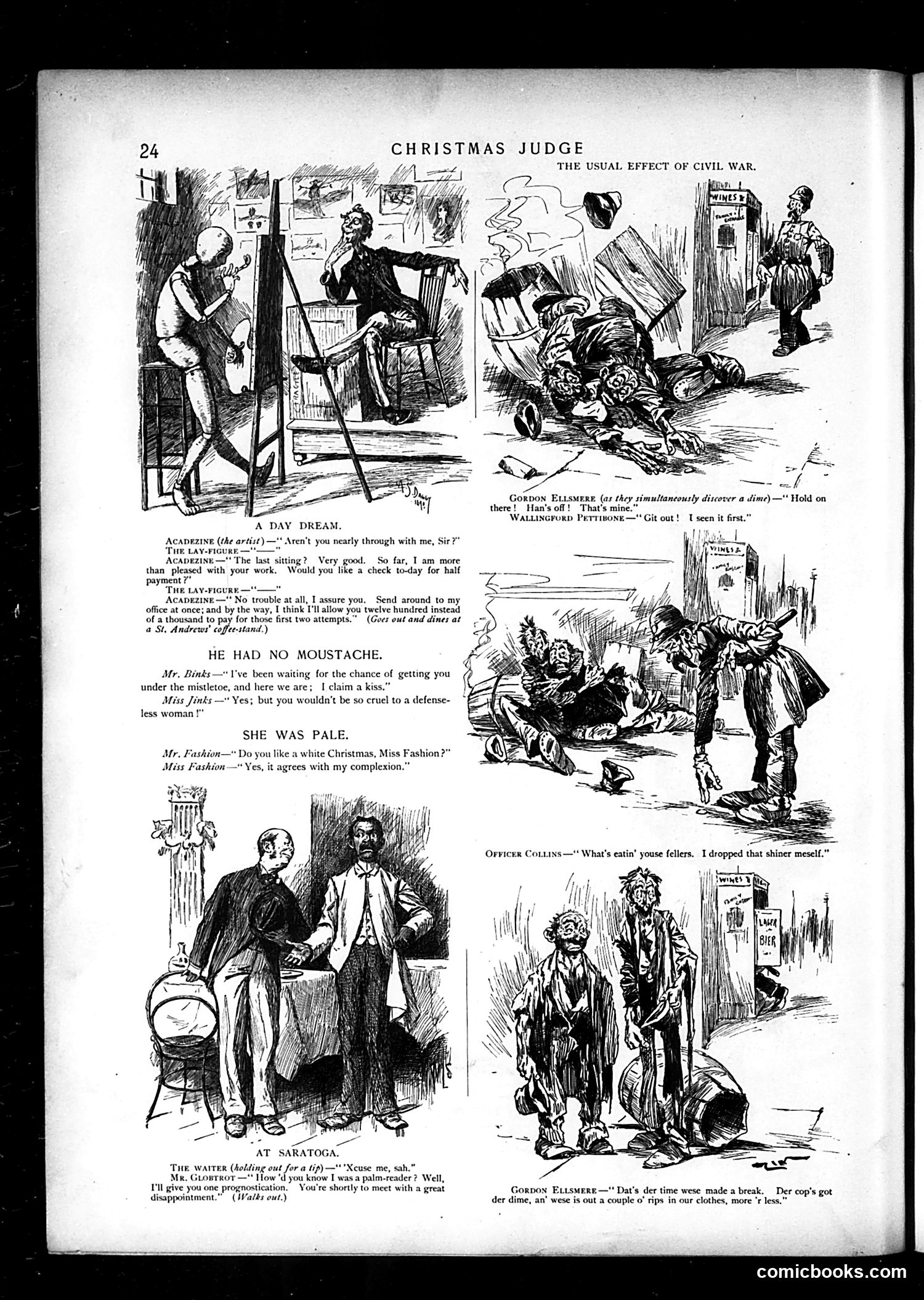
This page from *Judge* magazine satirizes American life through multiple vignettes. The title piece, "The Usual Effect of Civil War," depicts two street urchins (Gordon Ellsmere and Wallingford Pettibone, likely caricatured as Irish immigrants based on dialect) quarreling over a found dime. Their argument escalates until a police officer confiscates it—the joke being that internal conflict benefits only those in authority. This appears to reference post-Civil War tensions and class divisions. Other segments mock social pretension: a wealthy patron promising an artist lavish payment (unrealistic generosity), romantic mishaps around mistletoe, and a waiter's sardonic "prediction" that a customer will be disappointed—satirizing naïveté and false hopes. The overall theme critiques American society's tendency toward conflict, dishonesty, and the exploitation of the working poor and powerless by those with authority.
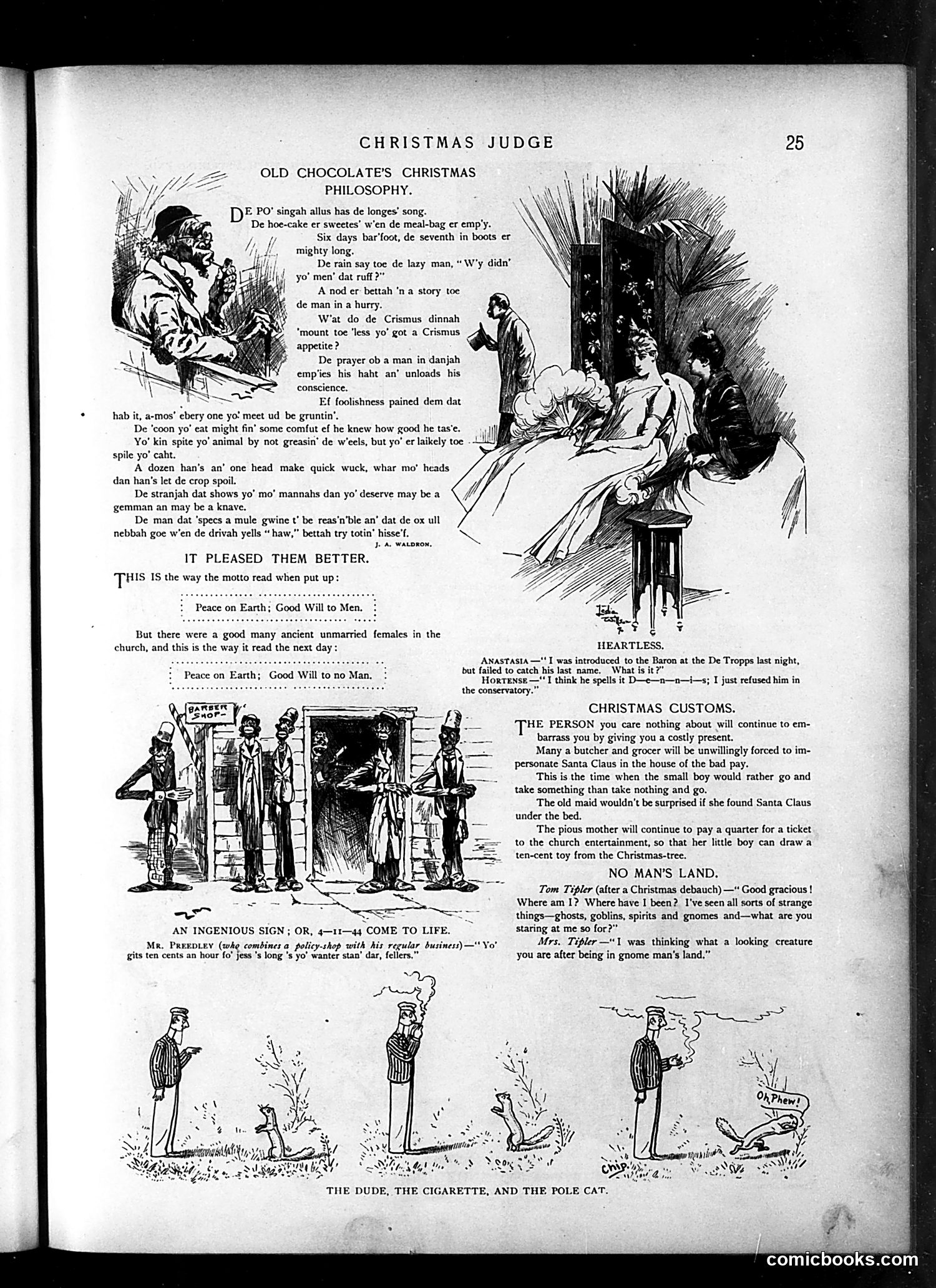
This Christmas-themed satirical page from Judge contains multiple social commentaries typical of late 19th-century American humor: **"Old Chocolate's Christmas Philosophy"**: A dialect piece presenting pseudo-philosophical observations attributed to a Black character, reflecting the era's racial caricature conventions. The humor relies on stereotypical speech patterns. **"It Pleased Them Better"**: Satirizes how unmarried women would alter the church's "Peace on Earth; Good Will to Men" motto to "Peace on Earth; Good Will to no Man"—mocking unmarried women's presumed bitterness toward men. **"Heartless"**: A brief joke about a woman refusing a man's proposal while gathering his personal information, emphasizing female coldness. **"Christmas Customs"**: Observational humor about holiday-season human behavior—bad debtors, greedy merchants posing as Santa, and church charity schemes. **"No Man's Land"**: Features a drunk man and references "gnomes," apparently a euphemistic reference to his altered mental state. **Bottom cartoon**: "The Dude, the Cigarette, and the Pole Cat"—likely visual comedy about social types, though details are unclear from the image.
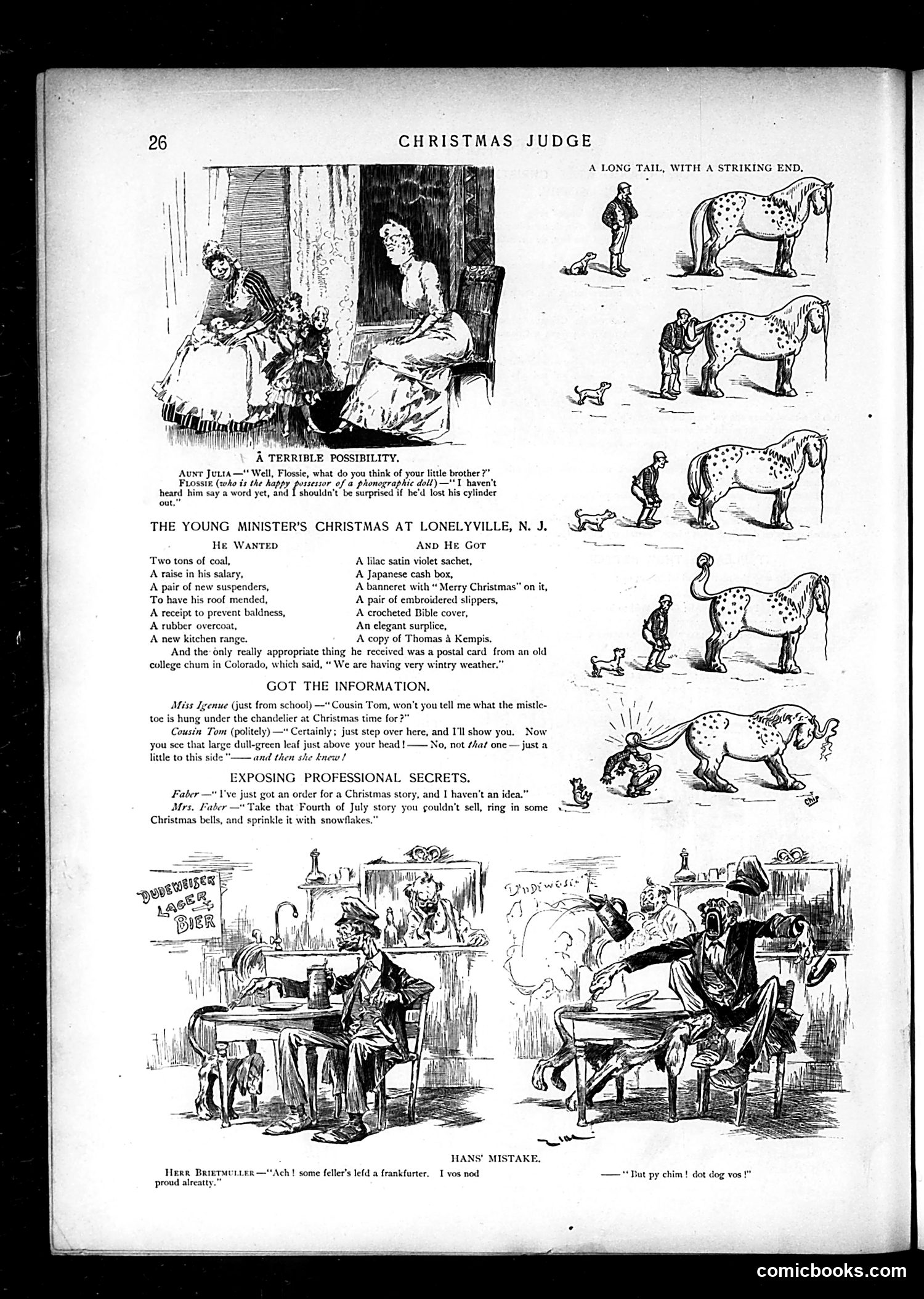
This Christmas-themed satirical page from *Judge* contains several disconnected humor pieces mocking Victorian-era social conventions and commercialism: **"A Terrible Possibility"** jokes about a child with a phonographic (mechanical recording) doll losing its cylinder—implying the doll's monotonous repetition mirrors real children. **"Young Minister's Christmas"** contrasts what a rural clergyman *needed* (coal, salary raise, roof repair) versus what he *received* (frivolous gifts like sachets and Bible covers)—satirizing impractical gift-giving and society's neglect of clergy needs. **"Got the Information"** depicts a young woman and her cousin at mistletoe, implying a romantic/sexual encounter through euphemistic language ("show you"). **"Exposing Professional Secrets"** mocks hack writers recycling old stories with seasonal decorations rather than creating original work. **"Hans' Mistake"** features a German character finding a frankfurter; the dog eating it provokes his complaint—playing on ethnic stereotypes and the absurdity of caring more about lost food than a dog's actions.
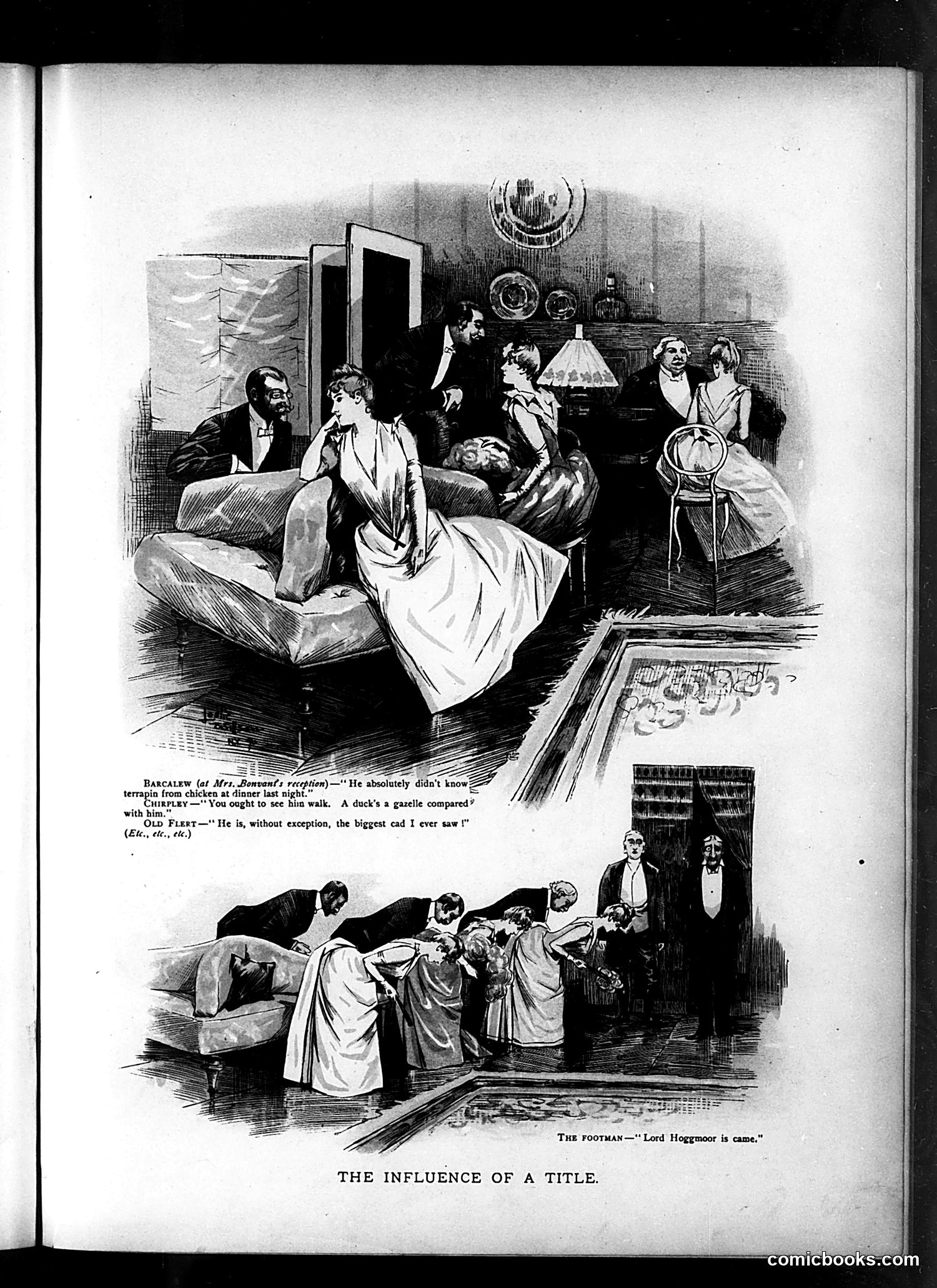
This two-panel satirical cartoon mocks social pretension and class snobbery. The upper panel shows a wealthy reception where guests gossip about a man named "Lord Hoggmoor." They ridicule his awkward gait and uncouth behavior—comparing his walk unfavorably to a duck's. The lower panel reveals the joke: the same man, now identified as simply "the footman," is treated with complete indifference by the same social circle. The servants and staff barely acknowledge him. The satire exposes how Victorian society judged people entirely on titles and social rank rather than character or merit. A titled "lord" warranted ridicule and attention; the identical person without a title was invisible. The cartoon critiques the superficiality and arbitrary nature of class consciousness among the wealthy elite.
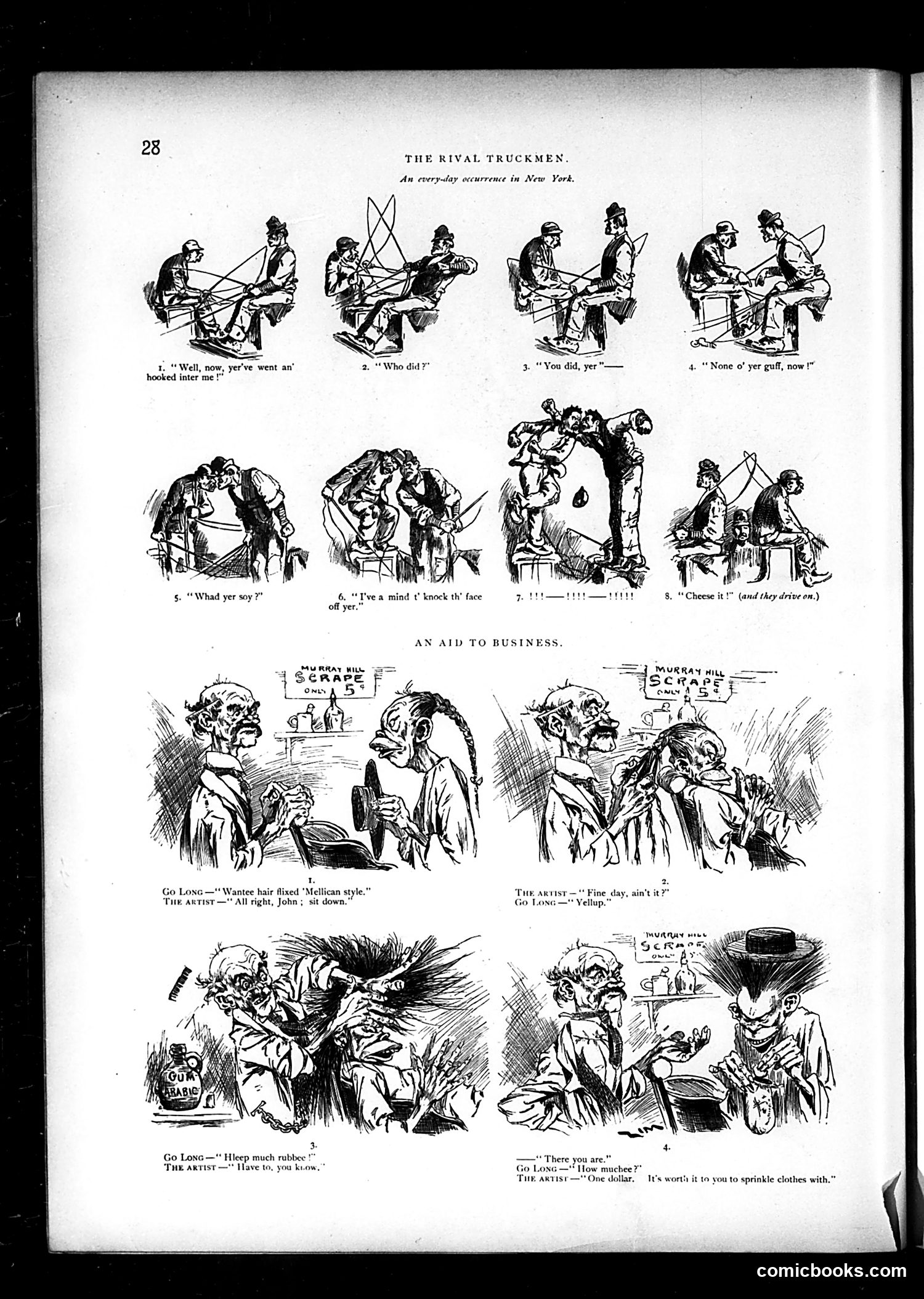
**"The Rival Truckmen"** depicts a stereotypical New York street fight between two truck drivers over a collision ("hooked inter me"). The eight panels show escalating verbal insults and physical violence—a common urban scene the magazine presents as everyday entertainment. **"An Aid to Business"** shows a Chinese immigrant ("Go Long") getting a haircut from an American barber ("The Artist"). The humor relies on heavy racial dialect stereotyping and xenophobic caricature. The immigrant's broken English and the barber's dismissive attitude reinforce period prejudices. The final panel's punchline about sprinkling clothes with water as a laundry aid mocks Chinese immigrant labor—laundries were a dominant occupational niche due to discrimination from other industries. Both strips exemplify how Judge used crude racial and ethnic caricatures and exaggerated dialects for humor, reflecting late 19th/early 20th-century American attitudes toward immigrants and working-class groups.
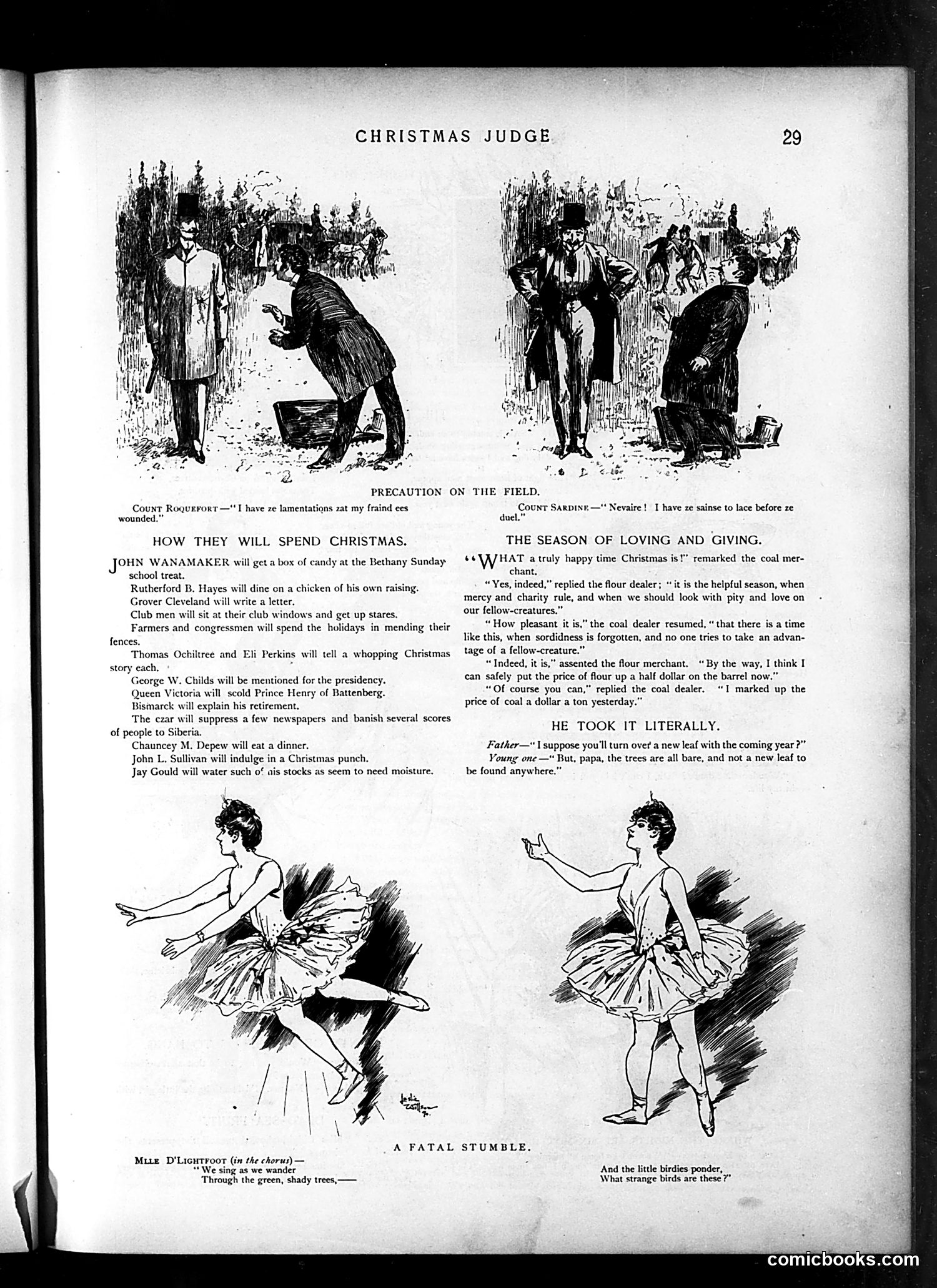
This page contains multiple satirical vignettes lampooning prominent 1880s figures and social hypocrisy. **Top cartoons** ("Precaution on the Field"): Two French military officers nervously prepare for a duel, each claiming superior sense—satirizing the absurdity of aristocratic honor codes. **"How They Will Spend Christmas"**: A list mocking famous Americans' predictable behavior—John Wanamaker (retail magnate), Hayes, Cleveland, and others—suggesting their Christmas activities reveal their true characters and obsessions. **"The Season of Loving and Giving"**: The central satire exposes capitalist hypocrisy. A coal merchant and flour dealer rhapsodize about Christmas charity and compassion, then immediately confess to price-gouging each other—raising coal prices a dollar per ton and flour prices accordingly. The joke: their stated values collapse the moment Christmas sentimentality ends. **Lower sketches**: A ballet dancer and a child's misunderstanding of "turning over a new leaf" (interpreting it literally rather than metaphorically). The page satirizes wealth inequality, commercial greed masked by seasonal piety, and social pretension.
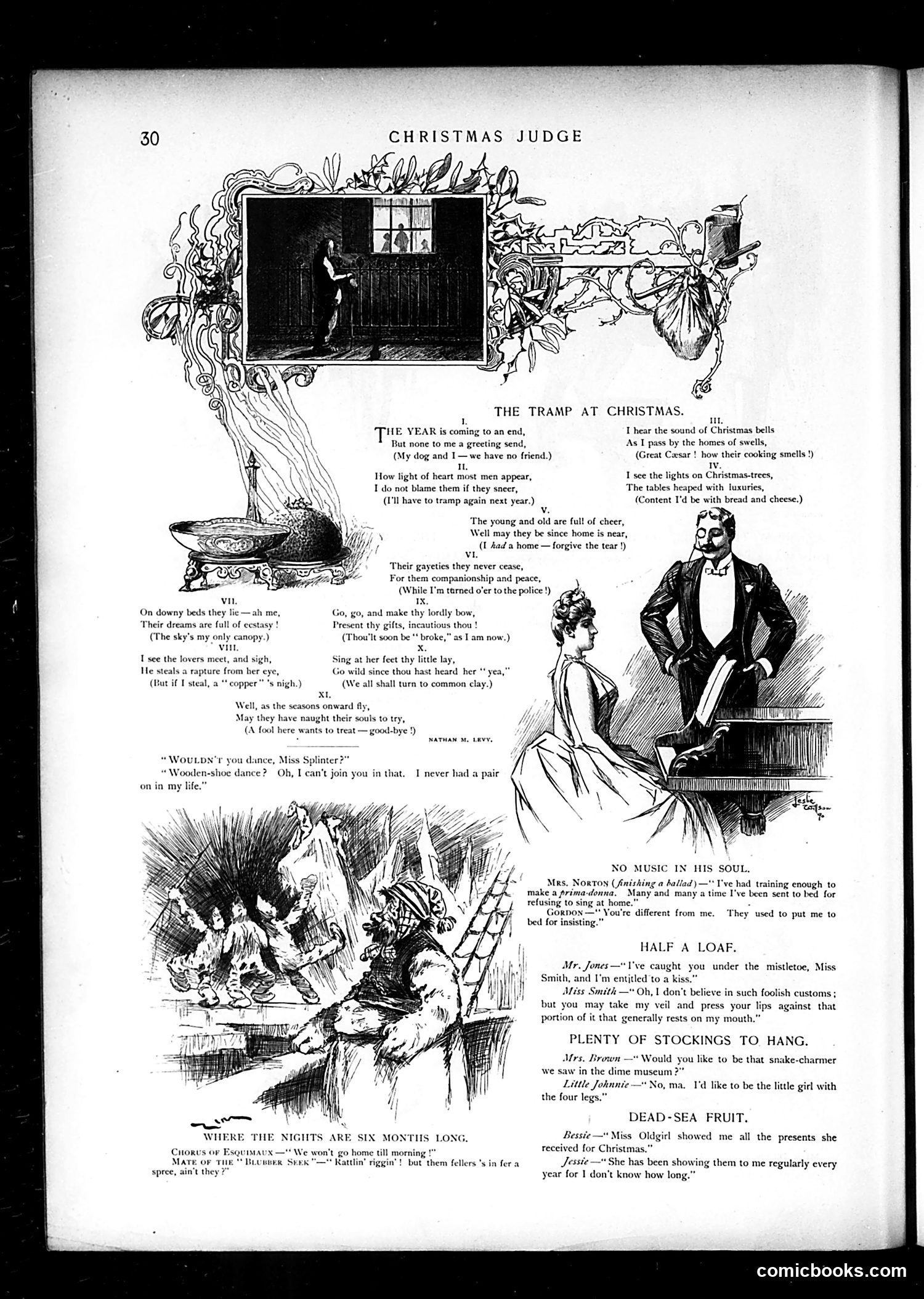
This page centers on a sentimental poem contrasting a homeless man's misery with wealthy families' holiday cheer. The tramp observes Christmas celebrations—bells, feasts, family gatherings, romance—from outside, emphasizing his isolation ("My dog and I—we have no friend"). The satire targets both class inequality and Victorian sentimentality about poverty. The accompanying comic vignettes mock various social pretenses: a woman rejecting mistletoe customs by offering only her veil to kiss; a child preferring to be a snake-charmer's assistant over a respectable profession; a woman repeatedly showing the same Christmas gifts to friends year after year (implying either poverty or vanity). The overall message critiques holiday hypocrisy—the wealthy celebrate abundance while the poor suffer—and deflates romantic/genteel social conventions through crude humor. Nathan M. Levy's illustrations emphasize the tramp's degradation and the gap between classes during Christmas.
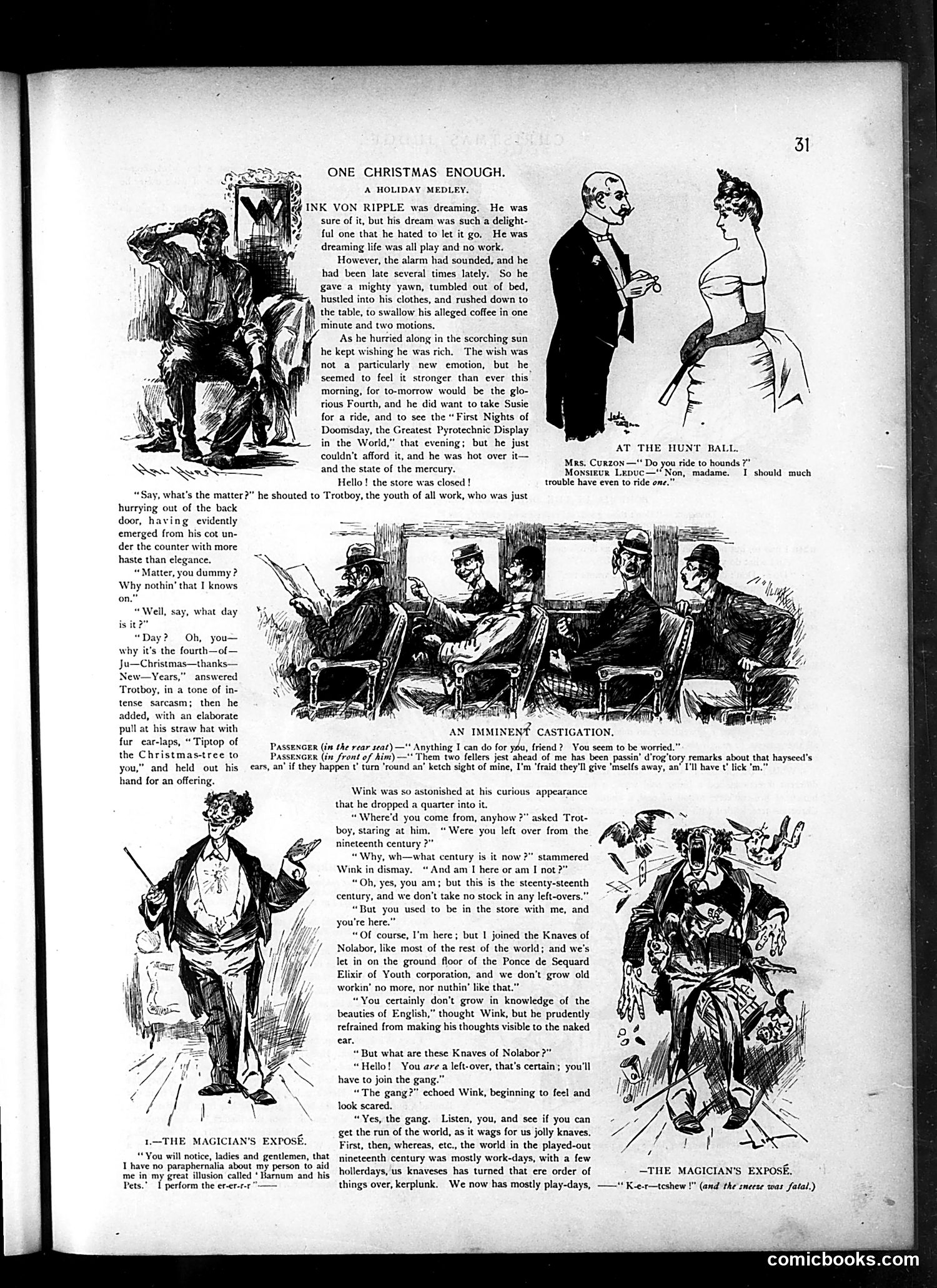
This page presents a holiday-themed satirical story about Mink von Ripple, a working-class man frustrated by poverty on Independence Day. The narrative mocks both his circumstances and contemporary labor movements. The main story follows von Ripple as he rushes to work, only to discover it's a holiday—compounded by his inability to afford entertainment. The plot takes a surreal turn when he encounters "Trotboy," who claims to have joined the "Knaves of Nolabor," a fictional organization representing a utopian future where work has been abolished and perpetual youth is available through the "Ponce de Sequard Elixir of Youth." The satire targets both workers' desires for leisure and late-19th-century anxieties about labor movements and utopian schemes. The accompanying illustrations and brief comedic vignettes (including one about horseback riding) provide typical Judge magazine humor: social commentary wrapped in working-class and aristocratic character sketches, satirizing economic inequality and cultural pretension.
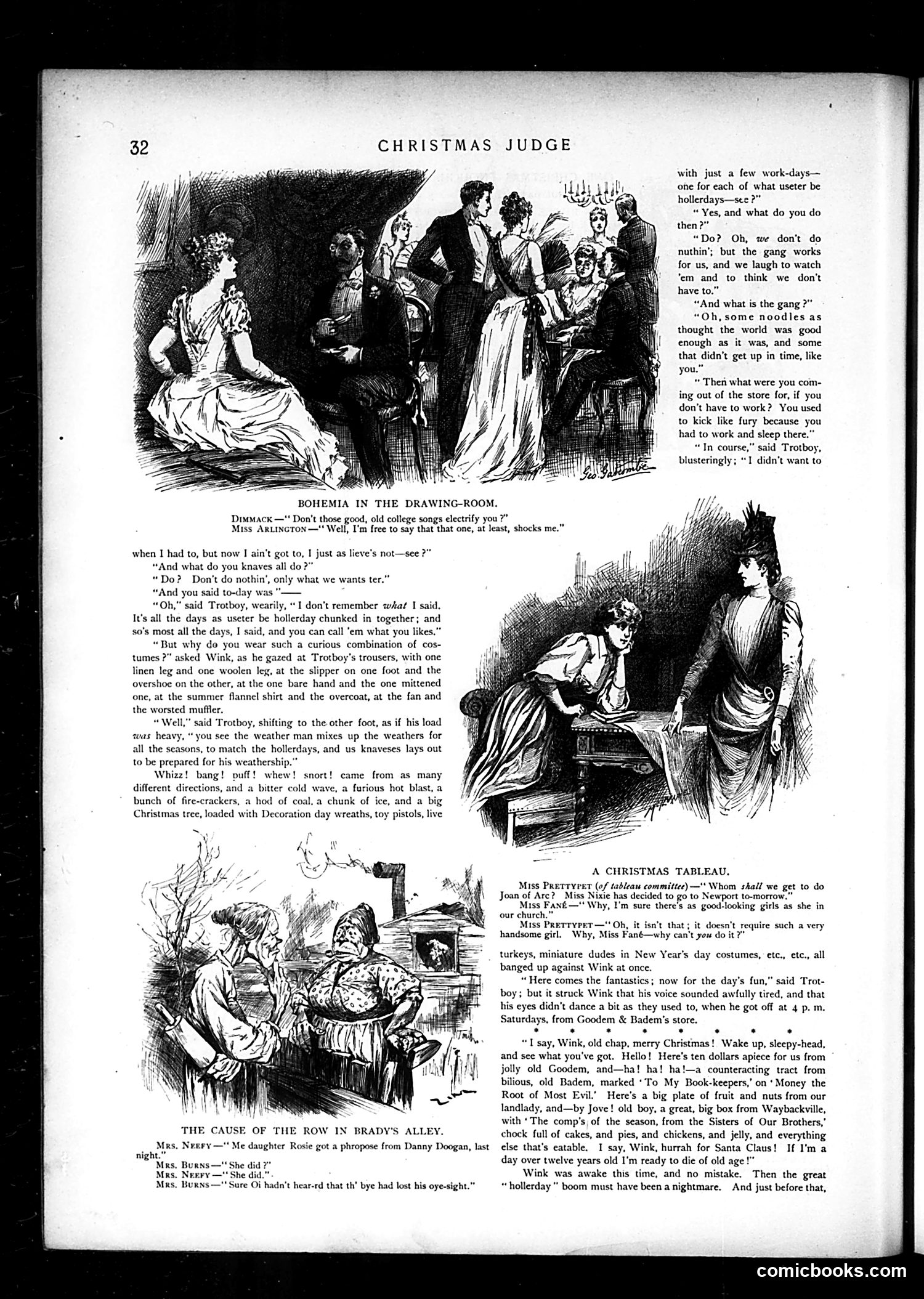
This Judge magazine page satirizes the commercialization and exhaustion of Christmas holidays. The main cartoon depicts "Trotboy," a working-class character who has abandoned his job but now dresses in a chaotic patchwork of seasonal clothing because the "weather man mixes up the weathers" to match confused, commercialized holidays. The satire critiques how the holiday season has become so cluttered and commodified that it's lost meaning—all holidays blur together into one exhausting "hollerday." Trotboy's ragged appearance and weariness reflect working people's fatigue from constant commercial pressure. Secondary sketches mock upper-class affectation ("Bohemia in the Drawing-Room") and shallow tableaux preparations. The final scene offers ironic relief: a worker receives genuine gifts and kindness, suggesting authentic human connection—not commercialism—makes holidays meaningful. The overall message: modern holiday excess has corrupted what should be restful celebration into an exhausting commercial blur.
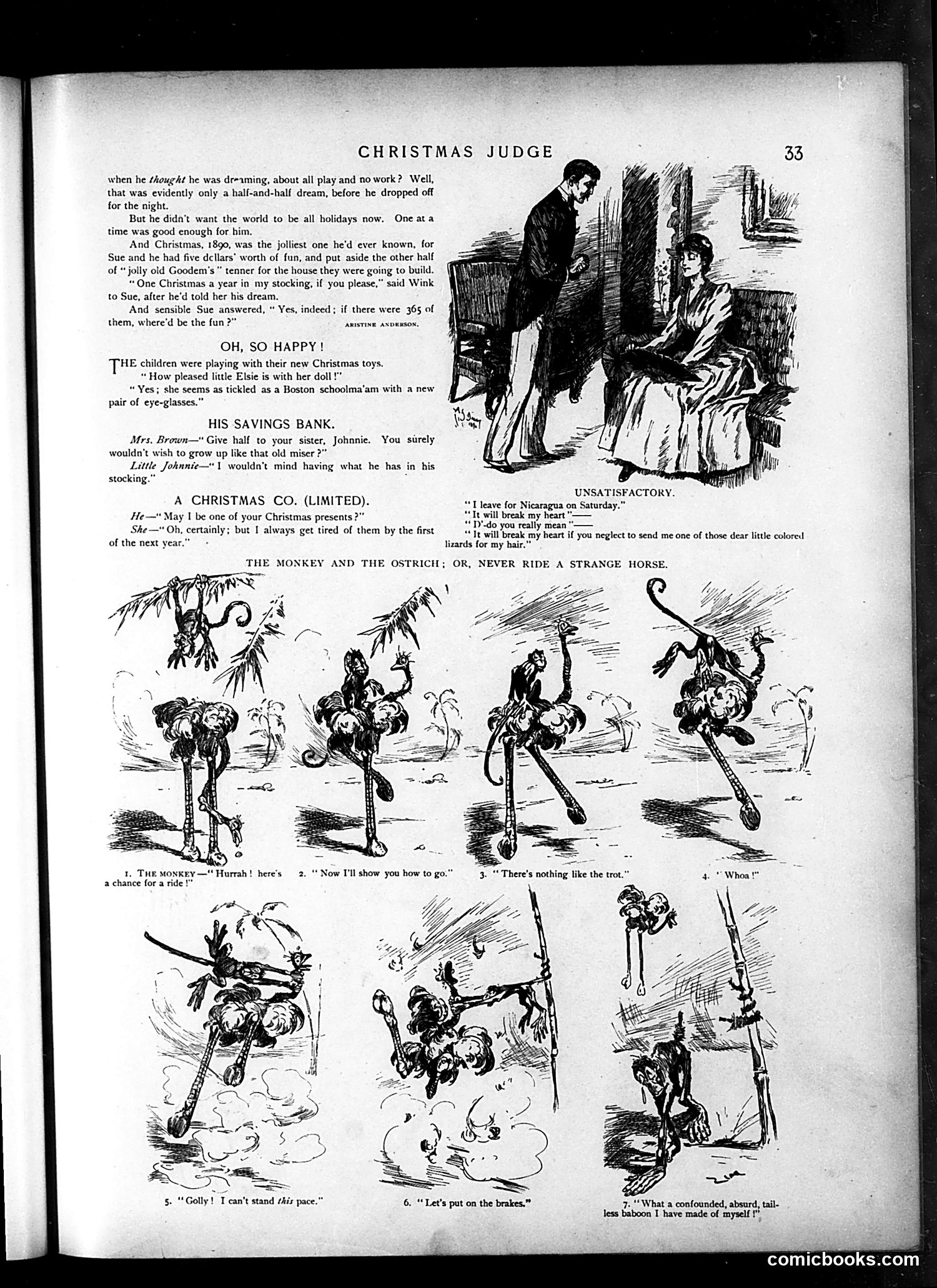
This sequential comic strip depicts a monkey attempting to ride an ostrich, with predictably disastrous results. The narrative arc shows the monkey's initial enthusiasm ("Hurrah! here's a chance for a ride"), the ostrich's confident demonstration, the monkey's inability to control the unfamiliar mount (progressing through loss of balance and desperation), and finally his humiliating conclusion. The moral appears to be a warning against riding "strange horses"—literally, but serving as metaphor for trusting unfamiliar or untested situations. The monkey's final self-recrimination ("What a confounded, absurd, tail-less baboon I have made of myself!") emphasizes the foolishness of his venture. This is classic Victorian-era humor: slapstick animal antics with an implicit lesson about caution and good judgment—appropriate for *Judge* magazine's mixed audience.
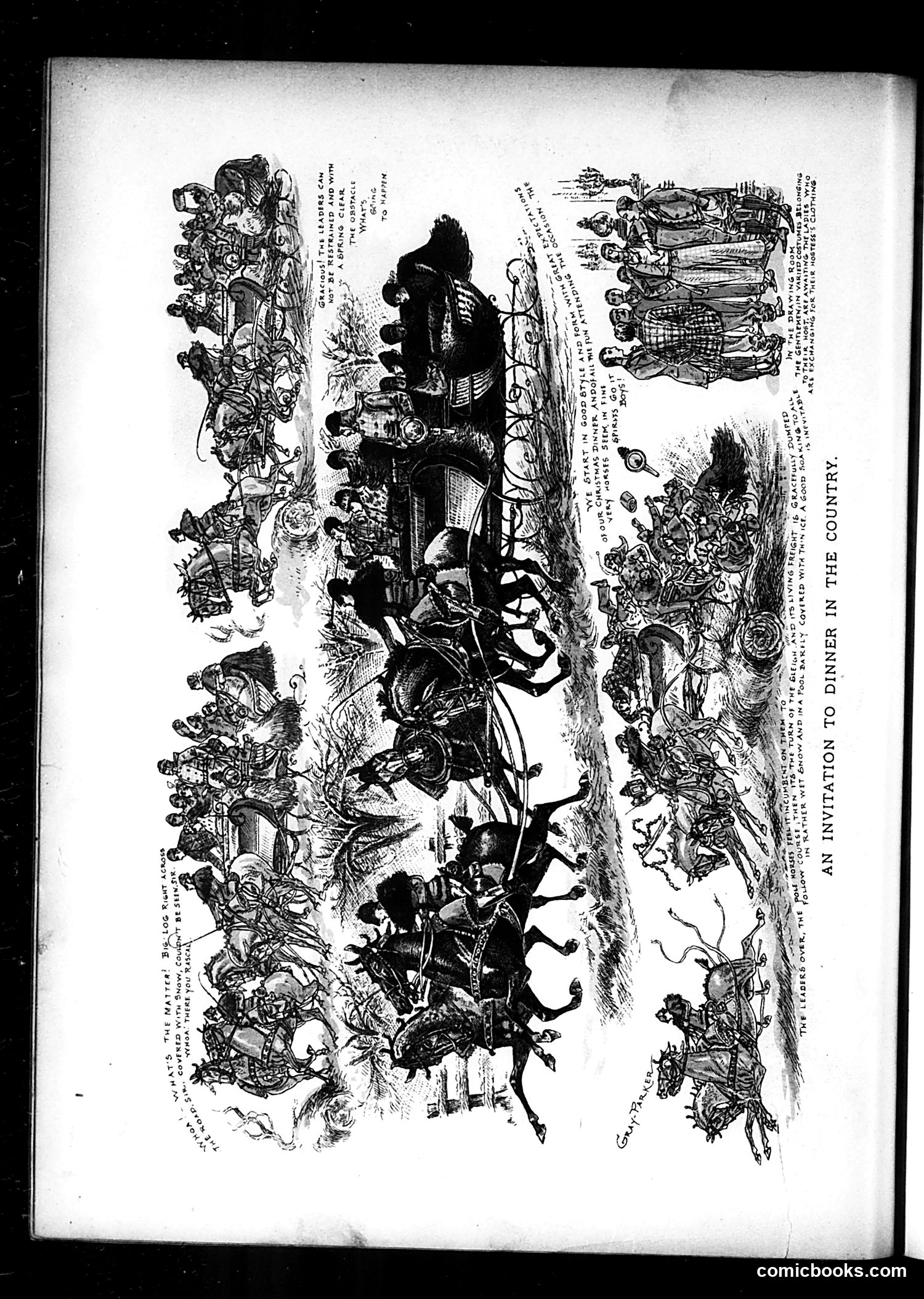
I cannot reliably interpret this page. While the title "AN INVITATION TO DINNER IN THE COUNTRY" is visible, the OCR text is severely corrupted and mostly illegible—appearing almost entirely reversed or garbled. The illustration itself, though detailed, is oriented sideways on the page and too small for me to confidently identify specific political figures or caricatures or understand the satirical point being made. To accurately explain this Judge magazine content to a modern reader, I would need either a clearer image or legible source text. I can only say it appears to be a satirical scene involving multiple figures in what might be a rural or countryside setting.
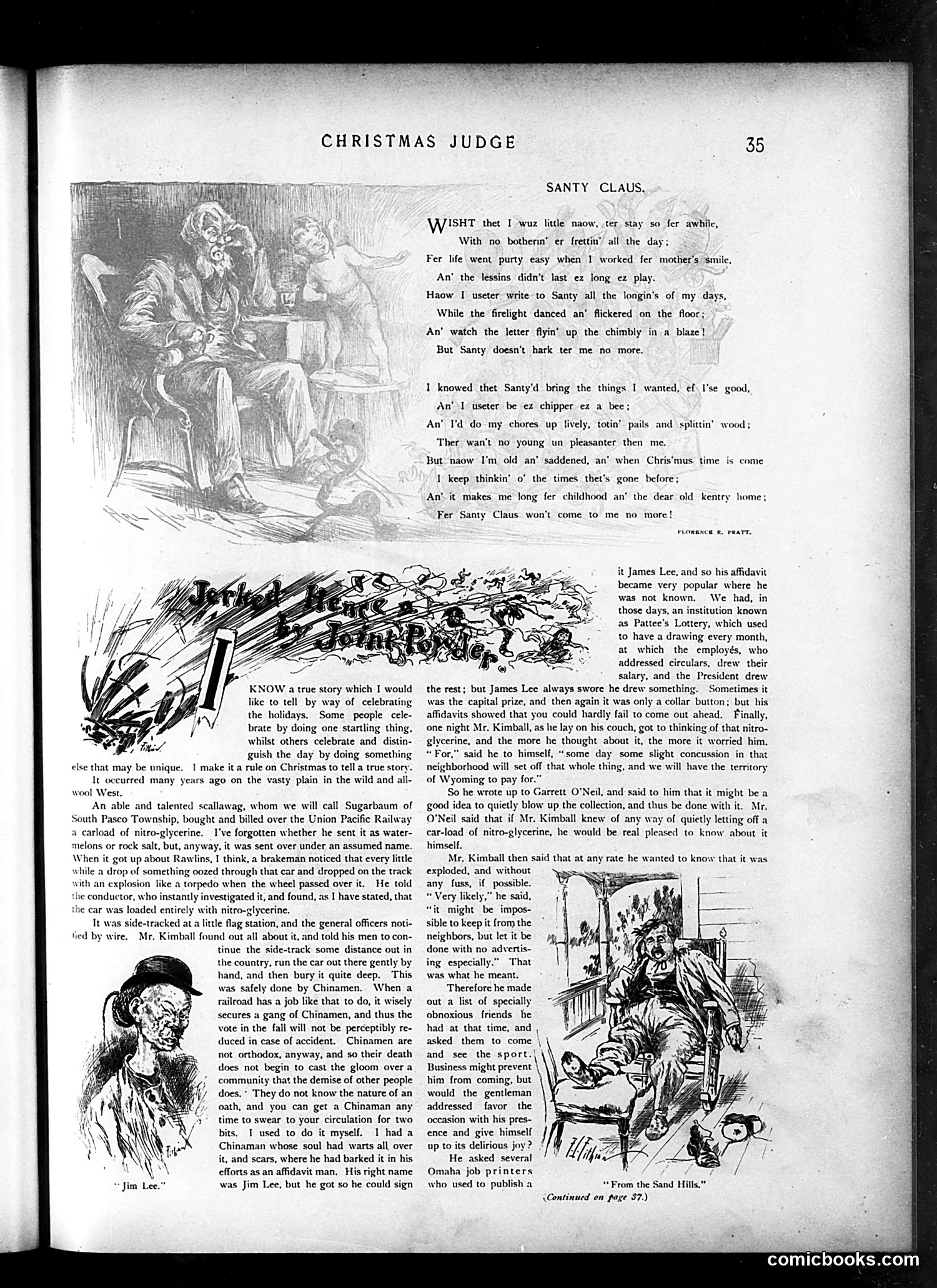
This page from Judge magazine contains two distinct pieces: **"Santy Claus" (poem by Florence R. Pratt):** A sentimental dialect poem about aging and lost innocence. An elderly narrator laments that Santa no longer comes to him—a metaphor for lost childhood wonder and rural simplicity. The nostalgic tone contrasts sharply with Judge's typical satirical edge. **"A True Story" (main narrative):** A cynical tale exposing railroad corruption and casual racism. A scoundrel named Sugarbaum ships dangerous nitro-glycerine under false pretenses via Union Pacific. When discovered, railroad officials bury it secretly using Chinese laborers—deliberately, because their deaths wouldn't reduce the voting population or disturb the community like white casualties would. The narrative includes a subplot about "Jim Lee," a corrupt Chinese affidavit man. The piece satirizes corporate malfeasance, indifference to worker safety, and the dehumanization of Chinese immigrants in the American West. The cynical commentary on using expendable labor reflects period attitudes—presented without moral condemnation, suggesting Judge's audience found such callousness darkly humorous.
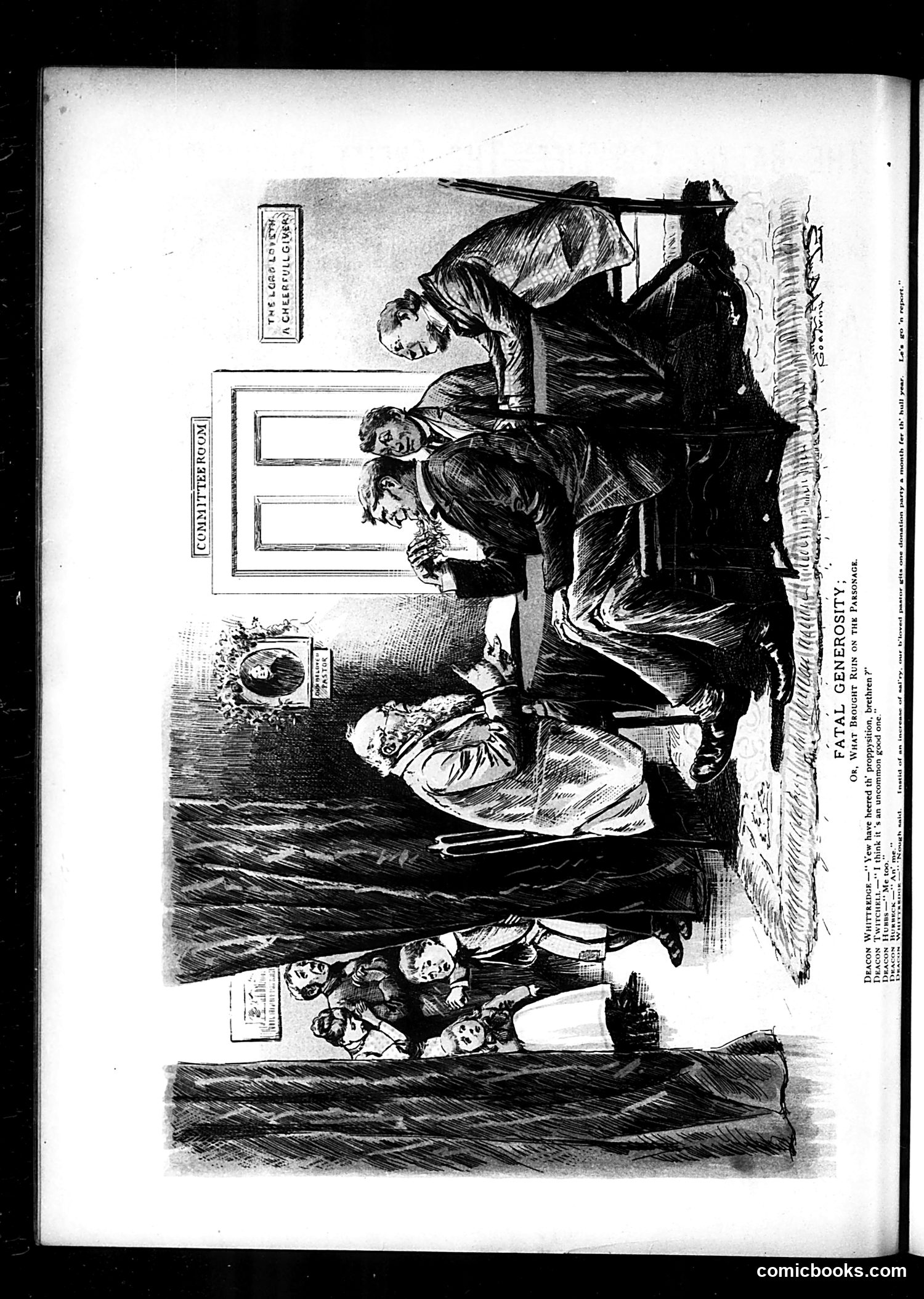
This appears to be a satirical cartoon titled "Fatal Generosity" from *Judge* magazine. The image depicts a scene of social charity or relief work, with well-dressed figures (likely representing wealthy philanthropists or government officials) distributing aid or assistance to poor people below them. The cartoon likely critiques the inadequacy or condescending nature of charity given by the wealthy or powerful to the impoverished. The "fatal" generosity suggests that such charitable efforts, while well-intentioned, are ultimately insufficient or even harmful—possibly masking systemic inequalities rather than addressing root causes of poverty. The hierarchical composition—with donors elevated above recipients—emphasizes the power imbalance and suggests mockery of paternalistic attitudes toward the poor. Without clearer OCR text or a visible date, the specific historical context remains unclear, but this reflects common *Judge* themes about class inequality and the limitations of private charity.
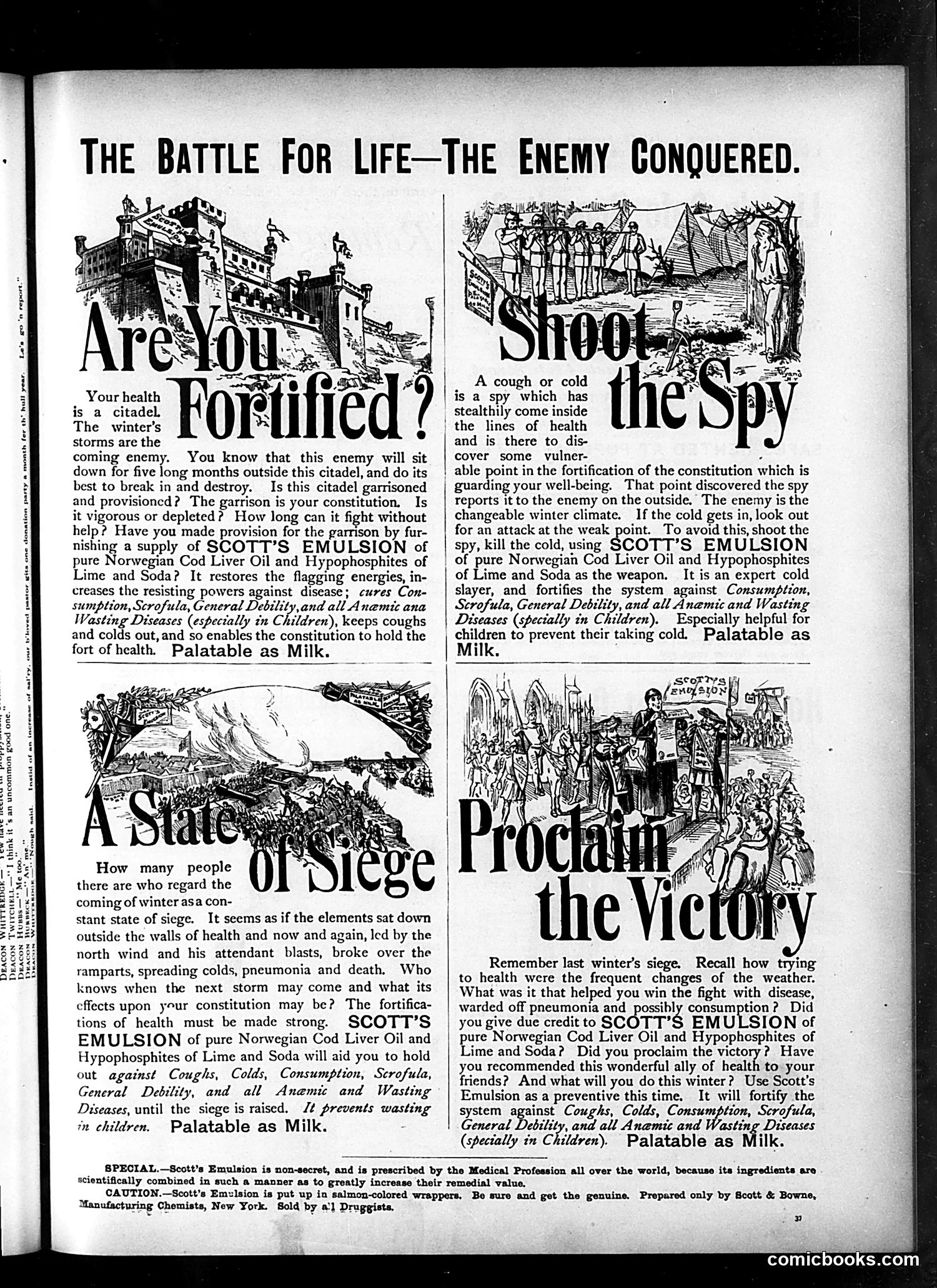
This page is entirely a **product advertisement**, not satire or political commentary. It promotes Scott's Emulsion, a cod liver oil supplement popular in the early 20th century. The "Battle for Life" framing uses military metaphors—health as a "citadel," winter as an "enemy," colds as "spies"—to dramatize illness prevention. Four illustrated panels personify winter threats and position the product as protective fortification. The ad targets middle-class anxieties about winter-related diseases (consumption/tuberculosis, pneumonia, scrofula) that were serious public health concerns before antibiotics. By claiming medical endorsement ("prescribed by the Medical Profession all over the world"), it appeals to authority and legitimacy. The repeated phrase "Palatable as Milk" addresses a key selling point: cod liver oil tastes terrible, so this formulation's palatability was a significant advantage. This is straightforward health marketing using period-appropriate health fears and wartime-adjacent language, not satire.
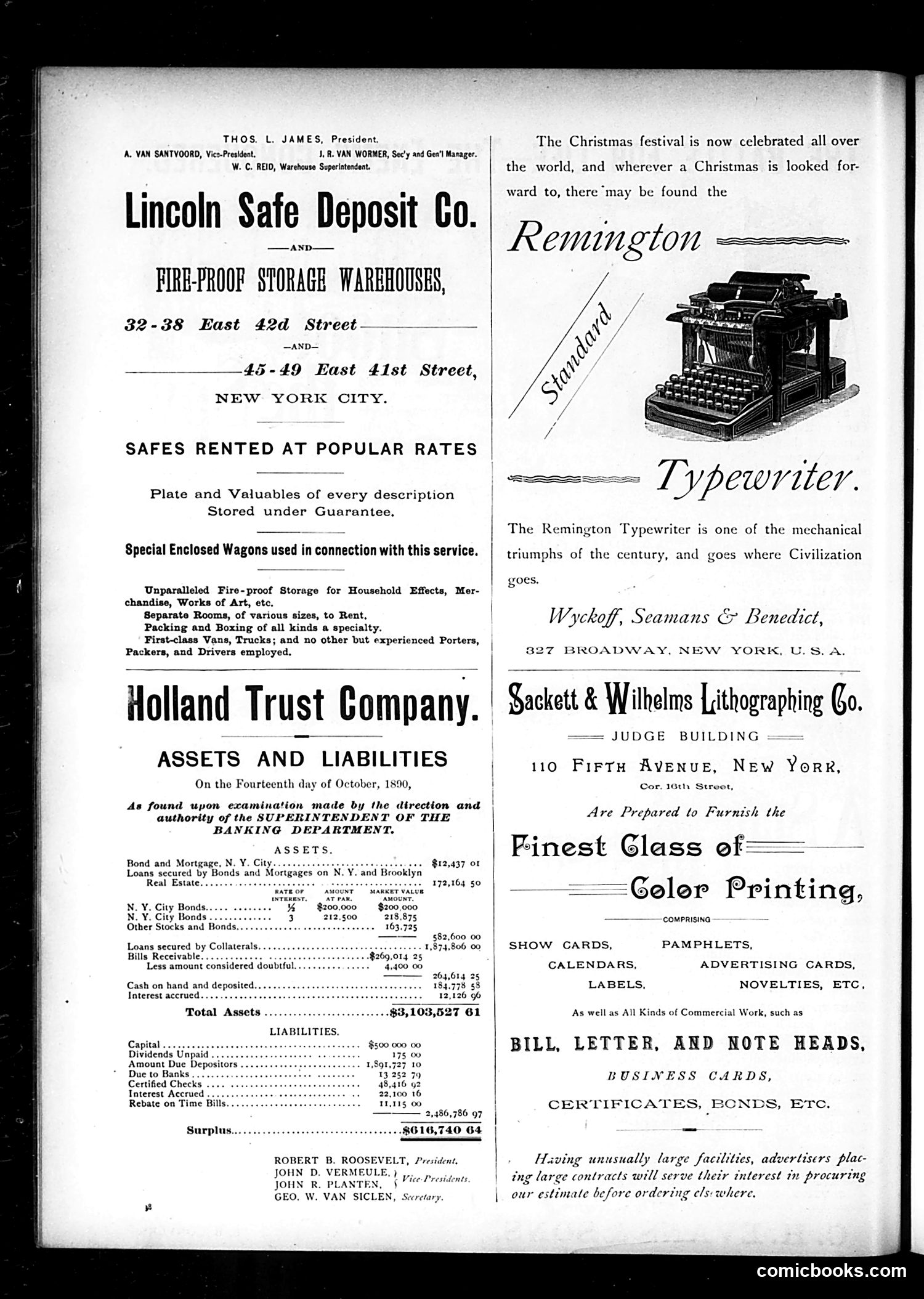
This page is primarily **advertising**, not editorial satire or political cartoon content. It contains advertisements from New York City businesses (circa 1890): **Key ads include:** - Lincoln Safe Deposit Co. (fire-proof storage) - Holland Trust Company (financial institution with assets/liabilities statement) - Remington Typewriter (marketed as a symbol of civilization) - Sackett & Wilhelms Lithographing Co. (printing services) - Wyckoff, Seamans & Benedict (Remington's distributor) **Notable element:** The Remington Typewriter ad claims the machine "goes where Civilization goes"—reflecting late-19th-century assumptions about technological superiority and Western expansion. This represents period attitudes about progress. The page also includes the Holland Trust Company's official financial report from October 14, 1890, listing assets of approximately $3.1 million and a surplus of $616,740. **No political satire or cartoon content is visible on this page.** It functions as a commercial/financial record typical of Judge magazine's revenue model.
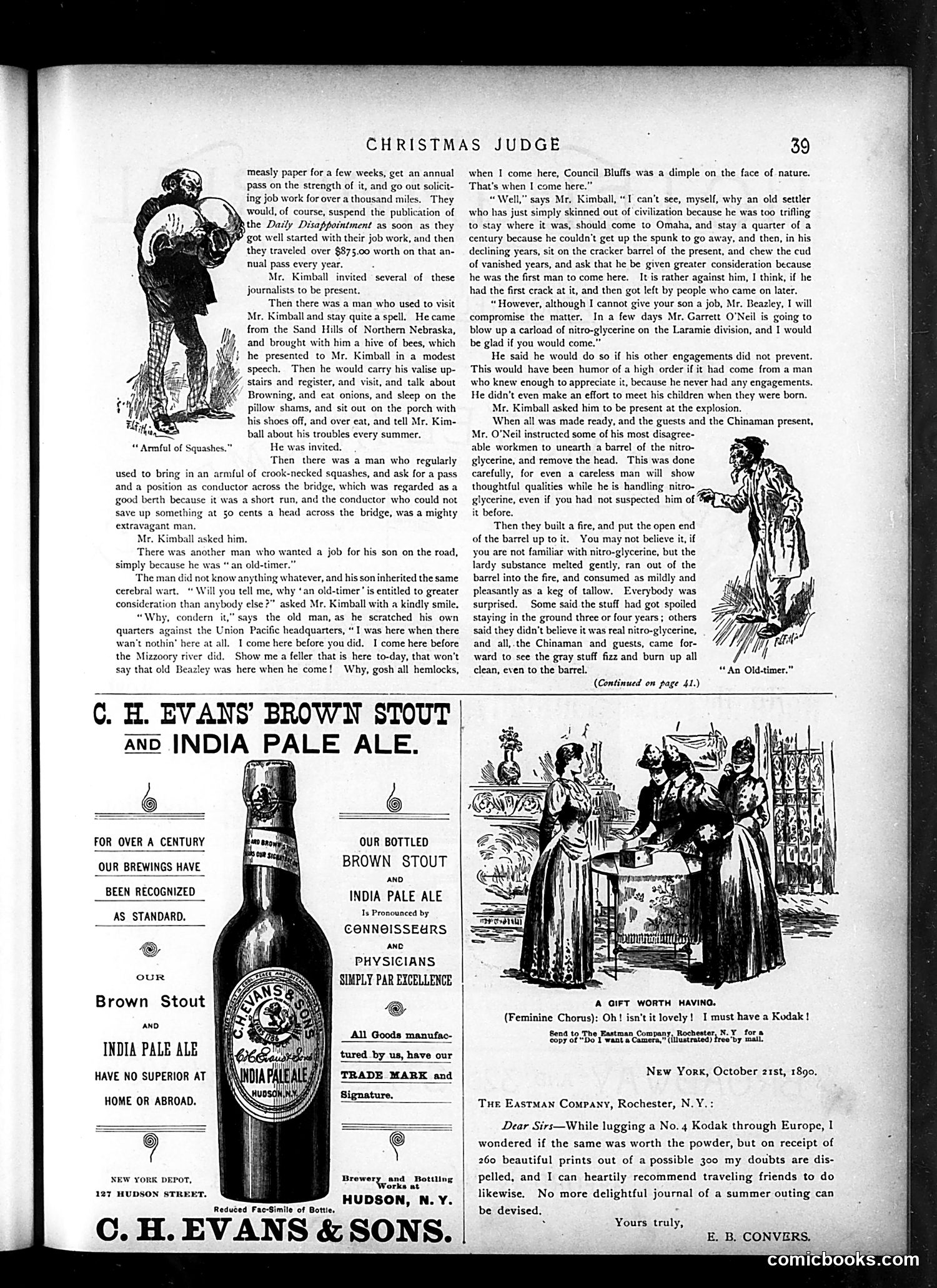
This page from Judge magazine (October 21, 1890) satirizes frontier pretension and economic parasitism through multiple anecdotes about visitors to Mr. Kimball's Omaha establishment. The main targets are: **"Old-timers"** — settlers claiming superiority merely for arriving early, despite contributing nothing. The old man Beazley exemplifies this: he boasts of being present before the town existed, yet has accomplished nothing and remains dependent on others' charity. **Economic freeloaders** — journalists, bee-keepers, and job-seekers who exploit hospitality and railroad passes while contributing nothing. The satire's dark humor peaks when Kimball "compromises" by inviting Beazley to witness a nitroglycerin explosion — a dangerous event presented as entertainment for the worthless. The message: frontier mythology celebrating mere longevity is absurd. Those who arrived early but failed to build or improve themselves deserve no special status or respect. Ambition and actual accomplishment matter; nostalgia does not. The illustrations depict these characters as types — sketched with period clothing details that would have been immediately recognizable to contemporary readers.
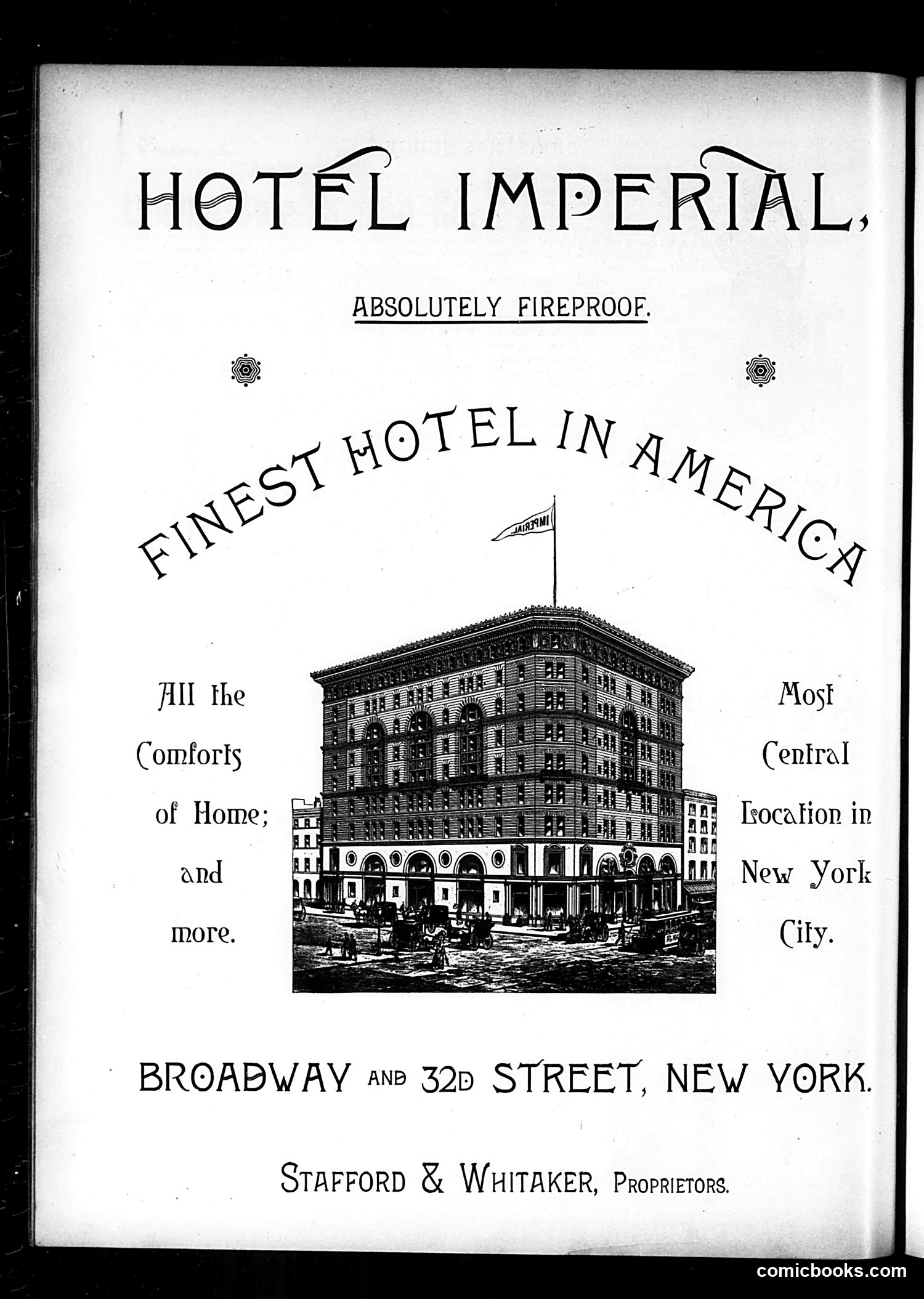
This is an advertisement, not a cartoon or satirical content. It promotes the Hotel Imperial, located at Broadway and 32nd Street in New York City, managed by proprietors Stafford & Whitaker. The page emphasizes the hotel's key selling points: it's described as "absolutely fireproof" (likely a significant safety concern of the era), offers "all the comforts of home," and claims to be the "finest hotel in America" with "most central location in New York City." The architectural illustration shows a substantial multi-story building typical of late 19th or early 20th-century hotel construction. This appears to be a straightforward commercial advertisement rather than satirical content from Judge magazine.
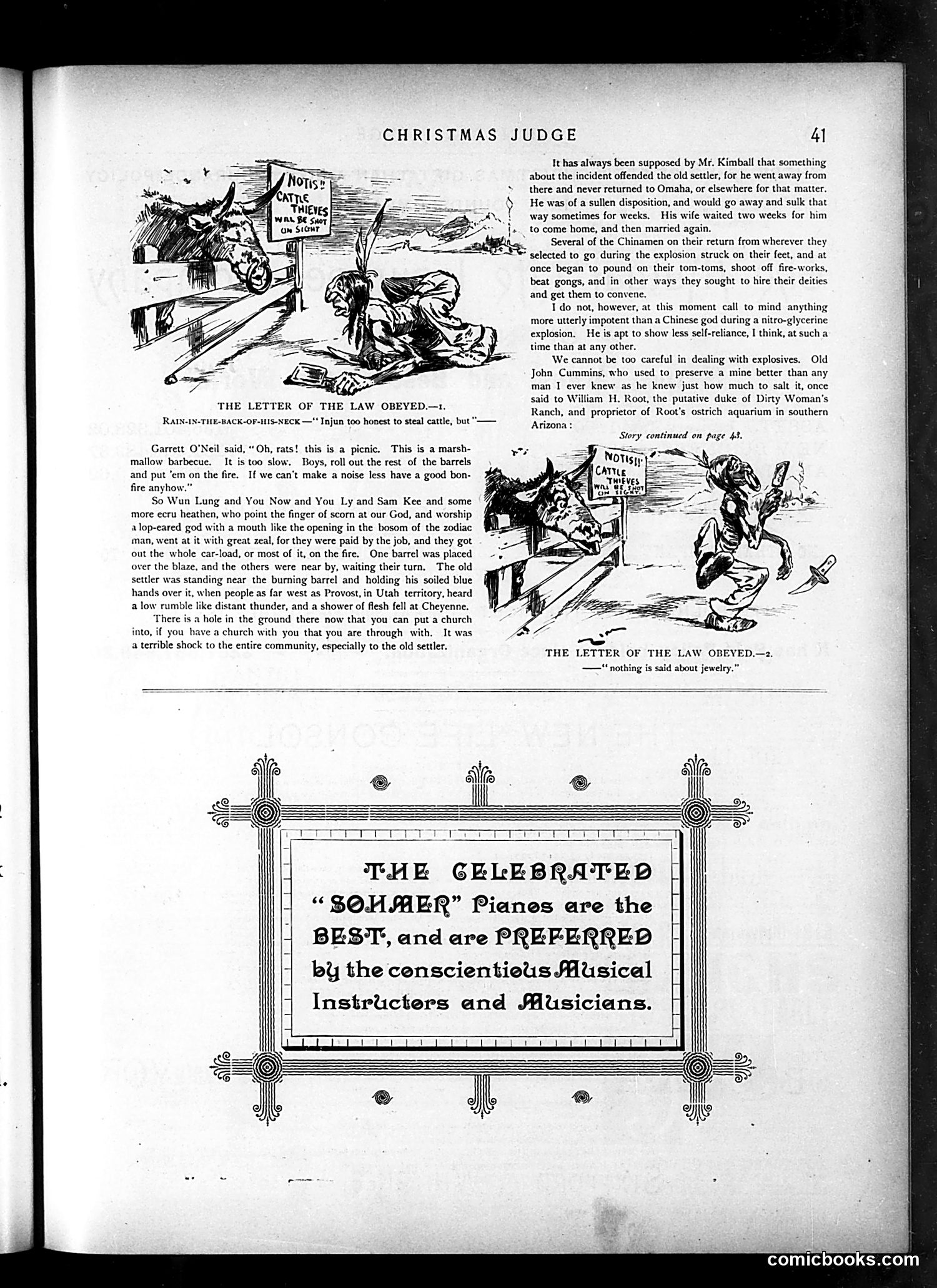
This page contains two related cartoons satirizing Chinese laborers and Western settlement attitudes. The narrative describes an incident where Chinese workers, hired to handle explosives, cause a catastrophic nitro-glycerine explosion that kills an old settler—presented with darkly comedic detachment. The satire operates on multiple levels: it mocks Chinese religious practices (depicted as ineffectual "worship"), portrays Chinese workers as recklessly indifferent to danger, and uses the settler's death as punchline material. The phrase "The Letter of the Law Obeyed" suggests ironic commentary on labor practices or safety regulations being technically followed while remaining fundamentally unsafe. The cartoons feature caricatured Chinese figures alongside exaggerated Western characters. The humor relies on period racist stereotypes common to 1880s-1890s American satirical magazines, treating Chinese immigrants and workplace explosions as subjects for dark comedy rather than genuine tragedy.
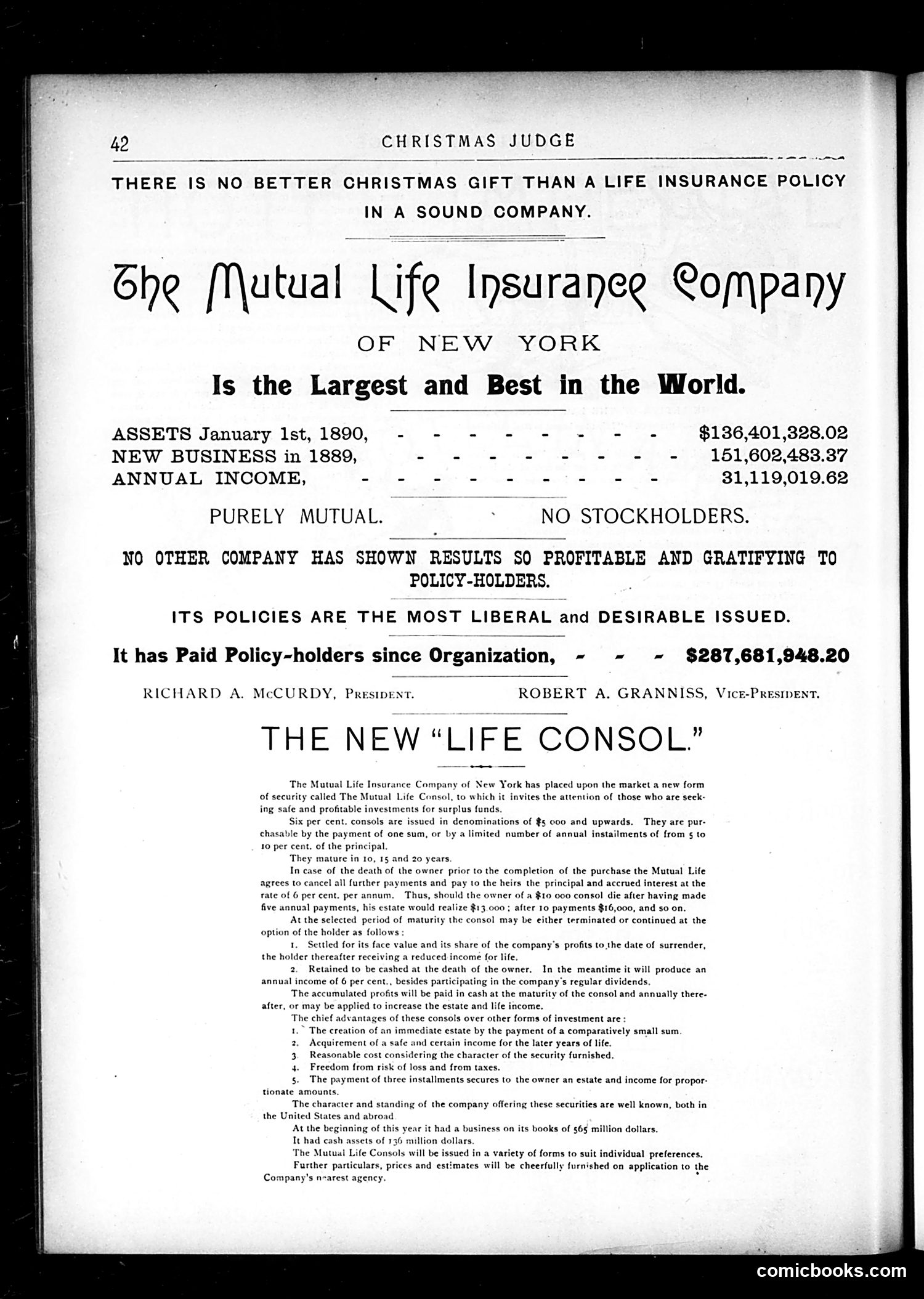
This page is primarily **advertising**, not satire or political commentary. It's a full-page advertisement for The Mutual Life Insurance Company of New York, positioned as a Christmas gift recommendation. The ad emphasizes the company's scale (assets of $136 million as of 1890) and mutual structure (no stockholders, profits go to policyholders). It introduces a new financial product called "Life Consols"—essentially investment-insurance hybrids offering 6% returns, purchasable in installments, maturing in 10-20 years. The appeal combines financial security with mortality protection: if an owner dies before completing payments, heirs receive the full principal plus interest. This addresses a genuine concern for families in the 1890s—leaving dependents financially vulnerable. The prominent names (Richard A. McCurdy, President) and astronomical payout figures ($287 million distributed to policyholders) serve as trust markers. There is no satirical angle here—Judge's editorial simply endorses life insurance as sensible holiday giving.
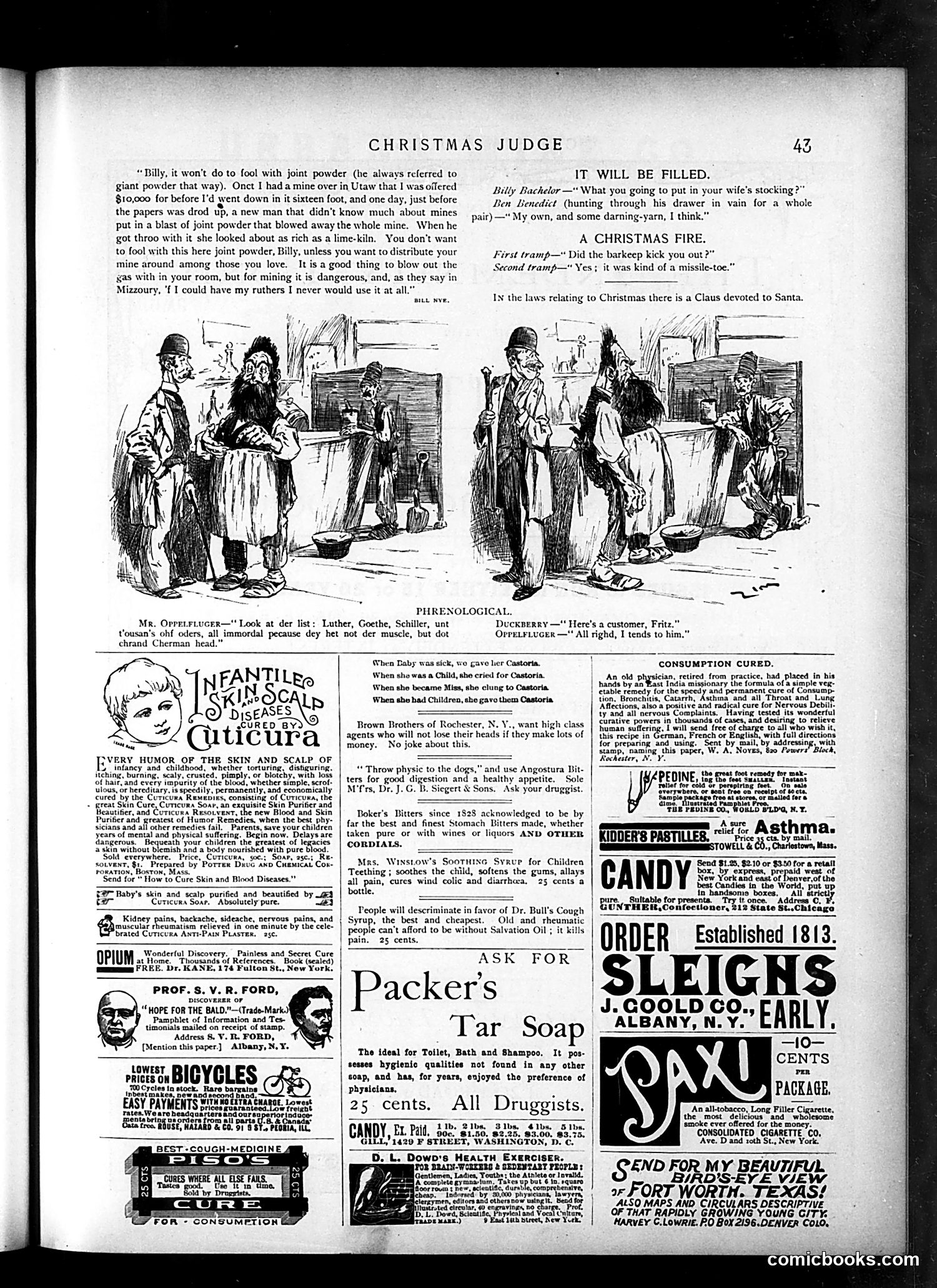
This page contains two short satirical cartoons plus extensive period advertisements. **"It Will Be Filled"**: Two tramps discuss what to put in a wife's Christmas stocking. The joke relies on class-based humor—poor men joking about wives' meager possessions, with a pun on "stocking" (both the garment and the verb). **"A Christmas Fire"**: A barkkeeper ejects a tramp, who quips the expulsion was "kind of a missile-toe"—a pun on "mistletoe," playing on Christmas traditions. **"Phrenological"**: A shopkeeper examines a customer's head, listing great German thinkers (Luther, Goethe, Schiller) to mock the customer's intellectual pretensions despite lacking physical "muscle." The page is primarily **advertisements** for period remedies (Cuticura for skin conditions, opium cures, bicycles, cough medicine), reflecting Judge's commercial nature. The humor is broad, pun-heavy, and class-conscious—typical of 1880s-90s American satirical magazines.
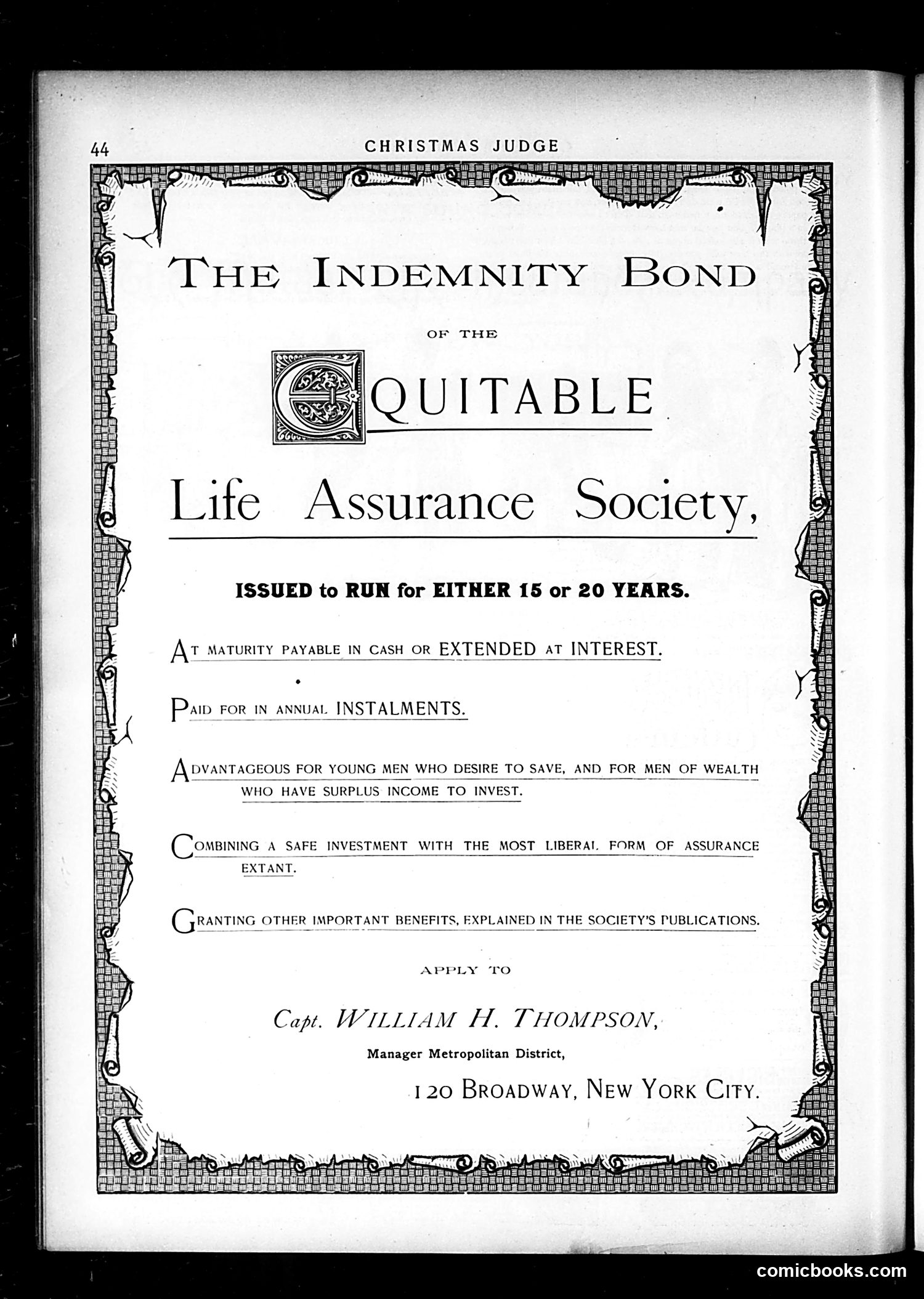
This page is **not a cartoon or satirical content** — it's a **full-page advertisement** for the Equitable Life Assurance Society's indemnity bond product, placed in Judge magazine. The ad promotes a 15 or 20-year life insurance/investment hybrid instrument payable in annual installments, marketed toward young savers and wealthy men with surplus income. It emphasizes safety and liberal terms. Readers should contact Capt. William H. Thompson, the Metropolitan District Manager, at 120 Broadway in New York City. This represents how 19th-century Judge monetized its pages — major corporations purchased advertising space in the magazine alongside satirical content. The ornamental border and typography were typical of period advertising design. There is no satirical point or political reference; this is straightforward commercial promotion.
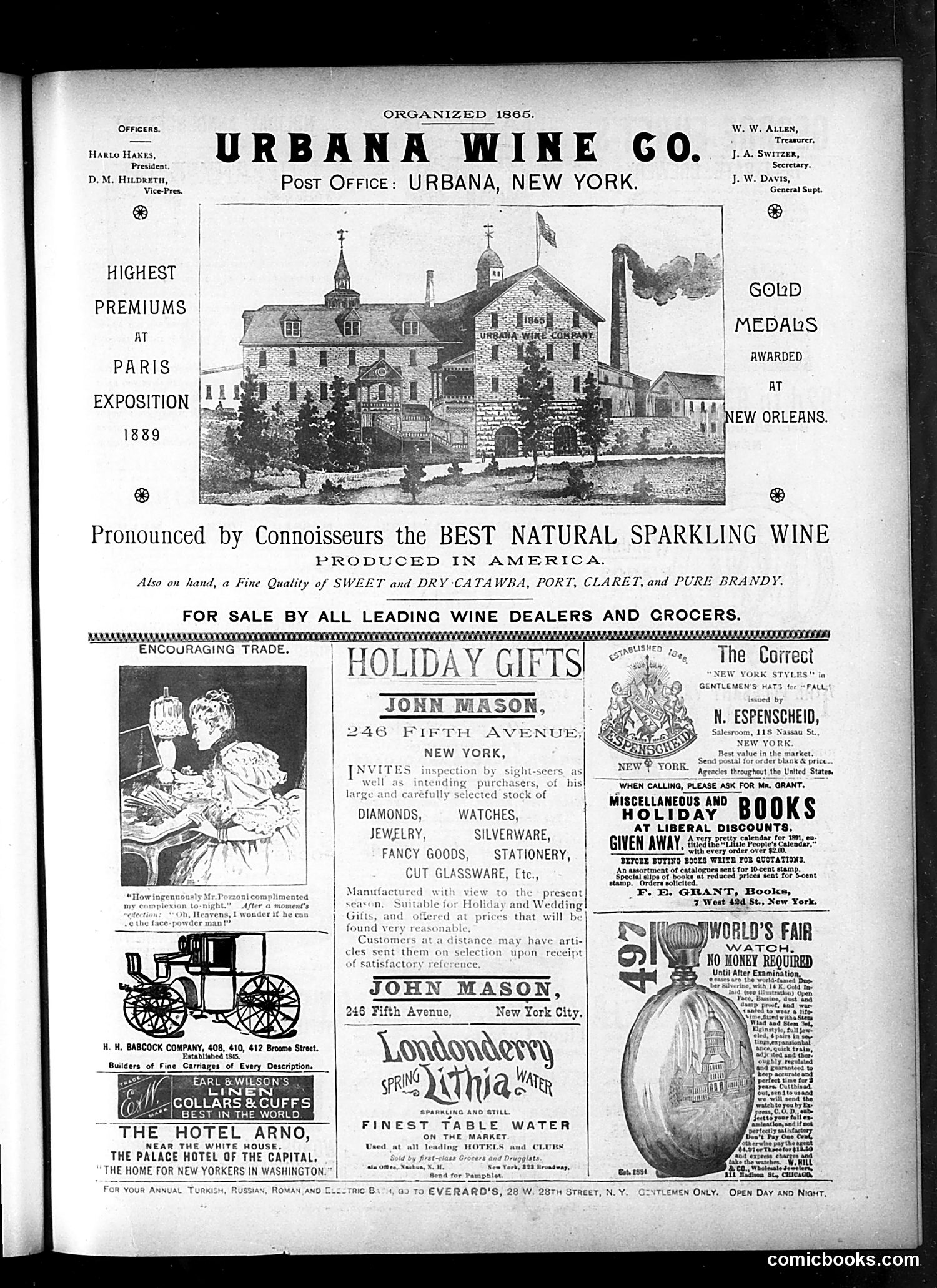
This page is primarily **advertising**, not editorial or satirical content. It showcases the Urbana Wine Company's promotional materials, prominently featuring their winery building and awards won at the 1889 Paris Exposition and New Orleans competitions. The advertisements reflect Gilded Age consumer culture: luxury goods (John Mason's jewelry and holiday gifts), fine carriages, hotels catering to wealthy Washington visitors, and table water marketed as premium. The small illustration on the left showing well-dressed figures appears to be a generic advertising image promoting luxury holiday shopping—typical of period marketing. There is **no political cartoon or satire visible** on this page. The content simply represents Judge magazine's revenue stream: advertisements from upscale merchants targeting the magazine's affluent readership. The page documents what luxury goods and services wealthy Americans could purchase in the 1880s-90s.
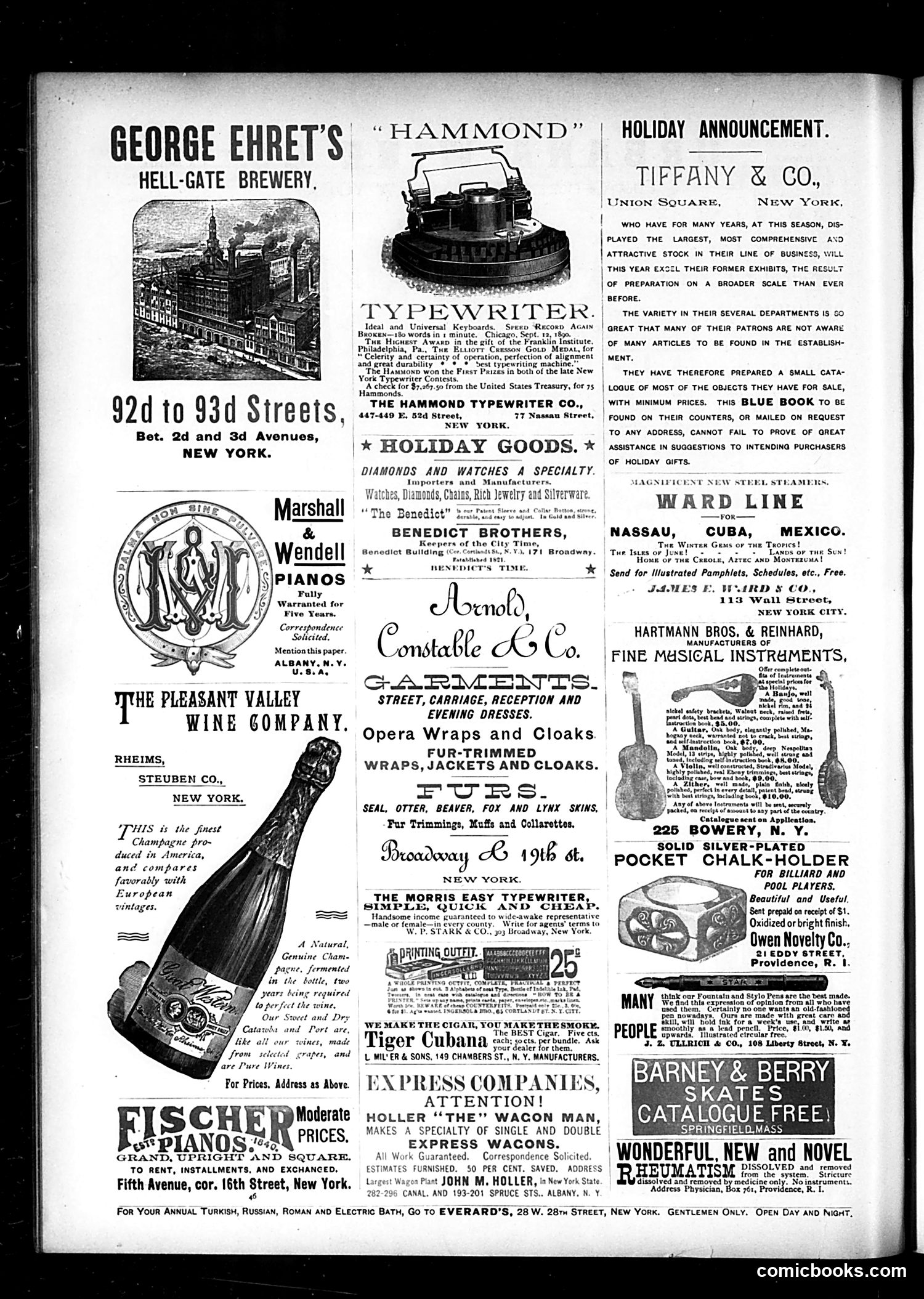
This is primarily an **advertising page**, not a satirical cartoon section. The page contains multiple commercial advertisements typical of late 19th-century American magazines, including: - **George Ehret's Hell-Gate Brewery** (NYC beer) - **Hammond Typewriter** (competing with rivals like the Morris Easy Typewriter) - **Tiffany & Co.** holiday announcement - **Ward Line Steamships** to tropical destinations - **Musical instruments, cigars, champagne, and pianos** The page reflects Gilded Age consumer culture and commercial competition. The typewriter advertisements notably compete for market dominance—Hammond emphasizes awards and speed (180 words/minute), while Morris promotes affordability and easy operation. No clear political satire is evident. This represents **Judge** functioning as a commercial publication where advertisements subsidized editorial content rather than as pure political commentary.
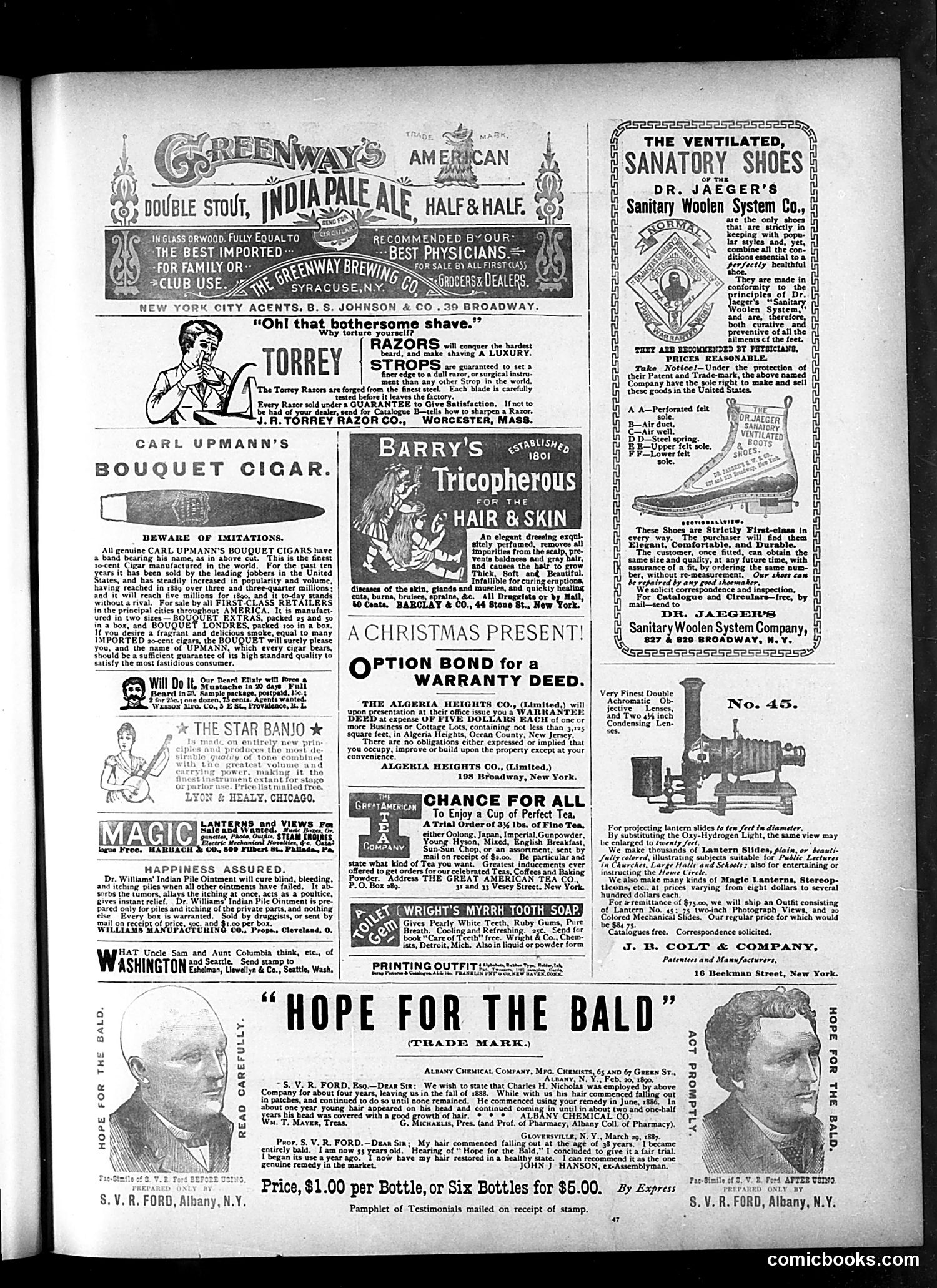
This page is primarily **advertising**, typical of Judge magazine's revenue model. It contains no significant political cartoons or satire requiring historical context. The largest visual element, "Hope for the Bald" (bottom half), is a product advertisement for S.V.R. Ford's hair-restoration remedy, featuring testimonial letters from satisfied customers claiming success. This reflects late-19th-century patent medicine marketing practices—often making dubious medical claims without regulation. Other advertisements include shaving razors, cigars, sanitary shoes, and various remedies (for piles, baldness, tooth problems). The small Torrey Razor ad includes a humorous tagline ("Oh that bothersome shave") but this is commercial humor, not satirical commentary. The page demonstrates how Judge funded itself through ads alongside editorial content, and reveals period consumer culture: concerns about grooming, baldness remedies, and unregulated medicinal products marketed with testimonials rather than scientific evidence.
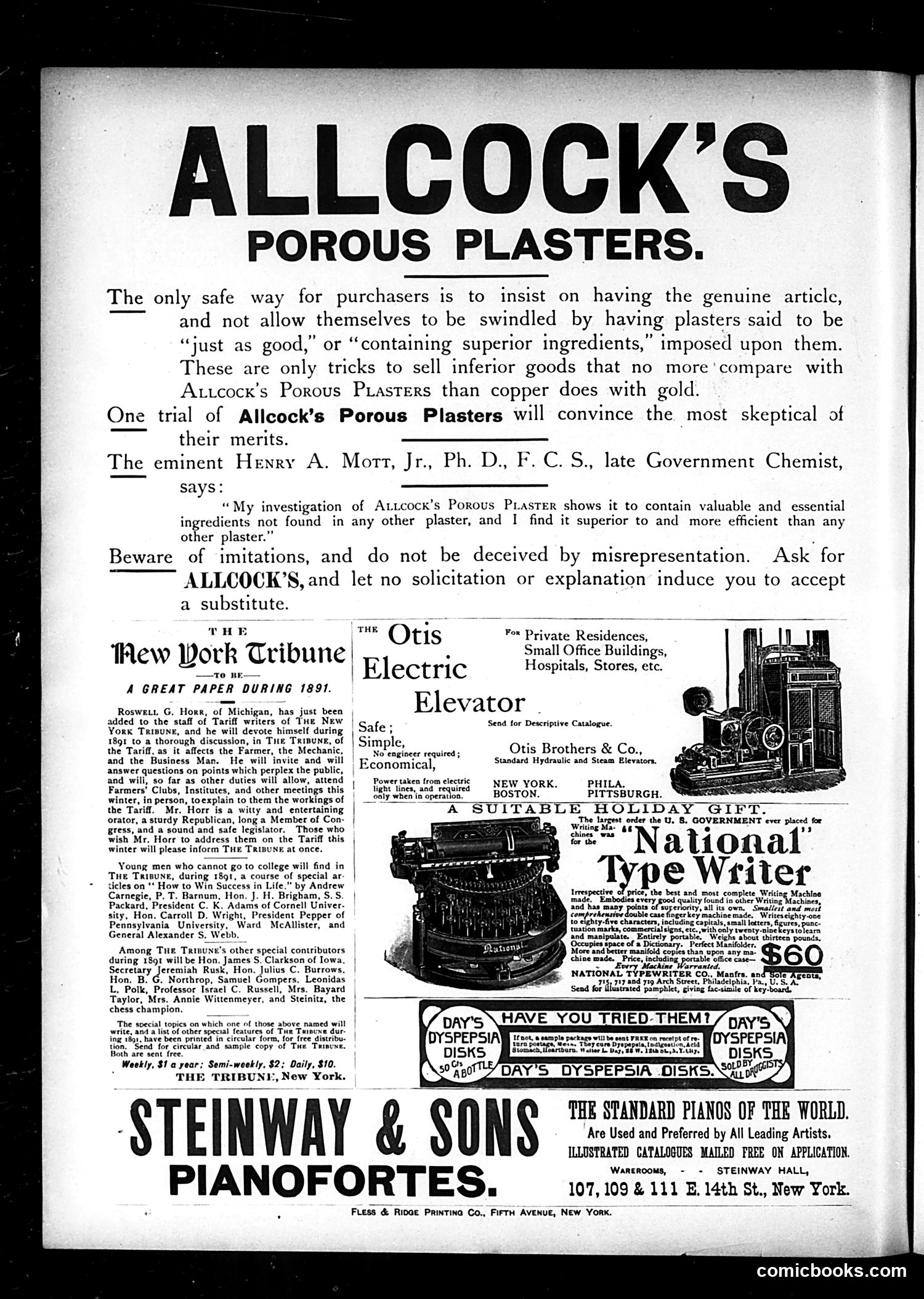
This page is primarily **advertising**, not satire or editorial content. The main feature is a large advertisement for **Allcock's Porous Plasters**, a medicinal product popular in the 1890s. The ad warns consumers against **counterfeit or inferior imitation products**, citing endorsement from Henry A. Mott Jr., a "Government Chemist," to establish legitimacy. This reflects genuine commercial concerns of the era—patent medicines and medical devices were frequently counterfeited or bootlegged by competitors, with no federal regulation to prevent it. The page also contains smaller ads for the **Otis Electric Elevator**, the **National Type Writer**, and **Steinway & Sons Pianofortes**, plus promotional material about the New York Tribune's 1891 tariff coverage. There is **no cartoon or satire** visible. This appears to be a standard newspaper advertising page from *Judge* magazine, circa 1891.
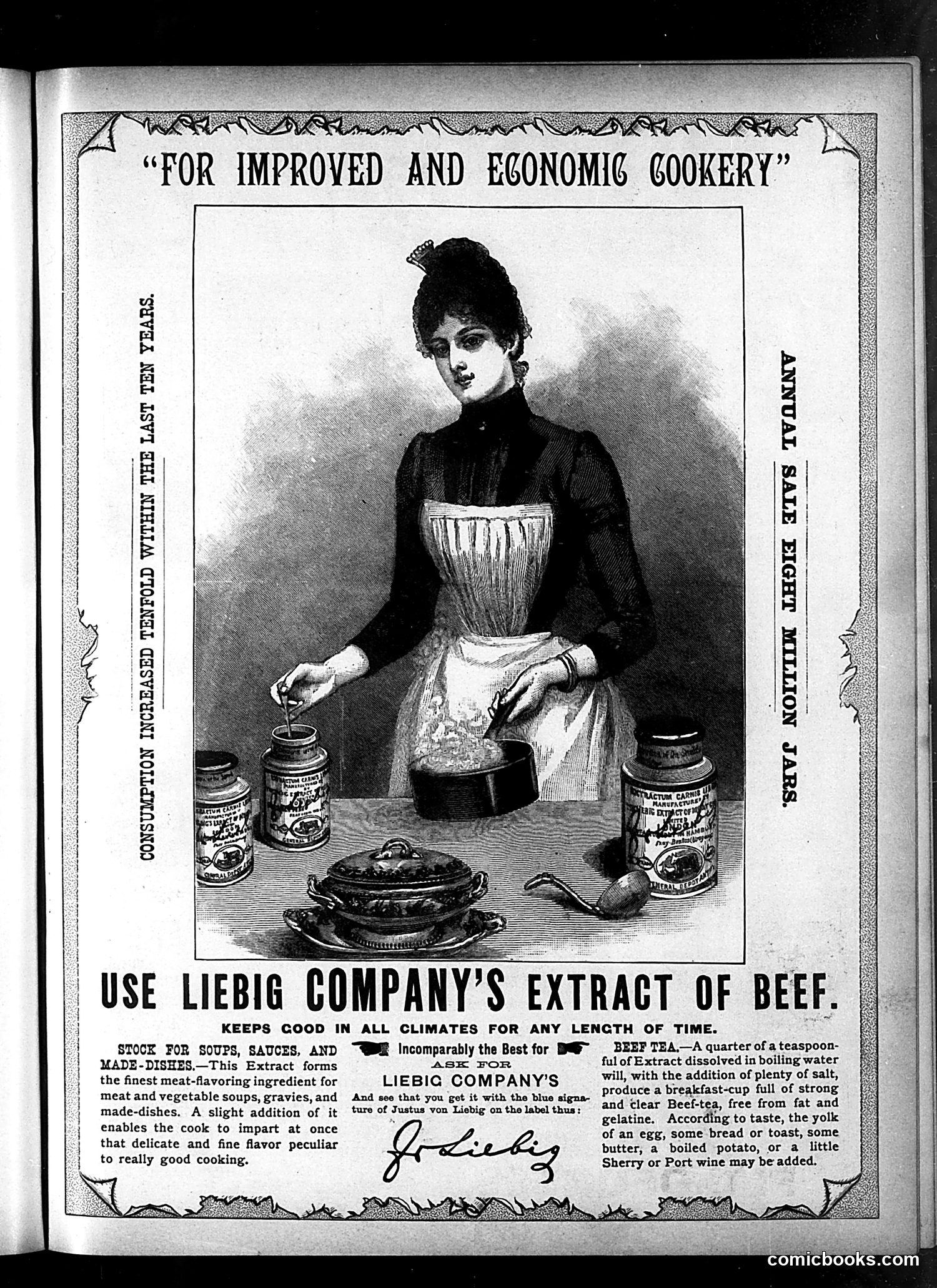
This is a **product advertisement**, not political satire. It promotes Liebig Company's Extract of Beef, a commercial meat concentrate popular in the Victorian era. The page features a well-dressed woman in period clothing demonstrating the product's use in cooking. The ad emphasizes economy and convenience—key selling points for the time—claiming consumption has "increased tenfold within the last ten years." The text describes practical applications: making soups, sauces, and "beef tea" (a light broth). The advertisement includes instructions for preparing beef tea and suggests it can be enhanced with eggs, bread, butter, or wine. There is no political cartoon or satire visible. Judge magazine apparently carried substantial advertising alongside editorial content. The Liebig extract was a genuine food product, and this represents straightforward commercial promotion from the late 19th or early 20th century.
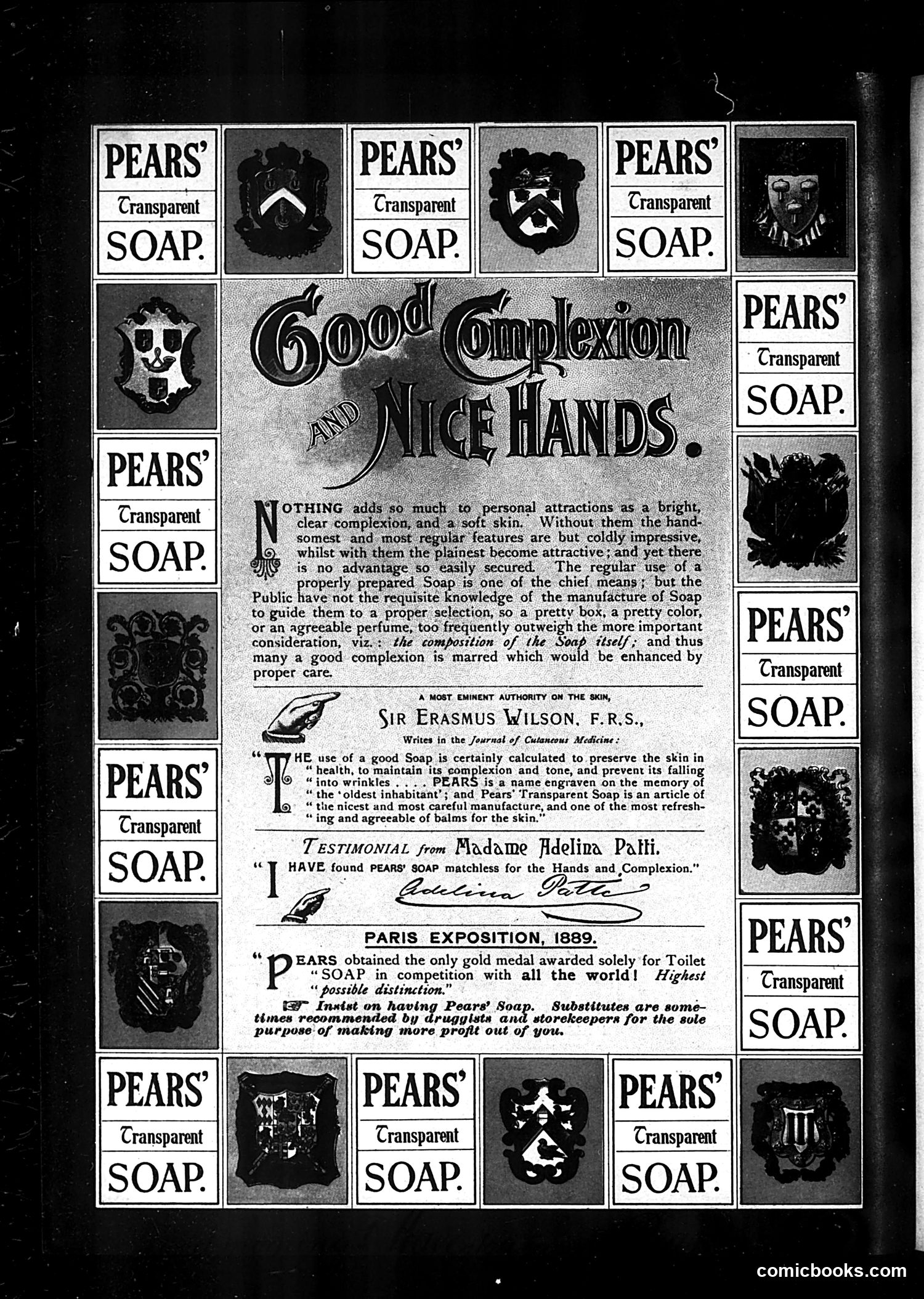
This is primarily **advertising, not political satire**. The page promotes Pears' Transparent Soap through testimonials and product imagery rather than commentary or cartoon humor. The advertisement claims superiority by citing: - A quote from Sir Erasmus Wilson, a real 19th-century dermatologist, endorsing the soap's skin-preserving properties - A testimonial from "Madame Adelina Patti" (likely the famous opera singer), praising it for complexion and hands - A gold medal supposedly won at the 1889 Paris Exposition The decorative heraldic shields and ornamental borders frame these claims to convey prestige and authority. The "Good Complexion and Nice Hands" headline targets beauty-conscious consumers. This represents typical Victorian-era advertising strategy: leveraging celebrity endorsements and expert authority to market consumer goods.