
Judge, 1890-12-06 · page 41 of 52
Judge — December 6, 1890 — page 41: what you’re looking at
What you’re looking at
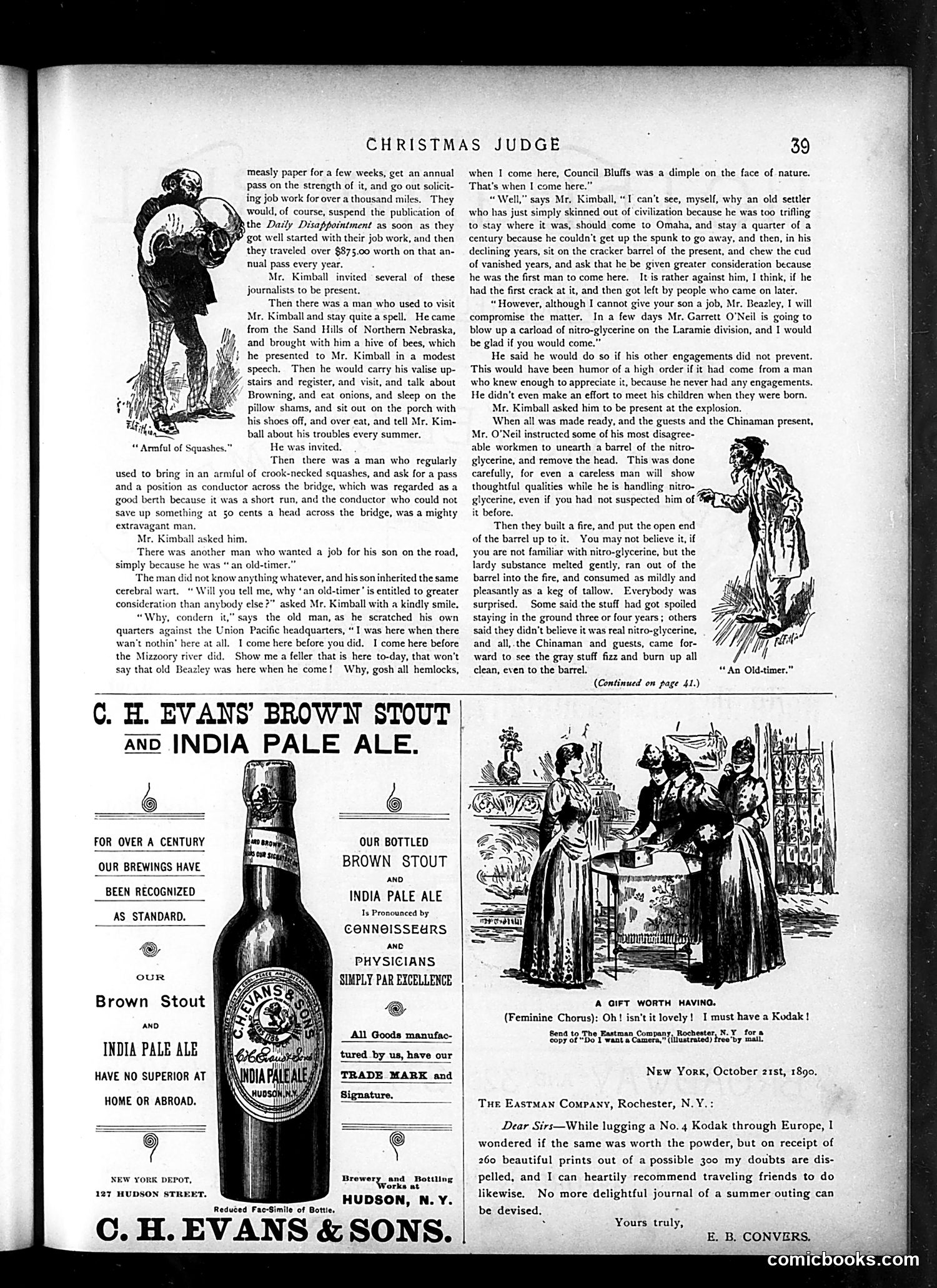
This page from Judge magazine (October 21, 1890) satirizes frontier pretension and economic parasitism through multiple anecdotes about visitors to Mr. Kimball's Omaha establishment. The main targets are: **"Old-timers"** — settlers claiming superiority merely for arriving early, despite contributing nothing. The old man Beazley exemplifies this: he boasts of being present before the town existed, yet has accomplished nothing and remains dependent on others' charity. **Economic freeloaders** — journalists, bee-keepers, and job-seekers who exploit hospitality and railroad passes while contributing nothing. The satire's dark humor peaks when Kimball "compromises" by inviting Beazley to witness a nitroglycerin explosion — a dangerous event presented as entertainment for the worthless. The message: frontier mythology celebrating mere longevity is absurd. Those who arrived early but failed to build or improve themselves deserve no special status or respect. Ambition and actual accomplishment matter; nostalgia does not. The illustrations depict these characters as types — sketched with period clothing details that would have been immediately recognizable to contemporary readers.
📄 Transcribed text from this page (OCR, searchable)
Machine-transcribed from the original scan — historical spelling and the odd misread are preserved.
CHRISTMAS JUDGE : 39 measly paper for a few weeks, get an annual pass on the strength of it, and go out solici ing job work for over a thousand miles. They would, of course, suspend the publication of the Daily Disappointment as soon as they got well started with their job work, and then they traveled over $875.00 worth on that an- nual pass every year. : Mr. Kimball invited several of these journalists to be present. Then there was a man who used to visit Mr. Kimball and stay quite a spell. He came from the Sand Hills of Northem Nebraska, and brought with him a hive of bees, which | he presented to Mr. Kimball in a modest speech. Then he would carry his valise up- stairs and register, and visit, and talk about Browning, and eat onions, and sleep on the pillow shams, and sit out on the porch with his shoes off, and over eat, and tell Mr. Kim- ball about his troubles every summer. “ Armful of Squashes.” He was invited. Then there was a man who regularly used to bring in an armful of crook-necked squashes, and ask for a pass and a position as conductor across the bridge, which was regarded as a good berth because it was a short run, and the conductor who could not save up something at 50 cents a head across the bridge, was a mighty extravagant man, Mr. Kimball asked him. There was another man who wanted a job for his son on the road, simply because he was “an old-timer. id not know anything whatever, and his son inherited the same cerebral wart.“ W' c, why ‘an old-timer’ is entitled to greater ?" asked Mr. Kimball with a kindly smile. condern it,” says the old man, as he scratched his own quarters against the Union Pacific headquarters, “I was here when there wan't nothin’ here at all. I come here before you did. I come here before the Mizzoory river did. Show me a feller that is here to-day, that won't say that old Beazley was here when he come! Why, gosh all hemlocks, when I come here, Council Bluffs was a dimple on the face of nature. That's when I come here.” “Well,” says Mr. Kimball, “I can’t see, myself, why an old settler who has just simply skinned out of civilization because he was too trifling to stay where it was, should come to Omaha, and stay a quarter of a century because he couldn't get up the spunk to go away, and then, in his declining years, sit on the cracker barrel of the present, and chew the cud of vanished years, and ask that he be given greater consideration because he was the first man to come here. It is rather against him, I think, if he had the first crack at it, and then got left by people who came on later. “ However, although I cannot give your son a job, Mr. Beazley, I will compromise the matter. In a few days Mr. Garrett O'Neil is going to blow up a carload of nitroglycerine on the Laramie division, and I would be glad if you would come.” He said he would do so if his other engagements did not prevent. This would have been humor of a high order if it had come from a man who knew enough to appreciate it, because he never had any engagements. He didn’t even make an effort to meet his children when they were born. Mr. Kimball asked him to be present at the explosion. When all was made ready, and the guests and the Chinaman present, Mr. O'Neil instructed some of his most disagree- able workmen to unearth a barrel of the nitro- glycerine, and remove the head. This was done carefully, for even a careless man will show thoughtful qualities while he is handling nitro- glycerine, even if you had not suspected him of 4 it before. Then they built a fire, and put the open end of the barrel up to it. You may not believe it, if you are not familiar with nitro-glycerine, but the lardy substance melted gently, ran out of the barrel into the fire, and consumed as mildly and pleasantly as a keg of tallow. Everybody was surprised. Some said the stuff had got spoiled staying in the ground three or four years; others said they didn’t believe it was real nitro-glycerine, and all,.the Chinaman and guests, came for- ward to see the gray stuff fizz and burn up all clean, even to the barrel. (Continued on page 41.) C. H. EVANS’ BROWN STOUT anD INDIA_PALE ALE. FOR OVER A CENTURY te OUR BOTTLED OUR BREWINGS HAVE. BROWN STOUT AND _BEEN RECOGNIZED _ INDIA PALE ALE 1, aE a spent ee CONNOISSEURS ® fi a ANC PHYSICIANS our 3 SOW) SIMPLY PAR EXCELLENCE Brown Stout Oy ee All Goods manufac- INDIA PALE ALE tured by us, have our HAVE NO SUPERIOR AT imN\\ TRADE MARK and HOME OR ABROAD. j Sigoature tne Saas ue NEW YORK DEPOT, f Browery. Bottling ‘orks at 127 HUDSON STREET. HUDSON, N.Y. Reduced Fac-Simile of Bottle. C.H. EVANS & SONS. A GIFT WORTH HAVING. (Feminine Chorus): Oh! isn’t it lovely! I must have a Kodak! Send to,The Eastman Company, Rochester, N.Y for a copy of “Do T want a Camera,” (ilustrated) freo"by mall, New York, October 21st, 1890. Tue Eastman Company, Rochester, N.Y.: Dear Sirs—While lugging a No. 4 Kodak through Europe, I wondered if the same was worth the powder, but on receipt of 260 beautiful prints out of a possible 300 my doubts are dis- pelled, and I can heartily recommend traveling friends to do likewise. No more delightful journal of a summer outing can be devised. : S Yours truly, E. B, CONVERS, : : comicbooks.com