
A complete issue · 67 pages · 1922
Captain Billy's Whiz Bang #35
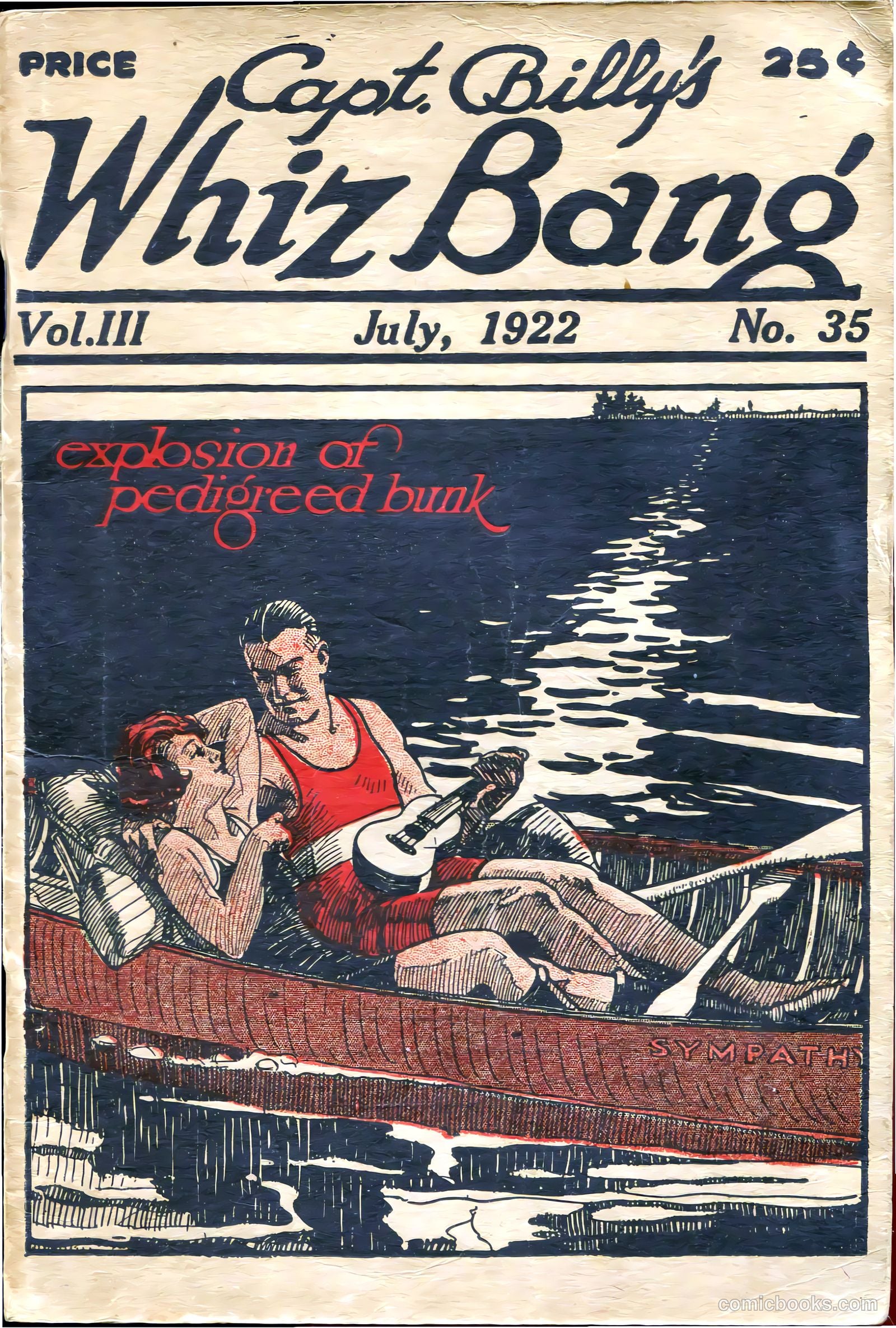
This July 1922 cover depicts a satirical scene titled "explosion of pedigreed bunk." A man in a red bathing suit sits in a rowboat holding a baby, playing a banjo while the boat appears to be sinking or exploding in the water. The word "SYMPATHY" appears at the bottom. The satire likely mocks sentimentality or emotional manipulation—the cover suggests someone performing feel-good entertainment (the banjo) while a disaster unfolds, implying hypocrisy or deflection. "Pedigreed bunk" indicates the magazine is calling out what it views as pretentious nonsense. The specific cultural reference remains unclear without additional context, though the 1922 date suggests this may reference contemporary social or political absurdities of that era. The illustration's expressionistic style emphasizes the chaotic, dramatic nature of the "explosion."
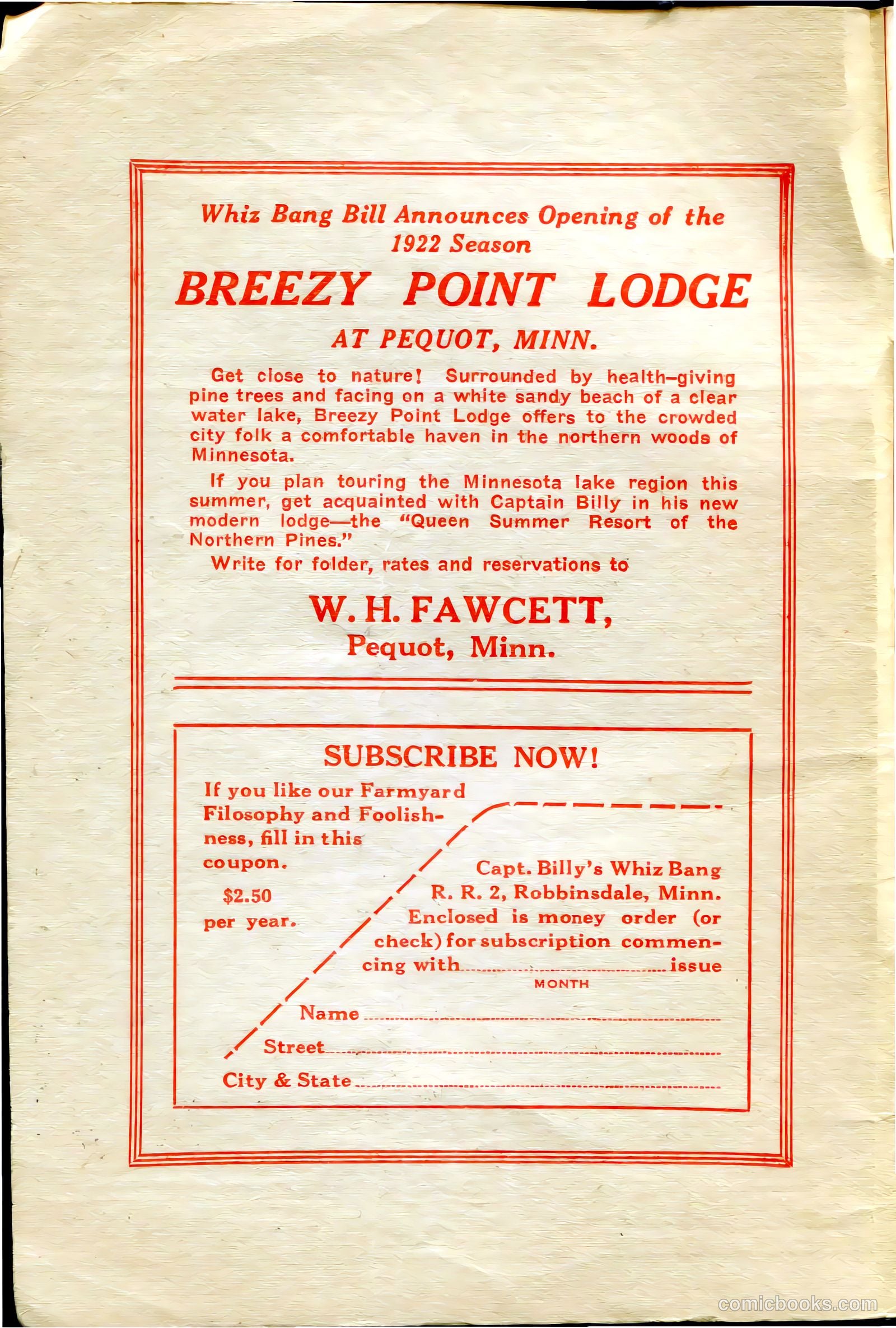
This page is primarily an advertisement, not a satirical cartoon. It announces the 1922 opening of Breezy Point Lodge in Pequot, Minnesota, run by "Captain Billy" (the magazine's editor). The ad promotes the lodge as a nature retreat with pine trees and a sandy beach, targeting city dwellers seeking a northern woods vacation. Below is a subscription coupon for Whiz Bang magazine itself ($2.50 yearly), described as offering "Farmyard Philosophy and Foolishness." The contact address is listed as R.R. 2, Robbinsdale, Minnesota. This appears to be self-promotion—the magazine's editor advertising his own vacation business to his readership.
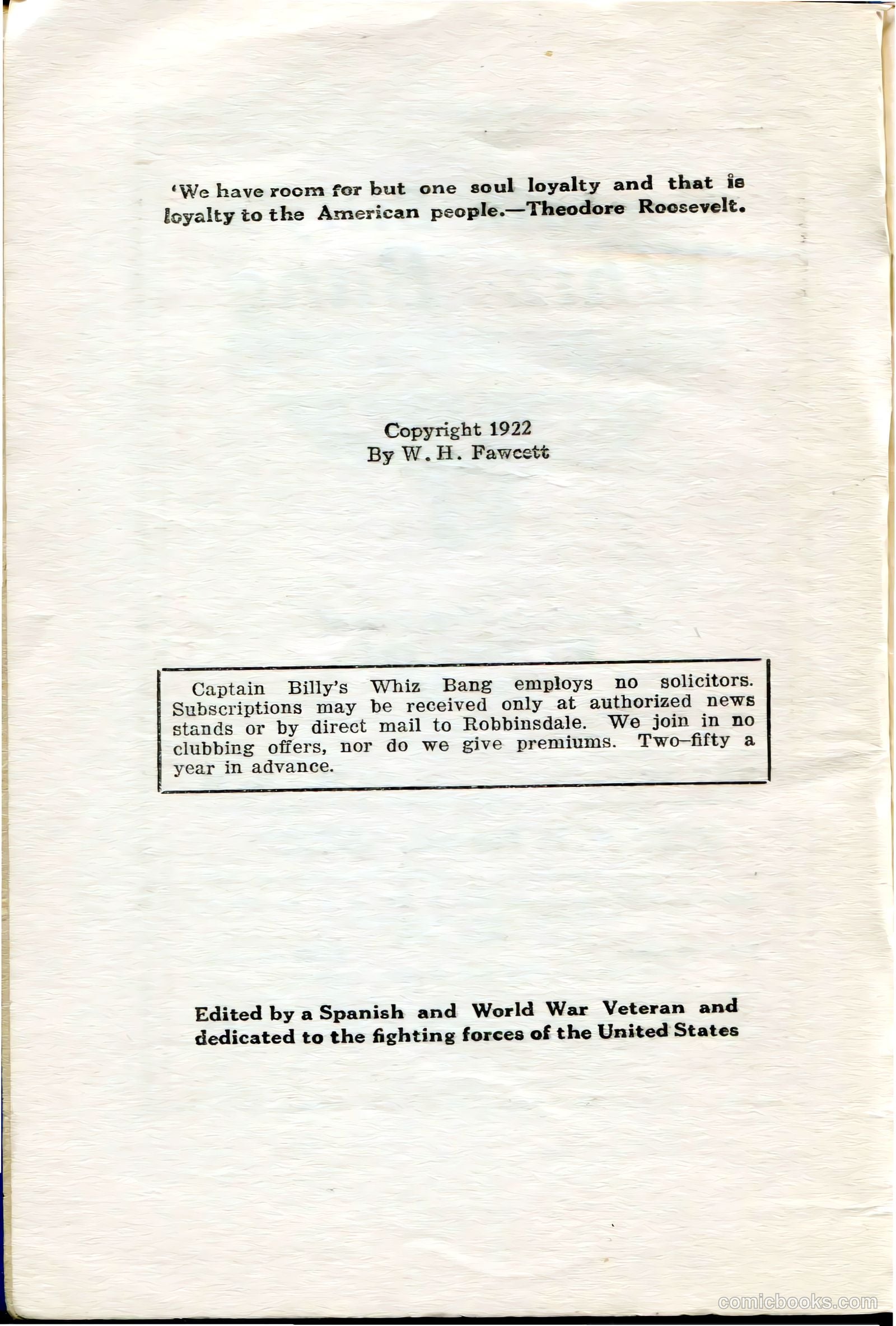
This is a **title/copyright page**, not a satirical cartoon page. It contains: 1. **A Theodore Roosevelt quote** about American loyalty, positioning the magazine as patriotic 2. **Copyright notice** (1922) by W.H. Fawcett 3. **Subscription information** for "Captain Billy's Whiz Bang"—a humor magazine published in Robbinsdale, costing $2.50/year 4. **Editorial note** stating it was "Edited by a Spanish and World War Veteran and dedicated to the fighting forces of the United States" The page establishes the magazine's patriotic credentials and business model rather than containing satirical content. The Roosevelt epigraph suggests the editors positioned themselves as nationalist humorists, while the war-veteran editor note appealed to post-WWI American audiences during the 1920s.
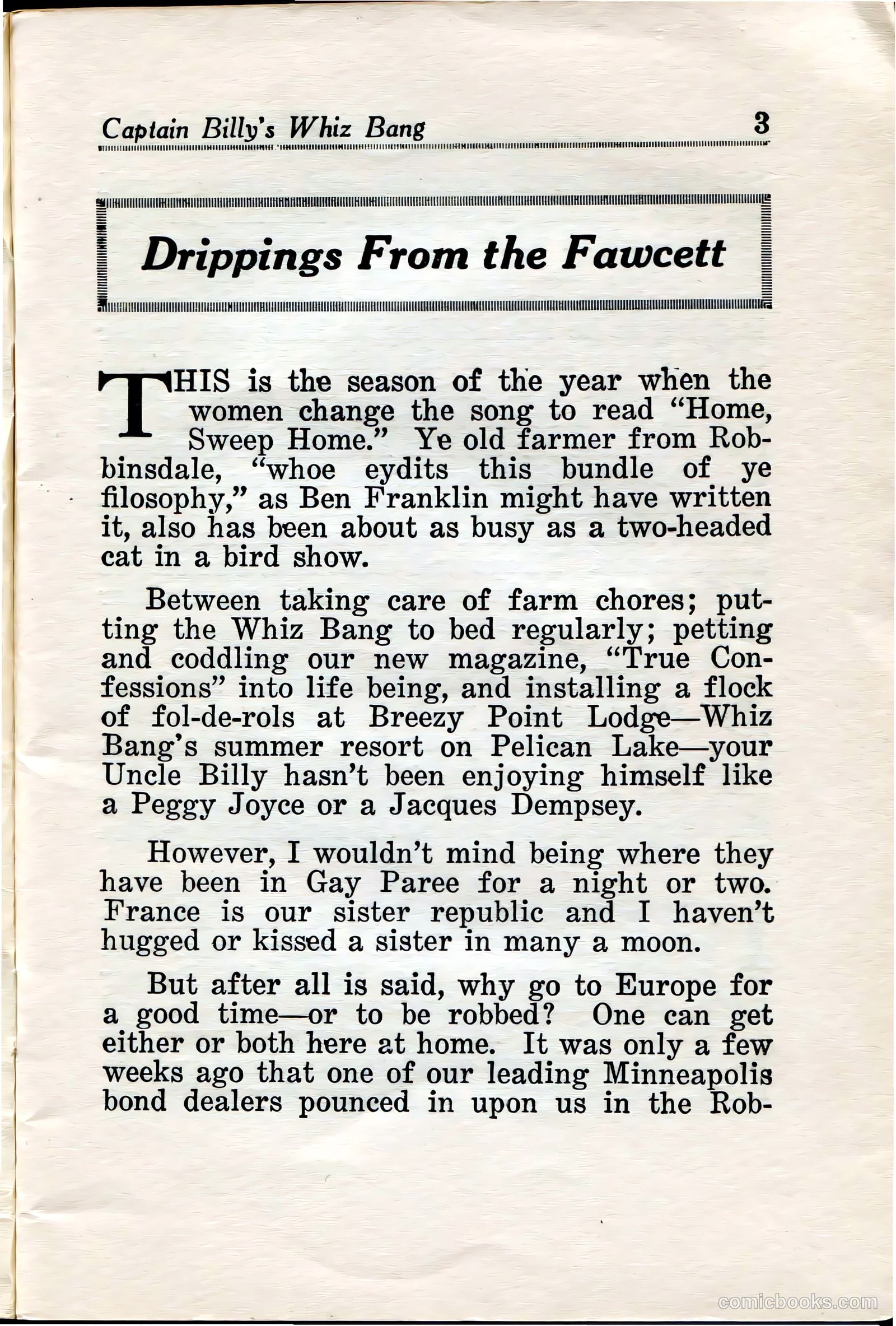
This is a humorous editorial column, not a cartoon. The author (identified as "Uncle Billy," the magazine's editor) uses casual, folksy satire to comment on his busy life running *Whiz Bang* magazine and launching a companion publication called *True Confessions*. The piece contains period-specific references: mentions of celebrities Peggy Joyce and Jacques Dempsey (likely referring to boxer Jack Dempsey), and a jab at Americans traveling to Paris ("Gay Paree") for excitement or to get robbed. The satire targets post-WWI American attitudes—suggesting one needn't travel to Europe for thrills or crime when both are readily available at home. The "two-headed cat in a bird show" is simply colorful rural American slang for being overwhelmed. The overall tone mocks spring-cleaning season ("Home, Sweep Home" puns on the song "Home, Sweet Home") and pokes fun at the editor's frantic schedule.
This page from **Captain Billy's Whiz Bang** (a 1920s-era satirical magazine) contains three brief anecdotes rather than cartoons: 1. **Financial fraud complaint**: A farmer describes being pressured into buying bonds by a Bindsdale firm that went bankrupt, leaving him with worthless securities while others claimed priority. The satire mocks investment scams and the vulnerability of rural Americans. 2. **Darkly comic priorities**: A farmer mentions his hogs died of cholera and his wife died a week later—but emphasizes the hog loss because they were worth $50 each. The joke's cruelty reflects the magazine's cynical, edgy humor. 3. **Editor's three-year anniversary**: The editor notes *Whiz Bang*'s success, positioning it as filling a gap between "Victorian bawdiness" and modern prudishness—claiming the magazine offers frank, irreverent humor. The overall tone is anti-establishment, critical of financial swindlers, and proudly crude—typical of this irreverent publication's appeal to working-class readers skeptical of authority and uplift movements.
This page is an editorial defense of the magazine's satirical approach against moral critics. The editor argues that Whiz Bang seeks humor through "wholesome emotions" rather than crude smut, and attacks what he calls "sanctimonious simps"—likely referring to moral reformers and censorship advocates active in the 1920s who opposed changing literary and social standards. The text mocks Victorian prudery while distinguishing the magazine from genuinely obscene publications. The editor positions Whiz Bang as a moderate middle ground: respecting traditional morals but rejecting humorless rigidity. The reference to a letter from "Vigilantes at Tulsa, Oklahoma" suggests organized reform or censorship efforts in that town—possibly civic groups attempting to restrict the magazine's distribution. No specific cartoon is visible on this page; it's primarily text defending the magazine's editorial philosophy against contemporary morality campaigns.
This is editorial commentary defending *Whiz Bang* magazine against a female reader's complaint that the publication was mocking kissing as a "sacred custom." The author (likely the magazine's editor) responds mockingly: kissing is common even among Puritans and appears constantly in American literature—it carries no erotic significance. He then provides examples: Lucy Terrill's novel contains 26 kisses, mostly on non-lips areas (neck, throat, shoulder) to maintain propriety. He alludes to his own past—an "Indian Guide" named Gus who worked in Hollywood, and casual kissing at "Breezy Point Lodge." The satire targets both the prudish reader and American literary hypocrisy: novels are saturated with kissing scenes yet claim they're innocent. The author dismisses the complaint as overly earnest ("more ardor than reason"), suggesting the "Tulsa vigilant friend" (the letter-writer) has misunderstood *Whiz Bang's* lighthearted tone. The piece exemplifies 1920s magazine humor mocking sexual propriety while technically maintaining it.
This page is the magazine's **self-promotional editorial**, defending *Whiz Bang* against censorship and imitators. The text claims the magazine succeeds despite "salacious imitators" while insisting it maintains "fundamental decency" despite broader standards than competitors. The editor references postal scrutiny ("goes through Uncle Sam's mail boxes"), suggesting the magazine faced obscenity concerns—common for 1920s humor magazines. The social jokes reflect post-WWI attitudes: women's changing behavior regarding alcohol (now drinking themselves rather than rejecting drinks), contrasting "before the uplifters got on the liquor trail" with Prohibition-era reality. The final section brags about the editor's "Breezy Point" resort and recreational aircraft/vehicles, suggesting wealth and leisure culture. The tone is boastful, self-congratulatory humor typical of the magazine's voice.
This page from *Captain Billy's Whiz Bang* (a 1920s humor magazine) contains personal anecdotes by "Captain Billy" rather than formal cartoons. The content reflects early aviation enthusiasm and rural American life in the 1920s. The main narrative describes Captain Billy's recent acquisition of a seaplane and a humorous crash landing in a farmer's field due to mechanical failure. The joke hinges on the incongruity of sophisticated aviation equipment breaking down in rural Minnesota. References to a "Henry Ford" engine (likely a Ford Model engine) and the comical concern about mixing carburetors with water pumps mock both mechanical ignorance and the novelty of aviation technology on farms. The brief inserted anecdotes ("WHEN in Robbinsdale..." and "YEARS ago...") appear to set up jokes about rural directions or Midwestern life, though the page cuts off before the punchlines. The humor targets rural/agricultural audiences unfamiliar with modern transportation technology.
This page contains four short humorous anecdotes rather than visual cartoons: 1. **Rural directions joke**: Mocks Kansas rural speech by having a local give absurdly circular directions ("four detours straight ahead"), satirizing both rural communication and poor road infrastructure of the era. 2. **Harvey Fawcett anecdote**: References a real staff member vacationing, establishing the magazine's informal, personal tone. 3. **Shop window satire**: A flirty joke about women ("sweetie") using window shopping as a front to attract wealthy men ("bank roll scorchers")—reflecting 1920s courtship anxieties and materialism. 4. **"True Confessions" magazine plug**: Advertises the new Fawcett magazine launching August 1922, positioning it as featuring real-life romance stories rather than fictional romance novels (referencing the popular *Graustark* series), claiming readers prefer authentic narratives. The page blends gossip, advertising, and gentle social humor typical of this satirical magazine's style.
This page contains editorial commentary from "Captain Billy's Whiz Bang," a satirical magazine. The main text criticizes manuscript submissions for poor physical presentation—writers using odd paper scraps, single-spacing, double-sided writing, and illegible handwriting. The second section references a reader complaint: "The Kansas Swede" corrects the magazine for mistakenly calling undertakers medical professionals. The reader sardonically argues undertakers are "scabbing" (stealing work) from buzzards—a crude joke implying undertakers are parasites profiting from death, just as buzzards scavenge corpses. There is no visible cartoon on this page. The content is primarily editorializing and reader correspondence typical of early 20th-century magazine filler material. The tone reflects the magazine's general irreverence toward respectable professions and social pretense.
This page from a 1920s humor magazine contains five brief, disconnected satirical anecdotes: 1. **Pilot joke**: Dark humor about an aeroplane pilot's funeral arrangements. 2. **Rooster proverb**: Mocks the traditional saying by noting that catching a fighting rooster is actually difficult—reversing the proverb's logic. 3. **Modern woman satire**: Criticizes younger women for abandoning old-fashioned morality pledges ("Lips That Touch Liquor...") to party instead. This reflects post-Prohibition era anxieties about changing female behavior. 4. **Small-town coincidence**: A humorous anecdote about a speeding mother and a girl on a kiddy car who happens to be a wedding attendant—emphasizing small-town interconnectedness. 5. **Mustache cup**: A comedic "fish-out-of-water" story where an old storekeeper discovers a specialized Victorian-era coffee cup, implying rural people were unfamiliar with such urban refinements. The humor relies on social commentary, generational conflict, and rural/urban contrasts typical of the era.
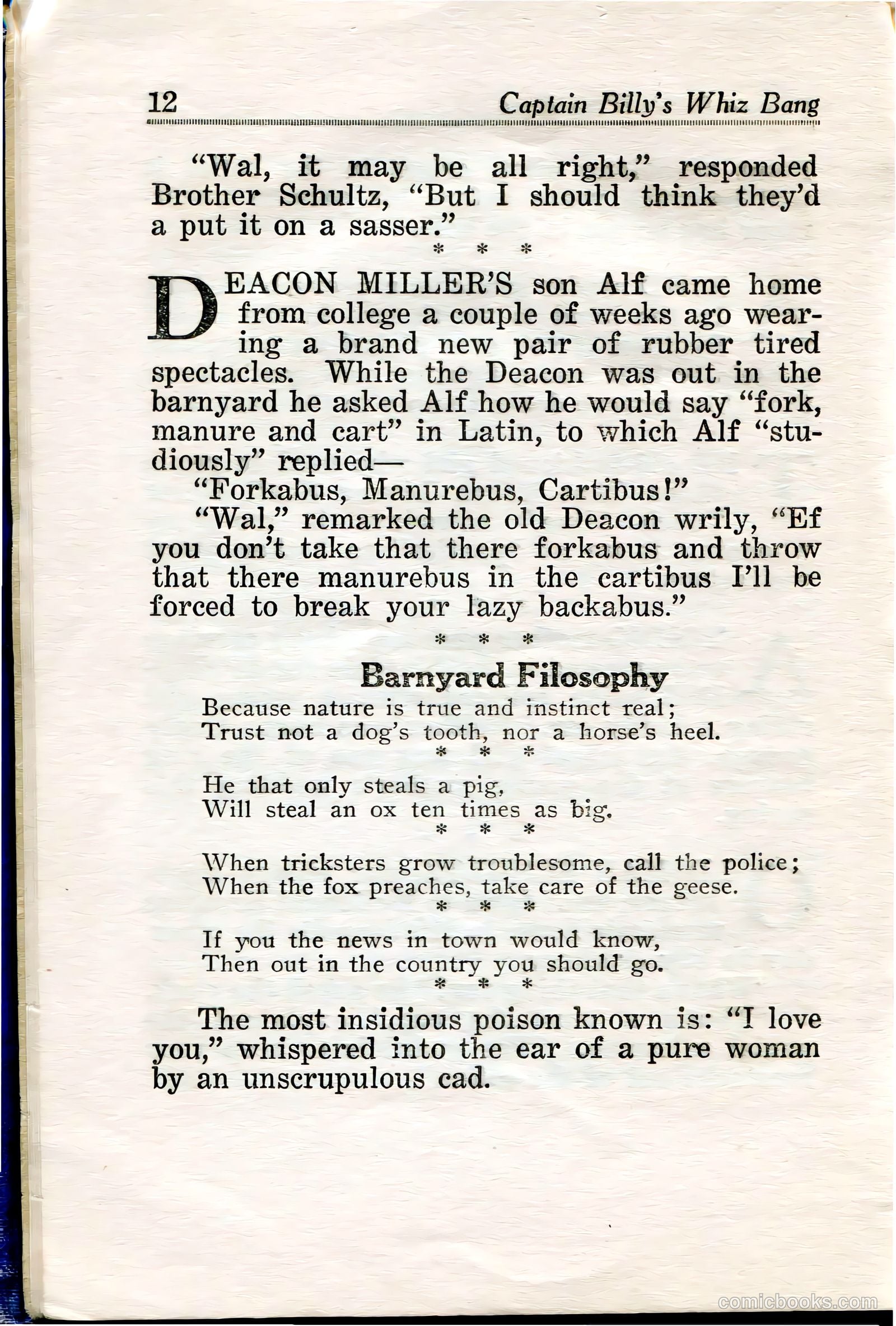
This page from the satirical magazine features rural humor typical of early 20th-century American comedy. The main joke mocks a college-educated farm boy ("Alf") who returns home with newfangled "rubber tired spectacles" (likely early eyeglasses with flexible frames). When asked to translate "fork, manure, and cart" into Latin, Alf produces absurd pseudo-Latin words ("Forkabus, Manurebus, Cartibus") by simply adding Latin endings to English words. His father, the Deacon, sarcastically responds by speaking in the same mock-Latin, ordering Alf back to farmwork. The satire targets two things: the pretentiousness of college education that disconnects youth from practical labor, and the contrast between urban sophistication and rural common sense. The joke suggests that education produces nothing of real value when confronted with actual work. The "Barnyard Filosophy" section reinforces rustic wisdom over learned foolishness, warning against trusting appearances and emphasizing practical morality.
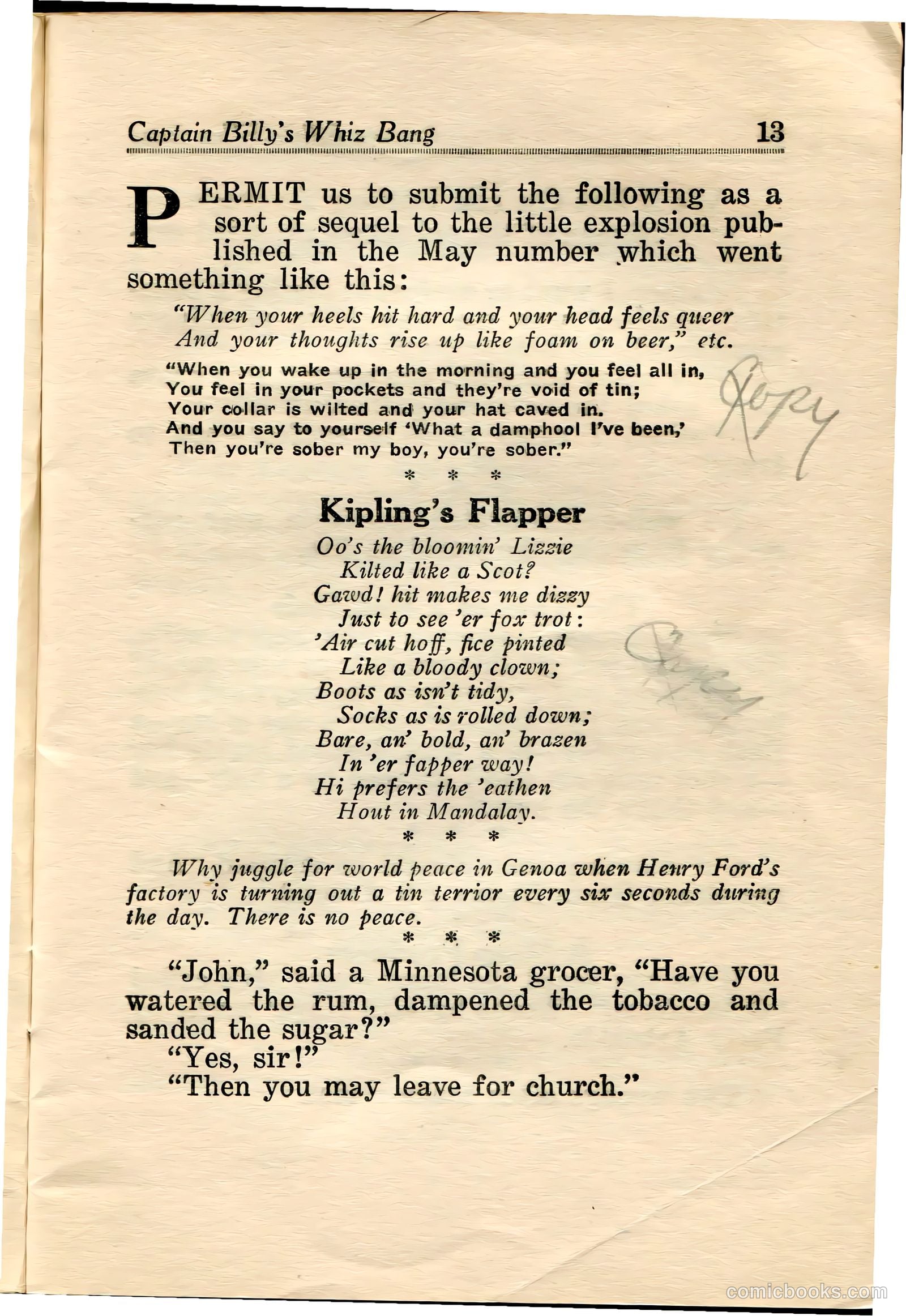
This page from the satirical magazine contains several jokes targeting 1920s social attitudes: **"Sober" Poem**: Mocks hangover symptoms—empty pockets, wilted collar, dented hat—as signs of a night's drinking. The humor depends on readers recognizing these as markers of working-class excess. **"Kipling's Flapper"**: Parodies Rudyard Kipling's famous poem "Mandalay" (about exotic colonial India), replacing romantic nostalgia with complaints about modern women—bobbed hair, short skirts, rolled socks, and bold behavior. The speaker prefers "heathen" colonial subjects to liberated young women. This satirizes both Kipling's romanticism and conservative backlash against 1920s female independence. **Henry Ford Reference**: Criticizes peace negotiations in Genoa (likely 1922) as futile when American industrial production (Ford's factories) continues unchecked—suggesting capitalism drives conflict regardless of diplomacy. **Grocer Joke**: Exposes merchant fraud—watering rum, dampening tobacco, sanding sugar to increase weight—then mocks the grocer's hypocrisy by attending church. Dark satire on commercial dishonesty and religious hypocrisy.
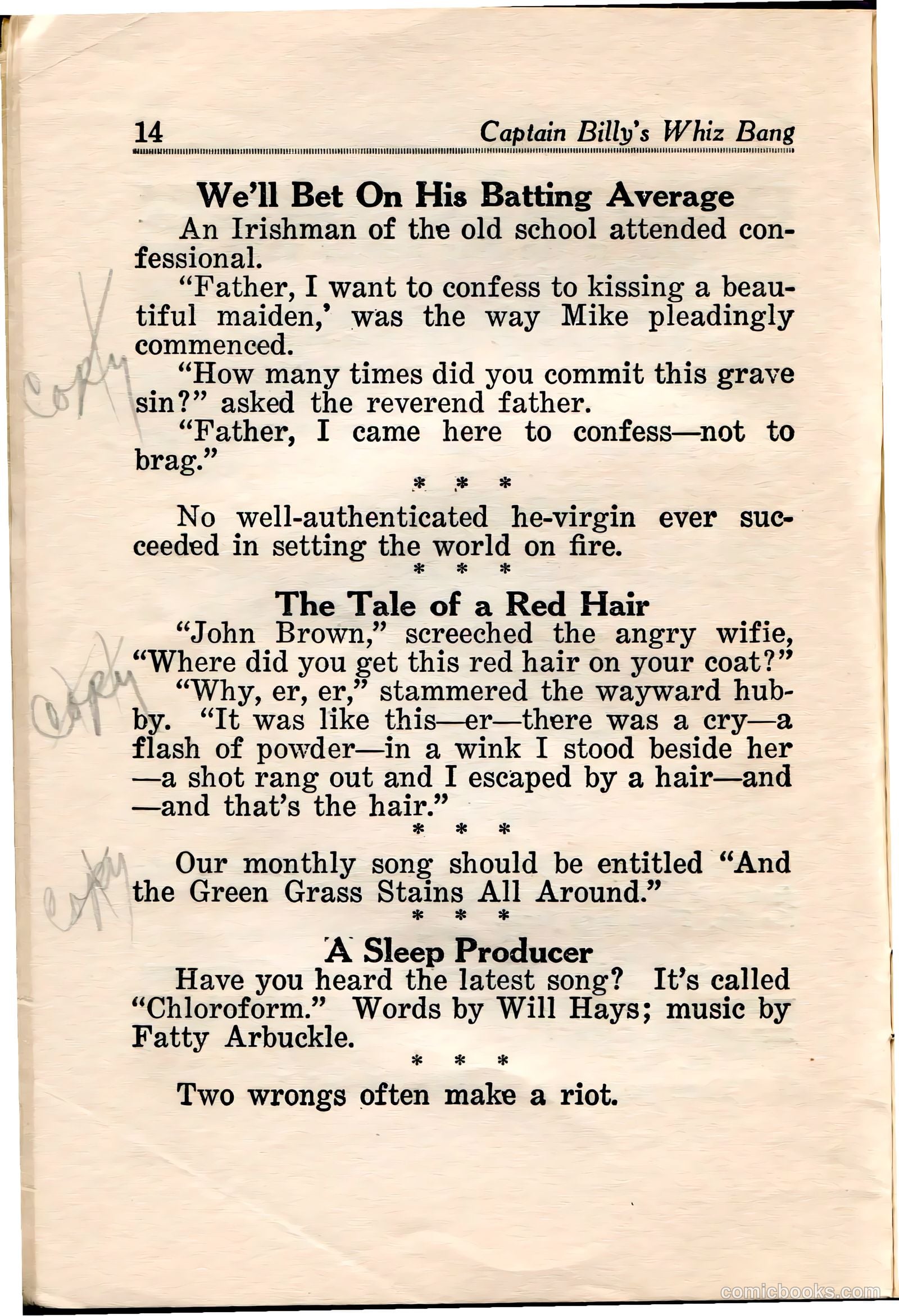
This page from an early 20th-century American humor magazine contains several short jokes targeting common domestic and social scenarios: **"We'll Bet On His Batting Average"**: Irish-American stereotype humor—a Catholic confession joke where an Irishman named Mike deflects the priest's question about how many times he kissed a woman by claiming he came to confess, not boast. **"The Tale of a Red Hair"**: Classic infidelity joke. A husband caught with another woman's hair on his coat invents an absurd excuse involving gunfire and powder flashes to explain it away. **"And the Green Grass Stains"**: A suggestive reference to outdoor romantic activity. **"A Sleep Producer"**: A dark joke naming "Chloroform" as a song, crediting real figures Will Hays and Fatty Arbuckle—possibly mocking their public personas or referencing scandals. The page reflects 1920s-era attitudes: ethnic humor, marital infidelity as comedy fodder, and cynical jokes about public figures.
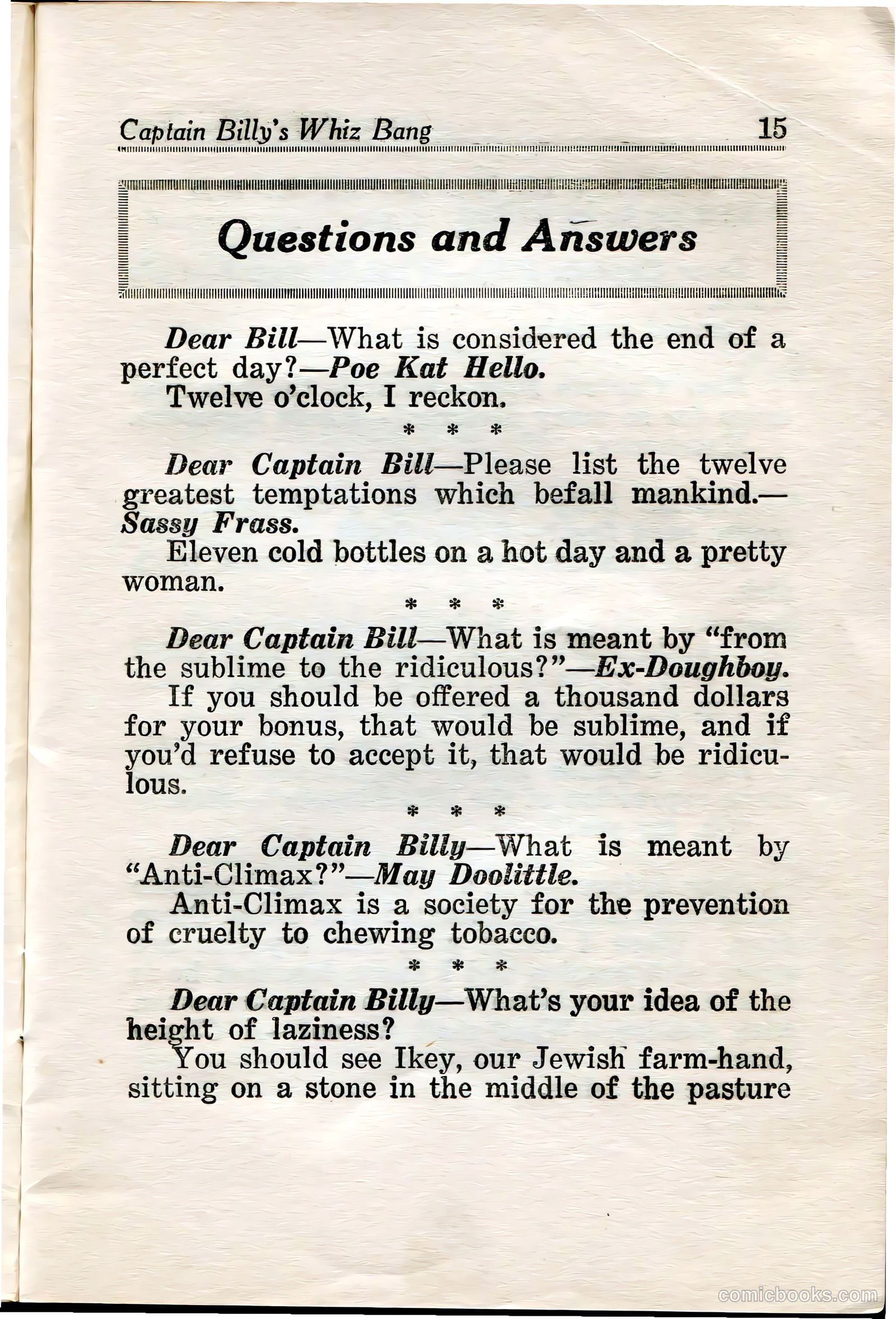
This is a humor Q&A column from *Captain Billy's Whiz Bang*, a post-WWI American satirical magazine known for irreverent jokes and wordplay. The humor relies on **puns and subversions of expectations**: readers ask definitions of phrases, but receive absurd, literal, or crude answers instead. Examples include defining "Anti-Climax" as a tobacco-cruelty society (playing on "climax"), and the perfect day ending at "twelve o'clock" (midnight, implying sleep/drunkenness). One answer references "Ex-Doughboy"—slang for a WWI veteran—making a joke about soldiers refusing war bonuses, topical to the 1920s veteran experience. The final answer about "Ikey, our Jewish farm-hand" employs a **ethnic stereotype** common to the era, characterizing Jewish workers as lazy. This reflects period prejudices that modern readers would recognize as offensive rather than humorous. The column's appeal lay in its irreverence toward authority and polite society—typical of 1920s American humor magazines.
This page from *Captain Billy's Whiz Bang* (a 1920s humor magazine) presents a Q&A advice column with satirical jokes targeting early 1920s social anxieties. The humor relies on: 1. **Marriage/divorce mockery** — "Matrimony" as divorce's cause reflects post-WWI skepticism about marriage 2. **1920s flapper culture** — The slang "Oh, my yes!" mocks young women's affectations 3. **Ethnic stereotyping** — The final letter uses "dago" (a slur for Italian immigrants) and puns "Ashes to ashes" as dismissive advice about a romantic relationship 4. **Crude animal/bodily humor** — Cat/mouse and milking references typical of the era's lowbrow comedy The column's anonymous questioners have comedic pseudonyms. The tone is cynical about love, marriage, and modernizing social behavior—characteristic of post-WWI American satire aimed at middle-class readers.
This is a humor advice column featuring absurdist, deadpan jokes typical of early 20th-century American satirical magazines. The "Dear Captain Billy" format mimics genuine advice columns, but answers are deliberately ridiculous non-solutions. **The jokes:** - Geographic puns (a "bang" creating locations) - Washing a profane parrot's mouth with soap (literal interpretation of cleaning speech) - "Painless dentists" — they don't feel pain, only patients do - Slang definitions contrasting "bindlestiff" (jobless tramp) with "gandy dancer" (employed tramp), the humor being minimal difference - Bed bug advice: exhaust them through years of chasing you between floor and bed The humor relies on **misdirection and literal interpretations** of figurative complaints. No specific political references are visible—this is pure comedic nonsense aimed at readers seeking entertainment during the interwar period. The tone is cynical about human problems having simple solutions.
This page from *Captain Billy's Whiz Bang* (a humor magazine popular in the 1920s-30s) contains three comedic sections with no political content: **Robbinsdale Society Notes**: Faux-serious local gossip items (a cow's calf, a barber's inventory) mimicking small-town newspaper columns—humor derives from treating trivial events as newsworthy. **Breezy Point**: A whimsical sound-poem listing barnyard and household noises, ending with a self-referential joke about the magazine itself ("This issue of Whiz Bang !!!—????****—"), suggesting the publication creates nonsensical noise. **Mistaken Identity**: A joke about a passenger in Athens confusing snow-covered hills with "Greece"—the humor plays on the woman's foolishness and the gentleman's equally absurd "correction," creating a double misunderstanding. These are gentle, domestic humor pieces typical of the magazine's focus on everyday absurdities rather than satire.
This gossip column exposes drug use among 1920s Hollywood elite. The piece alleges that a San Francisco man's Santa Monica bungalow hosts "dope parties" disguised as afternoon "tea," attended by film actors including Gloria Swanson—who the columnist suggests may have unknowingly attended. One guest "completely passed out," implying overdose. The satire mocks Hollywood's corruption and moral decay. The follow-up section coins "Hollywooditis"—a disease afflicting naive Eastern newcomers who succumb to the city's decadence and hedonism, contrasting disciplined "old timers" with weak newcomers. The piece satirizes both the drug culture and Hollywood's glamorous facade, suggesting that beneath the studio system's respectability lurked rampant substance abuse and moral compromise among celebrities.
This page satirizes "Hollywooditis"—a condition afflicting brilliant men who move to Hollywood and become frivolous and unfaithful. The article mocks two literary figures: **Gouverneur Morris** (a writer who abandoned his wife for young women after taking studio work) and **Douglas Doty** (respected editor of *Century* and *Cosmopolitan* magazines, now at Lasky Studio, whose marriage failed due to his Hollywood obsession). The satire's point: Hollywood corrupts serious intellectuals, turning them into shallow playboys chasing starlets and nightlife. The author presents this as a genuine "fever" afflicting America's best minds—a scathing critique of how the film industry supposedly debases literary talent. The tone is disapproving moralism typical of 1920s concerns about Hollywood's corrupting influence on American culture and values.
This gossip column satirizes "Hollywooditis"—the supposed moral corruption that befalls respectable people (particularly married men) when they come to Hollywood. The piece mocks several real figures: **Sir Gilbert Parker**, a conservative British MP, supposedly caught this "disease" while writing for producer Jesse Lasky. The joke suggests Hollywood's temptations (implied to be women and loose morality) seduce even staid, mature men. **The unnamed "Doty"** appears to be someone who constantly introduces different women as his work "inspirations"—satirizing the transparent excuse-making of unfaithful men. The column then lists those who *resisted* corruption (Rupert Hughes, Mary Roberts Rinehart) versus **Elinor Glyn**, who allegedly succumbed by dancing with teenage boys—presented as scandalous behavior. The final item about Betty Blythe's apartment rental is gossipy wordplay questioning whose apartment it really is—implying confusion about marital arrangements. Overall, this reflects 1920s anxiety about Hollywood as a morally corrupting influence on traditional society.
This page from **Captain Billy's Whiz Bang** (a satirical humor magazine) contains three gossip items mocking Hollywood celebrities and entertainers circa the 1920s. The jokes target: 1. **Cecile DeMille** and other performers adopting children—satirizing them as morally superior while implying the entertainment industry is wicked 2. **Miss du Pont** divorcing her husband (a Chicago salesman), with humor at the salesman's inadequate income compared to her film star earnings 3. An incomplete item about **Henry Lehrman** (likely a film director) and a prank involving a Los Angeles Times personal ad The satire mocks: entertainment industry moral hypocrisy, the wealth gap between celebrities and ordinary workers, and Hollywood gossip culture itself. The magazine's tone is irreverent, treating famous performers as subjects of ridicule rather than admiration—typical of this era's satirical humor targeting entertainment elites.
This page contains satirical gossip about early 1920s film industry figures. Henry Lehrman, a silent-film director/actor, is mocked for his financial irresponsibility—someone offers him $1 million for a film venture while he's being arrested for not paying for his wife's fur coat. The joke about "Arbuckle waiting around the corner with a brickbat" likely references Roscoe "Fatty" Arbuckle, suggesting retaliatory violence over unpaid debts. The final item ridicules small-town credulity: a rural newspaper editor's citizen claims Mabel Normand (silent film star) is "hiding" in the hills despite Los Angeles papers reporting her European travel. The satire implies locals believe unfounded rumors while actress Mabel actually delays filming during the William Desmond Taylor murder investigation—a major 1922 Hollywood scandal—before pursuing legitimate European travel.
This page from the December 1921 satirical magazine contains several discrete humor pieces: **"A Serious Case"** presents a mock-serious doctor's letter about Mrs. Pat Rooney's numerous ailments (salpingitis, oophoritis, arthritis, cholecystitis, flat feet). The joke appears to be the absurd catalog of medical conditions and repeated surgeries—satirizing either hypochondriacs or doctors' tendency to prescribe endless operations. **"On the Missing List"** is a brief joke playing on Irish dialect humor, popular in 1920s America. A husband discovers his wife missing and asks the Irish washerwoman if she knows her whereabouts. The punchline relies on the washerwoman's malapropism: she hasn't seen the wife in the laundry this week, so she's "nary a soign" (sign) of her. The humor trades on period ethnic stereotyping. **"Whiz Bang's Monthly Motto"** offers cynical advice about card-playing cheating—reflecting the magazine's irreverent tone toward trustworthiness and gambling culture. The page demonstrates *Whiz Bang*'s blend of medical satire, ethnic humor, and cynical worldview typical of post-WWI American comedy magazines.
This page from an early 20th-century humor magazine collects brief satirical jokes and light verse typical of the era. The "Hibrow Stuff" section parodies melodrama through wordplay—a villain wronged "Lucinda" but claims "slips don't count," a pun on the word's double meaning. "Saturday Evening Poetry" mocks banal domestic frustrations (no soap in the bathtub), a common complaint-based humor style. "Colgate's Special" plays on "strip poker" and the advertising brand. The conductor joke relies on the double meaning of "punch" (transit-punch tool vs. physical force). The "William/Will" entry is a crude sexual pun about coercion. The Elizabeth Lowder epitaph jokes about seidlitz powder (a digestive/laxative product) and "effervesce"—dark humor about bodily functions in death. The final item compares old public anxieties about "land grafts" (fraudulent real estate schemes) to contemporary interest in "gland grafts" (early transplant science), suggesting how quickly concerns date. Overall: lowbrow humor relying on puns, product placement, and mild social commentary.
This page contains several brief satirical jokes typical of 1920s humor magazines: **"This Isn't True"**: A Jewish stereotype joke. After a swimmer rescues a Jewish boy from drowning, the father's only concern is the lost hat—playing on an antisemitic caricature of Jewish frugality and misplaced priorities. **"Oh, You Frat Boys"**: References college fraternities (A.D., D.K.E., S.A.C., B.V.D.) in a suggestive verse about romantic/physical encounters, with B.V.D. (a underwear brand) as the punchline. **"Shave, Shoe Shine or Singe?"**: A barber-shop complaint that the barber is incompetent—"worse than barberous" (playing on the word "barbarous"). **"Four reasons why Gus left home"**: Lists four women's names, implying infidelity or romantic entanglement drove him away. The humor relies on period stereotypes, double entendres, and wordplay rather than sophisticated satire. The Jewish joke reflects casual bigotry common in early 20th-century American entertainment.
This is a humor page from an early 20th-century American satirical magazine, consisting of brief jokes and quips rather than visual cartoons. The content reflects period attitudes: women are mocked for their appearance ("Women and eggs alike"); sorority girls are derided for loose morality ("nothing to fasten them to"); and there's wordplay on naval terminology where "screw" (the ship's propeller) sets up an innuendo joke. A drunk man's excuse for lying in a gutter plays on slurred speech and faulty logic. The final joke mocks female ignorance, equating a "football coach" with a vehicle—likely referencing the slang term "coach" for a car or carriage. The tone is lighthearted misogyny typical of 1920s humor magazines, targeting women's intellect and morality as stock comedic subjects.
This page from the satirical magazine contains brief humorous items rather than traditional cartoons. The jokes target early 20th-century social absurdities: **"He Has Every Care"** reports on Otto Kuntz's illness with mock-serious concern, typical of gossip-column parody. **The college dolls joke** mocks collegiate immaturity. **The oyster book** satirizes absurdist literature titles, referencing the bizarre song "If Beer Bottles Had Nipples I Would Be a Baby All My Life"—likely parodying sentimental or nonsensical popular songs. **"Love's Force"** is a limerick about a Siamese maid resisting a suitor's advances with flirtation. **The hair-in-hash item** makes a crude domestic joke about finding unexpected things in food. **"Flees in Her Night Dress"** hints at scandal or comedic misadventure. **The final jokes** mock poor memory (possibly from alcohol) and forgiveness through violence—cynical humor reflecting post-WWI American attitudes.
This page from the satirical magazine contains no cartoons—only text-based humor and aphorisms typical of 1920s "joke book" publications. The main joke involves three traveling salesmen (a stock comedic figure of the era). The humor hinges on the third man's punchline: he buys a baseball bat, knocks on his front door, runs to the back door, and claims he "hasn't missed a man in six years"—implying he's beaten an intruder/rival. This is dark domestic humor playing on anxieties about infidelity and masculine protection of the home. The remaining content consists of scattered aphorisms, puns (the baker saying "early to bread" instead of "early to bed"), and folk wisdom—common filler in magazines of this period. "Bum Bomb Advice" likely references post-WWI satirical commentary, though the specific "Go West...blow up with the country" reference is unclear without broader historical context. The overall tone is lighthearted, cynical entertainment for male travelers and salesmen—the magazine's core audience.
This is a tragic ballad about a vagrant railroad worker ("boomer shack") named Jack who dies of thirst and despair after being barred from Mexico—likely during Prohibition or at the U.S.-Mexico border. Jack, heading toward Mexico for beer ("lager flow"), encounters a border line marked "Thou shalt not pass" that prevents him crossing. Tormented by seeing a Pilsener beer sign across the boundary, he dies at the pavement. The satire targets immigration restrictions and arguably Prohibition-era alcohol bans that left working-class transients like Jack suffering. The absurdist riddles below ("blind flea," "pickled tripe") and the ethnic joke about "Olaf, our Swedish plow-hand" are typical *Whiz Bang* humor—crude, anti-immigrant jabs common to 1920s American satire magazines. The piece mocks both border policy and the desperation of migrant laborers.
This page from *Captain Billy's Whiz Bang* (a WWI-era humor magazine) satirizes post-war American hardship through mock-religious parody. "The Doughboy's Prayer" inverts Psalm 23, replacing God with Congress—mocking soldiers' betrayal after combat. Veterans faced unemployment, denied bonuses, and broken promises, leading to genuine hardship and political anger (the "Bonus Army" became a major 1930s issue). The shorter pieces mock economic absurdity: "Topsy-Turvy" catalogs wartime commerce gone strange (seeds in hardware stores). The "jewelry" joke depicts poverty so severe that soup droplets on clothing masquerade as pearls—dark humor about Depression-era desperation. The final line, "A 'tip' in time saves many a fine," likely warns against bribery (paying cops). Overall: biting satire of broken promises to veterans and economic chaos.
This page reprints Dr. Frank Crane's article criticizing racist ideology, using satire to expose its absurdity. The Whiz Bang—a satirical magazine—republishes Crane's argument against white supremacist justifications for racial hierarchy. Crane mocks the "white man's burden" concept and the biblical justification for Black oppression (the "curse of Ham"), calling both unconvincing rationalizations. He points out the contradiction in American ideals: the U.S. claimed to support self-determination (referencing Woodrow Wilson's Fourteen Points), yet denied this to African peoples. He also contrasts Africa's peaceful indigenous life with the disruption colonialism brought. The editorial's title—"The Ball is Mightier Than the Bullet"—suggests reason and debate (represented by a ball/sphere) defeat violence. The piece responds to a 1919 Harlem demonstration where Black Americans "stood up for their rights," presenting this as justified resistance rather than provocation.
This page contains two distinct pieces. The first is a brief satirical essay comparing African customs favorably to American behavior—praising African restraint in warfare (fighting only when hungry) versus American wars fought "for no reason," while advocating for ethnic self-determination ("Africa for the Africans...New York for the Jews"). This reflects 1920s progressive attitudes, though the racial language is period-typical. The second piece begins a sentimental narrative about encountering a drunk foreigner in winter. He's revealed to be devastated by his lover Lucy's death, seeking oblivion through alcohol ("hootch"—prohibition-era slang for illegal liquor). The story appears designed to elicit pathos, setting up a human-interest tale in a satirical magazine's pages. Both pieces address alcohol and cultural attitudes characteristic of post-WWI America.
This passage from the satirical magazine depicts a street scene where a drunk man attracts a crowd eager to mock him. The narrator intervenes, redirecting the situation toward compassion rather than cruelty. The satire targets two groups: the callous crowd that views the drunk man's misery as entertainment ("let's have some sport with him"), and implicitly, the taxi driver who candidly admits his routine involvement in transporting intoxicated men—and his expectation that some will "get nabbed by the cops." The joke operates on contrasting values: the crowd's instinct toward humiliation versus the narrator's quiet charity (providing money for a cab ride home). The driver's casual admission that this is "the same old story" satirizes urban indifference and suggests police harassment of drunks was routine and expected. The ending—where the silent crowd disperses—suggests the narrator's moral stance has shamed them into reflection, mocking their initial callousness and society's casual cruelty toward the vulnerable.
This page contains no cartoon—it's a collection of moralizing aphorisms typical of *Whiz Bang*, a humor and wisdom magazine. The text preaches compassion for social outcasts: "fallen women" condemned by their own sex, and drunken men mocked by peers. The underlying social critique addresses early 20th-century hypocrisy—how the poor and desperate faced double punishment (legal and social), while those with advantages showed little Christian charity. References to "the drunken man" and "fallen woman" suggest Prohibition-era concerns and attitudes toward moral failings. Later sections warn about gossip, betrayal by confidants, and the destructive power of rejected love and wounded pride. The overall message advocates kindness toward those who've stumbled, treating them with dignity rather than cruelty. This reflects contemporary Progressive-era social reform sentiment.
This page contains no cartoon—only aphoristic satirical sayings typical of the publication's humor style. The content targets early-20th-century social attitudes and reformers. Key targets include: **Anti-modernism**: The magazine mocks those who romanticize the "good old days" while complaining about jazz and automobiles—the text suggests their nostalgia is selective and uninformed. **Gender roles**: "The hands that roll the stockings" (women's domestic work) versus those who "rule the world" reflects contemporary class and gender divisions. **Reformers**: The final quip satirizes moral crusaders as hypocritical—they advocate for reform, then criticize the results, suggesting performative rather than genuine conviction. The sayings use folk-wisdom tone to deflate pretension and self-righteousness. Overall, *Whiz Bang* positions itself as cynically pragmatic against both nostalgists and self-appointed moral improvers.
This is not a cartoon but a three-part poem published in *Captain Billy's Whiz Bang*, a humor magazine popular in the 1920s-30s. The poem expresses a plainspoken, anti-pretentious philosophy suited to the Western frontier spirit. The speaker requests a simple tombstone epitaph: "He Done His Damdest"—rejecting elaborate marble monuments and flowery sentiments. The poem defends this humble choice against those with "phony piety" who'd be scandalized, arguing that honest effort matters more than concealing life's sins beneath virtuous words. A footnote reveals the poem originally memorialized the editor's dog at "Breezy Point," whose tombstone praised qualities like "Beauty without Vanity"—suggesting the satirical magazine valued straightforward virtue over social pretense, even applying this philosophy to pet memorials. The satire targets Victorian sentimentality and hypocrisy.
This page contains **no political cartoons**—it's a collection of humorous poetry and literary pieces typical of this satirical magazine. The content includes: 1. **A tribute to "Boatswain, a dog"**—a sentimental memorial using elevated language, likely mocking overwrought eulogies. 2. **"Age and Youth"**—a Shakespeare excerpt contrasting youth's vigor with age's decline, framed as romantic poetry but undercut by its clichéd comparisons. 3. **"At Breezy Point"**—satire of flowery nature poetry. A poet hails spring's "gorgeous charms," but the joke is that spring literally "hailed" (produced hail/sleet) instead, making the grandiose language ridiculous. 4. **"Pot of Ink"**—self-aware mockery of pretentious verse, where the poet dramatically addresses an inkwell with hatred and love. The satire targets romantic and nature poetry's overwrought sentimentality—a common target in American humor magazines of this era. The humor relies on puncturing pompous literary conventions through mundane reality.
This page contains three humorous poems from an early 20th-century American satirical magazine: **"If the Park Benches Could Talk"** imagines park benches gossiping about romantic scandals they've witnessed—specifically mentioning "Katie Thomas" suing for breach of promise and "Stupid Willie" making a romantic conquest of "Millie." The joke depends on readers recognizing these appear to be references to local scandals or common romantic mishaps. **"The Lumber-jack Blues"** humorously catalogs summer pest infestations (ants, roaches, bedbugs, insects) that torment workers during warm months—likely resonating with working-class readers. **"Song of Uncle Sam"** satirizes American money flowing overseas, requesting it be returned. The final poem jokes about Prohibition by suggesting home-brewing as a solution to constant thirst. The overall tone is lighthearted social commentary targeting everyday frustrations and romantic indiscretions. No specific political figures are caricatured; instead, the satire targets universal human experiences and popular anxieties of the era.
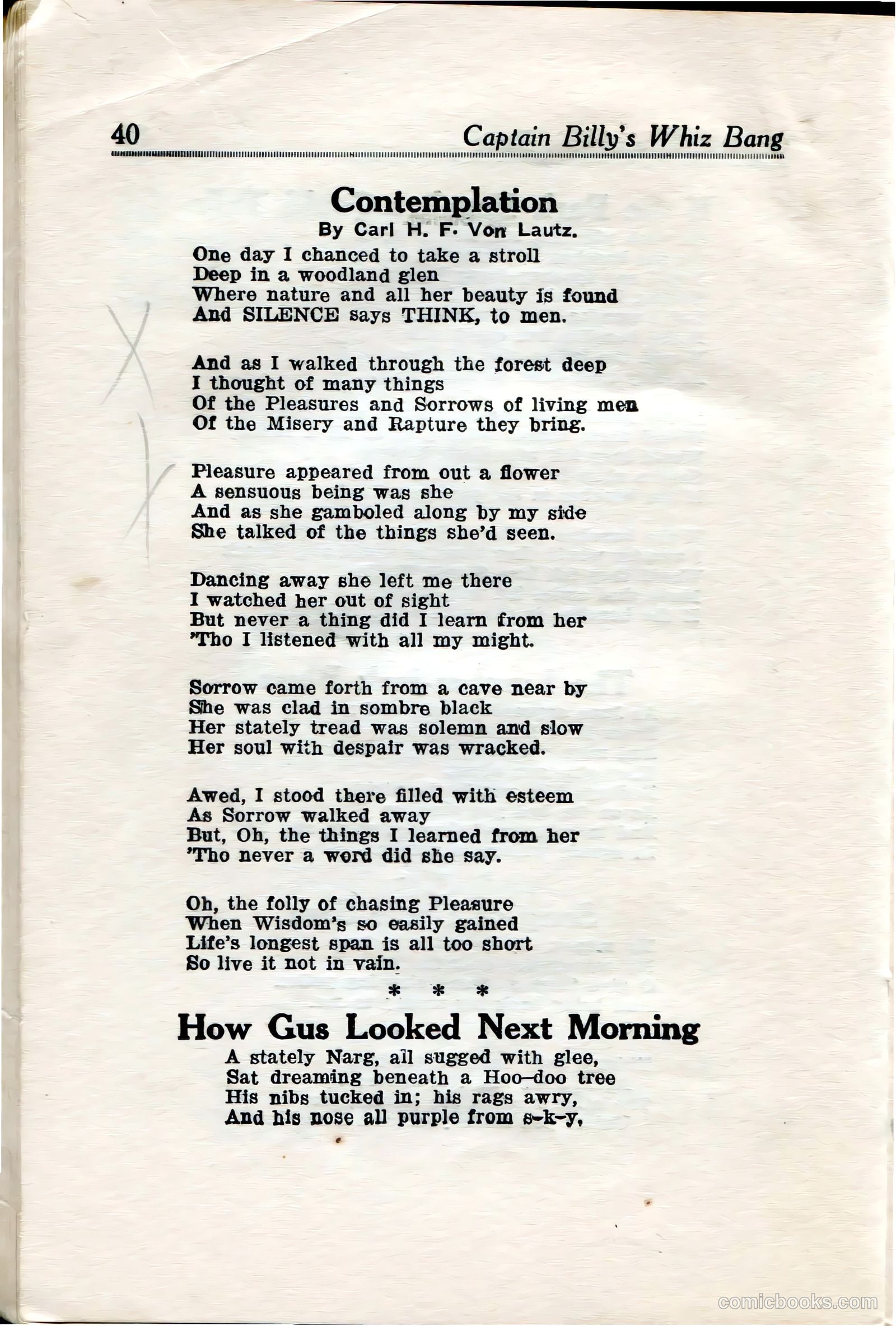
This page contains two pieces of light verse from *Captain Billy's Whiz Bang*, a humor magazine popular in the 1920s. **"Contemplation"** is a philosophical poem using allegorical figures—Pleasure (sensuous, talkative but teaches nothing) and Sorrow (silent, somber, yet instructive)—to argue that life's hardships offer more wisdom than frivolous enjoyment. The moral is conventional: suffer nobly rather than chase empty pleasures. **"How Gus Looked Next Morning"** appears to be comedic doggerel about a character named Gus (likely a recurring figure in the magazine) who has overindulged. The nonsense words ("Narg," "Hoo-doo tree," "s-k-y"—likely spelled out to mean "whiskey") and physical comedy description (purple nose, disheveled appearance) suggest a hangover joke. The humor is slapstick rather than sophisticated. Neither piece contains political satire. Both reflect the magazine's blend of sentimental philosophy and bawdy humor typical of post-WWI American periodicals.
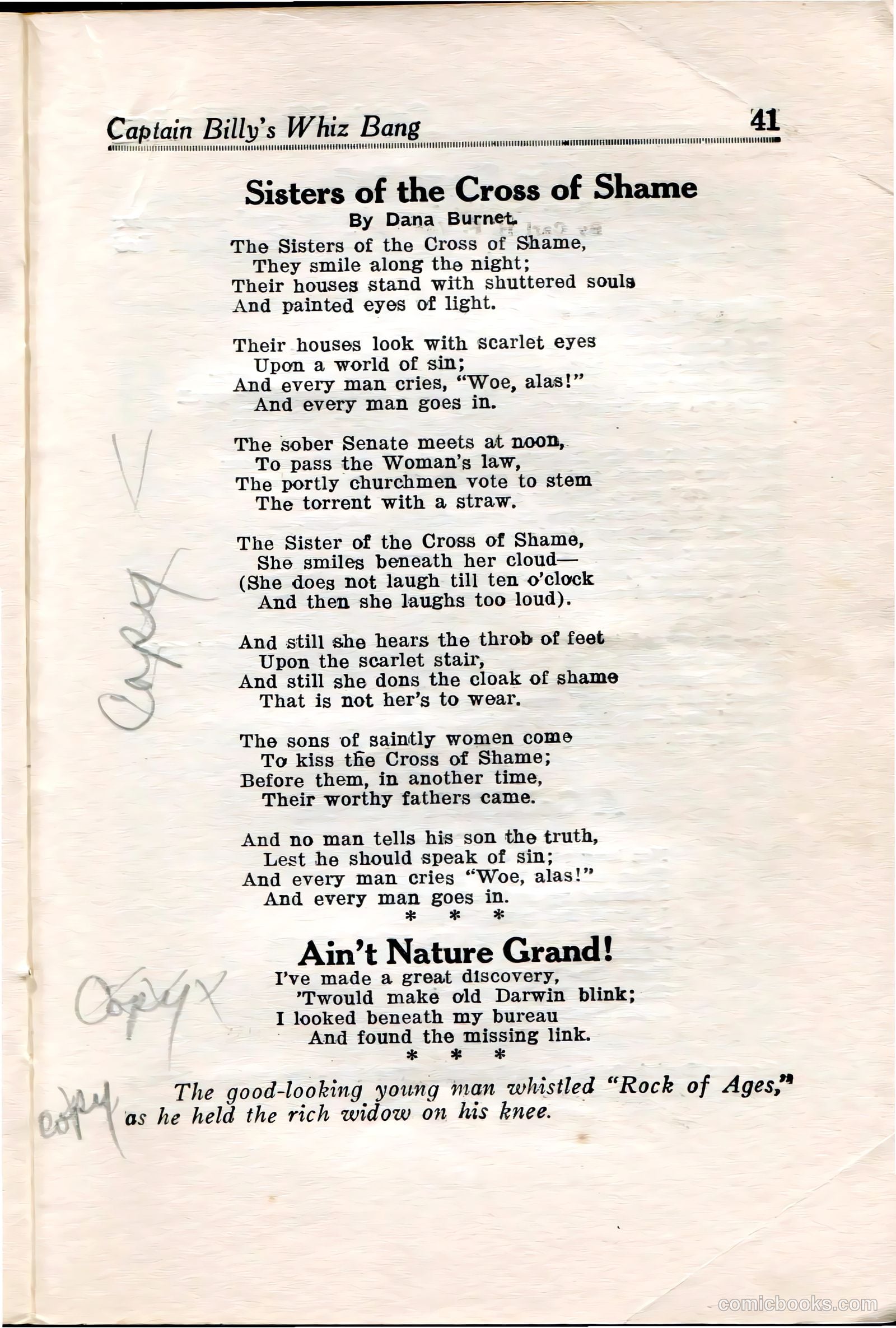
This page contains two distinct satirical pieces critiquing early 20th-century hypocrisy. **"Sisters of the Cross of Shame"** attacks moral double standards around prostitution. The poem mocks legislators and clergy who publicly condemn "sin" while privately visiting brothels ("scarlet" houses). The satire's bite lies in showing that respectable men—senators, churchmen, even sons of "saintly women"—patronize these establishments while society blames the women who work there. The "Sisters" wear shame that isn't rightfully theirs; the real shame belongs to the hypocritical men who visit yet deny the reality. **"Ain't Nature Grand!"** is a crude joke mocking Darwinian evolution theory, suggesting a man found "the missing link" (evolutionary connection between humans and apes) under his bureau—likely referring to a woman or servant, reflecting the era's casual misogyny. The final snippet about a young man courting a widow while whistling a hymn continues the hypocrisy theme: religious pretense masking mercenary romance.
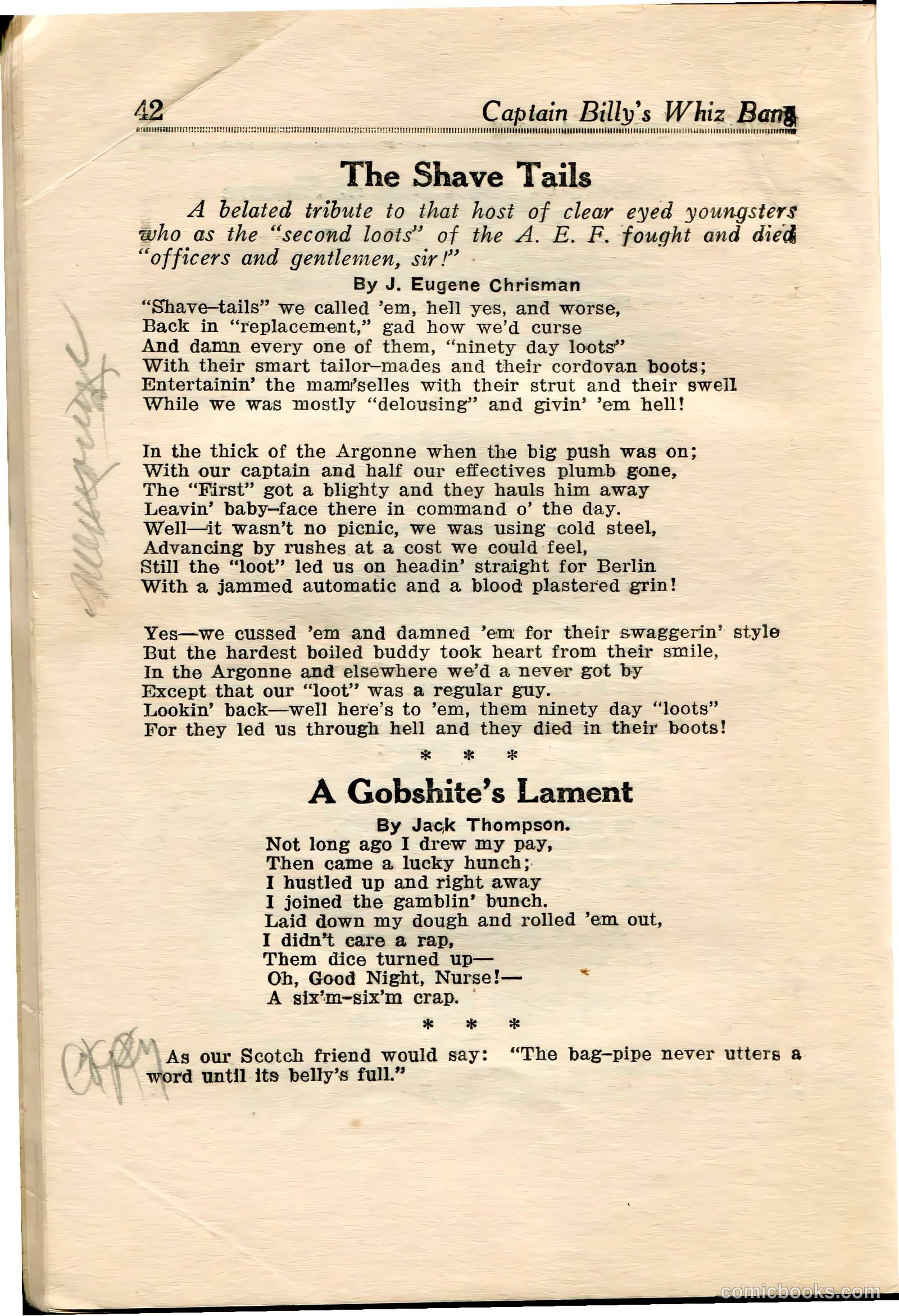
This page contains two satirical poems from a WWI-era American humor magazine. **"The Shave Tails"** is a veteran's tribute to newly commissioned officers ("ninety day loots"—slang for lieutenants) in the American Expeditionary Forces during WWI. Initially mocked for their inexperience, fancy uniforms, and youth, these young officers proved their worth during the brutal Argonne Offensive. The poem's central irony: soldiers cursed these green officers but ultimately respected them because they led courageously ("blood plastered grin") and died alongside their men. "Shave-tail" itself meant an inexperienced officer. **"A Gobshite's Lament"** is a brief comic poem about losing money gambling—a common soldier's vice. The punchline relies on the phrase "Oh, Good Night, Nurse!" (a period exclamation of dismay) and rolling "craps" (losing dice rolls). The page reflects post-WWI American sentiment: nostalgic respect for soldiers' sacrifice mixed with crude humor typical of working-class soldiers' culture.
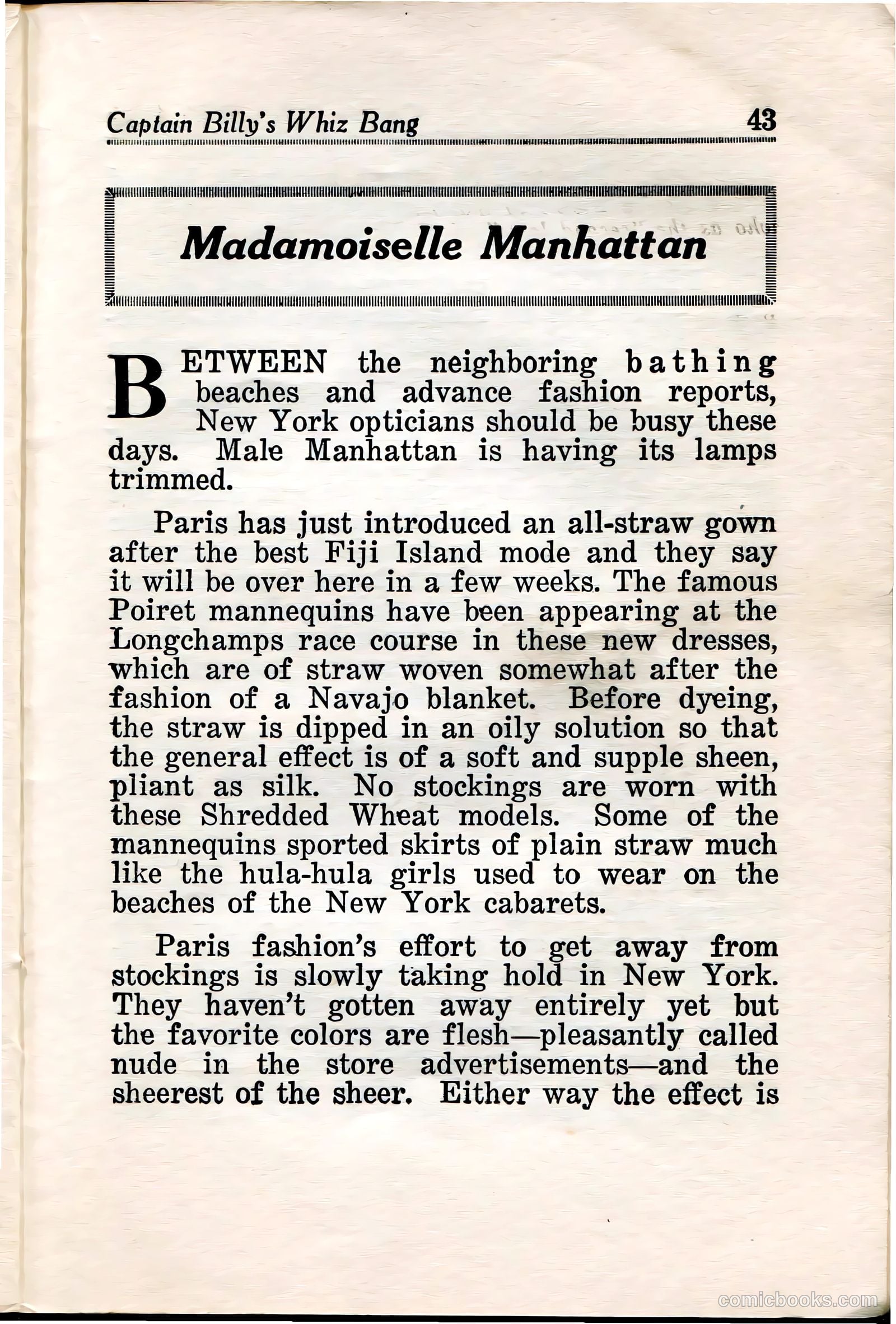
This satirical column mocks emerging 1920s fashion trends imported from Paris. The piece opens with a joke about New York men needing eye doctors because women are displaying their legs more openly—"Male Manhattan is having its lamps trimmed" is slang for men being visually distracted. The column ridicules the latest Paris fashion: straw dresses inspired by Fiji Island and Navajo aesthetics, worn without stockings. The satire lies in treating these expensive haute couture garments as absurd ("Shredded Wheat models") and comparing fashionable mannequins to hula dancers in New York cabarets—equating high fashion with lowbrow entertainment. The closing joke about "nude" stockings emphasizes the risqué nature of the trend: women adopting near-bare legs was scandalous. The piece captures 1920s anxiety about rapidly changing sexual and fashion norms, presented through satirical mockery of both Paris pretension and American women's adoption of these styles.
This page contains satirical commentary on 1920s theatrical costume trends. The author mocks burlesque producers who claim they're returning to "tights" out of moral concern, when the real issue is that modern women's fashion (short skirts) has eliminated the theatrical appeal of exposed legs—previously scandalous, now mundane. The piece then critiques the Winter Garden's "Make It Snappy" (an Eddie Cantor revue) for attempting daring costume minimalism, describing performers wearing only strings of beads as "protection." The satire targets both the hypocrisy of theatrical producers claiming moral revival while actually chasing profit, and the absurdity of theatrical "decency" standards that allow near-nudity through creative justification. The crude opening reference appears to mock women's rolled stockings, popular 1920s fashion worn with short skirts—presented as hazardous or attention-grabbing on streets.
This page satirizes contemporary debates about changing women's fashion and behavior in 1920s America. A French character, Rene Callay, critiques American women's short skirts and low necklines as immodest by European standards, yet simultaneously calls them prudish for not reciprocating male attention. He dismisses their "fluency of movement" compared to French women. The magazine responds playfully, inviting debate. The second section mocks extreme bohemian fashion via Greenwich Village "art models" wearing scandalous bathing suits—socks rolled down, tight trunks, and implied brassieres (alluding to ancient queens). The satire targets post-WWI cultural anxieties: women's increased workplace participation, the "flapper" style with shorter hemlines, and bohemian rejection of Victorian modesty. The magazine uses exaggeration to simultaneously mock both prudish foreign judgments and America's avant-garde fashion experimenters.
This satirical column from the 1920s mocks several targets: **The Bathing Suit Controversy**: The author criticizes censorship hypocrisy—revealing two-piece swimsuits (attributed to filmmaker Mack Sennett) are worn openly on beaches by flappers but prohibited on film by censors. He notes the absurdity that "inland America" can't see on screen what exists in reality. **"Wood Alcohol" Reference**: A darkly comic jab at Prohibition-era drinking—men supposedly risk blindness consuming dangerous bootleg liquor while simultaneously being scandalized by women's bathing attire. **Long Island Studio Misconduct**: The second section alleges sexual harassment at an unnamed studio where a director pressures aspiring actresses—they can either leave "insulted or remain and blush." The author challenges why Hollywood monopolizes blame for immorality when the problem is systemic and industry-wide. The overall tone: frustrated at moral double standards—censorship of women's bodies on film while real exploitation goes unchecked.
This is a gossip and entertainment column satirizing Broadway and Hollywood in the 1920s. The text mocks: **De Wolf Hopper and Hedda Hopper**: A famous comedian known for multiple marriages; the column jokes that his impending divorce from actress Hedda Hopper may set a record for his marital adventures. **"Lady Godiva" film adaptation**: The column ridicules the movie's excessive censoring—making Tennyson's famous nude-horse-ride legend completely inoffensive. It sarcastically notes promoters added "Lord" to the poet's name thinking "nobility stuff counts big" for marketing. **Lady Diana Manners in "The Glorious Adventure"**: The writer dismisses her as stiffly aristocratic and overly concerned with appearing "bred" rather than delivering genuine performance. The satire targets both Hollywood's timidity with censorship and the era's snobbish valorization of British nobility in American entertainment. The humor relies on readers recognizing these entertainment figures and industry practices of the period.
This page from the satirical magazine *Captain Billy's Whiz Bang* contains several short humorous commentary pieces rather than traditional cartoons. The first section mocks a melodramatic scenario (likely from pulp fiction or cinema): an aristocratic English lady maintains her composure and class pretenses even while being kidnapped by an escaped convict, worrying afterward about propriety—a jab at upper-class pretension and rigid social codes. The subsequent sections present tongue-in-cheek philosophical observations on gender relations, arguing women subtly rule men despite appearing submissive. One passage sarcastically compares animal and human mating behavior. The drinking joke references Prohibition-era anxiety: five years prior, drunk men sang secular songs; now they sing hymns, suggesting increased drunkenness or moral decline. The final note defends female nudity in art as morally acceptable when the body is "perfect" enough—likely satirizing contemporary debates over artistic expression and censorship during the 1920s.
This page from *Captain Billy's Whiz Bang* is a nostalgic article about the Old West, not a political cartoon. It recounts a funeral for Riley Grannan in Rawhide, Nevada, attended by Rev. H. W. Knickerbocker ("Old Sky-Pilot Knick") approximately fourteen years prior to publication. The piece celebrates vanishing frontier figures—rough adventurers drawn by gold rushes—particularly "Diamondfield Jack Davis," a gunslinger known for notches on his gun's grip (indicating kills). The article romanticizes this era as irreplaceable, lamenting that "no more will such a galaxy of picturesque figures be assembled." The subtitle jokes that Knickerbocker refused "to Give God Pointers"—suggesting the preacher's sermon was so forceful he didn't need divine guidance. This is a sentimental, nostalgic piece celebrating Old West mythology and frontier characters, typical of the magazine's Americana content.
This page from the satirical magazine presents a prose narrative (not a cartoon) describing colorful characters from the Nevada mining boom era, particularly Rawhide and Goldfield. The text catalogs various figures—brokers, prospectors, gamblers, and a German nobleman—highlighting their scandals and fortunes. The satire centers on "Old Knick" (Rev. Mr. Knickerbocker), a former Los Angeles church pastor who abandoned respectability to join fortune-hunters in the desert. The joke appears to be setting up his unconventional response to California's drought: while other churches prayed for rain, he apparently did not, suggesting either irreverence toward religious convention or faith in alternative solutions. The passage mocks the chaotic morality of the Gold Rush era—casual violence (Jack Hines's acquittal for murder), gambling fortunes lost overnight, and a clergyman preferring desert prospecting to lecturing. For modern readers, "Whiz Bang" was known for irreverent, bawdy humor targeting American hypocrisy.
This page celebrates "Old Knick" (a character based on real person Jack Knickerbocker), a colorful frontier figure from Nevada mining towns Goldfield and Rawhide. The anecdote satirizes religious presumption: when parishioners demand he pray for rain, Knick refuses, declaring God needs no "pointers"—a humorous jab at formulaic prayer and human arrogance. The text praises Knickerbocker's eulogy for a friend (Grannan), which unexpectedly achieved widespread circulation after publication in *Whiz Bang*. The satire's point: this spontaneous, irreverent tribute will outlast both the famous celebrities who visited Rawhide and the town's gold itself. Notably mentioned is Elinor Glyn, author of the scandalous novel *Three Weeks*—emphasizing how even notorious figures fade while a humble man's words endure. The piece celebrates authentic character over fame.
This page from *Captain Billy's Whiz Bang* (a 1920s satirical magazine) contains multiple brief jokes reflecting Prohibition-era concerns and social anxieties: **"See America First"** mocks travel boosterism while referencing alcohol's hallucinogenic effects—a common concern during Prohibition. **"Washington News Note"** is political satire predicting Congressional turnover, likely referencing upcoming elections and political instability of the period. **The Indian joke** plays on outdated racial stereotypes while making a crude economic comparison—"bucks" as currency puns on both dollars and Native American trade. **"See the Pint?"** satirizes bootleggers during Prohibition, suggesting illegally-produced alcohol contained dangerous substances (fish hooks representing contamination/harm). **The factory owners' craps game** uses gambling terminology ("shoot," "piker," "works") as double entendre for reckless betting during economically volatile times. Throughout, the humor reflects Prohibition anxieties, economic instability, and casual prejudices typical of 1920s American popular culture.
This gossip column satirizes **Willard Mack**, a stage actor/playwright, for financial irresponsibility. The joke: Mack rents a mansion while supposedly too preoccupied "thinking" plays to pay his bills—avoiding rent collectors, grocers, and butchers. The satire mocks his pretentious artistic priorities over basic obligations. A persistent rent collector literally camps on his steps for two days to collect payment. The column adds a punchline: Mack is rehearsing a vaudeville sketch about **Al Jennings** (a real former bank robber turned actor), sarcastically asking if the "famous bandit" has been teaching Mack criminal behavior—a witty comparison between financial deadbeating and actual crime. The second item (incomplete) references an exclusive Wilshire Boulevard residence offering discreet services to well-connected clientele, likely implying illicit activity. The satire targets Hollywood's financial chaos and moral looseness during the 1920s entertainment boom.
This page is a satirical gossip column from *Captain Billy's Whiz Bang* (a 1920s humor magazine), not a cartoon. It mocks celebrity romance and Prohibition-era speakeasies. The text references famous silent-film stars of the era—Jack Dempsey (boxer), Bebe Daniels, Peggy Joyce, and Harold Lloyd—satirizing their romantic entanglements. The column's opening joke suggests that wealth and celebrity status (not looks) attract romantic attention. The "Green Mill" section appears to reference a Chicago nightclub operating during Prohibition (roughly 1920-1933). The satirical point is transparent: the restaurant claims no visible alcohol ("nary a bottle projects itself across the horizon"), but the author winks that patrons clearly obtain drinks anyway—the "something besides H₂O" phrase suggests bootleg liquor is being served covertly at nearby tables. The humor mocks the absurdity of Prohibition's pretense: establishments openly flouting the law while maintaining a thin veneer of legality.
This page from the satirical magazine contains three Hollywood scandal items from circa 1921: **George Walsh vs. Tom Mix lawsuit**: Actor Walsh sues Western star Mix for $25,000 over possession of "Joe," a famous stunt horse. Walsh claims Mix promised temporary custody but refused to return the animal. **Mae Busch divorce**: The actress (known for "Foolish Wives") files for divorce from actor husband Francis McDonald. **The Hypocrisy Joke**: Reverend R.J. Whitcomb Brougher had publicly denounced Hollywood immorality, but his own son-in-law Norman Buist entered the film industry—upsetting the family. The satire mocks clergy hypocrisy regarding the "corrupt" film industry. The opening paragraph jokes about speakeasy culture (likely Prohibition-era Green Mill bar), where blind waiters facilitated covert drinking signals. These items ridicule both Hollywood excess and moral crusaders' double standards.
This is a gossip/scandal column from *Captain Billy's Whiz Bang*, a satirical magazine popular in the 1920s. The page contains three Hollywood celebrity items: 1. **Rudolph Valentino scandal**: The famous "Sheik" actor married Natacha Rambova (perfume magnate's daughter), but officials claim his previous marriage to Jean Acker wasn't dissolved—making this marriage bigamous. The "sweet lavender" opening mocks Valentino's perfumed, romantic image. 2. **Hoot Gibson wedding**: A Western film star impulsively married vocalist Helen Johnson after seeing her perform in vaudeville. 3. **Robert Campbell lawsuit**: A two-year-old sues over catching a cold while working on a film set—satirizing the absurd litigation culture of early Hollywood. The humor relies on celebrity scandal exposure, marital chaos, and mocking the entertainment industry's excess and litigiousness.
This page from the satirical magazine contains four brief gossip items and jokes about 1920s entertainment figures: 1. **Robert's lawsuit**: A quip about a young child suing over life's hardships—satirizing frivolous litigation trends. 2. **Virginia Fox and Billy Joy**: Reports of their impending marriage. Billy Joy, brother of actress Leatrice Joy, formed a comedy company to star Fox. 3. **Unemployed show girl**: A humorous anecdote about a former theater performer working as a waitress who impulsively greets an old acquaintance ("Bertie") at a formal dinner by dropping soup and covering his eyes—costing her the job. The joke ridicules her lack of professional restraint. 4. **Constance Talmadge's elopement**: Confirms the actress eloped with wealthy Greek tobacco manufacturer John Pialoglow to Greenwich, Connecticut on Christmas Day 1920, defying parental opposition. The page is primarily celebrity gossip and light humor rather than political satire, reflecting the magazine's focus on entertainment-world scandals and social observation.
This page from a 1920s satirical magazine presents gossip items and humor typical of the era: **Celebrity gossip**: Brief items mock show-business marriages, including Lillian Shaw's two-day marriage to manufacturer John Goldstein that ended in violence—satirizing hasty celebrity unions and domestic discord. **Wordplay jokes**: "Naw, Pa Won't Jam Ma" is a pun playing on "pajama" sounds; "Our Daily Hint to Olaf" appears to mock Scandinavian farm workers (common stereotypes then). **Sheriff anecdote**: A joke about an escaped prisoner the sheriff fails to recognize—playing on incompetence. **Final quip**: "The female of the species is more deadly for the specie than the male" puns on Kipling's phrase, replacing "peace" with "specie" (money), suggesting women are financially dangerous—reflecting period anxiety about women's economic independence and power. The tone is lighthearted, gossipy, and relies on contemporary celebrity knowledge and ethnic stereotypes now unfamiliar to modern readers.
This page from a 1920s satirical magazine contains short jokes and aphorisms rather than cartoons. The humor targets contemporary social anxieties: **"To the Old Guard"** mocks aging men trying to appear youthful around women ("chickens"—period slang for attractive women)—they want to "crow" (boast) but can only "cackle" (gossip). **"Race suicide"** joke references early-1900s fears about declining birth rates among white Americans, sardonically suggesting labor-saving devices won't reduce reproduction. **Sky pilots/hell** satirizes modern clergy rejecting hellfire doctrine while businessmen experience financial "hell." **Olaf's chicken complaint** uses "bird" as slang for woman, making it a joke about women leaving for other men. The page reflects Jazz Age anxieties: aging, changing gender dynamics, commercialism, and secularization—all delivered in quick, cynical quips typical of Whiz Bang's irreverent tone.
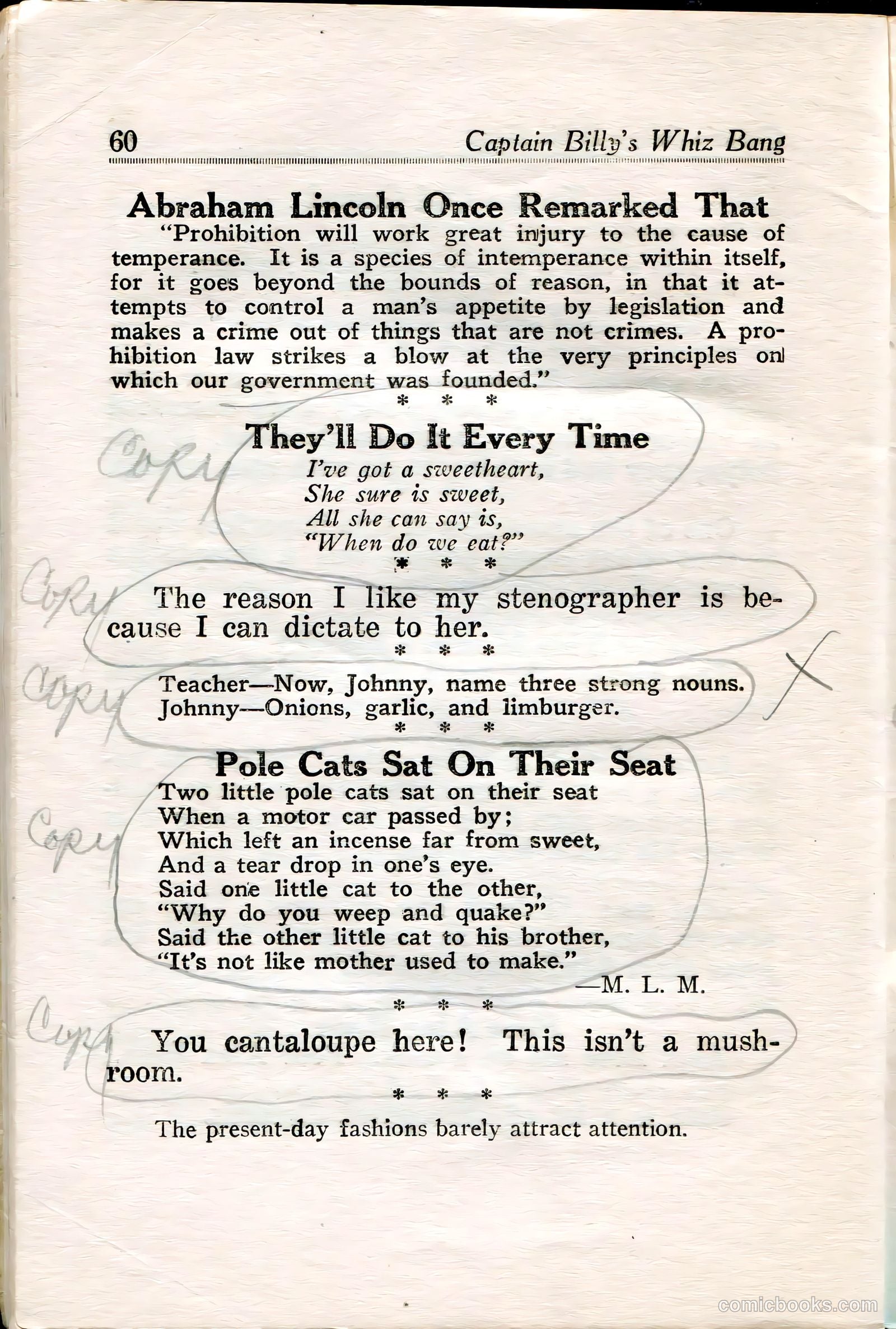
This page from a satirical magazine contains several brief jokes and one substantive political commentary about **Prohibition**. The opening section attributes a quote to Abraham Lincoln opposing Prohibition as counterproductive to temperance—arguing it's governmental overreach that contradicts founding principles. (Whether Lincoln actually said this is unclear; the quote appears designed to lend authority to anti-Prohibition sentiment.) The remaining content consists of light humor typical of 1920s magazines: - **"They'll Do It Every Time"**: A joke about a girlfriend interested only in eating - **Teacher/Johnny exchange**: Wordplay on "strong nouns" (onions, garlic, limburger are foods with strong odors) - **"Pole Cats"**: A pun-based poem where skunks ("pole cats") compare car exhaust unfavorably to their mother's smell - **Cantaloupe joke**: A pun ("can't a lope"/can't elope) The Prohibition quote suggests *Whiz Bang* positioned itself as skeptical of alcohol bans—a common stance in 1920s-30s satirical publications critical of government regulation.
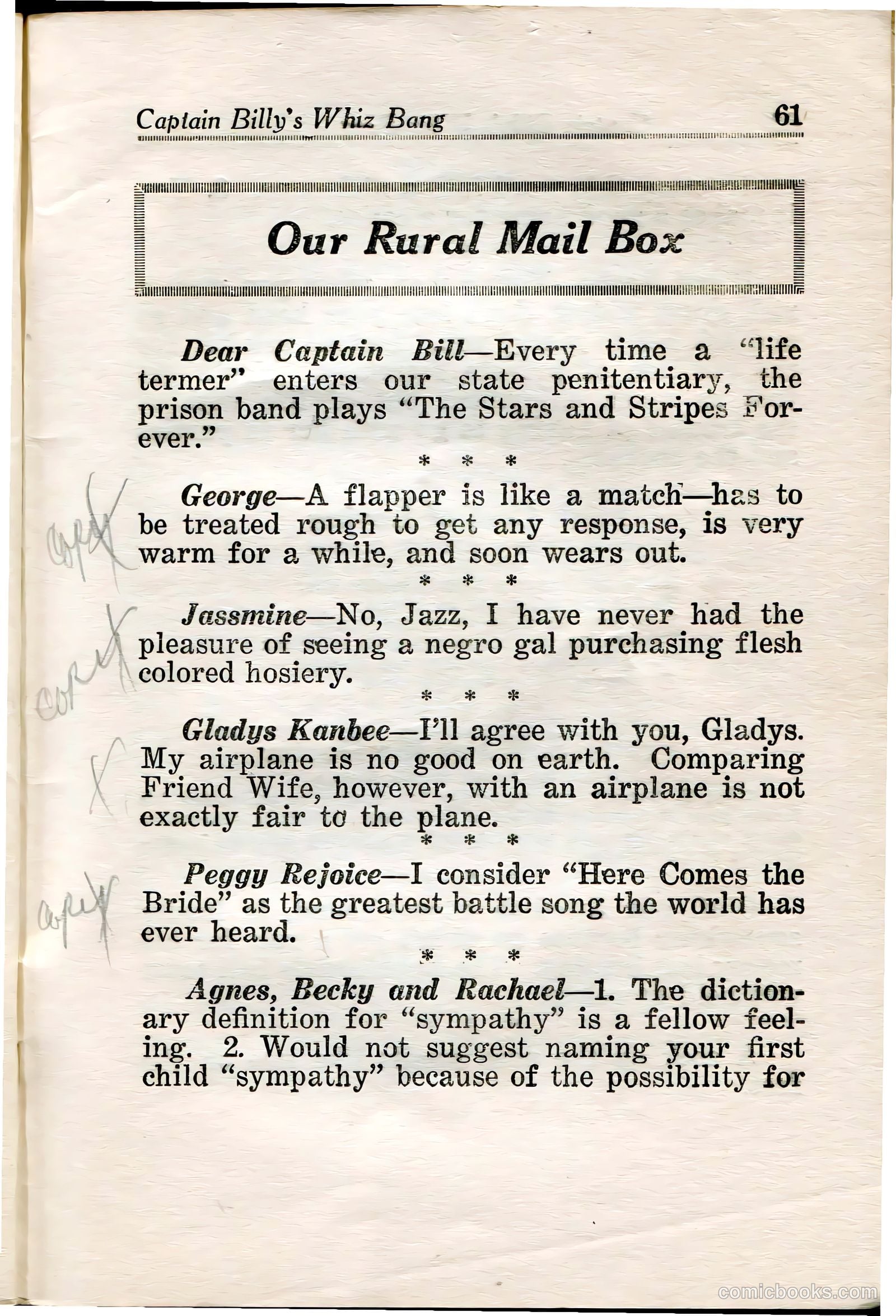
This is a **reader-submitted advice/humor column** from *Captain Billy's Whiz Bang*, a 1920s-era satirical magazine. There are no cartoons on this page—only text exchanges. The content reflects period attitudes through humorous responses to readers: - **Prison humor**: A joke about condemned inmates and patriotic music - **"Flapper" commentary**: Compares young women to matches—implying they need "rough treatment" to respond and burn out quickly; reflects 1920s anxiety about changing female independence - **Racist content**: A response containing a slur and crude joke about Black women, representing the era's casual racial prejudice - **Spousal humor**: A husband joking his wife is worse than a broken airplane - **Marriage satire**: Suggesting "Here Comes the Bride" is a "battle song" - **Name advice**: Warning against naming a child "sympathy" The column shows how mainstream publications normalized period prejudices through seemingly lighthearted banter. The humor reflects 1920s anxieties about gender roles, race, and marriage.
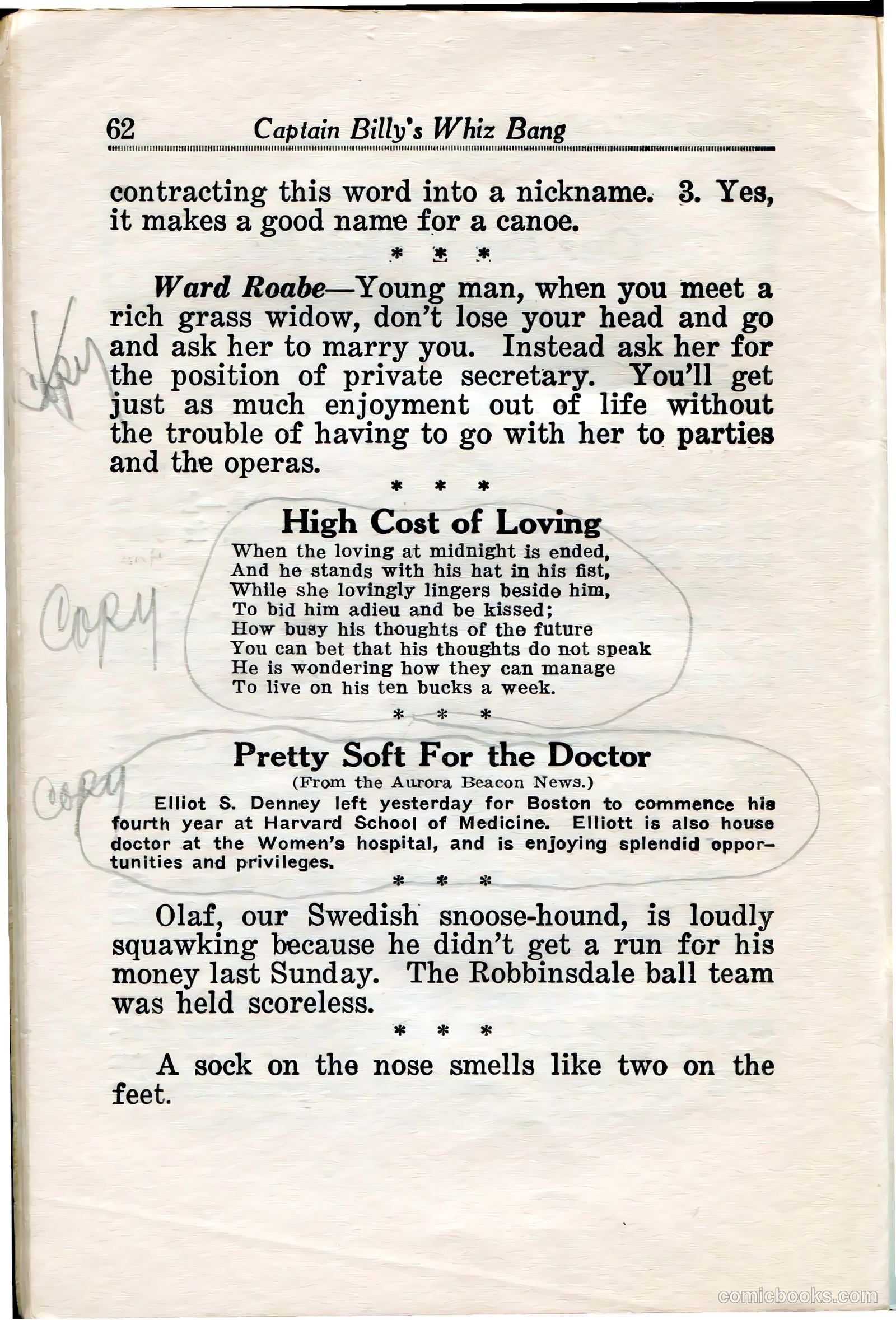
This page contains humorous advice and short jokes typical of 1920s American satirical magazines. The main satirical pieces target: **"Ward Roabe" advice**: A cynical quip suggesting young men should become "private secretaries" to wealthy "grass widows" (divorced/separated women) rather than marry them—avoiding marital obligations like social events while maintaining the relationship's benefits. **"High Cost of Loving"**: Satirizes post-war economic anxiety, depicting a young man's romantic goodbye interrupted by financial worries. The punchline—he's mentally calculating how to survive on ten dollars weekly—mocks working-class economic hardship during the period's inflation. **Medical school notice**: Appears to be genuine society news, not satire. **Bottom jokes**: Crude humor about a Swedish character's dog and a non-sequitur pun about punching. Overall, the page reflects 1920s concerns about dating costs, economic precarity, and class differences—delivered through irreverent humor characteristic of the magazine's populist, cynical tone.
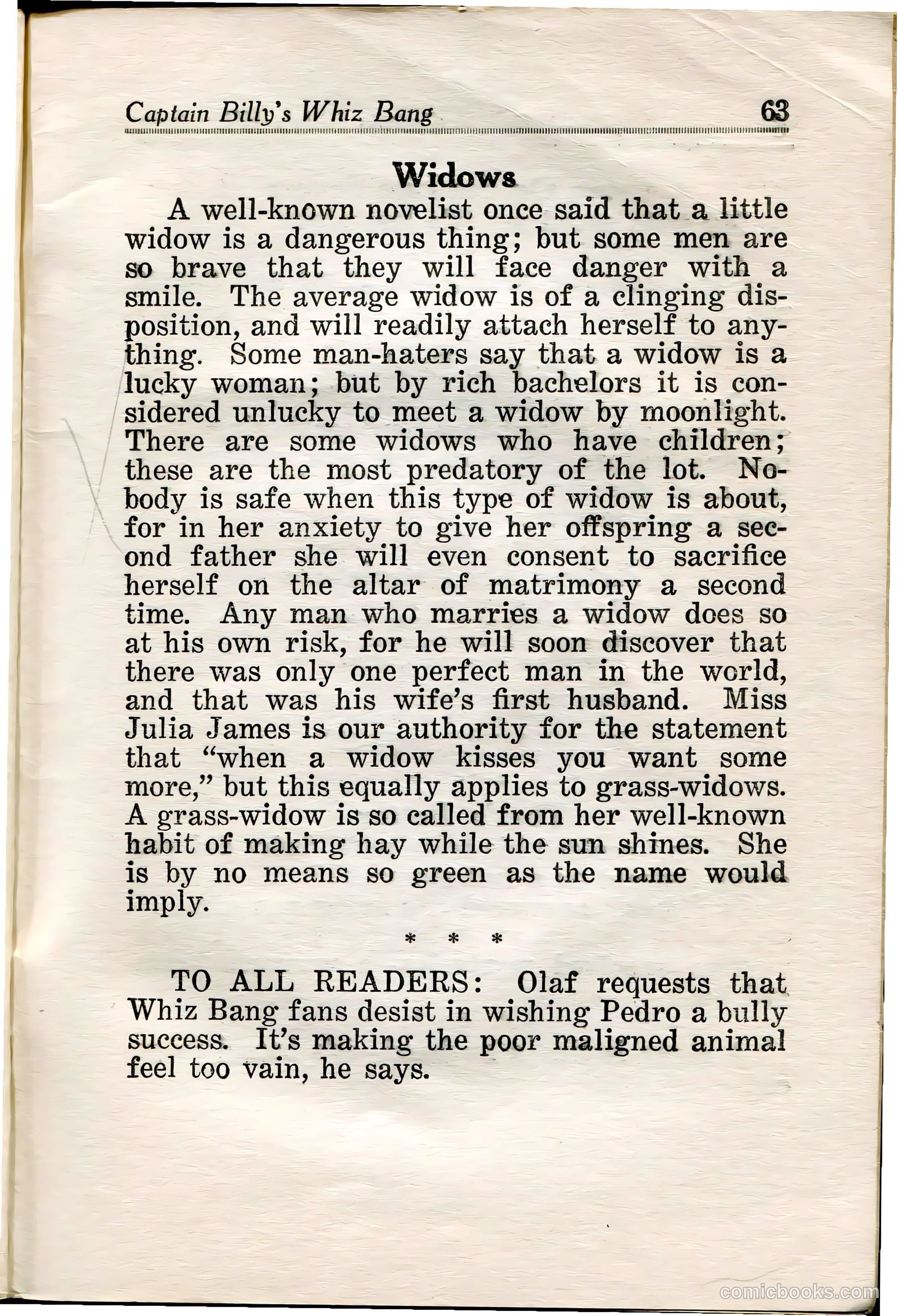
This is a satirical humor article with no accompanying cartoon. It mocks widows through exaggerated stereotypes common to 1920s-era humor. The piece presents widows as predatory, emotionally manipulative, and desperate to remarry—particularly those with children, portrayed as most dangerous. It jokes that any man marrying a widow faces a losing battle, as he'll be constantly compared unfavorably to her deceased first husband. The term "grass-widow" (a woman separated or divorced from her husband, not widowed) receives wordplay commentary: she "makes hay while the sun shines" (pursues opportunities opportunistically) and isn't truly "green" (innocent) despite the name. The brief editorial note requests readers stop praising "Pedro" (likely a recurring character or reference), claiming it makes the animal "vain"—a throwaway absurdist joke typical of the magazine's tone.
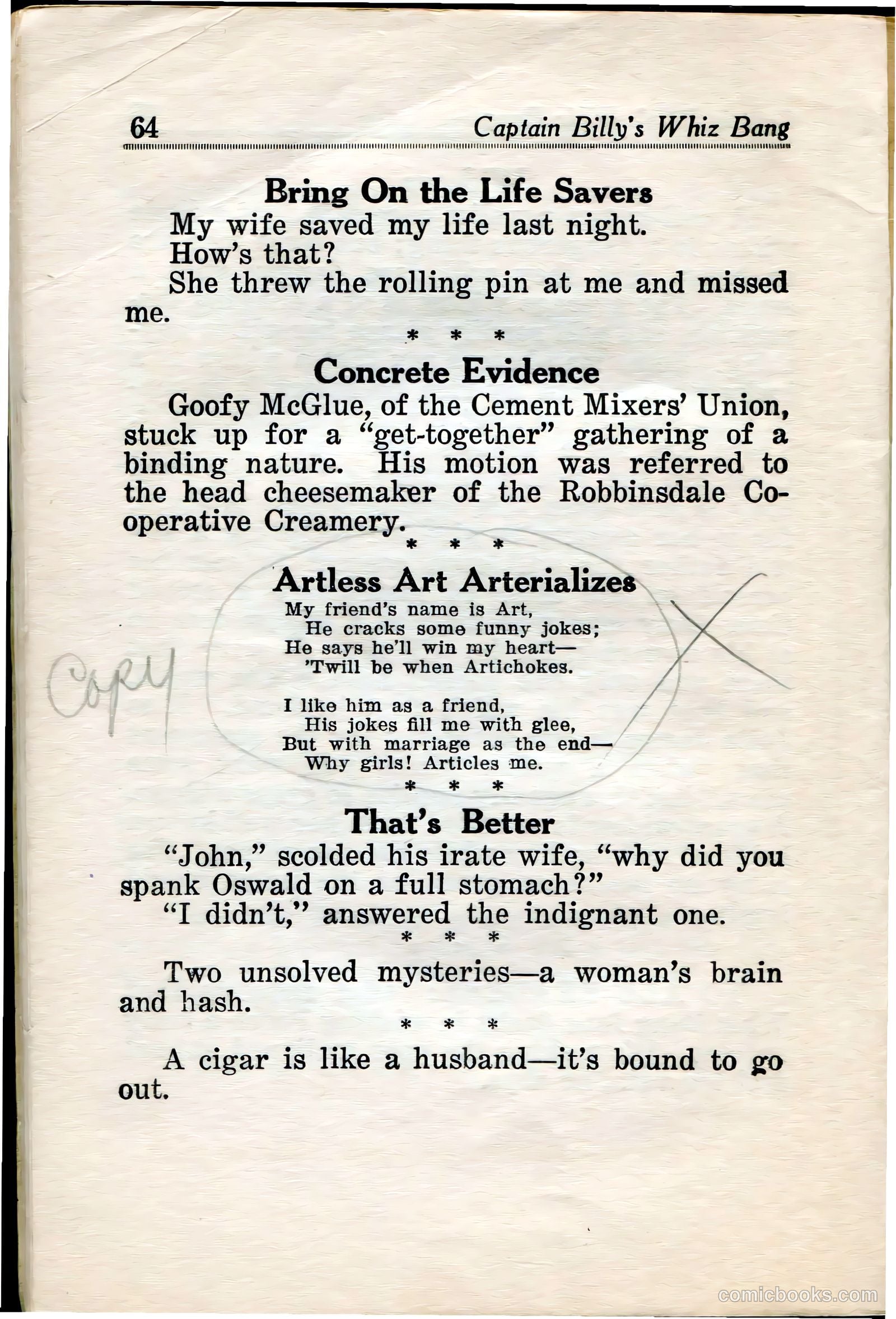
This page contains six brief jokes typical of 1920s humor magazines, presented without illustrations. The humor relies on wordplay, domestic situations, and period stereotypes: **"Bring On the Life Savers"** uses a pun on "life savers" (the candy) in a domestic violence joke about a wife throwing a rolling pin—standard "nagging wife" trope of the era. **"Concrete Evidence"** appears to mock union meetings and bureaucratic absurdity through nonsensical character names and procedures, suggesting satirical commentary on labor organizations. **"Artless Art Arterializes"** is an extended pun conflating the name "Art" with "artichokes" and "articles," playing on romantic rejection. **"That's Better"** depicts marital conflict involving child discipline, playing on misunderstanding. The final two items are one-liners mocking women's intelligence ("woman's brain and hash") and comparing cigars to husbands—reflecting casual, dismissive attitudes toward women common in the period. No specific political figures or dated events appear; these are generic social satire targeting marriage dynamics and labor unions.
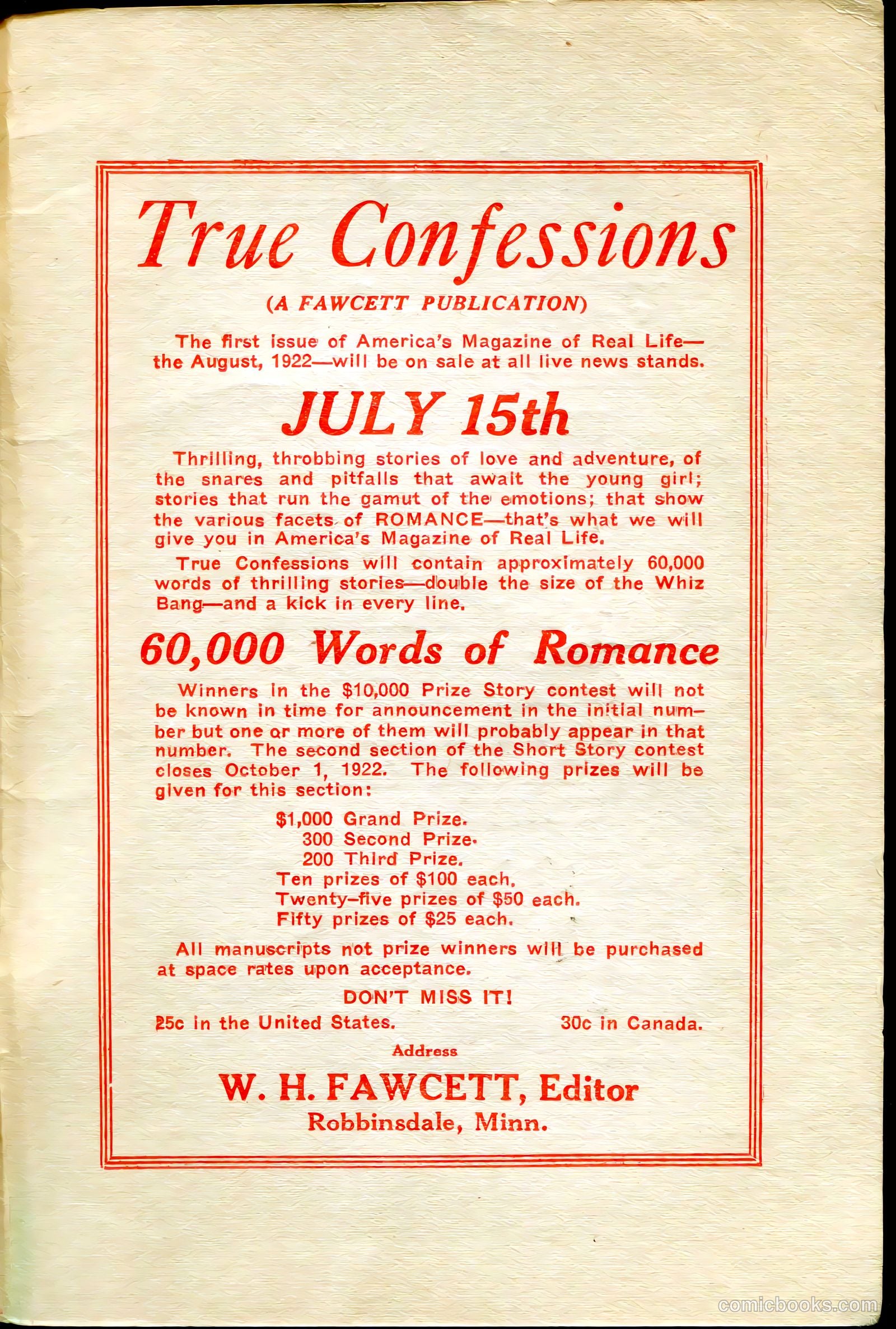
This is a title page for a 1922 magazine advertisement, not a cartoon. It announces the launch of *True Confessions*, a Fawcett publication debuting August 1922. The ad promotes the magazine's focus on romantic stories aimed at young women, emphasizing "love and adventure" and the "snares and pitfalls" facing girls. Notably, it advertises alongside *Whiz Bang*, suggesting Fawcett was expanding its magazine portfolio. The generous prize money ($10,000 total) and purchase rates for non-winning manuscripts indicate an attempt to attract story submissions and build readership. At 25 cents, the magazine targeted working- and middle-class readers. This reflects the 1920s commercial magazine boom and emerging "confessional" genre targeting female audiences with sensational romantic content.
This is a **title/advertisement page** for *Whiz Bang* magazine, not a political cartoon. The page promotes the magazine's availability and pricing across various retail channels (hotels, newsstands, trains) during what appears to be the early 20th century. The only visual element is a **cartoon cow in clothing** at the bottom—a mascot or logo rather than satirical commentary. The cow's presence is unclear without additional context about the magazine's branding or mascot. The page functions purely as **promotional material**, listing subscription and single-copy prices ($0.25 at newsstands, $0.30 on trains, $2.50 annually). The "Winter Annual" special edition costs one dollar. No political or social satire is present on this particular page.