
Captain Billy's Whiz Bang, July 1922 · page 51 of 67
Captain Billy's Whiz Bang #35 — page 51: what you’re looking at
What you’re looking at
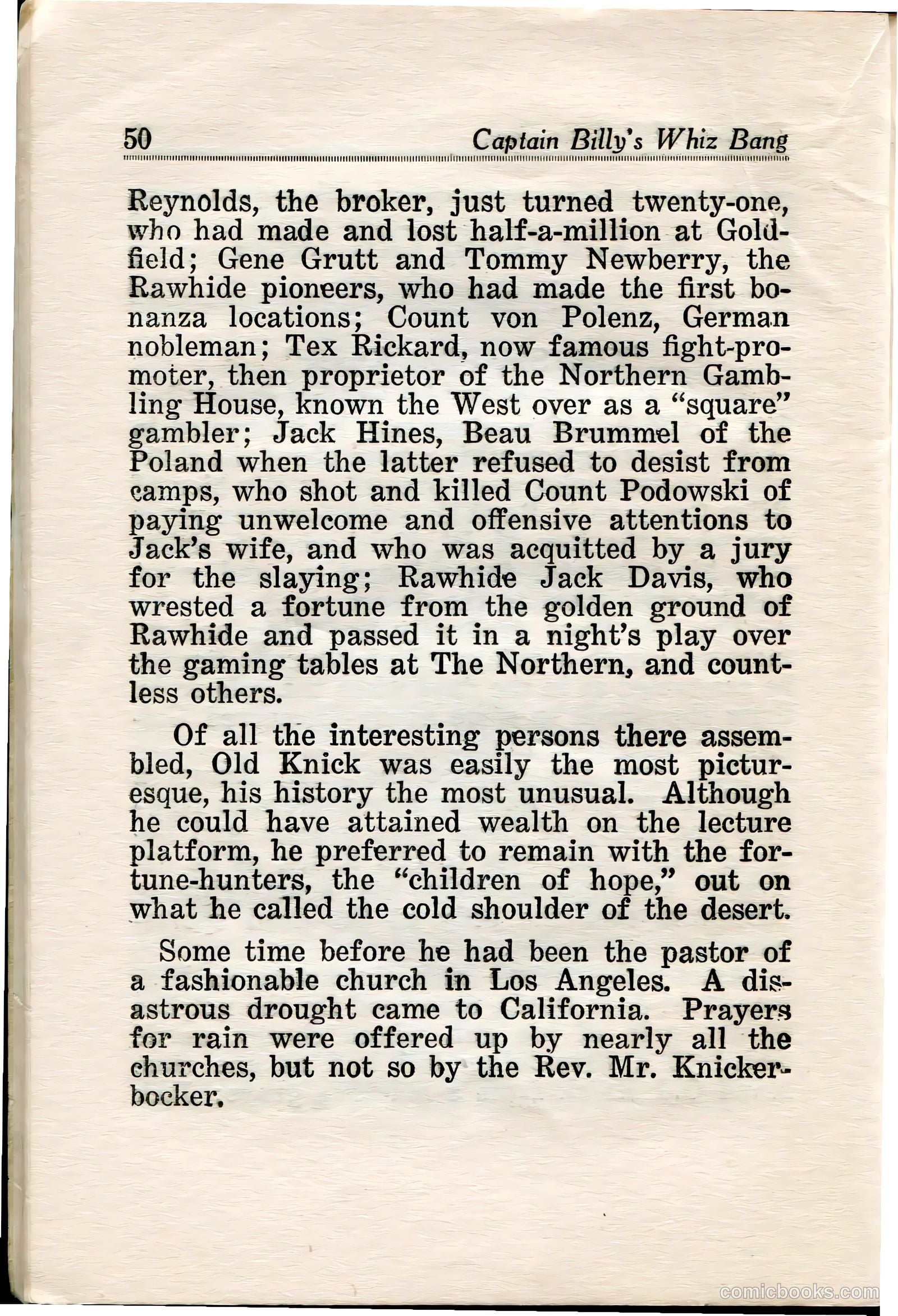
This page from the satirical magazine presents a prose narrative (not a cartoon) describing colorful characters from the Nevada mining boom era, particularly Rawhide and Goldfield. The text catalogs various figures—brokers, prospectors, gamblers, and a German nobleman—highlighting their scandals and fortunes. The satire centers on "Old Knick" (Rev. Mr. Knickerbocker), a former Los Angeles church pastor who abandoned respectability to join fortune-hunters in the desert. The joke appears to be setting up his unconventional response to California's drought: while other churches prayed for rain, he apparently did not, suggesting either irreverence toward religious convention or faith in alternative solutions. The passage mocks the chaotic morality of the Gold Rush era—casual violence (Jack Hines's acquittal for murder), gambling fortunes lost overnight, and a clergyman preferring desert prospecting to lecturing. For modern readers, "Whiz Bang" was known for irreverent, bawdy humor targeting American hypocrisy.
📄 Transcribed text from this page (OCR, searchable)
Machine-transcribed from the original scan — historical spelling and the odd misread are preserved.
50 Captain Billy's Whiz Bang Reynolds, the broker, just turned twenty-one, who had made and lost half-a-million at Gold- field; Gene Grutt and Tommy Newberry, the Rawhide pioneers, who had made the first bo- nanza locations; Count von Polenz, German nobleman; Tex Rickard, now famous fight-pro- moter, then proprietor of the Northern Gamb- ling House, known the West over as a “square” gambler; Jack Hines, Beau Brummel of the Poland when the latter refused to desist from camps, who shot and killed Count Podowski of paying unwelcome and offensive attentions to Jack’s wife, and who was acquitted by a jury for the slaying; Rawhide Jack Davis, who wrested a fortune from the golden ground of Rawhide and passed it in a night’s play over the gaming tables at The Northern, and count- less others. Of all the interesting persons there assem- bled, Old Knick was easily the most pictur- esque, his history the most unusual. Although he could have attained wealth on the lecture platform, he preferred to remain with the for- tune-hunters, the “children of hope,” out on what he called the cold shoulder of the desert. Some time before he had been the pastor of a fashionable church in Los Angeles. A dis- astrous drought came to California. Prayers for rain were offered up by nearly all the churches, but not so by the Rev. Mr. Knicker- bocker.