
A complete issue · 68 pages · 1921
Captain Billy's Whiz Bang #27
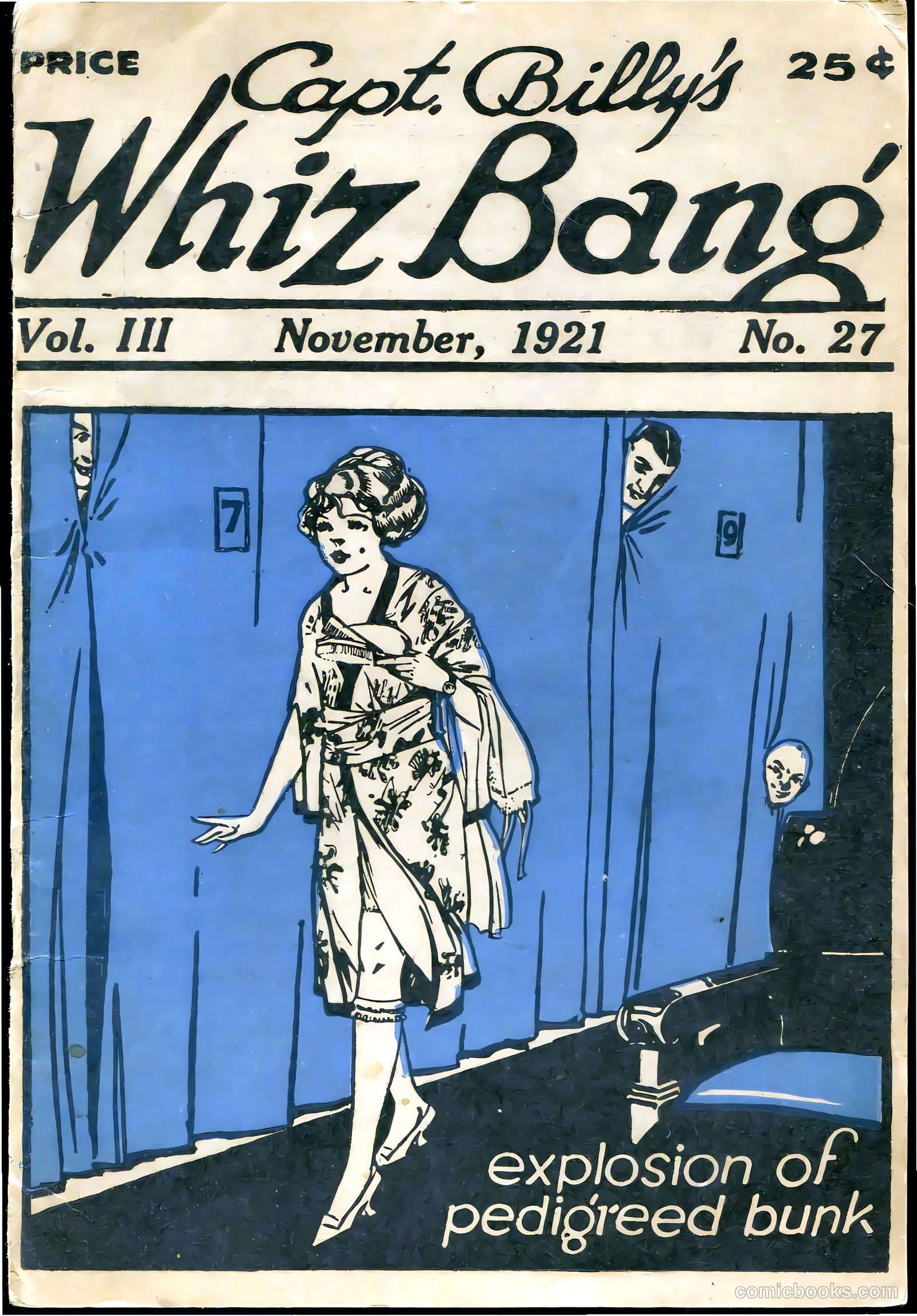
This November 1921 *Captain Billy's Whiz Bang* cover illustrates "explosion of pedigreed bunk"—satirizing pretentious or false claims dressed up as sophisticated. The central figure is a well-dressed woman in an elegant patterned dress, observed by men peeking through doorways (top and right). The blue interior and formal attire suggest she's presenting herself as respectable or upper-class. The satire likely mocks either: a woman making false claims about her status or respectability, or broader post-WWI cynicism about "refined" society masking deception. The watching men suggest voyeuristic interest in exposing her pretense. "Pedigreed bunk" implies something with fancy trappings that's actually worthless—fitting the 1920s satirical tone targeting social pretension.
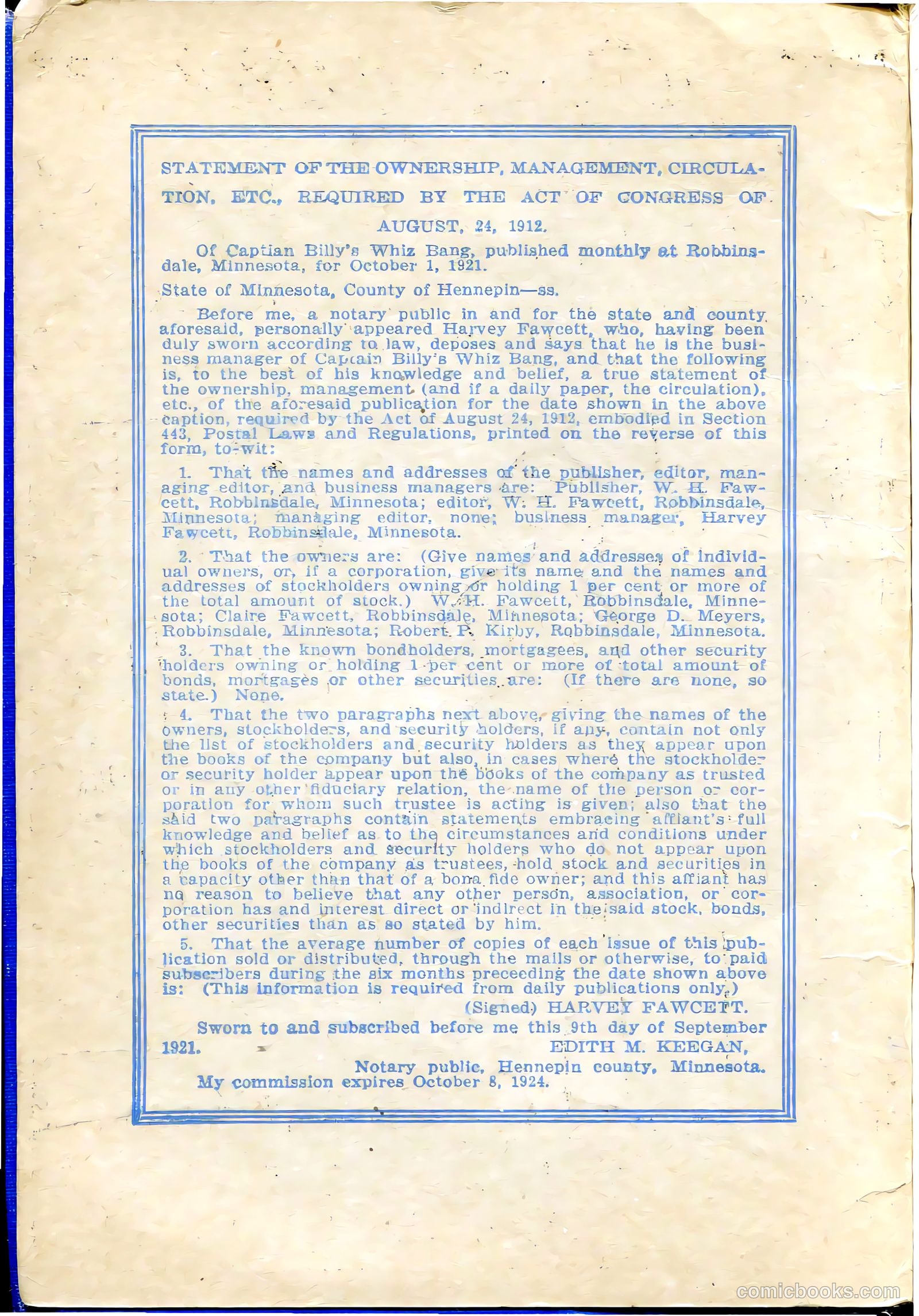
This page is not a cartoon but a legal document: a **Statement of Ownership and Management** required by federal law for periodicals. It declares ownership of **Captain Billy's Whiz Bang**, a monthly satirical magazine published in Robbinsdale, Minnesota as of October 1921. The document lists publisher/editor W. H. Fawcett and business manager Harvey Fawcett as principal owners, with stockholders including Claire Fawcett, George D. Meyers, and Robert P. Kirby. This is mundane administrative compliance filing—typical of early 20th-century magazine publishing regulations. There is no satirical content visible here, only formal ownership disclosure sworn before notary Edith M. Keegan on September 9, 1921.
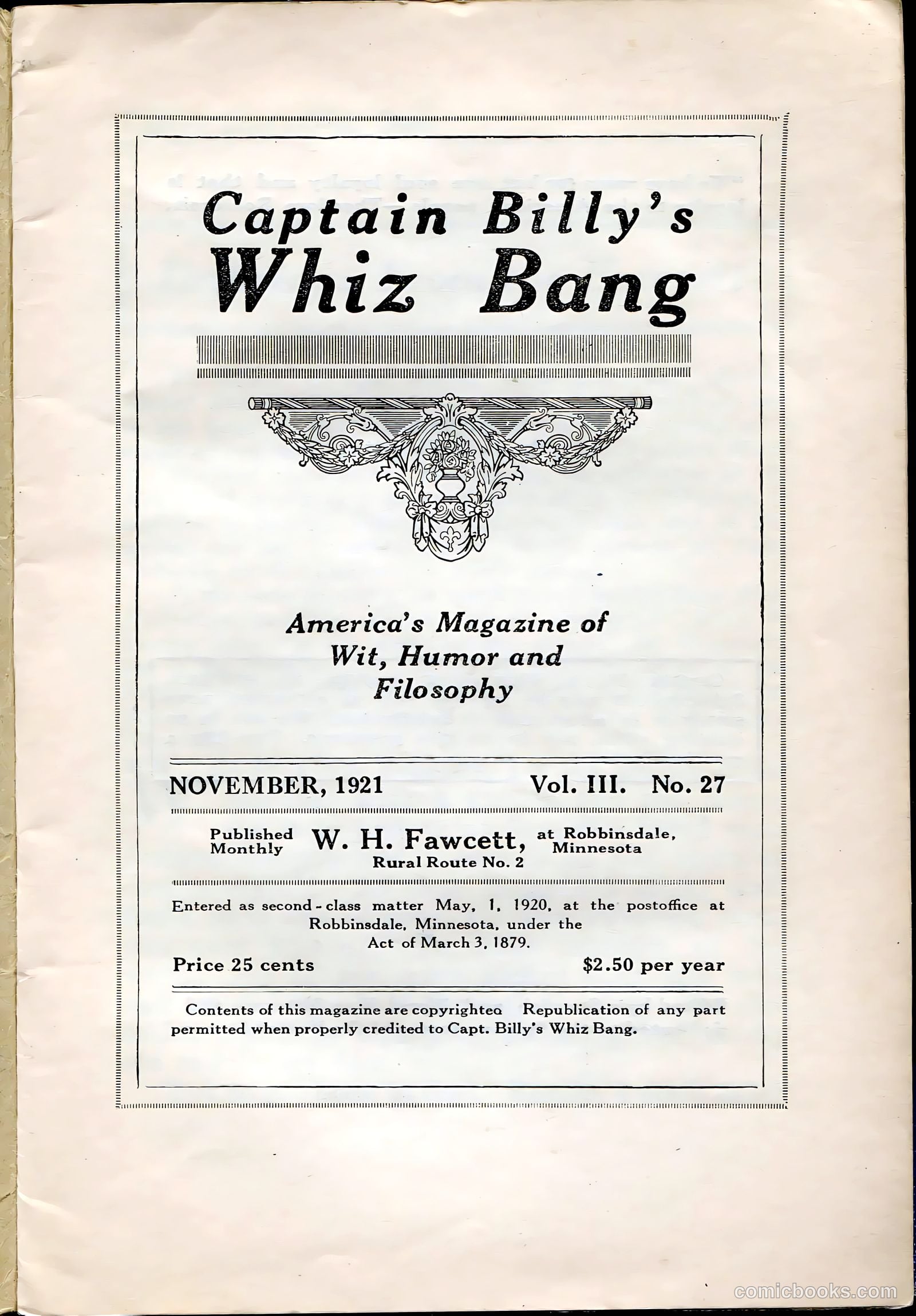
This is a **title page**, not a satirical cartoon or editorial content. It presents the cover information for *Captain Billy's Whiz Bang*, a humor magazine published November 1921 by W.H. Fawcett in Robbinsdale, Minnesota. The page displays the magazine's self-description as "America's Magazine of Wit, Humor and Philosophy" and includes standard publication details: volume III, number 27, priced at 25 cents per issue ($2.50 annually). The decorative ornament is purely aesthetic—a typical Art Nouveau flourish common to 1920s design. Without seeing the actual interior content pages, we cannot identify specific satirical targets, political references, or jokes the magazine's editors intended for this particular issue.
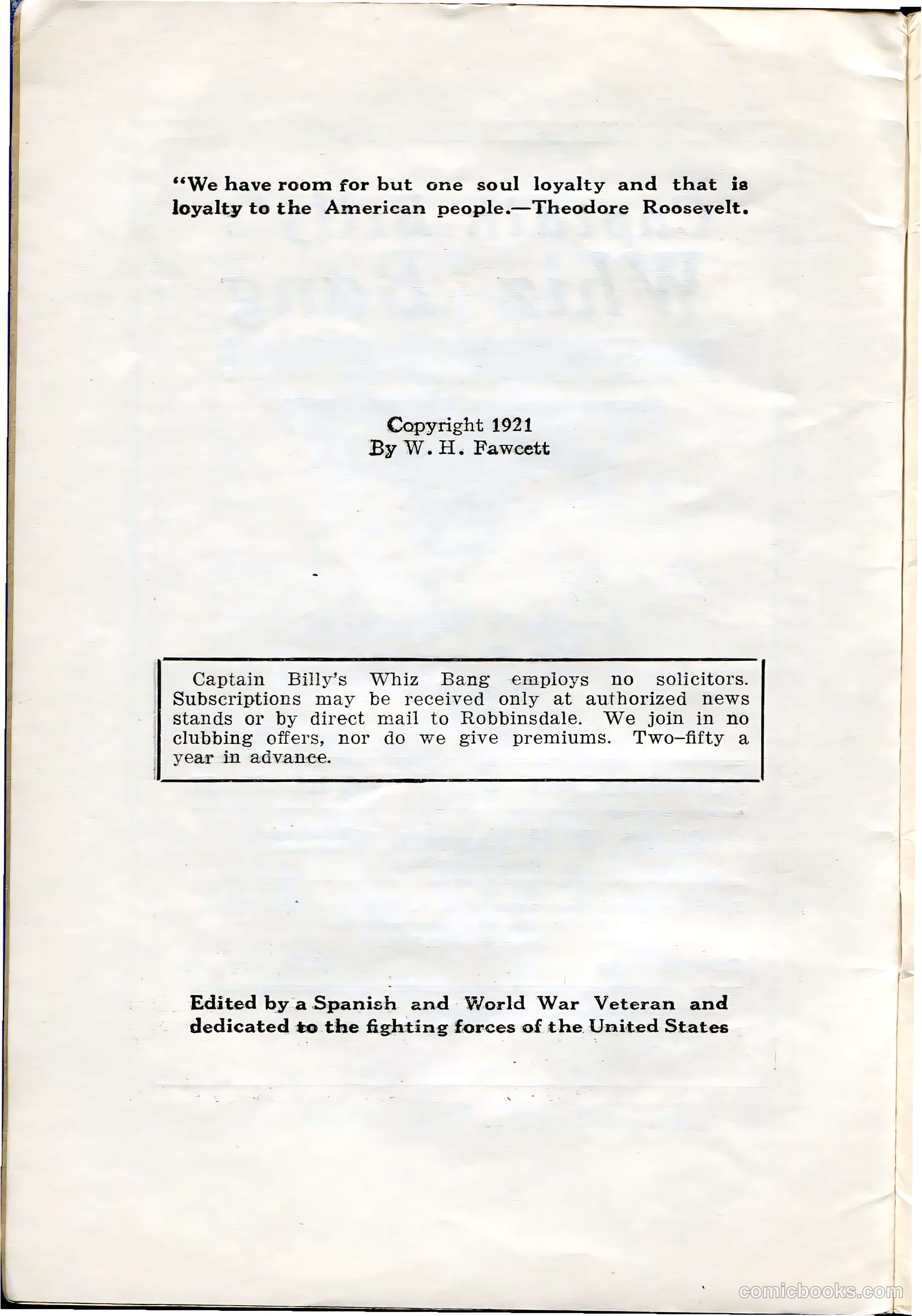
This is a title page for *Captain Billy's Whiz Bang*, a satirical magazine copyrighted 1921 by W.H. Fawcett. The page features a Theodore Roosevelt quote about loyalty to the American people, establishing the publication's patriotic stance. The boxed text announces the magazine's subscription policy: no solicitors, subscriptions only through authorized news stands or direct mail to Robbinsdale, no clubbing offers or premiums, and a cost of two dollars and fifty cents yearly. The dedication states the magazine is edited by a Spanish-American War and World War veteran, aimed at supporting U.S. fighting forces. No specific political cartoons or caricatures are visible on this page—it functions primarily as front matter establishing the publication's credentials and business practices.
This is page 3 of *Captain Billy's Whiz Bang*, a satirical magazine. The visible content consists of two sections: **"Drippings From the Fawcett"** is an editorial note describing the magazine's travels across America searching for a "Famed Pedigreed Bull" (likely a humorous MacGuffin). It name-drops celebrity visits: D.W. Griffith (famous silent film director) and Fatty Arbuckle (silent comedian), positioning the magazine as having insider Hollywood access—a boast designed to impress readers during the 1920s movie boom. **The main article** begins a humorous rural anecdote about the editor's bad morning after his hired hand "Gus" quits. The narrator must do farm chores himself, encountering indignities: sweet-smelling manure wafting through the air and a cow kicking over milk while swishing its tail in his face. This is farm-life comedy—rustic slapstick humor typical of the era's satirical magazines, playing on city readers' romanticized or comedic views of rural work.
This page contains no cartoon—it's prose text from what appears to be a humorous column or letter. The narrator describes firing an employee named Gus, who became increasingly difficult after enjoying modern luxuries (aeroplane rides, trips to New York and Atlantic City). Gus grew so self-important he refused basic work, eventually declaring "I'm through" and departing for Minneapolis. The satire targets **working-class entitlement and social climbing**—a common post-WWI concern. The narrator suspects Gus was homesick for urban Minnesota and especially attracted to Prohibition-era drinking opportunities (Minneapolis vs. the "dry" Breezy Point area in Indian territory). The humor relies on the narrator's begrudging admiration mixed with exasperation: he wishes Gus well but can't resist cursing him ("Gosh Darn you"). The piece satirizes both employee disloyalty and the disruptions of modern leisure travel on traditional labor relationships.
This is a text-only page—no cartoons or illustrations beyond decorative elements. The author discusses experiencing post-debauchery remorse while working at the Whiz Bang farm, struggling to produce copy for the November issue. The piece pivots to praising Omar Khayyam's *Rubaiyat*, a Persian poem celebrating hedonism and fatalism. The author suggests that in modern times, Khayyam might have titled his work "The Philosophy of An Old Sport" or "Wine, Women and Song"—establishing that "old sport" refers to the leisured male reader enjoying life's pleasures. The quoted verses reference Jamshyd (a legendary Persian king) and hunting, fitting Khayyam's theme of mortality and indulgence. The satire targets aging men clinging to youthful excess while rationalizing it through classical poetry.
This page from *Captain Billy's Whiz Bang* contains a poem about wine, drinking, and mortality—not a political cartoon. The text is a satirical meditation on indulgence and fate, referencing the speaker's "Second Marriage" to wine and philosophical musings on the "Pot and Potter" (suggesting divine creation and human purpose). The poem alludes to the *Rubáiyát of Omar Khayyam*, a famous work celebrating wine and questioning existence. References to "Saki" (wine) and garden imagery echo that Persian classic. The satire targets Victorian morality by celebrating hedonism and questioning divine judgment of human pleasures. The joke is essentially: if wine is God's creation, why condemn its use? The final lines invite the reader to commemorate the speaker's death with a drink. No specific political figures or events are identifiable here.
This page contains three brief anecdotes rather than traditional cartoons. The content reflects early 20th-century American humor, including problematic stereotypes. The first anecdote uses an ethnic stereotype, presenting a Jewish farm worker named "Ikey" speaking in exaggerated dialect ("It won't be long now"), a common comedic device of the era. The second anecdote is a light travel observation about tourists visiting Minnesota, noting a car bearing a Pennsylvania license plate. The third anecdote describes a fishing expedition at "Breezy Point Lodge" in Northern Minnesota. The humor culminates in an absurdist tall tale: anglers catch a pike so large it had swallowed a fawn, which kicked through the fish's belly. This exaggerated hunting/fishing story type was popular frontier humor. The magazine appears to be a humor publication featuring this mix of everyday observations, ethnic jokes, and tall tales typical of early 20th-century American popular entertainment.
This page addresses the **Fatty Arbuckle scandal** of the early 1920s. Arbuckle was a major silent film comedian accused of causing actress Virginia Rappe's death during a party in 1921. The magazine makes a "plea for fair play"—Arbuckle hasn't been convicted yet, though newspapers sensationalize his past. Whiz Bang admits it previously mocked Arbuckle's famous "pajama parties" and his playboy Hollywood lifestyle, but argues this prior coverage shouldn't be used as evidence of guilt in Rappe's death. The final anecdote about ordering "Sherry and Egg" is unclear but likely a separate joke playing on similar-sounding words or an old joke format unrelated to Arbuckle. The opening dialogue fragment appears to reference bootleg bourbon (spelled "Bourb'n"), reflecting Prohibition-era underground drinking culture. This satirical magazine combined gossip, innuendo, and editorial commentary on celebrity scandals of its time.
This is a humor column from an early 20th-century satirical magazine featuring disconnected anecdotes and jokes. The content includes: **A bartender joke** mocking stale eggs and aged sherry—implying poor-quality alcohol. **Deacon Miller anecdote**: A conservative rural neighbor dismisses both the narrator's new airplane and the magazine itself as foolish. The humor lies in Miller's absurd logic: he won't own something that "flies and doesn't lay eggs"—conflating machines with livestock. **The 33,000-pound bull**: A humorous news item about an unusually large pedigreed animal, with a joke about the difficult labor required to manage it. **The "Whiffenpoof" debate**: Readers dispute the definition of this (apparently fictional) creature. A Kansas reader proposes it's a bird eating hot peppers that must fly backward to prevent its tail from catching fire—pure nonsense humor. **Final aphorism**: A mild joke about young men confusing romantic pursuit with fashion-following. The page's tone is lighthearted, provincial, and absurdist—typical of pre-1920s American comic magazines.
This page contains three separate humor pieces with no visible cartoons or illustrations—it's purely text-based content. The first anecdote mocks a new hired hand named Pete who behaves like the pigs he tends. After attempting to court Nelson's daughter Tillie at a dinner, his poor manners and boorish behavior ("acted like a pig") end any romantic prospects. The second brief passage offers biblical consolation to readers. The third piece, "Those Inquisitive Aussies," reports an anecdote from an Australian editor about a woman visiting Madame Tussauds Wax Museum. She asks an attendant whether wax figures of historical queens wear undergarments. His reply jokes that Australians are the only visitors crude enough to ask such questions, playing on stereotypes of Australian soldiers as uncouth.
This page contains three brief humorous anecdotes rather than political cartoons: 1. **"Hot Tamales"**: A joke about a woman on a train who removes her stockings and turns them inside-out while two men watch. The punchline reveals she was simply adjusting her "hose" (stockings), not engaged in seduction. 2. **"An Eye Opener"**: A story about a seventeen-year-old girl who receives a gold watch from a boy. When asked who gave it to her, she falsely claims her mother did to conceal the gift's true romantic origin. The joke mocks her naive attempt at deception. Both stories rely on double meanings and mild innuendo typical of 1920s-era men's magazine humor, targeting readers' assumptions about feminine behavior and morality.
This page contains three brief humorous anecdotes rather than illustrated cartoons: 1. **"Heard On the Toonerville"**: A joke about a couple arguing on a streetcar, where the woman threatens to tell her husband about the man's rudeness—a mild domestic squabble joke. 2. **"Ring On, Oh Bells"**: Satirizes marital dynamics. A wife cleverly interrupts her husband's lengthy conversation with a visitor by faking a phone call using an alarm clock, exposing that the "solicitor" was just trying to sell him a telephone service. The humor targets both aggressive salesmen and domestic maneuvering. 3. **"For Freedom"**: A brief joke contrasting a convict's imprisonment for polygamy with a visitor's sarcastic question about his "liberty"—dark humor about marital excess and incarceration. All three are gentle social satire focused on domestic life and consumer culture.
This page contains a "Questions and Answers" humor section featuring satirical advice. The jokes rely on wordplay and contemporary cultural references: 1. **"Soubrette"** joke plays on theatrical terminology—a soubrette is a young female stage role, here humorously redefined as an underpaid performer. 2. **Three-foot kiss** references movie romance conventions of the era, with the absurdist answer about asbestos alarm clocks. 3. **"Getting Gertie's Garter"** (mentioned at bottom) was apparently a popular theatrical production of the period. The humor is mild, vaudeville-style comedy typical of 1920s pulp magazines. It targets show business, movies, and entertainment industry practices familiar to contemporary readers but now historically obscure.
This is a humorous advice column where "Captain Billy" responds to reader questions with satirical answers. The satire targets: 1. **Movie title sensationalism**: Captain Billy criticizes motion pictures for using provocative titles like "Once to Every Woman" and "Why Change Your Wife?" to attract audiences, contrasting this with stage plays' more respectable naming conventions. 2. **Ex-President Taft's golf**: A joke mocking William Howard Taft's weight and golfing ability, suggesting he plays like a "hippopotamus." 3. **Identifying gentlemen**: A quip about distinguishing gentlemen by their evening wear versus pajamas—suggesting single men might wear pajamas. 4. **Dream composition**: A cynical answer that attractive dreams rely on superficial artifice: "paint, powder, padding and false hair." The humor relies on period-specific references and social commentary about early 20th-century entertainment and manners.
This page contains a humor column featuring letter responses to reader queries, styled as advice from "Captain Billy's Whiz Bang." The jokes rely on absurdist wordplay and deliberate misinterpretations: **Key Content:** - A recipe for "Strawberry Surprise" that humorously includes oyster shells and raisins—subverting expectations of what a dessert should contain - Fashion advice about summer furs (mole skin) with a crude joke about displaying the mole - A question about fighting ability (dog vs. badger) answered seriously - A definition of "Matrimonial Progress" as "Maid One; Maid Won; Made One"—a pun on domestic servants and marriage progression The humor is characteristic of 1920s bawdy magazines: crude, punny, and often sexually suggestive through innuendo. The format mimics legitimate advice columns while deliberately providing absurd or inappropriate answers.
This is a question-and-answer advice column featuring humorous responses to reader inquiries. The page includes: 1. **Women's fashion origins** - A joke that while styles start in Paris, "we finish 'em here" (America) 2. **Animal tail signals** - A serious-ish answer about pumas, deer, and horses using tails functionally, with a self-deprecating joke about lacking expertise in "tail technology" 3. **Platonic love definition** - A crude joke equating it to kissing a woman while "forget[ting] she is a woman," concluding "there ain't no such animal" 4. **Fatty Arbuckle reference** - A topical joke about the silent film comedian allegedly pleading insanity, with a quip that he's "been acting rather funny for several months" The humor is deliberately lowbrow and irreverent, typical of Whiz Bang's satirical style.
This is a gossip column from *Captain Billy's Whiz Bang*, a satirical magazine popular in the 1920s. The page contains no cartoons—just celebrity rumors presented as innuendo. The jokes target Hollywood actresses and personalities: **Mary Miles Minter**: A pun comparing a battleship's hull-scraping to rumors about her romantic entanglements ("in the middle of a reel" = during filming). **Dorothy Dalton**: Mocked for publicly dating a wealthy studio executive ("angel" = financial backer). **Bebe Daniels and Jack Dempsey**: The famous boxer and actress are satirized for being seen together, with the columnist pretending to treat gossip as fact while winking at readers. **Wanda Hawley**: Ridiculed for bobbing her hair (a controversial 1920s trend) and for her appearance change, with the column suggesting vanity or transformation. The satirical tone treats Hollywood's romantic entanglements and personal choices as juicy scandal, characteristic of 1920s celebrity culture mockery. The magazine delighted in exposing or exaggerating stars' social activities.
This page contains Hollywood gossip items from an early 1920s satirical magazine. The content mocks film industry figures through brief, catty anecdotes: **Key subjects include:** - **Thompson Buchanan** (Lasky studio scenario chief) and actress Helene Chadwick - **Kathleen Clifford** meeting mysterious men - **Herbert Rawlinson** vacationing without his wife Roberta Arnold while attracting admiration from schoolgirls—implying infidelity or impropriety - **Lucita Squire**, a scenario (screenwriter) for director Marshall Neilan - **Ruth Wightman**, another scenario writer being promoted by Gouverneur Morris **The satire's point:** The magazine ridicules Hollywood's romantic entanglements, absent spouses, and the rapidly emerging profession of "scenario writers" (screenwriters)—treating them as disposable commodities ("all in a minute"). The tone is gossipy and insinuating rather than explicitly scandalous, typical of early 1920s fan magazines mixing genuine industry news with innuendo.
This gossip column satirizes early 1920s Hollywood scandals and Midwestern moral attitudes. Key references: **The Arbuckle scandal**: "Fatty" Arbuckle, a famous silent comedian, was arrested for the death of actress Virginia Rappe at a San Francisco hotel—a real 1921 scandal. The column contrasts his arrest with Charlie Chaplin's triumphant London reception the same day, highlighting how quickly celebrity fortunes reversed. **Horkheimer controversy**: The lengthy passage mocks Iowa's puritanical reaction to filmmaker Horkheimer's studio operations at Long Beach. Iowans condemned the filmmakers' "fast and furious" lifestyle as immoral, forcing the company to relocate. The column ridicules this provincial outrage with sardonic phrases like "simple minded" Iowans and "scene of piety." **The satire's point**: The magazine lampooned both Hollywood excess *and* Midwestern prudishness, using these real incidents to mock the era's cultural clash between progressive urban entertainment and conservative rural values.
This page contains gossip column content (no visible cartoon) about actor Lou Tellegen and opera star Geraldine Farrar's marital troubles. The satire operates on multiple levels: **The figures:** Tellegen, a French actor, and Farrar, a famous prima donna (opera singer), recently married but reportedly having problems. **The scandal:** Tellegen allegedly had a prior romance with a struggling French actress who has since become successful in Paris—raising speculation he might be reconsidering that old relationship. **The cynical joke:** Whiz Bang suggests this entire scandal may be fabricated publicity by a press agent to promote Tellegen's upcoming play "Don Juan"—implying Hollywood manufactures drama to sell tickets. **The context:** The piece mocks both celebrity gossip culture and the film industry's deliberate manipulation of public interest through manufactured controversy. The references to Pickford, Chaplin, Lasky, and Goldwyn establish the Hollywood studio system context.
This page contains gossip and satirical commentary rather than traditional cartoons. The main section discusses Geraldine Farrar, a famous opera singer, praising her musical talent and good nature while gossiping about her marriage to Lou Tellegen and his rumored infidelities. The piece uses gentle satire, suggesting Farrar's forgiving nature and her insistence that Tellegen remain faithful when they're in the same city. Below this is "The Agony Column," a humor section mocking a London newspaper's classified ads. The joke presented mocks changing social attitudes: an "old-fashioned mother" who was once clingy like a vine now has a daughter with "no more clinging qualities than a sapling"—inverting expectations about maternal influence across generations. The humor targets shifting social values regarding female independence.
This page from *Captain Billy's Whiz Bang* contains three brief humorous anecdotes rather than political cartoons. "Truth at Last" describes a confrontation at a hotel during Fair week: a large bully boasts of his fighting prowess, but a quiet smaller man calls him a "four-flusher" (a bluffer/fraud) and beats him severely. The editors apologize for the "unhappy ending," joking that truth should prevail in their columns "at all costs." The remaining two sections are brief jokes: one about a woman refusing to pay a garage bill, claiming her husband said to charge it; another about a woman dismissing a doctor's whiskey prescription, claiming to know "all about the dose." These are typical period humor pieces playing on everyday situations and character types rather than topical satire.
This page from *Whiz Bang* contains several humorous poems and verses rather than political cartoons. The content includes: **"Limber Kicks"** and **"Revamped Neckery"** — brief comic verses about meeting a well-dressed girl and commenting on her appearance. **"Cheer Up!"** — an uplifting poem about songs and smiles creating happiness. **"Hurry Now!"** — a flirtatious verse using flower/beauty metaphors to encourage romantic pursuit, with sexual undertones typical of the era's "spicy" magazine humor. **"The Best Firm"** — a joke by Sherwood listing fictional law firms with pun names (Watch & Waite, Attit Early & Layte, Doo & Dairet, Grin & Barrett), where the humor relies on wordplay rather than political reference. This appears to be a typical page of *Whiz Bang*'s light, somewhat risqué humor aimed at male readers.
This is a satirical article by Rev. "Golightly" Morrill mocking New Orleans' perceived moral laxity. The reverend ironically presents the city as a "course of study in gayety and godlessness," cataloging its sins: gambling on Sundays, prizefights, French morals, and abundant "resorts" (likely brothels). The satire works through hypocritical contrast—Morrill acknowledges New Orleans' genuine civic improvements (sewage, infrastructure, port expansion) while dismissing them as insufficient without moral reform. His backhanded compliment ("If she mends her ways...") suggests the city is fundamentally corrupt despite progress. The author is a Minneapolis pastor using Whiz Bang's irreverent humor to critique perceived Southern decadence. For modern readers, this reflects 1920s American moral anxiety about major cities, particularly those with French cultural influence and lax Prohibition enforcement.
This appears to be a prose narrative rather than a cartoon. The text is a satirical tour of New Orleans' red-light district, written with heavy irony and moral condemnation masked as tolerance. **Key references:** - References to segregated "night-court" where Black defendants faced sentencing - Vice establishments (gambling halls, cabarets, brothels) in the district - A wartime closure of these areas ("During the war...temporarily closed for moral repairs") - Biblical allusions ("Broadway to Baal," "Avenue to Avernus," "Hell's Highway," "Promenade to Perdition") equating vice with damnation **The satire:** The author claims not to "injure New Orleans' reputation for wantonness," but proceeds to catalog depravity—street fights, sex workers, gambling—while ironically suggesting wartime moral reforms couldn't permanently change the city's nature ("No war order can change the leopard spots"). The tone is smugly disapproving yet oddly complicit, typical of period satirical magazines mocking urban vice while sensationalizing it.
This page is primarily text rather than cartoon content. It's a first-person account describing New Orleans ("the Crescent City") during Mardi Gras, emphasizing the city's reputation for moral laxity and decadence. The author critiques: - **Theater performances** featuring risqué jokes and scandalous clothing - **Horse racing and betting culture**, with female attendees portrayed as promiscuous - **Mardi Gras revelry** as morally corrupting ("Devil's spirit") - **Jazz dancing** described disparagingly—dancers move erratically like "automatons," "grasshoppers," and victims of neurological disease - **Dance halls** (*maisons de joie*) thriving despite Prohibition The piece reflects 1920s-era moral conservatism, using medical/scientific language ("locomotor-ataxia") to pathologize modern entertainment and urban vice. It's satirizing Jazz Age excess through disapproving, moralistic commentary.
This page contains satirical prose rather than a cartoon. The text mocks New Orleans dining culture through exaggerated, humorous descriptions. The author ridicules a cheap, run-down café, personifying worn tableware and furniture to suggest their histories of romantic encounters and crude conversations. References to "callow couples," "spooning," and "off-color stories" emphasize the dingy establishment's role as a venue for working-class romance and ribald humor. The satire targets both the restaurant's poor conditions (garlic stench, falling plaster, filthy tablecloths) and New Orleans's reputation for hedonistic excess—the "Lotus-eating town" obsessed with "earthly gastronomy" rather than intellectual pursuits. The tone is lighthearted mockery of lower-class leisure culture and the city's bohemian reputation, typical of *Whiz Bang's* irreverent, humorous approach to American social life.
This page from *Captain Billy's Whiz Bang* is a satirical travel narrative about New Orleans, not a cartoon. The author describes visiting historical sites—the French Market, the Absinthe House (associated with pirate Jean Lafitte), and a haunted house with a history of enslaved people's torture. The satire operates through **ironic nostalgia**: the narrator describes antebellum Southern "pastimes" while cataloging shocking brutalities—public executions, mutilation of enslaved people, decapitated heads displayed at city gates. By listing these horrors alongside entertainment like horse races, the text exposes the moral bankruptcy of romanticizing the "old time Southerners." The absurd tone—drinking absinthe in Lafitte's bar, casually mentioning hallucinations and "idiocy"—reinforces the satirical distance. This appears to be deflating sentimental mythology about the pre-Civil War South by juxtaposing its vaunted gentility against documented atrocities.
This page contains no cartoon or illustration—it's prose text from a satirical magazine article about early New Orleans history. The piece contrasts the colonial/antebellum past with the "modern" (early 20th century) present, using ironic nostalgia. The satire mocks both eras: the old Plaza is described with darkly humorous catalog of brutal punishments (fleur-de-lis brandings, hangings, breaking on wheels), while "modern" entertainments (horse racing, polite gambling, jazz bands) are presented as tame substitutes. A sharp jab appears in the women section: the author sarcastically notes that colonial-era "select society" women were literally "selected" from hospitals and correctional facilities—a crude reference to the historical Filles à la Cassette (French women of questionable backgrounds sent to Louisiana colonies). The tone is satirical mockery of both past brutality and present pretension.
This page contains **text only**—no cartoon or illustration visible. It's a descriptive essay about New Orleans from *Captain Billy's Whiz Bang*, an American satirical magazine known for irreverent humor. The piece discusses New Orleans' transformation from a lawless colonial settlement (populated by deportees, slaves, and soldiers) into a commercial city. It includes period stereotypes: references to "Creole" women as "coquettish damsels" and a crude racist folk saying ("I love you as a little pig loves the mud"). The text also makes a crude commentary on colonial "picture brides"—poor French women sent to the colony as wives—comparing this unfavorably to contemporary American marriage practices, sarcastically suggesting modern men choose wives just as poorly. The overall tone is satirical and vulgar, typical of *Whiz Bang's* style, mixing social commentary with offensive period stereotypes.
This page contains five brief satirical items rather than traditional cartoons: 1. **Orleans critique**: A jab at New Orleans for its perceived moral laxity ("lassitude and laissez-faire morals"). 2. **Thash Our Stashon**: Humor about a pronunciation dispute between railroad employees over "Eurelia" station, with passengers amused by their public argument. 3. **Lawn Mower Missionaries**: Satire of Christian missionaries in the South Sea Islands, suggesting they'll impose "civilization" on indigenous women, replacing traditional dress with Western clothing. 4. **No Indian to Guide Her**: Mockery of actress Mrs. Stillman's divorce and potential movie contract, with a sarcastic film title suggestion. 5. **Why, of Course Not**: Ridicule of police incompetence through an absurd headline about a bullet wound that didn't penetrate clothing.
This is a satirical editorial criticizing censorship hypocrisy. The piece mocks San Diego police for raiding a theater showing "Adam and Eve," a South American film they deemed obscene for exposing "feminine anatomy." The satire's point: authorities apply arbitrary moral standards to cinema while ignoring nudity accepted elsewhere. The editorial notes that classical art (the "Aphrodite of the galleries") displays nude figures without censorship, and beachgoers expose themselves freely. Yet the same authorities crack down on film. The headline—"The Bull is Mightier Than the Bullet"—suggests moral authority (the "bull," or official decree) matters more than force, implying this censorship represents arbitrary power rather than legitimate protection. The referenced Carpentier-Dempsey fight was a major 1921 boxing match, establishing the magazine's timeframe. This reveals 1920s-era debates over film censorship and moral regulation during the early cinema era.
This is a humorous editorial defending women's bare legs against moral critics, likely responding to 1920s debates over hemlines and modesty. The piece mocks puritanical "prude morality mongers" and elderly "grannies" who condemned the rising hemlines of the flapper era. The satire works on multiple levels: it ridicules a character named Gus for claiming all women are bow-legged (disqualifying him from moral judgment), dismisses Puritan outrage over exposed knees as overwrought, and argues that immodesty is "relative." The final joke—that unattractive legs "don't get there" on stage or screen anyway—suggests that only conventionally beautiful women wear short skirts, so the moral panic is baseless. The piece reflects Jazz Age irreverence toward Victorian sexual propriety, using exaggeration and casual crudeness typical of Whiz Bang's comic style.
This is a satirical essay (not a cartoon) from *Captain Billy's Whiz Bang*, a 1920s humor magazine. The piece critiques **sexual double standards** in marriage. The author attacks hypocritical men who: - Live dissolute lives in youth ("orgy of flagrant living") - Yet demand virginal wives - Discover or suspect their wives had premarital relationships - Respond with fake moral outrage, verbally or physically abuse them - Then divorce and claim victimhood in court, portraying themselves as virtuous men "tricked" by women of disrepute The reference to **Diogenes** (ancient Greek philosopher famous for seeking an honest man) is ironic—these men search for "perfect" women while being morally corrupt themselves. The satire's point: men's hypocrisy about female chastity while holding themselves to no standard. The piece exposes how men weaponize morality claims in divorce proceedings to escape accountability for their own degeneracy.
This page satirizes male hypocrisy regarding morality and sexuality. The text describes a hypocritical man who establishes himself as "godly" through religious institutions (Y.M.C.A., B.Y.P.U.) and courtroom proceedings, then immediately solicits young women ("flappers") in his automobile—behavior the author mocks as contradicting Puritan standards while claiming them. The second section defends modern women's fashion (short skirts revealing legs), arguing that "immodest dress" is subjective—"all in the mind." The author suggests different viewers interpret the same display differently based on their own reactions rather than the object itself. The satire targets male moral posturing: men proclaim godliness while pursuing sexual encounters, then blame women's clothing or viewers' minds for their own desires. This reflects 1920s debates over "flappers," female autonomy, and changing sexual standards.
This page from *Captain Billy's Whiz Bang* (a popular 1920s satirical magazine) defends modern fashion and social liberalism against conservative moralists. The text argues that short skirts and low necklines are natural expressions of sexuality—not moral threats—and that those offended are simply "insufficiently advanced in the scale of civilization." The piece mocks moral crusaders and reformers, using a Stevenson quote to argue against paternalistic judgments of neighbors' behavior. The phrase "cocoanut throwing hit-her-on-the-head-with-a-club status" references supposed primitive courtship, positioning prudishness as backward. The essay's conclusion—"Live and let live"—encapsulates the Jazz Age ethos of personal freedom against Victorian constraints. This reflects 1920s culture wars over women's liberation, sexual frankness, and generational conflict.
This page contains no political cartoon or satire. It's a **poetry section** from *Captain Billy's Whiz Bang*, a humor magazine. The page features: 1. **Header announcement** promoting upcoming poetry content, including a piece titled "Ten Years On the Islands" and "The Spirit of Mortal" 2. **A poem titled "Down In the Lehigh Valley"** — a narrative ballad about a former blacksmith turned tramp reflecting on his lost prosperity and family in Pennsylvania's Lehigh Valley The poem uses no satire or caricature. It's a sentimental work about economic decline and personal misfortune, told from a vagrant's perspective. The speaker nostalgically recalls better days when he had "cash and clothes," a skilled trade, and a daughter before "gin colored up my nose." This appears to be earnest, sympathetic working-class poetry rather than satirical content.
This page contains a narrative ballad titled "Who Wrote This Crazy Thing?" that tells a tragic folk-tale story about seduction and loss. The poem recounts how a young woman named Nellie was abandoned by a charming stranger, resulting in her death from fever and her mother's subsequent death from grief. The narrative culminates in the narrator's declaration that he will drink himself to death seeking revenge on the seducer. This appears to be satirical commentary on sentimental Victorian-era melodramatic ballads and folk songs that romanticized tragic tales of seduction and moral ruin. By presenting this overwrought narrative with the title questioning its authorship ("Who Wrote This Crazy Thing?"), the magazine mocks both the genre's excessive emotionalism and the drinking culture often depicted in such tales.
This page from *Whiz Bang* (page 39) contains no cartoon or satirical illustration—it is entirely textual content. The page presents a Civil War-era poem by Colonel W. S. Hawkins titled "Your Letter, Lady, Came Too Late." The accompanying prose explains the historical context: a Confederate officer imprisoned on Johnson Island had been engaged to a Georgia woman. After his death in captivity, she sent him a letter containing cruel, heartless remarks—abandoning her previous tender signature ("Your own devoted and faithful Virginia") for cold formality. Hawkins's poem responds to this betrayal, imagining the soldier's dignified indifference to her cruelty and suggesting she should witness his peaceful death to understand what she lost through her faithlessness. The content reflects popular Civil War nostalgia and romantic Lost Cause mythology common in early 20th-century American magazines.
This page from *Whiz Bang* contains a poem titled "Captain Billy's Whiz Bang" (visible in the header). The text is a dramatic narrative poem dealing with themes of lost love, death, and moral judgment. It appears to tell the story of a man who has died, with the speaker—possibly a woman or friend—reflecting on his relationship, his sorrow, and questioning the woman who won or manipulated him. The poem references prison, execution ("death house of the prison"), and religious salvation ("Court of Heaven"), suggesting the deceased may have been condemned to death. The tone is sentimental and moralistic, typical of early 20th-century popular verse. No specific political figures or satire are evident on this page—it's literary rather than cartoon content.
This page contains two poems. The first concludes an earlier piece titled "Captain Billy's Whiz Bang," appearing to address betrayal or infidelity—the speaker would rather see his comrade dead than "clasped in your embrace," suggesting a love triangle or romantic betrayal theme. The second poem, "Bein' Human" by Bill Stinger, is a philosophical meditation on authenticity and genuine human character. It critiques people who pretend and lose their natural selves trying to conform to others' patterns. The poem argues for honest self-expression, trust in relationships, and rejecting false pretense—advocating that true greatness requires being genuinely oneself rather than imitating others or maintaining artificial facades.
This page contains three humorous poems with no accompanying cartoons or caricatures. The content satirizes 1920s social attitudes toward women and femininity. "God's Richest Blessing" mocks conservative morality by requesting women return to restrictive dress codes and behavior—tight skirts, modest exposure, old-fashioned dances—while ironically framing this as a "blessing." "What Every Girl Thinks" presents a cynical view of female nature, suggesting women contain contradictory traits (angel and devil) that become irresistible when combined in a man. "If" concludes by sarcastically suggesting that women who adopted modern practices—bobbed hair, makeup, shorter dresses, confident speech—would become unpopular, when the opposite was clearly true in the Jazz Age. The satire targets conservative attitudes resisting 1920s women's liberation and changing social norms.
This is a humorous anecdote from a 1920s satirical magazine comparing the celebrity draw of movie star Douglas Fairbanks and his wife Mary Pickford versus heavyweight boxing champion Jack Dempsey. **The figures:** "Doug" is Douglas Fairbanks (silent film star), "Mary" is Mary Pickford (actress/his wife), and "Charley" likely refers to Chaplin. Jack Dempsey was the era's most famous boxer. **The joke:** The author describes massive crowds gathering for Fairbanks' film premiere on Broadway, so huge that even the famous boxer Dempsey couldn't compete for attention. Women literally shoved Dempsey aside to see Fairbanks. The satire mocks how movie stardom had surpassed athletic celebrity—previously, crowds would abandon even the President to see a boxing champion, but now a film actor outranks them all. **Context:** This reflects 1920s Hollywood's meteoric rise in American culture and the public's obsession with silent film stars over traditional celebrities.
This page from *Captain Billy's Whiz Bang* satirizes **Charlie Chaplin's declining public relevance** circa the early 1920s, comparing him unfavorably to contemporary celebrities. The piece describes how **Douglas Fairbanks and Mary Pickford**—then major Hollywood stars—drew massive crowds during a Boston trip, while Chaplin went unnoticed. It mocks Chaplin's attempt to stay relevant by appearing with boxer **Jack Dempsey**, suggesting he's become a supporting player to bigger names. The satire's core point: Chaplin's emotional instability and bitterness are ruining his image. The anecdote about him nearly attacking a reporter who compared him to **Lenin the Bolshevik** suggests Chaplin's defensive, hostile attitude toward Americans. The author implies Chaplin is having a nervous breakdown—his "divorce suit" and gray hair symbolizing his deterioration. The joke targets Chaplin's wounded ego and poor publicity management rather than his talent, portraying a once-great entertainer becoming bitter and irrelevant.
This gossip column satirizes **Charlie Chaplin's emotional sensitivity** by contrasting him with his ex-wife **Mildred Harris**. The piece mocks Chaplin for weeping at minor slights while praising Harris's composure during a director's tongue-lashing on a De Mille film set. Harris remained unmoved, methodically applying makeup throughout the tirade—a comedic inversion of expected feminine emotionality. The satire's punchline: Harris cries *after* finishing her makeup, on her own schedule, treating emotional response as just another task requiring "systematic and proper rotation." The second paragraph amplifies the joke: Chaplin simultaneously complains about marriage while obsessing over his gray hair, even demanding photographers retouch pictures to hide aging. The satire equates his vanity and emotional fragility, portraying him as hypocritical and vain—the opposite of the tough pragmatism he should learn from Harris.
This satirical piece attacks the hypocrisy of film industry figures responding to the Virginia Rappe death scandal (involving comedian Fatty Arbuckle). The author criticizes how Broadway insiders eagerly blame Arbuckle for all Hollywood scandals while distancing themselves. The main target is "Pathe" Lehrmann, a director who publicly condemned Arbuckle's morals in newspaper columns—despite being engaged to the deceased victim. Lehrmann sneered that Arbuckle's rise from poverty (cleaning spittoons in Arizona) to wealth explained his supposed depravity. The satire's punch: the author claims to remember Lehrmann before his own rise in the industry, when he lived in "east side lodging house[s]"—suggesting Lehrmann himself came from humble origins. Therefore, he's hardly positioned to moralize about class and character to someone with a similar background. The piece exposes Lehrmann's self-righteous hypocrisy and the double standards of newly-wealthy Hollywood figures judging their peers.
This page from *Captain Billy's Whiz Bang* (a satirical magazine) comments on the 1921-1922 Fatty Arbuckle scandal—the comedian faced rape and murder accusations following a party death. The writer defends Arbuckle as simply an unfunny rich person, not a monster, while critiquing how he couldn't suppress the scandal like others. The piece then contrasts Arbuckle's public ruin with Zelda Crosby's hushed-up scandal. Crosby, a teenage scenario writer, allegedly had an affair with a famous male movie mogul known for publicly campaigning for film "purity." The asterisks represent a sexual encounter—the satire's point being that wealthy, morally sanctimonious Hollywood figures could quietly cover up their own misconduct while lesser celebrities like Arbuckle faced public destruction. The cartoon exposes Hollywood hypocrisy and unequal accountability.
This page contains a satirical narrative about Hollywood scandal and corruption, likely referencing real events from the silent film era. The story depicts a "film magnate" (studio executive) who has an affair with a young actress, then abandons her for another woman. When the actress commits suicide, her friend threatens to expose the scandal at a party. The satire targets the film industry's power dynamics: the magnate sends a threatening telegram to an innocent screen star who merely shares the same name as the gossip. The joke satirizes Hollywood's ruthlessness—the executive's willingness to threaten an innocent person's career to suppress scandal. The final paragraph introduces a journalist attempting a "grand jury investigation," mocking press sensationalism and suggesting such investigations never materialized. The satire criticizes both studio corruption and the industry's ability to suppress accountability.
This page contains satirical theater criticism, not a cartoon. The author critiques Broadway's catastrophic season, where nineteen shows closed within a month of opening—with most "richly deserved" the failure. The satire targets the "high brow" literary movement toward "realistic" theater, which he mocks for replacing dramatic action with endless dialogue. He argues that modern playwrights justify tedious conversation by claiming people talk about nothing for hours in real life, therefore stage characters should do the same. His sarcasm crescendos with a prediction that these authors will eventually show realistic mundanities like "putting hair lotion on their bald spots and trimming" nails—implying such extreme realism becomes absurd and boring. The economic context matters: even "Six Cylinder Love," supposedly the season's hit, was already discount-priced, indicating severe box office troubles. This satirizes both pretentious avant-garde theater and Broadway's commercial collapse.
This page discusses theatre industry figures and satirizes artistic versus commercial priorities in entertainment. **Al Woods** (theatre producer): The satire mocks Woods's abandonment of "high-brow" artistic plays after losing $75,000, pivoting instead to profitable bedroom farces like "Finding Gertie's Garter"—a work condemned by critics and preachers but commercially successful. **Irving Berlin** (songwriter/producer): Presented as a self-made success story, rising from waiter in an East Side café to millionaire songwriter and theatre owner. The passage humorously notes his romantic "distinction" as one of several men engaged to actress **Constance Talmadge** before she married a wealthy Greek millionaire, with Berlin being "the last of the jilted ones." **The satire's point**: Commercial entertainment wins over artistic integrity; talent and persistence overcome humble origins, but romantic disappointment follows even wealth.
This page contains three humorous anecdotes rather than cartoons: 1. **Florida Climate Joke**: A man named Irving returns from Florida lovelorn but claims to have gained "the air"—a pun on his romantic disappointment. 2. **"Oh, Cholly!"**: A dialogue where Gwendolyn seeks birthday gift advice for her beau. Susie suggests increasingly absurd presents (book, cigars, beer, kimona) that the boyfriend doesn't use, culminating in the joke that such an ascetic man needs a "kimona" (likely a humorous ethnic reference). 3. **"An Irishman's Toast"**: A sentimental poem praising whiskey, employing Irish dialect stereotypes popular in early 20th-century American humor. The final line references Brigham Young's polygamy, suggesting modern fabric abundance would amuse him.
This page contains two humorous sections: **"Embolusing the Thrombosis"** parodies courtroom testimony, where a doctor uses deliberately obscure medical jargon to explain a death in absurdly convoluted terms. The joke mocks expert witnesses who employ incomprehensible terminology to sound authoritative—the diagnosis is nonsensical pseudo-medical gibberish that the judge nonetheless accepts ("I think so, too"). **"Good Evening, Bartender!"** is a brief joke about a man arrested for impersonating a police officer. His offense: he knocked on a speakeasy door and drank the illegal alcohol offered to him, mimicking officer behavior during Prohibition-era raids. The humor lies in the absurdity of his "impersonation"—he successfully conned bootleggers by pretending to be law enforcement. Both pieces satirize authority figures and highlight 1920s Prohibition-era lawlessness.
This page contains absurdist humor typical of Whiz Bang magazine's satirical style. The poem "Sniff, Sniff" is deliberately nonsensical, making increasingly outlandish claims—being 10,000 years old, witnessing Adam and Eve, marrying Queen Elizabeth secretly, fighting mosquitoes with General Hooker. The subsequent sections ("Whuzzat?" and "We are still looking for...") appear to be humorous filler items—fake nature facts and absurd want-ads designed purely for comedic effect rather than social commentary. Rather than targeting specific political figures or events, this page exemplifies Whiz Bang's formula of random, surreal humor meant simply to amuse readers through their sheer illogicality and irreverence. The joke is the randomness itself.
This page contains humor pieces rather than political cartoons. The content includes: **"Such a busyness!"** — A list of complaints about domestic chaos, likely poking fun at marital discord and household management. **"In the Day's News"** — Two brief anecdotes: one about a grocery errand ending in a fall, another about a waiter's flirtation attempt. Both are mild physical comedy. **"His Pathos Burning"** — A joke where someone claims lateness resulted from sitting on a stove to contain smoke from a lost pot lid—absurdist humor playing on exaggeration. The page also references songs and includes a final quip about beating a cow before milking it—crude domestic humor typical of early 20th-century satirical magazines. These pieces target everyday American life rather than specific political figures or events.
This page contains a collection of brief humorous anecdotes and one-liners rather than illustrated cartoons. The jokes target various social attitudes of the era: - "Up to Date" mocks infidelity - "Height of Piety" ridicules excessive religious scrupulosity through a Scottish woman's illogical fear medicine will work on Sunday - The stocking/bobbed hair joke appears to mock both women's fashion and their intelligence - "Begin at the Bottom" is crude sexual humor about viewing women - References to feuds and cheap cars suggest rural/working-class cultural commentary - The final item advertises actress Billie Burke, questioning whether "beauty is only skin deep" The humor is predominantly sexist and targets women's appearance, morality, and intelligence. No political figures or specific events appear referenced—this is social satire of general attitudes.
This page contains humorous anecdotes rather than cartoons. The content includes: 1. **"Cut 'er Out, Dang!!"** - A joke about a man noisily drinking coffee in a restaurant, so loud a deaf man outside thinks a dam has broken. 2. **A quip about marriage** - Comparing dogs hiding bones from wives to men unable to hide anything from wives who check pockets. 3. **"An Accommodating Judge"** - A courtroom anecdote where a juror seeks dismissal, claiming he's needed at home because he must leave his wife with "the hired man." Judge Evans excuses him until Thursday, the humor implying the judge understands the suspicious domestic situation. The satire targets marital dynamics and male anxiety about wives' authority and suspicion—common themes in 1920s-era humor magazines.
This is page 57 from *Captain Billy's Whiz Bang*, a satirical magazine, containing a "Classified Ads" section rather than editorial cartoons. The ads appear to be humorous fake classifieds spoofing genuine want ads of the era. They include absurdist offerings like "Four sows with babies and 25 half-bred Toggenberg goats," a housekeeper position at a hotel, a sanitary article business pitch, a rental listing, pedigreed Boston terrier puppies, and a soft drink parlor manager position. The humor derives from the deadpan presentation of ridiculous or mundane items alongside legitimate classifieds—typical of *Whiz Bang's* irreverent style. Without cartoons or named political figures, the satire targets advertising conventions and everyday absurdities rather than specific political subjects.
This page from *Whiz Bang* contains three brief satirical anecdotes rather than cartoons: 1. **"How're Everything?"** mocks upper-class pretension by describing a "high-brow" Boston family dining at a casual market restaurant, where a waiter addresses the mother familiarly as "sister"—implying democracy and informality trump social status. 2. **"The Height of Sociability"** is a dry joke about Prohibition-era lawbreaking: a farmer finds bootleg whiskey on his property and reports it to police, treating an illegal act as a civic duty. 3. **"Tough Guys"** satirizes street toughs and their exaggerated, nonsensical threats using period dialect ("darkies," "dat gal"), mocking their performative masculinity and absurd violence rhetoric. The satire targets class pretense, Prohibition hypocrisy, and street culture stereotypes.
This page contains four brief humorous anecdotes rather than political cartoons: 1. **"Overheard in a Hospital"**: A joke using racial dialect humor (common in 1920s publications) where a Black woman expresses relief at being only engaged rather than married. 2. **"Homeopathic Dose"**: A barber-shop dialogue mocking someone's request for hair tonic in exchange for a nickel when hair tonic sells for a dollar per pint—absurd haggling humor. 3. **"Fleas Be Fleas"**: A wordplay poem using circular logic about why insects are named as they are. 4. **"Quick, Doctor!"**: A joke about Yellowstone Park's geysers, where a tourist asks if the boiling lake freezes, leading to a darkly comic punchline about a woman scalded by hot water. These are generic jokes rather than political satire, typical of Whiz Bang's lighthearted humor approach.
This page contains three separate humor pieces with no visible cartoons or caricatures: 1. **"The Life of the Party"** — A poem by R.C. Gordon about Roscoe Arbuckle (a famous silent film comedian) hosting a Labor Day party that ends tragically when a female guest dies. The satire mocks how the drunk partygoers ignored her distress, and how Arbuckle's only concern was his consumed liquor. 2. **"A London Report"** — A brief anecdote about a woman assaulted twice by the same man; she mistook the first kick in darkness for her husband's behavior, but screamed when she realized it was a stranger. This is dark humor about domestic violence normalcy. 3. A closing Kipling quote about "squeaking wheels" getting attention. The page is text-based satire rather than illustrated cartoons.
This page contains a humor column featuring reader submissions and editorial responses. The content includes: **"Heaven's Above"** - A brief romantic poem about kissing a woman's chin, published at a reader's request. **References to contemporary figures:** - **Ben Turpin** - A cross-eyed silent film comedian, referenced humorously regarding someone's distinctive eyes - **Al A. Baster** - Appears to be either a pseudonym or real reader **Social commentary** on dating and courtship customs of the era, including awkward moments at formal events (nosebleeds at fancy dress balls) and advice on male flirtation requiring "chilled steel nerve." The satirical tone mocks courtship etiquette and romantic mishaps among young people of the 1920s era. This appears to be a advice/humor column rather than a political cartoon.
This satirical piece targets 1920s "flappers"—young women who challenged Victorian conventions through bobbed hair, makeup, and independent behavior. The humor works on multiple levels: **The main article** mocks the flapper's pretended innocence. She claims her beauty stems from natural radiance and simplicity, but actually relies on "rows and rows of expensive jars" (cosmetics). The joke: she deceives men into thinking her appeal is artless naivety, when she's actually calculating and experienced. **The follow-up quips** continue this theme of female deception and sexual innuendo (the "blushing young thing" with ambiguous "expectations"; the "Roll Your Own" cigarette reference implying loose morals). **The final joke** plays on the flapper's contradiction: she demands a husband with "common sense," but the author suggests no sensible man would marry someone so obviously duplicitous. The satire reflects anxiety about women's changing roles—presenting flappers as manipulative, materially driven, and sexually knowing, contradicting their claimed innocence.
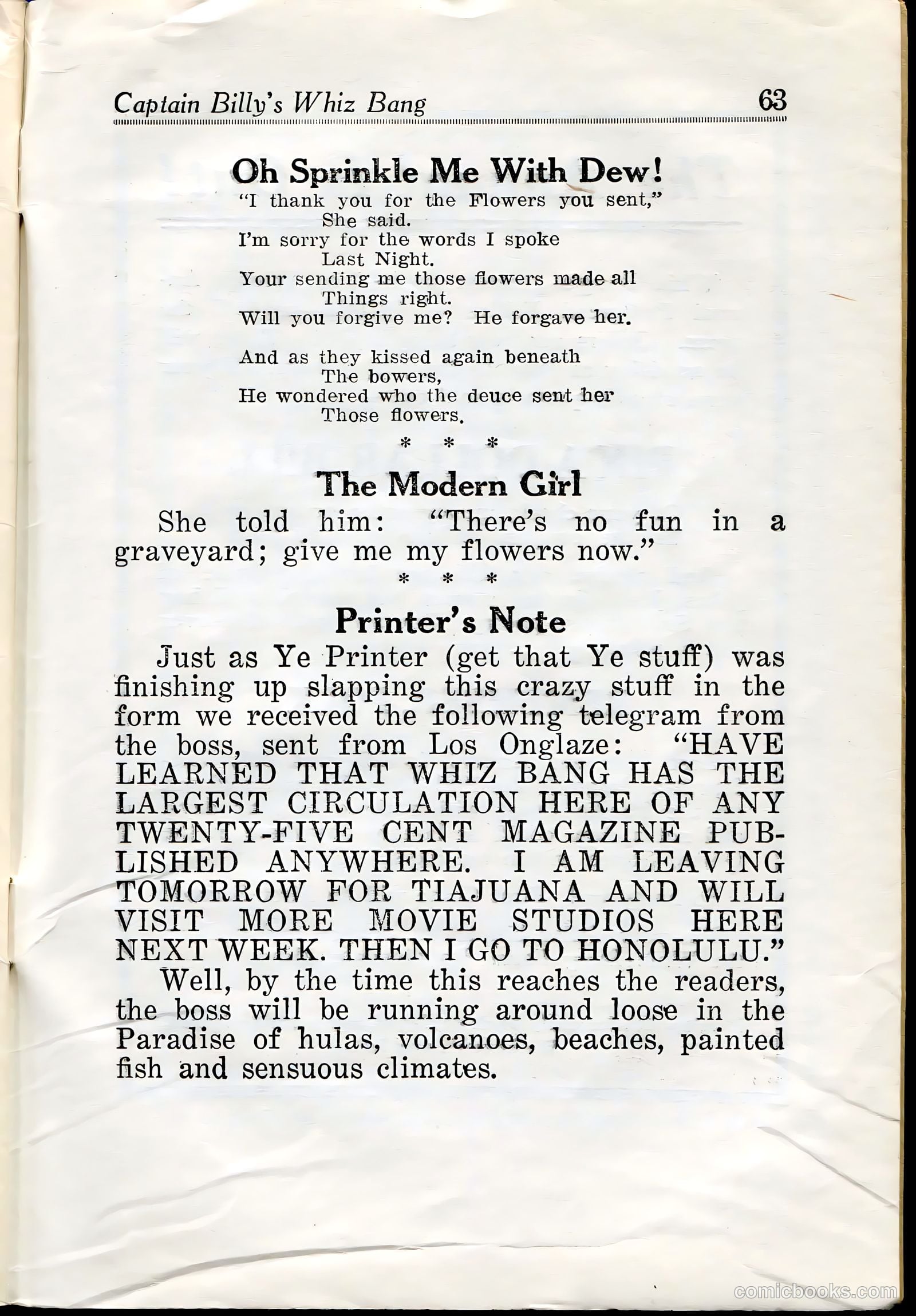
This page contains three brief pieces of satirical content: 1. **"Oh Sprinkle Me With Dew!"** - A poem about reconciliation between a couple. A man apologizes for harsh words spoken the previous night; flowers he sent her led to their reunion. The final stanza mocks romantic conventions with a cynical twist. 2. **"The Modern Girl"** - A one-liner joke contrasting traditional sentimentality with contemporary attitudes. A woman rejects the romantic notion of receiving flowers at her funeral, demanding flowers while living instead—satirizing shifting social values about materialism and instant gratification. 3. **"Printer's Note"** - A humorous editor's aside describing the magazine's boss leaving for Hawaii after learning Whiz Bang has the largest circulation among 25-cent magazines, mixing boasting with comedic exaggeration about his vacation plans.
This is an advertisement, not a cartoon. **Whiz Bang** was a humor magazine, and this page promotes its annual compilation book for winter 1921-22. The ad uses aggressive sales tactics typical of early 20th-century direct mail: urgency ("First Come will be First Served!"), scarcity claims (last year's smaller edition sold out in days across the U.S.), and a simple mail-order system (pin a dollar bill to a coupon). The tone is deliberately casual and colloquial ("Remember, Folk," "hurry up!"), matching the magazine's satirical humor style. The final note—dismissing requests for back issues—suggests strong demand and supply problems, likely reflecting post-WWI printing limitations and paper shortages of the early 1920s.
This is a **title/advertisement page**, not a satirical cartoon page. It promotes "Our Winter Annual" of *Captain Billy's Whiz Bang*, a humor magazine published from Robbinsdale, Minnesota. The page advertises the Winter Annual of 1921-22, promising "four times as much reading matter" as regular issues, for one dollar. It lists content including jokes, poetry, and stories with titles like "Johnnie and Frankie" and "The Girl in the Blue Velvet Band." The page includes an order form requesting payment via "dollar bill, check, money order or stamps" with spaces for name and address. This appears to be a **promotional insert** rather than editorial content, designed to solicit subscription orders from readers.
This is a **title/advertisement page** for *Whiz Bang* magazine itself, not a political cartoon or satirical content page. The page announces distribution and pricing information for the publication. A cartoon cow mascot appears at the bottom, likely the magazine's recognizable symbol. The pricing structure reflects early 20th-century magazine economics: 25 cents at newsstands, 30 cents on trains (markup for captive audiences), direct subscription at 25 cents, yearly subscription at $2.50, and a special Winter Annual at $1.00. *Whiz Bang* was a humor and satirical magazine popular in the 1920s-30s, known for risqué jokes and cartoons. This page simply promotes the magazine's availability and pricing across multiple sales channels.