
Captain Billy's Whiz Bang, September 1921 · page 49 of 68
Captain Billy's Whiz Bang #27 — page 49: what you’re looking at
What you’re looking at
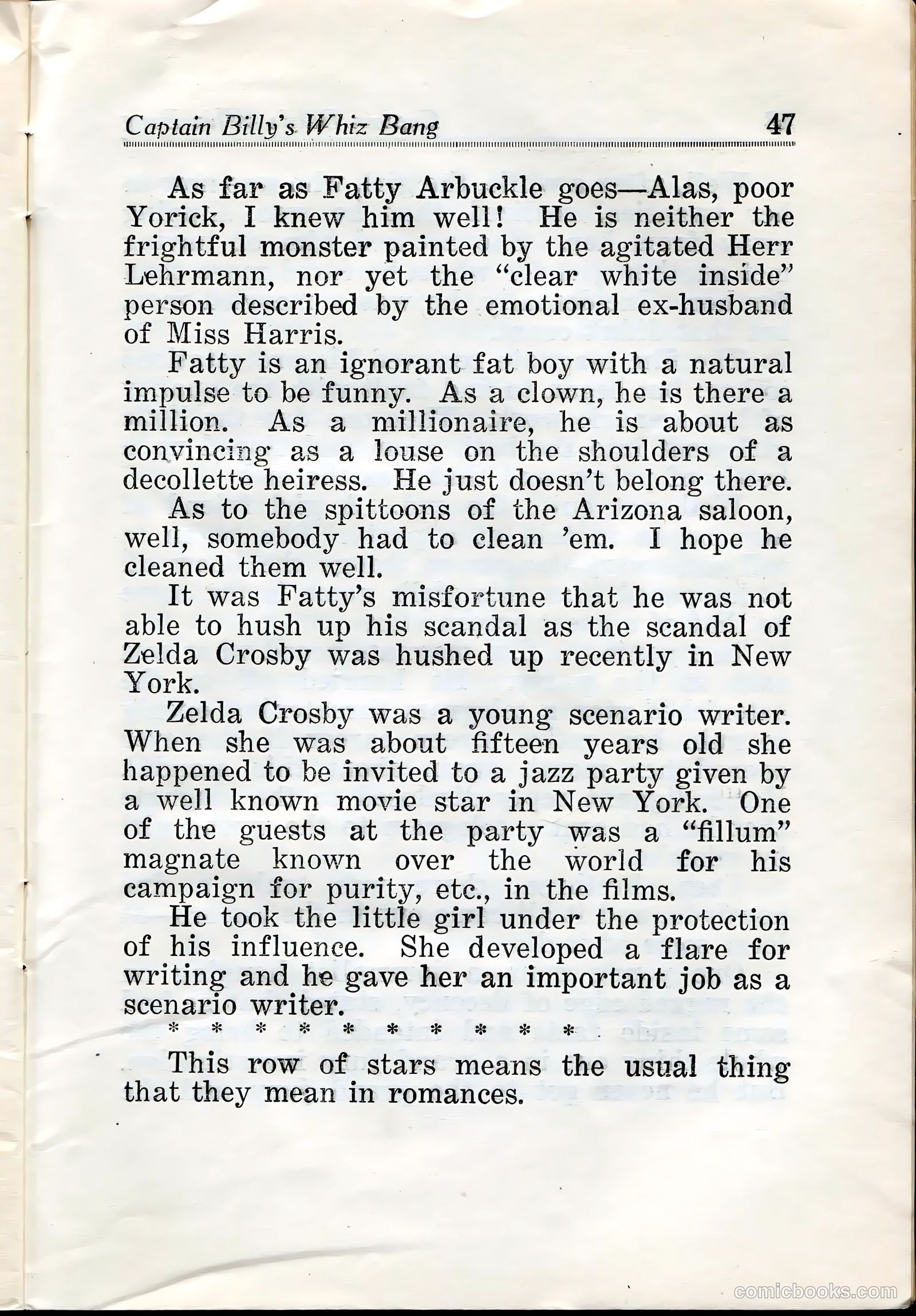
This page from *Captain Billy's Whiz Bang* (a satirical magazine) comments on the 1921-1922 Fatty Arbuckle scandal—the comedian faced rape and murder accusations following a party death. The writer defends Arbuckle as simply an unfunny rich person, not a monster, while critiquing how he couldn't suppress the scandal like others. The piece then contrasts Arbuckle's public ruin with Zelda Crosby's hushed-up scandal. Crosby, a teenage scenario writer, allegedly had an affair with a famous male movie mogul known for publicly campaigning for film "purity." The asterisks represent a sexual encounter—the satire's point being that wealthy, morally sanctimonious Hollywood figures could quietly cover up their own misconduct while lesser celebrities like Arbuckle faced public destruction. The cartoon exposes Hollywood hypocrisy and unequal accountability.
📄 Transcribed text from this page (OCR, searchable)
Machine-transcribed from the original scan — historical spelling and the odd misread are preserved.
Captain Billy's Whiz Bang 47 As far as Fatty Arbuckle goes—Alas, poor Yorick, I knew him well! He is neither the frightful monster painted by the agitated Herr Lehrmann, nor yet the “clear white inside” person described by the emotional ex-husband of Miss Harris. Fatty is an ignorant fat boy with a natural impulse to be funny. As a clown, he is there a million. As a millionaire, he is about as convincing as a louse on the shoulders of a decollette heiress. He just doesn’t belong there. As to the spittoons of the Arizona saloon, well, somebody had to clean ’em. I hope he cleaned them well. It was Fatty’s misfortune that he was not able to hush up his scandal as the scandal of Zelda Crosby was hushed up recently in New York. Zelda Crosby was a young scenario writer. When she was about fifteen years old she happened to be invited to a jazz party given by a well known movie star in New York. One of the guests at the party was a “fillum” magnate known over the world for his campaign for purity, etc., in the films. He took the little girl under the protection of his influence. She developed a flare for writing and he gave her an important job as a scenario writer. * * * * * * * * * * * This row of stars means the usual thing that they mean in romances.