
Captain Billy's Whiz Bang, September 1921 · page 26 of 68
Captain Billy's Whiz Bang #27 — page 26: what you’re looking at
What you’re looking at
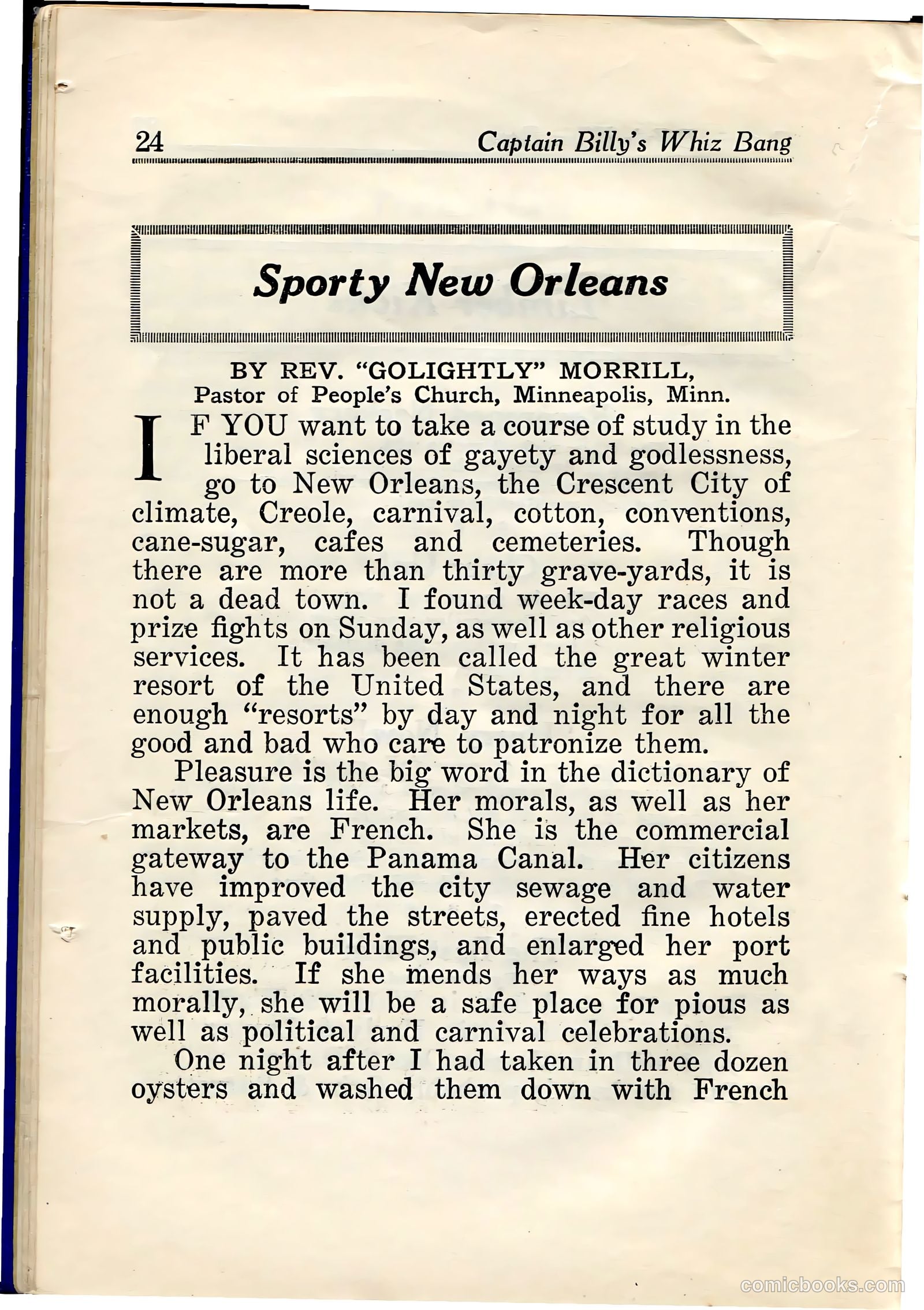
This is a satirical article by Rev. "Golightly" Morrill mocking New Orleans' perceived moral laxity. The reverend ironically presents the city as a "course of study in gayety and godlessness," cataloging its sins: gambling on Sundays, prizefights, French morals, and abundant "resorts" (likely brothels). The satire works through hypocritical contrast—Morrill acknowledges New Orleans' genuine civic improvements (sewage, infrastructure, port expansion) while dismissing them as insufficient without moral reform. His backhanded compliment ("If she mends her ways...") suggests the city is fundamentally corrupt despite progress. The author is a Minneapolis pastor using Whiz Bang's irreverent humor to critique perceived Southern decadence. For modern readers, this reflects 1920s American moral anxiety about major cities, particularly those with French cultural influence and lax Prohibition enforcement.
📄 Transcribed text from this page (OCR, searchable)
Machine-transcribed from the original scan — historical spelling and the odd misread are preserved.
24 Captain Billy's Whiz Bang Sporty New Orleans BY REV. “GOLIGHTLY” MORRILL, Pastor of People’s Church, Minneapolis, Minn. I F YOU want to take a course of study in the liberal sciences of gayety and godlessness, go to New Orleans, the Crescent City of climate, Creole, carnival, cotton, conventions, cane-sugar, cafes and cemeteries. Though there are more than thirty grave-yards, it is not a dead town. I found week-day races and prize fights on Sunday, as well as other religious services. It has been called the great winter resort of the United States, and there are enough “resorts” by day and night for all the good and bad who care to patronize them. Pleasure is the big word in the dictionary of New Orleans life. Her morals, as well as her markets, are French. She is the commercial gateway to the Panama Canal. Her citizens have improved the city sewage and water supply, paved the streets, erected fine hotels and public buildings, and enlarged her port facilities. If she mends her ways as much morally, she will be a safe place for pious as well as political and carnival celebrations. One night after I had taken in three dozen oysters and washed them down with French