
Captain Billy's Whiz Bang, September 1921 · page 37 of 68
Captain Billy's Whiz Bang #27 — page 37: what you’re looking at
What you’re looking at
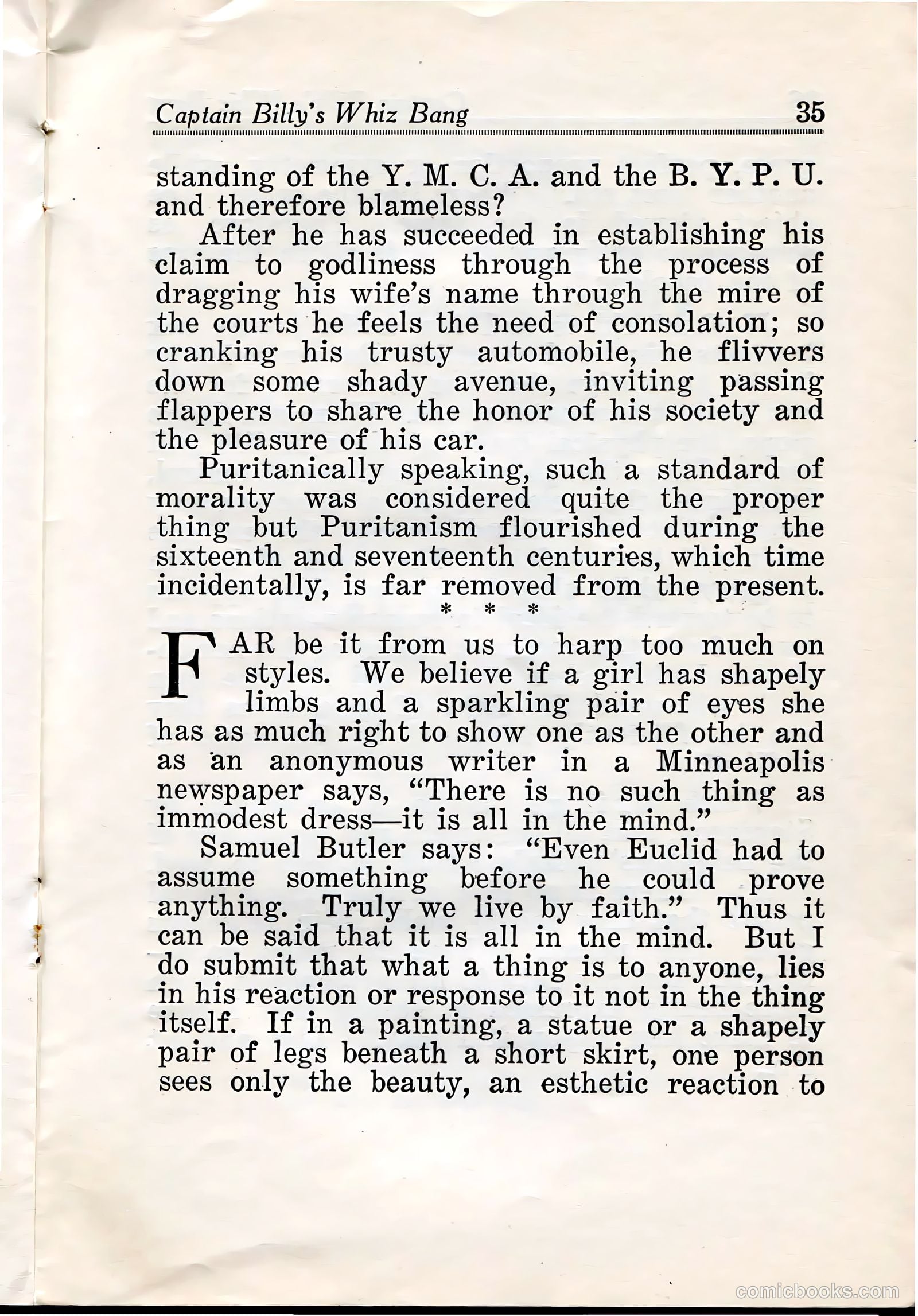
This page satirizes male hypocrisy regarding morality and sexuality. The text describes a hypocritical man who establishes himself as "godly" through religious institutions (Y.M.C.A., B.Y.P.U.) and courtroom proceedings, then immediately solicits young women ("flappers") in his automobile—behavior the author mocks as contradicting Puritan standards while claiming them. The second section defends modern women's fashion (short skirts revealing legs), arguing that "immodest dress" is subjective—"all in the mind." The author suggests different viewers interpret the same display differently based on their own reactions rather than the object itself. The satire targets male moral posturing: men proclaim godliness while pursuing sexual encounters, then blame women's clothing or viewers' minds for their own desires. This reflects 1920s debates over "flappers," female autonomy, and changing sexual standards.
📄 Transcribed text from this page (OCR, searchable)
Machine-transcribed from the original scan — historical spelling and the odd misread are preserved.
Captain Billy's Whiz Bang 35 standing of the Y. M. C. A. and the B. Y. P. U. and therefore blameless? After he has succeeded in establishing his claim to godliness through the process of dragging his wife's name through the mire of the courts he feels the need of consolation; so cranking his trusty automobile, he flivvers down some shady avenue, inviting passing flappers to share the honor of his society and the pleasure of his car. Puritanically speaking, such a standard of morality was considered quite the proper thing but Puritanism flourished during the sixteenth and seventeenth centuries, which time incidentally, is far removed from the present. * * * FAR be it from us to harp too much on styles. We believe if a girl has shapely limbs and a sparkling pair of eyes she has as much right to show one as the other and as an anonymous writer in a Minneapolis newspaper says, “There is no such thing as immodest dress—it is all in the mind.” Samuel Butler says: “Even Euclid had to assume something before he could prove anything. Truly we live by faith.” Thus it can be said that it is all in the mind. But I do submit that what a thing is to anyone, lies in his reaction or response to it not in the thing itself. If in a painting, a statue or a shapely pair of legs beneath a short skirt, one person sees only the beauty, an esthetic reaction to