
Captain Billy's Whiz Bang, September 1921 · page 27 of 68
Captain Billy's Whiz Bang #27 — page 27: what you’re looking at
What you’re looking at
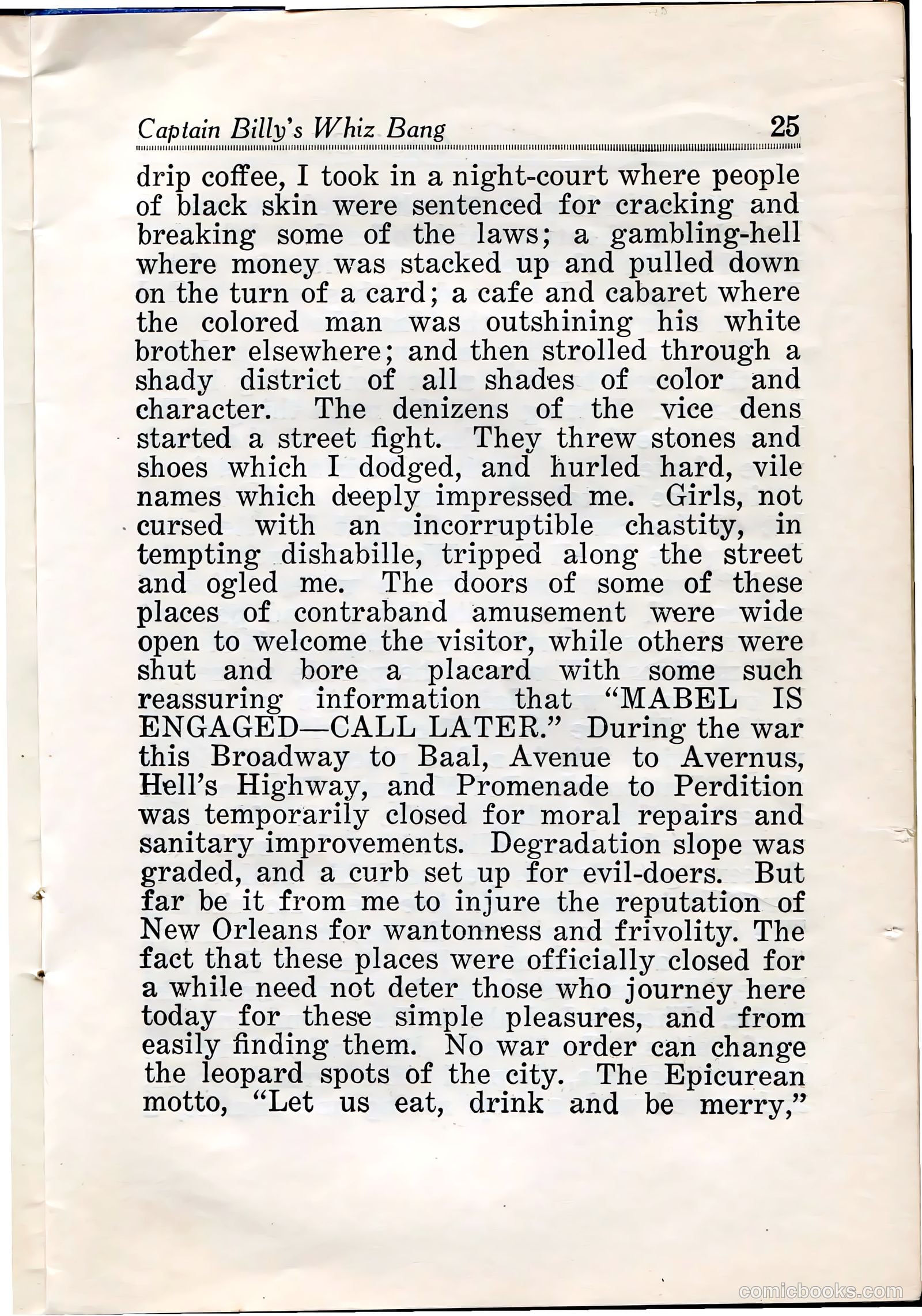
This appears to be a prose narrative rather than a cartoon. The text is a satirical tour of New Orleans' red-light district, written with heavy irony and moral condemnation masked as tolerance. **Key references:** - References to segregated "night-court" where Black defendants faced sentencing - Vice establishments (gambling halls, cabarets, brothels) in the district - A wartime closure of these areas ("During the war...temporarily closed for moral repairs") - Biblical allusions ("Broadway to Baal," "Avenue to Avernus," "Hell's Highway," "Promenade to Perdition") equating vice with damnation **The satire:** The author claims not to "injure New Orleans' reputation for wantonness," but proceeds to catalog depravity—street fights, sex workers, gambling—while ironically suggesting wartime moral reforms couldn't permanently change the city's nature ("No war order can change the leopard spots"). The tone is smugly disapproving yet oddly complicit, typical of period satirical magazines mocking urban vice while sensationalizing it.
📄 Transcribed text from this page (OCR, searchable)
Machine-transcribed from the original scan — historical spelling and the odd misread are preserved.
Captain Billy's Whiz Bang 25 drip coffee, I took in a night-court where people of black skin were sentenced for cracking and breaking some of the laws; a gambling-hell where money was stacked up and pulled down on the turn of a card; a cafe and cabaret where the colored man was outshining his white brother elsewhere; and then strolled through a shady district of all shades of color and character. The denizens of the vice dens started a street fight. They threw stones and shoes which I dodged, and hurled hard, vile names which deeply impressed me. Girls, not cursed with an incorruptible chastity, in tempting dishabille, tripped along the street and ogled me. The doors of some of these places of contraband amusement were wide open to welcome the visitor, while others were shut and bore a placard with some such reassuring information that “MABEL IS ENGAGED—CALL LATER.” During the war this Broadway to Baal, Avenue to Avernus, Hell’s Highway, and Promenade to Perdition was temporarily closed for moral repairs and sanitary improvements. Degradation slope was graded, and a curb set up for evil-doers. But far be it from me to injure the reputation of New Orleans for wantonness and frivolity. The fact that these places were officially closed for a while need not deter those who journey here today for these simple pleasures, and from easily finding them. No war order can change the leopard spots of the city. The Epicurean motto, “Let us eat, drink and be merry,”