
Captain Billy's Whiz Bang, September 1921 · page 38 of 68
Captain Billy's Whiz Bang #27 — page 38: what you’re looking at
What you’re looking at
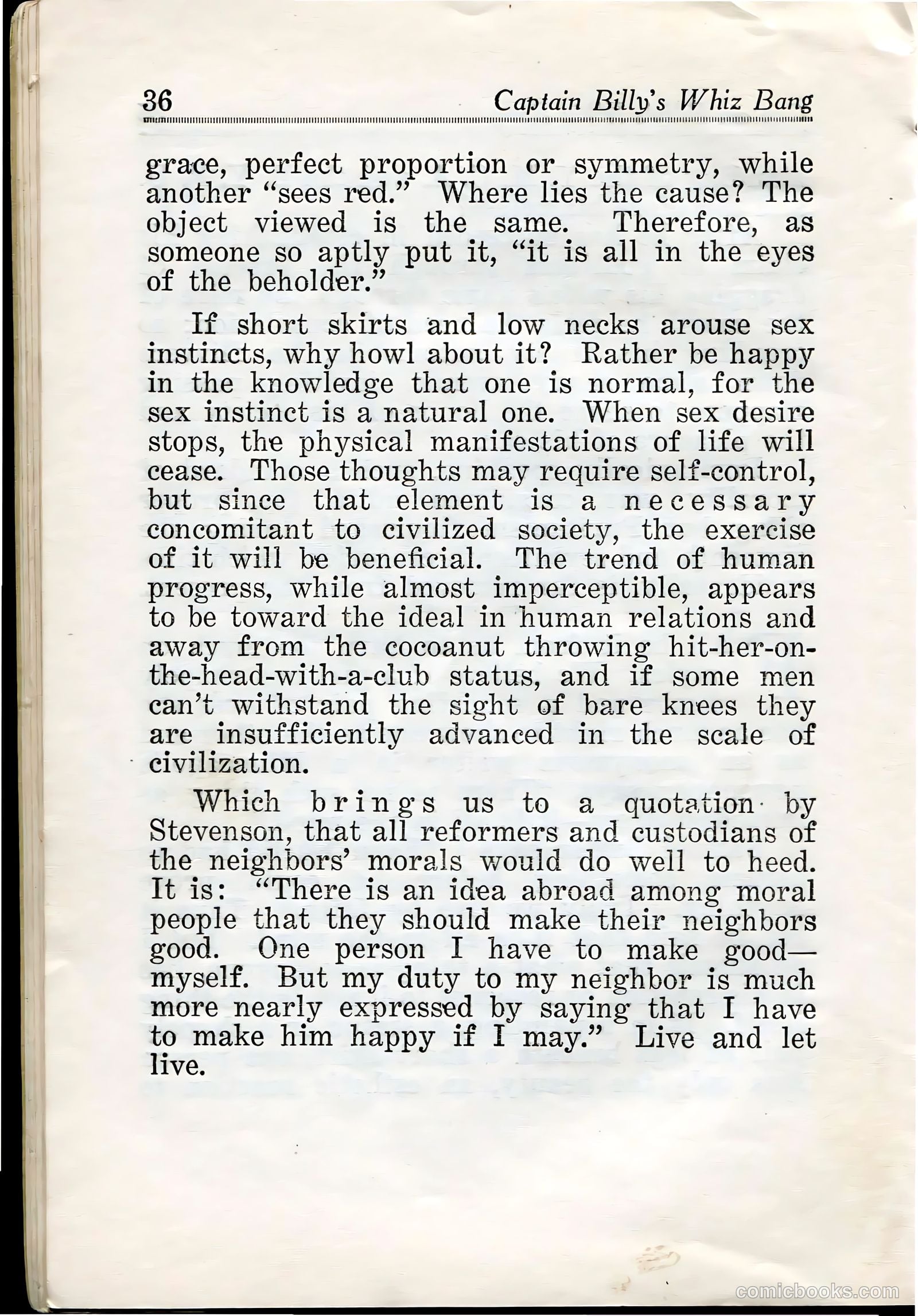
This page from *Captain Billy's Whiz Bang* (a popular 1920s satirical magazine) defends modern fashion and social liberalism against conservative moralists. The text argues that short skirts and low necklines are natural expressions of sexuality—not moral threats—and that those offended are simply "insufficiently advanced in the scale of civilization." The piece mocks moral crusaders and reformers, using a Stevenson quote to argue against paternalistic judgments of neighbors' behavior. The phrase "cocoanut throwing hit-her-on-the-head-with-a-club status" references supposed primitive courtship, positioning prudishness as backward. The essay's conclusion—"Live and let live"—encapsulates the Jazz Age ethos of personal freedom against Victorian constraints. This reflects 1920s culture wars over women's liberation, sexual frankness, and generational conflict.
📄 Transcribed text from this page (OCR, searchable)
Machine-transcribed from the original scan — historical spelling and the odd misread are preserved.
36 Captain Billy's Whiz Bang grace, perfect proportion or symmetry, while another “sees red.” Where lies the cause? The object viewed is the same. Therefore, as someone so aptly put it, “it is all in the eyes of the beholder.” If short skirts and low necks arouse sex instincts, why howl about it? Rather be happy in the knowledge that one is normal, for the sex instinct is a natural one. When sex desire stops, the physical manifestations of life will cease. Those thoughts may require self-control, but since that element is a necessary concomitant to civilized society, the exercise of it will be beneficial. The trend of human progress, while almost imperceptible, appears to be toward the ideal in human relations and away from the cocoanut throwing hit-her-on- the-head-with-a-club status, and if some men can’t withstand the sight of bare knees they are insufficiently advanced in the scale of civilization. Which brings us to a quotation by Stevenson, that all reformers and custodians of the neighbors’ morals would do well to heed. It is: “There is an idea abroad among moral people that they should make their neighbors good. One person I have to make good— myself. But my duty to my neighbor is much more nearly expressed by saying that I have to make him happy if I may.” Live and let live.