
Captain Billy's Whiz Bang, September 1921 · page 36 of 68
Captain Billy's Whiz Bang #27 — page 36: what you’re looking at
What you’re looking at
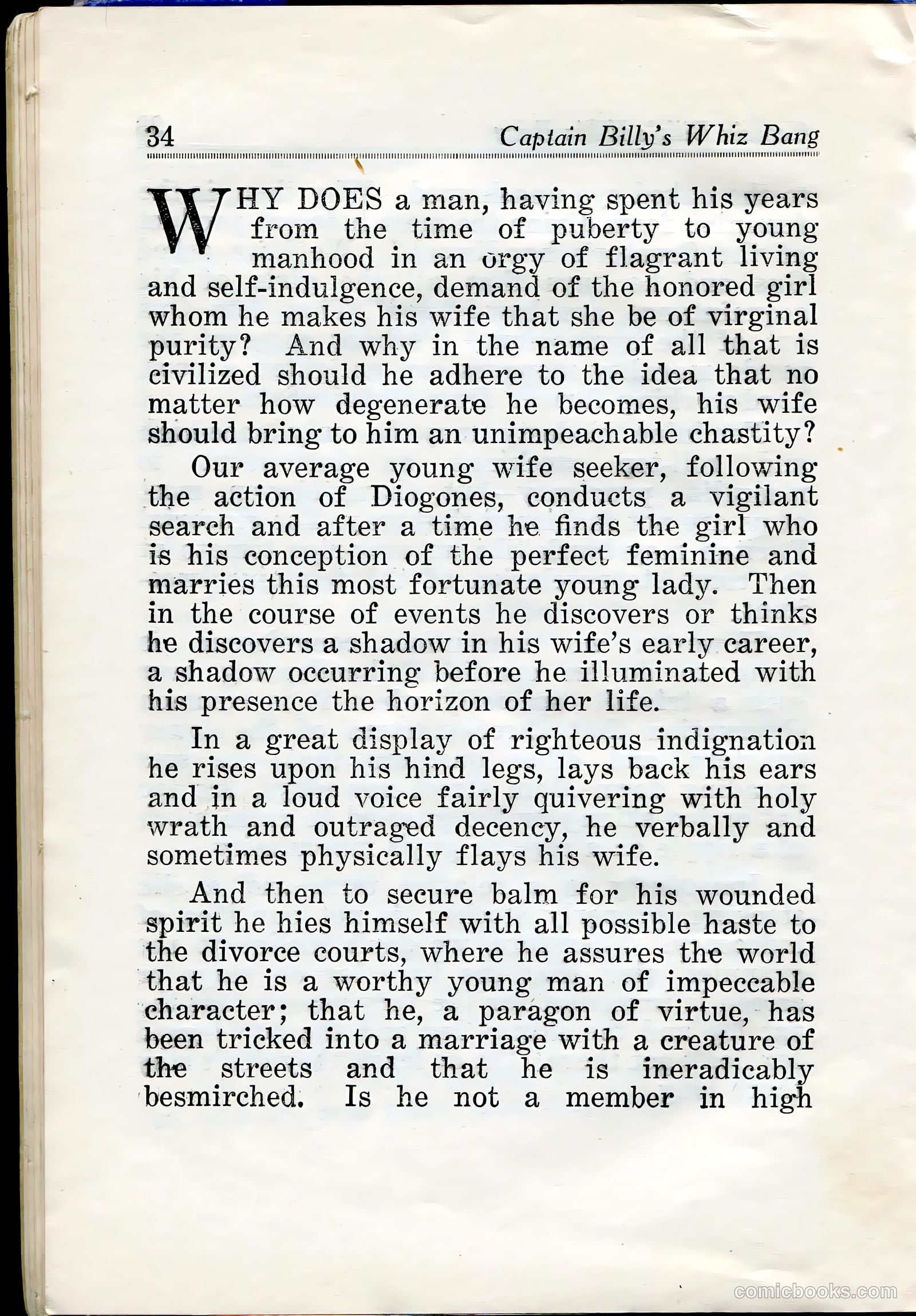
This is a satirical essay (not a cartoon) from *Captain Billy's Whiz Bang*, a 1920s humor magazine. The piece critiques **sexual double standards** in marriage. The author attacks hypocritical men who: - Live dissolute lives in youth ("orgy of flagrant living") - Yet demand virginal wives - Discover or suspect their wives had premarital relationships - Respond with fake moral outrage, verbally or physically abuse them - Then divorce and claim victimhood in court, portraying themselves as virtuous men "tricked" by women of disrepute The reference to **Diogenes** (ancient Greek philosopher famous for seeking an honest man) is ironic—these men search for "perfect" women while being morally corrupt themselves. The satire's point: men's hypocrisy about female chastity while holding themselves to no standard. The piece exposes how men weaponize morality claims in divorce proceedings to escape accountability for their own degeneracy.
📄 Transcribed text from this page (OCR, searchable)
Machine-transcribed from the original scan — historical spelling and the odd misread are preserved.
34 Captain Billy's Whiz Bang WHY DOES a man, having spent his years from the time of puberty to young manhood in an orgy of flagrant living and self-indulgence, demand of the honored girl whom he makes his wife that she be of virginal purity? And why in the name of all that is civilized should he adhere to the idea that no matter how degenerate he becomes, his wife should bring to him an unimpeachable chastity? Our average young wife seeker, following the action of Diogenes, conducts a vigilant search and after a time he finds the girl who is his conception of the perfect feminine and marries this most fortunate young lady. Then in the course of events he discovers or thinks he discovers a shadow in his wife's early career, a shadow occurring before he illuminated with his presence the horizon of her life. In a great display of righteous indignation he rises upon his hind legs, lays back his ears and in a loud voice fairly quivering with holy wrath and outraged decency, he verbally and sometimes physically flays his wife. And then to secure balm for his wounded spirit he hies himself with all possible haste to the divorce courts, where he assures the world that he is a worthy young man of impeccable character; that he, a paragon of virtue, has been tricked into a marriage with a creature of the streets and that he is ineradicably besmirched. Is he not a member in high