
Captain Billy's Whiz Bang, September 1921 · page 30 of 68
Captain Billy's Whiz Bang #27 — page 30: what you’re looking at
What you’re looking at
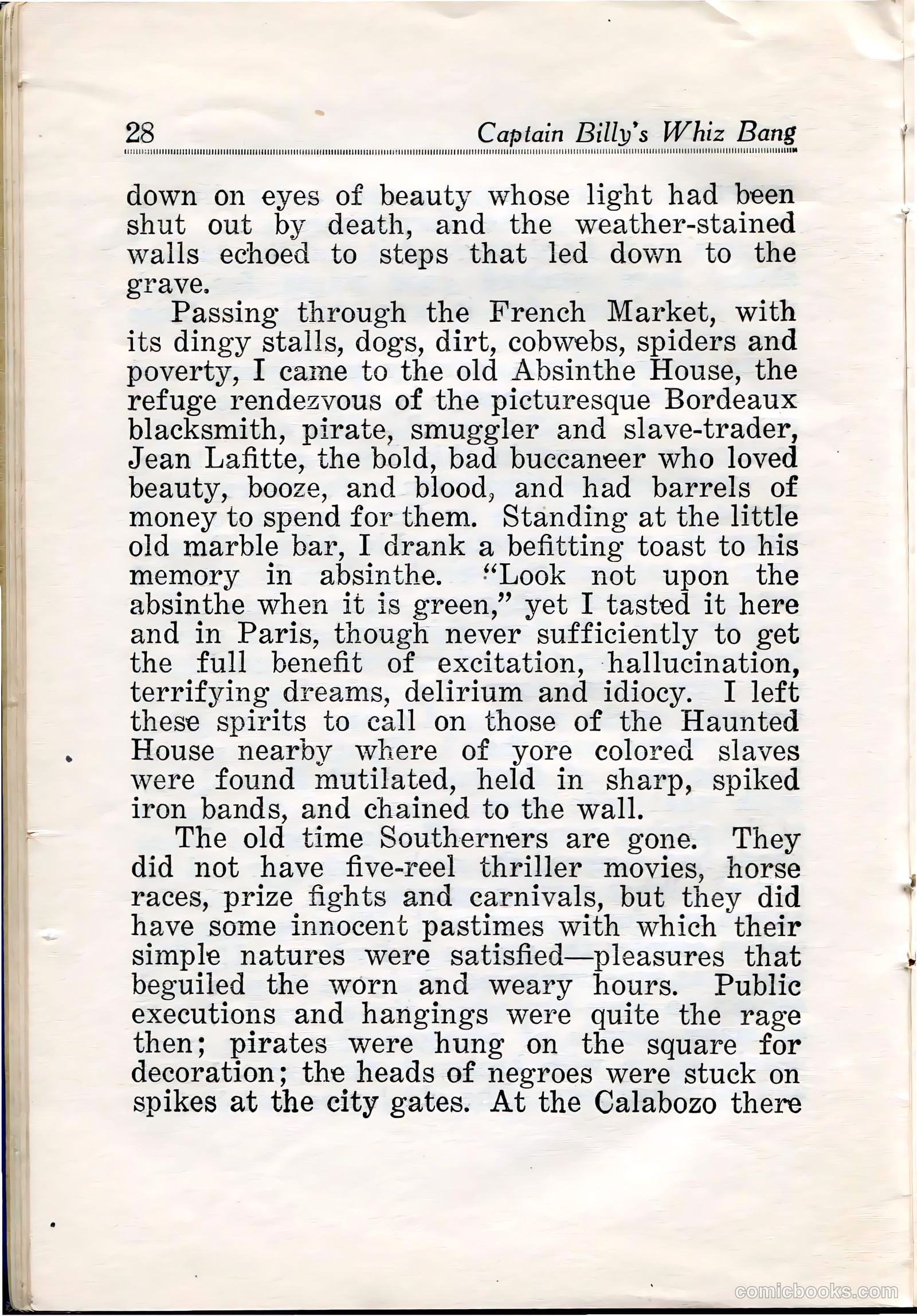
This page from *Captain Billy's Whiz Bang* is a satirical travel narrative about New Orleans, not a cartoon. The author describes visiting historical sites—the French Market, the Absinthe House (associated with pirate Jean Lafitte), and a haunted house with a history of enslaved people's torture. The satire operates through **ironic nostalgia**: the narrator describes antebellum Southern "pastimes" while cataloging shocking brutalities—public executions, mutilation of enslaved people, decapitated heads displayed at city gates. By listing these horrors alongside entertainment like horse races, the text exposes the moral bankruptcy of romanticizing the "old time Southerners." The absurd tone—drinking absinthe in Lafitte's bar, casually mentioning hallucinations and "idiocy"—reinforces the satirical distance. This appears to be deflating sentimental mythology about the pre-Civil War South by juxtaposing its vaunted gentility against documented atrocities.
📄 Transcribed text from this page (OCR, searchable)
Machine-transcribed from the original scan — historical spelling and the odd misread are preserved.
28 Captain Billy's Whiz Bang down on eyes of beauty whose light had been shut out by death, and the weather-stained walls echoed to steps that led down to the grave. Passing through the French Market, with its dingy stalls, dogs, dirt, cobwebs, spiders and poverty, I came to the old Absinthe House, the refuge rendezvous of the picturesque Bordeaux blacksmith, pirate, smuggler and slave-trader, Jean Lafitte, the bold, bad buccaneer who loved beauty, booze, and blood, and had barrels of money to spend for them. Standing at the little old marble bar, I drank a befitting toast to his memory in absinthe. “Look not upon the absinthe when it is green,” yet I tasted it here and in Paris, though never sufficiently to get the full benefit of excitation, hallucination, terrifying dreams, delirium and idiocy. I left these spirits to call on those of the Haunted House nearby where of yore colored slaves were found mutilated, held in sharp, spiked iron bands, and chained to the wall. The old time Southerners are gone. They did not have five-reel thriller movies, horse races, prize fights and carnivals, but they did have some innocent pastimes with which their simple natures were satisfied—pleasures that beguiled the worn and weary hours. Public executions and hangings were quite the rage then; pirates were hung on the square for decoration; the heads of negroes were stuck on spikes at the city gates. At the Calabozo there