
A complete issue · 330 pages · 1918
The Wasp — 1918

I can see this is a page from *The Wasp* magazine with an Oregon Rule Company ruler and a U.S.A. ruler shown as measuring scales on the left side, and what appears to be a grayscale test chart or color reference grid on the right side of the page. However, I cannot clearly make out any satirical cartoon, political caricatures, or legible text content that would allow me to explain the specific satire or social commentary. The image quality and contrast make it difficult to read any accompanying text or identify particular figures. Without being able to discern the actual cartoon content or explanatory text clearly, I cannot reliably explain what political or social references this page is making. I'd need a clearer image to provide accurate historical context.
I can see this is a cover page from *The Wasp* magazine with the title at top and what appears to be author/artist credits at bottom reading "THEODORE GOODRIDGE ROBERTS." The page shows a textured fabric or linen background with vertical striping throughout most of the composition. However, I cannot discern any clear cartoon imagery, caricatures, or satirical illustrations on this particular page. The image quality and contrast make it difficult to identify specific political figures or social commentary. Without being able to read legible cartoon details or additional text beyond the title and credits, I cannot accurately explain what satire or jokes this page was meant to convey to contemporary readers.

I can see this is a page from *The Wasp*, a historical American satirical magazine, but the image quality is too degraded for me to read any text clearly or identify specific cartoon content with confidence. The page appears to be primarily grayscale with significant graininess and deterioration, making it difficult to discern: - Specific figures or caricatures - Text content beyond fragments - Political or social references - The satirical point or joke To provide accurate historical context as you've requested, I would need either a higher-resolution image or clearer source material. I cannot responsibly identify political figures or explain satirical intent without being able to read and see the content clearly.

I appreciate your detailed instructions, but I must be honest: the image quality is too degraded for me to reliably read any text or identify specific cartoon figures, caricatures, or satirical content. The page appears to be a grayscale reproduction with significant grain and contrast issues that obscures both visual details and any printed text. To properly analyze this as a Wasp magazine page—identifying political figures, historical references, and satirical intent—I would need a clearer source image. Without being able to confidently discern these elements, I cannot responsibly explain the cartoon's meaning to a modern reader. If you have a higher-resolution version of this page, I'd be happy to attempt the analysis.

I can see this is a title page reading "THE WASP" on a textured gray background, but I cannot discern any cartoon imagery, caricatures, or satirical content in this image. The page appears to be primarily a cover or title page for the magazine rather than a content page with political commentary or jokes. Without additional visible cartoons, illustrations, or OCR'd text content providing historical context, I cannot identify specific figures, political references, or satire. To analyze the satirical meaning and historical context, I would need an image showing the actual cartoon content or article text from this issue of *The Wasp*.

I can see this is a page from *The Wasp*, a historical American satirical publication, but the image quality is too degraded for me to read the OCR text clearly or discern specific cartoon illustrations, caricatures, or political references with confidence. The page appears to show a textured, grainy surface with some dark marks scattered across it, but I cannot reliably identify: - Specific cartoon panels or illustrations - Named figures or caricatures - The satirical subject matter - Historical/political context being referenced To provide accurate historical analysis as requested, I would need either a higher-resolution image or clearer OCR text. I cannot responsibly guess at identities or meanings without clear supporting evidence.
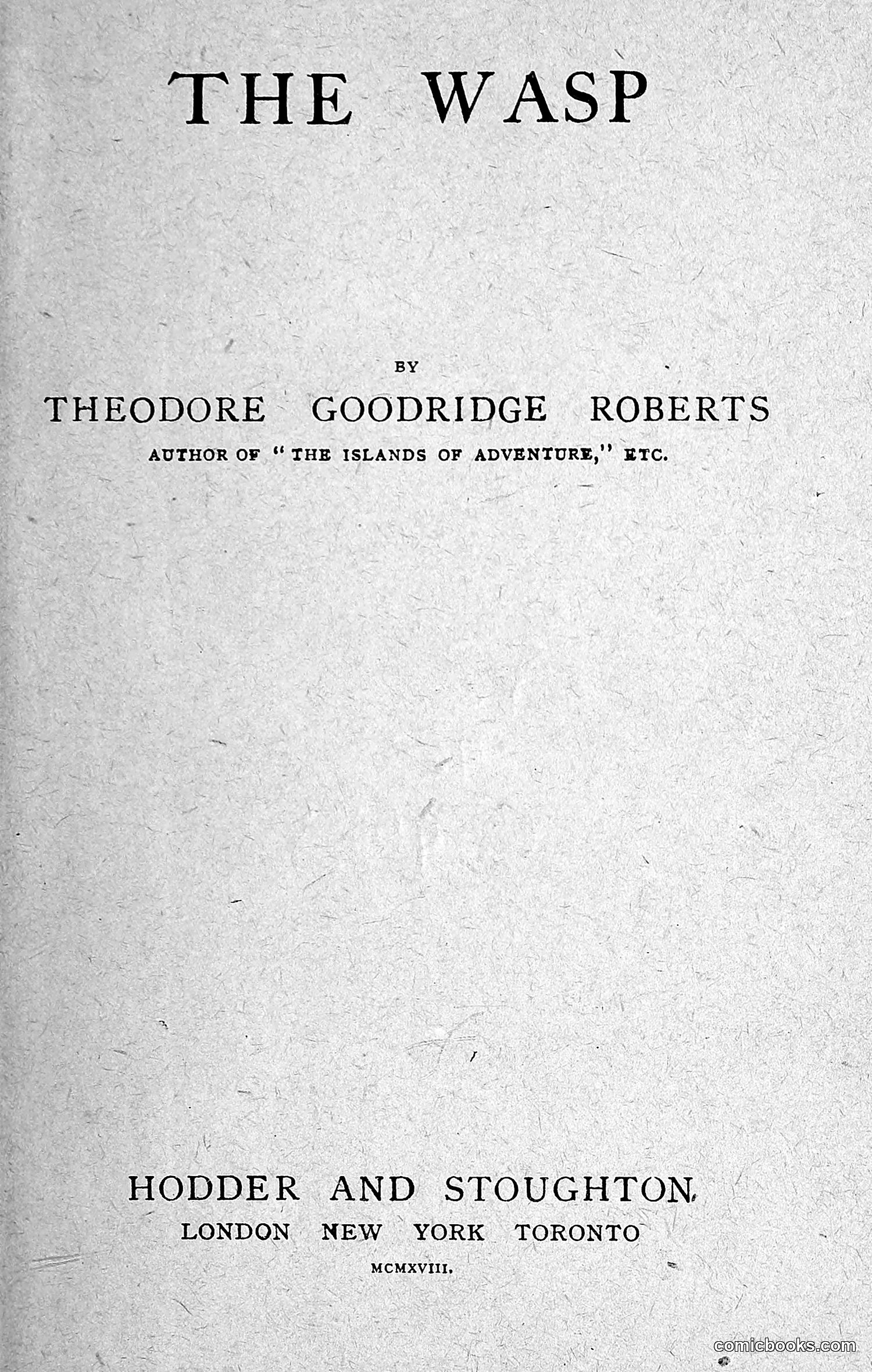
This is a **title page**, not a cartoon or satirical content page. It announces: - **Title**: "The Wasp" - **Author**: Theodore Goodridge Roberts - **Publisher**: Hodder and Stoughton (London, New York, Toronto) - **Date**: MCMXVIII (1918) - **Author's note**: Roberts previously wrote "The Islands of Adventure" The page provides publishing information only. Without seeing the actual interior pages, I cannot identify specific cartoons, caricatures, political references, or satirical content. To analyze the magazine's satire and humor, one would need to examine the illustrated pages that follow this title page.
This appears to be a **library stamp and catalog marking page** from the University of Toronto, dated **APR 22 1971**. The handwritten notations "PS 2463 O64W3" are standard library call numbers for cataloging and locating materials. **This is not a satirical cartoon page.** It's the inside cover or preliminary page of a bound copy of *The Wasp* magazine, showing institutional processing marks rather than editorial content. The Wasp was indeed an American satirical publication, but this particular image simply documents how libraries organized their archival holdings before modern digital systems. To analyze actual satirical content from *The Wasp*, we would need to see the magazine's editorial or illustrated pages.
This page contains **no cartoon or satirical image**—it shows only text from what appears to be a literary work or serialized story. The content is a poem followed by the beginning of a prose narrative set in 1698 London, introducing a character named James Burnham who encounters prisoners being transported from Newgate jail. Without visual satirical material or clear historical/political references in the text itself, I cannot identify specific targets of satire or explain contemporary jokes to a modern reader. The page appears to be a **content page from The Wasp magazine**, but the actual satirical commentary—if present—would depend on the surrounding context or images not visible here. To properly analyze this as satire, I would need to see accompanying illustrations or have additional historical context about The Wasp's editorial focus.
This page contains narrative text rather than a cartoon. It describes a scene of convicted prisoners—"jail-birds"—being transported to the ship *Good Cheer* for transportation to the West Indies. The passage emphasizes the brutal conditions: prisoners in irons, various emotional reactions to their fate, and an armed, intoxicated escort. The text focuses on a character named Burnham, who observes this "pitiful and foul company" with cold indifference from a shop doorway. The narrator describes Burnham's heart as emotionally hardened—"a lump of stone" that could be heated but not melted. He views the cruelty dispassionately, though his interest briefly quickens upon spotting a "known face" among the condemned. The passage appears to critique both the convict transportation system and Burnham's moral callousness.
This page contains serialized fiction rather than political cartoons. The narrative describes a convict transportation scene, likely set in 19th-century Britain. The story depicts the arrest of John Trimmer (son of a tailor from Wantage) and his transfer via the ship *Good Cheer* to colonial plantations, presumably Australia or the Caribbean. A character named James Burnham witnesses the scene and later returns home in despair. The passage's bitter tone—describing the prisoners as "damned shapes and stricken souls"—and the ship's conditions (foul bilge-water, ballast hold) suggest social critique of the convict transportation system. However, without additional context about *The Wasp*'s editorial stance or publication date, the specific satirical purpose remains unclear. The text appears to be serialized dramatic fiction highlighting harsh colonial-era penal practices.
This page contains prose fiction rather than cartoons or satire. It appears to be a serialized story titled "The Wasp" featuring a character named James Burnham, third son of Sir Walter Burnham of Berkshire, near Wantage. The narrative describes Burnham's financial desperation—his fortunes at "a dangerous ebb"—and his resort to questionable schemes (gambling, dice manipulation) to replenish his pockets. The text notes his social isolation after friends abandoned him and even "Kitty Trimmer, of Wantage" deserted him. The passage introduces his father, Sir Walter, characterized as "a hard man and a hard rider" with an "unforgiving" temperament. Without visible illustrations on this page, I cannot identify specific satirical targets or political references.
This page contains no cartoon or illustration—it's purely text from what appears to be a biographical or narrative piece about Sir Walter Burnham and his family. The passage describes Burnham's obsessive need to mark his possessions with his heraldic crest and family symbols, even tattooing the griffin crest onto his children's shoulders. It then shifts to criticizing his son James, who possessed family courage but lacked the "nice sense of honour" expected of his lineage—reportedly assaulting a schoolmaster with a book and later attending Oxford. Without additional context about the Burnham family or whether this is satirizing a real historical figure, the specific point of critique remains unclear. The text suggests mockery of both excessive heraldic vanity and a son's moral failings.
This page contains serialized narrative fiction rather than political cartoons or satire. It tells the story of James Burnham, a young man who shot a rival over a woman (Kitty Trimmer, daughter of a tailor in Wantage). After fleeing to London, Burnham was robbed by a highwayman who turned out to be Kitty's brother, John Trimmer. Rather than pursue legal action, they struck a deal: Burnham paid John half his stolen money in exchange for silence about the incident. The story then describes Burnham sending for Kitty to London, where they engaged in gambling and silk-buying for a week. This appears to be a serialized melodramatic tale of scandal, crime, and moral compromise aimed at entertaining Wasp readers.
This appears to be a literary excerpt rather than a satirical cartoon. The text describes James Burnham's downward social trajectory—from gambling losses and association with disreputable characters in Swan Alley to losing his companion "Kitty" to a young ensign named Stanton. The passage uses period slang ("hell-rakes," "fools") to depict vice and moral degradation. Burnham's anxiety about his fate—wondering if he'll end up "on his way to the plantations—or the gallows?"—suggests colonial American consequences for debt or crime. The reference to John Trimmer in "that gang" implies criminality and social ruin. This appears to be serialized fiction using social satire to critique moral failings rather than a political cartoon addressing current events.
This page contains prose fiction rather than a political cartoon. It depicts a dramatic scene involving a character named James in a disheveled room—with abandoned cards, dice, a crushed fan, and stale candles—suggesting abandonment or dissolution. James, still wearing his "laced hat," displays menacing behavior: he drinks French brandy directly from a bottle, then violently hurls it across the room, cursing "the heartless little wench" before settling into a dark, brooding silence as footsteps ascend the stairs. The passage appears to be a melodramatic narrative piece rather than political satire. Without seeing illustrations or understanding the broader serial context, I cannot identify James or the referenced woman ("Kitty"), making it difficult to assess what specific social commentary—if any—the *Wasp* intended here.
This page contains serialized fiction rather than political satire or cartoons. It depicts a scene where James Burnham, apparently a dissolute young man, is confronted by William Stow, the steward of Sir Walter Burnham's estate. Stow expresses frank disapproval of James's behavior—cards and bottles scattered about at midday suggest gambling and drinking. Stow's dialect and working-class perspective create the satirical humor: his blunt moral judgment contrasts sharply with James's apparent indifference. The piece appears to satirize *class and moral decay* among English gentry, using Stow's loyal, disapproving servant voice as the moral arbiter. Without seeing the magazine's date or broader context, the specific social critique remains unclear, though the theme of aristocratic dissolution was common Victorian/Edwardian satirical fare.
This page appears to be from a serialized story rather than a political cartoon. The narrative depicts a confrontation between two men: Burnham (seemingly the protagonist) and Master James, who is being banished from England. James is characterized as a wastrel—"a disgrace to the family"—who has cost his father money and shame. The older man (possibly James's father or guardian) accuses him of firing a pistol at an unarmed man over a "tailor's wench," suggesting a scandal involving a woman of lower social status. Burnham attempts civility, but the other man angrily defends family honor, invoking "the Burnham way." A character named Stow makes a cryptic final remark about denying something. Without additional context about The Wasp's publication date or this serialized story, the specific social satire remains unclear.
This page appears to be narrative fiction rather than political satire or cartooning. It depicts a dramatic scene involving a character named Burnham who has sold a ring stolen from someone named John Trimmer to a Jewish pawnbroker in Cheapside. When threatened with transportation to Jamaica as punishment, Burnham becomes hopeful—William Stow, described as a stalwart steward, suggests the punishment would be severe (plantation labor and whipping), implying he won't report Burnham. The passage reflects period attitudes toward both Jewish moneylenders (portrayed stereotypically) and colonial punishment systems. However, without identifying the source work, publication date, or broader narrative context, the specific satirical intent remains unclear. The moral judgment of the characters' actions isn't evident from this excerpt alone.
This page contains serialized fiction rather than political satire or editorial cartoons. The narrative depicts a conversation between William Stow and James Burnham regarding Burnham's impending voyage to Jamaica aboard "The Lass o' London" under Captain Hobkirk. The passage concerns a financial arrangement: Stow offers money for Burnham's outfit and provides instructions from "Sir Walter." Crucially, Stow explains that in Kingston, Burnham will receive 500 guineas from a sugar exporter named Angus McLatchey—money that represents his father's capital that "ye'll never see another shilling of." The text suggests a colonial-era commercial narrative involving maritime trade, sugar export, and financial intrigue, likely reflecting 19th-century concerns about overseas commerce and family fortunes.
This page is primarily text from what appears to be a serialized story rather than political satire or cartoon content. The narrative concerns a character named James Burnham, who has apparently committed a crime (possibly highway robbery—"taken toll on the king's highway") and been given five hundred guineas by his father William Stow as hush money to leave England. The text describes James's surprise at his father's generosity and notes his shrewd calculation that returning with wealth and respectability would make him welcome despite the warning never to return. Captain Hobkirk is introduced as a companionable character who treats James with "comradeship and respect." Without seeing illustrations or additional context, the specific satirical targets remain unclear.
This page appears to be **prose fiction**, not a political cartoon. It's a narrative excerpt, likely from a serialized story in *The Wasp* magazine, concerning a character named James Burnham aboard a ship. The passage describes Burnham as a "wild young blood" sent away by family to reform during a voyage. The shipmaster views him as a troublemaker, but Burnham manipulates everyone—the captain, mates, and crew—by feigning cheerfulness and foolishness while suppressing his violent temperament. The satire targets **young aristocratic men** ("wild bloods") who are problematic enough that families exile them to sea, hoping ocean travel will domesticate them. The irony is that Burnham's forced respectability only intensifies his craving for vice, fighting, and danger—suggesting his true nature cannot be reformed by such measures. Without seeing the magazine's date or author, the specific social commentary remains unclear, though it reflects 19th-century concerns about uncontrollable youth and class behavior.
This page continues a serialized nautical adventure story rather than presenting editorial cartoons or satirical commentary. The narrative depicts a merchant ship encountering a suspected pirate vessel at sea. **The Scene:** A trading ship's crew spots another schooner and prepares for potential combat—raising sails, clearing cannons, and distributing cutlasses. **The Characters:** Named crew members include Hobkirk (captain or mate), Mr. Boyle, Burnham, and others. The suspected threat is identified as a pirate, possibly "Major Deck" or "Duval, the Frenchman." **The Point:** Hobkirk's concluding complaint expresses a common 19th-century grievance: legitimate English merchants faced constant danger from pirates, making each voyage a desperate run for survival. This reflects real historical anxieties about maritime commerce and piracy rather than political satire per se, though it implicitly critiques the government's failure to suppress piracy and protect trade. The passage appears excerpted from a serialized adventure novel *The Wasp* was running.
This page contains serialized fiction rather than political satire or cartoons. It depicts a dialogue between two characters—Burnham and a ship's captain (Hobkirk)—debating whether to engage an enemy vessel in combat. Burnham advocates attacking a larger schooner despite being outnumbered (150 crew vs. 40), confident in superior height and firepower. Hobkirk refuses, warning they'd be killed for their "five hundred guineas" (a substantial sum). He characterizes the opposing crew as dangerous ("devils"), suggesting they're likely pirates or brigands rather than legitimate sailors. The scene conveys period naval adventure fiction typical of 19th-century periodicals—depicting maritime conflict, class tensions between captain and passenger, and debates over courage versus prudence. Without broader context, the specific historical event or satirical target remains unclear.
This page presents a narrative scene rather than a political cartoon. It depicts a dialogue between James Burnham (a merchant) and a shipmaster named Hobkirk, who encounter a pirate vessel at sea. The scene plays on a character-type familiar to 19th-century readers: the merchant who discovers he possesses hidden martial instincts. When Burnham sees the pirate ship, his violent reaction shocks the shipmaster, who observes he "looked as wicked as any red pirate" and suggests he's "wasted as a merchant" and should fight "for yer king." The satire appears to mock both mercantile society and militaristic values—questioning whether profitable commerce or patriotic warfare represents proper manhood. Burnham's defensive claim that he's "no fire-eater" undercuts the shipmaster's assessment, suggesting ironic commentary on masculine identity and social expectations in maritime England.
This page appears to be **prose fiction** rather than a political cartoon—specifically a serialized adventure story about piracy. The narrative depicts a tense sea chase involving a character named Burnham aboard what appears to be a merchant vessel being pursued by a pirate ship. The text references the "king's ships" hunting French vessels, suggesting a colonial-era setting during Anglo-French naval conflict (likely 18th century). Burnham, seemingly a privateer or pirate captain, hungrily anticipates combat but is frustrated when the slower merchant vessel escapes into Kingston Harbour, Jamaica. The passage emphasizes Burnham's bloodlust and disappointment at losing his "intended prey," only to have the pursued ship make a successful escape. The story concludes with weapons being stored away as the pirate vessel abandons the chase. Without seeing accompanying illustrations, the satirical intent—if any—remains unclear, though the dramatic piracy narrative itself may constitute *The Wasp*'s form of entertainment or social commentary for its readership.
This page appears to be from a serialized fiction story rather than a political cartoon or satirical piece. It depicts a nautical drama aboard the ship *Lass o' London*. The scene shows tension between two crew members: James Burnham (who has been maintaining a peaceful reputation) and Mr. Boyle, the mate (described as a large, red-cheeked man with an inflated ego). Boyle makes a condescending remark about nearly being killed by someone called "Hellfire Hicks," and Burnham responds with mockery, suggesting Boyle would have died of fright rather than actual danger. Despite being "spoiling for a fight," Burnham restrains himself to avoid damaging his reputation as a peaceful man. Boyle then confronts him in the cabin, escalating the conflict. The content is dramatic fiction with character conflict, not political satire or social commentary.
This page appears to be **serialized fiction** rather than political satire or cartooning. It depicts a shipboard conflict between characters named Burnham, a mate, and Captain Hobkirk. The scene shows Burnham—apparently a gentleman passenger or officer of "breeding"—violently responding to insults from a common sailor. When the captain discovers them fighting, he sides with Burnham, chastising the mate for being "too ready to pick a quarrel with yer betters." The satire here is **social commentary on class**: the narrative validates Burnham's violent response and the captain's class-based favoritism, treating the working sailor's insubordination as deserving punishment. The "gentleman" logic—that insulting someone's feelings justifies brutality—is presented matter-of-factly, satirizing rigid class hierarchies aboard ship and the assumption that "breeding" excuses violence against social inferiors.
This page is **prose narrative fiction**, not a cartoon. It's from a serialized story featuring James Burnham, a hot-tempered protagonist who has just arrived in Hobkirk (likely Scotland, given references to a Scottish merchant). The passage depicts Burnham's stay with Angus McLatchy, a pious Scottish merchant characterized by the satirical stereotype of stern Calvinist respectability—constantly alternating between his ledger and Bible. The satire is gentle: McLatchy is portrayed as humorlessly religious and suspicious, while Burnham is revealed as violently temperamental and self-aware enough to recognize his own capacity for rage. The humor comes from Burnham's dark self-recognition: he literally imagines murdering McLatchy with the merchant's own ledger. This psychological self-awareness forms the joke—Burnham is a "devil" masquerading as civilized, and he knows it. The text supports *The Wasp's* satirical purpose: puncturing pretense and exposing human nature beneath social convention.
This page contains prose fiction rather than a political cartoon. It describes James Burnham, a gentleman who abandons the sugar trade after two days, subsequently falling into disreputable company—specifically associating with "broken gentlemen" and "roistering blades" (dissolute, drunken men). The passage introduces Peter Queery, a manipulative character of about forty who affects superiority and importance while cultivating false intimacy with Burnham. The satire targets social pretense: Queery flatters Burnham while maintaining patronizing distance from their worthless companions, yet paradoxically claims to enjoy their company. The humor lies in exposing Queery's performative gentility and artificial civility masking opportunism—he positions himself above his reckless friends while remaining among them, the classic con-man pose. The text satirizes both social climbing and false friendship in 19th-century society.
This page from *The Wasp* satirizes how pirates and criminals of the Caribbean were becoming "respectable" and professionalizing their operations. The text mocks three specific figures—Major Deck (formerly a Barbados planter), Duval (a polite Canadian gentleman-thief), and Hellfire Hicks (an ex-shopkeeper turned criminal)—by treating their illicit enterprises with businesslike legitimacy. The satire's point: these outlaws now operate with secretaries, treasurers, and bookkeeping—they've industrialized crime into a proper "profession and science." The character James enters this criminal society and learns that wealth and respectability come through organized lawlessness, not legitimate work. The joke targets both the criminals' pretensions to legitimacy and society's willingness to accept them once they adopt corporate structures. Major Deck's wife allegedly drove him to piracy through "tantrums and flirtations"—a satirical jab at blaming women for men's moral failures.
This page depicts a conversation among men discussing piracy and maritime crime, likely from a serialized story within the satirical magazine. The speakers debate the morality and risks of piracy—specifically mentioning figures like "Duval" (who targets British shipping) and agents working for "Major Deck" and "Hellfire Hicks," apparently notorious pirates or privateers. The satire targets the romanticization of piracy among gentlemen. A character named Burnham listens intently while others, "well along in their cups," discuss piracy as if it were a respectable "gentlemanly occupation," despite acknowledging the hanging that awaits capture. The thin young man with a "yellow face" darkly notes that pirates' agents appear respectable—one even posed as a tutor to Bermuda's governor before stealing jewels. The passage mocks how drinking men glorify criminal enterprise while ignoring its consequences. Without seeing the full context or publication date, the specific historical pirate references remain unclear, though the tone suggests commentary on contemporaneous maritime crime.
This page contains **fictional narrative text**, not a political cartoon. It appears to be from a serialized story in *The Wasp* magazine (page 25). The text describes **James Burnham**, a character spending time in Kingston engaging in gambling and disreputable company. The narrative emphasizes his dangerous temperament—his "white rage" and intimidating pale eyes that terrify his companions when he suspects cheating. The opening passage recounts a pirate named the "tutor" (apparently educated as clergy but turned to piracy), establishing a theme of respectable origins corrupted into criminality. The story seems to satirize or dramatize **moral degradation**—how genteel backgrounds can mask violent, dangerous natures. Without additional context about the story's publication date or author, the specific social critique remains unclear, though the emphasis on Burnham's capacity for sudden violence suggests commentary on hidden depravity among ostensibly civilized individuals.
This appears to be narrative fiction rather than a political cartoon. The text describes two men—Burnham and Queery—embarking on a Caribbean voyage from Kingston. Burnham owns a plantation on Nevis and has offered his younger companion Queery a business partnership, though Queery seems more interested in touring other islands first (apparently at Burnham's expense, given the reference to "Burnham's box of guineas"). The passage depicts their first night aboard a shabby brigantine, where they drink wine and make toasts with the ship's master. Queery repeatedly mentions his Nevis property to the captain, suggesting either pride or perhaps duplicitous intent. The tone—with its emphasis on Queery's hand on Burnham's shoulder and "most amiable" conversation—hints at potential betrayal or confidence schemes, though the narrative's exact satirical target remains unclear without additional context or seeing accompanying illustrations.
This page presents a serialized fictional narrative rather than a political cartoon. It depicts a plot of treachery involving characters named Peter Queery and James Burnham. **The Story**: Queery, apparently a hospitable island landowner, befriends Burnham and plies him with rum punch. Burnham awakes drugged and abandoned in an open boat at sea—apparently robbed and deliberately cast adrift as punishment or theft. **The Satire/Social Context**: The passage likely satirizes: - Deceptive hospitality and false friendship among men seeking inheritance or advantage - Colonial-era moral corruption and opportunism - The vulnerability of gentlemen travelers to scheming locals The drowsy, detailed description of Burnham's predicament and the ominous gull suggests melodramatic serial fiction—a format The Wasp may have used to entertain readers while embedding social commentary about dishonesty and betrayal in 19th-century society. Without seeing illustrations or knowing the series' broader arc, specific political targets remain unclear.
This appears to be a page of **narrative fiction rather than a political cartoon**. It's prose text from *The Wasp* magazine, describing a scene aboard a boat. The passage depicts a man named James Burnham in distress at sea. A wasp (the bird) approaches him with "round, crimson eyes," and a shark's fin circles the vessel ominously. Burnham awakens from drugged sleep, appearing physically deteriorated—"haggard from the ravages of the drug." The piece suggests a survival story with gothic atmosphere: isolation, danger (predatory wildlife), and substance addiction creating a threatening environment. Without seeing the magazine's cover date or surrounding context, the specific satirical target is unclear. The passage may be social commentary on drug use, maritime danger, or human desperation, but the image alone doesn't reveal *The Wasp's* intended critique or which public figure or social issue Burnham might represent.
This page contains **fiction text rather than political satire or cartooning**. It appears to be a serialized story excerpt from *The Wasp* magazine featuring a character named Burnham in a dramatic narrative involving violence. The text describes Burnham's hallucinatory dreams—apparently drugged—wherein he fantasizes about strangling Peter Queery. The narrative shifts confusingly between settings (a boat, London lodgings, a Kingston wine-shop) while Burnham is under the influence of "drugged punch." The passage culminates with Queery's apparent death and Burnham's delirious laughter. Without additional context about the publication date, the broader story, or accompanying illustrations, it's unclear whether this represents satirical social commentary or sensational fiction typical of late 19th/early 20th-century periodicals. The dark, violent subject matter and hallucinatory sequences suggest sensationalism rather than political satire.
This appears to be a **literary excerpt rather than a political cartoon**—a passage from a serialized fiction story in *The Wasp* magazine (a 19th-century American satirical publication). The text describes a nightmarish scene: a man named Burnham on a boat in a fiery sea, repeatedly throwing a dead body overboard, only to have it persistently return, bumping against the vessel. He attacks it with an oar as it seems to deliberately avoid his strikes, finally awakening in horror. **What this likely represents**: This reads as **gothic psychological horror or allegory**—possibly depicting guilt made manifest, or an inescapable conscience. The dead body's persistent return despite Burnham's efforts suggests themes of moral reckoning or supernatural punishment that were popular in late 19th-century American literature. Without seeing accompanying illustrations or knowing the broader narrative context, the specific satirical or political point remains unclear—it may satirize a real person or event, or it may simply be entertainment fiction published in a magazine known for humor and social commentary.
This page contains **narrative fiction**, not political cartoons or satire. It's a dramatic survival story depicting a man adrift in a boat, weakened by hunger and thirst, encountering a shark. The passage emphasizes his psychological distress—hallucinations of a dead man, terror at the shark's presence—and his desperate, violent response to the threat. The text employs vivid imagery (the "pearl-grey shell" sky, the gull's "red eyes," the shark's "vague shape") to build tension and mood. This appears to be serialized fiction published in *The Wasp*, the 19th-century American satirical magazine. **No political figures, caricatures, or topical satire are evident on this page.** It's purely literary—adventure/survival narrative rather than the magazine's typical satirical content.
This page contains **no cartoon or satirical illustration**—it's prose fiction. It appears to be an excerpt from a serialized story in *The Wasp* magazine featuring a character named James Burnham, a castaway who spots a ship approaching at dawn. The passage is pure narrative, describing a beautiful sunrise and the protagonist's desperate hope for rescue. The ironic contrast is between the idyllic natural scene (poetic descriptions of light, color, and sea) and the brutal reality it masks: sharks lurking below, rough sailors aboard the approaching vessel, and the castaway's hunger for basic survival (coffee and stale bread). This represents *The Wasp's* literary content rather than its satirical cartooning. Without knowing the story's context, publication date, or whether "James Burnham" references a real person, we cannot identify specific political satire here.
This page contains **narrative prose fiction**, not a political cartoon or satire. It appears to be serialized story content from *The Wasp* magazine. The text describes James Burnham, a castaway, being rescued by a Boston-bound merchant brig headed to Barbados. Weakened by hunger, Burnham drinks from a water cask and attempts to signal the ship. Once aboard, the skeptical ship's master—described with physical detail (goatish beard, shaven upper lip)—questions Burnham about his survival story involving someone named Peter Queery. **Without the illustrated portion visible**, it's unclear whether there's accompanying satirical artwork or if this is purely textual content. The narrative itself contains no obvious political satire or social commentary—it reads as a straightforward adventure tale typical of 19th-century periodical fiction. To fully explain the satire or editorial intent, the accompanying illustrations would be necessary.
This page presents a lengthy monologue by a shipmaster, depicted as a hypocritical religious figure addressing a young man (James Burnham). The satire targets sanctimonious piety combined with moral blindness. The shipmaster delivers a sermon condemning the young man's "ungodliness" and "high-bellied living," yet his own example—Captain Moses Smith—reveals the hypocrisy: Smith was a "constant reader" of scripture who nonetheless trafficked in rum and enslaved people ("black negroes"), and was subsequently killed by pirates. The shipmaster presents Smith's death as God's will while remaining oblivious to the moral contradiction: that a "godly man" engaged in the slave trade. The satire critiques how religious rhetoric masked and justified the Atlantic slave trade and piracy, exposing how pious language could coexist with brutal exploitation. The shipmaster's whining voice and self-righteous lecturing underscore the caricature of hollow religiosity.
This page depicts a cynical encounter between a recently rescued castaway (Mr. Burnham) and a ship's captain (Mr. Smith). The castaway has asked how to dedicate his life to God in gratitude for survival. The captain's response is darkly satirical: he suggests the young man repay divine mercy by taking a dead sailor's berth and working the ship to Barbados—thinly veiling what amounts to indentured servitude or potential sale into slavery. The satire targets religious hypocrisy and predatory maritime labor practices. The captain invokes "Providence" while cynically exploiting a vulnerable man. Burnham, having learned the realities of "western waters" (Caribbean slave trade routes), recognizes the trap: a penniless white man has no protection from being sold to a planter. His sneering response indicates he sees through the captain's false piety and exploitative scheme. The passage critiques both corrupt Christianity and the brutal economics of 19th-century maritime commerce.
This page contains prose narrative rather than a cartoon—an excerpt from a serialized story featuring characters James Burnham, Mr. Smith, and a referenced Mr. Angus McLatchy of Kingston. The passage depicts a confrontation aboard a ship ("brig") where Burnham claims connection to McLatchy to gain passage to Barbados. Smith demands proof, skeptical of Burnham's word. The text reveals Burnham possesses "a mark on his shoulder"—likely a brand or tattoo serving as identification—but recognizes it will mean nothing to strangers. The scene illustrates class and social hierarchy: Burnham is treated as a common sailor, confined to the main-deck, excluded from the cabin, and eating galley fare rather than dining with officers. The narrative suggests themes of identity, proof of status, and social exclusion aboard ship—common in 19th-century adventure or social commentary fiction that *The Wasp* serialized for its readership.
This page contains only text with no visible cartoon or illustration. It appears to be page 37 from *The Wasp* magazine, presenting a narrative passage about an unnamed male character interacting with ship crew members. The passage describes a tense social dynamic: the protagonist maintains deliberate distance by asking no questions and receiving none in return, while the crew—described as "rough and dejected-looking"—regard him with curiosity and suspicion. Without seeing accompanying artwork or additional context, the specific satirical target and identity of this character remain unclear. This may be part of a serialized story rather than a standalone satirical piece.
This page contains **no cartoon or satirical imagery**—it's prose fiction from *The Wasp* magazine, appearing to be Chapter III of a serialized story. The text describes a confrontation between **James Burnham** (a castaway or passenger) and a **ship's master** aboard a vessel. Burnham, recovered from illness, politely requests tobacco and information about his berth. The shipmaster responds with violence, attacking Burnham's throat. Burnham, however, demonstrates superior reflexes and fighting skill, evading the attacks by stepping aside—suggesting he's a more refined or educated man outmaneuvering a rough, brutish sailor. The narrative appears designed to establish Burnham as the protagonist: courteous yet capable, contrasted against an uncouth adversary. This reflects common 19th-century adventure-fiction tropes favoring educated protagonists over working-class antagonists. Without additional context about the specific story or publication date, the precise satirical intent remains unclear.
This page contains narrative prose rather than a cartoon—it appears to be a serialized story excerpt published in the satirical magazine. The text describes a violent altercation aboard a ship between characters named Smith and Burnham, with a mate named Winch intervening by striking Burnham unconscious with a belaying-pin (a nautical tool). Burnham awakens imprisoned in the ship's forecastle (crew quarters), chained and injured. The vivid description of the cramped, foul conditions—with stagnant air reeking of tobacco, bilge, and human filth—emphasizes the brutal, degrading nature of seafaring life. Without seeing accompanying illustrations or knowing the story's larger context, the specific satirical target remains unclear. However, *The Wasp* typically lampooned social injustices, corruption, and class hierarchies. This passage may be critiquing harsh maritime labor conditions or shipboard abuse of authority, common subjects for American satirical magazines of this era.
This page contains **narrative fiction rather than a political cartoon**—it's prose from a serialized story in the satirical magazine *The Wasp*. The text depicts a scene aboard a ship where a prisoner named James Burnham, shackled in the brig after being struck by an officer, encounters Henry Todd, the ship's boy. The passage characterizes Burnham as a hardened man incapable of pity, even when witnessing the boy's mistreatment by the crew (cook, shipmaster, mates). Without additional context or visible illustrations on this page, the specific satirical point remains unclear. However, the narrative's focus on shipboard brutality and a callous protagonist suggests the story may be critiquing maritime labor conditions or class exploitation—themes common to 19th-century American satire. The magazine's name indicates this likely contained social commentary, but this particular excerpt functions as straightforward dramatic storytelling.
This page appears to be from a serialized fiction story rather than a political cartoon. It depicts a scene aboard a ship where a character named Burnham receives a bottle of rum and water from another character, Todd, whom Burnham has apparently treated dismissively as a "whipped dog of a friend." The passage illustrates Burnham's hypocrisy: he ironically congratulates himself on his "tender and genial disposition" and the power of "kind words," immediately after having spoken to Todd with contempt. He then sneaks the bottle away to drink alone, hoarding it secretly. The satire appears to target pretentious self-deception—characters who congratulate themselves for virtue while behaving selfishly. Without seeing the broader narrative context or knowing the publication date, the specific satirical target remains unclear, though the critique of duplicitous behavior was common in American satirical magazines.
This page presents a serialized dramatic narrative (not a political cartoon) from *The Wasp*, a 19th-century American satirical magazine. The passage depicts a scene aboard a ship where a character named Burnham lies apparently unconscious or severely ill in the forecastle (crew quarters). A New England shipmaster and first mate Mr. Winch discover him and debate whether he's dying. Their dialogue reveals the economic calculation underlying maritime labor: they determine Burnham is worth "thirty guineas" if delivered alive to a planter (likely in the Caribbean or colonial region), but worthless dead. They decide to revive him with brandy. The fragment's final line suggests a piracy subplot, though it's cut off. The narrative appears to be serialized fiction exploring themes of labor exploitation, survival at sea, and colonial-era commerce—typical content for *The Wasp*'s mix of satire and adventure storytelling.
This page appears to be from a serialized adventure narrative rather than a political cartoon. It depicts pirates debating the identity of a mysterious man they've rescued (or captured). Two crew members—Smith and Winch—speculate whether their prisoner is actually the notorious pirate "Hellfire Hicks," worth 200 pounds alive or 100 pounds dead. They plan to claim the reward from the governor. The humor relies on the pirates' crude logic: they assume anyone found adrift in a boat must be a pirate (since that's how pirate crews dispose of unwanted captains). The passage then shifts to showing their captive's treatment—he's given brandy, food, and a cabin, with a sympathetic young crew member named Henry Todd attending to him. Without seeing the illustration, the exact satirical target remains unclear, though the piece seems to mock pirate stereotypes and frontier justice narratives popular in 19th-century American periodicals.
This page appears to be from a serialized adventure story rather than a political cartoon. It depicts a dialogue between James Burnham and a desperate young boy named Henry Todd, who is threatening mutiny aboard a merchant vessel called the *Virtue*. The boy, apparently mistreated by Captain Smith and the crew, proposes helping Burnham (seemingly a pirate or fugitive) escape in exchange for a berth on a pirate ship. Todd expresses willingness to commit violence—swabbing "bloody decks" and assisting in revenge against his current officers. The satire lies in the ironic contrast: Todd claims Bible-reading parents and honest upbringing, yet eagerly volunteers for piracy and murder. This likely mocks either naive idealism about adventure, working-class desperation, or hypocrisy about morality—though without more context about *The Wasp's* satirical targets, the precise point remains unclear. The narrative itself appears to be serialized fiction rather than a standalone satirical piece.
This page appears to be an excerpt from a serialized adventure story rather than a political cartoon or satire. The narrative involves characters named Burnham and Todd planning an escape by boat from a Caribbean location, with references to Nevis, St. Kitts, and potential capture by pirates or sale into slavery/plantation labor. The dialogue reflects period concerns about colonial conflicts (French versus English control) and maritime danger. The text emphasizes the urgency and darkness of their situation—preparing weapons, maintaining silence, moving under cover of night. Without seeing the accompanying illustration or knowing the publication date, I cannot identify the specific political context or determine whether this is genuine fiction or satirical commentary on colonial adventures and naval conflicts.
This page contains **narrative fiction, not a political cartoon**. It's a serialized story from *The Wasp* magazine titled "The Wasp," depicting a dramatic nighttime scene aboard a ship. The text describes characters named Burnham and Henry Todd moving stealthily across a darkened deck carrying a glass bottle, avoiding sleeping sailors, apparently attempting to access a moored boat. When discovered by a sleeping man who grabs Burnham, tension escalates—Burnham's violent reaction ("blood went through Burnham's veins like spurting flame") suggests an altercation is beginning. This appears to be **adventure or crime fiction**, possibly involving theft, escape, or mutiny. Without seeing preceding pages establishing context, the exact plot remains unclear, but the clandestine nighttime activity and Burnham's aggressive response suggest illegal or dangerous action is underway. The page is primarily **literary content, not satire or political commentary**.
This page contains **narrative fiction, not political satire or cartooning**—it's a dramatic serial story excerpt titled "The Wasp," depicting a violent escape scene. The passage describes a character named Burnham attacking a sleeping sailor with a bottle, then fleeing with a boy named Todd in a small boat from a larger ship (the "brig"). The scene emphasizes action and danger: the escape, pursuit by torch light, gunfire, and moral desperation. **Important limitation**: Without knowing the story's full context, publication date, or whether "The Wasp" characters represent real historical or political figures, I cannot identify what this narrative *satirizes* or *references*—or if it does at all. This may simply be adventure fiction rather than political commentary, which was common in 19th-century magazines alongside satirical content. The page reveals nothing distinctly satirical or caricatured from the text alone.
This page contains **narrative text only—no visible cartoon or illustration**. It appears to be prose fiction rather than satirical commentary. The excerpt describes characters named James Burnham and Henry Todd aboard a small vessel. Burnham shoots at a torchlight on a nearby brig's rail, apparently to disable or deter pursuit. By dawn, the brig has disappeared, suggesting the shot succeeded in deterring their pursuers. **Without visible images or dates, I cannot identify:** what specific historical event or political figure this story references, who publishes it, or what satirical point it makes. The narrative suggests adventure/escape fiction—possibly related to piracy, smuggling, or naval conflict—but the satirical target remains unclear from text alone. To properly contextualize this, we would need: the magazine's publication date, the story's title, and any accompanying illustrations or editorial framing.
This page appears to be from a serialized fiction story rather than a political cartoon. It depicts a narrative scene where a character named James Burnham lands on an island with a boy named Todd. The story shows Todd—apparently a naive, malnourished youth—mistakenly believing Burnham is a pirate captain. Todd has helped Burnham obtain a boat and eagerly seeks to join in piracy. Burnham corrects him sharply, clarifying he's not a pirate. **Without additional context**, it's unclear whether this fiction carries satirical political meaning about a real person named James Burnham or whether it's simply adventure fiction. The narrative focuses on their island exploration and Todd's inexperience (having never had shore leave despite sailing to the West Indies twice). To identify any satirical intent targeting an actual historical figure or political situation would require knowing *The Wasp's* publication date and Burnham's prominence at that time—information not visible on this page.
This page is narrative prose rather than a cartoon. It depicts a scene from what appears to be a serialized adventure story featuring a character named Burnham, who has been robbed and set adrift near St. Kitts. Burnham, now destitute and disheveled after days at sea, asks young Henry Todd for a knife. Todd recoils in fear, suspecting Burnham intends violence. Burnham's laughter and reassurance suggest mistaken identity—Todd apparently believes Burnham is "Hellfire Hicks," likely a notorious pirate or criminal figure. The humor derives from the dramatic irony: Burnham's desperate appearance and past misfortunes make him seem threatening, though he claims reformed or benign intent. The reference to "Hellfire Hicks" appears to be a stock character representing lawlessness, suggesting *The Wasp* serialized adventure fiction alongside its satirical content. Without additional context about publication date or author, the specific historical references remain unclear.
This page contains **serialized fiction** rather than political satire or cartoons. It's from "The Wasp," a satirical magazine, but this particular installment appears to be a dramatic adventure narrative. The text depicts a scene between **James Burnham** (a gentleman, son of a baronet) and **Todd** (a young boy). Burnham has apparently rescued Todd from some distress—Todd fears becoming a pirate and losing opportunities for honest work. Burnham reassures him, takes command by accepting a stolen knife from Todd, and plans their survival: they'll have breakfast and travel toward civilization (a plantation or port within two days). The narrative suggests a **shipwreck or maritime disaster scenario**—they're stranded with provisions salvaged from a boat. Burnham's composed authority and Todd's emotional vulnerability establish their relationship dynamically. Without seeing illustrations or earlier context, the satirical angle remains unclear, but this reads as **adventure fiction** serialized within a satire magazine—possibly parodying contemporary adventure narratives or exploring class dynamics between a gentleman and working boy.
This page appears to be **narrative fiction rather than satirical cartoon content**. It's a passage of serialized prose depicting characters named Burnham, Henry Todd, and Mr. Winch on a beach setting. The text describes Burnham shaving himself with a knife, then waiting anxiously while observing the shoreline with "baffled, desperate glance"—suggesting he's awaiting something or someone important. A woman then approaches from along the beach. **Without additional context** (publication date, previous installments, or visible illustrations), it's unclear what social or political satire this narrative might contain. The setup—stranded men on a beach, urgent waiting, a mysterious female arrival—could be adventure fiction, or could contain satirical elements we cannot identify from this page alone. The passage reads as straightforward adventure/suspense narrative rather than overt political commentary. More context would be needed to explain any intended satirical meaning to a modern reader.
This page contains **narrative fiction, not a political cartoon**. It appears to be Chapter IV of a serialized story in *The Wasp* magazine. The text describes a dramatic scene: a character named Burnham encounters an unconscious young woman on a beach. She's described as white, young, dressed in white with riding boots and spurs, carrying a whip—suggesting she's an equestrian or possibly someone of higher social status. The narrative emphasizes her vulnerability (unconscious, disheveled) contrasted with her apparent authority (the whip, spurs, booted appearance). Burnham's exclamation "Here's a guide for me, as I live!" is unclear without broader context, but suggests her arrival holds significance to him. **Without knowing the story's full plot or date of publication**, the precise satirical or social commentary remains unclear. This appears to be serialized entertainment fiction rather than topical satire.
This page appears to be **prose fiction rather than a cartoon**—specifically a narrative excerpt from a serialized story. The text describes a character named Burnham discovering an unconscious young woman who has fallen from her horse, recognizing her wealth (indicated by her gold-handled whip) and high social status on an island. The passage's satirical point, typical of *The Wasp*'s style, appears to be **social commentary on male self-interest and class consciousness**. Burnham's relief at finding the woman alive is explicitly stated as being "for his own sake rather than for the lady's"—a cutting observation on masculine opportunism. His satisfaction upon realizing she is "a person of considerable importance" suggests satire of how men's behavior shifts based on a woman's social rank and wealth. Without identifying the story's title or author from this page alone, the narrative seems designed to mock mercenary attitudes and the intersection of romance, class, and economic interest in Gilded Age society.
This page contains prose fiction rather than a political cartoon. It depicts a romantic narrative scene where a man (apparently named Burnham) encounters an unconscious woman on a beach whom he believes is from St. Kitts. She reveals herself as the governor's daughter of Nevis—a nearby island. The passage emphasizes her beauty through elaborate description ("eyes as deep and blue as the sea") and establishes dramatic irony: Burnham's despair upon learning her identity suggests he's fleeing from "Smith and Winch and the detested New" (text cuts off)—likely criminals or antagonists—and now finds himself dangerously close to them while helping this woman. The content appears to be serialized fiction within *The Wasp* magazine rather than satire or political commentary. Without additional context about the full story or the individuals referenced, the specific satirical target remains unclear.
This page contains **serialized fiction** rather than a political cartoon. It's a narrative excerpt about a fugitive male character stranded on an island with a young girl (unconscious or asleep) and a boy named Todd. The plot involves: the protagonist escaping from a British ship called the *Virtue* after violent confrontation; his fear of encountering "Captain Smith," who apparently intended to sell him into slavery or as a pirate; and his dilemma about contacting authorities without risking capture. The passage suggests a melodramatic adventure story, likely serialized across multiple *Wasp* issues. The protagonist views the girl as leverage—"the card with which it must be won"—indicating a plot device rather than a satirical commentary. Without additional context or visible cartoons, **the satirical or humorous intent of this particular page is unclear**. It may be part of a larger satirical narrative, but the excerpt alone reads as conventional adventure fiction.
This appears to be a narrative passage from a serialized story in *The Wasp* magazine, not a political cartoon. The text describes a scene where a character named Burnham tends to an unconscious young woman (identified as "the governor's daughter") by pouring water on her face to revive her. The passage emphasizes Burnham's courteous, deferential behavior—he bows, speaks respectfully, and expresses regret about his limited resources. The governor's daughter observes him with "frank curiosity and suspicion," noting his eyes are "fearless and honest." Without seeing prior context, it's unclear what satirical point *The Wasp* intends here. The interaction could be mocking excessive Victorian politeness, class dynamics, or the melodramatic conventions of adventure fiction. The reference to a "castaway" suggests a survival narrative, but without knowing the full story or the magazine's date and political leanings, the specific satire remains ambiguous.
This page presents a serialized narrative rather than a political cartoon. It depicts a scene between James Burnham (a gentleman in tattered clothes) and an injured young woman on a beach near Government House. The satire likely centers on **class contrast**: Burnham maintains "all the words and graces of a gentleman" despite wearing rags—a common Victorian literary trope exploring whether gentility is inherent or dependent on appearance and circumstance. The woman's surprise at his refined manner despite his ragged state suggests satirical commentary on social pretension and the arbitrary nature of class markers. The reference to "Government House" indicates this is set in a British colonial location (likely Australia or similar territory, given *The Wasp* was an American publication satirizing contemporary society). Without additional context about the serial's broader narrative or publication date, the specific satirical target remains unclear, though the juxtaposition of refined speech with poverty appears deliberately ironic.
This page contains serialized fiction rather than political satire or cartoons. It's a dramatic narrative excerpt, likely from a novella titled "The Wasp," depicting an encounter between a gentleman named Burnham and a woman near Charleston harbor. The social commentary is subtle: Burnham, despite shabby clothing and apparent poverty, maintains aristocratic bearing and "breeding"—he doesn't apologize for his torn linen or missing shoes, which the woman recognizes as a mark of true gentility. The satire seems directed at class pretense: a man of lower birth would desperately explain away such appearance, but Burnham's dignified silence paradoxically demonstrates his superior social status. The woman's alarm at water travel suggests narrative tension—perhaps she fears encountering "the brig Virtue" anchored in the harbor, hinting at complications in their encounter.
This page contains **narrative fiction rather than satire or political commentary**. It's a dramatic scene from a serialized story in *The Wasp* magazine. The scene depicts a conversation between **Burnham** (a male character) and **a young woman** (unnamed here) who is afraid to board a boat with him. She fears he might abduct her to St. Kitts. Burnham reassures her by ordering his companion Henry to hide the boat's oars and sail, proving he won't sail away. He demonstrates gentlemanly restraint and trustworthiness. This appears to be **melodramatic fiction**—common filler content in 19th-century satirical magazines alongside their actual satirical cartoons and commentary. The page emphasizes themes of honor, trust, and social propriety typical of the era's popular literature. Without additional context about which *Wasp* issue this is from or the broader story, the specific plot details remain unclear, but this is straightforward serial fiction rather than satire.
This page contains serialized fiction rather than political satire or editorial cartoons. It depicts a dramatic narrative scene involving characters named Burnham, Todd, and "the governor's daughter"—a young woman who is tired and dizzy, being assisted onto a boat bound for Charles Town. The passage is purely narrative prose: Burnham gallantly helps the weakened lady aboard while provisions and a musket are loaded. They row toward Charles Town (likely Charleston, South Carolina), where the governor's daughter falls asleep in the heat. This appears to be **adventure or romance fiction**, not satirical commentary. Without additional context about the serial's plot, publication date, or the historical moment it addresses, I cannot identify specific political references or satire. The Wasp did publish humorous fiction alongside cartoons, and this may be lighthearted adventure writing rather than pointed social criticism.
This page contains **prose fiction, not a cartoon**. It's a narrative excerpt from a serialized story in *The Wasp* magazine featuring characters named Burnham, Todd, and an unnamed young woman. The passage describes a dramatic rowing scene: Burnham and young Todd are straining to row a boat under intense heat toward an island. When Todd collapses from exhaustion, Burnham takes both oars and rows alone—a physically heroic but also performative gesture. The text explicitly notes Burnham's self-awareness: he checks whether the young woman has noticed his "heroic and humane action," then modestly lowers his gaze while pulling "desperately." The satire appears to target male vanity and performative masculinity—Burnham's nobility is undercut by his obvious desire for admiration, suggesting his kindness is partly theater for romantic effect.
This page is **narrative prose, not a cartoon**. It's an excerpt from a serialized story in *The Wasp* magazine, describing a character named Burnham arriving by boat at Charleston harbor. The passage depicts his observation of the town—its modest buildings, tropical landscape, and wealthy estates hidden in the hills—and the governor's daughter directing him to shore near the Government House rather than the main jetty. There is **no political satire or social commentary evident** on this page. It appears to be straightforward fiction, likely part of an adventure or romantic serial. Without knowing the broader story context, we cannot identify what "the point" might be, or whether Burnham, the governor's daughter, or other elements carry satirical meaning within *The Wasp's* broader editorial stance.
This appears to be a **serialized fiction excerpt**, not a political cartoon or satirical commentary. The page presents a dramatic narrative scene featuring characters named Burnham, a young woman, and Todd, apparently fleeing pursuit by ship (the "Virtue"). The scene depicts an action sequence: Burnham rescues the woman from a boat, rows to shore, and escapes gunfire from pursuers. When questioned about the shooting, he defers explanation, suggesting some unresolved conflict or mystery. **Without additional context** (publication date, chapter number, or story title beyond "The Wasp"), I cannot identify what historical event, political scandal, or social issue this narrative references. The tropical setting (coconut trees, harbor) and maritime drama suggest adventure fiction rather than political satire typical of *The Wasp* magazine. This may be a serialized novel or story running in the magazine rather than satirical content.
This page contains serialized fiction rather than political satire or cartoons. The narrative depicts a dramatic escape scene involving a character named Burnham carrying the governor's daughter through woods while being pursued. The text suggests a colonial-era adventure story. Burnham is fleeing from a "New England shipmaster" seeking revenge, using the governor's daughter as his protective hostage (she claims no one would dare harm her). Henry Todd—apparently an ally—suddenly appears armed, apparently to help Burnham's escape. **The satire point, if any, is unclear from this page alone.** The Wasp was primarily a humor and satire magazine, but this excerpt reads as straightforward dramatic fiction. Without seeing accompanying illustrations or knowing the full story's context, the satirical target and intent cannot be reliably identified. The page may simply be serialized entertainment rather than topical satire.
This appears to be a **narrative fiction excerpt** rather than a political cartoon. The page depicts an adventure story set in a jungle, likely colonial-era based on references to "Captain Algernon Nash, governor of Nevis" (a Caribbean island). The scene shows action: Burnham is exhausted and collapsing while fleeing with a young woman (apparently his daughter). A boy named Todd fires a musket, presumably at pursuers. The governor—the girl's father—arrives breathless. **The satire likely targets**: The pompous incompetence of colonial administrators. Nash is characterized as out-of-shape, struggling to run, representing the physical and moral weakness of imperial governance. His impressive "proportions" and dislike of exertion contrast with the younger generation's vigor. Without seeing illustrations, I cannot identify specific caricatures or political figures depicted. The piece appears to mock colonial administration through this adventure narrative framework, but the exact satirical target remains unclear without additional context.
This page excerpts a narrative story rather than a political cartoon. It depicts a dramatic colonial scene: an angry governor (Captain Nash) confronts a gentleman named Burnham who has rescued the governor's daughter Elizabeth after she was thrown from her horse. The governor initially suspects Burnham of wrongdoing, but Elizabeth explains he saved her and brought her to harbor by boat. They've since been pursued and shot at. The governor vows to hang whoever is responsible, then spots "the sanctimonious Master Smith" approaching with armed men. The satire appears directed at religious hypocrisy—Smith is mocked as "sanctimonious" despite leading an armed party. The scene's melodramatic tone (armed servants, pistols, threats of hanging) likely parodies colonial adventure narratives or contemporary political conflicts. Without knowing the specific publication date and broader context of *The Wasp*, the precise political references remain unclear.
This page contains dialogue from what appears to be a serialized narrative or comic story rather than editorial cartooning. A character named Burnham addresses a governor, claiming to have helped the governor's daughter and requesting fair hearing against "unsavory fellows" who will accuse him. Burnham and a young man escaped from "the New England brig" (a ship) the previous night. The scene depicts a tense confrontation: the governor listens with suspicion ("hard eyes"), while Burnham speaks with visible strain ("laboured voice"). Without additional context about *The Wasp's* publication date or the specific story being serialized, the exact political or social references remain unclear. The maritime setting and references to accusations suggest possible themes of justice, reputation, or class conflict typical of period fiction, but the specific satire or commentary cannot be definitively identified from this passage alone.
This page appears to be from a serialized adventure or melodrama rather than political satire. It depicts a confrontation between a **governor** and a character named **Burnham**, who is being accused of piracy by a man named **Smith** (described with a "goatish beard"). The scene involves: - A **governor** skeptical of Burnham's character - **Burnham**, accused of being "Hicks," a pirate - **Smith**, a dramatic accuser making moral pronouncements about lustful men and justice The satire seems directed at **theatrical moralizing and false accusations**—Smith delivers overwrought, hypocritical rhetoric ("lustful men be brought to justice untempered by mercy") while pointing fingers. The humor likely lies in the contrast between Smith's sanctimonious posturing and his apparent connection to disreputable figures, suggesting social hypocrisy. Without the accompanying illustration, full interpretation is limited. The text reads as dramatic fiction rather than explicit political commentary.
This page is prose fiction rather than a political cartoon. It depicts a dramatic confrontation scene involving Elizabeth Nash, a young woman who whips a New England shipmaster named Smith after he attempts to restrain her. Her father and a man named Burnham intervene—Burnham violently subduing Smith while the governor's servants arrive to prevent further violence. Without additional context about *The Wasp* magazine's date or the story's broader narrative, the specific political or social satire remains unclear. However, the scene's emphasis on a Southern belle's fierce resistance to a Northern shipmaster, combined with references to a governor and servants, suggests this may be satirizing regional tensions (North vs. South) or class conflicts common to 19th-century American literature. The romantic or dramatic tone suggests this could be satirizing popular melodramatic fiction of the era.
This page is text from a serialized story rather than a standalone cartoon. It depicts a violent confrontation between characters including James Burnham, Captain Nash (apparently a governor), and men from a ship's brig. The passage describes hand-to-hand combat where Burnham chokes an opponent (the "ship-master") while Nash uses his official authority to intimidate New England sailors into surrendering. A female character named Elizabeth faints after escaping unwanted advances from someone named Smith. **The satire's point remains unclear without broader context**—this appears mid-narrative in what *The Wasp* (a 19th-century San Francisco satirical magazine) was serializing. The humor likely involved mocking either the characters' melodramatic behavior, regional tensions (New Englanders vs. others), or contemporary political figures represented by these fictional roles. Without knowing the full story or *The Wasp's* specific targets, the exact satirical meaning is difficult to determine.
This appears to be a literary excerpt rather than a political cartoon. The text describes a character named Burnham who has collapsed near a governor's door and experiences a hallucinatory, near-death sequence at sea. He hears what he interprets as "the Last Trump" (a biblical reference to the final judgment) before regaining consciousness and swimming upward toward the surface. The passage employs surreal, dreamlike prose to depict unconsciousness and revival. Without seeing accompanying illustrations or knowing the publication date and broader context of this issue, I cannot identify the specific political or social satire this may reference. The mention of "the governor" suggests political relevance, but the exact target—whether Burnham represents a real political figure or embodies a satirical type—**remains unclear from this text alone**. Additional context about *The Wasp's* era and covers would be needed to interpret the intended satire.
This page contains no cartoon or satirical illustration—it's prose fiction from *The Wasp* magazine. The text appears to be an excerpt from a serialized narrative (likely a novel or novella) rather than satirical commentary. The passage depicts a man named Burnham recovering consciousness in bed, attended by Captain Nash and the governor of Nevis. Burnham strategically feigns weakness while gathering information about the governor's daughter's welfare. The dramatic tension suggests this is part of a larger plot involving danger, romance, or political intrigue in colonial Nevis. Without additional context about the full story, the specific identities of these characters, or the publication date, it's unclear what real historical events or figures this narrative might reference or satirize. The page is simply a chapter excerpt, not editorial commentary.
This page appears to be from a serialized fictional narrative rather than a political cartoon. The text depicts a scene where a colonial governor recognizes a young man named James Burnham as nobility based on a distinctive birthmark (a "paternal crest") on his back—suggesting he's the illegitimate son of Sir Walter Burnham of Berkshire. The satire likely mocks Victorian melodrama conventions: the coincidental recognition, the mysterious shipwreck backstory, and the gentleman's magnanimous treatment of the castaway. The reference to escaping a "New England brig" suggests this is adventure fiction set during the American colonial period. The humor targets overwrought narrative tropes popular in 19th-century serial fiction—unlikely recognitions, noble bastards, and conveniently revealing physical marks that establish identity and social status. Without seeing the broader story, the specific satirical targets remain unclear.
This page appears to be from a serialized narrative story rather than a satirical cartoon. The text describes a scene involving a wounded man named James Burnham being treated by a young surgeon (Mr. Willis) under a governor's care. The passage depicts gentlemanly conduct and social hierarchy of what appears to be a 19th-century setting—possibly colonial or early American based on the "governor" reference. Key elements include: Burnham's respectful acceptance of medical care despite his wound, the surgeon's professional humility, and the governor's hospitality in bringing a woman named Elizabeth to visit the convalescent. Without seeing illustrations or knowing *The Wasp* magazine's specific date and satirical targets, the political or social satire remains unclear. The content reads as domestic drama emphasizing virtue and social propriety rather than obvious satire of identifiable public figures or events.
This page appears to be from a serialized narrative fiction rather than a political cartoon. It depicts an emotional meeting between two young people—Elizabeth and a man named Burnham—following some incident where he performed "heroic services" and she suffered a wound (now hidden by her hair). The scene is satirical domestic melodrama: Elizabeth's portly father is portrayed as absurdly pretentious, boasting intimate knowledge of Berkshire landed families and their rent-rolls. Burnham responds with calculated theatrical charm—"nicely calculated expression of admiration and modest confusion"—suggesting the entire encounter is performative courtship ritual rather than genuine emotion. The satire likely mocks Victorian romantic conventions and the social climbing of the emerging middle class, where fathers flaunt knowledge of aristocratic families and young men perform practiced gallantry. Without seeing the full story context, the precise historical reference remains unclear.
This page contains no cartoon or illustration—it's prose text from a serialized story within *The Wasp* magazine. The narrative concerns James Burnham, who has returned from western adventures and is recounting his experiences to others after a woman named Elizabeth has collapsed on sand. The passage highlights Burnham's modest dishonesty: he exaggerates the money stolen by his "false friend" Queery (from 500 to 1,500 guineas) and conceals his misadventures from worried parents. The narrator treats this sympathetically as youthful vanity rather than serious deception. Without additional context or illustrations on this specific page, the satirical target remains unclear—whether *The Wasp* ridicules Burnham's character, colonial ambitions, or contemporary social attitudes toward financial failure and family reputation. The text alone suggests a serialized fiction rather than direct political satire.
This page contains dialogue from a serialized story rather than a political cartoon. It depicts a gentleman named Burnham (apparently English, awaiting funds from England) graciously *refusing* financial assistance from a governor—identified as Captain Nash—despite the captain's insistence on repaying a debt. The satire targets *excessive gratitude and social obligation*. The governor feels indebted because Burnham saved his daughter's life, and wants to advance him money. Burnham's refusal is portrayed as dignified: he accepts only hospitality and asks the governor to inform a tailor of his circumstances (so he can obtain credit). He even offers to work as a secretary. Captain Nash is "vastly relieved"—the humor lies in his fear that Burnham would demand substantial funds. The satire appears to mock either Americans' anxieties about English gentlemen's financial expectations, or to celebrate Burnham's honorable restraint as a contrast to expected mercenary behavior.
This page appears to be from a serialized story rather than a standalone cartoon. The narrative depicts a gentleman magistrate rewarding a young man (James Burnham) with twenty-five golden guineas—money extracted as a fine from Amos Smith, master of the brig *Virtue*. The satire targets **colonial-era abuse of power**: the magistrate punished Smith for imprisoning "a free subject of his majesty," yet the fine's proceeds go to a private individual rather than the Crown. This illustrates corruption in island governance and suggests the magistrate uses his authority for personal favors. The passage also comments on **class mobility and patronage**—the young man, though proud, accepts charity from a wealthy superior, and schemes begin forming in his mind. The threat to "hang him like a pirate" adds menace to what appears benevolent governance. Without seeing accompanying illustrations, the full satirical impact is unclear, but the text critiques colonial justice as arbitrary and self-serving.
This page contains **prose narrative text, not a cartoon**. It appears to be from a serialized story in *The Wasp* magazine. The passage describes a scheming character (named Burnham) calculating how to exploit his advantageous position. He's a man of poor reputation and empty pockets in England who has somehow gained the trust of a colonial governor and his daughter. Recognizing this opportunity, he plans to manipulate their gratitude before unfavorable reports about him can arrive from England—giving him approximately three months before communication exposes his true character. The satire is social rather than visual: it mocks opportunistic fortune-seekers who exploit kindness and isolation (likely relevant to colonial settings where news traveled slowly). The character's cold calculation of others' emotions as "trump-cards" critiques mercenary behavior masked by charm. Without seeing the publication date or identifying Burnham, the specific political context remains unclear.
This appears to be a **text page from a serialized story** rather than a cartoon page. The passage describes a character named Burnham scheming on the island of Nevis. He's writing deceptive letters to his father and to fictional London business agents, planning to disappear within three months before his fraud is discovered. The text emphasizes Burnham's audacity and cunning—he writes his lies "with his tongue in his cheek," displaying the "sardonic squint" for which he becomes "later famous." The narrative notes he won't worry about eventual exposure because he intends to flee. This excerpt likely comes from a serialized satirical novel in *The Wasp* magazine, satirizing either a real colonial swindler or a type of 19th-century con artist common in British colonial territories. The social context involves Nevis (a Caribbean island with British colonial administration) and transatlantic deception schemes.
This page contains **no cartoon or satire**—it's prose narrative fiction, likely serialized in the magazine. The text describes James Burnham's pleasant circumstances on the island of Nevis: his favorable position in Governor Nash's household, his courtship of Elizabeth Nash, his light administrative duties, and his social success gambling with English officers and planters. The passage is straightforward romantic/adventure storytelling with no apparent satirical intent. It establishes Burnham's advantageous social position and his pursuit of Elizabeth Nash before some implied complication ("without accident" suggests trouble may follow). The Wasp was primarily a humor magazine, but this particular page appears to be from a serialized story rather than satirical content—common for 19th-century publications mixing editorial cartoons with fiction. Without seeing the illustration (if any exists), and given the earnest narrative tone, **no specific satire or political reference is evident** on this page.
This page is prose fiction rather than a political cartoon—likely serialized narrative from the magazine. It depicts a character named Burnham scheming to marry a woman to hide his disreputable past and secure financial stability through her father-in-law's protection. The plot turns on dramatic irony: Burnham decides to rush the marriage when a naval frigate arrives at Nevis (a Caribbean island). When military officers visit the governor to pay respects, Burnham is horrified to recognize Young Mr. Stanton—a man he'd cheated at cards in London who also stole away Burnham's romantic interest, Kitty Trimmer. The satire targets social climbing and moral corruption: Burnham's willingness to marry for security despite his shameful past, and the arbitrary social hierarchies that make a well-dressed man acceptable in respectable company despite his fraud and dishonesty. The sudden appearance of his nemesis threatens to expose him, creating the narrative tension.
This page appears to be from a narrative or serialized story rather than a political cartoon. It depicts a dramatic moment involving a character named James Burnham who has just witnessed something shocking—described as "the end of it"—that causes him visible distress (cold sweat, withdrawal of gaze). The text provides no clear historical or political reference. Without seeing the preceding pages or knowing the story's context, it's impossible to identify who "the ensign" is or what revelation has occurred. The emotional intensity suggests a climactic moment in whatever plot *The Wasp* was serializing, but the specific satirical or social commentary remains unclear from this excerpt alone.
This page contains no cartoon or satirical visual content—it's prose fiction, specifically Chapter VI of what appears to be a serialized novel in *The Wasp* magazine. The text describes a tense social moment: James Burnham encounters Mr. Percy Stanton (identified as an "ensign," suggesting military context) and experiences a moment of deep consternation before recovering his composure. The scene then shifts to a formal breakfast gathering with a governor and various officers. **What's unclear:** Without seeing preceding chapters, I cannot identify who these characters are, what Burnham's conflict with Stanton represents, or what political/social satire (if any) *The Wasp* intended this serialized fiction to convey. The passage reads as straightforward narrative rather than obvious satire. To understand the satirical intent, one would need the story's full context and knowledge of what *The Wasp* was satirizing during its publication period.
This appears to be a narrative scene rather than a political cartoon. The text depicts a social confrontation between two men: young Mr. Stanton (an ensign, or junior military officer) and an older gentleman identifying himself as James Burnham. The scene's tension centers on class and social standing. Burnham tactfully corrects Stanton's reference to "Swan Alley" (implying a lower-class address) by asserting he's "of Burnham in Berkshire" (a more respectable location). Stanton reacts with anger and suspicion, interpreting this as a deliberate slight to his memory or status. The satire appears to mock the rigid social hierarchies and sensitivities of the period—how quickly offense is taken over geographical associations and the suggestion that one's past was spent in less-desirable neighborhoods. Stanton's aggressive response ("I'll prick your failing memory") reveals the precariousness of social position among ambitious young men. Without additional context or visible illustrations, the specific historical references remain unclear.
This page depicts a confrontation between two men: **Stanton** (an ensign, or military officer) and **Burnham**. Stanton has accused Burnham of cheating him at dice in a private parlor at "Swan Alley"—a reference to gambling and disreputable conduct. Burnham responds with aristocratic composure, calmly issuing a thinly veiled **duel challenge**. He proposes they continue their dispute in "his excellency's gardens" (a secluded spot), with "discreet friends in attendance"—the typical arrangement for a duel. The satire targets Burnham's affected gentility: he speaks politely while making threatening gestures (thrusting his face close), mocking Stanton's indignation and implying cowardice by suggesting he might "run to the governor for protection." This likely reflects *The Wasp's* criticism of corruption, gambling, and the code duello among California's elite—portraying how gentlemen used formal courtesy to mask dishonor and violence.
This page excerpts a narrative (likely serialized fiction) rather than presenting a cartoon. It depicts a confrontation between two men: Stanton and James Burnham, apparently on an island setting. Stanton has accused Burnham of cheating at play and is challenged to prove it—a taunt that exploits Stanton's social vulnerability ("your word" versus Burnham's authority on "this island"). Burnham's dominance is conveyed through physical description ("hell of ice and white fire"). The passage captures Stanton's internal conflict: he's humiliated and angry but also afraid of Burnham, which itself shames him. He regrets his outburst and his inability to act. **The satirical point appears to be about masculine pride, social hierarchy, and the gap between internal emotion and external performance**—Stanton must drink with his antagonist while seething. Without knowing the broader context or publication date, the specific social critique remains unclear, though this seems to mock upper-class masculine posturing and dueling culture.
This page contains narrative prose rather than a cartoon. It's an excerpt from what appears to be a serialized story in *The Wasp*, a 19th-century American satirical magazine. The passage describes a breakfast scene at the Nash household. The narrative focuses on tension between two men: James Burnham and another unnamed character. Burnham apparently knows compromising information about the other man—a "matter of cheatery" from London—which makes the other man nervous. The detailed description of the elaborate breakfast (turtle steak, curries, abundant spirits and wines) likely satirizes wealthy American or British social pretension and excess. The final detail—that only Burnham and the lady drink tea while other gentlemen ignore the tea-urn—appears designed to emphasize Burnham's unusual or pointed behavior, suggesting he's deliberately setting himself apart or making a social statement. Without seeing the cartoon portions or knowing the serialized story's full context, the specific satirical target remains unclear.
This page is **narrative fiction rather than a political cartoon**—it appears to be from a serialized story in the satirical magazine *The Wasp*. The passage describes a character named Burnham at a social gathering, deliberately avoiding alcohol to maintain steady hands for "clipping Stanton's comb" (likely a euphemism for fighting or defeating a rival named Stanton). The text satirizes 19th-century gentlemanly drinking culture, where heavy alcohol consumption was socially expected and women tolerated men's intoxication without shock. Burnham maintains composure while exchanging smiles with "Elizabeth," though internal despair gnaws at him. He recognizes that defeating his enemy Stanton would financially ruin him, yet wounding him wouldn't silence the threat—a strategic dilemma. The satire targets both masculine social conventions and the constraints of honor-bound society where personal vendettas carry catastrophic consequences.
This page from the satirical magazine *The Wasp* contains dialogue—no visible cartoon—depicting social gossip about a romantic entanglement. A character named Burnham overhears two young men discussing Percy Stanton's infatuation with a penniless woman of unknown identity. The satire targets class pretension: Stanton comes from new money (his grandfather was a corset-maker), yet his family opposes his romantic interest because she lacks nobility. The irony cuts both ways—the speakers mock inherited aristocracy while revealing their own snobbery about commerce-derived wealth. The woman is described as a parson's daughter, attractive enough to captivate a wealthy man despite her poverty. The satire suggests that both romantic foolishness and rigid class hierarchies deserve ridicule. Burnham's judgment of her as "a fool" hints at further complications to come in the narrative.
This page contains serialized fiction rather than a cartoon. It describes a dramatic confrontation between characters named Percy Stanton and James Burnham over some unspecified wrongdoing ("the cheat"). Stanton, drinking heavily and emotionally compromised, debates whether to confront Burnham or use blackmail involving "Kitty Trimmer" to silence him. He ultimately decides against a duel, choosing instead to negotiate and discover what Burnham knows. The narrative suggests Stanton cannot physically fight due to an undisclosed condition. Burnham, unaware of this limitation, waits in the garden prepared to duel if Stanton refuses to let him interview "the new charmer." **Without knowing the story's larger context, publication date, or earlier installments, the specific identities of these characters and what "the cheat" involves remain unclear.** This appears to be mid-plot in a serialized drama rather than political satire.
This page presents a narrative excerpt (likely from a serialized story) rather than a cartoon. The text depicts a rivalry between two men—an unnamed protagonist and Percy Stanton—apparently competing for advancement and romantic attention in a West Indian colonial setting. The protagonist is furious that Percy, despite being described as a "cowardly, pie-faced simpleton," may win favor with a woman nicknamed "fair Kitty" through Major Black's intervention. When the protagonist encounters officers who reveal Percy is incapacitated (sleeping off a heavy breakfast), he seizes the opportunity to pose as concerned, having Percy moved to his quarters while subtly probing whether Kitty is Percy's wife. The satire targets colonial social climbing and masculine rivalry—the protagonist's calculated performance of concern masks opportunistic maneuvering. The reference to West Indian breakfasts causing newcomers distress adds period-specific local color, mocking colonial pretensions and physical weakness.
This appears to be prose fiction rather than a cartoon. The passage depicts officers gossiping about romantic entanglements involving a woman named Kitty Trimmer and a man named Percy Stanton, apparently in a colonial military setting (references to a "senior major" and servants "of all colours and shades" suggest India). The satire targets romantic pretension: young officers bet that Kitty will marry Stanton despite her lack of fortune. When Burnham excuses himself with exaggerated civility, the officers immediately suspect him—they note his "queer" eyes and recognize him as a Berkshire Burnham with ulterior designs on "the girl." The humor lies in the transparent self-interest beneath polite military society: everyone claims innocence while clearly maneuvering for advantage. Burnham's "exultant smile" confirms their suspicions instantly.
This page appears to be from a serialized satirical story rather than a political cartoon. It depicts a dramatic confrontation between two men: Stanton (who is drunk and disheveled after being found passed out) and Burnham (speaking coolly and mockingly). Burnham taunts Stanton about a woman named Kitty Trimmer, suggesting they once lived together in Swan Alley. Burnham claims he doesn't recognize Stanton despite Stanton's apparent familiarity with him—a cutting insult implying Stanton is unmemorable or that Stanton is mistaken about their acquaintance. The scene satirizes masculine rivalry, drunkenness, and romantic entanglements through dramatic dialogue and physical comedy (Stanton's wet, undone condition). Without additional context about the publication date or the full story, the specific identities of these characters and any real-world figures they might parody remain **unclear**. This reads as literary satire rather than political commentary.
This page contains prose fiction rather than a political cartoon. It depicts a dramatic confrontation between two men—Stanton and Burnham—at Government House, apparently in a colonial setting (references to "barracks," "Major Black," and racial terminology suggest 19th-century colonial America or similar context). Burnham appears to be blackmailing or coercing Stanton regarding a woman named "Kitty," using leverage over Stanton's intoxicated state. Stanton, drunk and vulnerable, protests that no one would believe Burnham's accusations. After Burnham dismisses him, Stanton staggers away to find Major Black's quarters, where he encounters Mrs. Black—described with unflattering physical detail characteristic of period satire. The narrative suggests a scandal involving infidelity or impropriety, with Burnham exploiting Stanton's compromised condition for unstated purposes. Without seeing accompanying illustrations or knowing the publication's date and specific political context, the satirical target remains unclear.
This page contains narrative prose rather than a cartoon—it's a serialized story depicting a confrontation between two characters: an older woman (apparently of respectable social standing, being an archdeacon's daughter) and Percy Stanton, a military ensign. The scene satirizes Victorian social hypocrisy and class anxiety. The woman is outraged that her involvement in some scheme with Stanton has been exposed through "Kitty's note." She's concerned that a gentleman at Government House—an official colonial administrator—has recognized Kitty, threatening to expose their arrangement and ruin her reputation. Stanton's insulting response ("old harridan") suggests this involves financial manipulation or blackmail on her part. The satire targets the desperation of respectable but financially strapped middle-class women who compromise their principles, and the callousness of men like Stanton who exploit them. The setting appears to be a British colonial island, suggesting this is likely Australian or similar colonial context for *The Wasp*.
This appears to be a dramatic scene from a serialized story rather than a political cartoon. The narrative concerns reputation and blackmail in Victorian or Edwardian society. **The situation:** A man named Stanton confronts Mrs. Black about Kitty's background. Mrs. Black has revealed that Kitty's father is a tailor in Wantage and that a gentleman (James Burnham, son of Sir Walter Burnham) knows her from there—implying impropriety that threatens Kitty's "delicate reputation." **The satire's point:** Stanton's response exposes class-based hypocrisy. He's unconcerned about the social transgression itself, only that discretion be maintained among gentlemen. His threat to Mrs. Black—"keep your mouth shut, too"—suggests that scandal suppression through intimidation protects the privileged while silencing the working classes (represented by the tailor). The joke targets how Victorian gentility relied on mutual silence rather than actual virtue.
This page contains **prose fiction rather than a cartoon**—it appears to be serialized literary content from the satirical magazine. The passage depicts a melodramatic romantic scene between a character named Stanton and a woman he calls "Kitty," where he comforts her after an encounter with someone named James Burnham. The text itself functions as satire through **overwrought Victorian prose**: the excessively flowery descriptions of the woman ("bright and luxuriant hair...as soft as silk," "pulsing bosom") and the sentimental characterization of Stanton's feelings mock the era's romantic literary conventions. The mention of Stanton's moral virtue—that his "manliness" hasn't yet been "dissipated by stupid and vicious living"—suggests this is satirizing heroic military or society fiction. Without additional context about the magazine's date or the serialized story's arc, the specific identities and references remain unclear, but the satirical intent targets period literature's melodramatic style and romantic idealization.
This page appears to be **prose fiction rather than a cartoon**—specifically a serialized narrative story. The text depicts a romantic domestic scene featuring characters named Kitty, Burnham, James Burnham, and Elizabeth Nash. The passage describes a resolution to some past conflict: Burnham has been "silenced" regarding the past, followed by reconciliation between lovers (Kitty embracing her lover), and concludes with a peaceful evening scene of James Burnham reading poetry to Elizabeth Nash in a rose garden. **Without additional context or visible illustrations**, it's unclear whether this is standalone fiction, a satirical narrative mocking sentimental literature, or a serialized story. *The Wasp* was primarily a satirical publication, so the melodramatic tone might be intentionally parodic, but the page itself contains no overtly political references or identifiable caricatures to confirm satirical intent.
This appears to be a literary excerpt rather than a satirical cartoon page. The text is Chapter VII from what seems to be a serialized story published in *The Wasp* magazine, depicting a nighttime meeting between two characters—Stanton (an ensign) and James Burnham—in a tropical setting (likely Hawaii, given references to sugar-cane and bananas). Burnham, described as a fashionable dandy with "original ideas," poses a philosophical question about whether they should "live and let live" or dredge up past grievances. The passage emphasizes Burnham's cool composure and striking appearance—white linen, amber-glass cane, pipe—presenting him as an appealing but enigmatic figure. Without additional context or images showing the actual satirical content, the specific political or social satire *The Wasp* intended remains unclear. This reads as serialized fiction rather than commentary.
This page appears to be from a serialized narrative rather than a cartoon. It depicts a tense reconciliation between two men: **Stanton** and **Burnham**, likely colonial officials (references to "Government House" and "barracks" suggest a colonial setting, though the specific location is unclear). The exchange shows them agreeing to a cold truce—maintaining outward civility while mutually admitting dislike. Neither wants violence ("put you out of the way"), so they settle on performative friendship while keeping faith with an unstated agreement. The satire targets **colonial hypocrisy**: the governing classes publicly maintaining decorum while harboring genuine contempt. Stanton's immediate turn to gambling, and the reference to morning canters as elite amusement, underscore the frivolous, self-interested nature of colonial leadership. Without knowing the specific historical context or which colony is referenced, the broader point is clear: **The Wasp mocks the false civility and self-serving agreements among those in power**.
This page contains serialized **fiction**, not political satire or cartooning. It's a romantic narrative excerpt featuring characters (Elizabeth Nash, James Burnham, Major Black, Miss Kitty Trimmer) in what appears to be a colonial or plantation setting. The text describes Miss Nash's emerging romantic feelings for Burnham, emphasizing her emotional innocence and the "romantic circumstances" of their meeting. The narrator comments on her natural ability to communicate through glances and her attraction to Burnham's respectful, devoted behavior during his illness. **The Wasp** was a satirical magazine, but this particular page represents the magazine's literary fiction content rather than political commentary or visual satire. Without seeing accompanying illustrations or knowing the publication date, the broader context—whether this story itself contains social satire about courtship, class, or colonial society—remains unclear from text alone.
This page appears to be part of a serialized romantic fiction story rather than a political cartoon or satire. The text describes James Burnham, a man on horseback, observing a woman named Kitty Trimmer riding ahead with a young naval officer. The narrative centers on romantic tension and social maneuvering: Burnham has been carefully courting an unnamed girl, but becomes distracted when he notices Kitty—described as a tailor's daughter who possesses an almost calculated ability to attract men through her appearance and bearing. The passage emphasizes her "art" of captivation. This likely reflects *The Wasp*'s serialized fiction content, popular in 19th-century magazines. The social commentary, if any, may touch on class distinctions (tailor's daughter) and the "game" of courtship among various social ranks, but the primary content is romantic narrative rather than political satire.
This page contains prose narrative rather than a cartoon. It's an excerpt from a serialized story titled "The Wasp" featuring characters named James Burnham, Elizabeth Nash, and a young woman named Kitty. The passage depicts a flirtation scene: Burnham compliments a young woman as "the toast of the regiment," but when Elizabeth Nash (the governor's daughter) calls this woman "beautiful," Burnham pointedly disagrees—his meaningful glance suggesting he reserves that term for Elizabeth herself. Elizabeth responds with a brief moment of tenderness before turning away coyly. The text emphasizes character psychology and romantic tension rather than satire. Without additional context about the story's broader narrative or publication date, the specific satirical or social commentary point remains unclear from this passage alone.
This page contains **serialized fiction**, not a political cartoon. It's an excerpt from a romantic narrative set in Nevis (a Caribbean island), describing romantic entanglements among colonial officers and residents. The plot involves a woman named Kitty Trimmer whose arrival creates romantic competition among multiple men, including two central characters: Stanton and Burnham. Burnham is emotionally conflicted—torn between pursuing Elizabeth (the governor's daughter, presumably for social advancement) and his rekindled feelings for Kitty. Stanton responds to the rivalry with jealousy and drinking. The satirical point appears social rather than political: the story mocks masculine rivalry, emotional instability, and how a woman's presence disrupts rational self-interest among men. The magazine appears to be using this serial fiction for entertainment and social commentary on Victorian romantic entanglements rather than direct political satire.
This page contains **no cartoon or satire**—it's prose fiction from a serialized narrative appearing in *The Wasp* magazine. The text describes a melodramatic plot involving colonial Caribbean society (set on the island of Nevis). Key elements include: - **Kitty**: a woman romantically entangled with multiple suitors (Stanton, Mr. Willis, James Burnham) - **Captain Sterling**: a wealthy planter who unknowingly funded a shipment of convicts from Newgate Prison - **John Trimmer**: a convict who led a mutiny, killed the ship's officers, and took command—now secretly courting Sterling's sister The passage reveals that Sterling's mysterious missing cargo was actually freed/commandeered by the mutineers. The dramatic irony is that Sterling now unknowingly socializes with the man responsible for his lost investment. This appears to be adventure/romance serialization rather than satirical commentary on current events.
This page recounts a fictional pirate narrative rather than containing a political cartoon. It describes a new pirate ship named the *Wasp*, distinguished by its speed and a flag bearing a broken leg-iron device—a symbol likely referencing liberation from slavery. The text names three established pirate figures (Major Deck, Hellfire Hicks, Duval) to establish context, then introduces this new, more daring practitioner. The *Wasp* has attacked three times near Caribbean islands (Barbados and St. Lucia), with witnesses from shore observing crews forced to walk the plank. The broken leg-iron imagery suggests this pirate may have anti-slavery associations—a detail *The Wasp* magazine would emphasize for satirical effect. The narrative builds toward describing brutal violence, positioning the story as commentary on maritime lawlessness in colonial Caribbean waters, though the full satirical point requires seeing accompanying illustrations or knowing the magazine's specific date and editorial stance.
This page recounts fictional events involving the ship *Wasp* and British colonial authorities. A governor and Captain Moore learn from a shipmaster that the *Wasp* has engaged in piracy—destroying cargo, murdering sailors, and sinking vessels in sight of English-governed land. The officials are outraged not by piracy itself (which they note was committed by earlier figures like Duval, Deck, and Hellfire Hicks) but by the *audacity* of attacking British crown property and representatives so openly and flagrantly. The satire likely targets either incompetent colonial administration or the brazenness of the *Wasp's* captain. The page concludes with a frigate departing to pursue the *Wasp*, humorously noting it carries "at least half a dozen" of Kitty Trimmer's lovesick suitors—suggesting comedic romantic subplots intertwine with the naval action. Without seeing illustrations or prior context, the specific political target remains unclear.
This page contains **narrative text rather than a cartoon**. It appears to be from a serialized story within the satirical magazine. The passage describes James Burnham arriving at the governor's cabinet to find official correspondence from England and Caribbean islands. Captain Nash informs him that a naval sloop-of-war, the *Tartar*, has arrived from England with mail and will patrol the waters around St. Kitts and Nevis before proceeding to other duties. The scene establishes colonial administrative operations in what appears to be **the British Caribbean** (likely late 18th or 19th century, based on naval references). Nash's casual remark to Burnham about receiving "nothing for you" and lacking answers suggests Burnham is a newcomer or subordinate awaiting correspondence from home. Without seeing accompanying illustrations, we cannot determine what satirical point *The Wasp* intended here—whether it mocked colonial governance, naval operations, or social hierarchies among colonial officials.
This page appears to be from a serialized story or novel rather than a cartoon. It depicts a conversation between Governor Nash and James Burnham, a young man, about the arrival of the naval sloop *Tartar* to Carlisle Bay. The governor reveals he's seen Burnham's name on the ship's officer roster and asks if he has navy relatives. Burnham reveals his younger brother Alexander serves as the *Tartar's* senior navigating lieutenant. Nash responds warmly, expressing satisfaction with the Burnham family based on James's character. **Historical context**: The *Tartar* was a real British naval vessel; Carlisle Bay is in Barbados. This appears to be colonial-era fiction, likely 19th century, dealing with naval service and social advancement through military connections. The scene emphasizes Victorian social courtesy—Burnham's emotional restraint and formal gratitude reflect period etiquette. Without seeing illustrations or knowing the full story's context, the satire's specific target remains unclear.
This appears to be a narrative passage from a serial story rather than a political cartoon. The text describes James Burnham meeting with a governor who compliments him and inquires about his brother Alexander, a midshipman at sea. The governor mentions a letter indicating Alexander's ship, the *Tartar*, may arrive within ten days. Burnham initially appears pleased but later curses his luck "bitterly" in private, fearing his brother's imminent arrival will "ruin his game in Nevis." Without seeing the full context of *The Wasp* magazine or understanding what "game" Burnham is playing, the specific satire remains unclear. The passage suggests some scheme or deception that Alexander's arrival threatens to expose—likely the actual satirical point—but the details aren't evident from this page alone.
This appears to be a literary excerpt rather than a cartoon page. The text follows a character named James Burnham, who has experienced social disgrace and financial ruin but has found temporary success through gambling on the island of Nevis. The passage describes Burnham's resilience despite setbacks—he cannot marry Elizabeth Nash before a warship arrives (unclear what this event signifies), yet he remains optimistic, having won money at cards and maintained his health. The satire seems to target **class mobility and social pretension**: Burnham, born to respectability but stripped of honor and family connection, finds himself "pitted against organized society" yet maintains a "devilish" sense of humor about his predicament. The reference to "Kitty" (possibly "Kitty Trimmer," partially OCR'd) suggests romantic entanglement adds to his complicated circumstances. Without seeing the full narrative context or any accompanying illustrations, the specific historical or political references remain unclear.
This page appears to be from a serialized fiction story rather than a political cartoon. It depicts a dramatic scene set on the island of Nevis featuring characters named James Burnham and Kitty Trimmer. The narrative describes Burnham preparing for a clandestine meeting by gathering money and sending his servant Henry Todd away with twelve guineas. Burnham then waits on a secluded hillside path where Kitty Trimmer arrives on horseback. Their tense encounter suggests romantic or illicit intrigue—Kitty's nervousness ("unsteadily," "small face flamed") contrasts with Burnham's composed, predatory demeanor ("glinting eyes and smiling lips"). Without additional context about *The Wasp* magazine's publication date or the story's broader narrative, the specific satirical or political purpose remains unclear. This could be social satire about colonial relationships, scandal, or seduction, but the page alone doesn't confirm the intended target.
This page contains dialogue from what appears to be a serialized Victorian or Edwardian novel, not a political cartoon. The text depicts an emotional confrontation between a man named James (or Burnham) and a woman he addresses as "kitten" and "puss." The scene involves romantic rivalry and manipulation: James claims he sacrificed a respectable life (a parsonage position) for this woman, and now confronts her about her affection for another man named Percy Stanton. James holds her hand against her resistance while emphasizing his devotion and questioning Stanton's worthiness and courage. The narrative explores themes of masculine possessiveness, class anxiety (the lost parsonage and inheritance), and female agency within romantic relationships. Without additional context about which novel this excerpts, specific character identification remains unclear.
This appears to be a dramatic dialogue from a serialized story within the satirical magazine, rather than a political cartoon. The scene depicts Burnham attempting to manipulate a woman named Kitty away from her suitor Percy. **The Social Satire:** Burnham mocks the class anxiety of "fashionable" society—specifically how families obsess over marrying daughters to wealthy men. He ridicules the prospect of Percy, whose family makes corsets and breeches (working-class trades), being stripped of his fortune by in-laws seeking social advantage. **Burnham's Pitch:** Rather than pursuing respectable marriage, Burnham presents himself as a self-made adventurer operating "among these islands" (likely colonial settings), arguing he's naturally equipped for fortune-hunting without social legitimacy. **The Satire's Target:** The passage mocks Victorian class pretension and commercial marriage—how wealth and trade determine social acceptance more than character. Burnham's cynical "gamester" philosophy and Kitty's tears suggest the author views such calculations as morally corrupting.
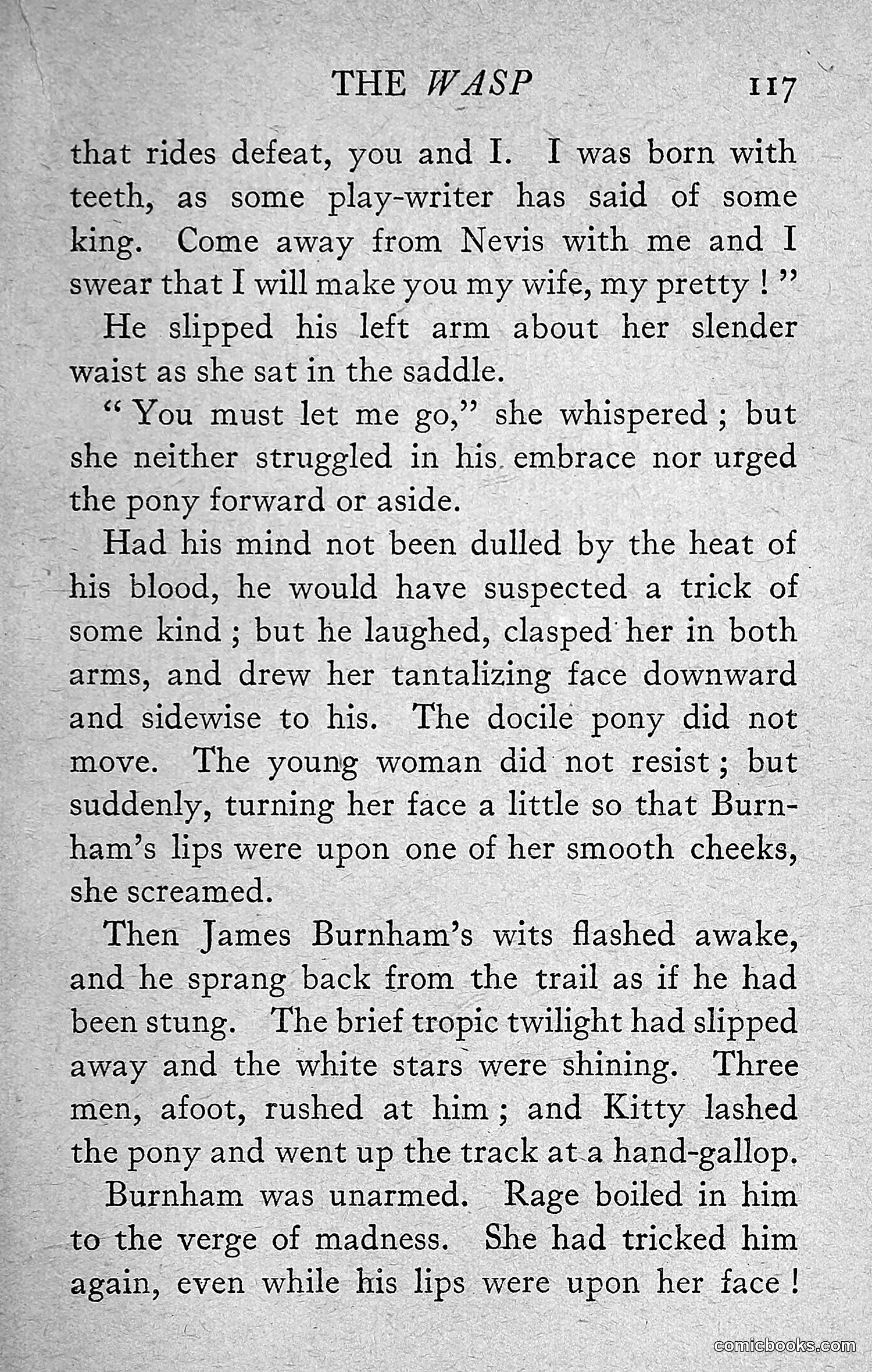
This page contains text from what appears to be a serialized fictional story rather than a political cartoon. It depicts a dramatic romantic encounter between James Burnham and a woman named Kitty (or the character being called that) near Nevis. The narrative describes Burnham attempting to seduce or elope with the woman, who feigns compliance before screaming—apparently signaling three men lying in ambush. The woman escapes on horseback while Burnham is left unarmed and outwitted. The story involves themes of seduction, betrayal, and frontier/colonial adventure (the Nevis setting suggests a Caribbean locale). Without additional context about the publication date or the ongoing serial, the specific satirical or political target remains unclear. This may parody contemporary romance fiction conventions or particular literary tropes of the era, though the page alone doesn't reveal the intended satire.
This page depicts a violent altercation between a character named Burnham and three drunk men, including Percy Stanton. The text describes Burnham defending himself against their drunken assault with whips, using a wooden billet to disarm them and then beating Stanton while venting frustrations about Stanton and someone named "Kitty Trimmer." Without seeing the actual illustration, the specific satirical target remains unclear. However, the passage appears to be from a serialized narrative rather than a standalone political cartoon. The satire likely concerns social scandal—possibly involving romantic rivalry or impropriety between the named characters—given the reference to "Kitty Trimmer" and Burnham's verbal grievances expressed during the beating. The "mess port" reference suggests these are military or naval figures, which may contextualize the social dynamics being mocked. The exact historical or personal references require additional context to identify with certainty.
This appears to be Chapter VIII of a serialized story in *The Wasp* magazine, rather than a political cartoon. The narrative describes a domestic scandal involving three named characters: Stanton (apparently the protagonist, called "Percy"), James Burnham, and a woman named Kitty. The plot involves Stanton's jealousy of Burnham. Stanton and Kitty set a trap to catch Burnham, with Stanton bringing armed officer friends to whip him. However, the friends become sober and realize the scheme is dishonorable—especially when they suspect Kitty didn't genuinely resist Burnham's advances. They pressure Stanton into a duel instead, as the only way to restore his honor as "an officer and a gentleman." The satire targets the rigid codes of masculine honor among military officers: the absurd escalation from attempted ambush with whips to a formal duel, and the gap between gentlemanly pretense and actual behavior. Without additional context about the magazine's date or these characters' origins, I cannot identify the specific social or political target.
This page depicts a confrontation between military officers and a civilian (James Burnham) over a romantic dispute. Captain Cross and Mr. Throgmorton are attempting to arrange a duel—Burnham has apparently kissed a lady in whom another man (Mr. Stanton) is interested. The satire targets the absurdity of honor-bound dueling culture among military men. Burnham strategically defuses the immediate threat by proposing a dawn meeting, buying time and suggesting his opponent is exhausted—a clever delay tactic that makes the whole affair seem ridiculous. The formal language and elaborate protocols around settling "private affairs" through violence are being mocked as overwrought and performative. This likely comments on late 19th-century military pretension and the persistence of dueling customs despite their illegality in most places. The humor lies in Burnham's shrewd maneuvering within the absurd system itself.
This page appears to be from a serialized fiction story rather than a political cartoon. It depicts a duel arrangement between James Burnham and an opponent (Stanton), with Captain Cross and Throgmorton as intermediaries negotiating the terms. The narrative centers on Burnham's emotional turmoil: he's challenging someone to a sword duel, yet his bitterness stems from romantic betrayal by a woman named Kitty, who has "escaped him again." The text suggests Burnham valued her "rogues' honesty" over conventional virtue. Without additional context about *The Wasp's* publication date or the broader narrative arc, the specific political or social satire remains unclear. The duel arrangement itself may satirize codes of honor among gentlemen, but the page primarily serves the serialized story's plot rather than standalone social commentary.
This page contains serialized fiction rather than a political cartoon. It depicts a scene between two characters: Burnham and Henry Todd, apparently conducting some kind of clandestine operation. The text suggests Burnham is a gentleman of respectable appearance whom Todd believes—or at least suspects—to be a pirate or criminal. Todd's dialect ("yer honour," "nor any common sailorman") marks him as working-class. The scene shows them exchanging a small heavy box and leather bag through a window at night, suggesting smuggling or theft. Without additional context about this serial's publication date and broader plot, the specific satirical target remains unclear. The humor appears to derive from the gentleman-criminal paradox: that refined appearance masks illicit activity, a theme common to 19th-century popular fiction.
This page presents a serialized fictional narrative rather than political satire. It depicts James Burnham, facing exile or death by morning, composing a farewell letter to the governor's daughter. The text combines melodramatic romance with desperation—Burnham writes of hopeless love, stating he can never win her affection, only perhaps her pity. The satire likely targets sentimental Victorian literature and overwrought romantic conventions. The narrative voice mocks Burnham's tortured pose ("love-sick, half-inspired poet"), suggesting the absurdity of such theatrical despair. His repeated revisions and anguished composition style parody the overwrought emotional expression common in period literature. Without seeing the full magazine context or knowing the serial's overall plot, the specific political or social targets remain unclear, but *The Wasp's* satirical intent appears directed at romanticized suffering and literary excess rather than contemporary political figures.
This page contains **no political cartoon or satire**. It's a literary excerpt—apparently from a serialized story or novel published in *The Wasp* magazine. The text presents a romantic letter from a character named James Burnham to Miss Elizabeth Nash, expressing passionate but self-aware devotion. The narrative that follows reveals the satire's actual target: **the writer himself**. After composing this emotionally florid letter, Burnham laughs and admits he temporarily fooled himself into believing his own romantic prose—"That is what it is to be a poet...You can make yourself believe anything—for a little while!" **The satire mocks**: overwrought romantic sentimentality and the gap between flowery literary expression and sincere feeling. The joke is that even the writer recognizes his letter as performative artifice rather than genuine emotion. The page concludes with a scene shift to five men gathering at dawn by the sea, suggesting the narrative continues elsewhere in the magazine.
This page depicts the setup for a formal duel between two gentlemen. The narrative describes five men—including Captain Cross, Lieutenant Stanton, James Burnham, surgeon Willis, and Mr. Throgmorton (apparently the seconds or officials)—preparing for a sword fight at dawn on a beach. The passage details the ritualistic elements: examination of matched rapiers for fairness, testing the sand for suitable fighting ground, and positioning of witnesses. The surgeon's presence with bandages and stimulants underscores the deadly stakes. This appears to be **serialized fiction** rather than editorial satire. *The Wasp* was known for both satirical commentary and literary content. Without seeing illustrations or additional context, it's unclear whether this straightforward narrative is itself meant as satire on outdated honor codes, or simply adventure fiction. The page number (125) suggests mid-story placement.
This page depicts a literary excerpt describing a formal duel between James Burnham and someone named Stanton. Rather than a political cartoon, this appears to be serialized fiction from *The Wasp*, a 19th-century American satirical magazine. The passage describes the ritualistic preparation for a gentleman's duel—the formal salute, selection of weapons (rapiers), and positioning on a beach at dawn. The narrative emphasizes Stanton's composed exterior masking inner violence ("the lust of blood seethed and bubbled"), a common romantic trope of the era. Without additional context about the original publication date or the full narrative, it's unclear whether these specific characters reference real historical figures or contemporaneous political rivals, or if this is purely fictional melodrama. *The Wasp* serialized both satirical commentary and literary pieces, making this difficult to categorize definitively without seeing accompanying illustrations or advertisements on the page.
This page depicts a dramatic duel between two military officers: Captain Cross Burnham and a character named Stanton. The text is a narrative description of their preparation and the moment they engage in sword combat. The passage provides detailed physical characterizations—Burnham appears lean and muscular; Stanton is heavier-built but theoretically the regiment's best swordsman despite being out of condition from drinking ("deep cups") and late hours. The satirical magazine *The Wasp* likely used this scene to mock military vanity, officer conduct, or perhaps a specific historical duel or scandal involving San Francisco military figures. Without seeing the accompanying illustration, the specific identities and political context remain unclear, but the tone suggests mockery of masculine posturing and the absurdity of gentlemen's duels as a conflict resolution method.
This page contains narrative fiction rather than a political cartoon. It depicts a duel between two men—Stanton and Burnham—fought with swords on a beach at sunrise. The text describes their technique, physical positioning, and psychological states during combat. The passage emphasizes Burnham's composure and skill despite tactical disadvantages (Stanton positions him facing the rising sun, causing glare in his eyes). Burnham remains "undismayed" and parries attacks "with ease and composure," while Stanton—described as "heavy but artful"—grows increasingly desperate, breathing and striking heavily. Without additional context about when this was published or who these characters represent, I cannot definitively identify them as political figures or explain specific satirical intent. The narrative appears to be a serialized adventure or dramatic story rather than editorial commentary.
This page contains fictional narrative prose—likely serialized fiction from *The Wasp*, a 19th-century San Francisco satirical magazine. It depicts a dramatic sword duel between two men: Stanton and Burnham. The scene describes Stanton's apparent victory turning suddenly fatal when Burnham, despite having "the light in his enemy's eyes," strikes a potentially mortal blow to Stanton's breast. Burnham claims the sun blinded him and he didn't intend a death-wound. The passage emphasizes class and emotional distinctions: Willis (apparently a servant or lower-status figure) provides medical aid; Throgmorton displays aristocratic sensitivity by turning away and using perfumed lace; Captain Cross extends a gesture of reconciliation to Burnham. Without additional context about the serialized story's political allegory, the specific satirical target remains unclear. The page appears to be straightforward melodramatic fiction rather than direct political commentary.
This page appears to be from a serialized fiction story rather than political satire or cartoon commentary. It depicts the aftermath of a duel between James Burnham and a man named Stanton, set on an island. The text shows a conversation where an unnamed figure (possibly Captain Cross or Nash) reassures Burnham that his conscience is clear—the duel was fair, fought in daylight with equal terms. Stanton was a skilled swordsman who "fought to kill," and Burnham's excuse that "the sun was in my eyes" explains his aim. Burnham is advised to flee the island until Stanton's fate is determined, as dueling carries legal/social consequences. He's offered money and Captain Nash promises him "a few days of grace" to escape. This appears to be a dramatic narrative installment, not satirical commentary on contemporary politics or social issues. Without knowing the publication date or broader context of *The Wasp*, the specific historical references remain unclear.
This page contains no political cartoon or satire—it's prose fiction, likely serialized in the magazine. The text describes a character named Burnham who has apparently wounded a military man in a sword fight and now prepares to flee by boat with his companion Todd. The passage suggests adventure fiction or swashbuckling narrative popular in periodicals of the era. Burnham's exultation after violence and his decision to abandon their island refuge ("take the world by the windpipe") indicates he's a rogue or pirate character. The dated language ("cap'n," "yer honour") and nautical setting reinforce this. Without seeing the full story context, the specific political or social satire—if any—remains unclear. This appears to be entertainment fiction rather than satirical commentary, though *The Wasp* was primarily a satirical publication.
This page contains narrative fiction rather than political satire or cartoons. It appears to be from a serialized story in *The Wasp* magazine depicting a duel's aftermath. The text describes Percy Stanton, a wounded duelist being treated after a fight. Henry Todd helps prepare an escape boat while Willis, a medical attendant, and Dr. Hamm, a regimental surgeon, tend to Stanton's wound. Dr. Hamm enters secretly, expresses surprise at Stanton's fighting ability ("pluck"), and offers a prognosis—Stanton will likely recover unless fever or infection sets in, given his strong constitution. The scene suggests military or officer-class drama involving honor duels, a common theme in period fiction. Without additional context about the publication date or larger narrative, the specific characters and plot details remain unclear beyond what the text directly states.
This page depicts a dialogue about a duel between Stanton and Burnham. An older military figure (appears to be a colonel or senior officer) discusses covering up Stanton's injury as a horseback accident rather than reporting it truthfully—reflecting period attitudes that dueling injuries were commonplace and unremarkable among gentlemen. Dr. Hamm's commentary reveals the satire's target: he dismisses Stanton's chances against "a son of old Walter Burnham," attributing Burnham family superiority to their "fighting strain" with "a dash of the fiend in it." The satire mocks the era's romanticization of dueling as honorable masculine tradition, while simultaneously critiquing the hypocrisy of concealing such violence behind social propriety. The characters' nostalgic celebration of past duels ("Men were men in those days") contrasts ironically with their present need for secrecy—exposing the contradiction between public morality and private practice among the upper classes.
This page appears to be dialogue from a larger narrative rather than a standalone cartoon. The text references a confrontation involving figures named Burnham, Willis, Stanton, and Borie. The mention of someone falling from a horse, being left on a beach, and an intention to "wing Stanton" (shoot him non-fatally) suggests a violent incident or duel. Without seeing the accompanying illustration or having broader context about *The Wasp* magazine's publication date and political climate, I cannot definitively identify these figures or explain the satirical point. The content suggests political or social commentary typical of 19th-century American satire, but the specific references and targets remain unclear from this text alone.
This is a serialized fiction excerpt, not a political cartoon. The text describes a narrative moment in what appears to be a 19th-century novel set on the island of Nevis. The passage depicts Captain Algernon Nash, the governor, discovering that his aide James Burnham has disappeared, leaving only a sealed letter for "Miss Nash" (Elizabeth). Through questioning Mr. Willis, Nash learns that Burnham has fought a duel that morning. The satire appears directed at colonial governance and personal relationships: Nash's dependence on Burnham for official duties, the dramatic entanglement involving Elizabeth Nash, and the duel as a "gentleman's" resolution to conflict. The governor's violent reaction underscores the social disruption caused by this affair. Without seeing the actual illustration on this page (if one exists), context about *The Wasp* magazine's date and editorial position, or knowing the serial's origin, precise historical references remain unclear.
This appears to be a serialized narrative fiction rather than a political cartoon. The text depicts a dramatic domestic scene: a colonial governor confronts his daughter Elizabeth about a young man who has fled the island after fighting a duel with someone named Stanton. The governor initially seems unconcerned about the duel itself, suggesting duels were socially accepted among gentlemen, but becomes visibly distressed upon reading the young man's letter to Elizabeth. The scene explores Victorian-era themes of honor, concealment, and romantic crisis. The governor's emotional reaction to the letter suggests it contains a revelation that troubles him more than the duel itself—possibly regarding the young man's true feelings or circumstances. Without additional context identifying the publication date or story title, the specific historical or political references remain unclear.
This page appears to be from a serialized narrative rather than a political cartoon. The text shows dialogue between Elizabeth and a governor discussing a man (apparently named in an earlier passage) whom Elizabeth has complicated feelings about—he saved her life and loves her, but she's uncertain if she loves him in return. The governor's response ("A queer thing") suggests bemused commentary on the emotional ambiguity. The remainder of the page shifts to prose narrative describing James Burnham and Henry Todd sailing between Caribbean islands (Nevis and St. Kitts), scanning the coastline. The descriptive language focuses on the landscape rather than satirical commentary. **Without seeing earlier pages, the political/social context is unclear.** This appears to be literary fiction serialized in a satirical magazine, but the specific historical references or satirical intent cannot be determined from this excerpt alone.
This page appears to be from a serialized fiction story rather than a political cartoon or satirical commentary. The text describes a character sailing along a coast, reflecting on a recent duel with someone named Stanton and his feelings toward a woman named Kitty, whom he plans to "teach...still more of the error of her ways." The narrative suggests a romantic or dramatic tale of conflict and manipulation. Without seeing the accompanying illustrations or knowing the story's broader context, the specific identities of these figures remain unclear. The reference to a "duel" and the character's calculated, somewhat sinister attitude toward Kitty suggests this is likely a serialized adventure or romance story typical of Wasp's mixed content. The sudden appearance of a boat at the passage's end implies an impending plot development, but the satirical or political point—if any exists—is not evident from this excerpt alone.
This page contains narrative text from a serialized adventure story rather than a political cartoon. It depicts a tense maritime encounter between two boats—a fishing-boat crewed by fugitives (including James Burnham) and an armed ship's long-boat with eleven men pursuing them. The dramatic moment occurs when Burnham recognizes the pursuing vessel's leader as **John Trimmer of Wantage**, identified as "the highwayman, the breeches-maker's son, Kitty's brother." This appears to be a plot revelation in an ongoing story, where an unexpected connection to someone in Burnham's past creates tension. Without seeing previous installments, the specific satirical or social commentary point is unclear. The passage emphasizes class details (the breeches-maker's son, the highwayman identity) typical of period adventure fiction, but whether this represents broader social satire requires additional context about *The Wasp*'s editorial stance and earlier chapters.
This page contains **narrative fiction**, not a political cartoon. It depicts a scene from what appears to be a adventure or crime story involving characters named James Burnham and John Trimmer. The plot shows Burnham meeting Trimmer, whom he recognizes as a **highway robber ("toll of the roads") now turned pirate ("toll of the seas")**. Trimmer has apparently escaped legal consequences and recruited a crew of rough sailors. Despite Trimmer's criminal status, Burnham greets him warmly as a childhood friend ("Jack"), approaching unarmed and with apparent admiration for Trimmer's daring escape. The narrative suggests a theme of **roguish camaraderie** — romanticizing outlaws and their exploits. Without knowing the publication date or broader context of this story's satirical intent within *The Wasp*, the specific social commentary remains unclear, though the tone seems to celebrate bold criminality rather than condemn it.
This page appears to be from a serialized adventure narrative rather than a political cartoon. It depicts a dialogue between two characters—John Trimmer and Jim Burnham—who are reuniting at sea. Burnham reveals he's a fugitive from Nevis fleeing before someone named Alexander arrives aboard the sloop-of-war *Tartar*. He claims to have been living there as "a gentleman of blameless reputation," though his family has disowned him and his father sent him to Kingston. The passage suggests themes of **social disgrace and escape**—common in 19th-century adventure fiction. Burnham's vague explanation to rough sailors about his "blameless reputation" while being a fugitive hints at irony or deception. Without additional context about *The Wasp*'s specific satirical targets or the full narrative, the precise political/social references remain unclear. This reads as **serialized adventure fiction** rather than satirical commentary.
This appears to be a narrative passage rather than a satirical cartoon. The text is from a serialized story featuring characters named Burnham, Henry Todd, and John Trimmer involved in what seems to be a kidnapping or coercive situation. The passage depicts Trimmer using authority and command to separate Henry Todd from Burnham's protection, moving both parties ashore. The description of Trimmer as an authoritative figure—slamming his fist, commanding obedience, with followers present—suggests he may represent a criminal or disreputable character, possibly a pirate or brigand given the nautical setting and the mention of a duel that morning. Without seeing illustrations or knowing the broader narrative context of *The Wasp*, the specific satirical target remains unclear. This could be commentary on maritime crime, colonial-era lawlessness, or a more general social critique, but the page alone doesn't reveal the satirical point.
This page appears to be from a serialized fictional story rather than a political cartoon. The text depicts a scene where characters Burnham, Trimmer, and Todd negotiate Burnham's circumstances. The satire here targets **criminals and "gentlemen of fortune"** (a period euphemism for pirates/highwaymen). Burnham has seventy guineas and faces either returning to England (where his father will turn him in as a highwayman) or returning to Nevis. Trimmer recruits him into what appears to be a criminal enterprise, with the darkly comic understanding that refusal means Trimmer would name a worse "alternative course"—likely death. The humor relies on the cavalier attitude toward criminality and the implicit threat delivered as casual banter. Todd, described as not looking "much like a gentleman of fortune," appears to be an unwilling or unsuitable recruit taken as part of the deal. Without seeing illustrations or knowing *The Wasp*'s publication date, the specific historical context remains unclear.
This page appears to be from a serialized narrative rather than a political cartoon. It's a literary passage describing events aboard a ship—specifically the takeover of the brig *Good Cheer* by escaped convicts and prisoners. The text recounts how John Trimmer, a prisoner, led a mutiny: he freed fellow inmates, overpowered the officers, and was elected captain by the survivors. His co-conspirators—Dodd (an ex-highwayman) and Slim Sam (a pickpocket)—were promoted to first and second mate respectively. The passage notes that many of the prisoners died during heavy weather following the mutiny. Without seeing illustrations or knowing *The Wasp's* publication date, the satirical intent is unclear, though the narrative's focus on criminals assuming command of a legitimate vessel may be social commentary. The detailed descriptions of the anchored schooner suggest this is part of a longer fictional story serialized in the magazine.
This page appears to be narrative text rather than a cartoon, describing a maritime encounter from what seems to be a serialized story about Captain Trimmer and his brig, the *Good Cheer*. The passage recounts how Trimmer, apparently a pirate or privateer, deceives a New England schooner by feigning distress. When the schooner's crew boards to investigate (the narrator sarcastically notes they likely wanted to confiscate cargo, given their twenty armed men), Trimmer ambushes them in "short and bloody work." He then disables the schooner with hidden guns and transfers his "villainous company" and valuables to it. The satire likely mocks either actual historical piracy, government corruption, or possibly New England maritime practices—though without the visual cartoon or fuller context of the serialized story, the specific political target remains unclear. The tongue-in-cheek tone suggests *The Wasp* is critiquing maritime deception and violence.
This page is from a serialized fictional narrative in *The Wasp*, not a political cartoon. It depicts a pirate story featuring a character named Trimmer and his ship, which becomes known as "the Wasp." The passage describes Trimmer's opportunistic violence: he encounters a merchant ship during mutiny, joins the winning side through brutal force, recruits survivors, and loots the vessel. He later repaints his own schooner without a name "for luck," claiming this superstition has protected him through multiple raids with minimal crew losses. The dialogue between Trimmer and a character (possibly named Burnham or Jim) suggests cynical humor about piracy—naming the ship "Wasp" because of the harm it inflicts on "fools," though Trimmer dismisses luck as irrelevant. The satire appears to mock pirate adventure narratives popular in the era, presenting rapacious violence with darkly comedic detachment rather than romanticizing it.
This page contains prose narrative fiction rather than a political cartoon. It appears to be from a serialized adventure story involving a pirate ship or privateer vessel called the "Good Cheer" (or an unnamed schooner). The text describes the crew's composition after leadership changes: James Burnham infiltrating the crew, various officers (Wells, Slim Sam, Trimmer), and crew members with criminal backgrounds from Newgate Prison. The narrative notes the slack discipline and violent deaths among the crew. This seems to be adventure fiction typical of *The Wasp*—a publication that mixed satirical commentary with serialized stories. Without seeing other pages, it's unclear what social or political commentary (if any) the story intends beyond entertainment.
This page is text-only narrative rather than a cartoon. It appears to be from a serialized story in *The Wasp* magazine, describing characters aboard a schooner. The passage characterizes two crew members: Trimmer, a hearty, lusty sailor—merry, strong, and fond of tavern singing and flirting—and Slim Sam, presented as an ascetic, priest-like figure with dark, brooding eyes, modest dress, and restraint. The narrator compares Burnham's observations of these shipmates to societies he's known (Berkshire gentry, London rakes, Nevis planters), suggesting social commentary on how personality types transcend class. The humor appears genteel rather than cutting—character sketches emphasizing the contrast between boisterous and austere temperaments. Without seeing other pages, the satirical intent remains unclear, though the detailed physical descriptions suggest *The Wasp* engaged in character-driven social observation.
This page contains no visible cartoon or illustration—it is purely text, appearing to be from a serialized fiction story featured in the satirical magazine *The Wasp*. The passage describes a white schooner and its crew under Captain Trimmer, detailing the casual work atmosphere aboard ship and the captain's profit-sharing system. The narrative mentions characters including James Burnham, Kitty, Wells, and Slim Sam. The text suggests this is likely a pirate or privateer story (references to "captures" and "spoils"), though *The Wasp* primarily published satire and humor rather than adventure fiction. Without additional context or visible illustrations, the specific satirical intent—if any—remains unclear from this page alone.
This page appears to be from a serialized narrative rather than a political cartoon. It describes life aboard a ship, likely a privateer or merchant vessel, detailing the crew's pay structure and gambling habits. The text recounts events involving crew members James Burnham, Captain Trimmer, and Wells gambling with cards and dice while the ship travels. A significant moment occurs when another vessel—identified as the *Tartar*, heading for Nevis—is spotted on the horizon. Without seeing illustrations or additional context, the satirical intent remains unclear. The passage could be mocking maritime life, critiquing gambling culture, or referencing a contemporary naval incident. The specific historical event or political target is not evident from this excerpt alone.
This page contains only a brief text passage describing someone making a bed from an old sail and lying in the starboard scuppers (ship's drainage channels) of a vessel. There is no visible cartoon, illustration, or advertisement on this page. The passage appears to be narrative fiction or a story excerpt, possibly describing a sailor or stowaway's sleeping arrangements aboard ship. Without additional context about the surrounding story or the identity of the character referenced, it's unclear what satirical point, if any, this passage is meant to convey. The page may be a continuation from a previous installment of a serialized story in *The Wasp*.
This page contains **narrative fiction, not a political cartoon**. It's an excerpt from a serialized adventure story featuring characters named James Burnham and an unnamed companion aboard a schooner. The passage depicts a dramatic nighttime scene: Burnham awakens when stepped on, draws a knife defensively, then learns from his fellow crewman that gunfire ("musketry") and lights have been spotted nearby. The setting is atmospheric—fog, calm seas, uncertain danger lurking in darkness. **No satire or political commentary is evident.** This appears to be a page from *The Wasp's* serialized fiction content, likely an action-adventure narrative typical of late 19th/early 20th-century magazines. Without seeing the publication date or earlier installments, the specific plot context remains unclear, but the writing style and nautical setting suggest a swashbuckling adventure story rather than satirical commentary.
This page contains **narrative fiction**, not a political cartoon. It's an excerpt from a sea adventure story featuring a character named Burnham, apparently a naval officer observing a distant naval battle in darkness. The passage describes Burnham detecting signs of combat at sea—distant sounds of gunfire ("small arms") and physical evidence suggesting two ships engaged in close combat ("fastened in the deathgrip"). The narrator speculates the combatants might be English and French vessels, though suspects they're "some craft of their" side instead. The text is pure adventure fiction employing vivid sensory language (sounds of sails, gunfire echoes, smell of pipe smoke). Without additional context about *The Wasp*'s publication date or the story's title, the specific historical naval conflict referenced remains unclear—it could reference various Anglo-French naval engagements from the 18th-19th centuries. This is **not satire**, but rather serialized dramatic fiction typical of period magazines.
This page contains prose fiction rather than a cartoon—specifically, what appears to be a serialized adventure story about naval conflict. The narrative describes Captain Trimmer and James Burnham aboard a white schooner engaged in what seems to be maritime warfare or privateering. The text emphasizes naval combat terminology ("grappled," "big guns," "forecastle deck") and depicts the men anticipating a confrontation. Burnham expresses eagerness to fight, offering his "last of my few guineas" for combat. Without additional context about *The Wasp* magazine's publication date or the story's title, I cannot identify the specific historical naval incident or conflict being referenced. The romantic adventure-story tone and gentlemen characters suggest this may be period fiction popular in late 19th-century American satirical magazines, but the exact satirical target—if any—remains unclear from this excerpt alone.
This page presents a **narrative passage** rather than a cartoon—it appears to be serialized fiction depicting a maritime scene of predation. The text describes a ship's captain spotting two disabled vessels ("lame ducks") at sea and planning to exploit them. The captain's excited dialogue ("reap the harvest") suggests piracy or opportunistic plunder of damaged ships. References to "Master Burnham," "Hellfire Hicks," and a "trader" indicate these are character names in an adventure or crime narrative. The phrase "like the good farmers we are" uses ironic pastoral language to mask criminal intent—harvesting disabled ships like crops. **Context**: *The Wasp* was a San Francisco satirical magazine (1876-1907). Without seeing illustrations or knowing the serialized story's full context, this appears to be **satirical fiction mocking maritime villainy** rather than political commentary. The satire likely critiqued actual piracy, smuggling, or cutthroat merchant practices of the era through dramatic storytelling. The exact target remains **unclear** without additional pages or publication date.
This is a **narrative fiction excerpt**, not a political cartoon or satirical commentary—it's a serialized adventure story about a naval pursuit. The passage describes an encounter between two ships: a white schooner pursuing a damaged vessel (apparently called the "Black Polly," associated with someone named "Hellfire Hicks"). The white schooner's crew arms themselves with weapons and mocks the crippled ship's failed escape attempts. The focus shifts to **James Burnham**, a crew member characterized as morally unmoored—he arms himself with a cutlass he previously used to wound someone named Stanton on Nevis. The narrator emphasizes his lack of remorse or compassion, describing him as driven by bloodlust and believing "the world was against him." Without seeing the magazine's cover, publication date, or broader context, **we cannot identify this as satire of specific political figures or events**. It appears to be dramatic adventure fiction typical of late 19th-century periodicals, focusing on themes of naval conflict and ruthless ambition.
This appears to be a passage from a serialized adventure story rather than a political cartoon or satirical commentary. The text describes a naval confrontation between ships—specifically between James Burnham (the protagonist, now an outcast) and Trimmer, who commands a vessel called the "Black Polly." The scene depicts an impending sea battle: two damaged vessels (a brig and a schooner) are within gun range of Trimmer's guns, yet he deliberately holds fire. Trimmer reveals he's encountered an enemy named Hicks previously and wonders if Hicks still lives. The content is literary fiction focused on maritime action and character development—Burnham's emotional detachment and readiness for combat—rather than social or political satire. Without seeing additional context or illustrations on this page, this reads as adventure narrative content rather than satirical commentary typical of *The Wasp* magazine.
This page depicts a fictional naval combat between two schooners—the *Wasp* (white) and the *Black Polly* (black)—described in dramatic, violent prose. The text is narrative rather than satirical commentary. The scene describes the aftermath of brutal ship-to-ship combat: destroyed weapons, dead crew scattered on deck, and a few surviving sailors still fighting. James Burnham and others from the *Wasp* are lowered in boats to finish off the disabled *Black Polly*, with one character asking if Burnham can shoot the enemy helmsman at the wheel. This appears to be **adventure fiction**, likely serialized in *The Wasp* magazine. Without seeing illustrations on this page or knowing the broader story, I cannot identify specific historical naval events being referenced or determine if this satirizes actual incidents. The violent, detailed description suggests this is entertainment content rather than political satire.
This page contains **serialized fiction narrative**, not political satire or editorial cartooning. It depicts an action sequence from what appears to be a pirate adventure story featuring ships named the *Polly* and the *Black Polly*, with characters including James Burnham and a quartermaster engaged in naval combat. The text describes a dramatic boarding scene: a pistol shot wounds an enemy helmsman, three boats launch toward the damaged vessel, and pirates aboard the *Black Polly* defend themselves by dropping an explosive device that kills members of the boarding party. **No political figures or contemporary references are evident.** This is straightforward adventure fiction—likely serialized entertainment for *The Wasp*'s readers. Without seeing surrounding pages or issue context, the specific story title and publication date remain unclear, but this represents the magazine's fiction content rather than its satirical editorial mission.
This page appears to be **narrative fiction rather than political satire or cartoon**. It describes a naval battle between two vessels—the *Polly* (commanded by "Hellfire Hicks") and the *Wasp* (commanded by "Trimmer")—during what seems to be hand-to-hand combat on deck. The text focuses on the action: Hicks's ship has been damaged but his crew fights fiercely despite being outnumbered only slightly. Trimmer observes the battle, curses at being tricked somehow, then—satisfied his men are winning—pursues the enemy. **Without additional context or visible illustrations**, I cannot identify specific historical figures, political references, or satirical targets. The page number (160) suggests this is mid-narrative in a longer serialized story. This reads as **adventure fiction** published in *The Wasp* magazine rather than political commentary.
This page is narrative text—likely serialized fiction or a literary excerpt—rather than a political cartoon. It describes a violent naval engagement between crews of two ships: the *Polly* (apparently a pirate vessel) and a white schooner. The passage chronicles a brutal hand-to-hand battle where James Burnham, a fighter of apparently exceptional skill, engages multiple opponents including a pirate named Hicks, whom he fatally wounds. The text emphasizes casualty counts: of 28 men from the schooner who boarded the *Polly*, only 5 remain unwounded. **Context for modern readers:** This appears to be 19th-century adventure fiction, possibly about piracy or naval combat. Without seeing surrounding pages, it's unclear what political satire—if any—*The Wasp* intended here, or whether this was satirical at all versus straightforward entertainment content.
This page contains narrative text—likely from a serialized adventure story—rather than political satire or editorial cartoons. The passage describes a violent scene aboard a ship where protagonist James Burnham, who has killed someone called "Hicks," leads wounded men into a cabin. The text reads like action fiction: Burnham enters a darkened ship's cabin with bloody sword in hand, followed by injured comrades. He explores the space, finding a pantry and attempting to break into a locked door. Without seeing illustrations or knowing the story's context, publication date, or whether this relates to actual historical events or fictional narrative, I cannot identify what (if any) satirical or political commentary this page contains. *The Wasp* was primarily a humor and satire magazine, but this excerpt appears to be straightforward adventure prose rather than satirical content.
This page appears to be from a serialized fiction story rather than a political cartoon. It depicts a narrative scene where character James Burnham encounters a mysterious woman in what seems to be a ship's cabin. The passage emphasizes her exotic beauty through detailed description—dark hair, dark eyes, powdered cheeks, and silk clothing—while noting she carries a small knife despite showing no fear or anger. The "tough rascals" admiring her from the doorway suggests either a working-class setting or a morally ambiguous location. Without additional context about *The Wasp* publication date, the broader story, or what precedes/follows this passage, the satirical or political intent remains unclear. The scene could be satirizing romantic fiction conventions, social attitudes toward women, class dynamics, or something specific to the period—but the text alone doesn't reveal which. More information about the publication's date and the story's context would be necessary for accurate interpretation.
This page fragment appears to be from a narrative or comic dialogue rather than a political cartoon. The text shows a man reassuring a woman about his sailor companions, claiming they're harmless ("veritable lambs") in the presence of a lady. His obsequious tone ("your most humble and devoted servant") and the woman's intensified interest suggest the satire targets either: 1. **Performative masculine gallantry** — the exaggerated politeness that masks opportunism 2. **Class dynamics** — sailors stereotyped as rough but deferential to genteel women 3. **Manipulation** — the speaker's false reassurances designed to gain the woman's trust The incomplete context makes precise interpretation difficult, but the satire appears social rather than explicitly political, mocking courtship rituals or class-based deference.
This page appears to be from a serialized novel or story within *The Wasp* magazine (Chapter XI), not a political cartoon. It depicts a tense confrontation between characters. **The Scene:** A young woman addresses "Captain" Burnham, a gentleman of fallen fortunes from Berkshire. She recognizes his genteel manner despite his poverty. When one of Burnham's rough companions (Bolt—a former mutineer and ruthless fighter) mocks Burnham's authority with laughter, Burnham responds with menacing quiet, asking who spoke, then directly confronting Bolt by name. **The Satire/Point:** The passage explores class dynamics and masculine authority. Burnham's gentility is undermined by his association with "mutineers" and common fighters. His dangerous, controlled response to insubordination suggests simmering tension—a man of quality asserting dominance over social inferiors through intimidation rather than legitimate rank. The tone suggests this is adventure or pirate fiction exploring themes of degraded gentlemen and rough-hewn men competing for power.
This page appears to be a **literary excerpt rather than a cartoon**—a scene from a serialized adventure story featuring conflict between two men aboard a ship. The passage depicts **James Burnham**, apparently a ship's officer or crew member, confronting someone called "Master Bolt" over a matter of authority and respect. Burnham, described as having a volatile temperament, insults Bolt ("stick in my gullet like a lump of rotten beef") and challenges him to a fight on deck, darkly joking there's "room enough in the scuppers for one more corpse." A **unnamed woman** observes the dispute with calculating interest, remaining unmoved by Burnham's warning about blood on deck—she replies calmly that she's "seen much." The scene emphasizes themes of **masculine honor, class tension, and maritime danger** typical of 19th-century adventure fiction. Without knowing the specific story's publication date or authorship, the exact satirical or social commentary remains unclear.
This page appears to be **narrative fiction rather than political satire**—specifically, a serialized adventure story set aboard a ship. The text describes a violent duel between characters named Bolt and Burnham, with Bolt's death resulting from a rapier wound after he attempts to stab Burnham with a cutlass. The dialogue that follows, spoken by sailors observing the corpse, characterizes Bolt as both treacherous (he previously stabbed someone called "Jersee Dick") and ambitious (he had the captain's favor and sought the quartermaster's position). The sailors' reactions suggest Bolt was disliked despite his strength and connections. **Without seeing the actual cartoon/illustration**, I cannot identify specific caricatures or political references. The page's satire target—if any—remains unclear from the text alone. This reads as **adventure fiction serialization**, possibly with satirical undertones about ship hierarchy and character that would require the visual component to fully interpret.
This page contains serialized **fiction**, not a political cartoon or satirical illustration. It appears to be part of an adventure story published in *The Wasp*, a satirical magazine, though this particular excerpt reads as straightforward narrative rather than satire. The text describes a violent maritime scene: James Burnham and an unnamed woman survive a ship battle involving treasure-hunting and boarding parties. A vessel called "the valiant brig" sinks while a white schooner approaches. The scene culminates with the woman expressing regret that Burnham isn't the ship's captain—suggesting either romantic interest or a plot twist about his true identity or role. **Without seeing illustrations or understanding the full serialized context**, I cannot identify what satirical or political points *The Wasp* intended here. The narrative itself appears to be adventure fiction typical of the era, not obviously satirizing contemporary politics or public figures. More context about the story's beginning and *The Wasp*'s editorial stance would be needed to explain the intended satire.
This appears to be a dialogue scene from a serialized story rather than a political cartoon. The text depicts a conversation between a character named Burnham and a woman (possibly of French or foreign origin, given her accent and phrasing) about Captain Hicks, whom Burnham has killed. The passage suggests a melodramatic narrative involving pirates, ships, and jealousy. The woman implies Burnham killed Hicks out of rivalry, then praises Burnham's boldness while questioning his ambitions—noting her father (a French soldier) could only accept piracy if he were captain himself. Without additional visual context or knowledge of this specific *Wasp* serial, the precise satirical or social commentary remains unclear. The page may be mocking romantic melodrama conventions, maritime villainy tropes, or contemporary social attitudes toward violence and ambition, but the exact target of satire cannot be definitively determined from this excerpt alone.
This page appears to be from a serialized adventure or pirate narrative in *The Wasp* magazine, not a political cartoon. The text depicts a scene aboard ships involving characters named Burnham, Trimmer, and Hicks, discussing plunder from a captured Spanish merchant vessel. The passage contains dialogue between Burnham and an unnamed young woman, followed by the arrival of Trimmer and crew with news of valuable cargo—bar silver, wine, and "ecclesiastical dignitary" (likely religious artifacts from the Spanish ship). Without additional context about the publication date or surrounding pages, it's unclear whether this narrative is satirical social commentary, a serialized adventure tale, or political allegory. The characters and their motivations—greed, piracy, division of spoils—suggest it *may* be satirizing contemporary society or politics through pirate-narrative metaphor, but the text alone doesn't make the specific target evident to a modern reader.
This page appears to be from a **serialized fictional narrative** rather than a political cartoon or satire. It describes a pirate raid on a merchant vessel called the *Polly*, commanded by "Captain Trimmer." The text recounts the plunder: gold coins worth 2,000 guineas, jewels, silks, and silver discovered hidden in the ship's berth. The *Polly* was found in poor condition—low provisions, foul water, no gunpowder—but her hold contained valuable merchandise. Trimmer transfers the valuables and recruits to his own schooner, then scuttles the captured ship. **The satire's target remains unclear** from this excerpt alone. Without seeing accompanying illustrations or earlier context, it's impossible to identify whether this narrative mocks specific political figures, contemporary piracy debates, or naval policy. The story may be allegorical social commentary disguised as adventure fiction—a common *Wasp* technique—but the specific references are not visible here.
This appears to be a narrative passage rather than a cartoon page. The text describes a ship's meeting called by Captain Trimmer following what seems to be a recent maritime conflict or disaster. The passage depicts crew members gathered, including a mysterious young woman from "the Polly" and a clergyman, with 32 people total now aboard. Captain Trimmer addresses his crew, naming the dead and making a darkly humorous observation: fewer survivors means larger shares of plunder for those remaining. The crew responds with crude laughter and oaths—appreciating his cynical gallows humor about profiting from casualties. James Burnham watches the young woman "covertly, with an ironic glimmer," suggesting romantic or suspicious tension. Without seeing the full context or illustration, the specific political/social satire remains unclear, though the tone suggests *The Wasp* is mocking either maritime greed, military leadership, or period-specific events through this fictional scene.
This page appears to be from a serialized story or novella rather than a political cartoon. The text describes a ship scene where a character named Jim Burnham is being proposed for the position of quartermaster. The proposal sparks conflict among the crew—one sailor nominates Burnham despite his being a newcomer, while another crew member protests, accusing the first of "toadyism" (sycophancy) and insulting his ancestry. A brawl nearly erupts before suddenly dispersing. Without seeing accompanying illustrations, I cannot identify specific caricatures or political figures. The passage reads as adventure fiction set aboard a vessel, likely satirizing naval hierarchy, class conflict, or crew politics of the period. The exact satirical target remains unclear from text alone.
This appears to be a fictional narrative excerpt rather than a political cartoon. The text describes a ship's meeting where violence erupts during debate about promoting James Burnham to a berth (position). The scene depicts a hierarchical maritime setting where Captain Trimmer maintains order through intimidation. A drunk man insults someone, gets stabbed with a knife, and is removed—yet no punishment follows. This leniency surprises even Trimmer himself. When voting on Burnham's promotion, crew members remain silent despite apparent reluctance, fearful of the knife-wielder's demonstrated willingness to use violence. The satire suggests that brutality and fear suppress honest dissent in hierarchical institutions. The piece likely critiques how power systems rely on intimidation rather than genuine consent, using a ship's microcosm to comment on broader social or political coercion. Without knowing the publication date or Burnham's identity, the specific historical reference remains unclear.
This is a narrative fiction excerpt, not a political cartoon. The page depicts a scene aboard a ship where Jim Burnham has been promoted to quartermaster following heroic action in combat. Captain Trimmer announces the promotion, the crew cheers, and Burnham experiences conflicted emotions—feeling pleased but disgusted by Trimmer, the crew, and himself. The passage emphasizes Burnham's moral detachment and cynicism. Despite his bravery earning him rank, he feels no genuine gratitude and views those around him with contempt. Welsh Owen, drunk and injured, attempts to claim credit for supporting Burnham's election, highlighting the self-serving nature of the crew's politics. The satirical point appears to be exposing the hypocrisy and moral emptiness beneath nautical hierarchy and working-class camaraderie—promotion based on expedience rather than merit, and the performative nature of crew solidarity.
This page depicts a narrative scene rather than a political cartoon. The text presents dialogue aboard what appears to be a ship, featuring character "Welsh Owen," a drunk sailor who justifies his behavior by claiming intoxication reveals his "true self"—contrasting his sober ordinariness with his drunken boldness. The scene then shifts to "Slim Sam" (the first mate) pulling aside "Burnham" to discuss "Trimmer," another officer who failed to punish Welsh Owen after a knifing incident. The mate suggests Trimmer showed weakness and fear, attributing this lapse to romantic distraction ("the wench"). This appears to be serialized fiction rather than satire—likely exploring themes of maritime hierarchy, masculine authority, and the consequences of weakness among ship's officers. Without seeing illustrations or knowing the broader narrative context, the specific satirical targets remain unclear, though the passage critiques both drunken working-class behavior and officer incompetence.
This page appears to be from a serialized fiction story rather than a satirical cartoon. It depicts a dialogue aboard a ship between characters named Burnham (apparently a new quartermaster), Slim Sam (an ex-pickpocket first mate), and references to Captain Hicks and a mysterious woman. The scene involves intrigue: a woman has illegally boarded the schooner, violating company rules. Slim Sam cryptically threatens that either the captain will put her ashore or there will be "a new captain"—implying mutiny or coercion. Burnham, wary of Sam's manipulations, feigns ignorance while questioning the woman's identity and origin (French or Spanish). The narrative explores themes of blackmail, maritime hierarchy, and scandal. Without knowing the publication date or broader story context, it's unclear what specific satirical or social commentary this story intended, though it likely reflects period attitudes about women, class, and moral transgression.
This page contains serialized fiction rather than political satire or cartoon content. It narrates a pirate ship story featuring James Burnham and Captain John Trimmer. The text describes the legendary pirate woman Héléne da Silva (presented as daughter of the executed French pirate Saint-Ovide), who commands respect and songs across maritime ports. The narrative depicts a lawless ship environment where discipline has collapsed—Welsh Owen commits unpunished violence, and Burnham fears for his safety among treacherous crew members. Captain Trimmer appears to be organizing a marriage ceremony, likely between Burnham and da Silva, though this remains unclear from this excerpt alone. The passage illustrates 19th-century American fascination with romanticized piracy and suggests anxiety about authority breakdown aboard vessels. Without seeing accompanying illustrations, the satirical intent—if any—remains unclear.
This appears to be a literary excerpt rather than a political cartoon—a passage from a serialized adventure story about pirates aboard the *Black Polly*. The text describes a moment of mutiny-brewing tension among a pirate crew. The captain, Trimmer, has lost his men's respect by taking "Hellfire Hicks's mistress and wardrobe" without sharing the spoils—a violation of pirate code. The crew, exhausted and resentful after violent combat, recognize their leader's weakness and question his authority. Trimmer recognizes the dangerous mood but maintains a facade of confidence, bowing and retreating below deck. A crew member, Wells, bitterly comments that "the wench has made a monkey of him." The passage concludes with Trimmer returning with a Spanish bishop and a woman named Hélène—likely an attempt to restore his authority or salvage the situation through some dramatic revelation. The satire targets masculine pride and the precarious nature of command among lawless men.
This page is from a serialized adventure narrative in *The Wasp* magazine (a 19th-century American satirical publication). The text describes a dramatic shipboard scene involving a character named Trimmer, who kills an elderly bishop—described as forced into ecclesiastical robes—apparently as a cruel "joke." The passage depicts Trimmer's mood shifting from manic laughter to dangerous rage when the crew doesn't share his amusement. A "beautiful young woman" witnesses the killing and turns pale with fear. The scene culminates with Trimmer drawing pistols, suggesting imminent violence. This appears to be **adventure fiction** rather than political satire—the kind of sensational melodrama *The Wasp* serialized for entertainment. The "joke" of killing a bishop reflects period dark humor and anti-clerical sentiment, but the primary purpose seems narrative tension rather than editorial commentary. Without more context about the broader story, specific character identities remain unclear.
This appears to be a narrative passage from a serialized story in *The Wasp*, a satirical American magazine, rather than a political cartoon. The scene depicts a confrontation between **Captain Trimmer** (an authoritarian ship captain) and **Slim Sam** (his first mate), with an unnamed crew member present. The passage illustrates a power struggle: Trimmer, initially enraged at being questioned about his absolute authority, is gradually persuaded by Sam's whispered reasoning to enforce discipline fairly—to apply rules equally rather than exercise arbitrary power. Trimmer's final capitulation ("Let it be so!") suggests Sam has convinced him that consistent rule-enforcement (even when inconvenient) serves the ship better than authoritarian caprice. The satirical point appears to target tyrannical leadership and the virtue of principled governance over unchecked personal power—relevant themes for American audiences of the era.
This page contains only text—no visible cartoon or illustration. It appears to be narrative prose, likely from a serialized story within *The Wasp* magazine. The passage describes a ship called *Héléne* putting into a lawless, uncharted port. It references a "dangerous company" engaging in treasure smuggling and debauchery ("carousing"). The tone is satirical, contrasting the port's heavenly appearance with its hellish reality. Without additional context or visible images, I cannot identify specific historical figures or events being satirized. The passage could reference piracy, colonial-era smuggling, or maritime scandals, but determining the precise satirical target requires either seeing accompanying illustrations or additional pages from this *Wasp* issue.
This page appears to be **narrative fiction rather than a political cartoon**. It's Chapter XII of a serialized story set on the island of Nevis, likely from the 19th century. The text describes a naval visit where a ship called the *Tartar* arrives in harbor. A young man named Mr. Willis is present—physically worn from his medical work trying to save a patient named Percy Stanton. The passage reveals dramatic irony: Willis has been desperately in love with "the beautiful Miss Kitty" (Kitty Trimmer), who assisted him, yet he's been straining himself to save a man he "would gladly have dead"—presumably Percy Stanton, a romantic rival. This appears to be **serialized fiction with romantic and melodramatic elements** rather than satire. Without seeing the image clearly or knowing the story's full context, the specific satirical targets remain unclear, though it may parody Victorian romantic melodrama.
This page is **narrative prose rather than a cartoon**—it's the fictional text from a serial story appearing in *The Wasp*, a 19th-century American satirical magazine. The passage describes Lieutenant Alexander Burnham's awkward entrance into a governor's reception. Everyone stares at him with confusion and interest, causing him embarrassment. The narrator reveals Alexander is nearly identical to his brother James in build and facial features, differing only in expression and eye color (dark-blue versus James's apparently lighter eyes). The dramatic tension suggests Alexander's surprising resemblance to James—presumably a notable or controversial figure—is causing the astonishment. The text emphasizes his "grave, but kindly" expression and direct gaze, setting up a character who resembles someone significant but differs in temperament. Without knowing the full serial context or which historical figures "James" and Alexander Burnham represent, the exact satirical point remains unclear, though the setup suggests mistaken identity or ironic contrast between similar-looking brothers.
This page is **text only** — part of a serialized story rather than a satirical cartoon. It depicts a dramatic moment where a governor informs Lieutenant Alexander about his brother's disappearance ("he has gone"). The narrative describes Alexander as virtuous and modest, contrasting him with an unnamed brother of opposite character. The governor's emotional reaction—whispering and showing "unmistakable signs of agitation"—suggests the absent brother's departure is significant and troubling. **Without seeing earlier or later pages, the specific satirical target remains unclear.** This could reference a real political or social scandal of the era, but the text alone doesn't identify who the governor, brothers, or "Nash" represent. The page number (185) indicates this is mid-narrative in a longer serial.
This appears to be a **literary excerpt rather than a political cartoon**—a dramatic dialogue from a serialized story or novel published in *The Wasp*, a 19th-century American satirical magazine. The scene depicts a governor speaking urgently to Alexander Burnham about Burnham's brother James, who has fled after a duel with a man named Stanton. The governor denies involvement in James's disappearance, emphasizing that he showed James a letter from someone named Scovil and would have supported him. The emotional tone—references to "youthful follies," "hopeless love," and a letter to "Elizabeth"—suggests a melodramatic narrative popular in period publications. Without seeing the full serial or magazine context, **the specific satirical target remains unclear**. This may be mocking conventional sentimental literature, or referencing a contemporary scandal, but the page alone doesn't reveal which.
This appears to be a narrative passage from a serialized story rather than a political cartoon. The scene depicts Lieutenant Burnham confronting an apparent impostor claiming to be his brother James. The dramatic tension centers on **identity verification**: Captain Nash insists he recognized the stranger as a genuine Burnham family member by observing a distinctive mark on his back—a family "whim" of Sir Walter Burnham's practice of marking his children "even as he marks his silver" (like property or livestock). This detail suggests satirical commentary on aristocratic pretension and class markers. Lieutenant Burnham's emotional turmoil—wondering if the man is actually an impostor—drives the plot. The mention of James having sailed to Kingston, Jamaica, and Captain Nash's composed authority create an unresolved mystery about whether deception is occurring. Without additional context or images, the specific satirical point remains unclear, though the story appears to mock aristocratic obsession with hereditary marks and identity claims.
This page contains **narrative prose rather than a cartoon**, appearing to be from a serialized story within the satirical magazine. The text describes a conversation between two characters: an unnamed "excellency" (likely a person of high rank) and **Alexander Burnham**. The excellency mistakes Alexander for someone named **James**, whom Alexander believes is safely in Jamaica. The confusion and physical resemblance between the two men creates dramatic tension. The passage reveals family conflict: James and their father had "a slight disagreement" before James left home, and James is described as "headstrong"—referenced as "the black goat of his family" (meaning the disreputable member). Alexander worries his father may have misjudged James's character. Without seeing the accompanying illustration or knowing the magazine's date, **the specific satirical target remains unclear**—this appears to be dramatic fiction rather than direct political satire.
This page appears to be from a serialized narrative rather than a satirical cartoon or political commentary. It's prose fiction describing a conversation aboard a ship called the *Tartar*. The text follows Alexander Burnham as he questions Mr. Willis, a young surgeon, about Alexander's brother James. Willis praises James extensively—describing his heroic rescue of a girl, his kind character after recovering from illness, and his "delicate attitude" toward someone named Elizabeth Nash. Willis also recounts a duel involving James, whose cause he doesn't understand. The passage emphasizes Willis's obvious admiration for James, which both reassures Alexander (soothing his family pride) and suggests Willis may harbor romantic feelings for Elizabeth Nash himself. **This is serialized fiction, not satire.** Without seeing accompanying illustrations or advertisements, the satirical intent—if any—remains unclear.
This appears to be a literary excerpt rather than a political cartoon—a serialized story about the Burnham family, likely from a 19th-century American publication. The text describes Alexander Burnham's conflicted feelings after his disreputable brother James participates in a duel with apparent honor and dignity, surprising Alexander who knew him as "a rascal at heart." The passage then depicts Alexander being waylaid by military adventurers who ply him with rum punch at a tropical resort (the setting appears to be the Caribbean island of Nevis) and inform him of news regarding his brother James. The satire or social commentary—if present—appears subtle here: possibly mocking the contradiction between James's notorious family disgrace and his sudden gentlemanly conduct, or the loose morality of "adventuring military gentlemen." However, **without seeing the actual cartoon artwork or knowing the broader serialized narrative context, the specific satirical point remains unclear.**
This page contains **serialized fiction narrative**, not a cartoon. It's from *The Wasp*, a satirical magazine, but this particular page presents dramatic prose rather than visual satire. The text describes a romantic plot involving multiple characters: James Burnham (described as a "rascal"), his brother Alexander Burnham (who has come to an island), Elizabeth Nash (whom James loves), and Kitty Trimmer (whom another man, Stanton, plans to marry). The narrative reveals that Elizabeth Nash is emotionally affected upon meeting Alexander, mistaking him for or confusing him with his brother James—the man she has idealized in her heart. The passage emphasizes her romantic delusion: she sees "James as she had dreamed of" in Alexander. **For modern readers**: This appears to be a melodramatic Victorian-era serial featuring romantic misunderstandings and moral ambiguity—typical magazine fiction of the period. Without seeing earlier installments, the specific satirical target (if any) remains unclear.
This page appears to be **prose fiction rather than a political cartoon**—specifically, a serialized romantic narrative published in *The Wasp*, a satirical magazine. The text describes a romantic entanglement involving Elizabeth (the governor's daughter), Alexander Burnham (a sailor), and James (implied to be a previous romantic interest or fiancé). The narrative follows their week-long courtship, noting how Elizabeth stops speaking of James as she grows closer to Alexander. The passage emphasizes the emotional and atmospheric details of their meetings—moonlit gardens, seaside rides, tender glances—building to Alexander's farewell visit before sailing away on a pirate-hunting expedition under Commander Scovil. **Without seeing illustrations or identifying marks, this reads as serialized romantic fiction** rather than satire, though *The Wasp*'s inclusion of such material may itself be satirical commentary on sentimental literature of the era. The actual satirical point, if any, remains unclear from this text alone.
This page contains **prose fiction rather than a political cartoon**—a serialized romantic story appearing in the satirical magazine *The Wasp*. The narrative depicts a melodramatic farewell scene between a uniformed officer (a "brave man" named James, based on context) and a woman. He's departing by ship for two weeks, and the passage explores their complicated emotional dynamic through period dialogue and flowery description ("elfin light," "starlit eyes"). The *Wasp*'s satirical angle likely targets **sentimental Victorian romance conventions**—the overwrought emotional language, the idealization of military service, and the passive female character who admits she loved James only "for an hour" suggest the magazine is gently mocking popular romantic fiction and the performative nature of 19th-century courtship rituals. Without seeing the magazine's broader context or illustration, the specific social criticism remains unclear, but the inclusion of this literary content suggests *The Wasp* mixed visual satire with literary parody.
This page contains narrative fiction rather than a cartoon. It depicts a romantic scene between a man (appears to be a naval officer or "Captain Nash") and a woman named Elizabeth, likely set in a Caribbean colonial setting (references to Nevis, Barbados). The passage describes the man kissing Elizabeth's hand before departing, then her emotional reaction. Subsequently, a letter arrives from "Sir Walter Burnham" addressed to Captain Nash—described as "heartless and just"—which deeply disturbs him, causing him to burn it. The satire likely concerns colonial naval or political intrigue, with the letter presumably revealing consequences for Nash's romantic entanglement or conduct. The contrast between the tender scene and the harsh letter's effect suggests mockery of either romantic folly among military men or the cold calculations of imperial authority. Without additional context about the magazine's date and the specific historical figures referenced, the precise satirical target remains unclear.
This page contains serialized fiction rather than political satire. It's a narrative story featuring characters named Elizabeth, James Burnham, Alexander Burnham, and a governor, with references to "the Tartar" (likely a ship) and "Sir Walter." The plot concerns a governor's romantic concern about Elizabeth's feelings toward James Burnham. Upon learning she doesn't love James—despite his bravery and wildness—the governor is relieved. The story involves family correspondence from Sir Walter (James's father) warning the governor about James's reckless nature. Without knowing the publication date or the full serialized narrative, the specific historical or political references remain unclear. This appears to be adventure or romance fiction typical of 19th-century periodical literature rather than satirical commentary on contemporary events or figures.
This page contains prose fiction rather than political satire or cartoon content. It appears to be a serialized narrative (likely from a 19th-century publication) involving romantic entanglements among colonial characters. The plot concerns Percy Stanton, a wounded gentleman recovering in Major Black's quarters, and his romance with Kitty Trimmer, a wealthy woman nursing him back to health. Their impending marriage is being kept secret from Stanton's ambitious family. Meanwhile, Alexander Burnham visits Government House to see Captain Nash and his daughter Elizabeth, whom Burnham clearly loves, though they maintain the appearance of friendship. The narrative emphasizes concealment—Stanton hiding his relationship, Burnham concealing his deeper feelings—suggesting themes of social propriety and class consciousness typical of period romantic fiction. Without seeing accompanying illustrations or knowing the publication date and context, the satirical intent (if any) remains unclear.
This appears to be a literary excerpt rather than a satirical cartoon—a scene from a serialized story published in *The Wasp* magazine. The passage depicts a confrontation between Alexander (apparently a man of social standing) and Nash (likely a person of authority, referred to as "his excellency"). Alexander has learned that Nash knows about Alexander's brother James's disreputable past in England, which led to his banishment. Alexander is ashamed and expects rejection. However, Nash surprises him by refusing to judge James for past sins or spread gossip, offering genuine friendship regardless. The dramatic irony lies in Alexander's wounded pride—he anticipated social ostracism but receives compassion instead, leaving him "gloomily" humbled. Without knowing the full story's context or publication date, the exact satirical target remains unclear, though the scene explores themes of class, family honor, and moral judgment typical of period social commentary.
This page contains only a brief text passage with no visible cartoon or illustration. The passage describes a character named Elizabeth pitying someone, noting that pity was an emotion he had "no ambition to inspire in any breast." Without additional context or visible imagery, I cannot identify who the character being pitied represents or what specific political or social situation this references. The passage appears to be part of a larger narrative or satirical piece, but this single page provides insufficient information to determine its satirical target or the historical reference intended for readers of *The Wasp* magazine. To properly analyze this content, I would need to see either the accompanying cartoon or access to surrounding pages that provide context.
This appears to be Chapter XIII from a serialized narrative in *The Wasp*, not a political cartoon. The text is prose fiction concerning Alexander Burnham, a character dealing with family shame on the island of Nevis. The passage describes Burnham's emotional distress after his brother James's dishonesty becomes publicly known. The satire lies in depicting how Burnham's acute "family pride" causes him greater suffering from *public knowledge* of the scandal than from the wrongdoing itself—a commentary on Victorian social pretension and the disproportion between private guilt and public reputation. His paranoid response (scrutinizing messmates' words and glances for evidence of their knowledge) mocks how shame-driven pride becomes self-destructive and illogical. The reference to Elizabeth Nash suggests romantic complications entangled with this social disgrace. Without seeing illustrations, I cannot identify specific caricatures, but the text satirizes the hypocritical values of 19th-century respectability.
This page appears to be **narrative fiction or serial storytelling** rather than a political cartoon. It's prose text describing a scene at a waterfront resort. The plot involves characters named Alexander Burnham, Mr. Stanton (recently recovered from a duel wound), and various naval figures including Captain Cross and Mr. Willis. Stanton is celebrating his "first day of freedom" from the authority of Mr. Willis and "Dr. Hamm" (likely Dr. Hammer, suggesting a medical supervisor). The satire seems aimed at **naval discipline and medical authority**—the phrase "irksome authority" suggests mockery of rigid shipboard hierarchy. The reference to Stanton's enforced abstinence from "wines and punches" ironically notes his improved health under constraint. Without seeing illustrations or knowing *The Wasp's* specific satirical targets, the broader context remains unclear, but this appears to mock naval bureaucracy and authority figures of the period.
This appears to be a literary excerpt rather than a cartoon page. The text depicts a social scene involving naval officers and sailors, likely from a serialized story in *The Wasp*. **Key figures:** Captain Cross, Willis (a young surgeon), Alexander, Stanton (a troublemaker), and Burnham (mentioned but absent or newly arrived). **The conflict:** Stanton, provoked by mention of Burnham's name, stares insultently at Alexander while the latter remains unaware. Cross and Willis discuss Stanton's problematic behavior, with Willis dismissing responsibility—suggesting Stanton poses a self-destructive threat ("let him die his own death"). **Social context:** The scene involves class distinctions (officers at separate tables from sailors), naval hierarchy, and interpersonal tension. Stanton's hostile reaction to Burnham's name suggests a personal rivalry or grudge, possibly over honor or a woman. **The satire's point:** Unclear without broader context, but the passage emphasizes masculine pride, naval culture, and the danger of uncontrolled rivalry among officers.
This appears to be a literary excerpt rather than a cartoon page. The text depicts a drunken confrontation at what seems to be a military or naval gathering. A intoxicated man, emboldened by punch, loudly insults someone named Burnham across the room, specifically taunting Alexander Burnham about his brother—referred to as "Sir Sucking Admiral"—who has apparently been "chased out of London." The brother's disappearance or disgrace is clearly a sensitive subject. Captain Cross intervenes angrily, ordering the drunk man to leave. Alexander Burnham's physical reaction—tremor and muscle twitching—suggests the insult struck a nerve, implying the brother's expulsion was shameful or scandalous. Without knowing the specific historical context or which Burnham family is referenced, the exact political/social reference remains unclear. The satire likely targets either naval incompetence, family scandal, or political disgrace, but identifying the specific figures requires additional historical documentation.
This page depicts a military disciplinary scene, likely from a serialized story in *The Wasp* (a 19th-century American satirical magazine). Captain Cross harshly punishes a soldier named Stanton for allegedly behaving dishonorably—forcing someone named Alexander's brother into a fight, then slandering him afterward. The satire centers on military codes of honor and rigid class hierarchy. Cross delivers theatrical condemnation, while subalterns brutalize the drunk Stanton. Notably, Alexander—apparently of higher social standing—mercifully attributes Stanton's misconduct to intoxication and recent illness rather than character, showing gentlemanly restraint the military officers lack. The passage critiques both rigid military discipline and how alcohol-fueled incidents expose hypocrisy in honor codes. The other officers' ready agreement with Cross suggests how institutional pressure enforces conformity regardless of circumstance.
This page depicts a confrontation between two colonial officials. Alexander has accused Captain Nash of leaking information to someone named Stanton about a family member (James). Nash responds with elaborate, theatrical outrage—swearing repeatedly that he's innocent and deeply insulted by the accusation. He lists reasons he won't challenge Alexander to a duel: his official position, love for his motherless child, and old affection for Alexander himself. The satire targets the performative nature of colonial political honor: Nash's excessive swearing and elaborate excuses undercut his claims of innocence, while his reluctance to actually duel (despite claiming sufficient cause) reveals the gap between gentlemanly posturing and real conviction. Alexander's quick capitulation suggests he recognizes he's misjudged—perhaps the real joke is on him for taking the political theater seriously. The specific colonial setting and characters remain unclear without additional context.
This page appears to be from a serialized fiction story rather than satirical content. It depicts a dramatic confrontation scene between Alexander Burnham and Kitty Trimmer on a tropical island (references to "manchineel-bush" and "this island" suggest a colonial setting). The narrative concerns Alexander's protective intervention regarding his brother James's "unfortunate past." Alexander threatens Kitty and Mr. Stanton with violence if they continue spreading damaging gossip about his brother. The tension stems from James's social standing being endangered by Kitty's association with the Nash family. Without additional context about the serial's plot, characters, or publication date, it's unclear what specific historical event or social scandal this fiction references. The content appears to be melodramatic Victorian-era fiction exploring themes of family honor, social reputation, and colonial society rather than direct political satire.
This page appears to be from a serialized fiction story rather than political satire. The narrative follows a sailor named Alexander Burnham, whose surname becomes a source of shame and wounded pride. The passage depicts Alexander's internal conflict after reconciling with a governor and a woman named Elizabeth. Though both show him kindness, Alexander torments himself believing their compassion stems from *pity* for his lowly surname rather than genuine regard. The satire targets masculine pride and class anxiety—a Burnham, apparently from a disreputable family, cannot accept kindness without interpreting it as condescension. The final line notes "The Tartar" (likely a ship) departing on a pirate-hunting cruise, suggesting this is a serial adventure tale rather than political commentary. The humor lies in Alexander's self-inflicted emotional torture over social status, a common theme in satirical literature about working-class pretension.
This appears to be a **fictional narrative passage** rather than a political cartoon. The text describes Captain Trimmer, a pirate operating off Trinidad, and his seizure of the French-Canadian schooner *Le Diable* ("The Devil"). The passage seems to be part of a serialized adventure story in *The Wasp*, a 19th-century American satirical magazine. It references privateering during a conflict between France and England (likely the Napoleonic Wars era), when nations sanctioned raiders to attack enemy shipping. The satirical angle appears to be **mocking romantic notions of piracy and privateering**—portraying Trimmer's crew as "reckless rascals" motivated purely by profit, while the Canadian captain is characterized as simultaneously serving France and "filling his pockets." This undercuts any heroic framing of such ventures. Without seeing accompanying illustrations or more context about *The Wasp's* editorial stance, the specific contemporary political targets remain unclear.
This page appears to be from a serialized fictional narrative rather than a political cartoon. It depicts a privateering or piracy scenario set during what seems to be the colonial era (references to French king, Canadian schooner "Le Diable"). **The Plot:** Captain John Trimmer, apparently a privateer, has a Canadian rival killed. Trimmer inspects the captured ship and its treasure, then contemplates expanding his operation by commanding two vessels instead of one, eliminating competition from rivals named Deck, Duval, and "Hellfire Hicks." **The Satire's Point:** The passage mocks Trimmer's opportunistic ambition and moral flexibility—he rationalizes betraying fellow privateers and potentially enslaving twenty prisoners to increase his wealth and power. The irony is that Trimmer believes his dead rival has done him a "good turn," when he's actually becoming the ruthless predator. This appears to be adventure fiction satirizing 19th-century commercial greed and maritime lawlessness, though the specific historical context remains unclear without additional pages.
This appears to be a serialized fiction excerpt rather than a satirical cartoon. The narrative describes Captain Trimmer, apparently a pirate or privateer operating the ship *Le Diable*, proposing to expand his criminal enterprise into two vessels. His first mate (Slim Sam) and James Burnham strategically oppose the plan, not on moral grounds, but by flattering Trimmer's ego—arguing he's uniquely irreplaceable and cannot command two ships simultaneously. This manipulation succeeds: Trimmer feels flattered by being called indispensable, yet remains committed to his ambitions. The satire targets masculine vanity and ego as a tool for manipulation, and perhaps critiques how men of fortune justify their schemes through self-aggrandizing logic. Without knowing *The Wasp*'s publication date, broader context remains unclear.
This appears to be a narrative passage from a serialized story rather than a political cartoon. The text describes a business negotiation among sea captains regarding monopolizing shipping in certain waters. The key figures are Captain Trimmer (who dominates the discussion through intimidation), James Burnham (initially cautious about the monopoly scheme), Slim Sam (reluctant and deferential), and Wells (notably excluded from speaking by Trimmer). The satire likely mocks aggressive capitalist expansion and monopolistic practices—common targets of *The Wasp*, a San Francisco-based satirical magazine. Trimmer's bullying tactics ("banged the table," called them "silly old women") parody robber-baron methods of the Gilded Age. The reluctance of Burnham and especially Slim Sam to accept command of the second vessel (*Le Diable*—"The Devil") suggests doubt about the scheme's legitimacy or viability. Without identifying the specific historical figures these characters represent, the passage satirizes corporate consolidation through intimidation rather than reasoned argument.
This page appears to be from a serialized fictional narrative rather than a political cartoon—likely from "The Wasp," a San Francisco satirical magazine. The text describes a piracy agreement between Captain Trimmer, Burnham, and others, detailing how they'll operate two vessels to attack merchant ships and divide plunder. The passage satirizes criminal enterprise through mock-serious legal language ("agreement," "clauses," "oaths"), treating piracy like a business partnership. References to "Major Deck and Duval" as rival threats, "secret havens," and the ironic mention of oaths bringing "withering fire from heaven upon their ungodly heads" emphasize the audacity of these criminals conducting organized lawbreaking. The satire likely comments on actual 19th-century piracy or privateering, or possibly critiques corrupt business practices by comparing them to outright criminality. The excluded "Canadian prisoners" and "Wells" suggest a broader narrative context now lost.
This page appears to be from a serialized adventure story rather than a political cartoon. The text describes a maritime narrative involving rival commanders—Burnham and a character called "Trimmer." The plot depicts Trimmer's humiliation when all volunteers choose to sail with the newly appointed Burnham instead. Slim Sam's derisive comment—calling Trimmer a "wooden-headed peacock"—indicates Trimmer is portrayed as vain and incompetent. Burnham responds strategically by enlisting prisoners as crew members, establishing his authority through pragmatism rather than bluster. The satire targets pompous, ineffectual leadership versus competent command. Trimmer represents the type of pretentious but incompetent figure common in 19th-century American satirical humor. The narrative suggests that merit and decisive action earn respect where aristocratic posturing earns contempt.
This passage describes a scheme of deception involving ships. A vessel called *Le Diable* is repainted to impersonate "Trimmer's schooner," then sent to sea to damage the reputation of a ship called the *Wasp* by committing acts of piracy or crime under false colors. Simultaneously, "Slim Sam" manipulates James Burnham by treating him respectfully while verbally attacking the absent John Trimmer, calling him dishonest and self-serving—a classic divide-and-conquer tactic using flattery and backbiting. The satire appears to critique underhand business or political dealings of the era: using false identities to harm competitors' reputations, spreading slander through two-faced charm, and exploiting absent parties. Without seeing the illustration or knowing the specific historical context of *The Wasp* magazine, the exact targets remain unclear, but the passage satirizes duplicity and character assassination masquerading as friendly negotiation.
This page is **text only** — a passage from what appears to be a serialized adventure narrative, not a political cartoon or satirical comic. It describes naval action involving ships named the *Wasp* and the *Tartar* during what seems to be a Caribbean conflict. The passage recounts a chase and battle between Major Deck's schooner and the *Tartar*, with the *Wasp* acquiring a fearsome reputation for speed. The *Tartar* successfully engages Deck in combat and returns to Nevis with prisoners ("material for a score of hangings"). **Without additional context**, it's unclear if this is historical fiction, satire of actual events, or purely imaginative. The colonial Caribbean setting and military figures suggest this may reference real naval conflicts, but the specific historical moment is not apparent from this excerpt alone. The dramatic, breathless prose style is typical of period adventure fiction rather than political satire.
This page contains narrative prose rather than a political cartoon. It's part of a serialized romantic story featuring characters named Alexander and Elizabeth Nash of the Burnham family. The passage depicts a melodramatic love story: Alexander recovers from a neck wound (inflicted by an unknown assailant) and confesses his love to Elizabeth. She responds by declaring she loves *him*, not his family—emphasizing this even if his relatives engage in dishonest conduct or piracy. The satire appears aimed at Victorian upper-class pretensions: Alexander, despite his joy, feels compelled to defend his disgraced brother James and lecture Elizabeth about family honor, arguing that only one Burnham could "fall from grace" per century. This highlights the contradiction between romantic love and rigid class pride. The text mocks how family loyalty and social position override genuine feeling among the gentry.
This page contains narrative fiction rather than political satire or cartoons. It's part of a serialized story involving characters named Elizabeth and Alexander, and military vessels—the *Tartar* (a sloop) and a French warship (a brig). The plot concerns a naval chase: while Alexander recovers from wounds at Government House, the *Tartar* encounters a larger, faster French twenty-two-gun brig. The *Tartar*, designed for pirate-hunting rather than naval combat, attempts to escape. The passage describes the vessels' relative speeds and suggests an extended pursuit. Without earlier installments visible, the specific political context—whether this reflects actual historical events, contemporary naval conflicts, or purely fictional adventure—remains unclear. The romantic subplot with Elizabeth suggests this is adventure fiction, possibly serialized entertainment for *The Wasp's* readers.
This page contains narrative text from what appears to be a serialized nautical adventure story, likely involving American naval vessels during a conflict (possibly the War of 1812, given references to "Frenchman" as adversary). The scene depicts Captain Scovil aboard the sloop *Tartar* spotting a pursuing French schooner. A second vessel, the *Wasp*, is also observed. The dialogue shows Scovil's grim resignation—he expects defeat by the Frenchman and believes the *Wasp* will merely watch rather than help. A young sailor responds optimistically that they might yet escape. Scovil's final quip ("our toes are sure to") darkly jokes that even if nothing else happens, they'll at least lose their feet in battle. **Note:** This appears to be fiction/serialized literature rather than political satire or cartoon content. The page contains no visible illustrations supporting the OCR'd text.
This page contains **narrative fiction rather than a political cartoon**—it's a serialized adventure story titled "The Wasp," depicting a naval chase scene. The text describes an impending battle between a military brig (a two-masted warship) and a sloop, with a white schooner and a "Frenchman" also involved in the action. The story emphasizes the desperate odds facing the sloop's crew ("not two in a hundred" chance of survival), their brave preparation despite knowing they're likely to die, and mysterious maneuvering by another vessel near the "danger zone." Without seeing the illustrations or knowing the publication date, the specific historical naval conflict being referenced remains unclear—though the mention of French involvement suggests a period when Britain and France were maritime rivals (possibly Napoleonic era or American independence period). This appears to be serialized adventure fiction rather than satirical political commentary.
This page contains a dramatic prose narrative describing a naval engagement between American and French vessels—likely referencing the Quasi-War period (1798-1800) or similar early American naval conflict. The text follows Commander Scovil commanding a sloop in combat against a French brig, with a supporting schooner. The passage depicts tactical naval warfare: cannon fire, ship maneuvers ("sheered off," "raked"), and escalating damage to both vessels. Notably, the French brig's foretop mysteriously falls during battle, suggesting American superiority or luck. The narrative emphasizes American resourcefulness—Scovil continues fighting despite heavy casualties and crippling damage, aggressively deploying "red-hot shot" against the enemy. **Without seeing accompanying illustrations**, the satirical context remains unclear, but The Wasp typically used such stories to mock or celebrate American naval prowess during this period of tension with France.
This page contains narrative fiction rather than a political cartoon. It describes a three-way naval engagement involving Commander Scovil's damaged sloop, a French frigate (the "brig"), and a white schooner. The text recounts a battle where the schooner attacks the French frigate while Scovil tends to his wounded vessel and crew. Scovil assumes the schooner has a personal vendetta against the French. However, the schooner then abandons its target and pursues Scovil's sloop instead—surprising and alarming him. Without seeing illustrations or knowing *The Wasp*'s publication date, the satirical intent remains unclear. This could be allegory for American-French-British naval rivalries, or commentary on unexpected alliances and betrayals, but the text alone doesn't confirm the specific historical or political reference.
This page appears to be from a serialized fiction story rather than a political cartoon or satire. It depicts a naval engagement between two vessels—a sloop commanded by Scovil and a white schooner. After a tense encounter where the schooner's crew cheers and someone throws a bottle onto Scovil's deck, the damaged *Tartar* limps into Nevis harbor. Alexander Burnham arrives to learn what happened during the engagement. Scovil, described as swarthy with a thin face and pensive eyes, privately meets with Burnham in his cabin. Without identifying specific historical figures or seeing accompanying illustrations, it's unclear whether this narrative contains satirical commentary on colonial naval affairs or is simply adventure fiction. The page provides no obvious political critique visible to a modern reader.
This page is narrative text from a serialized story rather than a political cartoon. The dialogue concerns a character named "the Wasp"—described as a notorious English pirate—who rescued a ship and its crew from a French vessel during naval combat. The story's dramatic tension centers on a mysterious sealed letter the Wasp threw aboard, addressed to a character named Alexander/Burnham. The other characters express gratitude toward the pirate despite his criminal status, with one stating "I owe him a debt which I fear I shall never be able to repay." Without additional context about *The Wasp* magazine's date and the larger serialized narrative, the specific historical or political references remain unclear. The page suggests a romantic adventure tale featuring honor among rogues—a common 19th-century literary trope.
This appears to be a dramatic literary excerpt rather than a political cartoon. The text depicts a scene aboard a naval vessel (*Sloop-of-War Tartar*) where Commander Scovil delivers a sealed packet to Lieutenant Alexander Burnham. The letter's contents provoke an extreme emotional reaction—Burnham becomes pale, his jaw sags, and he appears traumatized or in shock. Without seeing accompanying illustrations or knowing the full narrative context, the specific satirical target remains unclear. However, *The Wasp* was a San Francisco satirical magazine known for mocking politicians and public figures. This excerpt may be part of a serialized story satirizing naval officers, military hierarchy, or a particular scandal. The dramatic revelation suggests the letter contains damning or shocking information about Burnham, but the precise political or social reference cannot be determined from this page alone.
This appears to be a serialized dramatic narrative rather than a cartoon. Two military men—Alexander and Peter Scovil—are depicted in what seems to be a ship's cabin (references to "galley" and "berth"). Alexander has received a distressing letter that troubles him deeply, and Scovil urges him to destroy it without reading its contents. The tension concerns a potential "disgrace" that might force Alexander to leave military service. Alexander insists the letter must be read by both Scovil (his commanding officer) and Elizabeth Nash before any action is taken, suggesting the letter contains information affecting his honor and career. The satirical or dramatic point appears to center on military duty, personal honor, and whether concealing wrongdoing serves one's country—themes common in late 19th/early 20th-century American periodicals. Without seeing previous pages or knowing the full context, the specific scandal referenced remains unclear.
This page contains a fictional letter within a narrative story, not a political cartoon. The letter from "James Burnham" to his brother Alexander is a darkly humorous confession. Burnham claims he's now working "at sea" with "considerable success," using euphemistic language that suggests piracy rather than legitimate maritime trade—he references his family's founder doing similar "gentlemanly calling" on land "in the days of old." Scovil's response indicates Burnham was actually a pirate who mistakenly attacked Scovil's ship, but this error saved Scovil's life. The satire mocks the genteel pretense of Burnham's letter, which tries to dress up criminal activity in respectable language. Scovil respects Burnham's bravery despite his criminality, and wants to destroy the letter to protect the family reputation by burning it.
This page appears to be from a serialized romantic narrative rather than political satire. The text describes a dramatic scene between two male characters (Alexander and a commander) and a woman named Elizabeth. The plot involves a letter revealing some incident involving a "sloop" (ship). The commander agrees to help Alexander by allowing Elizabeth to read the letter before destroying it, while fabricating an alternate story for official authorities. Alexander then finds Elizabeth in a garden and gives her the letter. The passage emphasizes emotional intensity: Elizabeth's shock while reading, then her tender, forgiving response as she embraces Alexander. **Without identifying the specific work or publication date, this reads as melodramatic Victorian-era fiction—the kind of serialized romance that magazines published alongside satirical content.** The satire or social commentary, if present, isn't evident on this page alone. This may be a serial story rather than standalone satirical cartoon.
This page contains **serialized fiction rather than satirical cartoons**—it's a romantic narrative involving naval characters named Alexander Burnham and Elizabeth. The text describes Alexander's decision to resign from the navy to marry Elizabeth and settle on his Berkshire property, rather than continue pursuing his pirate-hunting duties (which apparently involve capturing his own brother). The "satire" here, if any exists, appears subtle: Elizabeth's prioritization of personal romance over "glory and the needs of her country" might be gentle social commentary on women's limited choices and conflicting loyalties in period society. However, **without seeing accompanying illustrations or knowing the broader serialized story context, the satirical point remains unclear**. This appears to be standard popular fiction serialization that *The Wasp* published alongside its political cartoons.
This page contains serialized fiction rather than political satire or cartoons. It describes a hastily arranged wedding between Elizabeth Nash and Alexander Burnham, brother of a pirate named James Burnham. Elizabeth rushed the marriage because she feared James might reveal his true identity and jeopardize her union—the governor disapproved of her marrying a pirate's brother. The narrative describes the wedding ceremony, attended by government officials and military personnel, followed by celebrations. The couple plans to sail for England soon, with Elizabeth's father (Captain Nash) to join them later in Berkshire. The passage appears to be from a serialized adventure or romantic story rather than satirical commentary. Without seeing illustrations or additional context, the specific satirical intent—if any—remains unclear.
This page contains narrative text rather than visual cartoons. It describes what appears to be a serialized story involving military personnel during what seems to be a colonial or Revolutionary period (references to Boston, garrison troops, and naval frigates suggest late 18th century). The satirical content mocks opportunistic behavior: Mr. Stanton marries "Kitty Trimmer" hastily, apparently to gain access to a family fortune in England. The narrative suggests he's using military service instrumentally—resigning his commission as soon as convenient to pursue financial gain. The quiet, sudden marriage and immediate plans to abandon his post mock mercenary attitudes toward both matrimony and military duty. The satire targets social climbers and fortune-hunters exploiting military life for personal enrichment rather than service. Specific historical figures or events aren't clearly identified in this text-only excerpt.
This page contains **text only—no visible cartoon or illustration**. It appears to be from a serialized narrative story (indicated by the chapter heading "XV") rather than satirical commentary. The text describes fictional pirates: James Burnham, a successful privateer/pirate captain whose crew is loyal and profitable; John Trimmer, his former associate; and "Slim Sam," apparently a trusted officer. The narrative recounts how Burnham's fortunes exceed those achieved under Trimmer's command, and describes an encounter between their ships near Barbuda after Trimmer has suffered reversals. **Without visible artwork, I cannot identify specific caricatures, political figures, or satirical targets.** This reads as adventure fiction rather than political satire. The magazine *The Wasp* did publish both satirical cartoons and serialized stories; this page represents the latter format. To understand any satirical intent, we would need context about whether these characters represent real historical figures (such as actual privateers or politicians), which the text alone does not establish.
This page contains serialized fiction rather than political satire or cartoons. It narrates a pirate adventure story involving rivalry between two sea captains: James Burnham and Captain Trimmer (described as an "ex-highwayman"). The plot depicts Burnham's superior leadership winning over Trimmer's crew, leading to conflict. When Trimmer demands Burnham's resignation from command of the ship *Le Diable*, Burnham physically retaliates, breaking Trimmer's nose. Burnham then takes about two dozen men and sails away on the same vessel, leaving Trimmer behind. The narrative appears designed for entertainment rather than political commentary. There's no visible political allegory, and the characters seem fictional creations for adventure fiction. The text focuses on maritime conflict, honor disputes, and crew loyalty typical of pulp adventure serials popular in American magazines of this era.
This page appears to be from a serialized adventure story rather than a political cartoon. It describes a naval plot involving a pirate ship called the *Wasp* operating in the Caribbean (around Barbados, Nevis, and St. Kitts). Captain Robinson receives anonymous intelligence about the pirate vessel's hideouts via a mysterious boatman. The governor sends military brigs to investigate. Meanwhile, the *Thunderous*—apparently a government ship—conducts a covert nighttime approach to St. Kitts, extinguishing lights to avoid detection. The narrative suggests either a manhunt for the pirate or a romantic subplot involving a character named Hélène associated with the *Wasp*. The language and setting indicate 19th-century colonial-era adventure fiction. Without seeing illustrations or additional context, the satirical intent—if any—remains unclear.
This page appears to be from a serialized fiction story rather than a political cartoon. The text describes Lieutenant Alexander Burnham's anguish upon learning that Captain Robinson plans to capture a pirate and hang him in Boston for public spectacle. The dramatic irony is that Alexander appears to know the pirate's identity—likely a family member or close associate. His emotional distress centers on the *social shame* this will bring to his family name (the Burnhams), his wife Elizabeth, and his father Sir Walter in distant Berkshire. The passage emphasizes his anxiety about public humiliation and the forthcoming trial more than the crime itself. This reflects 19th-century concerns with honor, family reputation, and how public execution functioned as social spectacle. The story mines tension from conflicting loyalties between justice and familial/social standing.
This page appears to be from a serialized **adventure fiction story**, not political satire or cartooning. The text describes a dramatic narrative involving pirates and naval action. The plot involves Alexander Burnham attempting a covert operation to prevent his brother James (a "notorious pirate") from being captured alive by authorities. Alexander has disguised himself as a seaman and left his companion Elizabeth safely aboard a ship called the *Thunderous*. He's determined to kill James rather than see him publicly tried and executed—a fate he imagines with horror (the device mentioned is apparently a branding or marking for punishment). The cutters are approaching Bottle Harbour by stealth to carry out this mission. **This is serialized melodramatic fiction rather than satire**, so modern readers wouldn't be "missing" satirical commentary about contemporary politics or social figures—the content is straightforward narrative adventure writing typical of 19th-century magazine serials.
This page contains **narrative fiction rather than a political cartoon**. It's an excerpt from a serialized adventure story titled "The Wasp" appearing in the satirical magazine *The Wasp*. The text describes a military attack on pirates. Captain Robinson orchestrates a surprise assault on a coastal settlement where pirates are based, using boats from a schooner (likely a naval vessel). The protagonist Alexander deliberately avoids combat, instead observing from the jungle. The attack succeeds despite resistance from pirates in stone houses; three naval personnel are killed and six wounded, while pirates are captured. This appears to be part of a longer serialized adventure narrative—common content in satirical magazines of the era, which mixed political satire with entertainment fiction. Without seeing illustrations or knowing the publication date, I cannot identify specific political references or satirical intent in this particular excerpt.
This appears to be a passage from a serialized fictional narrative rather than a political cartoon or satire. The text describes a dramatic scene involving a pirate captain's capture and escape. The scene depicts: a pirate captain being identified by a young lieutenant of a ship called the *Thunderous* through a distinctive device or tattoo on the pirate's shoulder. A character named Alexander witnesses this discovery. The narrative then describes nighttime chaos on a beach—prisoners, wounded being transported, gunfire—during which one of two lanterns is deliberately or accidentally extinguished, allowing the pirate captain to escape his bonds and flee into the jungle. The passage suggests this is adventure/action fiction rather than political satire. Without seeing accompanying illustrations or understanding the broader serialized story's context, the specific satirical or comedic intent remains unclear.
This page contains **serialized fiction narrative**, not a political cartoon. It's from "The Wasp," a 19th-century American satirical magazine, but this particular excerpt appears to be part of an adventure story rather than satire. The text describes a dramatic naval incident: a character named Alexander covers up what appears to be a crime (possibly murder or mutiny involving pirates). He destroys evidence—his soiled clothing weighted with weapons—by throwing it overboard, then returns to his cabin to appear innocent before his wife Elizabeth wakes. The narrative suggests a **cover-up of violence at sea**, with Alexander taking "his own hand" to prevent a "shameful tragedy." The irony lies in his gratitude to God while committing deception. Without seeing accompanying illustrations, the satirical intent—if any—remains unclear. This may be serialized adventure fiction rather than satirical commentary.
This appears to be a passage from a serialized narrative rather than a political cartoon. The text describes a naval officer named Alexander who participated in a nighttime raid against pirates, commanding a character named James. The scene depicts Alexander being summoned to Captain Robinson's cabin after breakfast, where he meets with embarrassed officers. Robinson explains they failed to capture the pirate leader but successfully destroyed his schooner and crew. Robinson's final statement—"for your sake"—suggests Alexander has a personal connection to the pirate captain (possibly a relative or friend), which the officers tactfully acknowledge by not pursuing him. The narrative explores themes of duty, honor, and the moral compromises of warfare. Without additional context about which specific historical incident or fictional work *The Wasp* was serializing, the exact political or social satire cannot be definitively identified.
This appears to be a passage from a serialized narrative (likely a novel or novella) rather than a political cartoon. The text describes a dramatic revelation: Alexander Burnham learns that the notorious pirate ship "The Wasp" is captained by his brother, James Burnham, a man with a criminal past on the island of Nevis. The satire targets family shame and social hypocrisy. Despite James's notorious piracy and "bloody reputation," Captain Robinson and his officers agree to suppress the identity publicly—protecting the respectable Burnham family name while the criminal secretly operates. Alexander's reaction—indignation at *pity* rather than outrage at his brother's crimes—suggests the family's warped priorities: reputation matters more than morality. The passage critiques how Victorian-era institutions and "gentlemen" conspired to conceal scandal among prominent families, prioritizing social standing over justice.
This appears to be a **fictional narrative passage** rather than a political cartoon. The text describes the aftermath of a shipwreck involving James Burnham's crew at Bottle Harbour, discussing betrayal by someone named John Trimmer, who allegedly "set the king's ship onto us"—suggesting these are pirates or smugglers whose operation was exposed. The crew expresses rage that their captain was captured rather than killed, which would have prevented their eventual revenge. The passage emphasizes Burnham's emergence from the jungle with renewed determination to settle scores, suggesting a revenge plot narrative. Without additional visual context or historical records of *The Wasp* magazine's publication date and subjects, **I cannot identify the specific historical figures or political allegories this fictional narrative may reference**. It could satirize actual criminal cases, political betrayals, or maritime incidents of its era, but that context isn't evident from the text alone.
This is a **text page** from what appears to be a serialized fiction story in *The Wasp* magazine, not a political cartoon. The passage is Chapter XVI of a narrative. The scene depicts James Burnham—apparently a pirate—being rescued on a beach by his brother, Lieutenant Burnham, a king's officer. The dramatic irony centers on **family loyalty versus duty**: a naval officer helps free a pirate relative, driven by "family pride" rather than duty to the Crown. The dialogue suggests this is **adventure fiction** rather than satire. James's weary acknowledgment that his brother sacrificed his honor as a king's officer to free him, and the ruffians' speculation about the officer's motivations, create melodramatic tension typical of 19th-century serialized stories. Without seeing other pages or knowing the publication date, I cannot identify specific historical references this story might satirize or parody.
This appears to be a **narrative/fiction excerpt** rather than a political cartoon or satirical commentary. The page presents a dialogue-driven story about pirates discussing buried treasure near Bottle Harbour. The scene involves characters named James, Tom Croft, and Todd discussing: - A rescue of someone from a French naval vessel - Bonds of loyalty ("blood be thicker nor water") - James's mysterious absence while "meditating on [his] sins" - A plan to meet someone named John Trimmer - Discovery of pirate treasure (gold, jewelry, silver in sail-cloth sacks stored in oak chests) **No clear political satire or social commentary is apparent** from this excerpt. It reads as serialized adventure fiction, possibly parodying or satirizing popular pirate narratives of the era, though without seeing accompanying illustrations or more context, the specific satirical intent remains unclear. The reference to French naval conflict suggests late 18th or early 19th century setting.
This page contains narrative text from what appears to be a serialized adventure story, likely involving pirates or smugglers. The visible content describes a band of thirteen men—led by someone named Tom Croft—who are preparing to pursue a figure called "Trimmer" to settle a score. The group possesses meager resources: salvaged sea-biscuits, a hidden boat, a cave stocked with arms and ammunition, and fresh provisions. One member, Bill Hook (described as red-haired, gaunt from fever), is seriously ill. The satire or joke appears to involve the superstition about the number thirteen. Croft expresses concern that pursuing Trimmer with exactly thirteen men invokes bad luck—"flyin' into the face of things." This seems to mock either superstitious seafaring culture or the bad fortune dogging this particular group. Without seeing illustrations or knowing the magazine's date and broader context, the exact satirical target—whether political figures, social types, or contemporary events—remains **unclear**.
This appears to be a serialized narrative fiction rather than a political cartoon. The passage depicts a conversation between sailors—James Burnham, Bill Hook, and Tom Croft—about a rival captain named John Trimmer. Burnham argues that superstitions (avoiding Friday departures, black cats, the number thirteen) are worthless, using Trimmer as an example of a superstitious man who nonetheless succeeded through luck. He attempts to convince the crew to mutiny against Trimmer, suggesting they follow him instead. Croft retorts that Trimmer has both a ship and a full crew, while Burnham has neither—implying Burnham's position is weaker. Burnham's "dangerous slow smile" suggests he's plotting violence, likely planning to attack Trimmer's vessel. The passage portrays a power struggle among rival sailors and captains, with themes of ambition, superstition, and betrayal. Without seeing illustrations or knowing *The Wasp's* specific date, the satirical intent remains unclear—though this may critique maritime culture or leadership generally.
This page appears to be **prose fiction rather than a cartoon**, presenting a dramatic dialogue from what seems to be a serialized adventure story about maritime piracy or privateering. The scene depicts a confrontation between **Captain James** (the commanding officer) and **Tom Croft** (a crew member), with discussion of rival captains **Burnham** and **Trimmer**. The conflict centers on crew loyalty and superstition: Croft objects to sailing with exactly thirteen men, viewing the number as unlucky and fatal to previous crew members. James threatens Croft with death for his "babbling." The passage illustrates **period attitudes toward maritime superstition**—the number thirteen was genuinely feared by sailors as an omen of doom. The dramatic tension reveals class dynamics aboard ship: despite being intimidated into silence, Croft's concerns resonate with other crew members who whisper doubts whenever the captain isn't watching. This appears to be **entertainment fiction** rather than satire, though without seeing other pages, the full context remains unclear.
This page appears to be a continuation of a serialized adventure narrative rather than a cartoon or satirical piece. It describes a captain (James Burnham) laying out a military or privateering campaign to his crew, involving sailing northward along a coast, raiding a French fishing village for boats and provisions, then proceeding to Nevis to acquire a trading schooner. The text mentions characters named Bill Hook and James Burnham, with reference to superstitions about unlucky numbers in the company. The passage emphasizes Burnham's dismissal of "ancient superstitions" while pragmatically organizing supplies and strategy. Without visible illustrations on this page, the satirical or humorous intent—if any—remains unclear. This reads as straightforward adventure fiction rather than political or social satire typical of *The Wasp's* content.
This page appears to be from a serialized adventure narrative rather than a political cartoon. The text describes a plot involving recruiting men and pursuing a "traitor" named John Trimmer to a hidden harbor where he allegedly hides with a schooner and a woman named Hélène. The passage focuses on a character named Bill Hook, who is suffering from fever but secretly separates from a group of twelve men camping in hills above "Bottle Harbour." His furtive action of testing his knife's edge suggests he plans some form of betrayal or violence. Without seeing illustrations or additional context, it's unclear what specific political or social satire *The Wasp* intended here. The narrative appears to be adventure fiction—possibly parodying popular adventure serials of the era—but the satirical target and any caricatured figures remain unclear from this text alone.
This appears to be a literary excerpt rather than a political cartoon—a passage from a pirate adventure story featured in *The Wasp*, a satirical magazine. The text presents the internal monologue of **Bill Hook**, a feverish pirate crew member. His crewmate **Tom Croft** plans to murder him in darkness to reduce their unlucky party of thirteen to twelve. Hook reasons that while he generally opposes knifing messmates, this constitutes an "exceptional case"—justifying preemptive self-defense by killing Croft instead. The satire likely mocks the absurd "gentleman pirate" code: Hook insists he's a "good man" and "self-respecting gentleman of fortune" despite being a criminal, and he mentally justifies murder as honorable under specific circumstances. The dark humor undercuts romantic pirate mythology by showing brutal pragmatism dressed in mock-genteel rationalization. Without seeing the original publication date or accompanying illustrations, the broader satirical context remains unclear.
This page appears to be from a serialized story rather than a political cartoon. It depicts a murder scene: Bill Hook, described as "red-headed" with a "yellow brow," kills Tom Croft—characterized as a "sentimentalist" and "defender of superstitions"—by stabbing him and stealing a gold cross from his chest. The satire seems to contrast two character types: Hook, the pragmatic "anatomist," versus Croft, the superstitious idealist. The killing is framed as inevitable ("fateful number"), suggesting deterministic or materialist philosophy triumphing over religious faith (the cross, superstitions). Without knowing the publication date or broader context of *The Wasp*, it's unclear whether this satirizes specific contemporary figures, ideological conflicts, or simply serves as dark serialized fiction. The language and themes suggest late 19th or early 20th-century skepticism toward religious belief, but specifics remain uncertain.
This page appears to be from a serialized adventure narrative rather than a traditional political cartoon. It depicts a dramatic scene among sailors or fishermen discovering that Tom Croft has died overnight. The passage satirizes working-class superstition and opportunism: Tom reportedly believed thirteen was unlucky and has conveniently died, proving his superstition "correct." One character attempts to collect a debt from Tom's body—the exact amount of "a little cross," suggesting Tom owed him money representable by that small sum—while James Burnham prioritizes the living crew's survival over settling accounts with the dead. The humor lies in the dark irony of Tom's fatal superstition and the crude materialism of his former friend, who sees death as merely a business inconvenience. The context suggests this is likely from a longer adventure tale published serially in *The Wasp*.
This page contains narrative text rather than a political cartoon. It appears to be a serialized adventure story from *The Wasp* magazine depicting a nighttime maritime raid or theft. The passage describes voyagers secretly provisioning boats and stealing a trading schooner from a coastal village. The text mentions characters James Burnham and Bill Hook executing a coordinated operation—scouts reconnoiter the village while others steal supplies and ships under cover of darkness. The writing emphasizes stealth and daring ("like a dark ghost," "muffled oars"). Without additional context or illustrations visible on this page, it's unclear what specific event, political situation, or public figures this adventure story references or satirizes. *The Wasp* was known for satirical content, but this reads as straightforward fiction rather than explicit commentary. The story's point or satirical target remains unclear from the text alone.
This appears to be a page of fiction rather than political satire or cartoon content. The text describes a nautical adventure narrative involving characters named James and Henry Todd who spot a mysterious brig called the *Virtue* (also referred to as "The Boston brig Virtue") while sailing southward near the Saints' Passage. The passage includes references to a previous conflict—mention of a stolen craft, Burnham's company, and a casualty named Bill Hook—suggesting this is a serialized adventure story with plot continuity. Without seeing illustrations or political commentary on this page, I cannot identify specific satirical targets or explain contemporary references that would require visual elements or clarifying context from the surrounding publication.
This page appears to be prose fiction rather than a political cartoon—likely serialized narrative from *The Wasp*, a 19th-century American satirical magazine. The text describes a pirate plot involving characters named James, John Trimmer, Burnham, and others. James plans to recruit crew from the brig *Virtue* by exploiting the brutality of its captains (Smith and Winch), then sail a "tublike brig" to Trimmer's position posing as a merchant vessel to stage a surprise attack. **The satire's target appears to be:** maritime crime and piracy, depicting the scheme with darkly comic matter-of-factness. The narrative treats pirate recruitment and ship seizure as straightforward tactical problems, which likely satirizes both actual 19th-century piracy and perhaps contemporary anxieties about maritime lawlessness. Without seeing accompanying illustrations or knowing the publication date, the specific political context remains unclear, but the tone suggests critique of seafaring criminality through pseudo-serious tactical narration.
This page contains literary text rather than a cartoon. It's an excerpt from a serialized adventure narrative involving naval conflict, likely from the late 19th century. The passage describes a tactical plan by **James Burnham** to capture a white schooner by luring out "John" (apparently a rival captain). Burnham plans to provoke a confrontation, declare Trimmer's treachery, then attack with hidden explosives and armed followers. **Captain Smith** of the brig *Virtue* examines an approaching French trading-schooner through his telescope, unaware of danger. The text suggests this is from a serialized adventure story with naval/pirate themes. Without seeing the full narrative context or publication date clearly stated, the specific historical events or figures being satirized remain unclear. The melodramatic tone and emphasis on violence and treachery suggests satirical commentary on adventure fiction conventions rather than contemporary politics.
This page contains dialogue from what appears to be a serialized nautical story rather than a political cartoon. Two ship captains—Smith and Mr. Winch—spot an approaching vessel and anticipate profitable trading. Winch recalls a previous encounter with a French trader where they obtained valuable cargo (brandy, fowls, cigars) for merely polite conversation rather than payment—a humorous reference to shrewd or perhaps dishonest maritime commerce. By noon, a shabby but fast sailing vessel (the *Virtue*) approaches, and a poorly-clothed sailor hails them seeking to trade salt fish for rum. The passage satirizes maritime opportunism and bartering culture—the joke being that seasoned sailors exploit naive traders, exchanging minimal courtesies for valuable goods. It reflects 19th-century attitudes toward maritime commerce and international trade practices.
This appears to be a narrative passage rather than a political cartoon. The text describes an encounter between two ships—Captain Smith's vessel and a French brig commanded by "Pierre Hatte" (revealed to be David Jones). The passage depicts a commercial transaction on the high seas involving traded goods (salt fish, molasses, tobacco, brandy). The humor and satire likely lie in the deception and mistaken identities: a man using an assumed French name conducting business while possessing minimal English capability, while Captain Smith speaks no French. This language barrier comedy and the implication of illicit or dubious maritime trade suggests social commentary on seafaring commerce, possibly involving smuggling or fraudulent dealing. Without seeing accompanying illustrations or knowing the specific historical context of *The Wasp* publication date, the exact satirical target remains unclear—though it appears to mock either maritime culture or Franco-American commercial dealings.
This appears to be a serialized narrative story rather than a political cartoon. The text describes a dramatic scene aboard a ship where a character named M. Hatte—initially believed to be a French trader—reveals himself as a pirate associated with "the Wasp," drawing two knives during a cabin meeting with Captain Smith and Mr. Winch. The humor is melodramatic rather than satirical: the setup plays on mistaken identity and false civility (trading drinks) disrupted by sudden violent threat. The characters' "sickly, mirthless grins" and raised hands suggest comedic overacting of fear. Without additional context about which *Wasp* publication this is, when it was published, or who the real "Wasp" reference might invoke, the specific political or social satire remains unclear. This reads as entertainment fiction with adventure-story conventions rather than commentary on contemporary events or figures.
This appears to be a **narrative fiction excerpt** rather than a political cartoon. The text describes a violent confrontation aboard a ship between Captain Burnham's forces and crew members including Smith, David Jones, and Winch. The passage depicts a brutal mutiny or piracy scene with graphic combat. The mention of "Henry Todd" suggests this is likely from a serialized adventure story rather than satire targeting contemporary politics or public figures. The reference to a "huge negro cook" reflects period terminology typical of 19th-century American literature, though the characterization—that he continues fighting because he distrusts mercy—presents him as rational rather than stereotypically buffoonish. **Without seeing the full context or The Wasp's publication date, I cannot identify what historical event or public figures this might reference.** This reads as entertainment fiction rather than political satire or commentary.
This page depicts a narrative scene (rather than a political cartoon) from what appears to be a serialized story set aboard a ship. The text describes a confrontation in the galley between a cook and sailors attempting to breach his position. The cook, characterized as a 220-pound bully who enjoyed striking sailors with a skillet, has barricaded himself in the galley. When assailants attempt to storm it, he defends himself with boiling water and hot food. A man named Henry Todd then climbs onto the roof, creates an opening, and fires six pistols through it to drive back the besiegers. The dramatic scene—with characters like "Smith," "Winch," and "James"—appears to be adventure fiction rather than satire. Without seeing illustrations or knowing the story's broader context, it's unclear whether this represents social commentary or simply entertainment. The crude violence and rough sailor characters suggest this is likely popular adventure fiction from The Wasp's pages.
This page appears to be **prose fiction or serialized narrative** rather than a political cartoon. It describes a violent mutiny aboard the ship *Virtue*, climaxing in hand-to-hand combat between the ship's cook (described in explicitly racist terms as "the huge negro") and crew member James Burnham. The text uses period-typical dehumanizing language regarding the Black cook, portraying him as a dangerous, barely-controllable force despite his injuries. The narrative frames his death by Burnham's sword as justified resolution. **Context we'd miss**: This likely reflects 19th-century anxieties about shipboard racial violence and mutiny. The story's racial stereotyping and its celebration of a white character's triumph over a Black antagonist would have appealed to *The Wasp's* contemporary audience, though such content is now recognized as offensive propaganda. The page contains **no visible cartoon imagery**—it's text-only narrative content.
This page appears to be **prose narrative rather than a cartoon**—likely from a serialized pirate adventure story running in the satirical magazine *The Wasp*. The text describes James Burnham, a pirate captain, recruiting new crew members after casualties from a scalding incident. Burnham uses charismatic rhetoric to convince "ignorant and unscrupulous mariners" that piracy offers the gentleman's life of fortune. He promises wealth from forthcoming treasure and frames their next action—overthrowing "traitor" John Trimmer—as justified conflict against a treacherous rival rather than honest men. The satire likely mocks both the pirate romanticization popular in contemporary adventure fiction and the manipulative rhetoric used by corrupt leaders to justify violence and recruitment. The emphasis on Burnham's persuasive "trick of argument" and the recruits' eagerness suggests ironic commentary on how easily men are swayed by promises of wealth and moral justification, regardless of the enterprise's actual ethics.
This appears to be a serialized fiction installment rather than a political cartoon. The passage depicts a lawless settlement established by Captain John Trimmer in an unspecified colonial port (possibly Caribbean, given references to "Spanish Main"). The narrative describes how Trimmer's harbor has attracted society's outcasts—deserters, fugitives, enslaved people, and criminals—after capturing the brig *Virtue*. Trimmer anticipates using another approaching vessel as a means to control his increasingly troublesome followers through violence and plunder. The satire appears directed at colonial enterprise and frontier lawlessness: the settlement initially seemed "a corner of heaven" but has devolved into a haven for humanity's "dregs." The text suggests commentary on how frontier communities, justified as civilizing ventures, actually became refuges for criminals and the dispossessed—critiquing both imperial ambitions and the moral compromises of colonial settlement. The historical context remains unclear without seeing the full publication.
This text page (no visible cartoon) appears from a serialized story about a pirate settlement ruled by "John Trimmer" and his consort Hélène. The narrative describes how a criminal community—organized like a mock aristocracy—gradually self-destructs through internal corruption. The satire critiques how lawless hierarchies inevitably decay: immigrant settlers become spies, gamblers, or laborers; Trimmer's followers squander resources at gaming houses; violence escalates as the pirate crew weakens through murder, disease, and alcoholism. The "parasites" (gamblers) gain power as the original "pirates" (leaders) decline. The passage suggests The Wasp is satirizing contemporary social stratification and criminal enterprise, possibly referencing real San Francisco underworld dynamics. The ironic "aristocracy" of scoundrels illustrates how even outlaw societies replicate and corrupt the class systems they supposedly reject. The text breaks off as mutiny against Trimmer begins.
This page appears to be from a serialized fictional narrative rather than a political cartoon or satire. It reads as prose fiction set in a maritime/pirate context, following a character named John Trimmer (also called "Toke Trimmer"). The text describes Trimmer's moral and physical deterioration after betraying associates named Burnham and someone connected to a ship called "Le Diable" and "Thunderous." He murders a spy to cover up his treachery, then suffers psychological torment—attributed not to fever but to guilt for "innumerable bloody sins against God and man." The passage employs religious and gothic language ("sickness of the soul," "hunted bear") to depict his spiritual corruption and fear as consequences of his crimes. Without seeing other pages or knowing the story's full context, the specific political or social satire intended remains unclear. This appears to be narrative fiction using moral decay as its theme rather than direct social commentary.
This page appears to be **narrative text rather than a cartoon**, likely from a serialized story within the satirical magazine. The text describes a maritime scene involving a character named Trimmer, apparently a ship captain or pirate preparing to attack a merchant vessel (a "brig"). The passage depicts Trimmer's indecision and paralysis—he's conflicted, holding back while being pushed forward. When a trader ship appears, he rallies his depleted, drunk, or mutinous crew of forty men to pursue what seems to be an easy target: an unarmed merchant brig with only ten men. **Without seeing an actual illustration**, the satirical intent likely critiques either political leadership (the "Trimmer" archetype suggests someone without conviction who shifts with circumstances) or commentary on maritime commerce and piracy. The context suggests this is part of a longer narrative story rather than a standalone political cartoon. More information about *The Wasp*'s publication date and the complete story would clarify the specific historical reference.
This page appears to be from a serialized adventure narrative rather than a political cartoon. It depicts a violent naval boarding action between two vessels—a schooner attacking a brig. The text describes a character named Trimmer leading an assault. The schooner's crew is portrayed unfavorably: poorly armed, sick with fever and rum-induced delirium, physically unfit for combat. The narrator sarcastically comments on their moral depravity ("the evil one had laid hold of their bodies"). Trimmer, appearing to be the protagonist or antagonist depending on perspective, leads the charge and is apparently killed in an explosion when armed men hidden on the brig's deck detonate gunpowder and fuses. Without additional context about *The Wasp*'s publication date or this story's arc, the specific satirical target remains unclear—though the vivid depiction of naval violence and moral decay suggests social or political commentary typical of the era.
This page contains **narrative fiction**, not a political cartoon. It's an excerpt from a serialized adventure story in *The Wasp* magazine (page 268). The text describes a violent naval engagement between two vessels: James Burnham's crew attacking a schooner defended by a man named Trimmer. The passage depicts hand-to-hand combat with improvised explosives, pistols, and knives. Burnham's forces overwhelm Trimmer's crew—described as "ill-conditioned"—killing nearly all of them except Welsh Owen and five others. **Without additional context** (publication date, earlier pages, or illustrations), I cannot identify the specific historical or political references these character names might represent, or whether this satirizes actual events or political figures of the era. The brutal tone and focus on maritime conflict suggests this may relate to 19th-century piracy, rebellion, or colonial-era naval warfare, but the exact reference remains unclear from this page alone.
This page contains **narrative text only**—no visible cartoon or illustration. It appears to be from a serialized story within *The Wasp* magazine (a 19th-century American satirical publication). The passage describes a pirate/adventure narrative featuring characters named Burnham and Trimmer. Burnham commands a ship called the *Wasp* (formerly white, now painted black) and leads a crew of twenty men. He decides against attacking Trimmer's harbor—where approximately 100 people defend hidden treasure—deeming the risk to his ship and crew unjustifiable for "a few thousand pounds' worth of coin and jewels." The story emphasizes Burnham's pragmatic judgment: wealth isn't worth certain death. The narrative then concludes ambiguously, noting the author knows nothing of the *Wasp's* ultimate fate. **Without seeing accompanying illustrations**, I cannot identify specific caricatures or satirical targets, though the adventure-tale format was common in *The Wasp's* editorial content.
This page contains no visible cartoon or illustration—it's purely text. It appears to be from a satirical literary piece in *The Wasp* magazine describing a fictional or real settlement involving a woman named Hélène da Silva. The passage imagines the decline of a colonial settlement: disease, crime, and abandonment would drive away inhabitants, while Hélène herself elopes with provisions and "parasites." Nature then reclaims the cleared land as jungle. The final paragraph morbidly catalogs what would remain—rusty weapons, a silver buckle from Hélène's slipper, and human bones reduced to powder. The satire likely targets colonial ventures, their instability, moral corruption ("parasites," "rum"), and the futility of imposing civilization on tropical environments. The tone is darkly ironic, treating colonial collapse as inevitable and deserved. Without identifying the specific settlement or publication date, the exact target remains unclear.
This is a **text page, not a cartoon**—it's Chapter XVIII of what appears to be a serialized narrative fiction piece in *The Wasp* magazine. The passage describes a mysterious passenger named "James Fitzwalter" boarding a ship from Jamaica to London four months after someone named "John Trimmer" has died. The detailed physical description—eye patch, hunched shoulders, worn clothing, solitary bookish habits, and brooding manner—suggests this is **a disguised character**, likely the same person under an assumed identity. The satire or satirical point is unclear without seeing preceding chapters. This reads as either: a **mystery/crime narrative** mocking Victorian melodrama conventions, or **political satire** where a real contemporary figure is disguised and fleeing (the Jamaica-to-London route suggests colonial intrigue). Without additional context or images, we cannot identify who "John Trimmer" or "Fitzwalter" represent, or what specific event this references.
This page contains serialized fiction rather than a political cartoon. It describes a mysterious traveler, "Mr. Fitzwalter," who arrives in London with carefully constructed deceptions: a mourning ring suggesting widowhood, vague age ambiguity, and most significantly, a fake leather hump strapped to his shoulders. The revelation is that this disguised figure is actually **James Burnham**, whose removal of the prosthetic reveals "the heraldic device of the Burnhams of Burnham"—suggesting he's a nobleman traveling incognito. The satire likely mocks elaborate Victorian disguises and the pretensions of the upper classes. The artificial hump serves as both practical concealment and a symbol of deceptive appearance versus hidden identity. Without knowing the larger narrative context, the specific social commentary remains unclear, but the piece appears to satirize class mobility, aristocratic secrecy, and the theatrical nature of Victorian society.
This page appears to be from a serialized fictional narrative rather than a political cartoon. It describes a character—identified as both "Mr. Fitzwalter" and "James Burnham"—who is disguising himself through clothing changes and physical alterations (removing a black eye patch and artificial hump). The character visits a tailor and wig-maker, paying generously in gold, to acquire fashionable clothing "that would have done credit to the greatest dandy at the court of the new queen." He alternates between two personas: one poorly dressed with a patch and hump, another well-dressed in fine silks. Without seeing illustrations or knowing *The Wasp*'s publication date and political context, the satirical target remains unclear. The "new queen" reference suggests 19th-century publication, but the specific social or political commentary this dual-identity narrative intended—whether mocking aristocratic pretension, criminal deception, or something else—cannot be determined from text alone.
This page appears to be from a serialized story rather than a cartoon. It depicts a mysterious man with a deformity who disguises himself by "leaving his deformity behind" when venturing into taverns to search for someone. While tavern-goers discuss Percy Stanton—described as "a bully, a sot, and a coward" with a dead corset-maker grandfather—the narrative suggests social class anxieties typical of 19th-century satire. Stanton's marriage to a tailor's daughter, rather than someone of equal station, appears scandalous to the gossipers, reflecting period prejudices about class mixing. The satire likely mocks both Stanton's moral failings and the snobbish attitudes of London's social climbers. However, without seeing the full story's context or any illustrations, the specific target and complete satirical intent remain unclear.
This appears to be a satirical dialogue from *The Wasp*, a 19th-century American satirical magazine. The text mocks the marriage institution and class anxiety through the story of "Percy," a corset-maker's son whose family desperately arranges a marriage to a baron's daughter to gain respectability. When the match fails, Percy descends into poverty and domestic abuse. The satire targets multiple subjects: the mercenary nature of marriage among the aspiring middle class; women's legal entrapment in marriage regardless of abuse (the speaker notes Kitty stays married "according to the laws of church and state"); and the pretensions of social climbing. The mention of Bob Willis—a poor man Kitty may have loved but couldn't marry due to Percy's supposed wealth—further critiques how economic circumstances, rather than genuine affection, dictate matrimonial outcomes. The overall point appears to be cynical commentary on Victorian marriage as a legalized trap prioritizing class and money over happiness or safety.
This appears to be a **literary excerpt rather than a political cartoon**—specifically, prose fiction from a serialized story about a character named James Burnham. The text describes Burnham's moral and psychological deterioration: once ambitious and violent ("blood-lust and money-lust"), he's now exhausted and spiritually broken, retaining only an "ignoble infatuation for Kitty." The passage depicts him deliberately disguising himself in rough seafaring clothes and a false beard to venture into dark streets—suggesting a morally questionable nighttime mission. The narrative tone is morally judgmental, emphasizing his corrupted nature. **Without seeing the magazine's masthead or publication date**, I cannot identify the specific political/social context this story engages. To modern readers, this reads as Victorian-era melodrama focused on individual moral failings rather than social satire. More context about *The Wasp*'s era and editorial stance would be needed to determine if this story carried satirical commentary on contemporary figures or social conditions.
This page contains serialized fiction rather than a political cartoon. It depicts a scene of apparent criminal intrusion: a character named James Burnham follows another man (Stanton) into a dilapidated building in a poor neighborhood, then sneaks upstairs toward a room where a woman is heard sobbing. Burnham deliberately disguises himself as drunk before entering. The passage emphasizes the squalor and decay of the setting—"mildew and poverty, of rags and misery"—typical of 19th-century urban slum depictions. Burnham's calculated deception and lack of sympathy ("He felt no pity for the cripple") suggests he's planning some form of exploitation or revenge. Without seeing previous installments or the full narrative, the exact social commentary is unclear, but the story appears to explore themes of urban poverty, moral corruption, and predatory behavior in tenement districts—common subjects in *The Wasp's* satirical fiction.
This page depicts a dramatic domestic violence scene from what appears to be a serialized fiction story rather than a satirical cartoon. The narrative describes a man named Stanton abusing his wife Kitty with a "supple-jack" (a flexible West Indian cane), when James Burnham, a bearded sailor, enters unexpectedly. The scene emphasizes Kitty's deterioration—she's unrecognizable from her former self in London or Nevis months prior, now thin, pale, and weeping with a torn dress. The dimly-lit, sordid tableau creates dramatic tension as the two men become "motionless as figures of wax" before Stanton rushes at the intruder. **What modern readers miss:** Without seeing the cover or earlier pages, the satirical or political context remains unclear. *The Wasp* typically combined fiction with social commentary, but this excerpt reads as straightforward melodrama rather than satire, leaving the underlying point unexplained by this page alone.
This page contains prose fiction rather than a cartoon. It describes a violent confrontation and theft scenario: a man named Stanton is beaten with a "supple-jack" (a flexible cane), his clothes torn to ribbons by an intruder who steals a supple-jack. The following night, a character named James prepares for some venture wearing fine new clothes and a wig. He retrieves an artificial leather hump—ostensibly a hunchback disguise—which actually functions as a hidden container. From this concealment, he extracts canvas packets containing precious gems: diamonds and rubies that sparkle vividly. The narrative suggests a crime story involving robbery, disguise, and concealment of stolen jewels. Without additional context about *The Wasp's* publication date or the story's title, it's unclear whether this is satirical commentary on specific social issues or simply serialized crime fiction that the magazine published.
This page contains prose fiction rather than a political cartoon. It's an excerpt from a serialized story featuring the character **James Burnham**, a criminal who has stolen jewels (emeralds, sapphires) and is now pawning them to convert stolen goods into cash. The passage illustrates Burnham's moral corruption—he feels no emotion despite his crimes, suggesting spiritual damnation. He cleverly deceives a London pawnbroker by posing as a dissolute aristocrat forced to sell family heirlooms due to gambling losses, using his refined appearance and charm to negotiate better terms than his actual status would permit. The satire targets both the criminal underworld and the gullible merchant class: the pawnbroker is easily duped by performative gentility. This reflects Victorian-era anxieties about class deception and urban crime. Without additional context about the larger story, specific historical events referenced remain unclear.
This page appears to be from a serialized fiction story rather than a political cartoon. It depicts a dramatic scene involving a character named James conducting a dangerous nighttime visit to confront someone named Stanton at his lodgings. The narrative describes James disguising himself in various personas (dandy, scholar, mariner) while carrying substantial wealth—fifty guineas plus diamonds worth a thousand guineas. He's armed with a sword and knife, preparing to enter what's explicitly described as "a risky place" in a disreputable area of town. The text suggests this is a revenge scenario: James previously administered a beating with a "supple-jack" and has been waiting to encounter Stanton again. The dramatic language and emphasis on danger and deception suggests this is likely a serialized adventure or crime story from *The Wasp*, a satirical publication that also ran fiction alongside its commentary pieces. Without seeing illustrations or more context, the specific satirical target remains unclear.
This page presents a dramatic domestic scene from a serialized story rather than a political cartoon. The narrative involves three characters: Kitty (a woman), James (a mysterious visitor), and Stanton (her husband, absent from this scene). The plot concerns a past romantic entanglement. James, disguised in a beard, once beat Stanton. Now unmasked, James confronts Kitty, who fears and despises him as "the devil." However, James claims he never raised a hand against *her* specifically, and renews a marriage proposal he'd apparently made before she married Stanton. The satire appears to target Victorian melodrama conventions—the overwrought emotional declarations, the mysterious visitor, the theme of compromised women and honor. Without seeing other pages or issue context, the specific social critique remains unclear, though The Wasp typically satirized San Francisco society, politics, and moral hypocrisy of the era.
This appears to be a dramatic scene from a serialized story or melodrama rather than a political cartoon. The page shows a confrontation between a man and woman, likely from a narrative work published in *The Wasp*, a 19th-century American satirical magazine. The unnamed male character, now wealthy, confronts the woman about her changed feelings toward him. He references three other men: Stanton (whom she allegedly hates), Willis (whom she loves and wishes to protect), and implicitly himself. The woman's desperate plea—begging him to spare Willis despite her willingness to accept her own death—suggests a love-triangle melodrama exploring themes of wealth, social status, and romantic loyalty. Without identifying the specific characters or story, the passage appears to satirize or comment on conventional Victorian romance tropes: sudden fortune changing relationships, female devotion, and moral tests of character.
This page is **not a political cartoon** but rather **serialized fiction**—Chapter XIX of a narrative story appearing in *The Wasp* magazine. The text shows a dramatic scene between characters named James Burnham, Kitty, and references to Percy, Willis, and Bob. The scene depicts James confronting a distressed woman (Kitty) about her husband Percy's apparent cowardice or fear—specifically his unwillingness to fight someone (Willis or Bob) in what appears to be a duel or combat. James seems to be manipulating or taunting Kitty with information about Percy's past swordsmanship, implying shame or hypocrisy. Without additional context about the serialized story's plot, political allegory, or publication date, I cannot definitively identify whether this represents specific real historical figures or events, or explain the satirical intent beyond the interpersonal drama visible on this page alone.
This page presents prose fiction rather than visual satire. The narrative depicts a dramatic Victorian-era scene involving criminal intrigue: a character named James delivers contraband (guineas and diamonds) to a woman on behalf of her brother John, who has fled legal authorities to the West Indies. The passage emphasizes moral complexity—James admits to past murders while claiming altruistic motives regarding this delivery. The woman expresses concern about potential violence against someone named Percy or Master Stanton. Without seeing the magazine's date, publication context, or illustrations accompanying this text, it's unclear whether this represents serialized fiction, social commentary on colonial crime, or satire of melodramatic literature conventions. The themes of fugitives, corruption, and class conflict suggest *The Wasp* may have been using sensationalized narrative for social critique, though the specific satirical target remains uncertain from this excerpt alone.
This is a narrative fiction piece, not a political cartoon. It tells a morality tale typical of Victorian-era satirical magazines. The story depicts Percy Stanton, a drunk gentleman leaving a pub at 2 AM, bitter about his marriage to "Kitty," whom he blames for costing him £7,000 annually. He threatens domestic violence against her. Meanwhile, two criminals—a cripple and a fake beggar (renting crutches)—lie in wait in a dark alley to rob him. The setup appears designed to satirize upper-class vice and irresponsibility: Stanton's drunkenness, marital cruelty, and carelessness make him an easy target for street criminals. The implicit moral message: a man of "his parts" (social status) has degraded himself through drink and vice, rendering him vulnerable to the urban underworld. This reflects period anxieties about class dissolution and urban danger.
This page depicts a violent street crime narrative rather than a political cartoon. The text describes a brutal murder: a disabled beggar (identified by crutches and missing teeth) accepts payment ("yellow boys"—gold coins) from an unnamed employer to kill a man named Stanton. The beggar feigns vulnerability, provokes Stanton into attacking him, then fatally stabs him multiple times. He collects his payment and flees before dawn, later examining the body with dark satisfaction. The passage reflects late-19th-century crime fiction common in *The Wasp*, a San Francisco satirical weekly. Rather than political satire, this appears to be sensationalist entertainment exploiting period anxieties about urban violence, class conflict, and criminality. The beggar's disability is used as narrative camouflage for his deadly role—a disturbing literary device typical of the era's lurid storytelling conventions.
This page is **not a political cartoon** but rather prose fiction—likely a serialized story running in *The Wasp* satirical magazine. It depicts a melodramatic plot involving murder and moral complications. **The narrative**: A man named Stanton has been killed (apparently by James Burnham). His widow, Kitty, accepts the official story of a drunken brawl but fears Burnham may now target her lover, Bob Willis. Burnham has given her money and diamonds—gifts she enjoys but suspects come with sinister intent. **The tension**: Kitty is paralyzed by conflicting concerns: her attraction to Willis's money/gifts versus fear of Burnham's violence, and uncertainty about Willis's piracy connections and whether the valuables originated from him. This appears to be **serialized entertainment fiction** rather than satire, using contemporary London criminal underworld themes popular in 19th-century penny dreadfuls and sensational journalism.
This page appears to be from a serialized fiction story in *The Wasp* magazine rather than a political cartoon or satire. The narrative concerns "Kitty," a widow who has received diamonds and money, apparently from a man named James Burnham who "turned pirate." The text describes Kitty's moral anxiety over blood-tainted stolen wealth, her relief at Burnham's disappearance, and her decision to nurse a sick gentleman named Willis at an inn called the "Green Dragon," posing as his sister from the country. This reads as melodramatic Victorian-era serialized fiction—the kind of morally complex tale *The Wasp* apparently published alongside its satirical content. Without additional context, the specific literary or social references embedded in this plot remain unclear.
This page contains no cartoon or satirical illustration—it's prose fiction from *The Wasp* magazine (page 291). The text appears to be the conclusion of a romantic narrative about characters named Willis and Kitty. The story describes Willis recovering from fever, marrying Kitty (who nursed him), and planning to move to the English countryside to practice medicine. It establishes their secure future: Willis comes from a respectable yeoman family with property, and they'll inherit a rose-covered cottage. A character named James Burnham made an unmentioned visit or gift to Kitty that she keeps secret from Willis. Without seeing preceding pages, the full satirical context is unclear. However, the conspicuous secrecy about Burnham's involvement suggests *The Wasp* may be critiquing romantic deception or class dynamics. The emphasis on Willis's family credentials and financial security hints at social commentary on marriage and respectability in late 19th-century America.
This page contains serialized melodramatic fiction rather than political satire or cartoons. The narrative follows characters named Willis, Kitty, and James Burnham in a domestic drama involving moral transgression. The plot concerns Kitty's anxiety over six diamonds given to her by James (apparently a romantic rival), which she experiences as burning guilt. When a knock interrupts her prayer for mercy, she fears James Burnham has arrived to expose her infidelity or compromise. Willis, her husband, answers the door to find James unexpectedly appearing—"gorgeously attired" and cordial, addressing Willis as "Bob." The passage emphasizes Kitty's internal anguish through Victorian melodramatic language ("chill like the chill of death's shadow," "shameful ruin"). The dramatic irony—Willis's obliviousness contrasting Kitty's guilty knowledge—drives the suspense. Without additional context about *The Wasp*'s publication date or this serial's arc, the specific social commentary remains unclear, though the content reflects period anxieties about wealth, fidelity, and class.
This appears to be a serialized fiction excerpt rather than a political cartoon. The passage depicts a dramatic domestic scene where Willis, a surgeon, receives an unexpected visit from James Burnham, described as a pirate now dressed as a gentleman in London. The satire targets Victorian hypocrisy: Burnham appears refined and courteous ("trigged out like a dandy at her majesty's court"), yet Willis recognizes him as a "bloody pirate" with "hands reek with the blood of hundreds." The humor lies in the contrast between respectable appearance and brutal reality—a critique of how criminals could infiltrate polite society through fine clothing and manners. Willis's internal conflict (considering whether to inform authorities) reflects period anxieties about lawlessness and social disorder disguised by genteel presentation. The passage critiques both piracy and the shallow judgment of character based on appearance rather than moral substance.
This page contains serialized fiction rather than a political cartoon. It depicts a dramatic domestic scene where Willis confronts his wife Kitty about James Burnham, a man apparently guilty of murdering "innocent voyagers." Willis reveals conflicted feelings—Burnham was once his friend and saved his life in a duel on the island of Nevis, yet Willis now knows him to be a criminal. Despite his moral qualms, Willis assures Kitty that Burnham is "safe" from his actions. The passage ends mysteriously with Kitty secretly throwing a silk pouch from a window, suggesting she's protecting Burnham or destroying evidence. The narrative explores themes of loyalty versus justice, past friendship versus present knowledge of wrongdoing—typical of Victorian-era serialized melodrama featured in *The Wasp*.
This page contains only text—no visible cartoon or illustration. The passage describes diamonds found by an impoverished man who needed food and clothing for his family. The narrator claims ignorance about what became of these diamonds and the man's fate. Without additional context or images showing who is speaking, the specific situation referenced, or the magazine's date, the satirical target remains unclear. The text likely comments on wealth inequality, crime, or corruption common to *The Wasp's* satirical focus, but the exact reference—whether to a real incident, prominent figure, or contemporary scandal—cannot be determined from this page alone.
This appears to be a narrative fiction piece rather than a political cartoon. The text describes the simultaneous disappearance of two characters: Mr. James Fitzwalter, a bookish lodger, and a bearded mariner known from the "Spotted Dog" tavern. The satire operates through character types rather than specific political figures. Fitzwalter represents respectable mediocrity—a "scratch-wig" gentleman of modest means and boring virtue. The mariner embodies a different stereotype: the mysterious, morally ambiguous tavern regular with a "silver-lined pocket" (suggesting ill-gotten wealth) and dangerous charisma. The joke appears to hinge on a revelation or twist—their simultaneous departures suggest either transformation or deception. The reference to James being "tired of life" and "heartily sick" of wickedness hints at moral reckoning or possible reinvention. Without seeing the complete narrative or subsequent pages, the specific satirical point remains unclear, though it likely mocks either hypocritical morality or the pretenses of Victorian gentlemen.
This page is prose fiction, not a cartoon. It's a serialized narrative from *The Wasp* magazine (page 297) depicting an unnamed male character aboard a ship returning to "the green isles," reflecting on a woman named Kitty whom he had to abandon, and on his brother Alexander who freed him from legal custody by cutting his bonds in Bottle Harbour. The passage suggests the protagonist is a criminal or fugitive whom his brother helped escape. His conflicted feelings about Kitty—simultaneously loving her yet surrendering her to someone named Willis—and his gratitude toward Alexander for literal and legal deliverance form the emotional core. Without additional context about the serial's installment or publication date, the specific historical references remain unclear, though the maritime setting and themes of escape suggest a 19th-century adventure narrative.
This page appears to be a **serialized fictional narrative** rather than a political cartoon. It tells a story about a character named James who arrives in Port Royal (a historical pirate haven) and encounters young Henry Todd, a desperate, impoverished man. James, despite his own reckless, alcoholic behavior, shows unexpected kindness by giving Todd money and companionship during a week-long drinking spree. The narrative takes a dramatic turn when a press-gang (forced military recruitment team) from Admiral Benbow's ship discovers James in a tavern surrounded by drunk hangers-on. The passage emphasizes themes of **vice, desperation, and rough colonial life**. Without seeing illustrations or knowing the larger story context, the exact satirical point remains unclear, though it appears to critique either the brutality of press-gangs, colonial excess, or the parasitic relationships formed in lawless port towns.
This appears to be a narrative excerpt rather than a cartoon, depicting a naval impressment scene (likely 18th-century, given references to "Admiral Benbow"). A young naval lieutenant attempts to impress James Fitzwalter into service. What begins as a violent confrontation—with Henry Todd drawing a knife—transforms when Fitzwalter reveals himself as an educated gentleman willing to volunteer. Rather than accept release based on class status, Fitzwalter insists on serving and even offers to purchase a master gunner's commission with fifty guineas. The satire likely mocks several targets: the arbitrary violence of impressment gangs, the class-based exemptions available to the educated wealthy, and perhaps glorified patriotism. Fitzwalter's immediate transformation from rowdy gang member to eloquent volunteer suggests either character complexity or satirical commentary on how respectability and financial means could manipulate the naval recruitment system. The admiral (Benbow) remains an unseen authority figure.
This appears to be a serialized fictional narrative rather than a political cartoon. The text tells of a man named James (using aliases Burnham/Fitzwalter) who volunteers aboard the British warship *Breda* as a master gunner, claiming to be a widower with fifty guineas. The exchange involves Admiral John Benbow, a historical figure, who accepts James despite his transparent deception about recent widowhood. Benbow is focused on pursuing the French privateer Du Casse to the south with limited crew. **Historical context**: This likely references real naval conflicts between British and French forces in the late 17th century, with Du Casse being a known French corsair. The narrative appears designed to entertain readers with tales of naval adventure and deception rather than deliver political satire. Without seeing accompanying illustrations, I cannot identify any visual caricatures or their satirical targets.
This page contains no political cartoon or satire. It's a narrative passage from what appears to be a serialized historical fiction story in *The Wasp* magazine. The text describes Master Gunner Fitzwalter, a naval officer serving under Admiral John Benbow (a historical English naval commander). The passage emphasizes Fitzwalter's professional dedication: his meticulous appearance, his nurturing leadership of his gun crews, his personal investment in their training, and his newfound sense of purpose aboard the ship *Breda*. The narrative culminates with a historical reference—Admiral Benbow's July 11, 1702 departure from Port Royal to search for French Admiral du Casse, an actual naval engagement from the War of Spanish Succession. This is straightforward historical adventure fiction, not satirical commentary.
This page contains **narrative fiction rather than a political cartoon**—it's a serialized story about Admiral John Benbow, a historical naval figure, and his interaction with a volunteer gunner named James Fitzwalter. The text depicts Benbow as a harsh but respected military commander: feared by his men, respected for his sailing expertise, but emotionally isolated and quick to criticize. The story emphasizes the admiral's recognition of a kindred "lonely soul" in Fitzwalter, shown through his otherwise uncharacteristic decision to promote him without formal praise or blame. The satire appears **social rather than political**—critiquing rigid military hierarchies and the emotional toll of command. The admiral's gruff manner and the tension between discipline and recognition reflect 19th-century anxieties about naval authority and masculinity. Without seeing illustrations or additional context, the specific satirical point remains **unclear**, though the narrative tone suggests commentary on naval culture and leadership dynamics.
This page is prose fiction, not a political cartoon. It appears to be from a serialized story in *The Wasp* magazine about a naval officer named James who has just received an improper promotion to command ten additional guns during what seems to be a naval conflict (likely Napoleonic-era, given references to the French fleet). The passage depicts James's cynical response to his advancement—he's amused rather than ambitious, expecting possible exposure and execution ("hang me to my own yard-arm"). The satire lies in his dark humor about military bureaucracy and the arbitrary nature of rank confirmation. The narrative emphasizes James's grim dedication: he drives his men relentlessly to prove the admiral's choice wasn't foolish, though he expects only death in the coming battle. The tone suggests *The Wasp* is satirizing naval ambition, military hierarchy, and the expendability of officers and men in wartime.
This page from *The Wasp* contains narrative text rather than political cartoon commentary. It appears to be part of a serialized fiction story titled "THE WASP" (page 304), depicting a naval military scene from August 19th involving French and English ships, with Admiral Du Casse and Captain Walton meeting aboard the flagship *Breda*. The passage focuses on character description—Walton is portrayed as physically unprepossessing (small, broken-nosed, shambling gait) yet somehow commanding respect from Admiral Benbow. The narrative emphasizes the contrast between his appearance and his authority. Without seeing accompanying illustrations or political context, this reads as historical naval fiction rather than political satire. The specific historical references and character identities remain unclear from text alone.
This page contains **narrative text only—no visible cartoon or satirical illustration**. It appears to be from a serialized story in *The Wasp* magazine (page 305), recounting a naval engagement. The text describes a confrontation between Admiral Benbow's British fleet and French forces (commanded by Admiral du Casse and Kirkby). The narrative centers on military tension: Kirkby's delayed arrival provokes the admiral's explosive anger; subsequent maneuvers involve signaling, tactical positioning, and pursuit across open water. **Historical context**: This likely references the real Battle of Española (1702), where English Admiral John Benbow pursued French ships. The story emphasizes naval hierarchy, discipline, and strategic maneuvering characteristic of period naval warfare literature. Without visible illustrations on this page, the satire or commentary remains unclear. The page may be primarily text-driven narrative rather than satirical cartoon content.
This page contains no cartoon or satire—it's a historical narrative from *The Wasp* magazine describing a real naval battle involving Admiral John Benbow. The text recounts the 1702 Battle of Santa Maria, where Benbow commanded the British ship *Breda* against French vessels. The passage emphasizes Benbow's aggressive leadership and superior seamanship ("faster, handier, and better sailed"), contrasting his bold tactics with his captains' cowardice—they held back while he engaged the enemy. The account praises Benbow's "valour" and "rage against his craven" captains, suggesting the piece uses this historical incident to illustrate naval heroism versus incompetence or dereliction of duty, likely resonating with contemporary American debates about military leadership and national honor.
This page contains **narrative text only—no cartoon or illustration visible**. It appears to be from a serialized fictional story about a naval battle, likely from the Spanish-American War era (The Wasp's publication period). The text describes a sea engagement between English ships (the *Breda* and *Ruby*) fighting against nine enemy vessels. It focuses on James Burnham, a gun-captain on the *Breda*, whose artillery crew performs exceptionally despite heavy casualties. The passage emphasizes Burnham's dedication and skill under fire, noting that even with a third of his men dead or disabled, his guns never fail to fire when targets appear. The narrative celebrates naval heroism and disciplined military performance rather than offering political satire. Without visible cartoons or caricatures, this page functions as straightforward adventure fiction rather than satirical commentary.
This page is from a serialized fictional narrative rather than a cartoon. It depicts a dramatic confrontation between Admiral Benbow and a gun-captain named James Burnham aboard ship. Benbow notices a distinctive tattoo on Burnham's back and recognizes it as a "heraldic device"—apparently connected to the Burnham family name. The exchange reveals that James Burnham is actually "the Wasp," a notorious pirate operating in these seas, comparable to the legendary pirate Flint. The satire or dramatic point appears to involve the irony of a famous pirate serving openly aboard a naval vessel under his own (or a variant) family name, with his distinctive mark literally marking his identity. The text emphasizes Benbow's hardening realization of who this man truly is. Historical figures Benbow and Flint appear to be references, though unclear if used literally or satirically within this fictional account.
This page contains serialized fiction rather than a political cartoon. It depicts a dramatic naval engagement, likely from the Age of Sail, featuring Admiral John Benbow (a real historical English naval commander) and a gun-captain named James Burnham. The narrative dramatizes intense combat: a wounded gun-captain pleads to continue fighting despite his injuries; Benbow grants permission but ominously promises execution if the man survives. The passage then describes Burnham's superhuman valor as French ships attack—he single-handedly replaces fallen crew members, fighting despite horrific casualties around him. This appears to be historical fiction celebrating naval heroism and duty, typical of *The Wasp's* entertainment content. Without seeing accompanying illustrations, the satirical angle (if any) remains unclear. The page emphasizes martial courage and the grim hierarchies of naval warfare.
This page recounts a historical naval battle, specifically the 1702 engagement involving Admiral John Benbow against French forces. The text celebrates Benbow's heroic persistence despite being severely outnumbered (one ship and one brig against five ships and four frigates) and abandoned by his own cowardly captains. The satire appears to use this historical episode as political commentary—likely criticizing contemporary naval or military leadership for lack of courage or commitment. Benbow's famous declaration "We are not beaten yet" exemplifies the martial virtue being championed, while the "craven captains" represent the target of ridicule. The phrase about "hanging of the cowards" suggests *The Wasp* was advocating for harsh accountability against those deemed disloyal to country and queen. The *Ruby*, though damaged, loyally follows orders and fights on—presented as the exemplary standard against which actual commanders fall short. This appears to be straightforward historical narrative used for patriotic and political effect rather than illustrated satire.
This page appears to be **narrative prose rather than a cartoon**—likely an excerpt from a serialized historical fiction story about a naval battle. The text depicts the death of **James Burnham** during a sea engagement involving the ship *Breda*. An admiral (identified as **Benbow**, likely referencing the historical English Admiral John Benbow) commands the vessel despite suffering a severe leg wound from chain-shot. The passage is sentimental/heroic rather than satirical: it portrays Burnham's noble death in combat and the admiral's steadfast courage despite injury. The narrative suggests that Burnham's death marked a turning point—"a terrible spirit of destruction had fled from the *Breda*"—implying the ship's fighting prowess diminished after his loss. **Without seeing the actual page image or knowing *The Wasp's* publication date, I cannot confirm** whether this is satire or straightforward historical adventure fiction, or what contemporary events this might reference.
This appears to be a **historical narrative rather than a political cartoon**—a text-heavy page from *The Wasp* satirical magazine describing a naval battle between British and French ships (*Breda* and *Ruby*). The passage recounts an admiral's fatal wound during combat, followed by court martial proceedings against his captains, some of whom were executed or imprisoned for apparent cowardice. The admiral, before dying, writes a letter commending a crew member named James Fitzwalter for his courage. **Context for modern readers:** This likely satirizes 18th-century British naval discipline and honor codes—the stark contrast between brutal punishment for perceived cowardice and praise for exemplary conduct. The formal, dramatic tone suggests *The Wasp* is either mocking the overwrought sentimentality of such narratives or critiquing the military's harsh justice system. Without seeing the actual illustrations or knowing the publication date, the specific historical engagement and satirical target remain unclear.
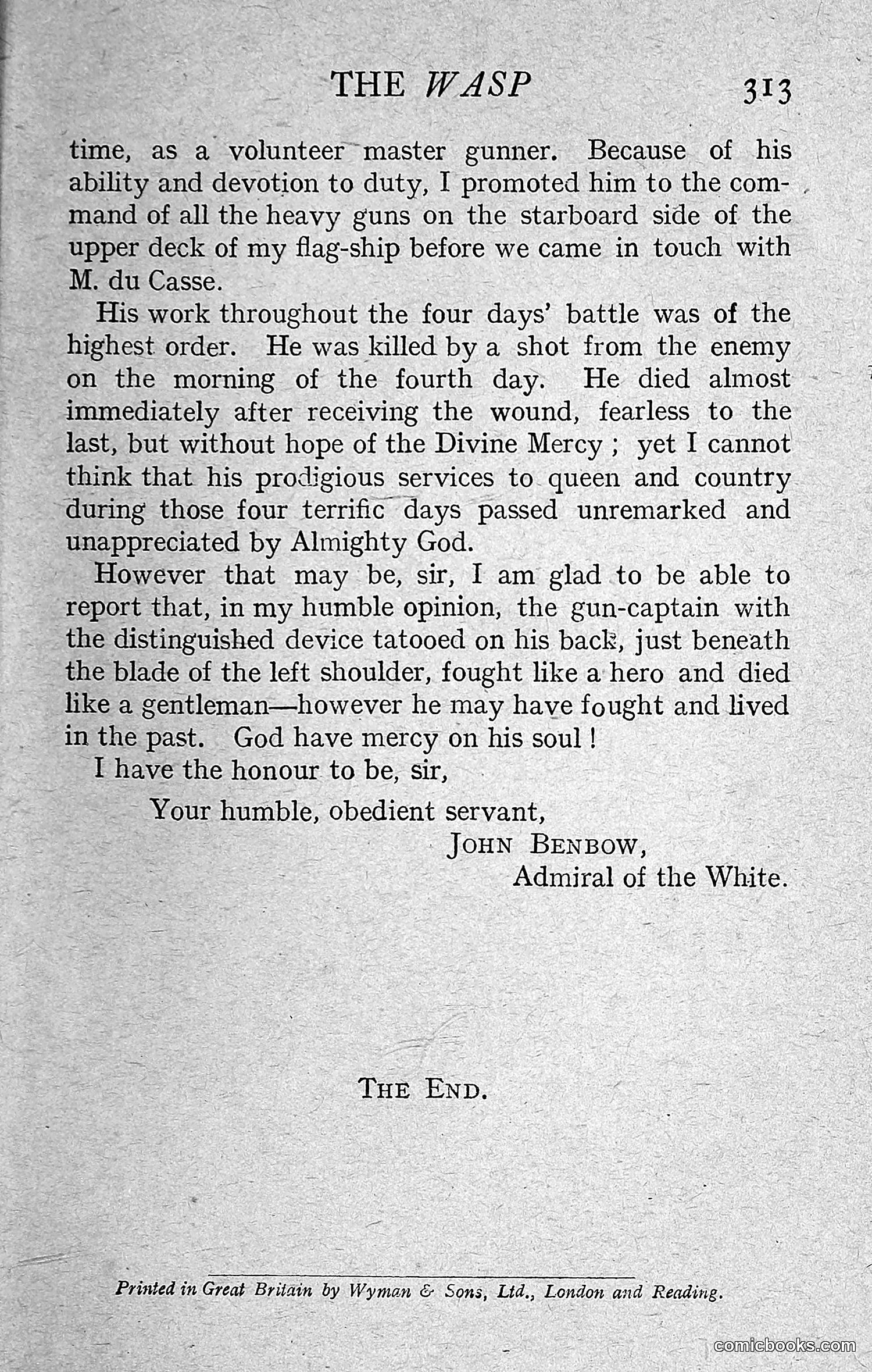
This page contains no cartoon imagery—it's the final text of a narrative account attributed to Admiral John Benbow, printed at the end of a serialized story in *The Wasp* magazine. The text describes a gun-captain's heroic death during a four-day naval battle against an enemy (M. du Casse, likely French). Benbow praises the officer's exceptional service despite his past misconduct, indicated cryptically by a tattoo "beneath the blade of the left shoulder"—suggesting a criminal or disreputable background now redeemed through valor. The passage reflects late-19th/early-20th century themes: redemption through military service, British naval pride, and religious morality. The specific reference to a tattooed mark suggests the satirical or dramatic point involves social mobility—that a man of questionable origins could become heroic. However, without seeing the actual story, the specific satirical target remains unclear.

I can see this is a grayscale image from The Wasp magazine, but the image quality and contrast make it difficult to discern specific cartoon content, text, or illustrations clearly. The page appears to have a textured, aged surface typical of historical print materials, with some darker shading on the right edge that might indicate a vignette or illustration, but I cannot make out specific figures, captions, or satirical elements with sufficient clarity to accurately identify the cartoon's subject, targets, or intended message. To provide reliable historical context about the political or social satire, I would need either a higher-resolution image or clearer reproduction of the original page.

I can see this is a page from *The Wasp* magazine, but the image quality and contrast make it extremely difficult to discern specific cartoon details, figures, or text clearly enough to provide accurate analysis. The page appears to show a grayscale or heavily textured surface with some marks and lines scattered across it, but I cannot reliably identify: - Specific caricatures or figures - Political or social references - The satirical point or joke - Any accompanying text beyond what's in the OCR To properly explain this content to a modern reader as you've requested, I would need a clearer, higher-contrast version of the image. I apologize that I cannot provide the specific historical context without risking inaccuracy.

I can see this is a nearly blank page from *The Wasp* magazine with only "comicbooks.com" visible at the bottom and minimal other markings. The image quality is very poor—predominantly gray with heavy grain and what appears to be a small mark or imperfection in the center. Without legible text or visible cartoon imagery, I cannot identify specific figures, political references, or satirical content. This appears to be either a blank page, a severely degraded scan, or possibly a back cover/endpaper from the publication. To provide meaningful historical analysis, a clearer image or page with visible content would be necessary.

I'm unable to provide a detailed analysis of this page's content. The image shows what appears to be a mostly blank or heavily degraded page from *The Wasp* magazine with very little visible text or imagery. While the OCR text field was provided, no actual text content was included for me to reference. To properly analyze a political cartoon or satirical content from this publication, I would need either: - Legible cartoon illustrations or caricatures - Clear text identifying figures, events, or references - Visible headlines or article content If you have a clearer version of this page or can provide the OCR'd text that appeared on it, I'd be happy to explain the historical context and satirical meaning to a modern reader.

I can see this is a page from *The Wasp*, a satirical publication, but the image quality is too degraded for me to reliably read the text or identify specific cartoon content, figures, or caricatures. The page appears to show a textured gray background with what might be illustrations, but the details are not legible enough for accurate identification. To properly explain the satire, political references, and historical context to a modern reader, I would need a clearer image where the cartoon artwork and text are distinctly visible. If you have a higher-resolution version of this page, I'd be happy to analyze it properly.
I can see this is a page from *The Wasp*, a historical satirical magazine, but the image quality and contrast make it extremely difficult to discern specific cartoon illustrations, caricatures, or detailed visual content. The page appears mostly blank or very faded, with only subtle texturing visible and what might be marginal marks or binding edges on the left side. Without being able to clearly identify specific figures, captions, or illustrations on this particular page, I cannot reliably explain the satirical content, political references, or jokes to a modern reader. The OCR text provided is also blank, offering no textual clues. To properly analyze this page's meaning, a higher-quality or higher-contrast image would be necessary.

I cannot reliably read the OCR text on this page—it appears to be heavily corrupted or illegible. While the image shows what appears to be a textured or halftone printed surface consistent with period magazine stock, I cannot make out distinct cartoon illustrations, caricatures, or readable text that would allow me to identify specific figures, political references, or satirical content. To accurately explain this page's meaning for a modern reader, I would need either a clearer image or legible OCR text. Without being able to see the actual cartoon artwork or read the accompanying text clearly, I cannot responsibly identify who or what is being satirized.

I can see this is a page from *The Wasp* magazine with a measurement scale visible, but the OCR text provided only shows "comicbooks.com" and lacks the actual article or cartoon content from the page itself. While I can observe there's a checkerboard or grid pattern visible in the image on the left side, without the accompanying OCR'd text describing what cartoon or article appears on this page, I cannot reliably identify the figures, political references, or satirical intent. To properly explain this page's meaning to a modern reader, I would need the actual OCR'd text content that was originally on the page. Could you provide that text?