
The Wasp, 1918 · page 224 of 330
The Wasp — 1918 — page 224: what you’re looking at
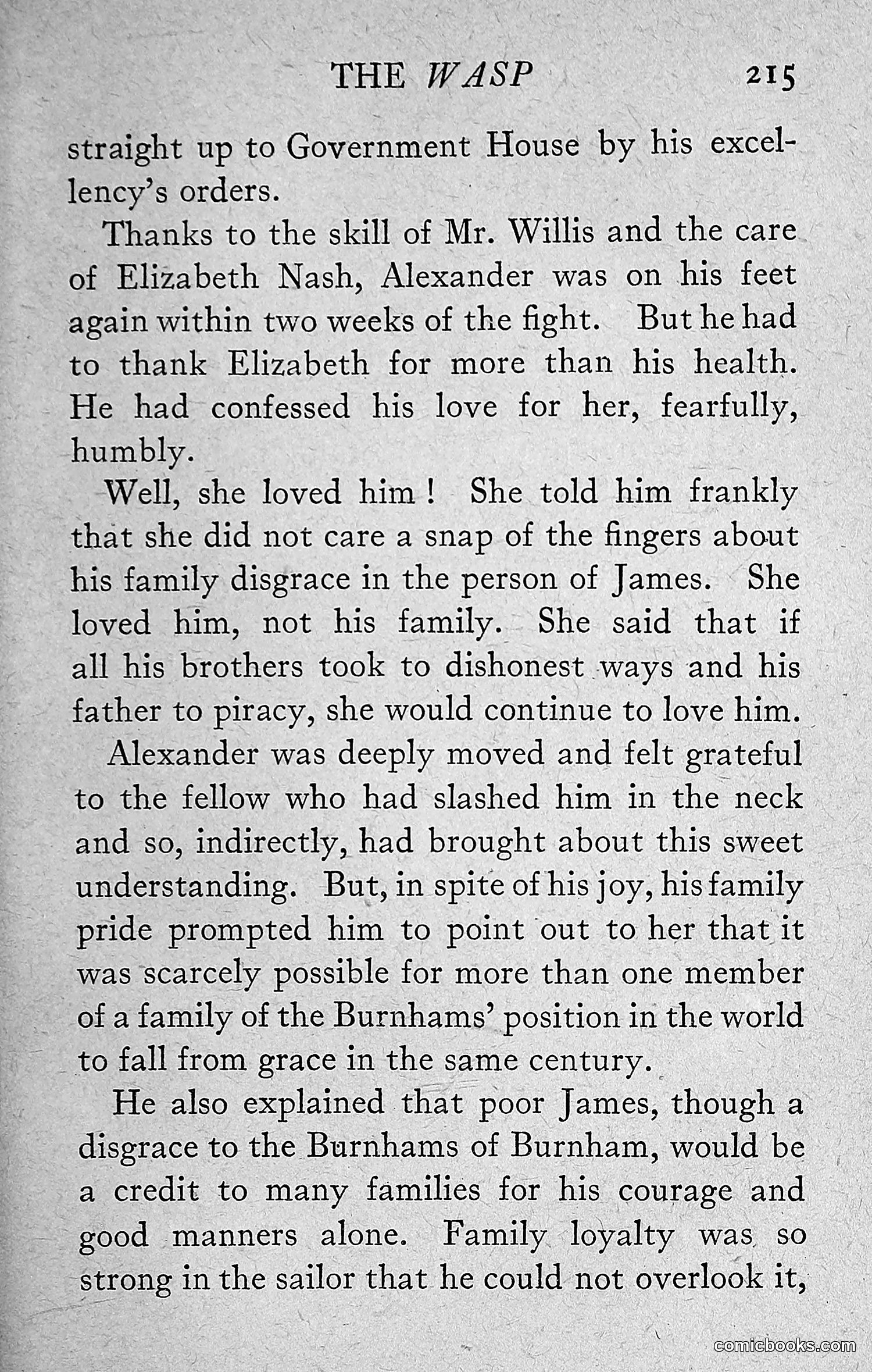
What you’re looking at
This page contains narrative prose rather than a political cartoon. It's part of a serialized romantic story featuring characters named Alexander and Elizabeth Nash of the Burnham family. The passage depicts a melodramatic love story: Alexander recovers from a neck wound (inflicted by an unknown assailant) and confesses his love to Elizabeth. She responds by declaring she loves *him*, not his family—emphasizing this even if his relatives engage in dishonest conduct or piracy. The satire appears aimed at Victorian upper-class pretensions: Alexander, despite his joy, feels compelled to defend his disgraced brother James and lecture Elizabeth about family honor, arguing that only one Burnham could "fall from grace" per century. This highlights the contradiction between romantic love and rigid class pride. The text mocks how family loyalty and social position override genuine feeling among the gentry.
📄 Transcribed text from this page (OCR, searchable)
Machine-transcribed from the original scan — historical spelling and the odd misread are preserved.
THE WASP 215 straight up to Gomera ent House by his excel- lency’s orders. Thanks to the skill of Mr. Willis and the care of Elizabeth Nash, Alexander was on his feet again within two weeks of the fight. But he had to thank Elizabeth for more than his health. He had confessed his love for her, fearfully, humbly. Well, she loved him! She told him frankly that she did not care a snap of the fingers about his family disgrace in the person of James. She loved him, not his family. She said that if all his brothers took to dishonest -ways and his » father to piracy, she would continue to love him. Alexander was deeply moved and felt grateful to the fellow who had slashed him in the neck and so, indirectly, had brought about this sweet understanding. But, in spite of his joy, hisfamily pride prompted him to point out to her that it was scarcely possible for more than one member of a family of the Burnhams’ position in the world to fall from grace in the same century. He also explained that poor James, though a a disgrace to the Burnhams of Burnham, would be a credit to many families for his courage and good manners alone. Family loyalty was, sO strong in the sailor that he could not overlook it, comichooks.com