
The Wasp, 1918 · page 195 of 330
The Wasp — 1918 — page 195: what you’re looking at
What you’re looking at
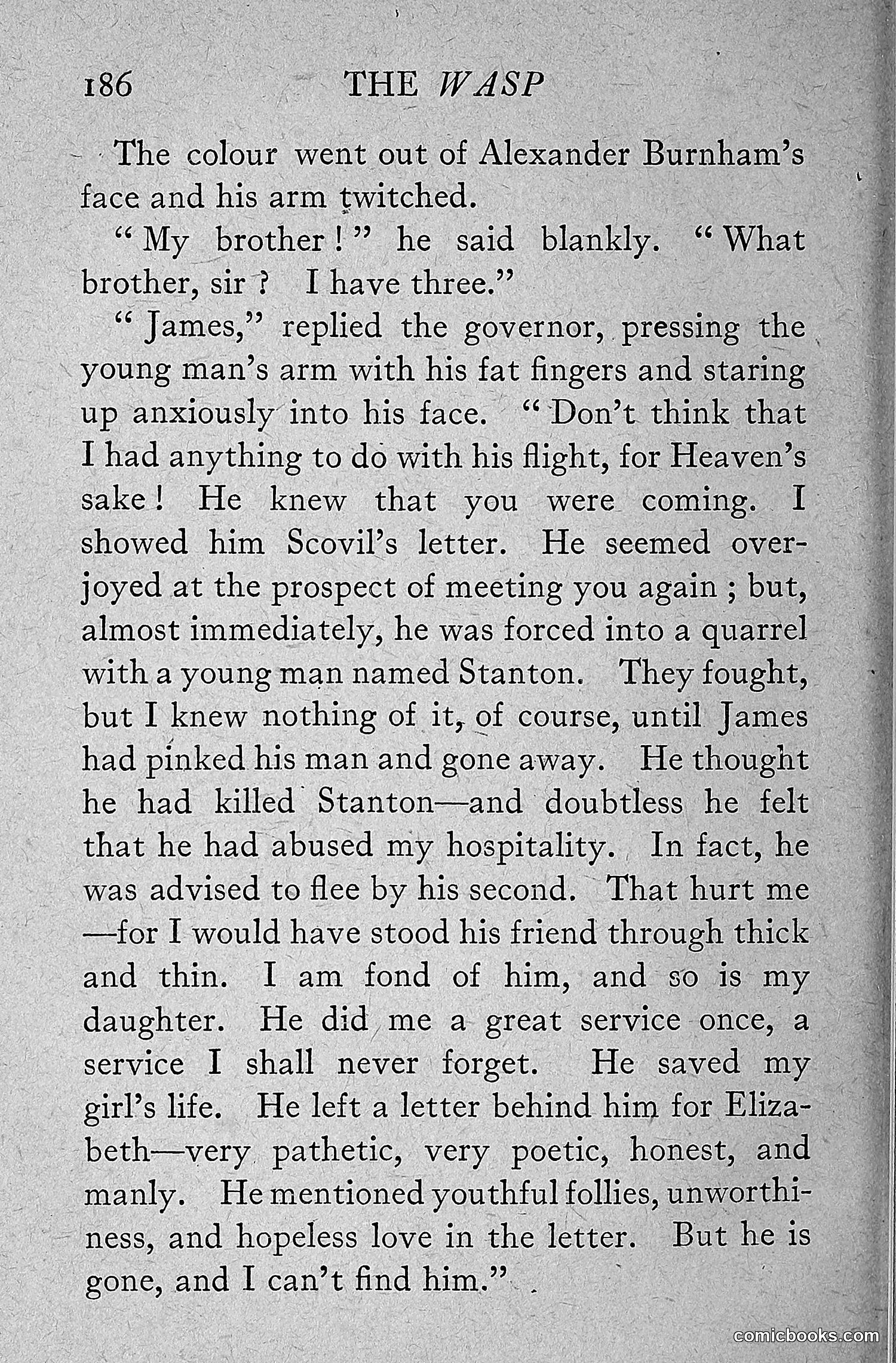
This appears to be a **literary excerpt rather than a political cartoon**—a dramatic dialogue from a serialized story or novel published in *The Wasp*, a 19th-century American satirical magazine. The scene depicts a governor speaking urgently to Alexander Burnham about Burnham's brother James, who has fled after a duel with a man named Stanton. The governor denies involvement in James's disappearance, emphasizing that he showed James a letter from someone named Scovil and would have supported him. The emotional tone—references to "youthful follies," "hopeless love," and a letter to "Elizabeth"—suggests a melodramatic narrative popular in period publications. Without seeing the full serial or magazine context, **the specific satirical target remains unclear**. This may be mocking conventional sentimental literature, or referencing a contemporary scandal, but the page alone doesn't reveal which.
📄 Transcribed text from this page (OCR, searchable)
Machine-transcribed from the original scan — historical spelling and the odd misread are preserved.
186 © THE WASP - The colour went out of Alexander Burnham’s face and his arm twitched. _ ‘““My brother!” he said blankly. ‘ What brother, sir? I have three.” : “James,” replied the governor, pressing the | young man’s arm with his fat fingers and staring up anxiously into his face. ‘‘ Don’t think that I had anything to do with his flight, for Heaven’s sake! He knew that you were coming. I showed him Scovil’s letter. He seemed over- joyed at the prospect of meeting you again ; but, almost immediately, he was forced into a quarrel with a young man named Stanton. They fought, but I knew nothing of it, of course, until James had pinked his man and gone away. He thought he had killed Stanton—and doubtless he felt — that he had abused my hospitality. In fact, he was advised to flee by his second. That hurt me —for I would have stood his friend through thick and thin. I am fond of him, and so is my daughter. He did me a great service once, a service I shall never forget. He saved my girl’s life. He left a letter behind him for Eliza- beth—very pathetic, very poetic, honest, and manly. He mentioned youthful follies, unworthi- ness, and hopeless love in the letter. But he is gone, and | can’t find him.”. . : lcomicbooks:com)