
The Wasp, 1918 · page 146 of 330
The Wasp — 1918 — page 146: what you’re looking at
What you’re looking at
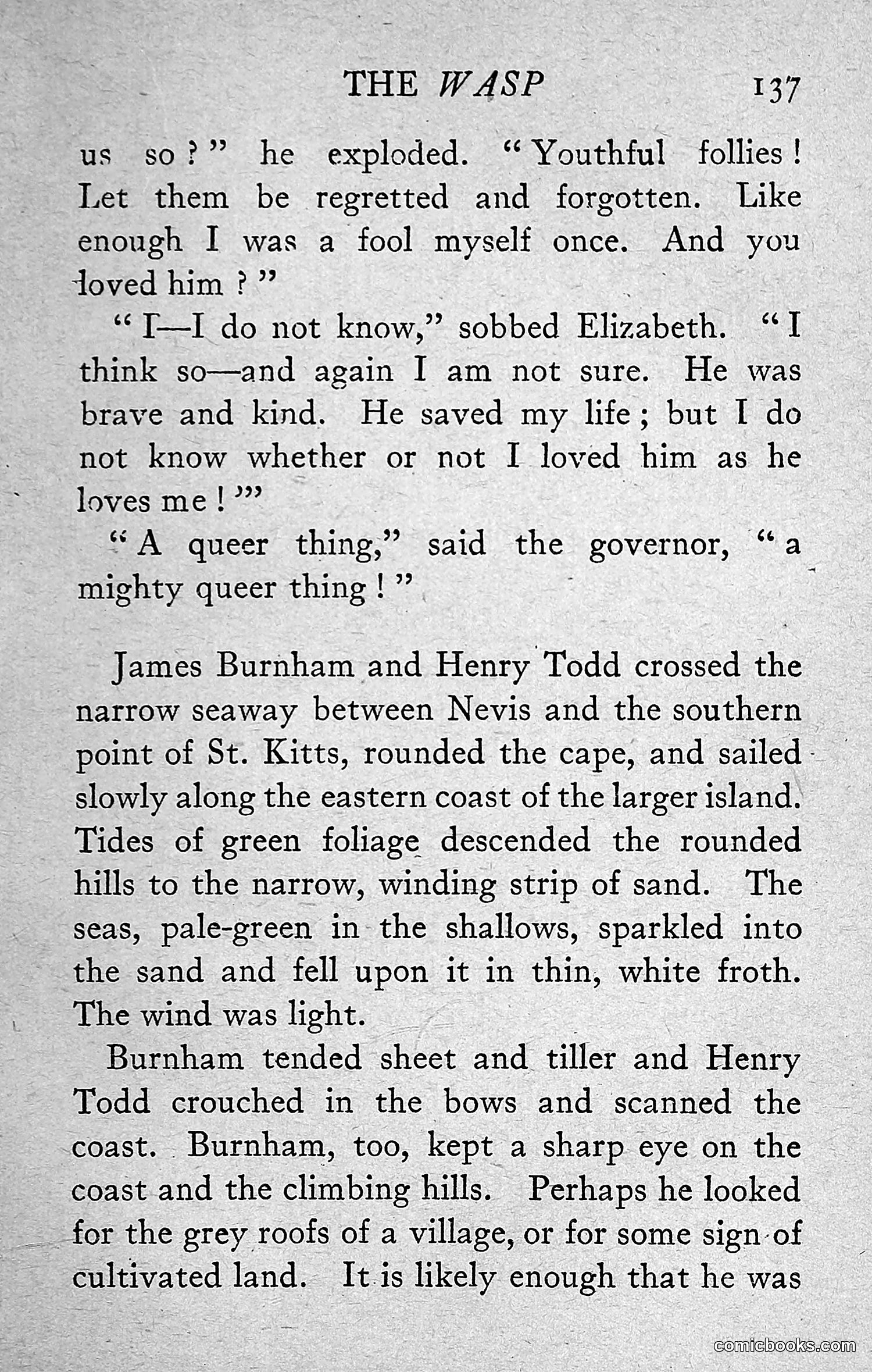
This page appears to be from a serialized narrative rather than a political cartoon. The text shows dialogue between Elizabeth and a governor discussing a man (apparently named in an earlier passage) whom Elizabeth has complicated feelings about—he saved her life and loves her, but she's uncertain if she loves him in return. The governor's response ("A queer thing") suggests bemused commentary on the emotional ambiguity. The remainder of the page shifts to prose narrative describing James Burnham and Henry Todd sailing between Caribbean islands (Nevis and St. Kitts), scanning the coastline. The descriptive language focuses on the landscape rather than satirical commentary. **Without seeing earlier pages, the political/social context is unclear.** This appears to be literary fiction serialized in a satirical magazine, but the specific historical references or satirical intent cannot be determined from this excerpt alone.
📄 Transcribed text from this page (OCR, searchable)
Machine-transcribed from the original scan — historical spelling and the odd misread are preserved.
THE WASP 137 us so?” he exploded. “ Youthful follies! Let them be regretted and forgotten. Like enough I was a fool myself once. And you loved him?” is **T—I do not know,” sobbed Elizabeth. “I think so—and again I am not sure. He was brave and kind. He saved my life; but I do not know whether or not I loved him as he loves me! ’” | “A queer thing,” said the governor, mighty queer thing ! ” | James Burnham and Henry Todd crossed the narrow seaway between Nevis and the southern point of St. Kitts, rounded the cape, and sailed: slowly along the eastern coast of the larger island. Tides of green foliage descended the rounded — hills to the narrow, winding strip of sand. The seas, pale-green in the shallows, sparkled into the sand and fell upon it in thin, white froth. The wind was light. _ Burnham tended sheet and tiller and Henry Todd crouched in the bows and scanned the coast. Burnham, too, kept a sharp eye on the coast and the climbing hills. Perhaps he looked for the grey roofs of a village, or for some sign of cultivated land. It is likely enough that he was comichooks.com