
A complete issue · 17 pages · 1878
Puck — September 4, 1878
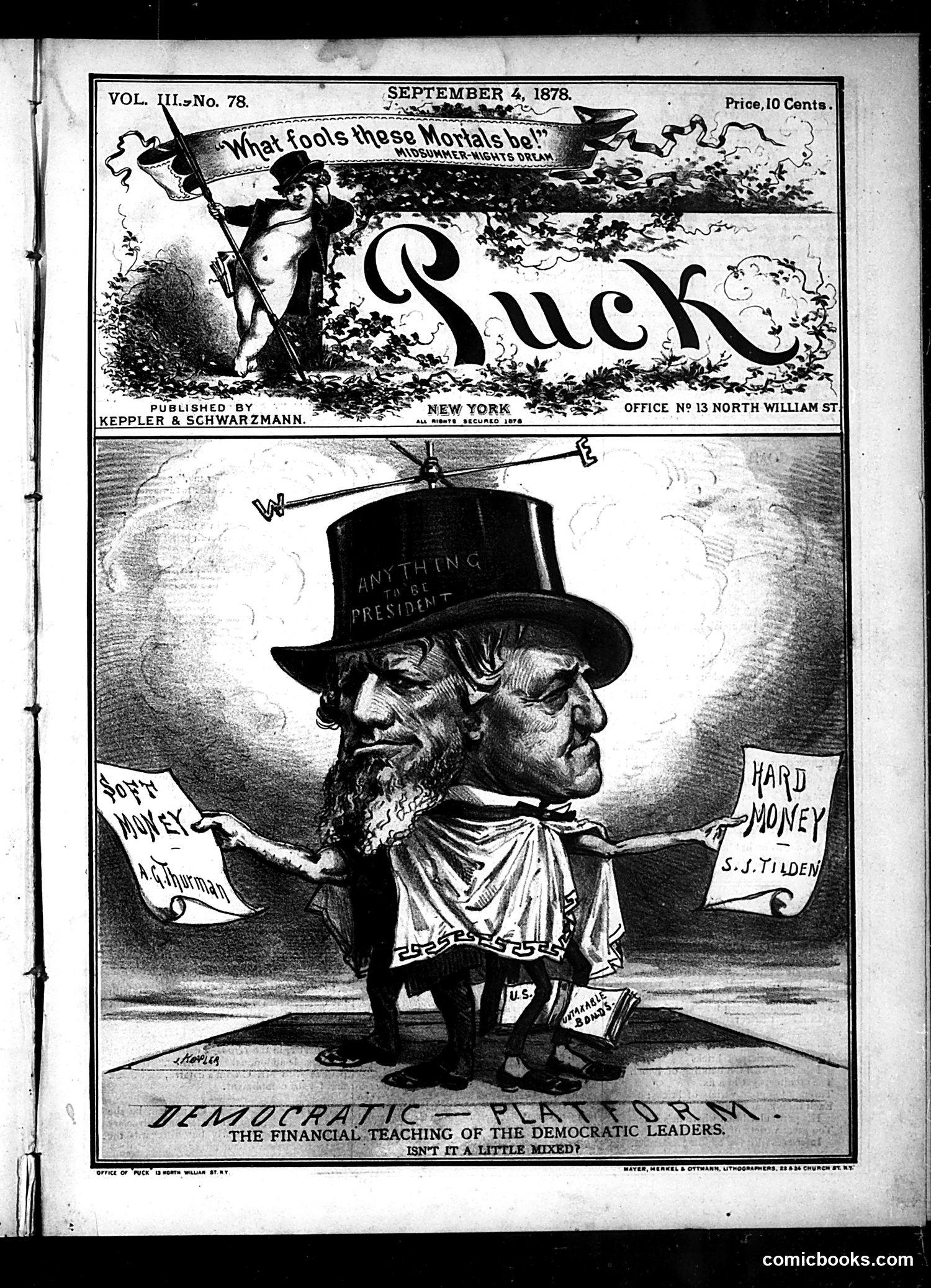
This political cartoon satirizes Democratic Party financial leadership during the 1878 election cycle. The central figure is a two-headed caricature wearing a top hat labeled "ANYTHING FOR PRESIDENT," representing divided Democratic leadership. One head holds a paper labeled "SOFT MONEY" (attributed to A. Thurman), while the other holds "HARD MONEY" (attributed to S.J. Tilden). The satire's point: the Democratic Party was internally fractured on monetary policy—a crucial issue of the era. The "mixed" approach criticized in the subtitle suggests Democrats lacked coherent financial principles, instead pursuing contradictory policies to appeal to different voter groups. This internal contradiction weakened their credibility on economic matters heading into elections.
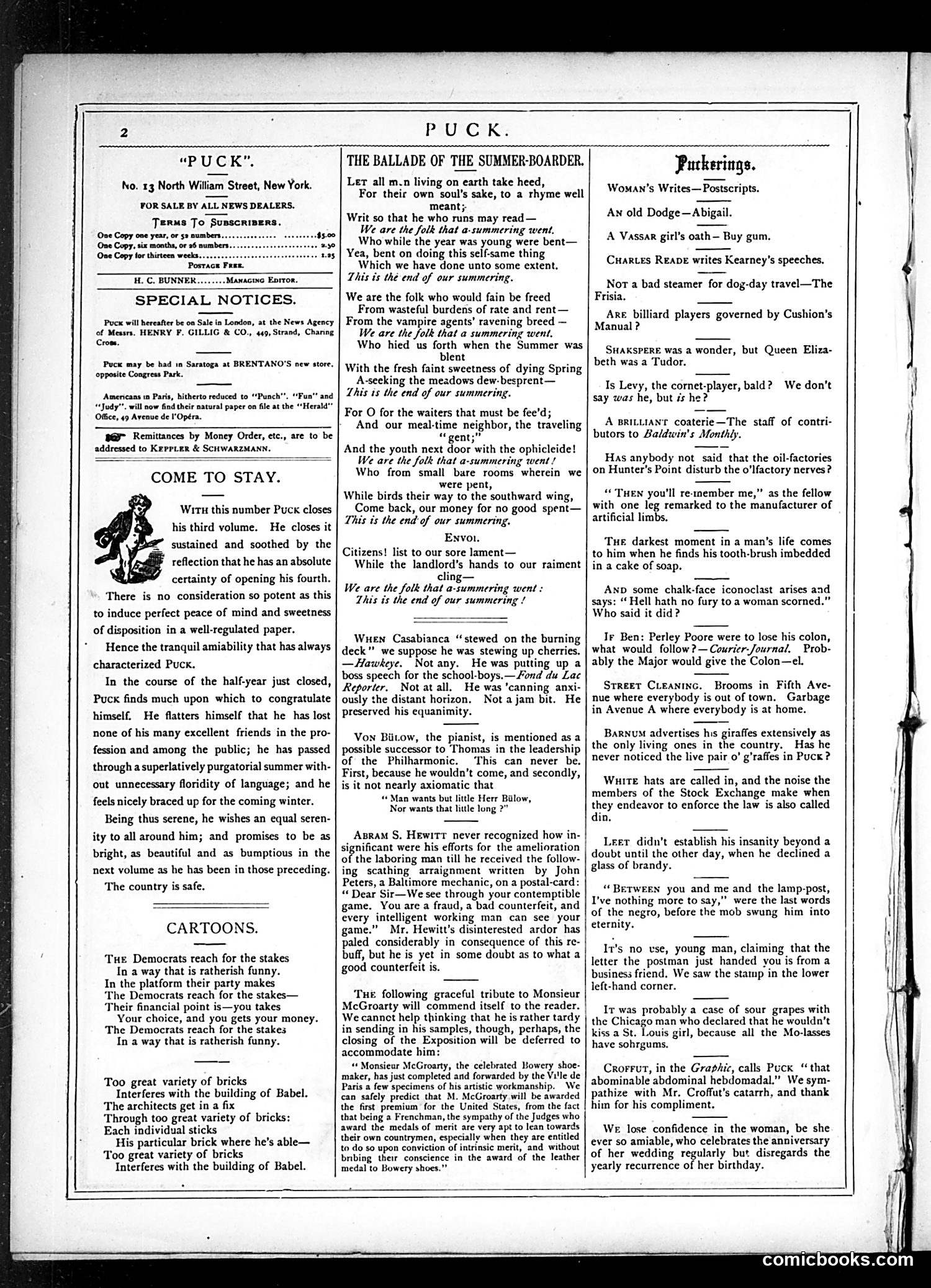
This page contains editorial content and humor rather than a major political cartoon. The "Ballad of the Summer-Boarder" satirizes vacationing city dwellers, mocking their wasteful spending and pretentious behavior at seaside resorts. The "Puckerings" section offers brief satirical notes on contemporary figures and events: references to Charles Reade's speeches, Queen Elizabeth as a Tudor (historical commentary), and Abram S. Hewitt's unsuccessful efforts regarding labor disputes. A note about McGroraty and the Exposition closing suggests late 19th-century context. The "Cartoons" section criticizes Democrats for inconsistent platform positions on currency and tariffs—standard partisan jabs of the era. Overall, this represents Puck's characteristic lighthearted social satire rather than hard-hitting political commentary, targeting middle-class leisure culture and political hypocrisy.
This page contains two separate pieces: a character sketch titled "A Character Sketch" (left column) and an essay titled "My Summer Rest" (right column). **"A Character Sketch"** appears to be a biographical narrative about Deacon Perent, a religious figure involved with the Christian Pamphlet Publishing Society. The text describes his hypocrisy—presenting himself as pious while engaging in dubious financial dealings and moral compromises. It satirizes his self-righteousness and the gap between his public reputation and private conduct. **"My Summer Rest"** is a humorous personal essay about someone's vacation experiences, including their awkward attempts at French and observations about English seaside life. Neither piece contains obvious political commentary or identifiable caricatures requiring historical context to understand the satire.
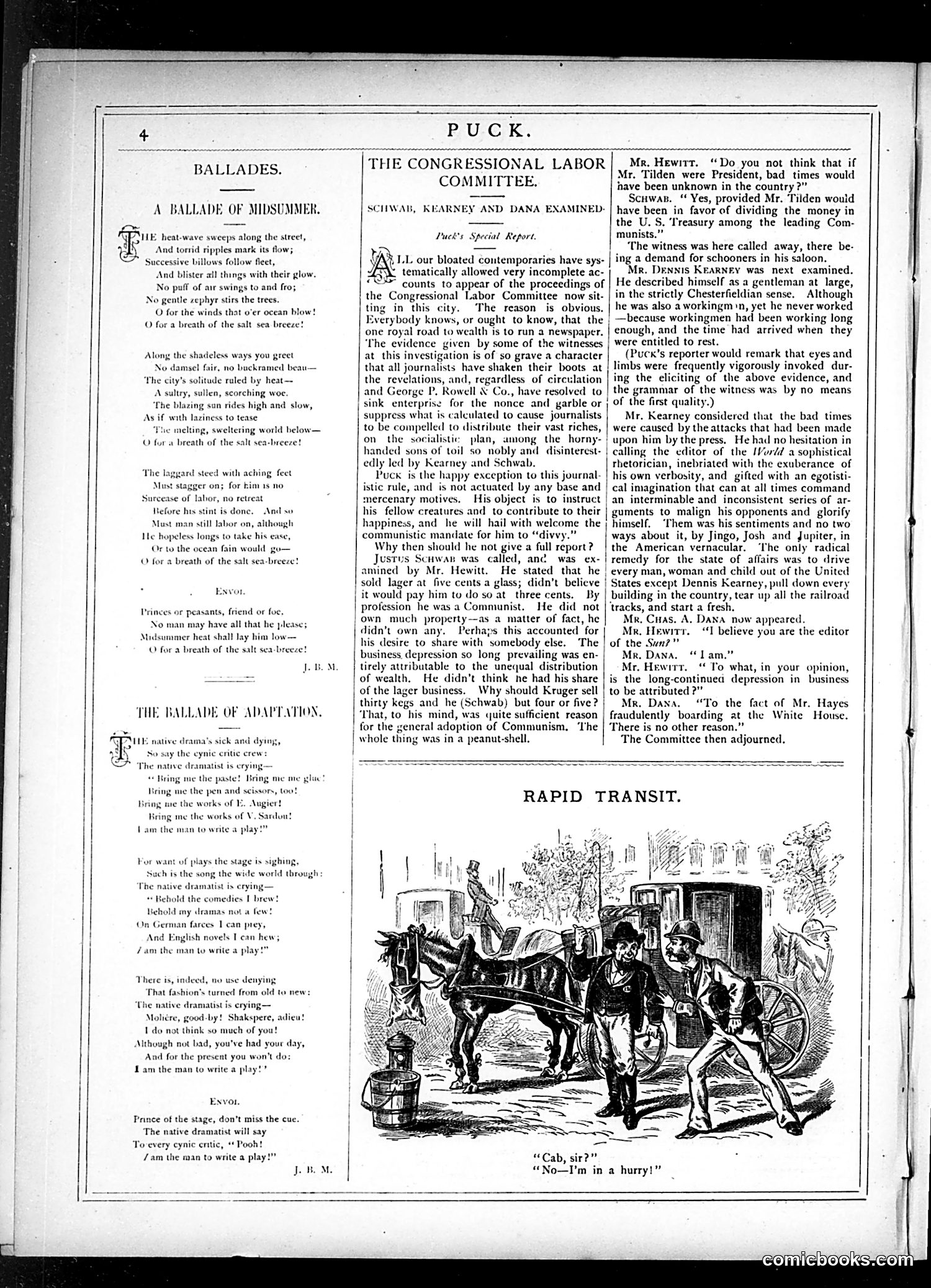
This cartoon satirizes late 19th-century urban transportation inefficiency. The illustration shows a cab driver whipping a horse while a dog pulls the carriage wheel—a visual joke about the chaotic state of city transit before modern systems. The dialogue ("Cab, sir?" / "No—I'm in a hurry!") reinforces the absurdity: a potential passenger refuses the cab *because* they're in a hurry, implying horse-drawn cabs were notoriously slow and unreliable. The cartoon mocks the irony of cities claiming to offer "rapid transit" while still relying on animal-powered vehicles. This likely references contemporary debates over modernizing city transportation, contrasting old methods with emerging technologies like electric streetcars that Puck's audience would recognize as genuinely fast alternatives.
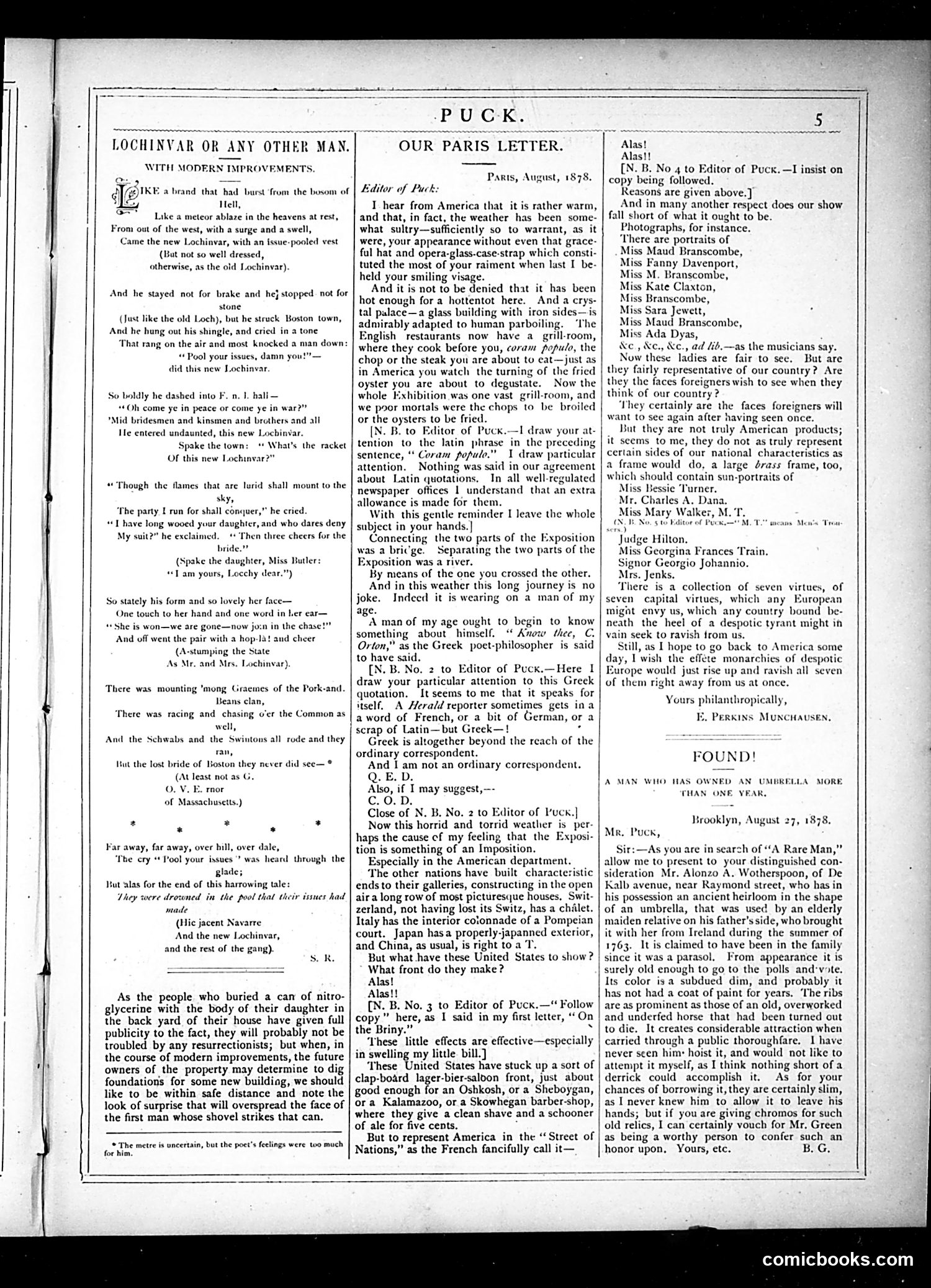
The main cartoon "Lochinvar or Any Other Man" satirizes a romantic figure—likely a contemporary political or social personality—depicted as a vain, well-dressed seducer. The verse mocks his vanity and romantic conquests, comparing him unfavorably to the legendary Lochinvar. The page contains three letters to the editor: "Our Paris Letter" discusses the Paris Exposition and American representation abroad; "Alas! Alas!" criticizes the absence of notable American figures from exhibits; and "Found!" describes a man searching for a rare umbrella in Brooklyn—likely humorous domestic satire rather than political commentary. The humor relies on period-specific social anxieties about American cultural standing versus Europe and personal eccentricity. Without clearer image visibility, specific figure identification remains uncertain.
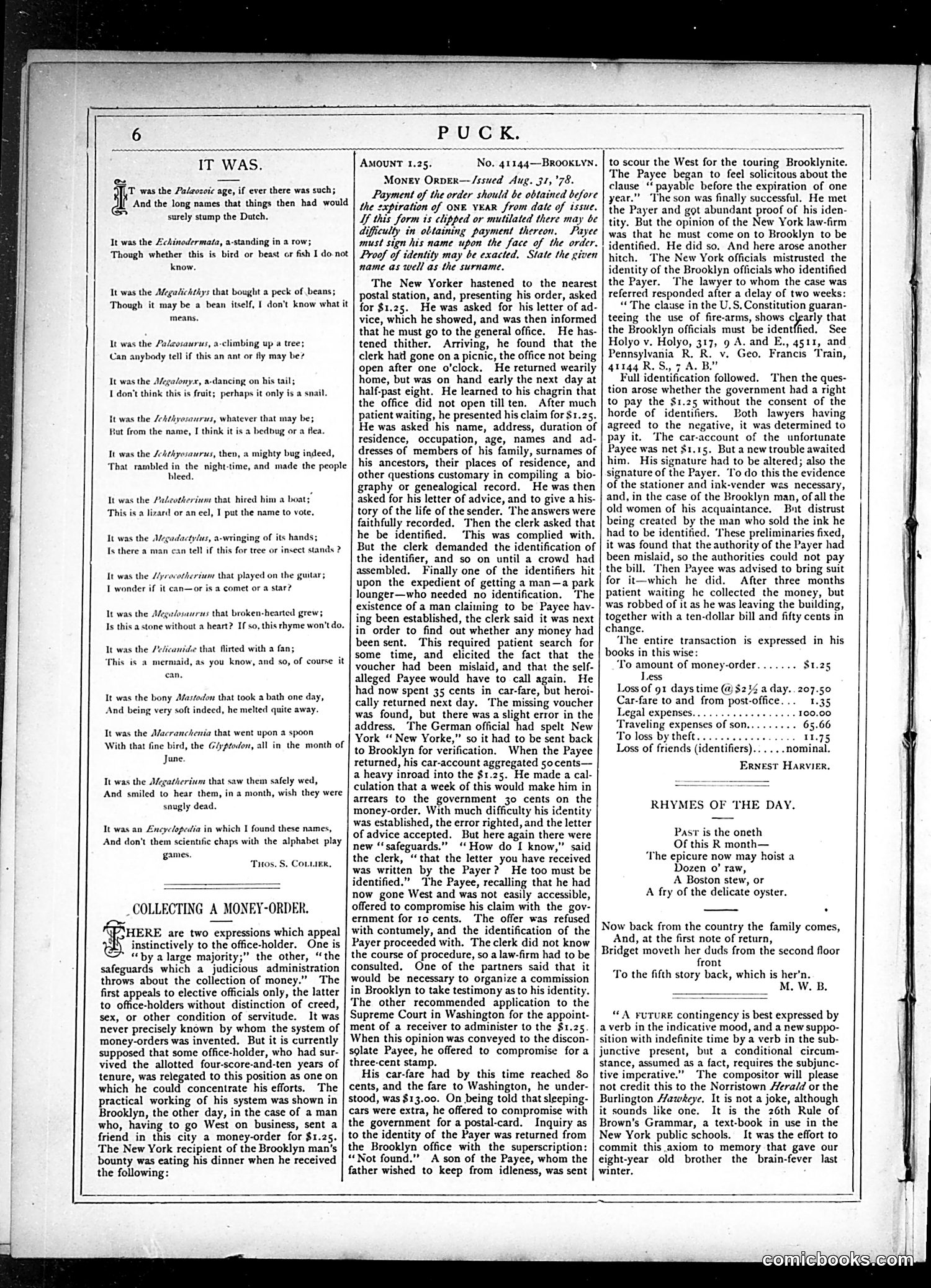
This page contains primarily **text content** rather than political cartoons. The main article, "Collecting a Money-Order," is a humorous essay about the bureaucratic frustrations of obtaining a money order from the post office. The piece satirizes **government inefficiency and red tape**—a recurring Puck theme. It describes an unnamed man's absurd ordeal trying to collect a $1.25 money order, involving repeated visits, identity verification demands, lost vouchers, and clerical errors. The narrative mocks both the postal system's incompetence and its excessive procedural safeguards. The page also includes "Rhymes of the Day" (light verse) and a brief grammar note. The satire targets institutional bureaucracy rather than specific political figures.
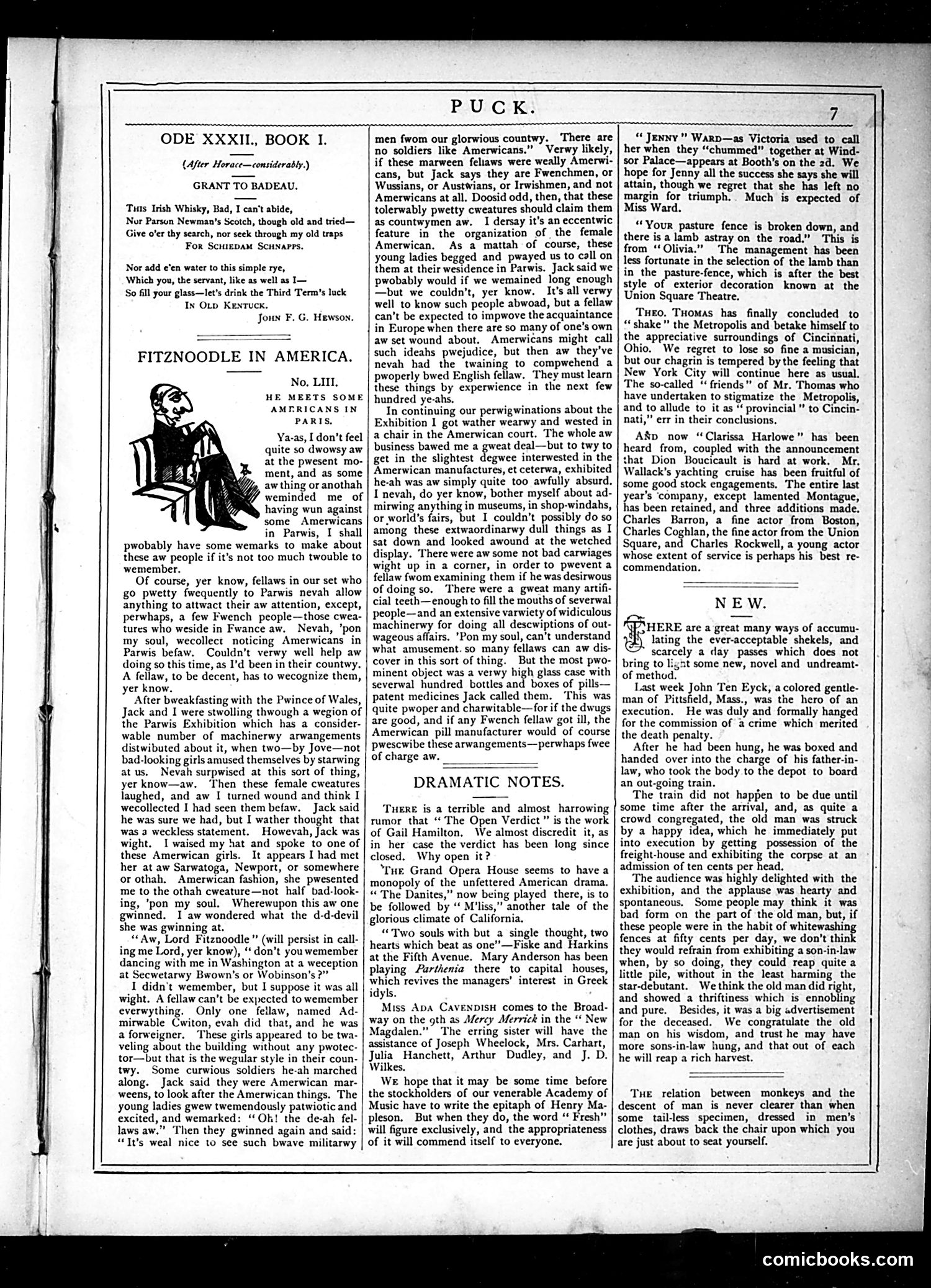
This page from Puck contains three distinct sections: 1. **"Ode XXXII, Book I"** - A poem by F.G. Hewson mocking Irish whiskey and Scottish characteristics. 2. **"Fitznoodle in America, No. LIII"** - A satirical essay with an illustration showing a man seated. The piece ridicules American attitudes toward European culture and art. The narrator, apparently an American visiting Paris, describes encountering pretentious Americans at museums and exhibitions who make uninformed judgments about European artistic traditions. The satire targets American cultural smugness and ignorance of Old World sophistication. 3. **"Dramatic Notes"** and **"New"** sections - Brief commentary on theatrical productions and social observations, including remarks about monkey behavior. The overall theme mocks American cultural pretension and provincialism.
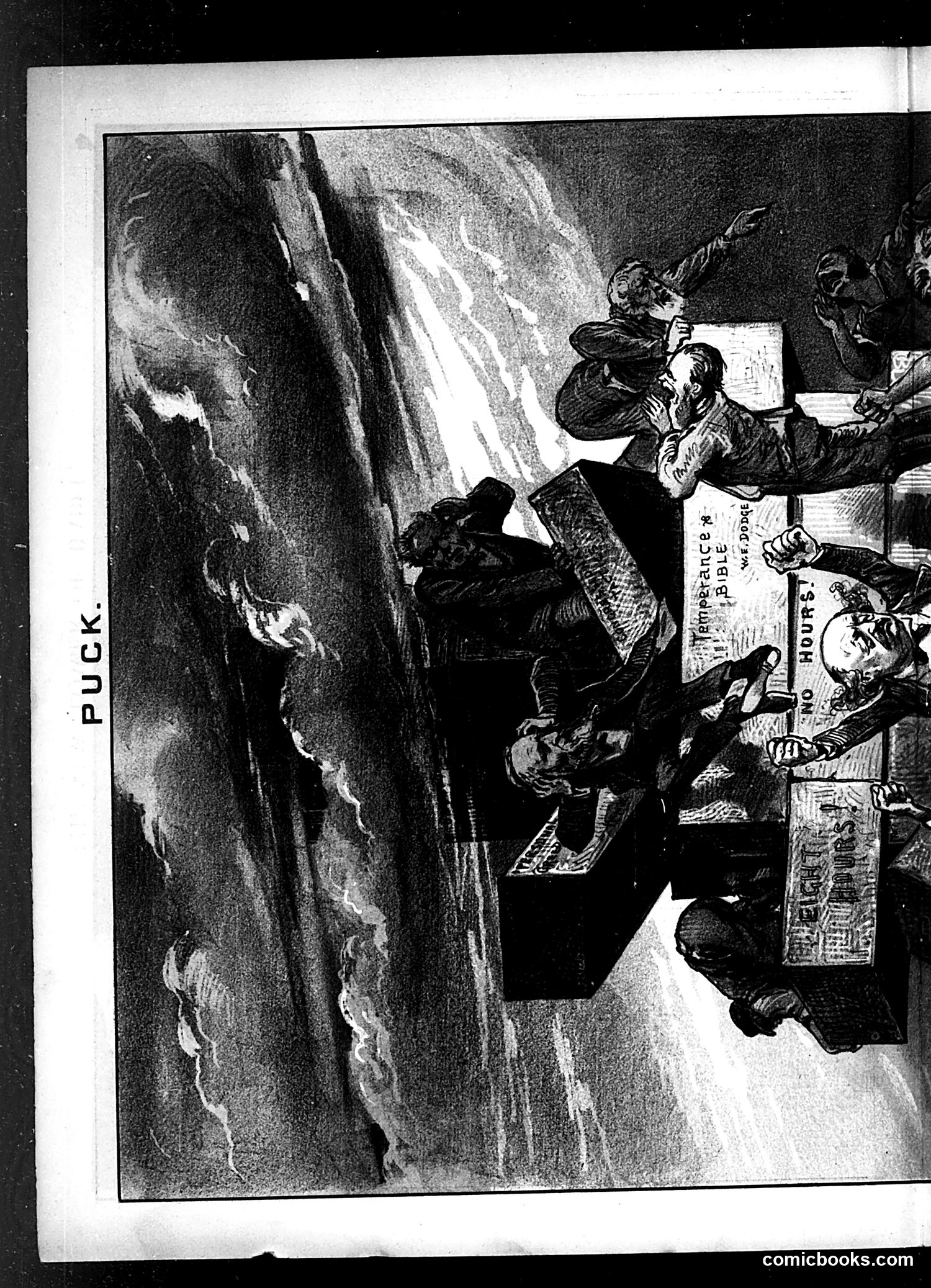
This page from *Puck* magazine appears to show a satirical scene rotated 90 degrees. The visible text references "IMPERMANENCE," "BIBLE," "HOURS WEDGE," and what appears to be advertising or publication information. The illustration depicts multiple figures in period dress gathered around what seems to be a dramatic, turbulent scene with stormy skies on the left. The composition suggests chaos or upheaval—possibly depicting a religious or moral controversy given the "BIBLE" reference visible on papers in the scene. However, without being able to read the full caption or surrounding text clearly, I cannot definitively identify the specific political figures, the exact event being satirized, or the precise point of the joke. The image quality and rotation make complete interpretation difficult. More context would be needed for accurate analysis.
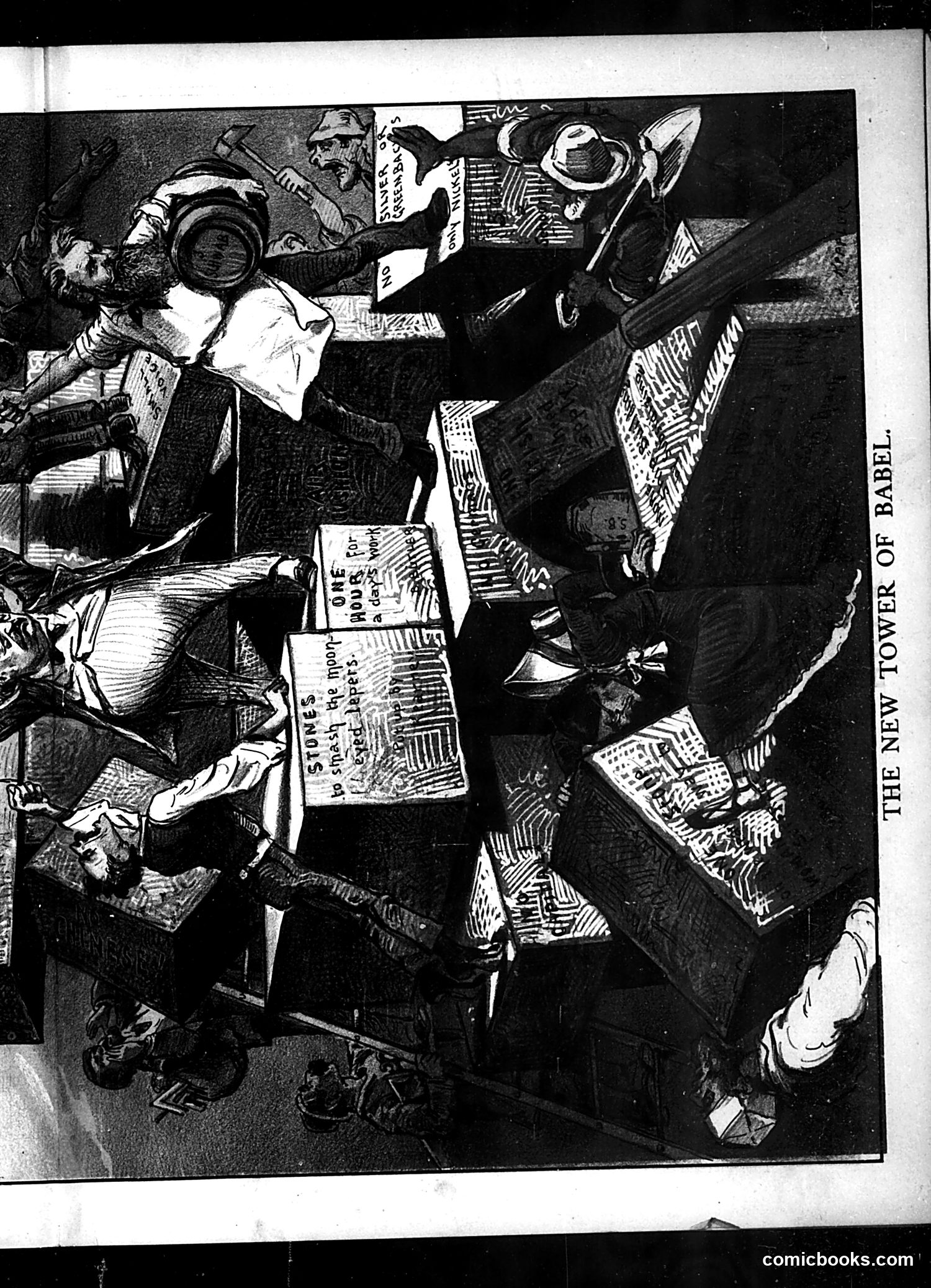
This political cartoon satirizes confusion and miscommunication, likely depicting a construction or political scene. Multiple figures appear to be workers or laborers attempting to communicate while holding papers or documents with visible text (though specific words are difficult to read clearly in this reproduction). The "Tower of Babel" reference alludes to the biblical story where workers couldn't understand each other's languages, creating chaos. The cartoon likely comments on governmental, industrial, or labor disputes of the Puck magazine era where different factions—possibly workers, management, or politicians—failed to communicate effectively. The various papers and signage suggest bureaucratic confusion or conflicting directives. Without clearer text visibility or publication date, the specific political context remains unclear, but the core message criticizes organizational or linguistic breakdown causing disorder.
This is a **text-heavy editorial page from Puck magazine**, not primarily a cartoon page. The content focuses on theatrical interviews and management practices rather than visual satire. The main article discusses a Puck reporter's interviews with theater managers about their casting and business decisions. It includes anecdotes about performers like Sara Bernhardt, Henry Irving, and various actors, documenting managers' candid remarks about engaging stars, managing costs, and dealing with troublesome performers. The bottom section, "Answers for the Inquisitive," addresses reader questions about theatrical terminology and performance practices. **No political satire is evident here**—this is primarily **entertainment industry reportage and gossip**, typical of Puck's coverage of contemporary theatrical life and personalities.
This is a satirical short story by Frank Barrett (byline: "on London 'March'"), not a political cartoon. The narrative mocks two poor artists—Dobbs (a painter) and Wrot (a poet)—whose poverty and pretension the author ridicules throughout. The satire targets artistic self-importance: both men possess grand egos despite their complete lack of money or success. The story follows their misadventures on a train journey, including Dobbs's embarrassing behavior (an "Alexandrian head" obsession) and Wrot's ridiculous attempts at superiority. The "gallows-tree inn" title sardonically references their desperate circumstances. The humor derives from depicting impoverished bohemian artists as simultaneously delusional and pathetic—a common Victorian satirical target attacking artistic pretense and financial irresponsibility.
This page is primarily **text content** rather than a cartoon. It contains a serialized story titled "Puck's Perranges" (likely a fiction installment), along with a section called "Literature" featuring brief satirical items and commentary. The visible content includes: - A narrative about characters named Mr. Dobbs and Mr. Wrot engaged in some kind of theft or crime involving gold and silver - Several short satirical quips about contemporary topics: a demented prophet mocking Goldsmith Mandt, a reference to Chinese Embassy officials wearing silk, commentary on President MacMahon, and social observations about dogs, church members, and fashion **The actual editorial cartoons are not visible on this page**—only text-based satire and humor typical of Puck magazine's miscellaneous commentary sections.
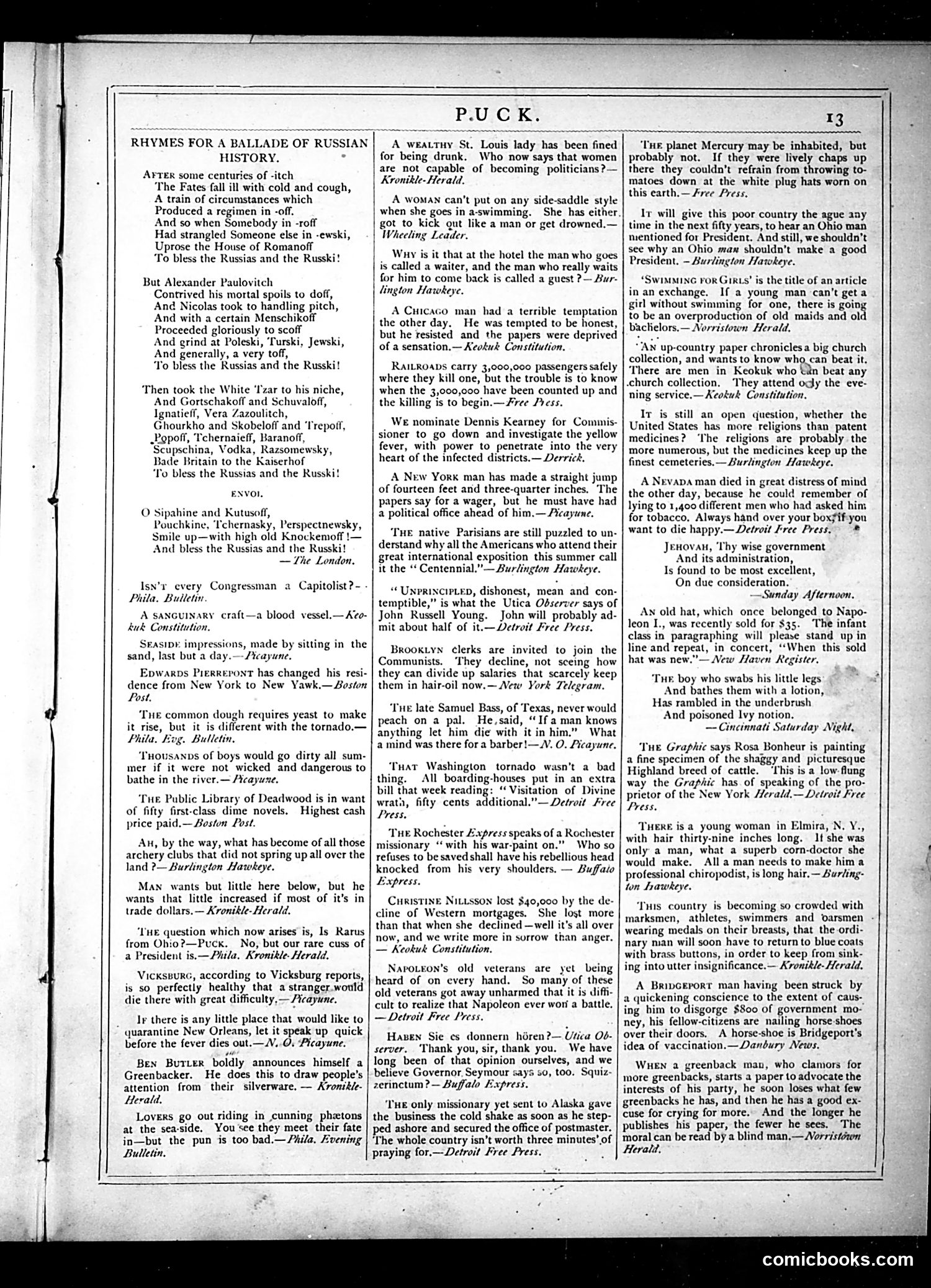
This page contains satirical short pieces and brief jokes rather than a single large cartoon. The content targets various contemporary issues: **Political satire** includes jabs at congressmen, the question of whether Kansas is a "President" (unclear reference), and commentary on religious vs. patent medicine debates. **Social commentary** addresses women's fashion and behavior ("side-saddle style"), immigration/nationality questions, and urban crowding with medals and buttons. **Satirical observations** mock Russian history, government inefficiency (the Public Library of Deadwood wanting dime novels), and various American absurdities. The pieces are brief, punchy satirical items typical of Puck's format—designed to amuse readers while needling politicians, social pretensions, and contemporary follies. Without clear illustrations, the specific targets of some jokes remain unclear to modern readers.
This page is primarily **advertising and miscellaneous content** rather than political cartoons. The main advertisements include Apollinaris Natural Mineral Water ("The Queen of Table Waters"), Frederick de Bary & Co.'s mineral water products, Dr. Sweeny's Dental Rooms, and various other services (photographers, binders, dentists). The page also contains short **humorous anecdotes and jokes** typical of Puck's filler content—including quips about Irish soldiers, hats, and social observations. One section mocks the drinking habits of Americans, suggesting Chicagoans water down their whisky. There is **no identifiable political cartoon** on this page. It appears to be a standard interior page from the magazine devoted to advertisements and brief comedic commentary rather than substantive satire of political figures or events.
This is primarily an **advertising page** from Puck magazine (page 15), featuring various late 19th-century commercial advertisements rather than political cartoons or satire. Notable ads include: - **Vienna Coffee Pot** by Edward D. Bassford (house furnishings) - **Herring's Safes** (fireproof storage) - **Champagne advertisements** (Devenoge & Cie, Puck's branded champagne) - **Furniture, tailoring, and book-selling services** - **Patent filing covers** for Puck readers The only potentially satirical element is an advertisement by **A. Werner & Co.** (page bottom) addressing counterfeit champagne claims—defending their "American" branded champagne against accusations it's inferior imitation, suggesting contemporary concerns about brand authenticity and product fraud in the 1870s-80s marketplace. The page reflects Puck's business model: advertising subsidized the satirical content.
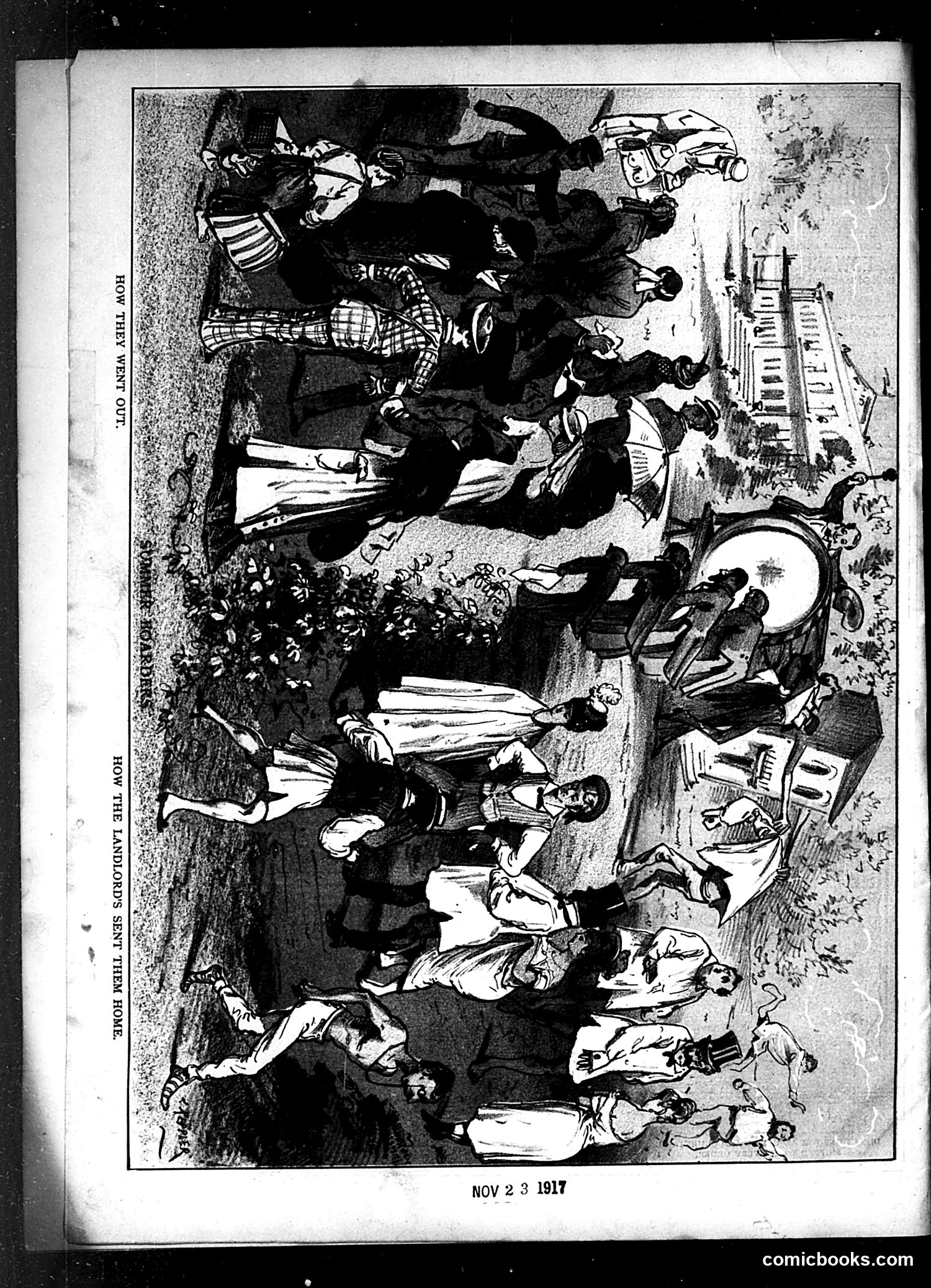
This page appears to be a satirical illustration dated November 23, 1917, during America's involvement in World War I. The cartoon depicts a chaotic street or public scene with numerous figures in various states of activity—some appear to be military personnel, civilians, and possibly politicians or authority figures. The specific identities of the caricatured individuals are not clearly legible in this reproduction. However, given the 1917 date, the satire likely comments on wartime conditions, military mobilization, government administration, or public reaction to American war efforts during WWI's final year. Without clearer labels or visible text identifying specific figures or the cartoon's title, I cannot definitively state the precise political targets or satirical point being made.
I can see this is a page from Puck magazine, but the image is almost entirely black with only a thin white border visible on the left side. The OCR text provided is empty or unreadable. Without being able to see the actual cartoon(s), illustrations, captions, or legible text content on this page, I cannot identify the figures, political references, or explain the satirical point. To properly analyze this as a historical political cartoon, I would need a clearer, more visible image where the cartoon artwork and text are actually discernible. The current image appears to be either severely underexposed, improperly scanned, or corrupted.