
Puck, 1878-09-04 · page 10 of 17
Puck — September 4, 1878 — page 10: what you’re looking at
What you’re looking at
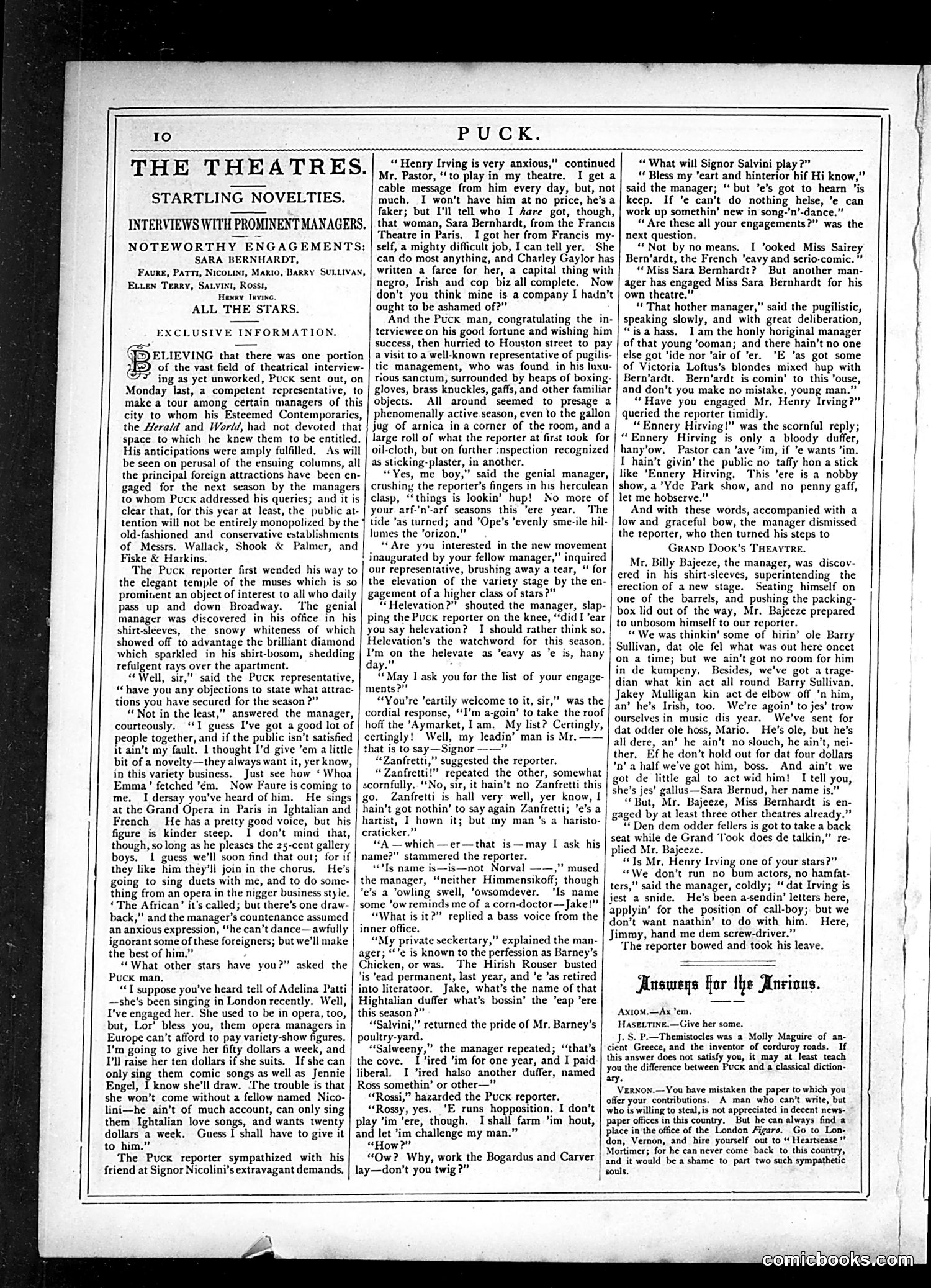
This is a **text-heavy editorial page from Puck magazine**, not primarily a cartoon page. The content focuses on theatrical interviews and management practices rather than visual satire. The main article discusses a Puck reporter's interviews with theater managers about their casting and business decisions. It includes anecdotes about performers like Sara Bernhardt, Henry Irving, and various actors, documenting managers' candid remarks about engaging stars, managing costs, and dealing with troublesome performers. The bottom section, "Answers for the Inquisitive," addresses reader questions about theatrical terminology and performance practices. **No political satire is evident here**—this is primarily **entertainment industry reportage and gossip**, typical of Puck's coverage of contemporary theatrical life and personalities.
📄 Transcribed text from this page (OCR, searchable)
Machine-transcribed from the original scan — historical spelling and the odd misread are preserved.
= 10 PUCK. THE THEATRES. STARTLING NOVELTIES. INTERVIEWS WITH PROMINENT MANAGERS. NOTEWORTHY ENGAGEMENTS: SARA BERNHARDT, Faure, PATTI, NICOLINI, MARIO, BARRY SULLIVAN, ELLen Terry, Satvint, Rossi, Henry Ixvinc. ALL THE STARS. EXCLUSIVE INFORMATION. GB ELIEVING that there was one portion & of the vast field of theatrical interview- ‘ing as yet unworked, Puck sent out, on Monday last, a competent representative, to make a tour among certain managers of this city to whom his Esteemed Contemporaries, the Hera/d and World, had not devoted that space to which he knew them to be entitled. His anticipations were amply fulfilled. As will be seen on perusal of the ensuing columns, all the principal foreign attractions have been en- gaged for the next season by the managers to whom Puck addressed his queries; and it is clear that, for this year at least, the public at- tention will not be entirely monopolized by the old-fashioned and conservative establishments of Messrs. Wallack, Shook & Palmer, and Fiske & Harkins. The Puck reporter first wended his way to the elegant temple of the muses which is so prominent an object of interest to all who daily pass up and down Broadway. ‘Ihe genial manager was discovered in his office in his shirt-sleeves, the snowy whiteness of which showed off to advantage the brilliant diamond which sparkled in his shirt-bosom, shedding refulgent rays over the apartment. “Well, sir,” said the Puck representative, “‘have you any objections to state what attrac- tions you have secured for the season?” “Not in the least,” answered the manager, courteously. “I guess I’ve got a good lot of people together, and if the public isn’t satisfied it ain’t my fault. 1 thought I'd give ‘em alittle bit of a novelty—they always want it, yer know, in this variety business. Just see how ‘Whoa Emma’ fetched ’ém, Now Faure is coming to me. I dersay you've heard of him. He sings at the Grand Opera in Paris in Ightalian and French He has a pretty good voice, but his figure is kinder steep. I don’t mind that, though, so long as he pleases the 25-cent gallery boys. I guess we'll soon tind that out; for if they like him they'll join in the chorus. He's going to sing duets with me, and to do some- thing from an opera in the nigger business style. ‘The African’ it’s called; but there’s one draw- back,” and the manager's countenance assumed an anxious expression, “he can’t dance—awfully ignorant some of these foreigners; but we'll make the best of him.” . “What other stars have you?” asked the Puck man, “T suppose you've heard tell of Adelina Patti —she's been singing in London recently. Well, I've engaged her. She used to be in opera, too, but, Lor” bless you, them opera managers in Europe can’t afford to pay variety-show figures. I'm going to give her fifty dollars a week, and I'll raise her ten dollars if she suits. If she can only sing them comic songs as well as Jennie Engel, I know she'll draw. ‘Che trouble is that she won’t come without a fellow named Nico- lini—he ain’t of much account, can only sing them Ightalian love songs, and wants twenty dollars a week. Guess I shall have to give it to him.” The Puck reporter sympathized with his “Henry Irving is very anxious,” continued Mr. Pastor, ‘‘to play in my theatre. I get a cable message from him every day, but, not much. I won't have him at no price, he’s a faker; but I'll tell who I Aare got, though, that woman, Sara Bernhardt, from the Francis ‘Theatre in Paris. I got her from Francis my- self, a mighty difficult job, I can tell yer. She can do most anything, and Charley Gaylor has written a farce for her, a capital thing with negro, Irish aud cop biz all complete. Now don’t you think mine is a company I hadn't ought to be ashamed of?” And the Puck man, congratulating the in- terviewee on his good fortune and wishing him success, then hurried to Houston street to pay a visit to a well-known representative of pugilis- tic management, who was found in his luxu- rious sanctum, surrounded by heaps of boxing- gloves, brass knuckles, gaffs, and other familiar objects. All around seemed to presage a phenomenally active season, even to the gallon jug of arnica in a corner of the room, and a large roll of what the reporter at first took for oil-cloth, but on further :nspection recognized as sticking-plaster, in another, “Yes, me boy,” said the genial manager, crushing the reporter’s fingers in his herculean clasp, “things is lookin’ hup! No more of your arf’n'-arf seasons this 'ere year. The tide 'as turned; and 'Ope's 'evenly sme-ile hil- lumes the ‘orizon,” “Are you interested in the new movement inaugurated by your fellow manager,” inquired our representative, brushing away a tear, “ for the elevation of the variety stage by the en- gagement of a higher class of stars?” “‘Helevation?” shouted the manager, slap- ping the Puck reporter on the knee, “did I 'ear you say helevation? I should rather think so. | Helevation’s the watchword for this season, | I'm on the helevate as 'eavy as ’e is, hany | day.” % “May I ask you for the list of your engage- ments?” “You're eartily welcome to it, sir,” was the cordial response, ‘I'm a-goin’ to take the roof hoff the ’Aymarket, Iam. My list? Certingly, certingly! Well, my leadin’ man is Mr. —— that is to say—Signor ——” “Zanfretti,” suggested the reporter. | “Zanfretti!” repeated the other, somewhat | scornfully. ‘No, sir, it hain’t no Zanfretti this go. Zanfretti is hall very well, yer know, I} hain’t got nothin’ to say again Zanfretti; 'e’s a | hartist, I hown it; but my man's a haristo- | craticker.”” “A — which —er—that is—may I ask his name?” stammered the reporter. “Is name is—is—not Norval ——,” mused the manager, “neither Himmensikoff; though ‘e's a owling swell, ’owsomdever. ‘Is name some ‘ow reminds me of a corn-doctor—Jake!” “What is it?” replied a bass voice from the inner office. “My private seckertary,” explained the man- ager; *’e is known to the perfession as Barney's Chicken, or was. The Hirish Rouser busted ‘is ead permanent, last year, and ’e ’as retired into literatoor. Jake, what’s the name of that Hightalian duffer what's bossin’ the ’eap ’ere this season?” “Salvini,” returned the pride of Mr. Barney’s poultry-yard. “Salweeny,” the manager repeated; “that’s the cove. I ‘ired ’im for one year, and I paid liberal. I ’ired halso another duffer, named Ross somethin’ or other—” “Rossi,” hazarded the Puck reporter. “Rossy, yes. 'E runs hopposition, I don’t play ’im ‘ere, though. I shall farm ’im hout, and let ‘im challenge my man.” “How?” “Ow? Why, work the Bogardus and Carver “ What will Signor Sal\ play?” “ Bless my ‘eart and hinterior hif Hi know,” said the manager; “ but 'e’s got to hearn ‘is keep. If 'e can’t do nothing helse, ’e can work up somethin’ new in song-'n’-dance.” “ Are these all your engagements?” was the next question. “Not by no means, I 'ooked Miss Saire: Bern’ardt, the French ‘eavy and serio-comi “Miss Sara Bernhardt? But another man- ager has engaged Miss Sara Bernhardt for his own theatre.” “ That hother manager,” said the pugilistic, speaking slowly, and with great deliberation, “jis a hass. Iam the honly horiginal manager of that young ’ooman; and there hain't no one else got ide nor ‘air of ‘er. "E ’as got some of Victoria Loftus’s blondes mixed hup with Bern’ardt. Bern’ardt is comin’ to this ’ouse, and don’t you make no mistake, young man.” “Have you engaged Mr. Henry Irving?” queried the reporter timidly. “Ennery Hirving!” was the scornful reply; “Ennery Hirving is only a bloody duffer, hany’ow. Pastor can ‘ave ’im, if 'e wants ‘im. I hain’t givin’ the public no taffy hon a stick like ’Ennery Hirving. ‘This ‘ere is a nobby show, a’Yde Park show, and no penny gaff, let me hobserve.” And with these words, accompanied with a low and graceful bow, the manager dismissed the reporter, who then turned his steps to Granp Dook's THEAYTRE. Mr. Billy Bajeeze, the manager, was discov- ered in his shirt-sleeves, superintending the erection of a new stage. Seating himself on one of the barrels, and pushing the packing- box lid out of the way, Mr. Bajeeze prepared to unbosom himself to our reporter. “We was thinkin’ some of hirin’ ole Barry Sullivan, dat ole fel what was out here oncet on a time; but we ain’t got no room for him in de kumpeny. Besides, we've got a trage- dian what kin act all round Barry Sullivan. Jakey Mulligan kin act de elbow off 'n him, an’ he’s Irish, too. We're agoin’ to jes’ trow ourselves in music dis year. We've sent for dat odder ole hoss, Mario. He's ole, but he’s all dere, an’ he ain't no slouch, he ain't, nei- ther, Ef he don’t hold out for dat four dollars a half we've got him, boss. And ain't we got de little gal to act wid him! I tell you, she’s jes’ gallus—Sara Bernud, her name is,” “But, Mr. Bajeeze, Miss Bernhardt is en- gaged by at least three other theatres already.” “Den dem odder fellers is got to take a back seat while de Grand ‘look does de talkin,” re- plied Mr. Bajeeze. “Is Mr. Henry Irving one of your stars?” “We don’t run no bum actors, no hamfat- ters,” said the manager, coldly; ‘dat Irving is jest_a snide. He's been a-sendin’ letters here, applyin’ for the position of call-boy; but we don’t want naathin’ to do with him. Here, Jimmy, hand me dem screw-driver.” ‘The reporter bowed and took his leave. Answeys for the Anrious. Axiom.—Ax ‘em. HAsextine.—Give her some. . $. P.—Themistocles was a Molly Maguire of an- cient Greece, and the inventor of corduroy roads. If this answer does not satisfy you, it may at least teach you the difference between Puck and a classical diction- ary. VerNox.—You have mistaken the paper to which you offer your contributions. A man who can’t write, but who is willing to steal, is not appreciated in decent news- paper offices in this country, But he can always find a place in the office of the London Figaro. Go to Lon- don, Vernon, and hire yourself out to “ Heartsease ” Mortimer; for he can never come back to this country, and it would bea shame to part two such sympathetic friend at Signor Nicolini’s extravagant demands. lay—don’t you twig ?” | souls,