
Puck, 1878-09-04 · page 7 of 17
Puck — September 4, 1878 — page 7: what you’re looking at
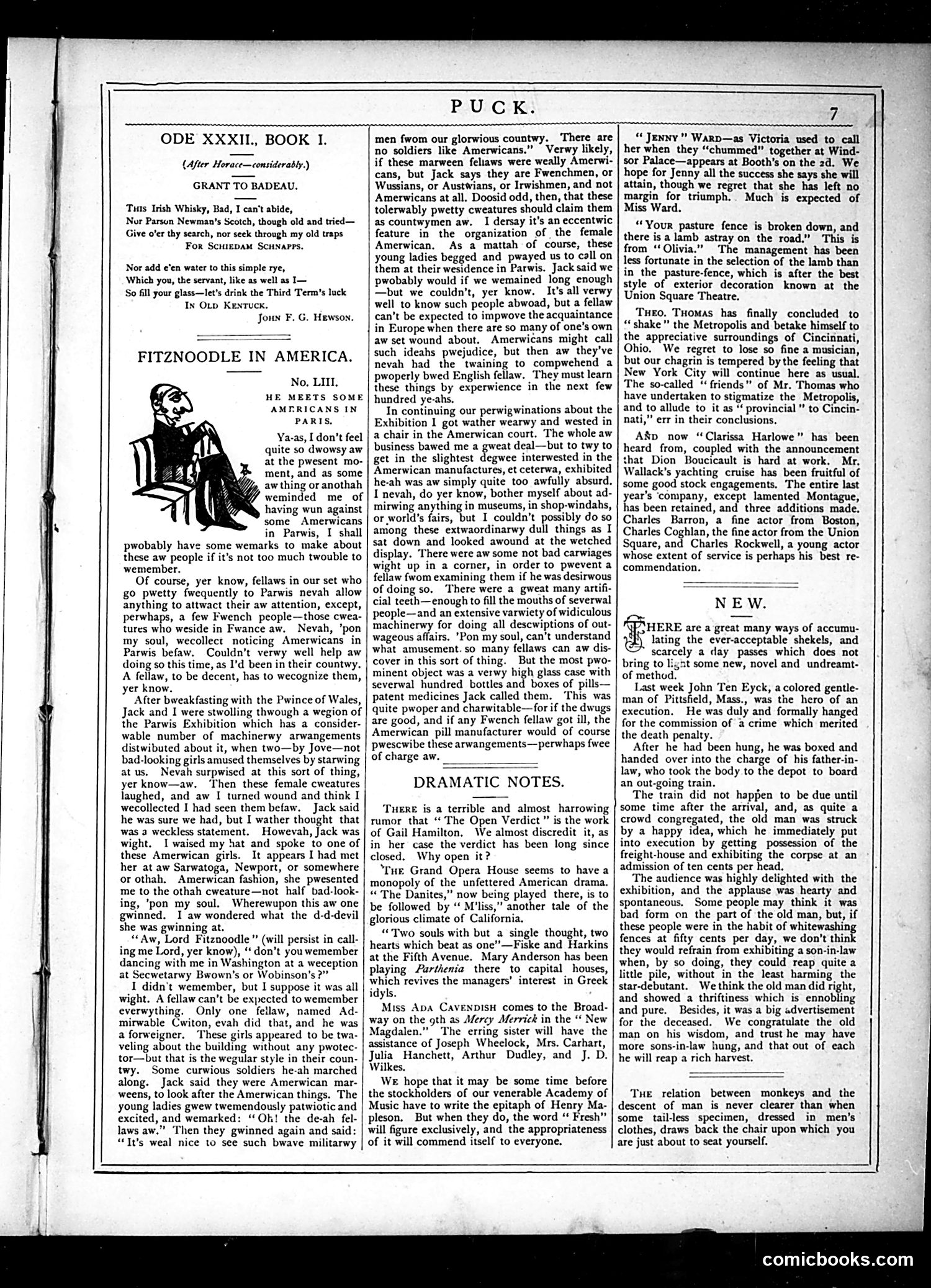
What you’re looking at
This page from Puck contains three distinct sections: 1. **"Ode XXXII, Book I"** - A poem by F.G. Hewson mocking Irish whiskey and Scottish characteristics. 2. **"Fitznoodle in America, No. LIII"** - A satirical essay with an illustration showing a man seated. The piece ridicules American attitudes toward European culture and art. The narrator, apparently an American visiting Paris, describes encountering pretentious Americans at museums and exhibitions who make uninformed judgments about European artistic traditions. The satire targets American cultural smugness and ignorance of Old World sophistication. 3. **"Dramatic Notes"** and **"New"** sections - Brief commentary on theatrical productions and social observations, including remarks about monkey behavior. The overall theme mocks American cultural pretension and provincialism.
📄 Transcribed text from this page (OCR, searchable)
Machine-transcribed from the original scan — historical spelling and the odd misread are preserved.
PUCK. ODE XXXII, BOOK I. (After Horace—considerably.) GRANT TO BADEAU. Tins Irish Whisky, Bad, I can't abide, Nor Parson Newman’s Scotch, though old and tried— Give o'er thy search, nor seek through my old traps For Scutepam ScHNAPrS. Nor add e'en water to this simple rye, Which you, the servant, like as well as I— So fill your glass—let’s drink the Third Term’s luck Ix Otp Kentuck. Joun F. G. Hewson. FITZNOODLE IN AMERICA. No, LIII. HE MEETS SOME AMERICANS IN PARIS, Ya-as, I don’t feel quite so dwowsy aw at the pwesent mo- ment, and as some aw thing or anothah weminded me of having wun against some Amerwicans in Parwis, I shall pwobably have some wemarks to make about these aw people if it’s not too much twouble to wemember. Of course, yer know, fellaws in our set who go pwetty fwequently to Parwis nevah allow anything to attwact their aw attention, except, perwhaps, a few Fwench people—those cwea- tures who weside in Fwance aw. Nevah, ’pon my soul, wecollect noticing Amerwicans in Parwis befaw. Couldn't verwy well help aw doing so this time, as I'd been in their countwy. A fellaw, to be decent, has to wecognize them, yer know. After bweakfasting with the Pwince of Wales, Jack and I were stwolling thwough a wegion of the Parwis Exhibition which has a consider- wable number of machinerwy arwangements distwibuted about it, when two—by Jove—not bad-looking girls amused themselves by starwing atus. Nevah surpwised at this sort of thing, yer know—aw. ‘Then these female cweatures laughed, and aw I turned wound and think I wecollected I had seen them befaw. Jack said he was sure we had, but I wather thought that was a weckless statement. Howevah, Jack was wight. I waised my hat and spoke to one of these Amerwican girls. It appears I had met her at aw Sarwatoga, Newport, or somewhere or othah, Amerwican fashion, she pwesented me to the othah cweature—not half bad-look- ing, ‘pon my soul. Wherewupon this aw one gwinned. I aw wondered what the d-d-devil she was gwinning at. “Aw, Lord Fitznoodle” (will persist in call- ing me Lord, yer know), “don’t you wemember dancing with me in Washington at a weception at Secwetarwy Bwown's or Wobinson's ?” 1 didn’t wemember, but I suppose it was all wight. A fellaw can't be expected to wemember everwything. Only one fellaw, named Ad- mirwable Cwiton, evah did that, and he was a forweigner. ‘These girls appeared to be twa- veling about the building without any pwotec- tor—but that is the wegular style in their coun- twy. Some curwious soldiers he-ah marched along. Jack said they were Amerwican mar- weens, to look after the Amerwican things. The young ladies gwew twemendously patwiotic and excited, and wemarked: “Ok! the de-ah fel- laws aw.”” Then they gwinned again and said: “It’s weal nice to see such bwave militarwy men fwom our glorwious countwy. There are no soldiers like Amerwicans.” Verwy likely, if these marween feliaws were weally Amerwi- cans, but Jack says they are Fwenchmen, or Wussians, or Austwians, or Irwishmen, and not Amerwicans at all. Doosid odd, then, that these tolerwably pwetty cweatures should claim them as countwymen aw. I dersay it’s an eccentwic feature in the organization of the female Amerwican. As a mattah of course, these young ladies begged and pwayed us to call on them at their wesidence in Parwis. Jack said we pwobably would if we wemained long enough —but we couldn't, yer know. It’s all verwy well to know such people abwoad, but a fellaw can’t be expected to impwove the acquaintance in Europe when there are so many of one’s own aw set wound about. Amerwicans might call such ideahs pwejudice, but then aw they've nevah had the twaining to compwehend a pwoperly bwed English fellaw. They must learn these things by experwience in the next few hundred ye-ahs. In continuing our perwigwinations about the Exhibition I got wather wearwy and wested in a chair in the Amerwican court. The whole aw business bawed me a gweat deal—but to twy to get in the slightest degwee interwested in the Amerwican manufactures, et ceterwa, exhibited he-ah was aw simply quite too awfully absurd, I nevah, do yer know, bother myself about ad- mirwing anything in museums, in shop-windahs, or world’s fairs, but I couldn't possibly do so aniong these extwaordinarwy dull things as I sat down and looked awound at the wetched display. ‘There were aw some not bad carwiages wight up in a corner, in order to pwevent a fellaw fwom examining them if he was desirwous of doing so. There were a gweat many artifi- cial teeth—enough to fill the mouths of severwal people—and an extensive varwicty of widiculous machinerwy for doing all descwiptions of out- wageous affairs. ’Pon my soul, can’t understand what amusement. so many fellaws can aw dis- cover in this sort of thing. But the most pwo- minent object was a verwy high glass case with severwal hundred bottles and boxes of pills— patent medicines Jack called them. ‘This was quite pwoper and charwitable—for if the dwugs are good, and if any Fwench fellaw got ill, the Amerwican pill manufacturer would of course pwescwibe these arwangements—perwhaps fwee of charge aw. DRAMATIC NOTES. ‘Tuere is a terrible and almost harrowing rumor that ‘‘ The Open Verdict ” is the work of Gail Hamilton. We almost discredit it, as in her case the verdict has been long since closed. Why open it? ‘Tue Grand Opera House seems to have a monopoly of the unfettered American drama. “The Danites,” now being played there, is to be followed by ‘“ M'liss,” another tale of the glorious climate of California. “Two souls with but a single thought, two hearts which beat as one’—Fiske and Harkins at the Fifth Avenue. Mary Anderson has been playing Parthenia there to capital houses, which revives the managers’ interest in Greek idyls. Miss Apa CAVENDISH comes to the Broad- way on the gth as Mercy Merrick in the “ New Magdalen.” The erring sister will have the assistance of Joseph Wheelock, Mrs. Carhart, Julia Hanchett, Arthur Dudley, and J. D. Wilkes. We hope that it may be some time before the stockholders of our venerable Academy of Music have to write the epitaph of Henry Ma- pleson. But when they do, the word ‘ Fresh” will figure exclusively, and the appropriateness of it will commend itself to everyone, “ Jenny" Warp—as Victoria used to call her when they ‘‘chummed” together at Wind- sor Palace—appears at Booth’s on the 2d. We hope for Jenny all the success she says she will attain, though we regret that she has left no margin for triumph.. Much is expected of Miss Ward. “Your pasture fence is broken down, and there is a lamb astray on the road.” This is from “Olivia.” The management has been less fortunate in the selection of the lamb than in the pasture-fence, which is after the best style of exterior decoration known at the Union Square Theatre. THEO. THomas has finally concluded to “shake” the Metropolis and betake himself to the appreciative surroundings of Cincinnati, Ohio. We regret to lose so fine a musician, but our chagrin is tempered by the feeling that New York City will continue here as usual. The so-called ‘ friends” of Mr. Thomas who have undertaken to stigmatize the Metropolis, and to allude to it as “‘ provincial ” to Cincin- nati,” err in their conclusions. Ap now “Clarissa Harlowe” has been heard from, coupled with the announcement that Dion Boucicault is hard at work. Mr. Wallack’s yachting cruise has been fruitful of some good stock engagements. The entire last year’s ‘company, except lamented Montague, has been retained, and three additions made. Charles Barron, a fine actor from Boston, Charles Coghlan, the fine actor from the Union Square, and Charles Rockwell, a young actor whose extent of service is perhaps his best re- commendation. NEW. APuere are a great many ways of accumu- rey lating the ever-acceptable shekels, and <* scarcely a day passes which does not bring to lignt some new, novel and undreamt- of method. Last week John Ten Eyck, a colored gentle- man of Pittsfield, Mass., was the hero of an execution. He was duly and formally hanged for the commission of a crime which merited the death penalty. After he had been hung, he was boxed and handed over into the charge of his father-in- law, who took the body to the depot to board an out-going train. The train did not happen to be due until some time after the arrival, and, as quite a crowd congregated, the old man was struck by a happy idea, which he immediately put into execution by getting possession of the freight-house and exhibiting the corpse at an admission of ten cents per head. The audience was highly delighted with the exhibition, and the applause was hearty and spontaneous. Some people may think it was bad form on the part of the old man, but, if these people were in the habit of whitewashin, fences at fifty cents per day, we don’t think they would refrain from exhibiting a son-in-law when, by so doing, they could reap quite a little pile, without in the least harming the star-debutant. We think the old man did right, and showed a thriftiness which is ennobling and pure. Besides, it was a big advertisement for the deceased. We congratulate the old man on his wisdom, and trust he may have more sons-in-law hung, and that out of each he will reap a rich harvest. Tue relation between monkeys and the descent of man is never clearer than when some tail-less specimen, dressed in men’s clothes, draws back the chair upon which you are just about to seat yourself. comicbooks.com