
Puck, 1878-09-04 · page 4 of 17
Puck — September 4, 1878 — page 4: what you’re looking at
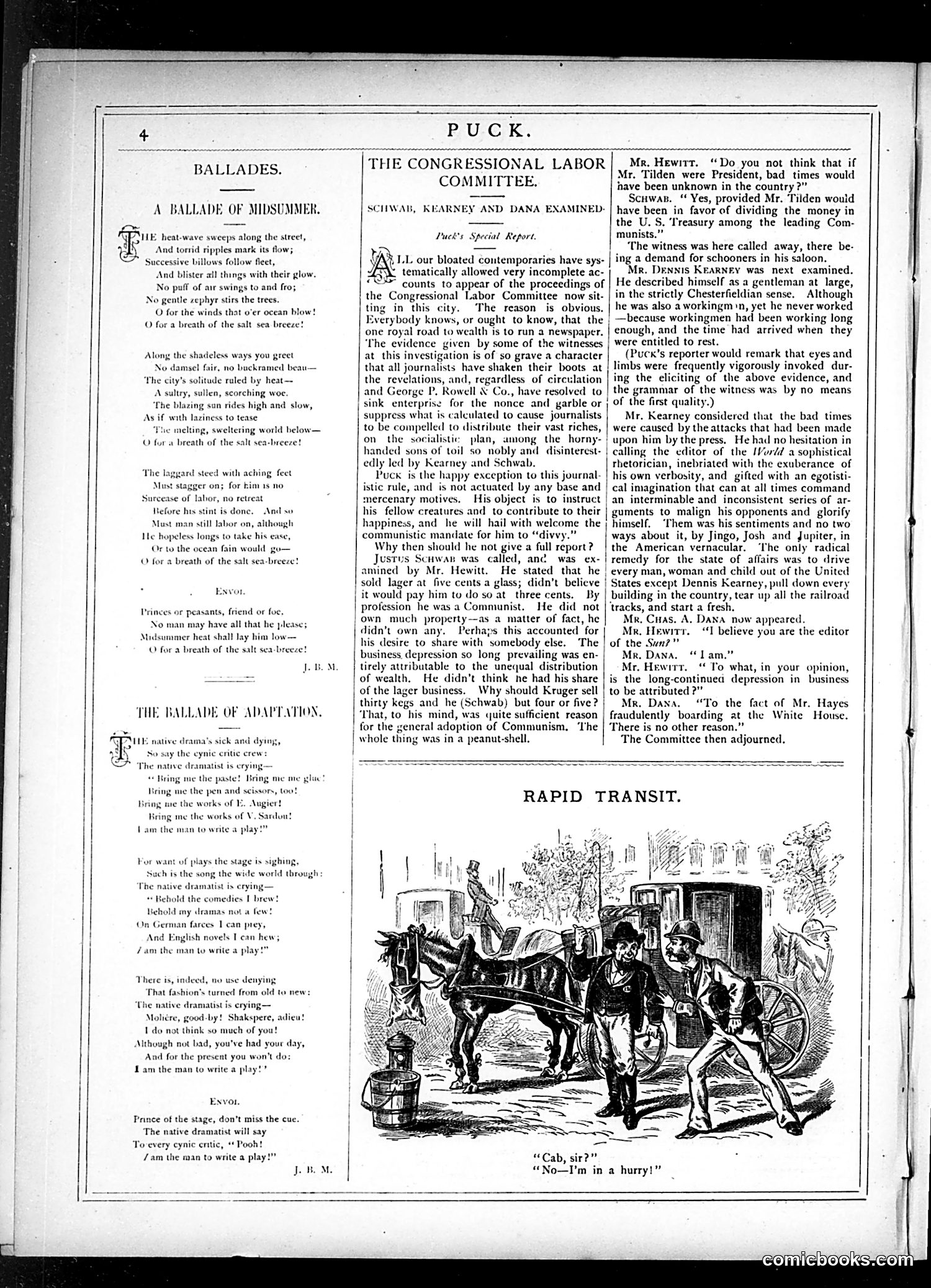
What you’re looking at
This cartoon satirizes late 19th-century urban transportation inefficiency. The illustration shows a cab driver whipping a horse while a dog pulls the carriage wheel—a visual joke about the chaotic state of city transit before modern systems. The dialogue ("Cab, sir?" / "No—I'm in a hurry!") reinforces the absurdity: a potential passenger refuses the cab *because* they're in a hurry, implying horse-drawn cabs were notoriously slow and unreliable. The cartoon mocks the irony of cities claiming to offer "rapid transit" while still relying on animal-powered vehicles. This likely references contemporary debates over modernizing city transportation, contrasting old methods with emerging technologies like electric streetcars that Puck's audience would recognize as genuinely fast alternatives.
📄 Transcribed text from this page (OCR, searchable)
Machine-transcribed from the original scan — historical spelling and the odd misread are preserved.
BALLADES. A BALLADE OF MIDSUMMER, Yo HE heatwave sweeps along the street, aff) nd torrid ripples mark its flow; SD successive billows follow feet, And blister all things with their glow. No puff of arr swings to and fro; gentle zephyr stirs the trees. O for the winds that o'er ocean blow! O for a breath of the salt sea breeze! Along the shadeless ways you greet No damsel fair, no buckramed beau— ‘The city’s solitude ruled by heat—~ A sultry, sullen, scorching woe. ‘The blazing sun rides high and slow, As if with laziness to tease ‘The melting, sweltering world a breath of the salt sea- ard steed with aching feet Must stagger on; for kim 1s no Surcease of labor, no retreat Nefore his stint is done. And sw Must man still labor on, althoug! Ie hopeless longs to take his ease, Or to the ocean fain would © for a breath of the salt sea-br Exvor. Princes of peasants, friend or foc No man may have all that he please; Midsummer heat shall Jay him low— © for a breath of the salt sea-b THE BALLADE OF ADAPTATION en a ative deama’s sick and dy » sy the eynic eritie crew native dramatist is erying— Kring me the paste! Bring me me glic d scissors, tou! Augier V. Sard Kring me the per Bring me tt ¥ Kring me the we he man to write a play!” ¢ of plays the stage is sighing, s the song the wide world thro Kehold the come: chold my «dramas On German farces I can prey, And English novels T ean hew; Zam the man to write a play There is, indeed, no use denying That fashion’s turned from old to new: The native dramatist is erying— Moliére, good-by! Shakspere, adie I do not think so much of you! Nithough not bad, you've had your day, And for the present you w lo: Lam the man to write a play! Eyyot. Prince of the stage, don't miss the cue. The native dramatist will say To-every cynic eric, “Pooh! Zam the man to write a play!”* PUCK. THE CONGRESSIONAL LABOR COMMITTEE, SCHWAB, KEARNEY AND DANA EXAMID Puck's Special Report. Au. our bloated contemporaries have sys- | AX tematically allowed very incomplete ac- «<" counts to appear of the proceedings of the Congressional Labor Committee now sit- ting in this city. The reason is obvious, Everybody knows, or ought to know, that the one royal road to wealth is to run a newspaper. ‘The evidence given by some of the witnesses at this investigation is of so grave a character that all journalists have shaken their boots at | the revelations, and, regardless of circulation and George P. Rowell & Co., have resolved to sink enterprise for the nonce and garble or suppress what is calculated to cause journalists to be compelled to distribute their vast riches, on the socialistic plan, among the horn handed sons of toil so nobly and disinterest- | edly led by Kearney and Schwab. Puck is the happy exception to this journal istic rule, and is not actuated by any base and ercenary motives. His object is to instruct his fellow creatures and to contribute to their happiness, and he will hail with welcome the | communistic mandate for him to “divvy.” Why then should he not give a full report? Justus Scuwan was called, anc was ex- amined by Mr. Hewitt. He stated that he | sold lager at five cents a glass; didn’t believe | it would pay him to do so at three cents. By profession he was a Communist. He did not | own much property—as a matter of fact, he | didn’t own any. Perhaps this accounted ‘for his desire to share with somebody else. The business depression so long. prevailing was en- | tirely attributable to the unequal distribution | of wealth, He didn’t think he had his share | of the lager business. Why should Kruger sell thirty kegs and he (Schwab) but four or five? | ‘That, to his mind, was quite sufficient reason for the general adoption of Communism, ‘The whole thing was in a peanut-shell, Mr. Hewitt. ‘Do you not think that if Mr. Tilden were President, bad times would have been unknown in the country ?” Scuwas. ‘ Yes, provided Mr. Tilden would have been in favor of dividing the money in the U.S, ‘Treasury among the leading Com- munists.”” ‘The witness was here called away, there be- ing a demand for schooners in his saloon. Mr. Dennis Kearney was next examined. He described himself as a gentleman at large, in the strictly Chesterfieldian sense. Although he was also a workingm in, yet he never worked —because workingmen had been working long enough, and the time had arrived when they were entitled to rest. (Puck's reporter would remark that eyes and limbs were frequently vigorously invoked dur- ing the eliciting of the above evidence, and the grammar of the witness was by no means of the first quality.) Mr. Kearney considered that the bad times were caused by the attacks that had been made upon him by the press, He had no hesitation in calling the editor of the Moerdd a sophistical rhetorician, inebriated with the exuberance of his own verbosity, and gifted with an egotisti- cal imagination that can at all times command an interminable and inconsistent series of ar- guments to malign his opponents and glorify himself. ‘Them was his sentiments and no two ways about it, by Jingo, Josh and Jupiter, in the American vernacular. ‘he only radical | i remedy for the state of affairs was to drive every man, woman and child out of the United States except Dennis Kearney, pull down every building in the country, tear up all the railroad ‘tracks, and start a fresh, Mr. Cus. A. DANA now appeared. Mr. Hewirr. “I believe you are the editor of the Sun?” Mr. Dana. “1am.” Mr. Hewrrr. “To what, in your opinion, is the long-continuea depression in business to be attributed ?” Mr. Dana. “To the fact of Mr. Hayes fraudulently boarding at the White House. There is no other reason,” The Committee then adjourned. RAPID TRANSIT. “Cab, sir?” Yo—I'm in a hurry!”