
Puck, 1878-09-04 · page 12 of 17
Puck — September 4, 1878 — page 12: what you’re looking at
What you’re looking at
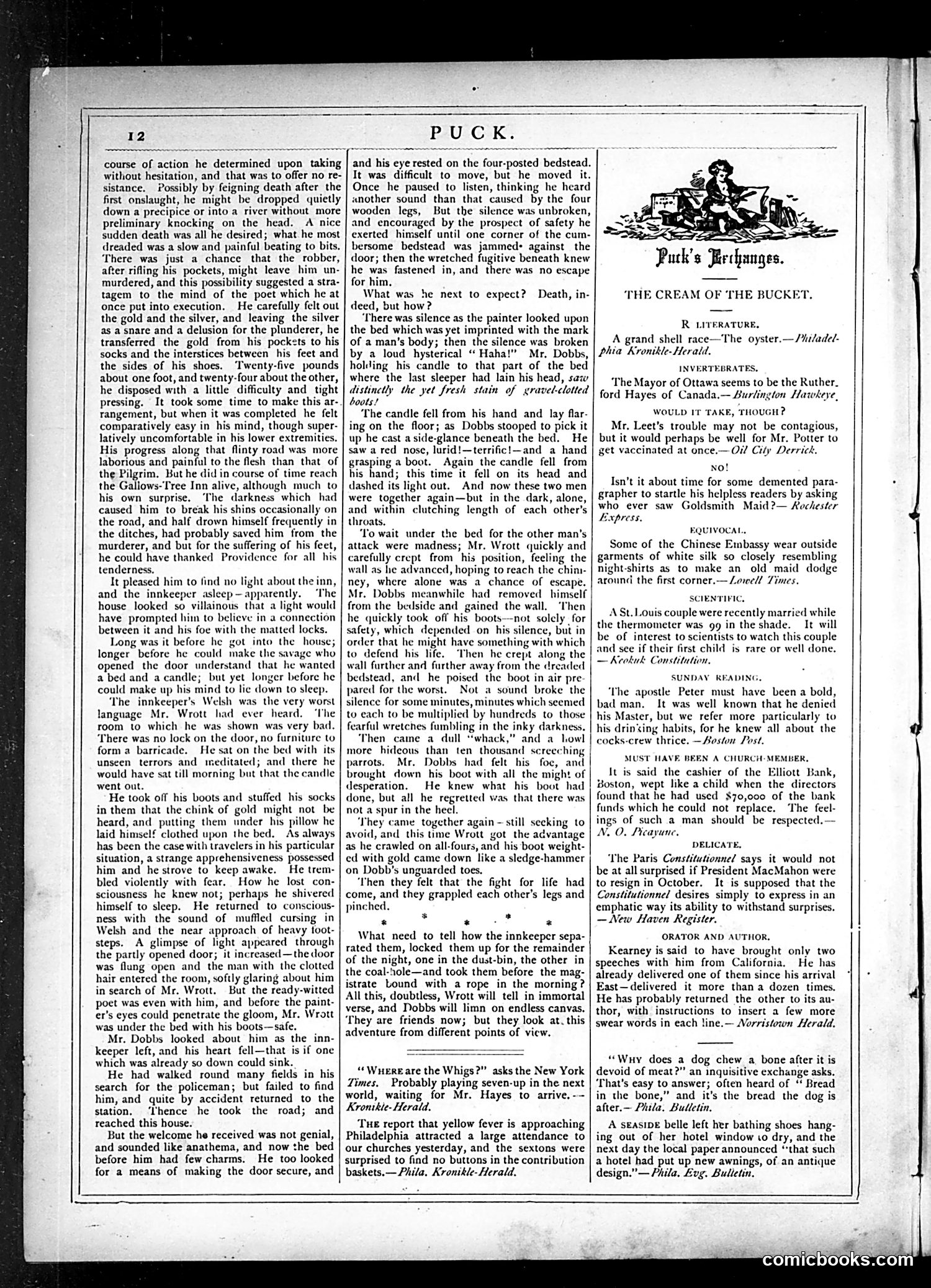
This page is primarily **text content** rather than a cartoon. It contains a serialized story titled "Puck's Perranges" (likely a fiction installment), along with a section called "Literature" featuring brief satirical items and commentary. The visible content includes: - A narrative about characters named Mr. Dobbs and Mr. Wrot engaged in some kind of theft or crime involving gold and silver - Several short satirical quips about contemporary topics: a demented prophet mocking Goldsmith Mandt, a reference to Chinese Embassy officials wearing silk, commentary on President MacMahon, and social observations about dogs, church members, and fashion **The actual editorial cartoons are not visible on this page**—only text-based satire and humor typical of Puck magazine's miscellaneous commentary sections.
📄 Transcribed text from this page (OCR, searchable)
Machine-transcribed from the original scan — historical spelling and the odd misread are preserved.
12 course of action he determined upon taking without hesitation, and that was to offer no re- sistance. Possibly by feigning death after the first onslaught, he might be dropped quietly down a precipice or into a river without more preliminary knocking on the head. A nice sudden death was all he desired; what he most dreaded was a slow and painful beating to bits. ‘There was just a chance that the robber, after rifling his pockets, might leave him un- murdered, and this possibility suggested a stra- tagem to the mind of the poet which he at once put into execution. He carefully felt out the gold and the silver, and leaving the silver as a snare and a delusion for the plunderer, he transferred the gold from his pockets to his socks and the interstices between his feet and the sides of his shoes. ‘Twenty-five pounds about one foot, and twenty-four about the other, he disposed with a little difficulty and tight pressing. It took some time to make this ar- rangement, but when it was completed he felt comparatively easy in his mind, though super- latively uncomfortable in his lower extremities. His progress along that flinty road was more laborious and painful to the flesh than that of the Pilgrim. But he did in course of time reach the Gallows-Tree Inn alive, although much to his own surprise. ‘The darkness which had caused him to break his shins occasionally on the road, and half drown himself frequently in the ditches, had probably saved him from the murderer, and but for the suffering of his feet, he could have thanked Providence for all his tenderness. It pleased him to find no light about the inn, and the innkeeper asleep—apparently. ‘The house looked so villainous that a light would have prompted him to believe in a connection between it and his foe with the matted locks. Long was it before he got into the house; longer before he could make the savage who opened the door understand that he wanted a bed and acandle; but yet longer before he could make up his mind to lie down to sleep. The innkeeper’s Welsh was the very worst language Mr. Wrott had ever heard. ‘The room to which he was shown was very bad. ‘There was no lock on the door, no furniture to form a barricade. He sat on the bed with its unseen terrors and meditated; and there he would have sat till morning but that the candle went out. He took off his boots and stuffed his socks in them that the chink of gold might not be heard, and putting them under his pillow he laid himself clothed upon the bed, As always has been the case with travelers in his particular situation, a strange apprehensiveness possessed him and he strove to keep awake. He trem- bled violently with fear. How he lost con- sciousness he knew not; perhaps he shivered himself to sleep. He returned to conscious- ness with the sound of muffled cursing in Welsh and the near approach of heavy toot- steps. A glimpse of light appeared through the partly opened door; it increased —the door was flung open and the man with the clotted hair entered the room, softly glaring about him in search of Mr. Wrott. But the ready-witted poet was even with him, and before the paint- er’s eyes could penetrate the gloom, Mr. Wrott was under the bed with his boots—safe. Mr. Dobbs looked about him as the inn- keeper left, and his heart fell—that is if one which was already so down could sink. He had walked round many fields in his search for the policeman; but failed to find him, and quite by accident returned to the station, ‘Thence he took the road; and reached this house. But the welcome he received was not genial, and sounded like anathema, and now the bed before him had few charms. He too looked for a means of making the door secure, and and his eye rested on the four-posted bedstead. It was difficult to move, but he moved it. Once he paused to listen, thinking he heard another sound than that caused by the four wooden legs, But the silence was unbroken, and encouraged by the prospect of safety he exerted himself until one corner of the cum- bersome bedstead was jammed against the door; then the wretched fugitive beneath knew he was fastened in, and there was no escape for him, What was he next to expect? deed, but how? ‘There was silence as the painter looked upon the bed which was yet imprinted with the mark of a man’s body; then the silence was broken by a loud hysterical “ Haha!” Mr, Dobbs, holding his candle to that part of the bed where the last sleeper had lain his head, saw distinctly the yet fresh stain of gravel-clotted boots! ‘The candle fell from his hand and lay flar- ing on the floor; as Dobbs stooped to pick it up he cast aside-glance beneath the bed. He saw a red nose, lurid!—terrific!—and a hand grasping a boot. Again the candle fell from his hand; this time it fell on its head and dashed its light out. And now these two men were together again—but in the dark, alone, and within clutching length of each other’s throats. ‘Yo wait under the bed for the other man’s attack were madness; Mr. Wrott quickly and carefully crept from his position, feeling the wall as he advanced, hoping to reach the chint- ney, where alone was a chance of escape. Mr. Dobbs meanwhile had removed himself from the bedside and gained the wall. ‘Then he quickly took off his boots—not solely for safety, which depended on his silence, but in order that he might have something with which to defend his life. Then he crept along the wall further and further away from the dreaded bedstead, and he poised the boot in air pre. pared for the worst. Not a sound broke the silence for some minutes, minutes which seemed to each to be multiplied by hundreds to those fearful wretches fumbling in the inky darkness. ‘Then came a dull “whack,” and a howl more hideous than ten thousand screeching parrots. Mr. Dobbs had felt his foe, and brought down his boot with all the might of desperation. He knew what his boot had done, but all he regretted was that there was not a spur in the heel. ‘They came together again - still secking to avoid, and this time Wrott got the advantage as he crawled on all-fours, and his boot weight- ed with gold came down like a sledge-hammer on Dobb's unguarded toes. ‘Then they felt that the fight for life had come, and they grappled cach other's legs and pinched. s * * e * What need to tell how the innkeeper sepa- rated them, locked them up for the remainder of the night, one in the dust-bin, the other in the coal-hole—and took them before the mag- istrate Lound with a rope in the morning? All this, doubtless, Wrott will tell in immortal verse, and Dobbs will limn on endless canvas. ‘They are friends now; but they look at. this adventure from different points of view. Death, in- “Where are the Whigs?” asks the New York Times. Probably playing seven-up in the next world, waiting for Mr. Hayes to arrive, -- Krontkie- Herald, ‘Tue report that yellow fever is approaching Philadelphia attracted a large attendance to our churches yesterday, and the sextons were surprised to find no buttons in the contribution baskets.— Phila, Krontkle- Herald. ‘THE CREAM OF THE BUCKET. R LITERATURE, A grand shell race—The oyster.—/%iladel- phia Kronikle-Herald. INVERTEBRAT! ‘The Mayor of Ottawa seems to be the Ruther. ford Hayes of Canada.— Burlington Hawkeye, WOULD IT TAKE, THOUGH? Mr. Leet’s trouble may not be contagious, but it would perhaps be well for Mr. Potter to get vaccinated at once.— Oil City Derrick. No! Isn't it about time for some demented para- grapher to startle his helpless readers by asking who ever saw Goldsmith Maid?— Rochester Express. VOCAL. Some of the Chinese Embassy wear outside garments of white silk so closely resembling night-shirts as to make an old maid dodge around the first corner.— Lowell Times. SCIENTIFIC, A St. Louis couple were recently married while the thermometer was 99 in the shade. It will be of interest to scientists to watch this couple and see if their first child is rare or well done. — Keokuk Constitution, SUNDAY READING. ‘The apostle Peter must have been a bold, bad man, It was well known that he denied his Master, but we refer more particularly to his drin<ing habits, for he knew all about the cocks-crew thrice. —Boston Post. MUST HAVE BEEN A CHURCH: MEMBER, It is said the cashier of the Elliott Bank, Boston, wept like a child when the directors found that he had used $70,000 of the bank funds which he could not replace. The feel- ings of such a man should be respected. — A. O. Picayune. DELICATE, ‘The Paris Constitutionnel says it would not be at all surprised if President MacMahon were to resign in October. It is supposed that the Constitutionnel desires simply to express in an emphatic way its ability to withstand surprises. —New Haven Register. ORATOR AND AUTHOR, Kearney is said to have brought only two speeches with him from California. H already delivered one of them since his arrival East—delivered it more than a dozen times. He has probably returned the other to its au- thor, with instructions to insert a few more swear words in each line.— Norristown Herald. ““Wuy does a dog chew a bone after it is devoid of meat?” an inquisitive exchange asks, ‘That's easy to answer; often heard of “ Bread in the bone,” and it's the bread the dog is after.— Phila, Bulletin. A SEASIDE belle left her bathing shoes hang- ing out of her hotel window io dry, and the next day the local paper announced “that such a hotel had put up new awnings, of an antique design.” — Phila, Evg. Bulletin.