
Puck, 1878-09-04 · page 6 of 17
Puck — September 4, 1878 — page 6: what you’re looking at
What you’re looking at
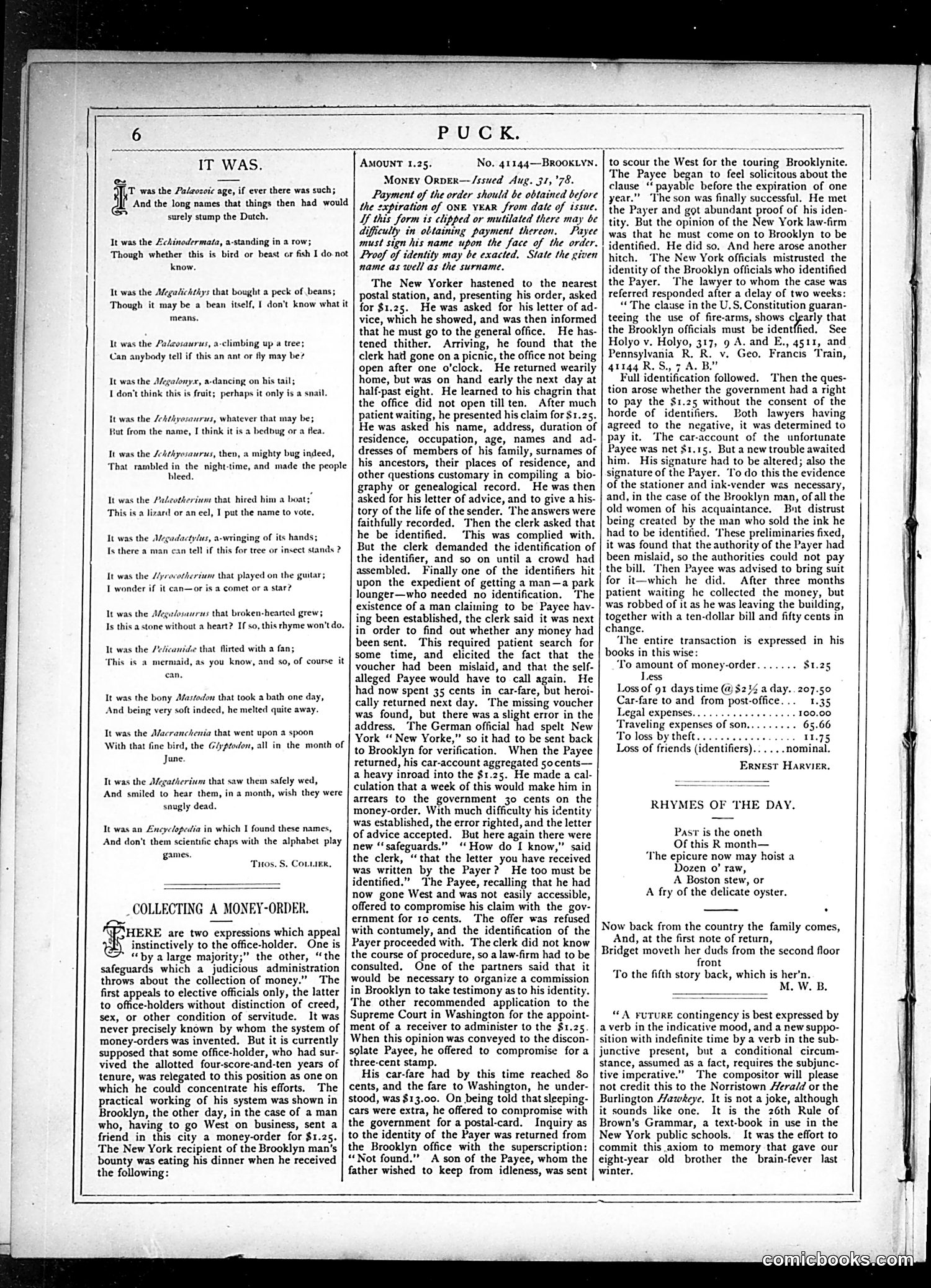
This page contains primarily **text content** rather than political cartoons. The main article, "Collecting a Money-Order," is a humorous essay about the bureaucratic frustrations of obtaining a money order from the post office. The piece satirizes **government inefficiency and red tape**—a recurring Puck theme. It describes an unnamed man's absurd ordeal trying to collect a $1.25 money order, involving repeated visits, identity verification demands, lost vouchers, and clerical errors. The narrative mocks both the postal system's incompetence and its excessive procedural safeguards. The page also includes "Rhymes of the Day" (light verse) and a brief grammar note. The satire targets institutional bureaucracy rather than specific political figures.
📄 Transcribed text from this page (OCR, searchable)
Machine-transcribed from the original scan — historical spelling and the odd misread are preserved.
IT WAS. ir, was the Palzozoic age, if ever there was such} ‘And the long names that things then had would surely stump the Dutch. It was the Echinodermata, a-standing in a row; ‘Though whether this is bird or beast or fish I donot know. It was the Megulichthys that bought a peck of beans; Though it may be a bean itself, I don’t know what it means. It was the Paleosaurus, a-climbing up @ tree; Can anybody tell if this an ant or fly may be? It was the Afegalonyx, a-dancing on his tail; I don't think this is fruit; perhaps it only is a snail. Itwas the /chthyosaurus, whatever that may be; Hut from the name, I think it is a bedbug or a flea. It was the Schthyosaurus, then, a mighty bug indeed, That rambled in the night-time, and made the people bleed. It was the /edeotherium that hired him a boat;” This is a lizard or an eel, I put the name to vote, It was the Aegudactylus, a-wringing of its hand: -an tell if this for tree or insect stands ? Is there a man It was the Hyrocotherium that played on the guitar; I wonder if it can—or is a comet or a star? It was the A©egit/osaurns that broken-hearted grew; Is this a stone without a heart? If so, this rhyme won't do. It was the /elicanidee that flirted with a fan; J, as you know, and so, of course it ‘This is a merm: can, It was the bony Mastodon that took a bath one day, And being very soft indeed, he melted quite away. It was the Macranchenia that went upon a spoon With that fine bird, the Glyptodon, all in the month of June. Tt was the Megatherium that saw them safely wed, ‘And smiled to hear them, ina month, wish they were snugly dead. It was an Encyclopedia in which I found these names, And don't them scientific chaps with the alphabet play games. ‘Tuos. S, CoLtier, _COLLECTING A MONEY-ORDER. 'HERE are two expressions which appeal instinctively to the office-holder. One is “by a large majority;” the other, “the safeguards which a judicious administration throws about the collection of money.” The first appeals to elective officials only, the latter to office-holders without distinction of creed, sex, or other condition of servitude. It was never precisely known by whom the system of money-orders was invented. But it is currently supposed that some office-holder, who had sur- vived the allotted four-score-and-ten years of tenure, was relegated to this position as one on which he could concentrate his efforts. The practical working of his system was shown in Brooklyn, the other day, in the case of a man who, having to go West on business, sent a friend in this city a money-order for $1.25. ‘The New York recipient of the Brooklyn man’s bounty was eating his dinner when he received the following: No. 41144—BROOKLYN. AMOUNT 1.25. Money Orper—/ssued Aug. 31,'78. Payment of the order should be obtained before the expiration of ONE YEAR from date of issue. Uf this form is clipped or mutilated there may be difficully in obtaining payment thereon, Payee must sign his name upon the face of the order. Proof of identity may be exacted, State the given name as well as the surname. The New Yorker hastened to the nearest postal station, and, presenting his order, asked for $1.25. He was asked for his letter of ad- vice, which he showed, and was then informed that he must go to the general office. He has- tened thither, Arriving, he found that the clerk hatl gone on a picnic, the office not being open after one o'clock. He returned wearily home, but was on hand early the next day at half-past eight. He learned to his chagrin that the office did not open till ten. After much patient waiting, he presented his claim for $1.25. He was asked his name, address, duration of residence, occupation, age, names and ad- dresses of members of his family, surnames of his ancestors, their places of residence, and other questions customary in compiling a bio- graphy or genealogical record. He was then asked for his letter of advice, and to give a his- tory of the life of the sender, ‘The answers were faithfully recorded. Then the clerk asked that he be identified. This was complied with, But the clerk demanded the identification of the identifier, and so on until a crowd had assembled. Finally one of the identifiers hit upon the expedient of getting a man—a park lounger—who needed no identification. The existence of a man claiming to be Payee hav- ing been established, the clerk said it was next in order to find out whether any nioney had been sent. This required patient search for some time, and elicited the fact that the voucher had been mislaid, and that the self- alleged Payee would have to call again. He had now spent 35 cents in car-fare, but heroi- cally returned next day. ‘The missing voucher was found, but there was a slight error in the address, ‘The German official had spelt New York ‘New Yorke,” so it had to be sent back to Brooklyn for verification. When the Payee returned, his car-account aggregated socents— a heavy inroad into the $1.25. He made a cal- culation that a week of this would make him in arrears to the government 30 cents on the money-order. With much difficulty his identity was established, the error righted, and the letter of advice accepted. But here again there were new “safeguards.” ‘How do I know,” said the clerk, “that the letter you have received was written by the Payer? He too must be identified.” The Payee, recalling that he had now gone West and was not easily accessible, offered to compromise his claim with the gov- ernment for ro cents. The offer was refused with contumely, and the identification of the Payer proceeded with. The clerk did not know the course of procedure, so a law-firm had to be consulted, One of the partners said that it would be necessary to organize a commission in Brooklyn to take testimony as to his identity. ‘The other recommended application to the Supreme Court in Washington for the appoint- ment of a receiver to administer to the $1.25. When this opinion was conveyed to the discon- solate Payee, he offered to compromise for a three-cent stamp. His car-fare had by this time reached 80 cents, and the fare to Washington, he under- stood, was $13.00. On being told that sleeping- cars were extra, he offered to compromise with the government for a postal-card. Inquiry as to the identity of the Payer was returned from the Brooklyn office with the superscription: “Not found.” A son of the Payee, whom the father wished to keep from idleness, was sent to scour the West for the touring Brooklynite. The Payee began to feel solicitous about the clause ‘payable before the expiration of one year.” ‘The son was finally successful. He met the Payer and got abundant proof of his iden- tity. But the opinion of the New York law-firm was that he must come on to Brooklyn to be identified. He did so. And here arose another hitch. The New York officials mistrusted the identity of the Brooklyn officials who identified the Payer. The lawyer to whom the case was referred responded after a delay of two weeks: “The clause in the U.S, Constitution guaran- teeing the use of fire-arms, shows clearly that the Brooklyn officials must be identffied. See Holyo v. Holyo, 317, 9 A. and E., 4511, and Pennsylvania R, R. v. Geo, Francis Train, 41144 R.S., 7 A. B.” Full identification followed. Then the ques- tion arose whether the government had a right to pay the $1.25 without the consent of the horde of identifiers. Both lawyers having agreed to the negative, it was determined to pay it. The car-account of the unfortunate Payee was net $1.15. Buta new trouble awaited him. His signature had to be altered; also the signature of the Payer. ‘To do this the evidence of the stationer and ink-vender was necessary, and, in the case of the Brooklyn man, ofall the old women of his acquaintance. But distrust being created by the man who sold the ink he had to be identified. ‘These preliminaries fixed, it was found that the authority of the Payer had been mislaid, so the authorities could not pay the bill. Then Payee was advised to bring suit for it—which he did. After three months patient waiting he collected the money, but was robbed of it as he was leaving the building, together with a ten-dollar bill and fifty cents in change. ‘The entire transaction is expressed in his books in this wis ‘To amount of money-order....... Sts Less Loss of 91 days time @ $24 a day.. 207.50 Car-fare to and from post-office... 1.35 Legal expenses. ‘ 100.00 ‘Traveling expenses of son. » 65.66 To loss by theft 11.75 Loss of friends (identifiers) + nominal. Ernest Harvier. RHYMES OF THE DAY. Past is the oneth Of this R month— ‘The epicure now may hoist a Dozen o’ raw, A Boston stew, or A fry of the delicate oyster. Now back from the country the family comes, And, at the first note of return, Bridget moveth her duds from the second floor front To the fifth story back, which is her’n. M. W. B. ‘A FuTURE contingency is best expressed by averb in the indicative mood, and a new suppo- sition with indefinite time by a verb in the sub- junctive present, but a conditional circum- stance, assumed as a fact, requires the subjunc- tive imperative.” The compositor will please not credit this to the Norristown Hera/d or the Burlington Hawkeye, It is not a joke, although it sounds like one. It is the 26th Rule of Brown's Grammar, a text-book in use in the New York public schools. It was the effort to commit this axiom to memory that gave our eight-year old brother the brain-fever last winter,