
Puck, 1878-09-04 · page 5 of 17
Puck — September 4, 1878 — page 5: what you’re looking at
What you’re looking at
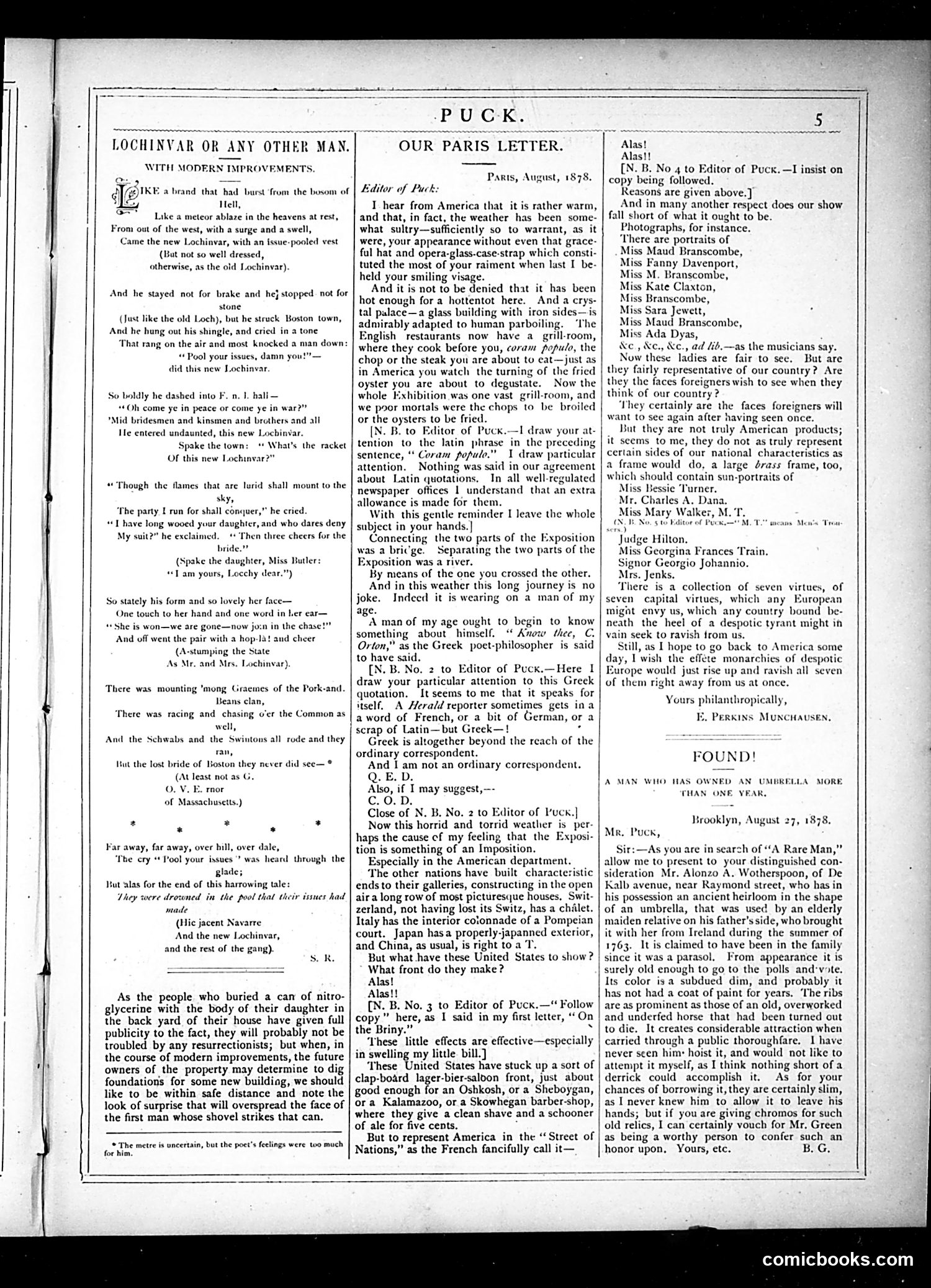
The main cartoon "Lochinvar or Any Other Man" satirizes a romantic figure—likely a contemporary political or social personality—depicted as a vain, well-dressed seducer. The verse mocks his vanity and romantic conquests, comparing him unfavorably to the legendary Lochinvar. The page contains three letters to the editor: "Our Paris Letter" discusses the Paris Exposition and American representation abroad; "Alas! Alas!" criticizes the absence of notable American figures from exhibits; and "Found!" describes a man searching for a rare umbrella in Brooklyn—likely humorous domestic satire rather than political commentary. The humor relies on period-specific social anxieties about American cultural standing versus Europe and personal eccentricity. Without clearer image visibility, specific figure identification remains uncertain.
📄 Transcribed text from this page (OCR, searchable)
Machine-transcribed from the original scan — historical spelling and the odd misread are preserved.
LOCHINVAR OR ANY OTHER MAN. WITH MODERN IMPROVEMENTS. abrand that had burst from the bosom of Hell, Like a meteor ablaze in the heavens at rest, From out of the west, with a surge and a swell, Came the new Lochinvar, with an issue-pooled vest (Bat not so well dressed, otherwise, as the old Lochinvar). And he stayed not for brake and hej stopped. not for stone (Just like the old Loch), but he struck Boston town, And he hung out his shingle, and cried in a tone ‘That rang on the air and most knocked a man down: « Pool your issues, damn yo did this new Lochinvar. boldly he dashed into F. n. 1. hali— “Oh come ye in peace or come ye in war?” *Mid bridesmen and kinsmen and brothers and all Ie entered undaunted, this new Lochinvar. Spake the town: What’s the racket Of this new Lochinvar?" “Though the flames that are lurid shall mount to the sky, ‘The party I run for shall conquer,” he cried. “ Thave long wooed your daughter, and who dares deny Phen three cheers for the My suit?” he exclaimed. Spake the daughter, Miss Butler: P ig! “Tam yours, Locchy dear.”) So stately his form and so lovely her face— One touch to her hand and one word in her ear— “She is won—we are gone—now jo:n in the chase!” nd cheer And off went the pair with a hop: (A-stumping the State As Mr. and Mrs, Lochinvar). There was mounting ’mong Gracies of the Pork-and. Beans clan, ‘There was racing and chasing o'er the Common as well, And the Schwabs and the Swintons all rode and they ran, Mhut the lost bride of Boston they never did see— ® (At least not as G. O. V. E. ror of Massachusetts.) * * ’ * * Far away, far away, over hill, over dale, ‘The cry * ool your issues? was heard through the glade; ut alas for the end of this harrowing tale: Vhey were drowned in the pool that their issues had made (ic jacent Navarre And the new Lochinvar, and the rest of the g As the people who buried a cam of nitro- glycerine with the body of their daughter in the back yard of their house have given full publicity to the fact, they will probably not be troubled by any resurrectionists; but when, in the course of modern improvements, the future owners of the property may determine to dig foundations for some new building, we should like to be within safe distance and note the look of surprise that will overspread the face of the first man whose shovel strikes that can. * The metre is uncertain, but the poet’s feelings were too much for him. OUR PARIS LETTER. Paris, August, 1878. Editor of Pack: 1 hear from America that it is rather warm, and that, in fact, the weather has been some- what sultry—sufficiently so to warrant, as it were, your appearance without even that grace- ful hat and opera-glass-case-strap which consti- tuted the most of your raiment when last I be- held your smiling visage. And it is not to be denied that it has been hot enough for a hottentot here. And a crys- tal palace—a glass building with iron sides— is admirably adapted to human parboiling. ‘The glish restaurants now have a_grill-room, where they cook before you, coram populo, the chop or the steak you are about to cat—just as in America you watch the turning of the fried oyster you are about to degustate. Now the whole Exhibition was one vast grill-room, and we poor mortals were the chops to be broiled or the oysters to be fried. [N. B. to Editor of Puck.—I draw your at- tention to the latin phrase in the preceding sentence, Coram popule.”” 1 draw particular attention. Nothing was said in our agreement about Latin quotations. In all well-regulated newspaper offices 1 understand that an extra allowance is made for them. With this gentle reminder I leave the whole subject in your hands.] Connecting the two parts of the Exposition vas a bricge. Separating the two parts of the position was a river. By means of the one you crossed the other, And in this weather this long journey is no joke. Indeed it is wearing on a man of my age. A man of my age ought to begin to know something about himself. “ Anow thee, C. Orton,” as the Greek poct-philosopher is said to have said. [N. B. No. 2 to Editor of Puck.—Here | draw your particular attention to this Greek quotation, It seems to me that it speaks for itself. A Herald reporter sometimes gets in a aword of French, or a bit of German, or a scrap of Latin—but Greek—! . Greek is altogether beyond the reach of the ordinary correspondent. And I am not an ordinary correspondent. Q. E. D. Also, if I may suggest,—- B. No. 2 to Editor of Vuck.] Now this horrid and torrid weather is per- haps the cause cf my feeling that the Exposi- tion is something of an Imposition. Especially in the American department. ‘The other nations have built characteristic ends to their galleries, constructing in the open aira long row of most picturesque houses, Swit- zerland, not having lost its Switz, has a chilet. Italy has the interior cotonnade of a Pompeian court. Japan hasa properly-japanned exterior, and China, as usual, is right to a T. But what have these United States to show? What front do they make ? Alas! Alas!! (N. B. No. 3 to itor of Puck.—‘ Follow copy” here, as I said in my first letter, “On the Briny.”” ad ‘These little effects are effective—especially in swelling my little. bill.) ‘These United States have stuck up a sort of clap-board lager-bier-saloon front, just about good enough for an Oshkosh, or a Sheboygan, ora Kalamazoo, or a Skowhegan barber-shop, where they give a clean shave and a schooner of ale for five cents. ‘ But to represent America in the ‘Street of Nations,” as the French fancifully call it— Alas! Alas!! (N. B. No 4 to Editor of Puck. —I insist on copy being followed. Reasons are given above.] And in many another respect does our show fall short of what it ought to be. Photographs, for instance. ‘There are portraits of Miss Maud Branscombe, Miss Fanny Davenport, Miss M. Branscombe, Miss Kate Claxton, Miss Branscombe, Miss Sara Jewett, Miss Maud Branscombe, Miss Ada Dyas, Xe, Xe, &¢., ad dib,—as the musicians say. Now these ladies are fair to see. But are they fairly representative of our country? Are they the faces foreigners wish to see when they think of our country? ‘They certainly are the faces foreigners will want to see again after having seen once. But they are not truly American products; it seems to me, they do not as truly represent certain sides of our national characteristics as a frame would do, a large érass frame, too, which should contain sun-portraits of | Miss Bessie Turner. Mr. Charles A. Dana. Miss Mary Walk (SEN Judge Hilton. Miss Georgina Frances ‘Train. Signor Georgio Johannio. Mrs. Jenks. | There is a collection of seven virtues, of seven capital virtues, which any European migat envy us, which any country bound be- neath the heel of a despotic tyrant might in vain seek to ravish from us. Still, as I hope to go back to America some day, I wish the efféte monarchies of despotic Europe would just rise up and ravish all seven of them right away from us at once. 5 t0 Editor of Treat Yours philanthropically, E, Perkins MUNCHAUSEN, FOUND! A MAN WHO HAS OWNED AN UMBRELLA MORE. THAN ONE YEAR, Brooklyn, August 27, 1878. Mr. Puck, Sir:—As you are in search of “A Rare Man,” allow me to present to your distinguished con- sideration Mr. Alonzo A. Wotherspoon, of De Kalb avenue, near Raymond street, who has in his possession an ancient heirloom in the shape of an umbrella, that was used by an elderly maiden relative on his father's side, who brought it with her from Ireland during the summer of 1763. It is claimed to have been in the family since it was a parasol, From appearance it is surely old enough to go to the polls and:vote. Its color isa subdued dim, and probably it has not had a coat of paint for years. ‘he ribs are as prominent as those of an old, overworked and underfed horse that had been turned out to die. It creates considerable attraction when arried through a public thoroughfare. 1 have never seen him: hoist it, and would not like to attempt it myself, as I think nothing short of a derrick could accomplish it. As for your chances of borrowing it, they are certainly slim, as I never knew him to allow it to leave his hands; but if you are giving chromos for such old relics, I can certainly vouch for Mr, Green as being a worthy person to confer such an honor upon, Yours, etc. B.G. comicbooks.com