
Puck, 1878-09-04 · page 3 of 17
Puck — September 4, 1878 — page 3: what you’re looking at
What you’re looking at
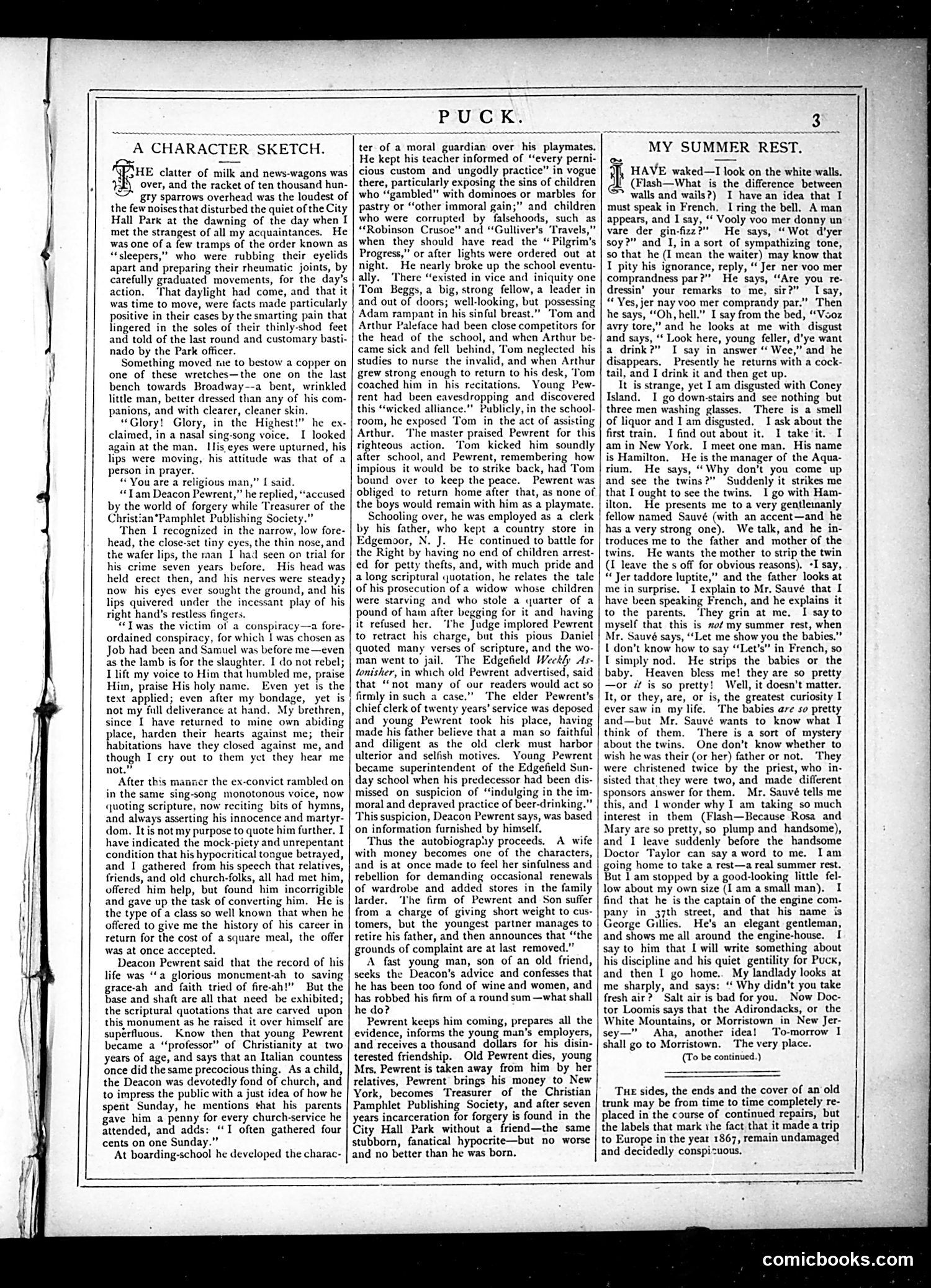
This page contains two separate pieces: a character sketch titled "A Character Sketch" (left column) and an essay titled "My Summer Rest" (right column). **"A Character Sketch"** appears to be a biographical narrative about Deacon Perent, a religious figure involved with the Christian Pamphlet Publishing Society. The text describes his hypocrisy—presenting himself as pious while engaging in dubious financial dealings and moral compromises. It satirizes his self-righteousness and the gap between his public reputation and private conduct. **"My Summer Rest"** is a humorous personal essay about someone's vacation experiences, including their awkward attempts at French and observations about English seaside life. Neither piece contains obvious political commentary or identifiable caricatures requiring historical context to understand the satire.
📄 Transcribed text from this page (OCR, searchable)
Machine-transcribed from the original scan — historical spelling and the odd misread are preserved.
L A CHARACTER SKETCH. AHE clatter of milk and news-wagons was over, and the racket of ten thousand hun- gry sparrows overhead was the loudest of the few noises that disturbed the quiet of the City Hall Park at the dawning of the day when I met the strangest of all my acquaintances. He was one of a few tramps of the order known as “sleepers,” who were rubbing their eyelids apart and preparing their rheumatic joints, by carefully graduated movements, for the day's action, That daylight had come, and that it was time to move, were facts made particularly positive in their cases by the smarting pain that lingered in the soles of their thinly-shod feet and told of the last round and customary basti- nado by the Park officer. Something moved me to bestow a copper on one of these wretches—the one on the last bench towards Broadway--a bent, wrinkled little man, better dressed than any of his com- panions, and with clearer, cleaner skin. “Glory! Glory, in the Highest!” he ex- claimed, in a nasal sing-song voice. I looked again at the man. [lis eyes were upturned, his lips were moving, his attitude was that of a person in prayer. “You are a religious man,” I said. “Tam Deacon Pewrent,” he replied, “accused by the world of forgery while Treasurer of the Christian*Pamphlet Publishing Society.” Then I recognized in the narrow, low fore- head, the close-set tiny cyes, the thin nose, and the wafer lips, the man I had seen on trial for his crime seven years before. His head was held erect then, and his nerves were steady now his eyes ever sought the ground, and his lips quivered under the incessant play of his right hand's restless fingers. “Twas the victim of a conspiracy—a fore- ordained conspiracy, for which | was chosen as Job had been and Samuel was before me—even as the lamb is for the slaughter. I do not rebel; 1 lift my voice to Him that humbled me, praise Him, praise His holy name. Even yet is the text applied; even after my bondage, yet is not my full deliverance at hand. My brethren, since I have returned to mine own abiding place, harden their hearts against me; their habitations have they closed against me, and though I cry out to them yet they hear me not.” After this manner the ex-convict rambled on in the same sing-song monotonous voice, now quoting scripture, now reciting bits of hymns, and always asserting his innocence and martyr- dom. It is not my purpose to quote him further, I have indicated the mock-piety and unrepentant condition that his hypocritical tongue betrayed, and I gathered from his speech that relatives, friends, and old church-folks, all had met him, offered him help, but found him incorrigible and gave up the task of converting him. He is the type of a class so well known that when he offered to give me the history of his career in return for the cost of a square meal, the offer was at once accepted. Deacon Pewrent said that the record of his life was “a glorious monument-ah to saving grace-ah and faith tried of fire-ah!” But the base and shaft are all that need be exhibited; the scriptural quotations that are carved upon this monument as he raised it over himself are superfluous. Know then that young Pewrent became a “professor” of Christianity at two years of age, and says that an Italian countess once did the same precocious thing. As a child, the Deacon was devotedly fond of church, and to impress the public with a just idea of how he spent Sunday, he mentions that his parents gave him a penny for every church-service he attended, and adds: “I often gathered four cents on one Sunday. At boarding-school he developed the charac- PUCK. ter of a moral guardian over his playmates. He kept his teacher informed of “every perni- cious custom and ungodly practice” in vogue there, particularly exposing the sins of children who “gambled” with dominoes or marbles for pastry or “other immoral gain;” and children who were corrupted by falsehoods, such as “Robinson Crusoe” and ‘Gulliver's ‘Travels,” when they should have read the “ Pilgrim's Progress,” or after lights were ordered out at night. He nearly broke up the school eventu- ally. ‘There “existed in vice and iniquity one Tom Beggs, a big, strong fellow, a leader in and out of doors; well-looking, but possessing Adam rampant in his sinful breast.” ‘Tom and Arthur Paleface had been close competitors for the head of the school, and when Arthur be- came sick and fell behind, ‘om neglected his studies to nurse the invalid, and when Arthur grew strong enough to return to his desk, ‘Tom coached him in his recitations. Young Pew- rent had been eavesdropping and discovered this “wicked alliance.” Publicly, in the school- room, he exposed Tom in the act of assisting Arthur. The master praised Pewrent for this righteous action. ‘Tom kicked him soundly after school, and Pewrent, remembering how impious it would be to strike back, had Tom bound over to keep the peace. Pewrent was obliged to return home after that, as none of the boys would remain with him as a playmate. Schooling over, he was employed as a clerk by his father, who kept a country store in Edgemoor, N. J. He continued to battle for the Right by having no end of children arrest- ed for petty thefts, and, with much pride and a long scriptural quotation, he relates the tale of his prosecution of a widow whose children were starving and who stole a quarter of a pound of ham after begging for it and having it refused her. ‘The Judge implored Pewrent to retract his charge, but this pious Daniel quoted many verses of scripture, and the wo- man went to jail. The Edgefield Weekly As- tonisher, in which old Pewrent advertised, said that “not many of our readers would act so firmly in such a case." The elder Pewrent’s chief clerk of twenty years’ service was deposed and young Pewrent took his place, having made his father believe that a man so faithful and diligent as the old clerk must harbor ulterior and selfish motives. Young Pewrent became superintendent of the Edgefield Sun- day school when his predecessor had been dis- missed on suspicion of “indulging in the im- moral and depraved practice of beer-drinking.”” This suspicion, Deacon Pewrent says, was based on information furnished by himself. Thus the autobiography proceeds. A wife with money becomes one of the characters, and is at once made to feel her sinfulness and rebellion for demanding occasional renewals of wardrobe and added stores in the family larder. ‘I'he firm of Pewrent and Son suffer from a charge of giving short weight to cus- tomers, but the youngest partner manages to retire his father, and then announces that “the grounds of complaint are at last removed.” A fast young man, son of an old friend, seeks the Deacon’s advice and confesses that he has been too fond of wine and women, and has robbed his firm of a round sum —what shall he do? Pewrent keeps him coming, prepares all the evidence, informs the young man’s employers, and receives a thousand dollars for his disin- terested friendship. Old Pewrent dies, young ‘Mrs. Pewrent is taken away from him by her relatives, Pewrent brings his money to New York, becomes Treasurer of the Christian Pamphlet Publishing Society, and after seven years incarceration for forgery is found in the City Hall Park without a friend—the same stubborn, fanatical hypocrite—but no worse and no better than he was born, MY SUMMER REST. i HAVE waked—I look on the white walls. (Flash—What is the difference between ‘>> walls and wails?) I have an idea that I must speak in French, I ring the bell. A man appears, and I say, ‘‘ Vooly voo mer donny un vare der gin-fizz?” He says, “Wot d’yer soy?” and I, in asort of sympathizing tone, so that he (I mean the waiter) may know that I pity his ignorance, reply, “Jer ner voo mer comprandness par?” He says, “Are you re- dressin’ your remarks to me, sir?” I say, “ Yes, jer nay voo mer comprandy par.” ‘Then he says, “Oh, hell.” I say from the bed, “Vooz avry tore,” and he looks at me with disgust and says, “ Look here, young feller, d’ye want a drink?” I say in’ answer “ Wee,” and he disappears, Presently he returns with a cock- tail, and I drink it and then get up. It is strange, yet I am disgusted with Coney Island. I go down-stairs and see nothing but three men washing glasses. There is a smell of liquor and I am disgusted. I ask about the first train. I find out about it. 1 take it. I am in New York. I meet one man. His name is Hamilton. He is the manager of the Aqua- rium. He says, “Why don’t you come up and see the twins?” Suddenly it strikes me that I ought to see the twins. I go with Ham- ilton. He presents me to a very gentlemanly fellow named Sauvé (with an accent—and he has a very strong one). We talk, and he in- troduces me to the father and mother of the twins. He wants the mother to strip the twin (I leave the s off for obvious reasons). «I say, “ Jer taddore luptite,” and the father looks at me in surprise. I explain to Mr. Sauvé that I have been speaking French, and he explains it to the parents, ‘They grin at me, I say to f that this is nof my summer rest, when ‘auvé says, ‘‘Let me show you the babies.” 1 don’t know how to say “Let’s" in French, so I simply nod. He strips the babies or the baby. Heaven bless me! they are so pretty —or if is so pretty! Well, it doesn't matter. It, or they, are, or is, the greatest curiosity I ever saw in my life. The babies are so pretty and—but Mr. Sauvé wants to know what I think of them. There is a sort of mystery about the twins. One don’t know whether to wish he was their (or her) father or not. They were christened twice by the priest, who in- sisted that they were two, and made different sponsors answer for them. Mr. Sauvé tells me this, and 1 wonder why I am taking so much interest in them (Flash—Because Rosa and Mary are so pretty, so plump and handsome), and I leave suddenly before the handsome Doctor Taylor can say aword to me. Iam going home to take a rest—a real summer rest. But I am stopped by a good-looking little fel- low about my own size (I am a small man). I find that he is the captain of the engine com- pany in 37th street, and that his name is George Gillies. He's an elegant gentleman, and shows me all around the engine-house. I say to him that I will write something about his discipline and his quiet gentility for Puck, and then I go home.. My landlady looks at me sharply, and says: “ Why didn’t you take fresh air? Salt air is bad for you. Now Doc- tor Loomis says that the Adirondacks, or the White Mountains, or Morristown in New Jer- sey—” Aha, another idea! To-morrow I shall go to Morristown. The very place. (To be continued.) Tue sides, the ends and the cover of an old trunk may be from time to time completely re- placed in the course of continued repairs, but the labels that mark vhe fact that it made a trip to Europe in the year 1867, remain undamaged and decidedly conspizuous. comicbooks.com