
Puck, 1878-09-04 · page 11 of 17
Puck — September 4, 1878 — page 11: what you’re looking at
What you’re looking at
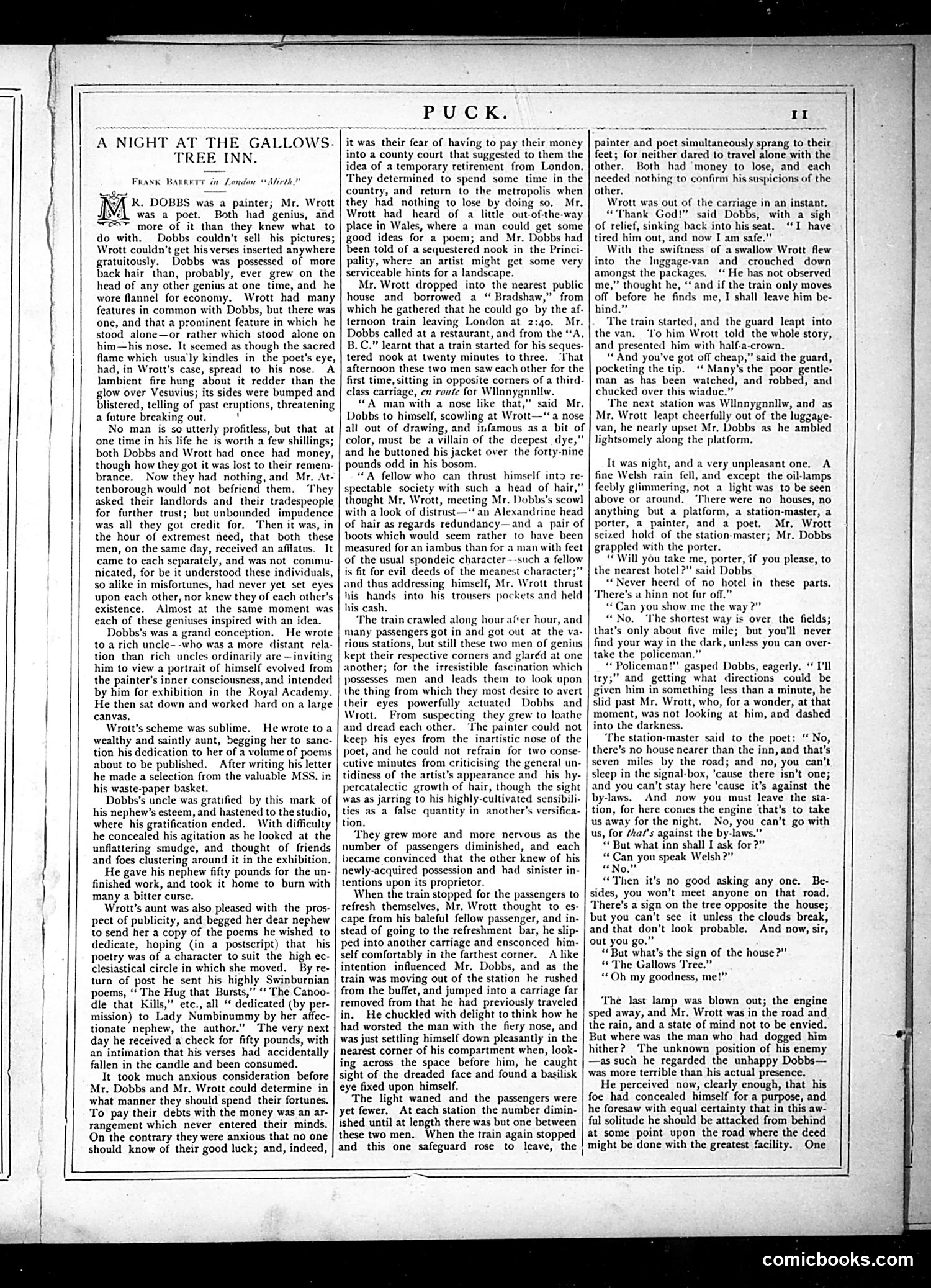
This is a satirical short story by Frank Barrett (byline: "on London 'March'"), not a political cartoon. The narrative mocks two poor artists—Dobbs (a painter) and Wrot (a poet)—whose poverty and pretension the author ridicules throughout. The satire targets artistic self-importance: both men possess grand egos despite their complete lack of money or success. The story follows their misadventures on a train journey, including Dobbs's embarrassing behavior (an "Alexandrian head" obsession) and Wrot's ridiculous attempts at superiority. The "gallows-tree inn" title sardonically references their desperate circumstances. The humor derives from depicting impoverished bohemian artists as simultaneously delusional and pathetic—a common Victorian satirical target attacking artistic pretense and financial irresponsibility.
📄 Transcribed text from this page (OCR, searchable)
Machine-transcribed from the original scan — historical spelling and the odd misread are preserved.
A NIGHT AT THE GALLOWS. TREE INN. Frank Barrerr in London “Mirth” R. DOBBS was a painter; Mr. Wrott was a poet. Both had genius, and “cS more of it than they knew what to do with. Dobbs couldn't sell his pictures; Wrott couldn't get his verses inserted anywhere gratuitously. Dobbs was possessed of more back hair than, probably, ever grew on the head of any other genius at one time, and he wore flannel for economy. Wrott had many features in common with Dobbs, but there was one, and that a prominent feature in which he stood alone—or rather which stood alone on him—his nose. It seemed as though the sacred flame which usua'ly kindles in the poet’s eye, had, in Wrott’s case, spread to his nose. A lambient fire hung about it redder than the glow over Vesuvius; its sides were bumped and blistered, telling of past eruptions, threatening a future breaking out. ' No man is so utterly profitless, but that at one time in his life he 1s worth a few shillings; both Dobbs and Wrott had once had money, though how they got it was lost to their remem- brance. Now they had nothing, and Mr. At- tenborough would not befriend them. ‘They asked their landlords and their tradespeople for further trust; but unbounded impudence was all they got credit for. ‘Then it was, in the hour of extremest need, that both these men, on the same day, received an afflatus. It came to each separately, and was not_commu- nicated, for be it understood these individuals, so alike in misfortunes, had never yet set eyes upon each other, nor knew they of each other’s existence. Almost at the same moment was each of these geniuses inspired with an idea. Dobbs’s was a grand conception. He wrote to a rich uncle--who was a more distant rela- tion than rich uncles ordinarily are —inviting him to view a portrait of himself evolved from the painter’s inner consciousness, and intended by him for exhibition in the Royal Academy. He then sat down and worked hard on a large canvas. Wrott's scheme was sublime. He wrote to a wealthy and saintly aunt, begging her to sanc- tion his dedication to her of a volume of poems about to be published. After writing his letter he made a selection from the valuable MSS. ii his waste-paper basket. Dobbs’s uncle was gratified by this mark of his nephew’s esteem, and hastened to the studio, where his gratification ended. With difficulty he concealed his agitation as he looked at the unflattering smudge, and thought of friends and foes clustering around it in the exhibition. He gave his nephew fifty pounds for the un- finished work, and took it home to burn with many a bitter curse. Wrott’s aunt was also pleased with the pros- pect of publicity, and begged her dear nephew to send her a copy of the poems he wished to dedicate, hoping (in a postscript) that his poetry was of a character to suit the high ec- clesiastical circle in which she moved. By re- turn of post he sent his highly Swinburnian poems, ‘‘ The Hug that Bursts,” “ The Canoo- dle that Kills,” etc., all “ dedicated (by per- mission) to Lady Numbinummy by her affec- tionate nephew, the author.” The very next day he received a check for fifty pounds, with an intimation that his verses had accidentally fallen in the candle and been consumed. It took much anxious consideration before Mr. Dobbs and Mr. Wrott could determine in what manner they should spend their fortunes. To pay their debts with the money was an ar- rangement which never entered their minds. On the contrary they were anxious that no one should know of their good luck; and, indeed, it was their fear of having to pay their money into a county court that suggested to them the idea of a temporary retirement from London. They determined to spend some time in the country, and return to the metropolis when they had nothing to lose by doing so. Mr. Wrott had heard of a little out-of-the-way place in Wales, where a man could get some good ideas for a poem; and Mr. Dobbs had been told of a sequestered nook in the Princi- pality, where an artist. might get some very serviceable hints for a landscape. Mr. Wrott dropped into the nearest public house and borrowed a ‘ Bradshaw,” from which he gathered that he could go by the af- ternoon train leaving London at 2:40, Mr. Dobbs called at a restaurant, and from the “A, B.C.” learnt that a train started for his seques- tered nook at twenty minutes to three. ‘That afternoon these two men saw each other for the first time, sitting in opposite corners of a third- class carriage, en route for Wilnnygnnllw. A man with a nose like that,” said Mr. Dobbs to himself, scowling at Wrott—“ a nose all out of drawing, and infamous asa bit of color, must be a villain of the deepest dye,” and he buttoned his jacket over the forty-nine pounds odd in his bosom. “(A fellow who can thrust himself into re- spectable society with such a head of hair,” thought Mr, Wrott, meeting Mr. Dobbs's scowl with a look of distrust—‘‘ an Alexandrine head of hair as regards redundancy—and a pair of boots which would seem rather to have been measured for an iambus than for a man with feet of the usual spondeic character --such a fellow is fit for evil deeds of the meanest character;” and thus addressing himself, Mr. Wrott thrust his hands into his trousers pockets and held his cash. ‘The train crawled along hour afer hour, and many passengers got in and got out at the va- rious stations, Lut still these two men of genius kept their respective corners and glaréd at one another; for the irresistible fascination which possesses men and leads them to look upon the thing from which they most desire to avert their eyes powerfully actuated Dobbs and Wrott. From suspecting they grew to loathe and dread each other. ‘I'he painter could not keep his eyes from the inartistic nose of the poet, and he could not refrain for two conse- cutive minutes from criticising the general un- tidiness of the artist’s appearance and his hy- percatalectic growth of hair, though the si; was as jarring to his highly-cultivated sensibi ties as a false quantity in. another's versifica- tion. ‘They grew more and more nervous as the number of passengers diminished, and each became convinced that the other knew of his newly-acquired possession and had sinister in- tentions upon its proprietor. When the train stopped for the passengers to refresh themselves, Mr. Wrott thought to es- cape from his baleful fellow passenger, and in- stead of going to the refreshment bar, he slip- ped into another carriage and ensconced _him- self comfortably in the farthest corner. A like intention influenced Mr. Dobbs, and as the train was moving out of the station he rushed from the buffet, and jumped into a carriage far removed from that he had previously traveled in. He chuckled with delight to think how he had worsted the man with the fiery nose, and was just settling himself down pleasantly in the nearest corner of his compartment when, look- ing across the space before him, he caught sight of the dreaded face and found a basilisk eye fixed upon himself. The light waned and the passengers were yet fewer, Ateach station the number dimin- ished until at length there was but one between these two men. When the train again stopped painter and poet simultaneously sprang to their feet; for neither dared to travel alone with the other. Both had ‘money to lose, and each needed nothing to confirm his suspicions of the other. Wrott was out of the carriage in an instant. “Thank God!” said Dobbs, with a sigh of relief, sinking back into his seat. ‘I have tired him out, and now I am safe.” With the swiftness of a swallow Wrott flew into the Inggage-van and crouched down amongst the packages. ‘‘ He has not observed me,” thought he, “and if the train only moves off before he finds me, I shall leave him be- hind.” ‘The train started, and the guard leapt into the van. ‘lo him Wrott told the whole story, and presented him with half-a-crown. “ And you've got off cheap,” said the guard, pocketing the tip.‘ Many’s the poor gentle- man as has been watched, and robbed, and chucked over this wiaduc.” ‘The next station was Wilnnygnoilw, and as Mr. Wrott leapt cheerfully out of the lugzaye- van, he nearly upset Mr. Dobbs as he ambled lightsomely along the platform. It was night, and a very unpleasant one. A fine Welsh rain fell, and except the oil-lamps feebly glimmering, not a light was to be seen above or around. ‘There were no houses, no anything but a platform, a station-master, a porter, a painter, and a poet. Mr, Wrott seized hold of the station-master; Mr. Dobbs grappled with the porter. “Will you take me, porter, if you please, to the nearest hotel ?” said Dobbs “Never heerd of no hotel in these parts. ‘There's a hinn not fur off.” ‘an you show me the way ?” 0. ‘The shortest way is over the fields; that’s only about five mile; but you'll never find your way in the dark, unless you can over- take the policeman.” Policeman!" gasped Dobbs, eagerly. “I'll try;” and getting what directions could be given him in something less than a minute, he slid past Mr. Wrott, who, for a wonder, at that moment, was not Jooking at him, and dashed into the darkness. ‘The station-master said to the poet: ‘ No, there's no house nearer than the inn, and that’s seven miles by the road; and no, you can’t sleep in the signal-box, ’cause there isn't one; and you can't stay here 'cause it's against the by-laws. And now you must leave the sta- tion, for here comes the engine that’s to take us away for the night. No, you can’t go with us, for that's against the by-laws.” “But what inn shall I ask for “Can you speak Welsh?” “No.” “Then it’s no good asking any one. Be- sides, you won’t meet anyone on that road. ‘There's a sign on the tree opposite the house; but you can’t see it unless the clouds break, and that don’t look probable. And now, sir, out you go.”” “But what's the sigi “ The Gallows Tree “Oh my goodness, me!” f the house ?"” ‘The last lamp was blown out; the engine sped away, and Mr. Wrott was in the road and the rain, and a state of mind not to be envied. But where was the man who had dogged him hither? The unknown position of his enemy —as such he regarded the unhappy Dobbs— was more terrible than his actual presence, He perceived now, clearly enough, that his foe had concealed himself for a purpose, and he foresaw with equal certainty that in this aw- ful solitude he should be attacked from behind at some point upon the road where the deed and this one safeguard rose to leave, the | might be done with the greatest facility. One comicbooks.com