
A complete issue · 16 pages · 1878
Puck — July 31, 1878
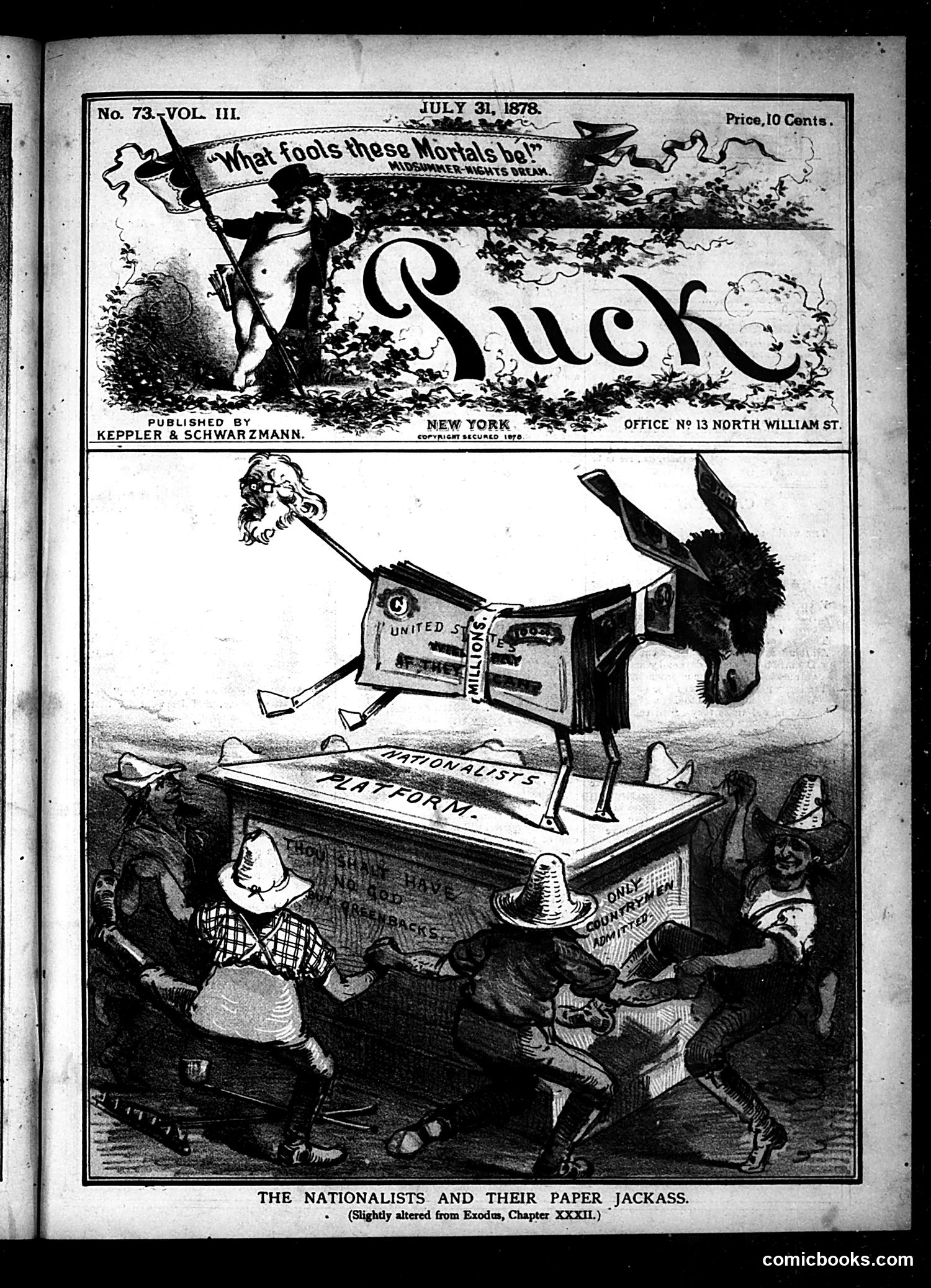
This 1878 *Puck* cartoon satirizes the Nationalist political movement and their associated newspaper (the "paper jackass"). The central image depicts a donkey standing on a platform labeled "Nationalist Platform," wearing a saddle marked "United States" with a classical bust (likely representing a founding principle or leader) protruding from its head. Figures below—appearing to represent different political or social groups—look up at this spectacle. The caption references Exodus Chapter XXXII, alluding to the biblical golden calf, suggesting the Nationalists are promoting a false idol or misguided movement. The cartoon's message: the Nationalist platform is foolish, unstable, and commands questionable devotion from its followers.
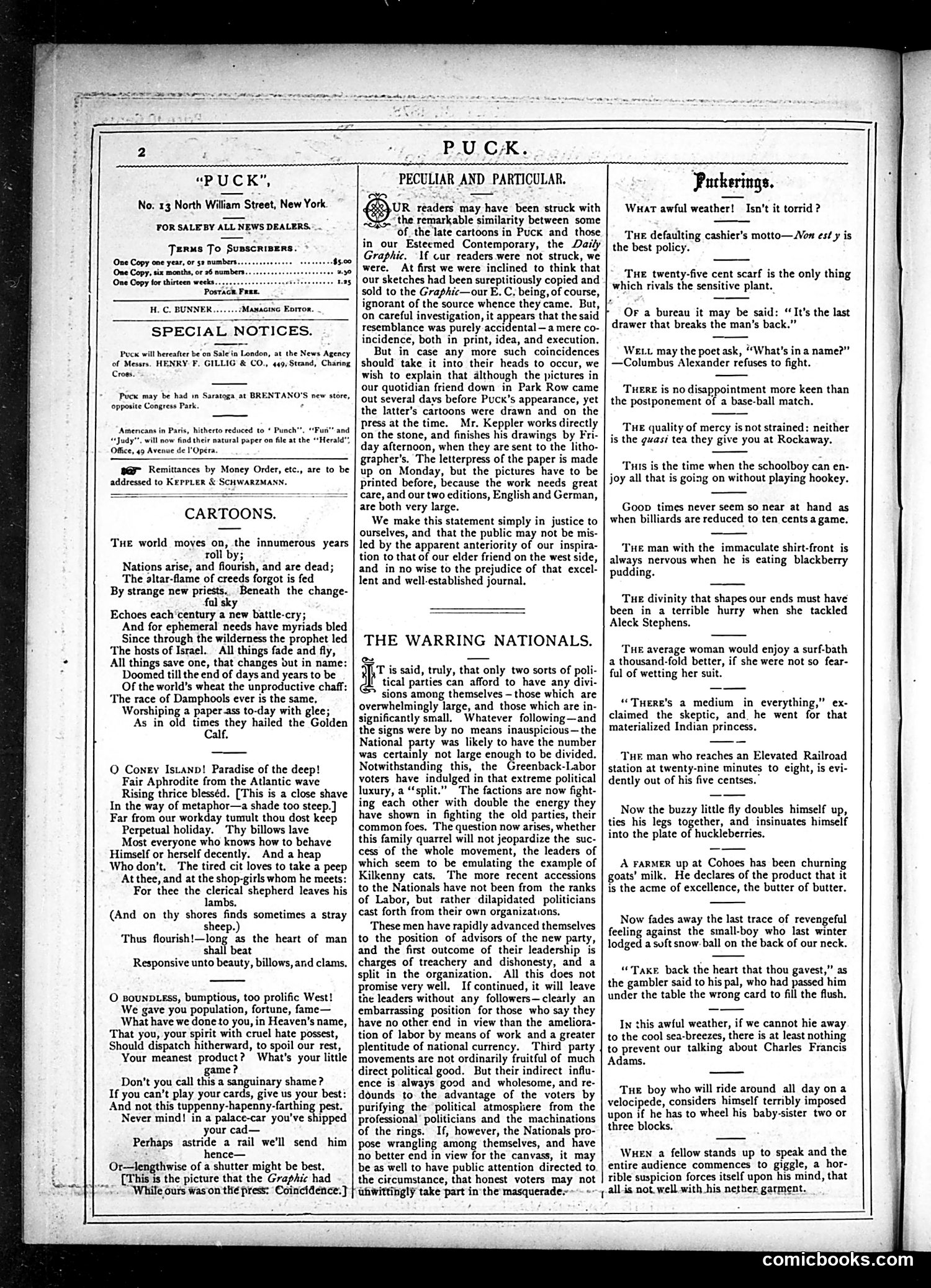
This page is primarily **text-based editorial and satirical commentary** rather than illustrated cartoons. The main political article, "THE WARRING NATIONALS," discusses factional infighting within what appears to be a labor or socialist political movement, specifically mentioning the **Greenback-Labor party** and criticisms of competing factions (possibly referencing the Populist/National party movements of the 1880s-90s). The satire argues these political groups are fragmenting through internal disputes over leadership and ideology, weakening their electoral impact. The piece criticizes politicians prioritizing personal power over genuine reform. The page also contains "Puckerings" (brief witticisms) and "Peculiar and Particular" commentary on various social observations. Without visible illustrations, the satire relies entirely on written critique of contemporary political dysfunction.
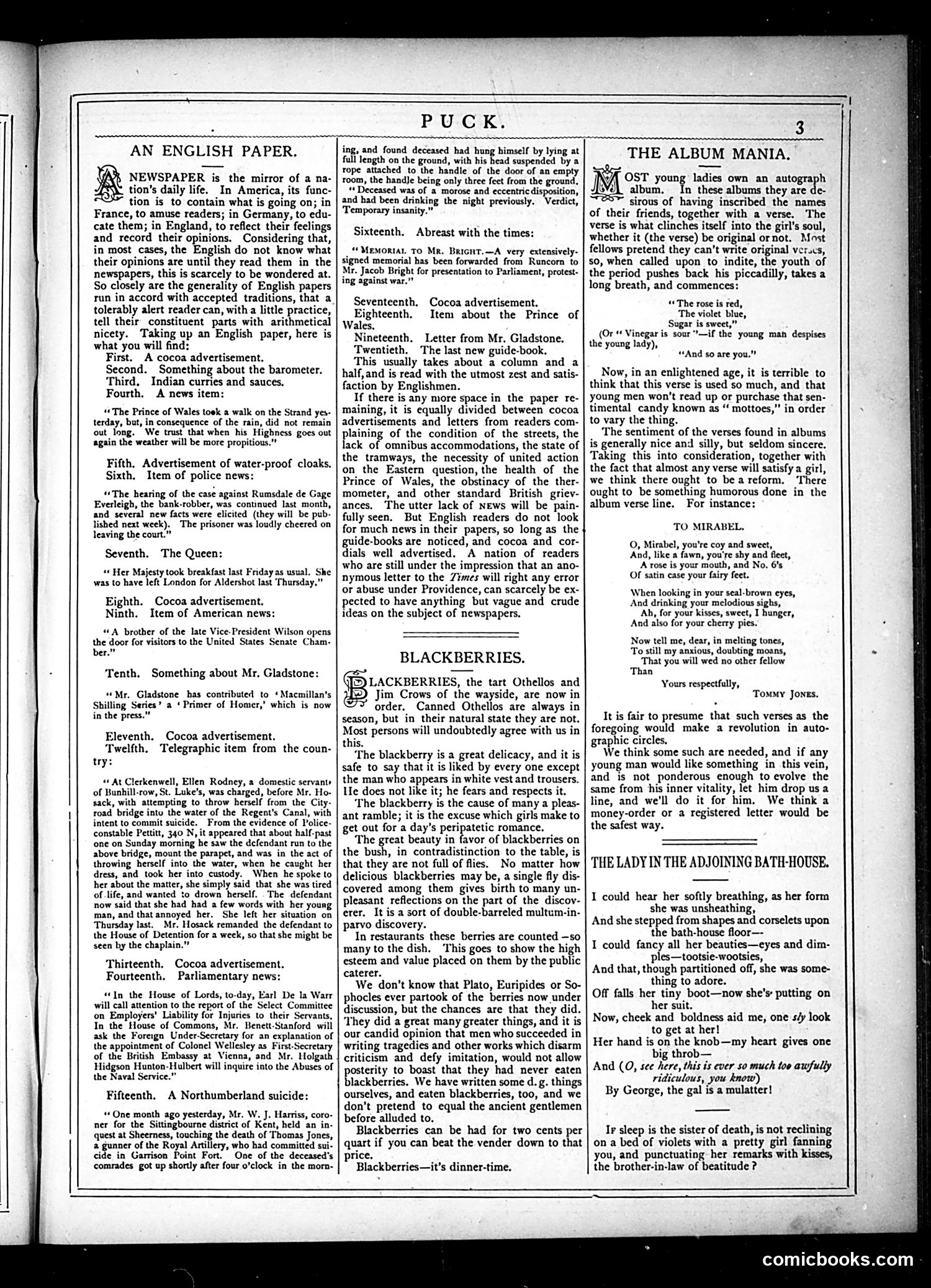
This page consists primarily of **text articles and poetry rather than political cartoons**. The content includes: 1. **"An English Paper"** — satirical commentary on English newspapers' structure and content, mocking their predictable format (advertisements, barometer readings, police news) 2. **"The Album Mania"** — critique of young ladies inscribing autograph albums with verses, satirizing this social trend as vapid and formulaic 3. **"Blackberries"** — humorous essay on the fruit's culinary merits and cultural history, referencing classical figures like Plato and Euripides 4. **"The Lady in the Adjoining Bath-House"** — comic poetry about overhearing a woman bathing The page functions as **satirical social commentary** on contemporary customs rather than political satire, targeting genteel Victorian leisure activities and publishing conventions.
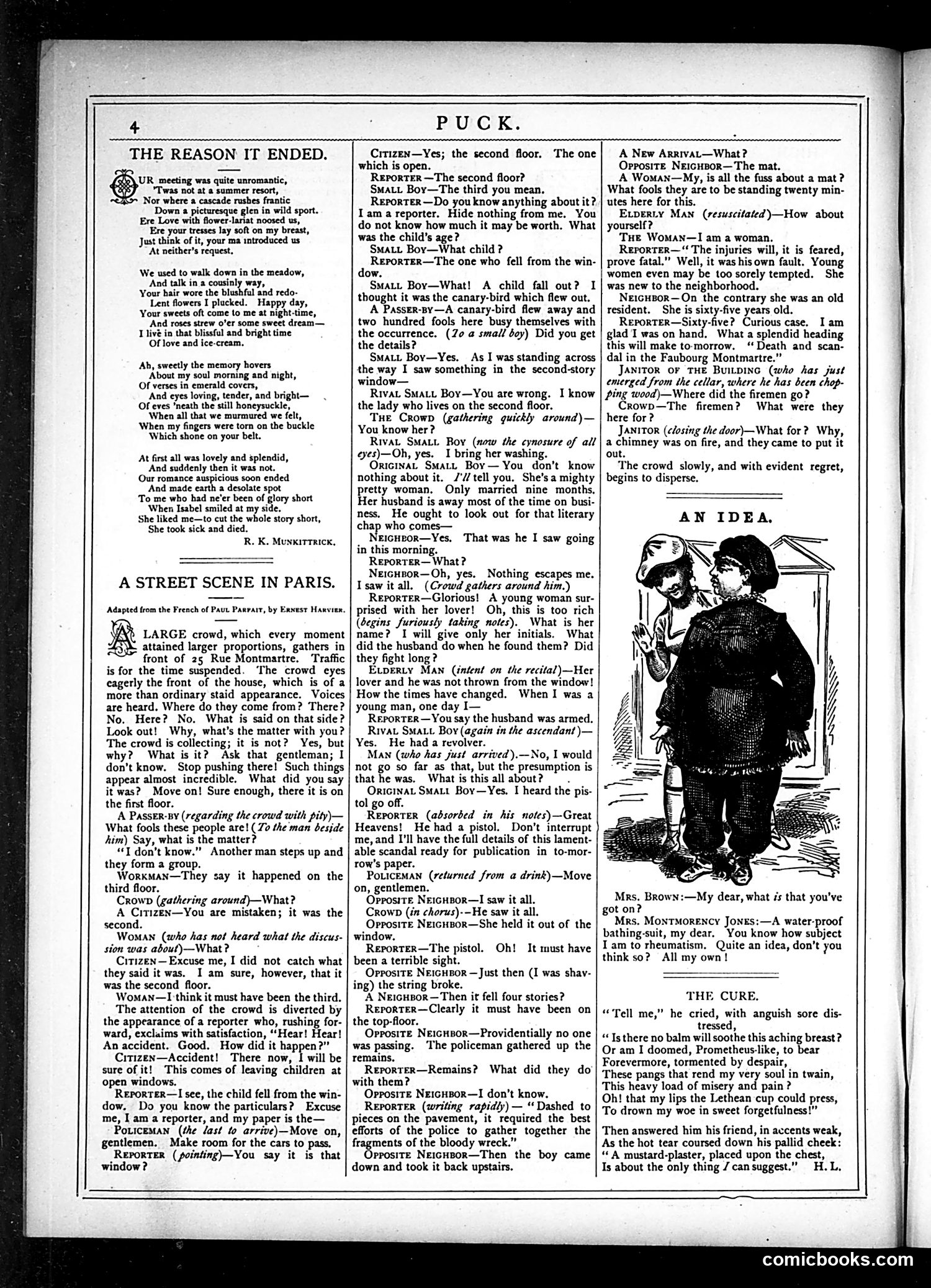
This page contains three distinct pieces rather than a unified cartoon: 1. **"The Reason It Ended"** — A poem about a failed romance, attributed to R.K. Munstrick. It's sentimental verse with no political content. 2. **"A Street Scene in Paris"** — A satirical dialogue adapted from French author Paul Parfait by Ernest Harvier. It depicts a street accident in Paris with multiple witnesses offering conflicting accounts. The satire targets how unreliable eyewitness testimony is, as different people describe the same incident (apparently a woman falling and a man with a pistol) in contradictory ways. 3. **"An Idea"** and **"The Cure"** — Brief humorous pieces about domestic life and relationships with no political significance. The content is primarily literary/social humor rather than political satire.
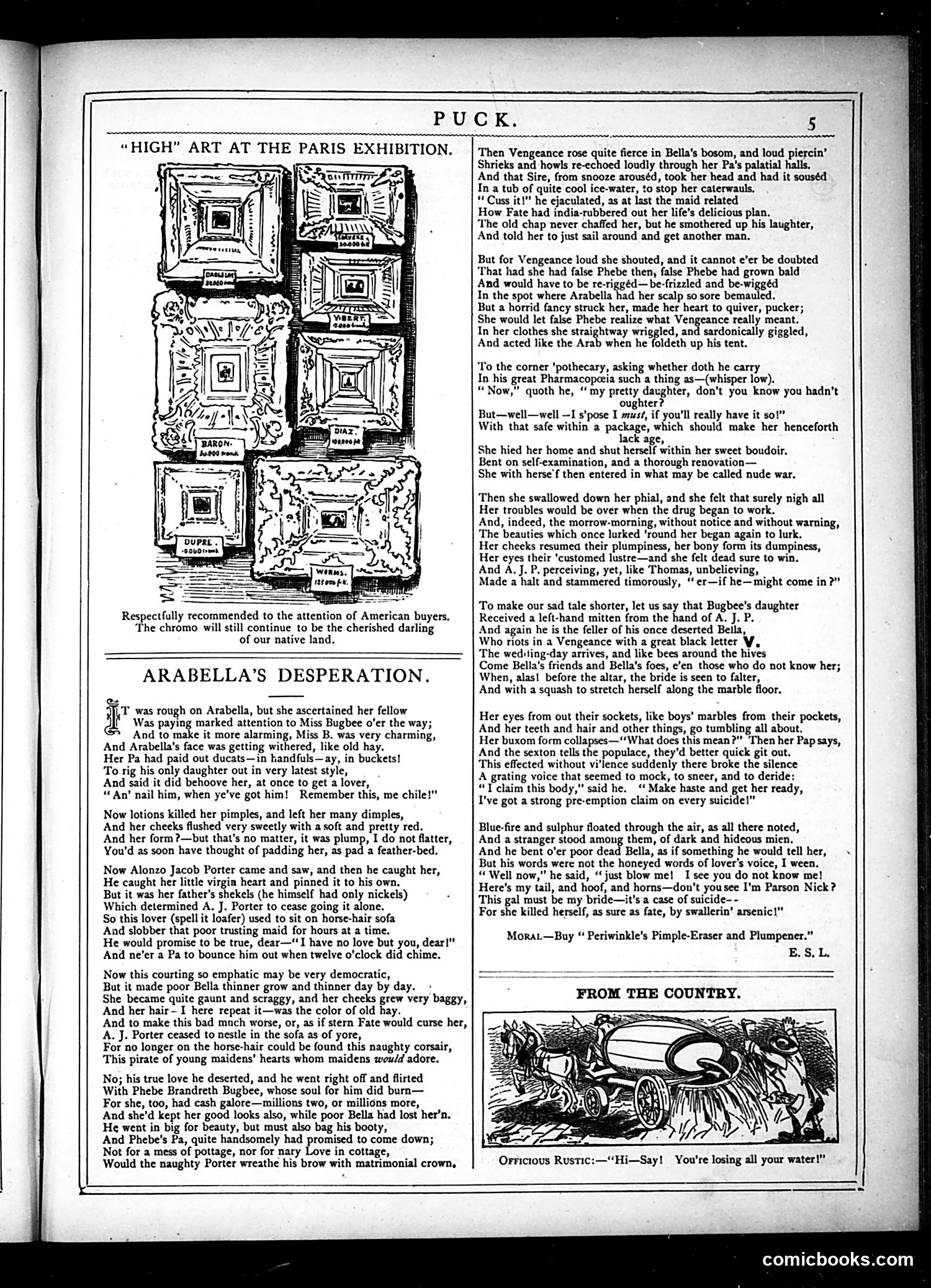
This page contains two distinct pieces: **"High Art at the Paris Exhibition"** (top): A satirical illustration mocking abstract or modernist art being displayed at the Paris Exposition. The geometric, increasingly simplified frames suggest artists reducing images to pure abstraction—a common mockery of avant-garde movements in early 20th-century American humor. The caption recommends these works to "American buyers," sarcastically implying only foreign taste would appreciate such incomprehensible art. **"Arabella's Desperation"** (bottom): A serialized story-poem about a woman named Arabella whose fiancé Alonzo Jacob Porter abandons her for another woman named Bella. The narrative details her heartbreak and despair, ending tragically with her suicide threat. This melodramatic morality tale was typical magazine serialized fiction of the era. The small cartoon bottom-right, "From the Country," appears unrelated—a rural humor sketch.
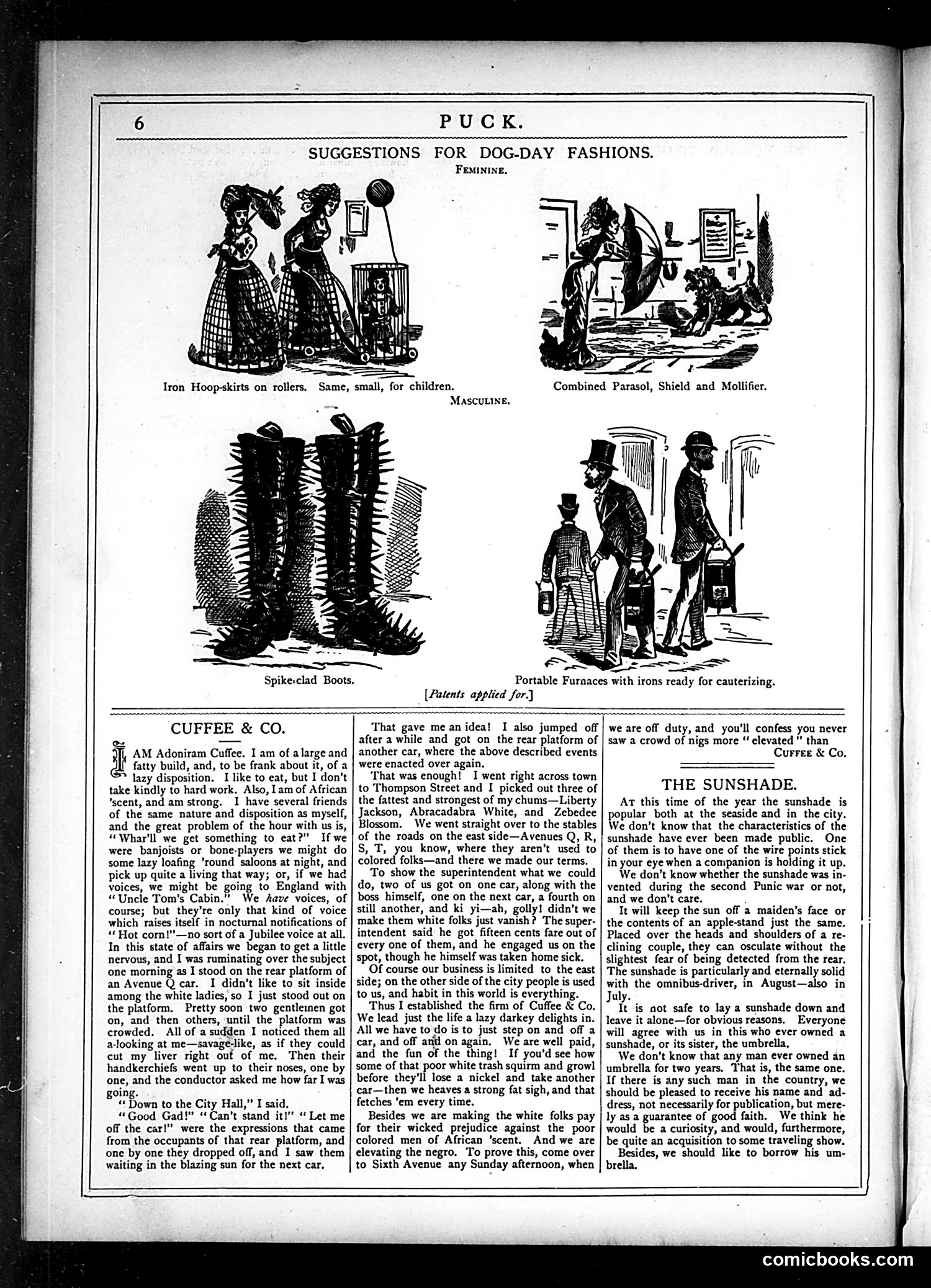
This page contains two distinct sections: **Top Section: "Suggestions for Dog-Day Fashions"** Four humorous illustrations satirize absurd fashion and utility items supposedly designed for summer heat. These include: iron hoop-skirts on rollers, spike-clad boots, a combined parasol/shield/mollifier, and "portable furnaces with irons ready for catering." The satire mocks impractical Victorian fashion and the era's obsession with gadgetry—suggesting these ridiculous contraptions represent the extreme thinking of fashion designers and inventors during hot weather. **Bottom Section: Advertisements and Articles** The remainder consists of commercial advertisements for "Coffee & Co." and a consumer advice column called "The Sunshade," which discusses practical summer concerns like umbrellas and city transportation. The page's humor targets middle-class consumer culture and the disconnect between fashionable aspirations and practical sense.
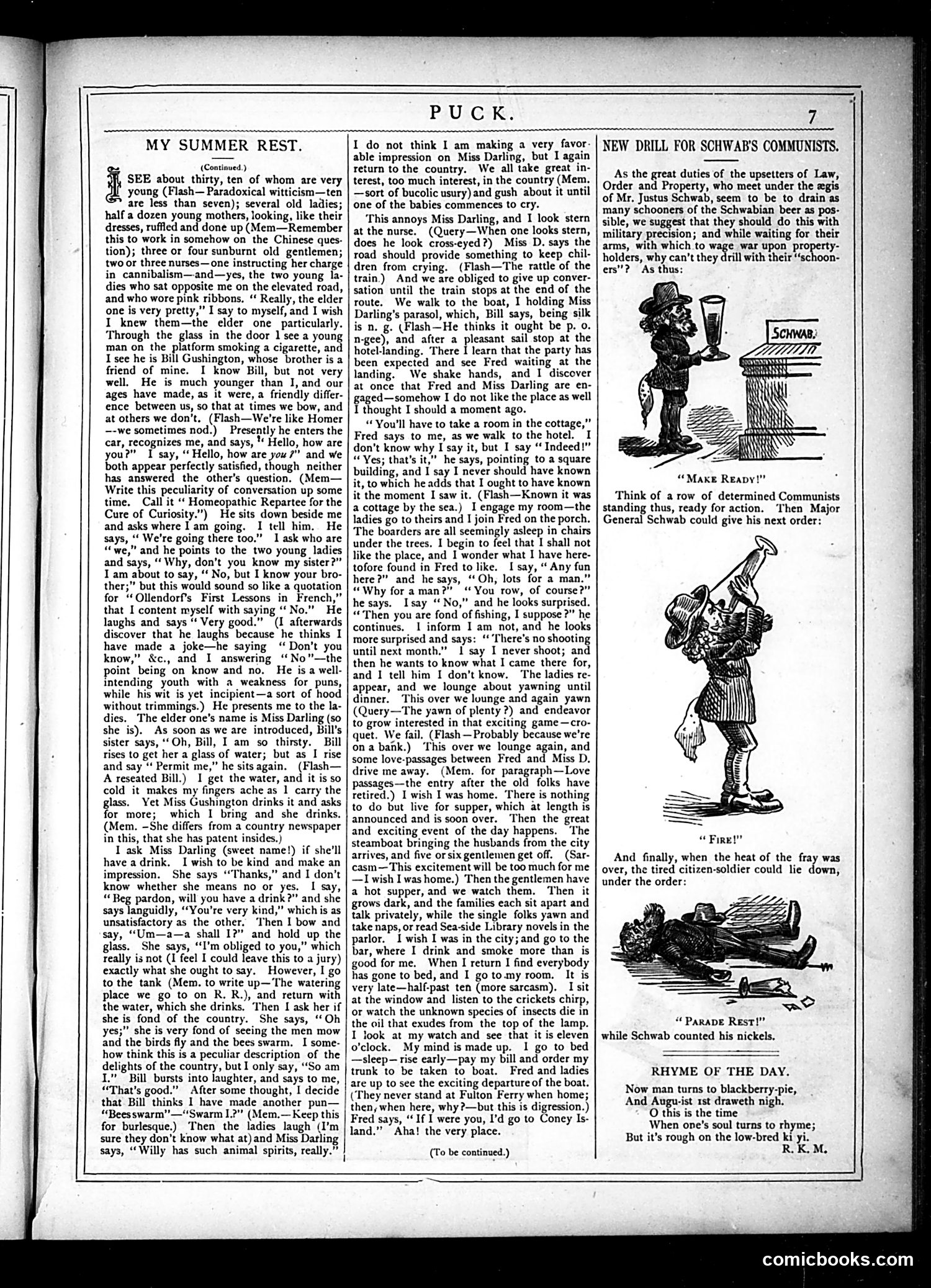
This cartoon satirizes **Charles M. Schwab**, a prominent steel industrialist of the Gilded Age, mocking him as sympathetic to communist or radical labor movements. The headline "Make Ready!" and accompanying illustrations show military-style drilling, suggesting Schwab is preparing armed communists for action. The satire likely responds to labor unrest in the steel industry and Schwab's complicated relationship with workers—either implying he was too lenient with radicals or that capitalists like him provoked revolutionary sentiment through poor labor conditions. The cartoon reflects America's post-industrial anxiety about communism and labor radicalism, treating Schwab as complicit in or deserving of such threats through his business practices. The military imagery suggests fear of organized worker uprisings.
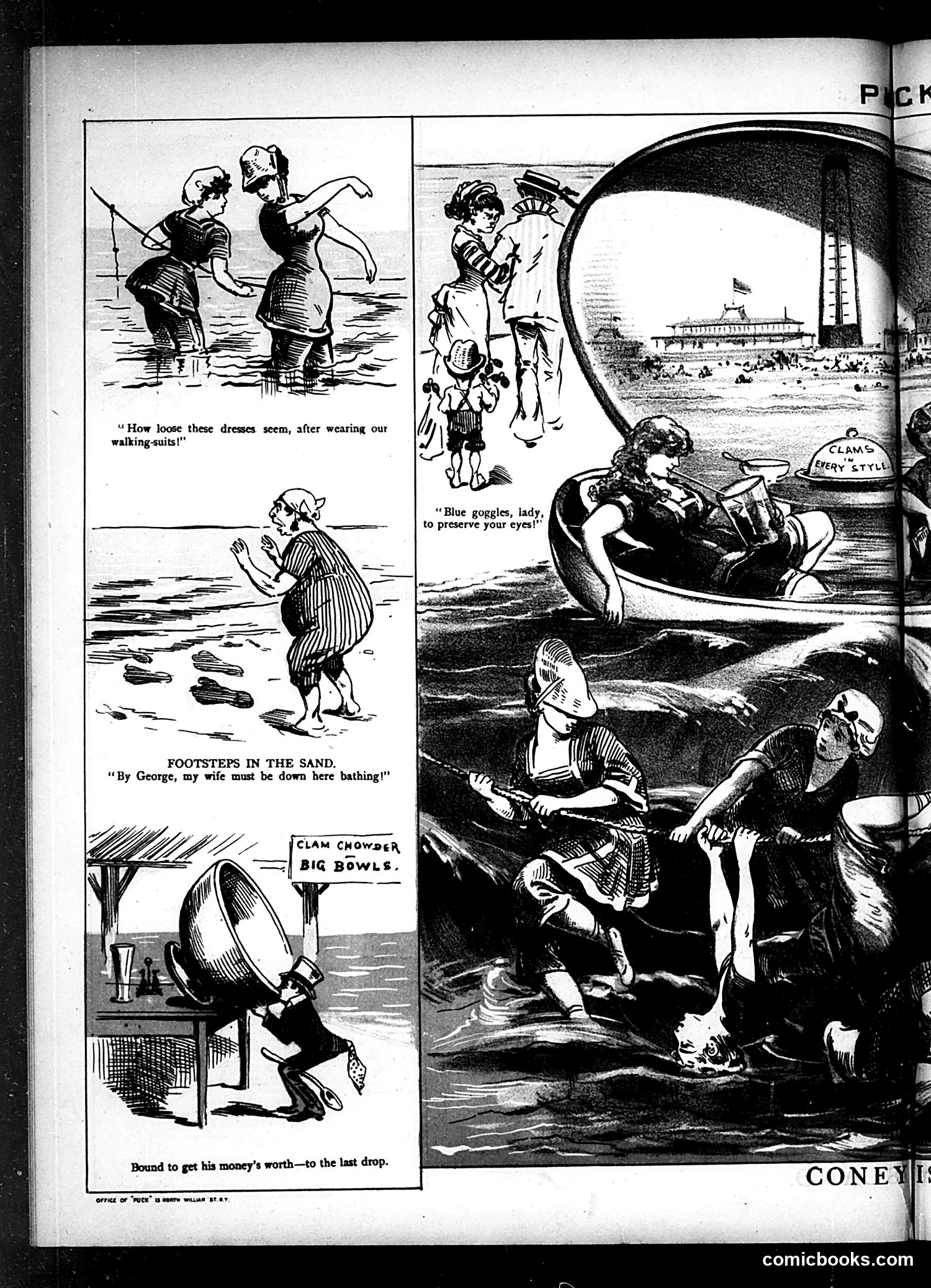
This page contains multiple comic strips satirizing beach and seaside bathing culture. The left column shows three separate gags: 1. **"Footsteps in the Sand"** — Women in bathing suits complaining their dresses feel loose after swimming, mocking how wet garments cling differently than dry ones. 2. A scene with women warning each other about "blue goggles" to preserve eyesight, likely referencing sun glare or beach hazards. 3. **"Clam Chowder Big Bowls"** — A man attempting to get his "money's worth" by eating an enormous serving, a joke about gluttony and value-seeking. The right side shows a beach/amusement park scene. These cartoons satirize middle and working-class leisure culture, mocking bathing fashions, vanity, and consumerist behavior at American seaside resorts during Puck's era (likely early 20th century).
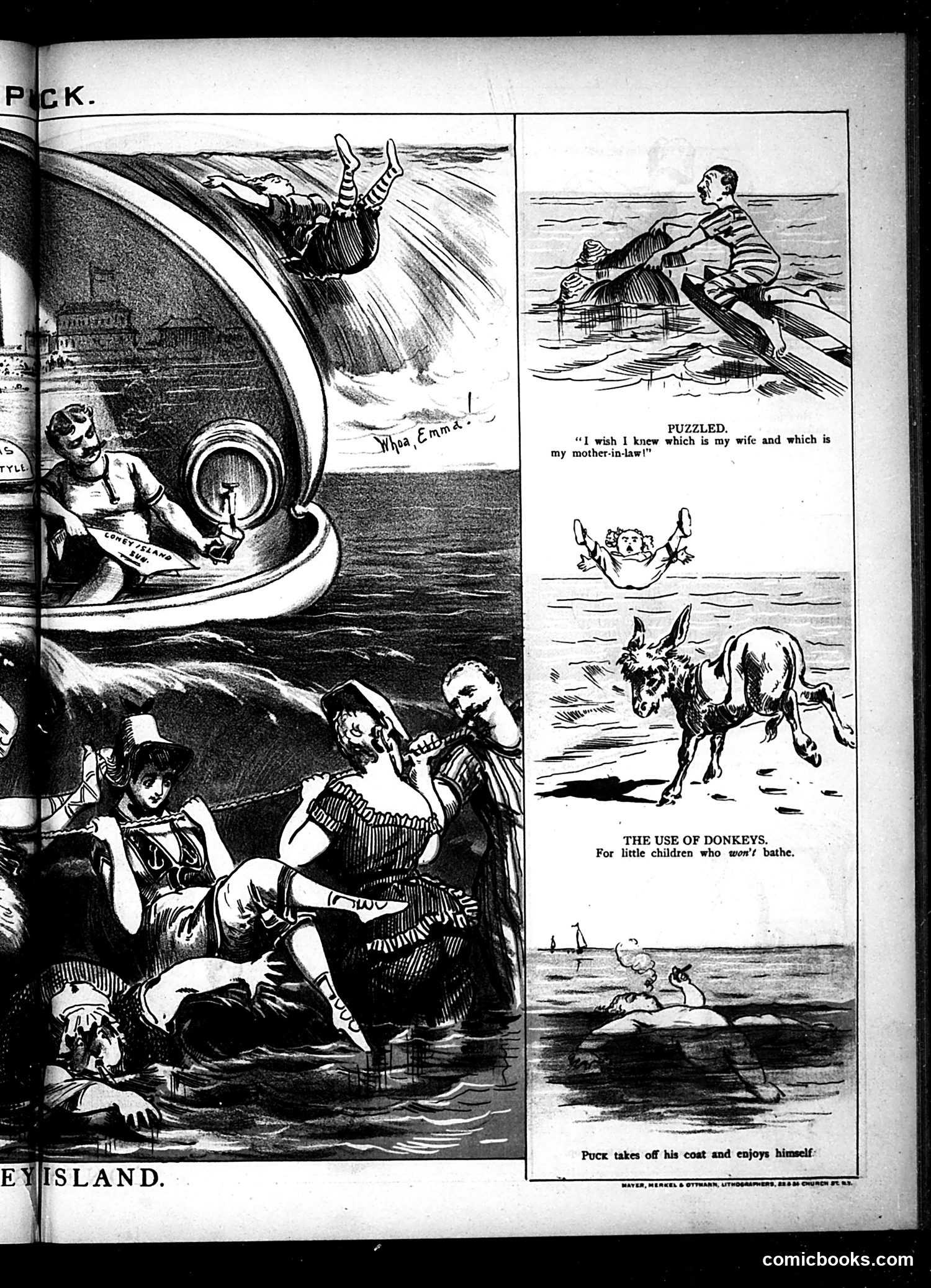
The left panel depicts a seaside scene with multiple figures in water and on shore, labeled "ISLAND" (partially visible). The imagery suggests a bathing or leisure scenario, though the specific satirical target is unclear from visible text alone. The right panel contains three separate sketches with captions: "PUZZLED" (showing two men in a boat), "THE USE OF DONKEYS. For little children who won't bathe" (depicting children with donkeys), and "Puck takes off his coat and enjoys himself" (showing a figure in water). These appear to be connected humorous observations about seaside behavior and bathing customs. Without additional context or clearer OCR text, the precise political or social commentary remains unclear, though they likely mock Victorian-era bathing practices or attitudes toward water recreation.
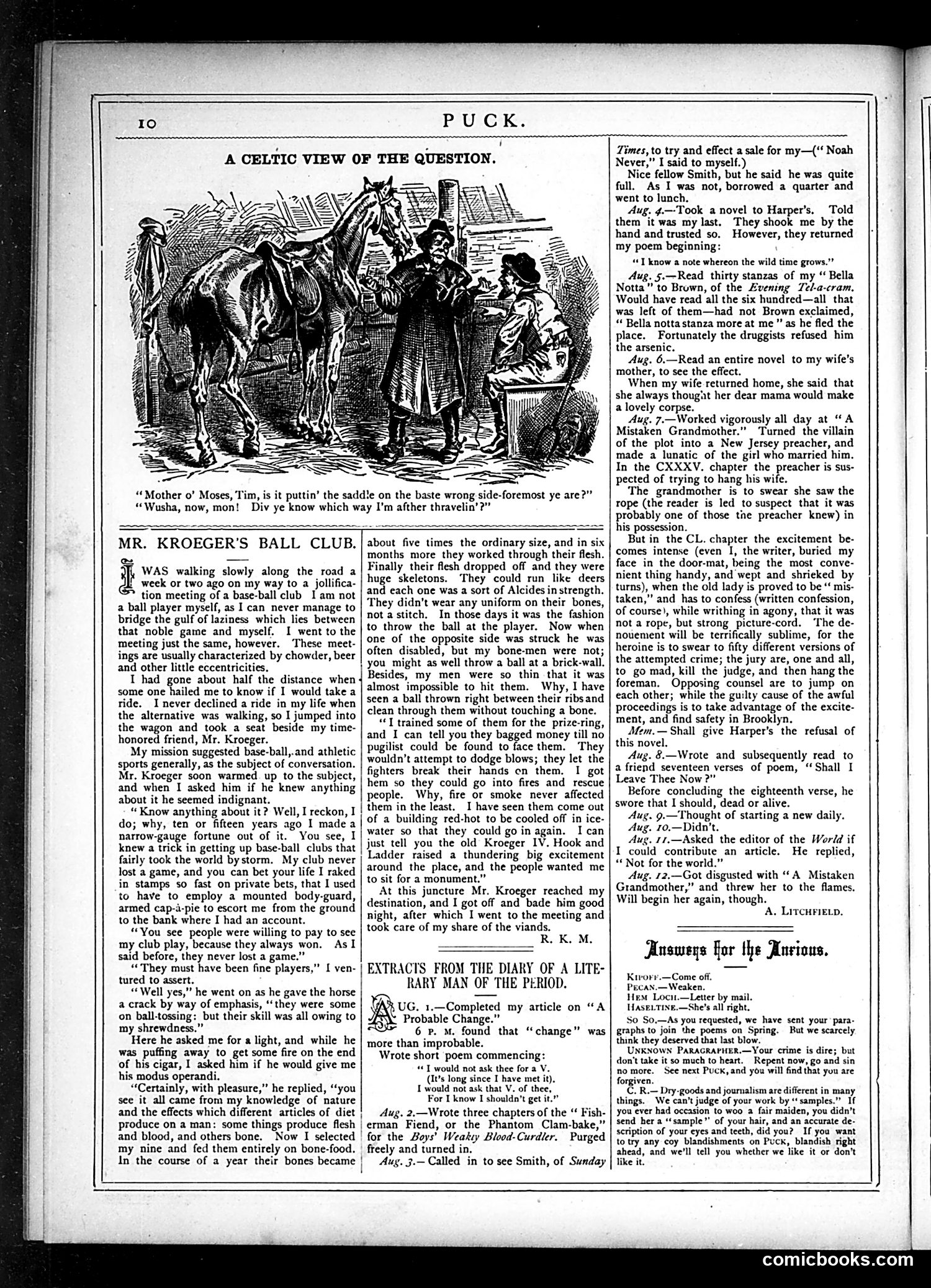
This cartoon depicts an Irish person (identified by the "Celtic" label and visual stereotyping) attempting to saddle a horse backwards. The accompanying dialogue—"Mother o' Moses, Tim, is it puttin' the saddle on the baste wrong side-foremost ye are?" and "Wusha, now, mon! Div ye know which way I'm after travellin'?"—presents Irish characters as comically incompetent and confused about basic tasks. The satire targets Irish immigrants through ethnic stereotyping, portraying them as foolish and befuddled. This reflects late-19th-century American prejudice against Irish populations, depicting them as unintelligent or bumbling—a common theme in period satirical magazines like Puck.
This page contains three separate articles rather than political cartoons: 1. **"An Outrage"** – Satirizes wealthy Americans who traveled to spas and mineral water resorts, claiming miraculous health benefits. The piece mocks both the gullible patients and the dubious medical claims. 2. **"The News From Japan"** – Reports on Japan's execution of assassins who killed Vice-Premier Ii Naosuke, framed as evidence of Japan's "barbaric" justice system compared to Western standards. 3. **"Nils Jensen"** – A serialized story (marked "Concluded") about a romantic conflict, likely continuing from previous issues. The page demonstrates Puck's mix of satirical commentary on American society alongside international news and fiction—typical of 1860s American humor magazines.
This page is primarily **text-based narrative fiction**, not political satire or cartoon content. It appears to be a serialized story titled "Puck's Intrigues" (visible at bottom right). The visible narrative concerns a character named Nils and his emotional conflicts—involving love, sacrifice, and moral dilemmas. The dense text discusses whether Nils should have saved a woman's life differently, touching on themes of duty and romantic obligation. **The small illustration** at the bottom shows what appears to be a winter landscape with figures, consistent with the Scandinavian setting mentioned in the text (references to "Norwegian," "Rosdahl," "glaciers"). This is primarily **serialized fiction content** rather than political commentary. Without the full context or headline, the specific satirical point—if any—remains unclear from this page alone.
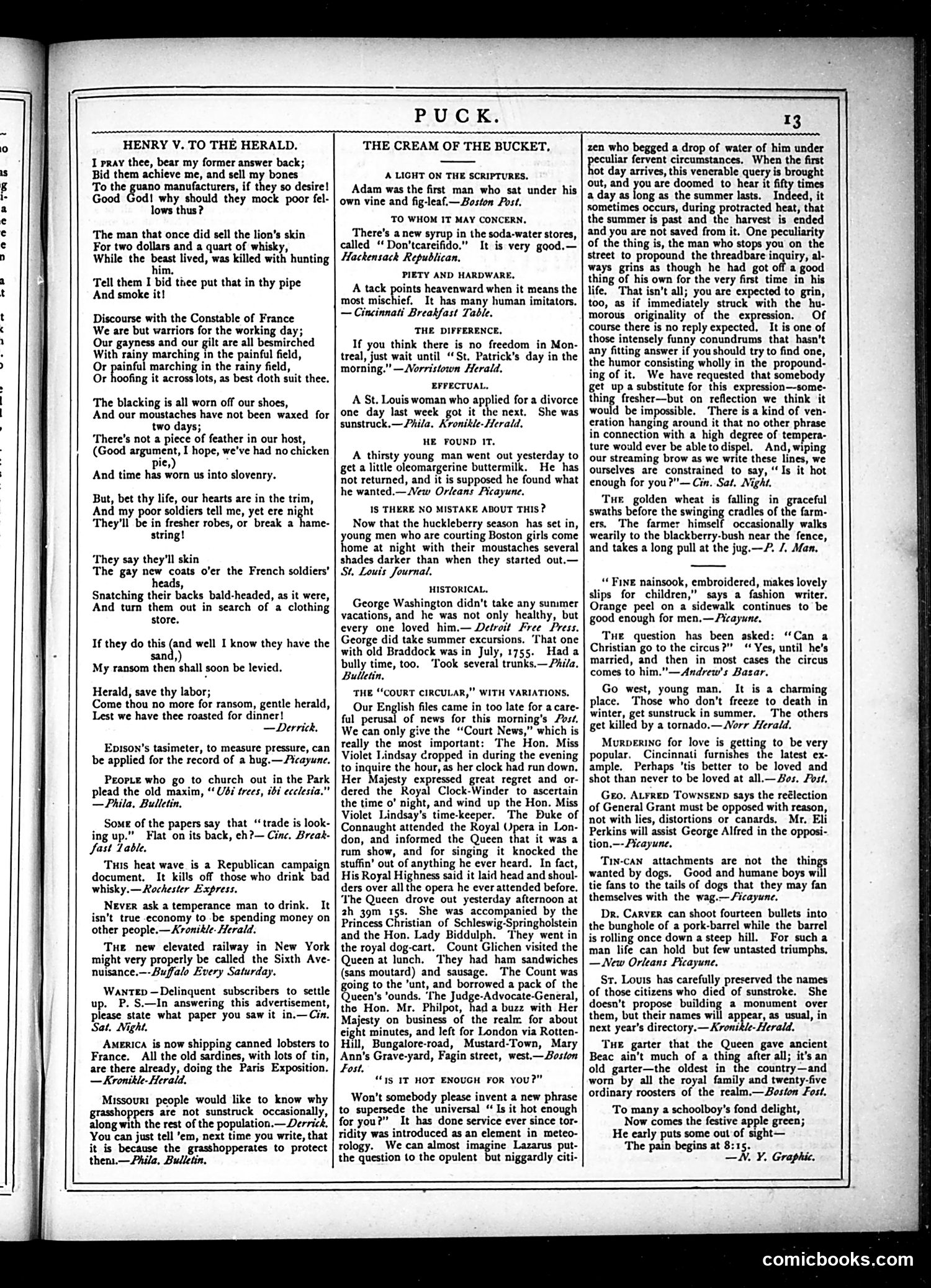
This page consists primarily of **brief satirical quips and jokes** rather than political cartoons. The content includes: - **"Henry V to the Herald"**: A mock-serious poem about selling a lion's skin - **Social commentary**: Jokes about French soldiers, huckleberry season courtship, and fashion trends - **Current events**: References to George Washington's summer vacations, the Royal Opera, and Queen Victoria's activities - **Domestic humor**: Quips about trade, temperance, and marital discord The satire targets **everyday American life and social pretensions** rather than specific political figures. Topics include fashion follies, gender relations, and public institutions. The page demonstrates Puck's approach of combining **sharp wit with accessible humor** for middle-class readers. Without detailed illustrations visible, the impact relies on **clever wordplay and topical references** to 1880s society.
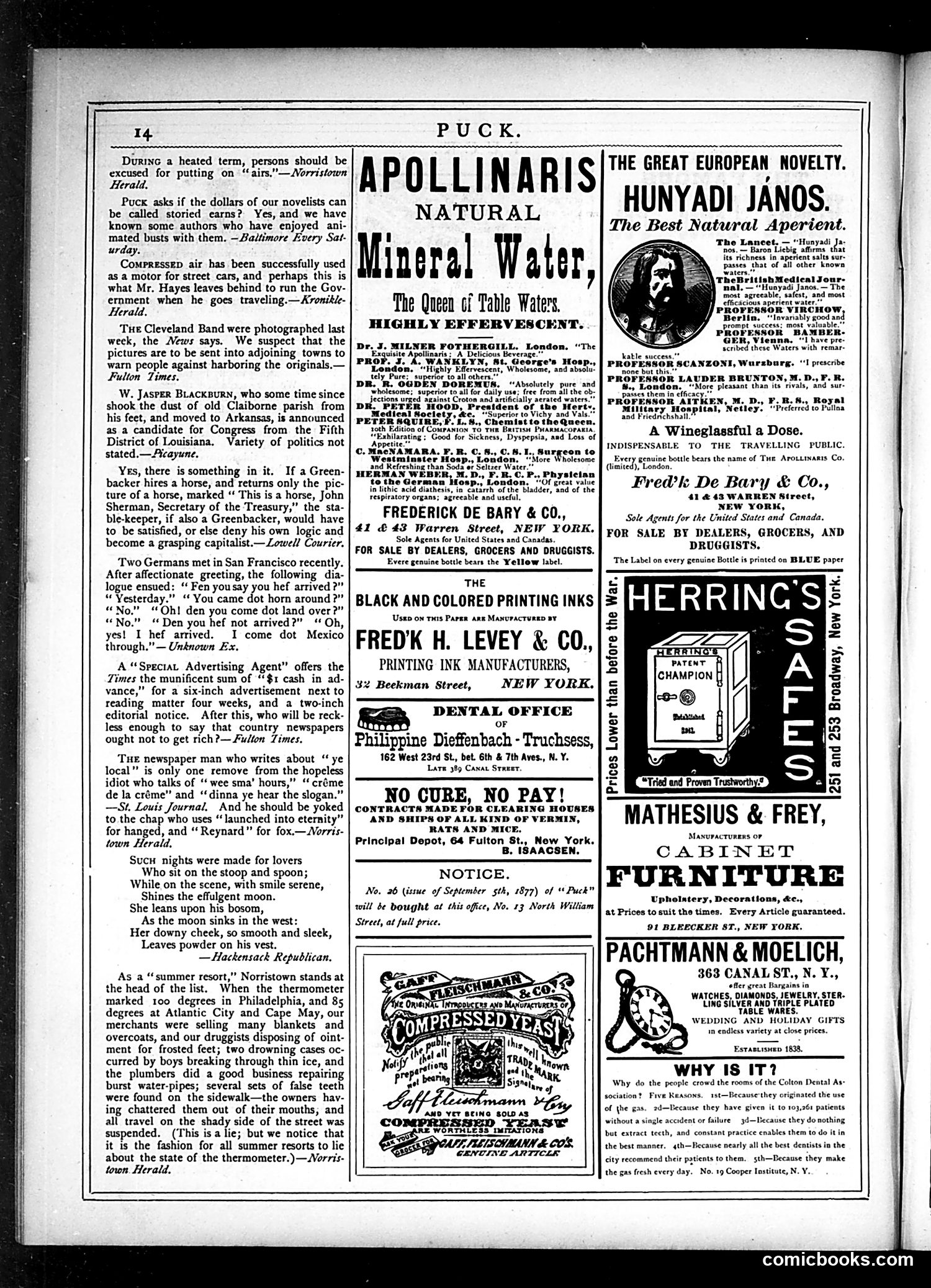
This page is primarily **advertising**, not political satire. It contains commercial notices for various products and services typical of late 19th-century America, including: - **Apollinaris Natural Mineral Water** (prominently featured with testimonials from European professors and physicians) - **Herring's Safe** (fireproof storage) - **Mathesius & Frey Cabinet Furniture** - **Pachtmann & Moelich Watches and Jewelry** - **Dental services, printing inks, and compressed yeast** The small text snippets at the top are brief humor items or anecdotes unrelated to the advertisements below. There are **no political cartoons** on this page—it functions as a revenue-generating advertising section typical of Puck magazine's format.
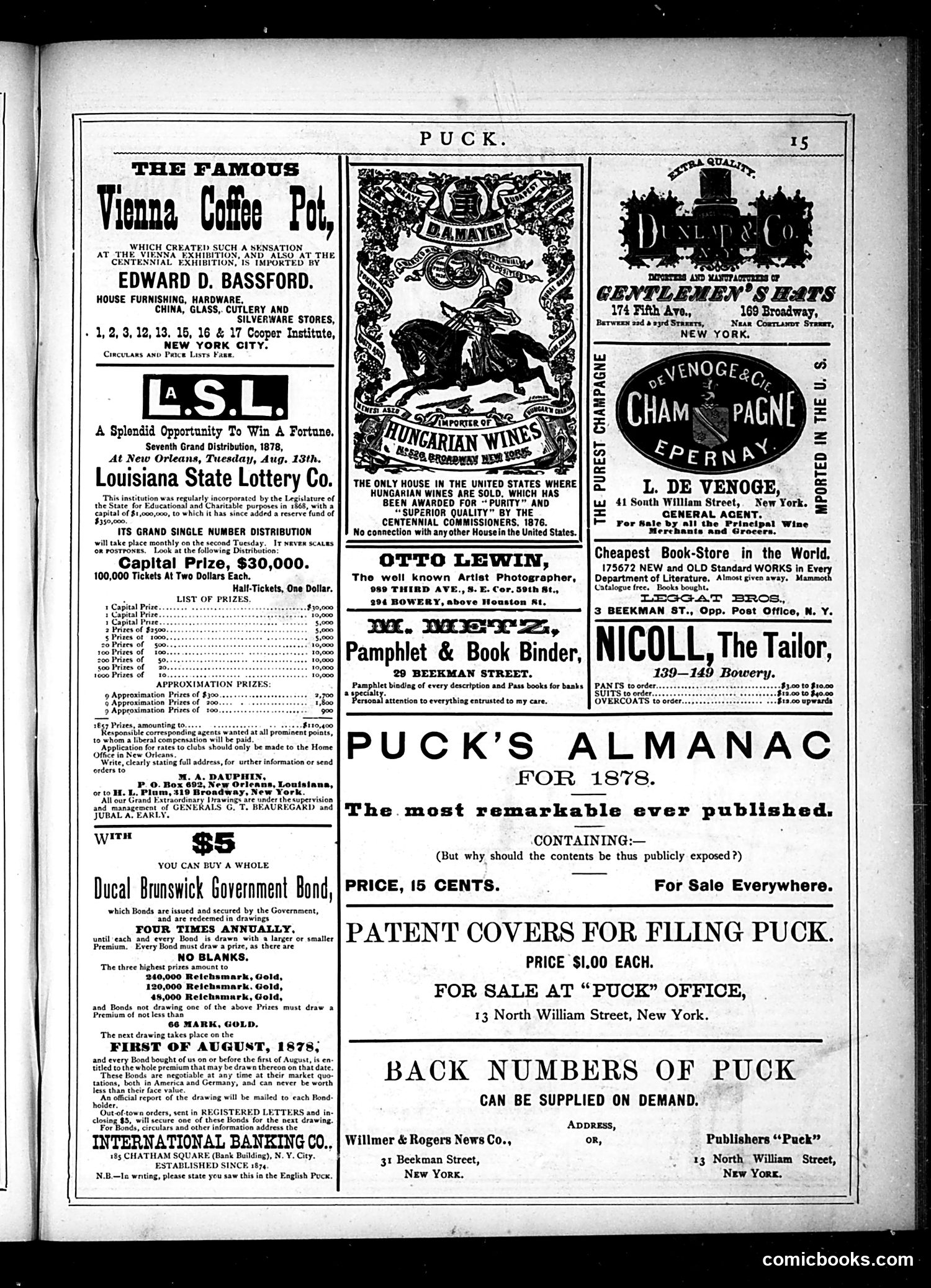
This page is primarily **advertising and promotional material** for Puck magazine itself, rather than featuring political cartoons. The central content advertises **"Puck's Almanac for 1878"** as "the most remarkable ever published," priced at 15 cents, available "For Sale Everywhere." The page also promotes patent covers for filing Puck ($1 each), back numbers available on demand, and subscription information. Surrounding this are advertisements for various 1870s businesses: a Vienna Coffee Pot, Hungarian wines, champagne, gentlemen's hats, a tailor shop, and lottery tickets. There is one decorative illustration of a horse and rider in period costume, but no clear political satire or social commentary visible on this particular page. This appears to be a back-page or interior advertising section of the magazine.
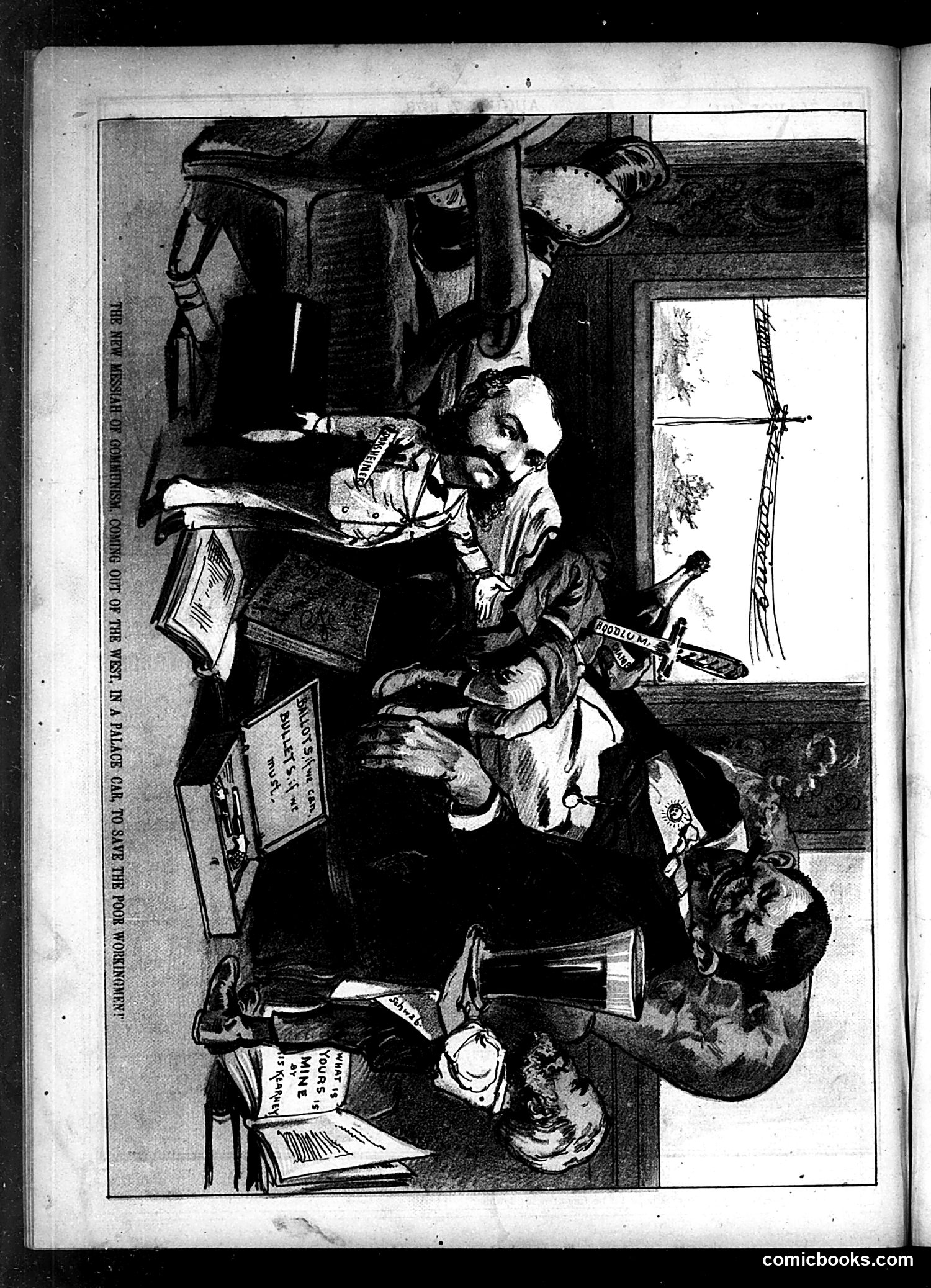
This political cartoon satirizes a figure (likely a politician or public official based on the formal dress) surrounded by documents, papers, and what appears to be correspondence. The character is depicted in a cluttered indoor setting near a window, overwhelmed by bureaucratic materials. The satire appears to target administrative incompetence or bureaucratic excess—a common Puck theme. The scattered papers, books, and documents suggest someone drowning in red tape or administrative responsibilities. A smaller figure (possibly representing the public or a constituent) appears below, seemingly ignored or overlooked. Without being able to read all text clearly, the exact political figure or specific scandal being mocked remains unclear, but the cartoon critiques government inefficiency and the gap between officials and those they serve.