
Puck, 1878-07-31 · page 2 of 16
Puck — July 31, 1878 — page 2: what you’re looking at
What you’re looking at
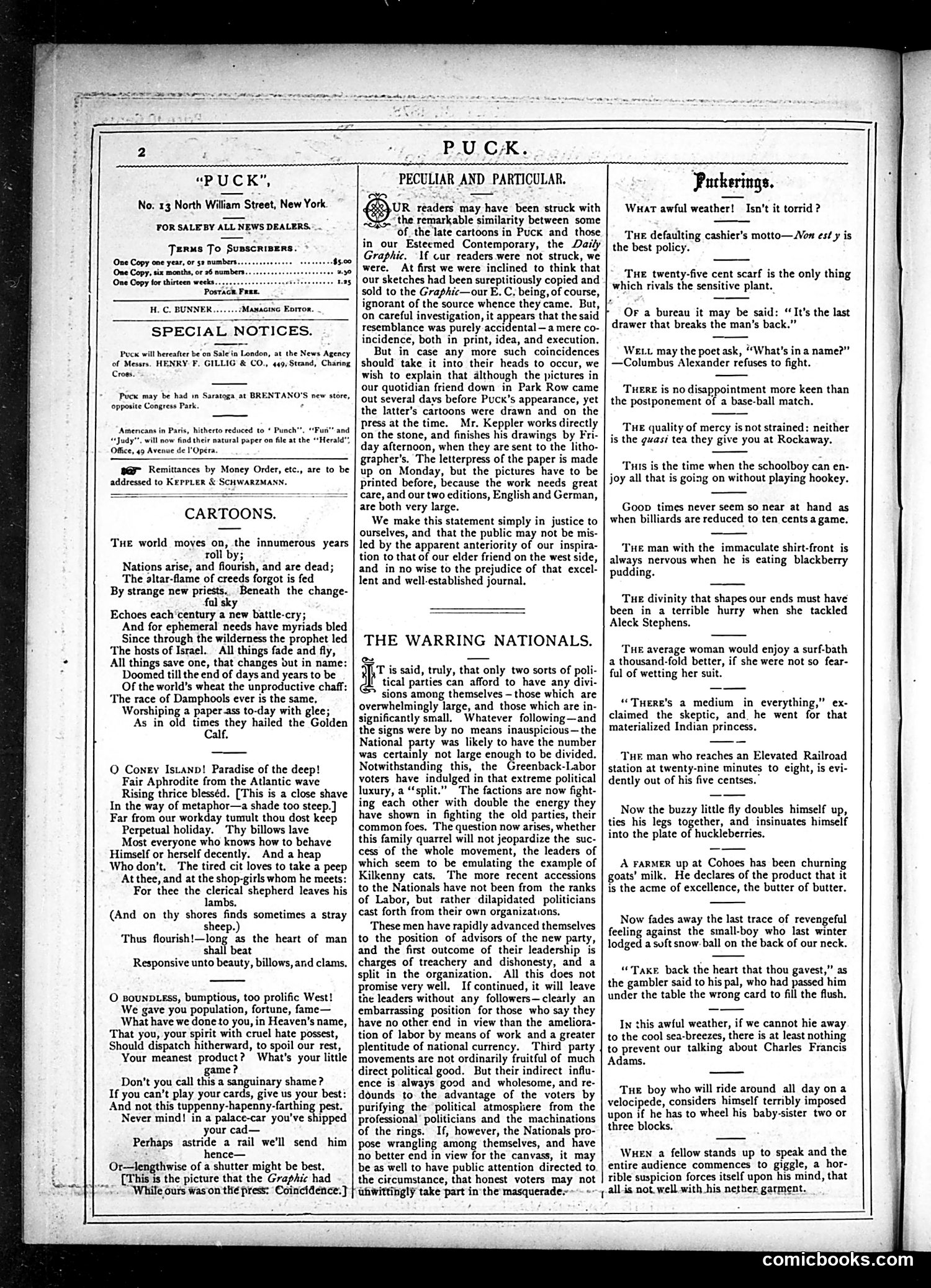
This page is primarily **text-based editorial and satirical commentary** rather than illustrated cartoons. The main political article, "THE WARRING NATIONALS," discusses factional infighting within what appears to be a labor or socialist political movement, specifically mentioning the **Greenback-Labor party** and criticisms of competing factions (possibly referencing the Populist/National party movements of the 1880s-90s). The satire argues these political groups are fragmenting through internal disputes over leadership and ideology, weakening their electoral impact. The piece criticizes politicians prioritizing personal power over genuine reform. The page also contains "Puckerings" (brief witticisms) and "Peculiar and Particular" commentary on various social observations. Without visible illustrations, the satire relies entirely on written critique of contemporary political dysfunction.
📄 Transcribed text from this page (OCR, searchable)
Machine-transcribed from the original scan — historical spelling and the odd misread are preserved.
PUCK. “PUCK”, No. 13 North William Street, New York. FOR SALE BY ALL NEWS DEALERS... Jurms To Susscriners. * One Copy one year, or 52 numbers... One Copy, six months, or 26 numbers ‘One Copy for thirteen weeks..... Postace Fraz. H. C. BUNNER......./Mawactnc Eorror. SPECIAL NOTICES. Puck will hereafter be'on Sale in London, at the News Agency of Messrs. HENRY: F. GILLIG & CO., 449, Strand, Charing Cross. Puck may be had in Saratoga at BRENTANO'S new store, opposite Congress Park. : ‘Amencans in Paris, hitherto reduced to ‘ Punch"*. “Fu and “Judy”, will now find their natural paper on file at the “Herald”: Office, 49 Avenue de I’ Opéra. e@r Remittances by Money Order, etc., are to be addressed to KErPLer CARTOONS. Tue world moyes on, the innumerous years roll by; Nations arise, and fiourish, and are dead; The altar-flame of creeds forgot is fed By strange new Priests. Beneath the change- Echoes each‘century a new battle-cry; ‘And for ephemeral needs have myriads bled Since through the wilderness the prophet led ‘The hosts of Israel. All things fade and fly, All things save one, that changes but in name: Doomed till the end of days and years to be Of the world’s wheat the unproductive chaff: ‘The race of Damphools ever is the same, Worshiping a paper-ass to-day with glee; As in old times they hailed the Golden O Coney Istanp! Paradise of the deep! Fair Aphrodite from the Atlantic wave Rising thrice blesséd. [This is a close shave In the way of metaphor—a shade too steep.] Far from our workday tuntult thou dost keep Perpetual holiday. Thy billows lave Most everyone who knows how to behave Himself or herself decently. And a heap Who don’t. The tired cit loves to take a peep At thee, and at the shop-girls whom he meets: For thee the clerical shepherd leaves his lambs. (And on thy shores finds sometimes a stray sheep.) Thus flourish!—long as the heart of man shall beat Responsive unto beauty, billows, and clams, O BounDLEss, bumptious, too prolific West! We gave you population, fortune, fame— What have we done to you, in Heaven's name, That you, your spirit with cruel hate possest, Should dispatch hitherward, to spoil our rest, Your meanest product? What's your little game Don’t you call this a sanguinary shame? If you can’t play your cards, give us your best: And not this tuppenny-hapenny-farthing pest. Never mind! in a palace-car you've shipped your cad— Perhaps astride a rail we'll send him ‘ hence— Or—lengthwise of a shutter might be best. [This is the picture that the Graphic had >. While ours was on the press: Coincidence.} PECULIAR AND PARTICULAR. UR readers may have been struck with the remarkable similarity between some of the late cartoons in Puck and those in our Esteemed Contemporary, the Daily Graphic. lf cur readers. were not struck, we were, At first we were inclined to think that our sketches had been sureptitiously copied and sold to the Graphic—our E. C. being, of course, ignorant of the source whence they came. But, |* on careful investigation, it appears that the said resemblance was purely accidental—a mere co- incidence, both in print, idea, and execution. But in case any more such coincidences should take it into their heads to occur, we wish to explain that although the pictures in our quotidian friend down in Park Row came out several days before Puck's appearance, yet the latter's cartoons were drawn and on the press at the time. Mr. Keppler works directly on the stone, and finishes his drawings by Fri- day afternoon, when they are sent to the litho- grapher’s. The letterpress of the paper is made up on Monday, but the pictures have to be printed before, because the work needs great care, and our two editions, English and German, are both very large. We make this statement simply in justice to ourselves, and that the public may not be mis- led by the apparent anteriority of our inspira- tion to that of our elder friend on the west side, and in no wise to the prejudice of that excel- lent and well-established journal. THE WARRING NATIONALS. ‘T is said, truly, that only two sorts of poli- tical parties can afford to have any divi- sions among themselves — those which are overwhelmingly large, and those which are in- significantly small. Whatever following—and the signs were by no means inauspicious—the National party was likely to have the number was certainly not large enough to be divided. Notwithstanding this, the Greenback-Labor voters have indulged in that extreme political luxury, a “split.” The factions are now fight- ing each other with double the energy they have shown in fighting the old parties, their common foes. The question now arises, whether this family quarrel will not jeopardize the suc- cess of the whole movement, the leaders of which seem to be emulating the example of Kilkenny cats, The more recent accessions to the Nationals have not been from the ranks of Labor, but rather dilapidated politicians cast forth from their own organizations. ‘These men have rapidly advanced themselves to the position of advisors of the new party, and the first outcome of their leadership is charges of treachery and dishonesty, and a split in the organization. All this does not promise very well. If continued, it will leave the leaders without any followers—clearly an embarrassing position for those who say they have no other end in view than the ameliora- tion of labor by means of work and a greater plentitude of national currency. Third party movements are not ordinarily fruitful of much direct political good. But their indirect influ- ence is always good and wholesome, and re- dounds to the advantage of the voters by purifying the political atmospiiere from the professional politicians and the machinations of the rings. If, however, the Nationals pro- pose wrangling among themselves, and have no better end in view for the canvass, it may be as well to have public attention directed to. the circumstance, that honest voters may not ‘ahwittingly take part in the masquerade~~*- ~~ Pauckerings. Wuat awful weather! Isn't it torrid ? Tue defaulting cashier’s motto—on est y is the best policy. Tue twenty-five cent scarf is the only thing which rivals the sensitive plant. Or a bureau it may be said: ‘It’s the last drawer that breaks the man’s back.” Welt may the poet ask, ‘What's in a name?” —Columbus Alexander refuses to fight. ‘Tuere is no disappointment more keen than the postponement of a base-ball match. THE quality of mercy is not strained: neither is the guasi tea they give you at Rockaway. ‘Tus is the time when the schoolboy can en- joy all that is going on without playing hookey. Goon times never seem so near at hand as when billiards are reduced to ten cents a game. ‘THe man with the immaculate shirt-front is always nervous when he is eating blackberry pudding. Tue divinity that shapes our ends must have been in a terrible hurry when she tackled Aleck Stephens. ‘Tue average woman would enjoy a surf-bath a thousand-fold better, if she were not so fear- ful of wetting her suit. “Tuere's a medium in everything,” ex- claimed the skeptic, and he went for that materialized Indian princess. ‘Tue man who reaches an Elevated Railroad station at twenty-nine minutes to eight, is evi- dently out of his five centses. Now the buzzy little fly doubles himself up, ties his legs together, and insinuates himself into the plate of huckleberries. A FARMER up at Cohoes has been churning goats’ milk, He declares of the product that it is the acme of excellence, the butter of butter. Now fades away the last trace of revengeful feeling against the small-boy who last winter lodged a suft snow: ball on the back of our neck. “Take back the heart that thou gavest,” as the gambler said to his pal, who had passed him under the table the wrong card to fill the flush, In this awful weather, if we cannot hie away to the cool sea-breezes, there is at least nothing to prevent our talking about Charles Francis Adams. Tue boy who will ride around all day ona velocipede, considers himself terribly imposed upon if he has to wheel his baby-sister two or three blocks. WHEN a fellow stands up to speak and the entire audience commences to giggle, a hor- rible suspicion forces itself upon his mind, that yallis not. well. with his nether. garment. comicbooks.com