
Puck, 1878-07-31 · page 7 of 16
Puck — July 31, 1878 — page 7: what you’re looking at
What you’re looking at
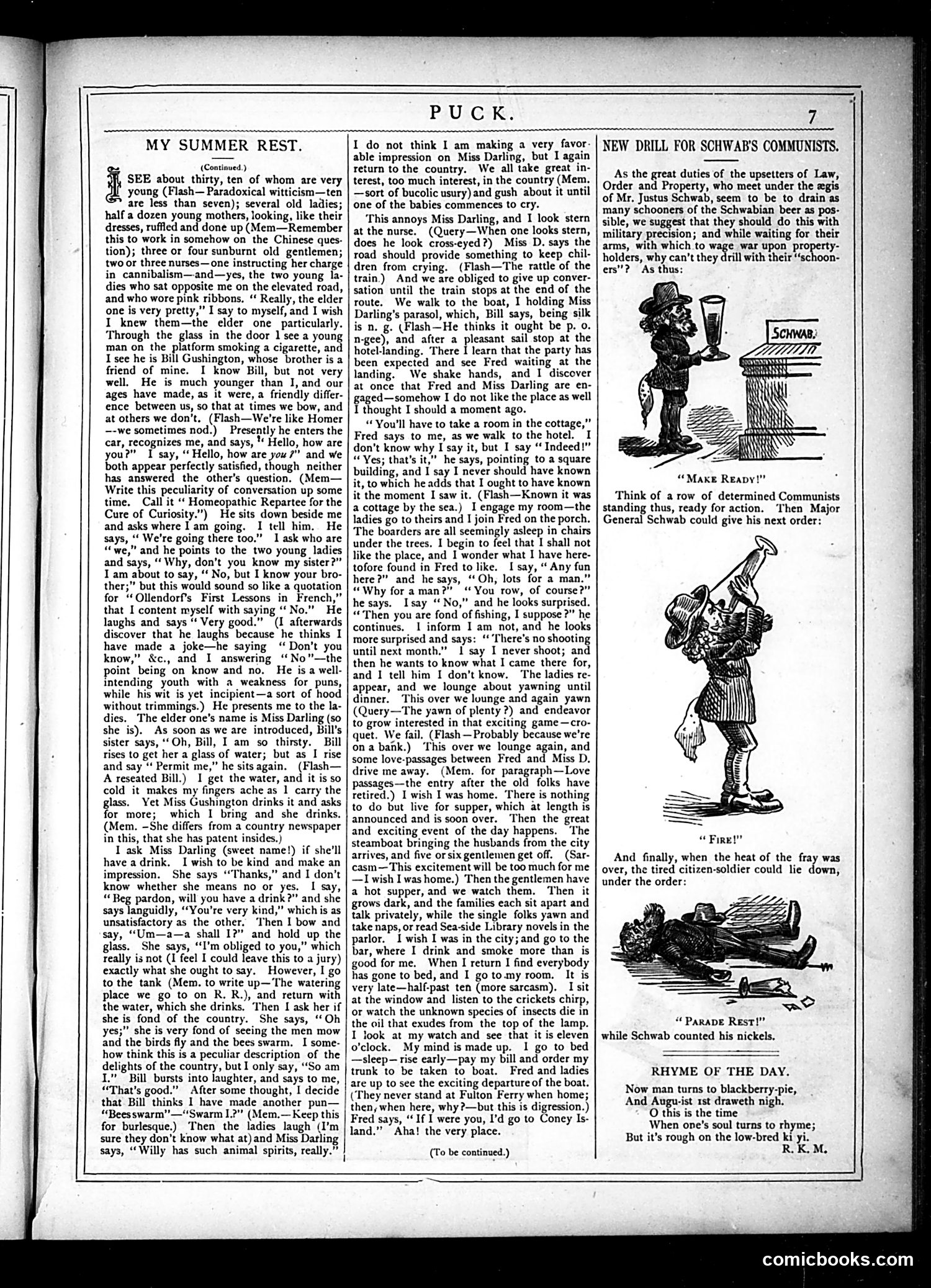
This cartoon satirizes **Charles M. Schwab**, a prominent steel industrialist of the Gilded Age, mocking him as sympathetic to communist or radical labor movements. The headline "Make Ready!" and accompanying illustrations show military-style drilling, suggesting Schwab is preparing armed communists for action. The satire likely responds to labor unrest in the steel industry and Schwab's complicated relationship with workers—either implying he was too lenient with radicals or that capitalists like him provoked revolutionary sentiment through poor labor conditions. The cartoon reflects America's post-industrial anxiety about communism and labor radicalism, treating Schwab as complicit in or deserving of such threats through his business practices. The military imagery suggests fear of organized worker uprisings.
📄 Transcribed text from this page (OCR, searchable)
Machine-transcribed from the original scan — historical spelling and the odd misread are preserved.
PUCK. 7 MY SUMMER REST. (Continued.) SEE about thirty, ten of whom are very young (Flash— Paradoxical witticism—ten are less than seven); several old ladies; half a dozen young mothers, looking, like their dresses, ruffled and done up (Mem—Remember this to work in somehow on the Chinese ques- tion); three or four sunburnt old gentlemen; two or three nurses—one instructing her charge in cannibalism—and—yes, the two young la- dies who sat opposite me on the elevated road, and who wore pink ribbons. ‘ Really, the elder one is very pretty,” I say to myself, and I wish I knew them—the elder one particularly. Through the glass in the door 1 see a young man on the platform smoking a cigarette, and I see he is Bill Gushington, whose brother is a friend of mine. I know Bill, but not very well, He is much younger than I, and our ages have made, as it were, a friendly differ- ence between us, so that at times we bow, and at others we don’t, (Flash—We're like Homer —-we sometimes nod.) Presently he enters the car, recognizes me, and says, * Hello, how are you?” TI say, “ Hello, how are you 7” and we both appear perfectly satisfied, though neither has answered the other's question. (Mem— Write this peculiarity of conversation up some time. Call it ‘‘ Homeopathic Repartee for the Cure of Curiosity.”) He sits down beside me and asks where I am going. I tell him. He says, ‘“‘ We're going there too,” 1 ask who are “we,” and he points to the two young ladies and says, Why, don’t you know my sister?” I am about to say, ‘‘ No, but I know your bro- ther;” but this would sound so like a quotation for “Ollendorf’s First Lessons in French,” that I content myself with saying “No.” He laughs and says “Very good.” (I afterwards discover that he laughs because he thinks I have made a joke—he saying “Don’t you know,” &c., and I answering ‘‘No"—the point being on know and no. He is a well- intending youth with a weakness for puns, while his wit is yet incipient—a sort of hood without trimmings.) He presents me to the la- dies. The elder one’s name is Miss Darling (so she is), As soon as we are introduced, Bill's sister says, “Oh, Bill, I am so thirsty. Bill rises to get her a glass of water; but as I rise and say “ Permit me,” he sits again. (Flash— A reseated Bill.) I get the water, and it is so cold it makes my fingers ache as 1 carry the glass. Yet Miss Gushington drinks it and asks for more; which I bring and she drinks. (Mem. -She differs from a country newspaper in this, that she has patent insides.) 1 ask Miss Darling (sweet name!) if she'll have a drink. I wish to be kind and make an impression. She says ‘“Thanks,” and I don’t know whether she means no or yes. I say, “ Beg pardon, will you have a drink?” and she says languidly, “You're very kind,” which is as unsatisfactory as the other. Then I bow and say, “Um—a—a shall 1?” and hold up the glass. She says, ‘I’m obliged to you,” which really is not (I feel I could leave this to a jury) exactly what she ought to say. However, I go to the tank (Mem. to write up—‘The watering place we go to on R. R.), and return with the water, which she drinks, Then I ask her if she is fond of the country. She says, ‘Oh yes;" she is very fond of seeing the men mow and the birds fly and the bees swarm. I some- how think this is a peculiar description of the delights of the country, but I only say, “So am I." Bill bursts into laughter, and says to me, “That's good.” After some thought, I decide that Bill thinks I have made another pun— “Bees swarm" —‘“Swarm I,?"" (Mem.— Keep this for burlesque.) ‘Then the ladies laugh (I'm sure they don’t know what at) and Miss Darling says, “Willy has such animal spirits, really.” | I do not think I am making a very favor- able impression on Miss Darling, but I again return to the country. We all take great in- terest, too much interest, in the country (Mem. —sort of bucolic usury) and gush about it until one of the babies commences to cry. ‘This annoys Miss Darling, and I look stern at the nurse. (Query—When one looks stern, does he look cross-eyed?) Miss D. says the road should provide something to keep chil- dren from crying. (Flash—The rattle of the train.) And we are obliged to give up conver- sation until the train stops at the end of the route. We walk to the boat, I holding Miss Darling's parasol, which, Bill says, being silk is n. g. (Flash—He thinks it ought be p. o. n-gee), and after a pleasant sail stop at the hotel-landing. There I learn that the party has been expected and see Fred waiting at the landing. We shake hands, and I discover at once that Fred and Miss Darling are en- gaged—somehow I do not like the place as well I thought I should a moment ago. “You'll have to take a room in the cottage,’ Fred says to me, as we walk to the hotel. I don’t know why I say it, but I say “ Indeed!” “Yes; that’s it,” he says, pointing to a square building, and I say I never should have known it, to which he adds that I ought to have known. it the moment I saw it. (Flash—Known it was a cottage by the sea.) I engage my room—the ladies go to theirs and I join Fred on the porch. The boarders are all seemingly asleep in chairs under the trees. I begin to feel that I shall not like the place, and I wonder what I have here- tofore found in Fred to like. I say, “ Any fun here?” and he says, “Oh, lots for a man.” “Why for aman?” “You row, of course?” he says. Isay “No,” and he looks surprised “Then you are fond of fishing, I suppose ?” he continues. 1 inform I am not, and he looks more surprised and says: ‘There's no shooting until next month.” I say I never shoot; and then he wants to know what I came there for, and I tell him I don’t know. The ladies re- appear, and we lounge about yawning until dinner. This over we lounge and again yawn (Query—The yawn of plenty ?) and endeavor to grow interested in that exciting game—cro- quet. We fail. (Flash—Probably because we're ona bank.) ‘This over we lounge again, and some love-passages between Fred and Miss D. drive me away. (Mem. for paragraph—Love passages—the entry after the old folks have retired.) I wish I was home. There is nothing to do but live for supper, which at length is announced and is soon over. Then the great and exciting event of the day happens. The steamboat bringing the husbands from the city arrives, and five orsix gentlemen get off. (Sar- casm—This excitement will be too much for me —I wish I was home.) Then the gentlemen have a hot supper, and we watch them. Then it grows dark, and the families each sit apart and talk privately, while the single folks yawn and take naps, or read Sea-side Library novels in the parlor. I wish I was in the city; and go to the bar, where I drink and smoke more than is good for me, When I return I find everybody has gone to bed, and I go to.my room. It is very late—half-past ten (more sarcasm). I sit at the window and listen to the crickets chirp, or watch the unknown species of insects die in the oil that exudes from the top of the lamp. look at my watch and see that it is eleven o'clock. My mind is made up. 1 go to bed —sleep— rise early—pay my bill and order my trunk to be taken to boat. Fred and ladies are up to see the exciting departure of the boat. (They never stand at Fulton Ferry when home; then, when here, why ?—but this is digression.) Fred says, ‘If I were you, I’d go to Coney Is- land.” Aha! the very place. (To be continued.) NEW DRILL FOR SCHWAB'S COMMUNISTS. As the great duties of the upsetters of Law, Order and Property, who meet under the egis of Mr, Justus Schwab, seem to be to drain as many schooners of the Schwabian beer as pos- sible, we suggest that they should do this with military precision; and while waiting for their arms, with which to wage war upon property- holders, why can’t they drill with their “schoon- ers’? As thus: “Make Reapy!”" Think of a row of determined Communists standing thus, ready for action. Then Major General Schwab could give his next order: “Fire!” And finally, when the heat of the fray was over, the tired citizen-soldier could lie down, under the order: — “ParabE Rest!” while Schwab counted his nickels, RHYME OF THE DAY. Now man turns to blackberry-pie, And Augu-ist 1st draweth nigh. O this is the time When one's soul turns to rhyme; But it’s rough on the low-bred ki yi. R.K.M. J| comicbooks.com