
Puck, 1878-07-31 · page 12 of 16
Puck — July 31, 1878 — page 12: what you’re looking at
What you’re looking at
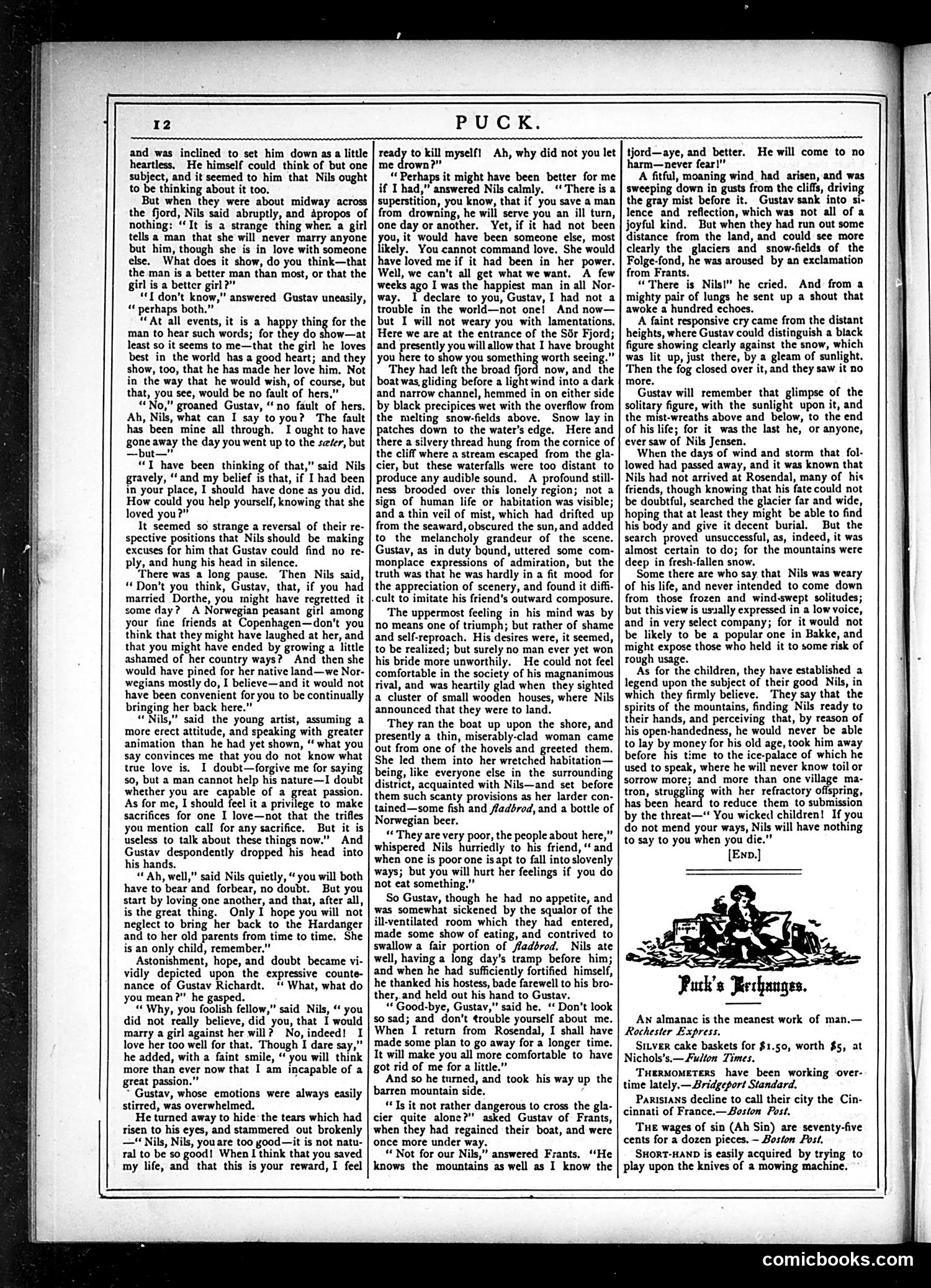
This page is primarily **text-based narrative fiction**, not political satire or cartoon content. It appears to be a serialized story titled "Puck's Intrigues" (visible at bottom right). The visible narrative concerns a character named Nils and his emotional conflicts—involving love, sacrifice, and moral dilemmas. The dense text discusses whether Nils should have saved a woman's life differently, touching on themes of duty and romantic obligation. **The small illustration** at the bottom shows what appears to be a winter landscape with figures, consistent with the Scandinavian setting mentioned in the text (references to "Norwegian," "Rosdahl," "glaciers"). This is primarily **serialized fiction content** rather than political commentary. Without the full context or headline, the specific satirical point—if any—remains unclear from this page alone.
📄 Transcribed text from this page (OCR, searchable)
Machine-transcribed from the original scan — historical spelling and the odd misread are preserved.
12 PUCK and was inclined to set him down asa little heartless. He himself could think of but one subject, and it seemed to him that Nils ought to be thinking about it too. But when they were about midway across the fjord, Nils said abruptly, and apropos of nothing: ‘It is a strange thing wher. a girl tells a man that she will never marry anyone but him, though she is in love with someone else. What does it show, do you think—that the man is a better man than most, or that the girl is a better girl?” “I don't know,” answered Gustav uneasily, “perhaps both.” “At all events, it is a happy thing for the man to hear such words; for they do show—at least so it seems to me—that the girl he loves best in the world has a good heart; and they show, too, that he has made her love him. Not in the way that he would wish, of course, but that, you see, would be no fault of hers.” “No,” groaned Gustav, “no fault of hers. Ah, Nils, what can I say to you? The fault has been mine all through. I ought to have gone away the day you went up to the se/er, but —but—" “I have been thinking of that,” said Nils gravely, ‘and my belief is that, if I had been in your place, I should have done as you did. How could you help yourself, knowing that she loved you?” It seemed so strange a reversal of their re- spective positions that Nils should be making excuses for him that Gustav could find no re- ply, and hung his head in silence. ‘There was a long pause. Then Nils said, “Don’t you think, Gustav, that, if you had married Dorthe, you might have regretted it some day? A Norwegian peasant girl among your fine friends at Copenhagen—don't you think that they might have laughed at her, and that you might have ended by growing a little ashamed of her country ways? And then she would have pined for her native land—we Nor- wegians mostly do, I believe—and it would not have been convenient for you to be continually bringing her back here.” “Nils,” said the young artist, assuming a more erect attitude, and speaking with greater animation than he had yet shown, “ what you say convinces me that you do not know what true love is. I doubt—forgive me for saying so, but a man cannot help his nature—I doubt whether you are capable of a great passion. As for me, I should feel it a privilege to make sacrifices for one I love—not that the trifles you mention call for any sacrifice. But it is useless to talk about these things now.” And Gustav despondently dropped his head into his hands. “Ah, well,” said Nils quietly, “ you will both have to bear and forbear, no doubt. But you start by loving one another, and that, after all, is the great thing. Only I hope you will not neglect to bring her back to the Hardanger and to her old parents from time to time. She is an only child, remember.” Astonishment, hope, and doubt became vi- vidly depicted upon the expressive counte- nance of Gustav Richardt. ‘‘ What, what do you mean?” he gasped. ‘Why, you foolish fellow,” said Nils, “ you did not really believe, did you, that I would marry a girl against her will? No, indeed! I love her too well for that. Though I dare say,” he added, with a faint smile, “ you will think more than ever now that I am incapable of a great passion.”” * Gustav, whose emotions were always easily stirred, was overwhelmed. He turned away to hide: the tears which had risen to his eyes, and stammered out brokenly —‘‘ Nils, Nils, youare too good—it is not natu- ral to be so good! When I think that you saved my life, and that this is your reward, I feel ready to kill myself! Ah, why did not you let me drown?” “Perhaps it might have been better for me if I had,” answered Nils calmly. ‘There is a superstition, you know, that if you save a man from drowning, he will serve you an ill turn, one day or another. Yet, if it had not been you, it would have been someone else, most ikely. You cannot command love. She would have loved me if it had been in her power. Well, we can’t all get what we want. A few weeks ago I was the happiest man in all Nor- way. I declare to you, Gustav, I had not a trouble in the world—not one! And now— but I will not weary you with lamentations. Here we are at the entrance of the Sér Fjord; and presently you will allow that I have brought you here to show you something worth seeing.” They had left the broad fjord now, and the boat was, gliding before a light wind into a dark and narrow channel, hemmed in on either side by black precipices wet with the overflow from the melting snow-fields above. Snow lay in patches down to the water's edge. Here and there a silvery thread hung from the cornice of the cliff where a stream escaped from the gla- cier, but these waterfalls were too distant to produce any audible sound. A profound still- ness brooded over this lonely region; not a sign of human life or habitation was visible; and a thin veil of mist, which had drifted up from the seaward, obscured the sun, and added to the melancholy grandeur of the scene. Gustav, as in duty bound, uttered some com- monplace expressions of admiration, but the truth was that he was hardly in a fit mood for the appreciation of scenery, and found it diffi- cult to imitate his friend’s outward composure. The uppermost feeling in his mind was by no means one of triumph; but rather of shame and self-reproach. His desires were, it seemed, to be realized; but surely no man ever yet won his bride more unworthily. He could not feel comfortable in the society of his magnanimous rival, and was heartily glad when they sighted a cluster of small wooden houses, where Nils announced that they were to land. They ran the boat up upon the shore, and presently a thin, miserably-clad woman came out from one of the hovels and greeted them. She led them into her wretched habitation— being, like everyone else in the surrounding district, acquainted with Nils—and set before them such scanty provisions as her larder con- tained—some fish and fladbrod, and a bottle of Norwegian beer. “They are very poor, the people about here,” whispered Nils hurriedly to his friend, “ and when one is poor one is apt to fall into slovenly ways; but you will hurt her feelings if you do not eat something.” So Gustav, though he had no appetite, and was somewhat sickened by the squalor of the ill-ventilated room which they had entered, made some show of eating, and contrived to swallow a fair portion of fladbrod. Nils ate well, having a long day’s tramp before him; and when he had sufficiently fortified himself, he thanked his hostess, bade farewell to his bro- ther, and held out his hand to Gustav. “Good-bye, Gustav," said he. “ Don’t look so sad; and don’t ¢rouble yourself about me. When I return from Rosendal, I shall have made some plan to go away for a longer time. It will make you all more comfortable to have got rid of me for a little.” And so he turned, and took his way up the barren mountain side. Ts it not rather dangerous to cross the gla- cier quite alone?” asked Gustav of Frants, when they had regained their boat, and were once more under way. “Not for our Nils,” answered Frants. ‘He knows the mountains as well as I know the tjord—aye, and better. He will come to no harm—never fear!" A fitful, moaning wind had arisen, and was sweeping down in gusts from the cliffs, drivin, the gray mist before it. Gustav sank into si- lence and reflection, which was not all of a joyful kind. But when they had run out some distance from the land, and could see more clearly the glaciers and snow-fields of the Folge-fond, he was aroused by an exclamation from Frants. “There is Nils!” he cried. And from a mighty pair of lungs he sent up a shout that awoke a hundred echoes. A faint responsive cry came from the distant heights, where Gustav could distinguish a black figure showing clearly against the snow, which was lit up, just there, by a gleam of sunlight. Then the fog closed over it, and they saw it no more. Gustav will remember that glimpse of the solitary figure, with the sunlight upon it, and the mist-wreaths above and below, to the end of his life; for it was the last he, or anyone, ever saw of Nils Jensen. When the days of wind and storm that fol- lowed had passed away, and it was known that Nils had not arrived at Rosendal, many of his friends, though knowing that his fate could not be doubtful, searched the glacier far and wide, hoping that at least they might be able to find his body and give it decent burial. But the search proved unsuccessful, as, indeed, it was almost certain to do; for the mountains were deep in fresh-fallen snow. Some there are who say that Nils was weary of his life, and never intended to come down from those frozen and wind-swept solitudes; but this view is usually expressed in a low voice, and in very select company; for it would not be likely to be a popular one in Bakke, and might expose those who held it to some risk of rough usage. As for the children, they have established a legend upon the subject of their good Nils, in which they firmly believe. They say that the spirits of the mountains, finding Nils ready to their hands, and perceiving that, by reason of his open-handedness, he would never be able to lay by money for his old age, took him away before his time to the ice-palace of which he used to speak, where he will never know toil or sorrow more; and more than one village ma- tron, struggling with her refractory offspring, has been heard to reduce them to submission by the threat—‘‘ You wicked children! If you do not mend your ways, Nils will have nothing to say to you when you die.”” Aw almanac is the meanest work of man.— Rochester Express. Stiver cake baskets for $1.50, worth $5, at Nichols’s,— Fulton Times. THERMOMETERS have been working over- time lately.—Bridgeport Standard, Parisians decline to call their city the Cin- cinnati of France.—Boston Post. Tue wages of sin (Ah Sin) are seventy-five cents for a dozen pieces. — Boston Post. Suort-HAnp is easily acquired by trying to play upon the knives of a mowing machine. comicbooks.com