
Puck, 1878-07-31 · page 10 of 16
Puck — July 31, 1878 — page 10: what you’re looking at
What you’re looking at
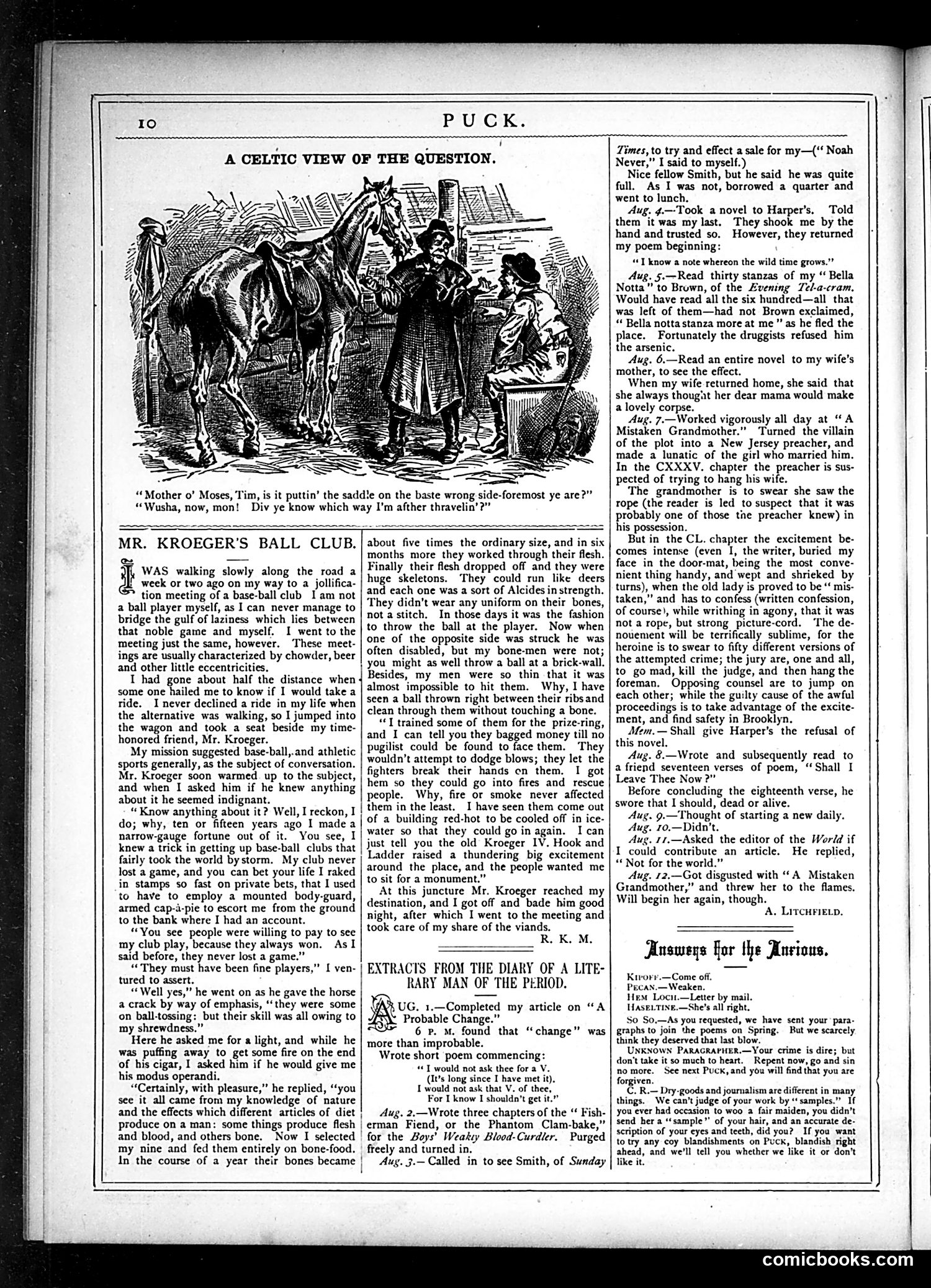
This cartoon depicts an Irish person (identified by the "Celtic" label and visual stereotyping) attempting to saddle a horse backwards. The accompanying dialogue—"Mother o' Moses, Tim, is it puttin' the saddle on the baste wrong side-foremost ye are?" and "Wusha, now, mon! Div ye know which way I'm after travellin'?"—presents Irish characters as comically incompetent and confused about basic tasks. The satire targets Irish immigrants through ethnic stereotyping, portraying them as foolish and befuddled. This reflects late-19th-century American prejudice against Irish populations, depicting them as unintelligent or bumbling—a common theme in period satirical magazines like Puck.
📄 Transcribed text from this page (OCR, searchable)
Machine-transcribed from the original scan — historical spelling and the odd misread are preserved.
PUCK. A CELTIC VIEW OF THE QUESTION. “Wusha, now, mon! “Mother o’ Moses, Tim, is it puttin’ the sadd!e on the baste wrong side-foremost ye are?” Div ye know which way I’m afther thravelin’?” MR. KROEGER’S BALL CLUB. i WAS walking slowly along the road a week or two ago on my way to a jollifica- tion meeting of a base-ball club Iam not a ball player myself, as I can never manage to bridge the gulf of laziness which lies between that noble game and myself. I went to the meeting just the same, however. These meet- ings are usually characterized by chowder, beer and other little eccentricities, I had gone about half the distance when some one hailed me to know if I would take a ride. I never declined a ride in my life when the alternative was walking, so I jumped into the wagon and took a seat beside my time- honored friend, Mr. Kroeger. My mission suggested base-ball,.and athletic sports generally, as the subject of conversation. Mr. Kroeger soon warmed up to the subject, and when I asked him if he knew anything about it he seemed indignant. “ Know anything about it? Well, I reckon, I do; why, ten or fifteen years ago 1 made a narrow-gauge fortune out of it. You see, I knew a trick in getting up base-ball clubs that fairly took the world by storm. My club never lost a game, and you can bet your life I raked in stamps so fast on private bets, that I used to have to employ a mounted body-guard, armed cap-i-pie to escort me from the ground to the bank where I had an account. “You see people were willing to pay to see my club play, because they always won. As I said before, they never lost a game.” “They must have been fine players,” I ven- tured to assert. “Well yes,” he went on as he gave the horse a crack by way of emphasis, “they were some on ball-tossing: but their skill was all owing to my shrewdness.” Here he asked me for a light, and while he was puffing away to get some fire on the end of his cigar, I asked him if he would give me his modus operandi. “Certainly, with pleasure,” he replied, “you see it all came from my knowledge of nature and the effects which different articles of diet produce on a man: some things produce flesh and blood, and others bone. Now I selected my nine and fed them entirely on bone-food. in the course of a year their bones became about five times the ordinary size, and in six months more they worked through their flesh. Finally their flesh dropped off and they were huge skeletons. They could run like deers and each one was a sort of Alcides in strength. ‘They didn’t wear any uniform on their bones, nota stitch. In those days it was the fashion to throw the ball at the player. Now when one of the opposite side was struck he was often disabled, but my bone-men were not; you might as well throw a ball at a brick-wall. Besides, my men were so thin that it was almost impossible to hit them. Why, I have seen a ball thrown right between their ribsand clean through them without touching a bone. “(T trained some of them for the prize-ring, and I can tell you they bagged money till no pugilist could be found to face them. They wouldn’t attempt to dodge blows; they let the fighters break their hands cn them. I got hem so they could go into fires and rescue people. Why, fire or smoke never affected them in the least. I have seen them come out of a building red-hot to be cooled off in ice- water so that they could go in again. I can just tell you the old Kroeger IV. Hook and Ladder raised a thundering big excitement around the place, and the people wanted me to sit for a monument.” At this juncture Mr. Kroeger reached my destination, and I got off and bade him good night, after which I went to the meeting and took care of my share of the viands. R. K. M. EXTRACTS FROM THE DIARY OF A LITE- | RARY MAN OF THE PERIOD. UG. 1.—Completed my article on “A Probable Change.” 6 p. mM. found that “change” was more than improbable. Wrote short poem commencing: «T would not ask thee fora V. (It’s long since I have met it), I would not ask that V. of thee, For I know I shouldn’t get it.” ; Aug. 2.—Wrote three chapters of the “ Fish- |erman Fiend, or the Phantom Clam-bake,” for the Boys’ Weakwy Blood-Curdler. Purged freely and turned in. ‘Aug. 3.— Called in to see Smith, of Sunday Times, to try and effect a sale for my—(‘‘ Noah Never,” I said to myself.) Nice fellow Smith, but he said he was quite full. As I was not, borrowed a quarter and went to lunch, ‘Aug. ¢—Took a novel to Harper's, Told them it was my last. They shook me by the hand and trusted so. However, they returned my poem beginning: «know a note whereon the wild time grows.”” Aug. 5.—Read thirty stanzas of my “ Bella Notta” to Brown, of the Evening Tel-a-cram. Would have read all the six hundred—all that was left of them—had not Brown exclaimed, “ Bella notta stanza more at me " as he fled the place. Fortunately the druggists refused him the arsenic. Aug. 6.—Read an entire novel to my wife’s mother, to see the effect. When my wife returned home, she said that she always thougat her dear mama would make a lovely corpse. Aug. 7.—Worked vigorously all day at “A Mistaken Grandmother.” Turned the villain of the plot into a New Jersey preacher, and made a lunatic of the girl who married him. In the CXXXV. chapter the preacher is sus- pected of trying to hang his wife. The grandmother is to swear she saw the rope (the reader is led to suspect that it was probably one of those tne preacher knew) in his possession. But in the CL. chapter the excitement be- comes intense (even I, the writer, buried my face in the door-mat, being the most conve- nient thing handy, and wept and shrieked by turns), when the old lady is proved to be “ mis- taken,” and has to confess (written confession, of course), while writhing in agony, that it was not a rope, but strong picture-cord. ‘The de- nouement will be terrifically sublime, for the heroine is to swear to fifty different versions of the attempted crime; the jury are, one and all, to go mad, kill the judge, and then hang the foreman. Opposing counsel are to jump on each other; while the guilty cause of the awful proceedings is to take advantage of the excite- ment, and find safety in Brooklyn. Mem.—Shall give Harper's the refusal of this novel, Aug. 8.—Wrote and subsequently read to a friend seventeen verses of poem, “Shall I Leave Thee Now ?” Before concluding the eighteenth verse, he swore that I should, dead or alive. Aug. 9.—Thought of starting a new daily. ‘Aug. 70.—Didn't. Aug, 11,—Asked the editor of the World if I could contribute an article. He replied, “‘Not for the world.” Aug. 12.—Got disgusted with “A Mistaken Grandmother,” and threw her to the flames. Will begin her again, though. A, Livcurietp, Answeys For the Anrious, Kivorr.—Come off. Pec ‘Weaken. Hem Locit. HASELTE: be So So.—As you requested, we have sent your’ para- graphs to join the poems on Spring. Rut we scarcely think they deserved that last blow. UNKNOWN PARAGRAPHER.—Your crime is dire; but don’t take it so much to heart. Repent now, go and sin no more. See next Puck, and you will find that you are ry-goods and journalism are different in many We can’t judge of your work by ‘ samples.” If (a things. you ever had occasion to woo a fair maiden, you didn’t send her a “‘sample” of your hair, and an accurate de- scription of your eyes and teeth, did you? If you want to try any coy blandishments on Puck, blandish right ahead, and well tell you whether we like it or don't like it. comicbooks.com