
Puck, 1878-07-31 · page 4 of 16
Puck — July 31, 1878 — page 4: what you’re looking at
What you’re looking at
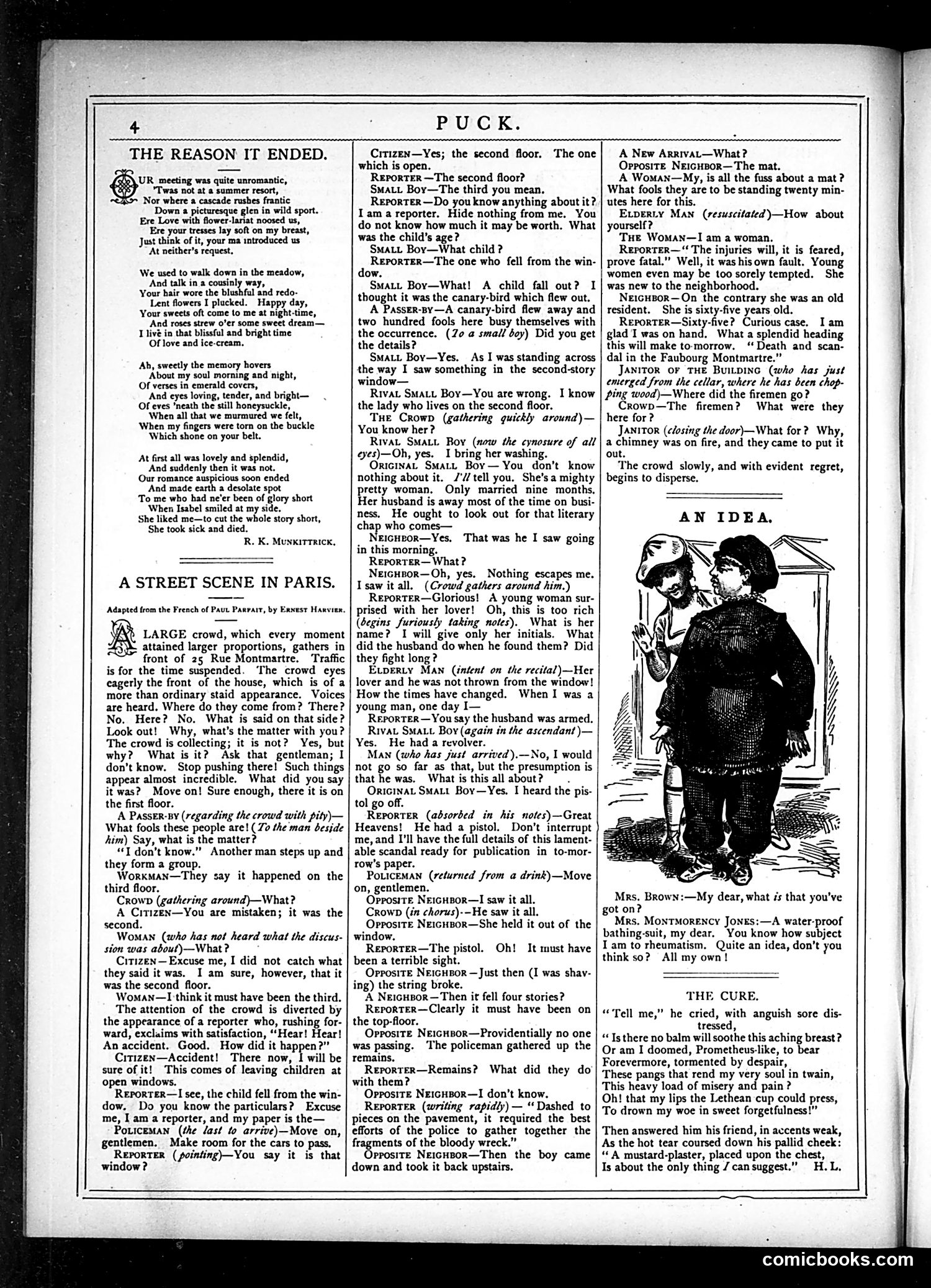
This page contains three distinct pieces rather than a unified cartoon: 1. **"The Reason It Ended"** — A poem about a failed romance, attributed to R.K. Munstrick. It's sentimental verse with no political content. 2. **"A Street Scene in Paris"** — A satirical dialogue adapted from French author Paul Parfait by Ernest Harvier. It depicts a street accident in Paris with multiple witnesses offering conflicting accounts. The satire targets how unreliable eyewitness testimony is, as different people describe the same incident (apparently a woman falling and a man with a pistol) in contradictory ways. 3. **"An Idea"** and **"The Cure"** — Brief humorous pieces about domestic life and relationships with no political significance. The content is primarily literary/social humor rather than political satire.
📄 Transcribed text from this page (OCR, searchable)
Machine-transcribed from the original scan — historical spelling and the odd misread are preserved.
4 PUCK. THE REASON IT ENDED. UR_ meeting was quite unromantic, "Twas not at a summer resort, Nor where a cascade rushes frantic Down a picturesque glen in wild sport. Ere Love with flower-lariat noosed us, Ere your tresses lay soft on my breast, Just think of it, your ma introduced us ‘At neither’s request, We used to walk down in the meadow, And talk in a cousinly way, Your hair wore the blushful and redo- Lent flowers I plucked. Happy day, Your sweets oft come to me at night-time, And roses strew o'er some sweet dream— I live in that blissful and bright time Of love and ice-cream, Ab, sweetly the memory hovers ‘About my soul morning and night, Of verses in emerald covers, ‘And eyes loving, tender, and bright— Of eves ‘neath the still honeysuckle, When all that we murmured we felt, When my fingers were torn on the buckle ‘Which shone on your belt. At first all was lovely and splendid, ‘And suddenly then it was not. Our romance auspicious soon ended ‘And made earth a desolate spot To me who had ne'er been of glory short When Isabel smiled at my side. She liked me—to cut the whole story short, She took sick and died. R. K. Munxirtrick, A STREET SCENE IN PARIS. Adapted from the French of Paut Panratr, by Ernest Harviex. LARGE crowd, which every moment attained larger proportions, gathers in front of 25 Rue Montmartre. Traffic is for the time suspended. ‘The crowd eyes eagerly the front of the house, which is of a more than ordinary staid appearance. Voices are heard. Where do they come from? There? No. Here? No, What is said on that side? Look out! Why, what's the matter with you? The crowd is collecting; it is not? Yes, but why? What is it? Ask that gentleman; I don’t know. Stop pushing there! Such things appear almost incredible. What did you say it was? Move on! Sure enough, there it is on the first floor. A Passer-By (regarding the crowd with pity)— What fools these people are! ( 70 the man beside him) Say, what is the matter? “I don’t know.” Another man steps up and they form a group. Workman—They say it happened on the third floor. Crown (gathering around)—What? A Citizen—You are mistaken; it was the second. Woman (who has not heard what the discus- sion was about)—What? Citizen—Excuse me, I did not catch what they said it was. I am sure, however, that it was the second floor. Woman—I think it must have been the third. The attention of the crowd is diverted by the appearance of a reporter who, rushing for- ward, exclaims with satisfaction, ‘Hear! Hear! An accident. Good. How did it happen?” Citizen—Accident! There now, Twill be sure of it! This comes of leaving children at open windows. Reporter—I see, the child fell from the win- dow. Do you know the particulars? Excuse me, I am a reporter, and my paper is the— Poticeman (the last to arrive)—Move on, gentlemen. Make room for the cars to pass, ReEporTER (pointing)—You say it is that window? Crtizen—Yes; the second floor. The one which is open. ReporTEeR—The second floor? Smatt Boy—The third you mean. ReEPoRTER—Do you know anything about it? Iam a reporter. Hide nothing from me. You do not know how much it may be worth. What was the child’s age? SMALL Boy—What child? - ReEPoRTER—The one who fell from the win- low. Smatt Bov—What! A child fall out? I thought it was the canary-bird which flew out. A Passer-By—A canary-bird flew away and two hundred fools here busy themselves with the occurrence. (70 a small boy) Did you get the details? Ssatt Bov—Yes, As I was standing across the way I saw something in the second-story window— Rivat Smatt Boy—You are wrong. I know the lady who lives on the second floor. Tue Crown (gathering quickly around)— You know her? Riva Smatt Boy (now the cynosure of all gyes)—Oh, yes. I bring her washing. Oricinat Smatt Boy— You don’t know nothing about it. /'//tell you. She's a mighty pretty woman. Only married nine months, Her husband is away most of the time on busi- ness. He ought to look out for that literary chap who comes— EIGHEOR—Yes. in this morning. ReEPORTER— What? NercHror—Oh, yes. Nothing escapes me. I saw it all. (Crowd gathers around him.) ReporTeR—Glorious! A young woman sur- prised with her lover! Oh, this is too rich (begins furiously taking notes). What is her name? I will give only her initials. What did the husband do when he found them? Did they fight long? EueRLY MAN (intent on the recital)—Her lover and he was not thrown from the window! How the times have changed. When I was a young man, one day I— ReporTER—You say the husband was armed. Rivat Smaxt Boy (again in the ascendant )— Yes. He had a revolver. MAN (who has just arrived).—No, I would not go so far as that, but the presumption is that he was. What is this all about? Oricinat Smatt Boy—Yes. I heard the pis- tol go off. Reporter (absorbed in his notes)—Great Heavens! He had a pistol. Don't interrupt me, and I'll have the full details of this lament- able scandal ready for publication in to-mor- row’s paper. POLICEMAN (returned from a drink)—Move on, gentlemen. Opposite NEIGHBOR—I saw it all. Crown (in chorus)-—He saw it all. Opposite NeiGHBor—She held it out of the window. ReporteR—The pistol. Oh! been a terrible sight. Opposite NEIGHBOR —Just then (I was shav- ing) the string broke. A NeicHpor—Then it fell four stories? Reporter—Clearly it must have been on the top-floor. Opposite NeicHBor—Providentially no one was passing. ‘The policeman gathered up the remains. ReportER—Remains? What did they do with them? Opposite NeicHBoR—I don’t know. REPORTER (writing rapidly) — ‘Dashed to pieces on the pavement, it required the best efforts of the police to gather together the fragments of the bloody wreck.” PPOSITE NEIGHBOR—Then the boy came down and took it back upstairs. That was he I saw going It must have A New ArrivaL—What? Opposite NEIGHBOR—The mat. A Woman—My, is all the fuss about a mat ? What fools they are to be standing twenty min- utes here for this. Experty Man (resuscitated )—How about yourself? THe Woman—I am a woman. Reporter—‘“ The injuries will, it is feared, prove fatal.” Well, it was his own fault. Young women even may be too sorely tempted. She was new to the neighborhood. NeicHBor—On the contrary she was an old resident. She is sixty-five years old. ReporTER—Sixty-five? Curious case. Iam glad I was on hand, What a splendid heading this will make to-morrow. ‘Death and scan- dal in the Faubourg Montmartre.” Janitor or THE Buiwpine (who has just emerged from the cellar, where he has been chop- ping wood}—Where did the firemen go? Crowp—The firemen? What were they here for? JanrTor (closing the door)—What for? Why, a chimney was on fire, and they came to put it out. The crowd slowly, and with evident regret, begins to disperse. AN IDEA, Mrs. Brown:—My dear, what és that you've got on? Mrs. Montmorency Jonrs:—A water-proof bathing-suit, my dear. “You know how subject Tam to rheumatism. Quite an idea, don’t you think so? All my own! THE CURE, “Tell me,” he cried, with anguish sore dis- tressed, “Tsthere no balm will soothe this aching breast ? Or am I doomed, Prometheus-like, to bear Forevermore, tormented by despair, ‘These pangs that rend my very soul in twain, This heavy load of misery and pain ? Oh! that my lips the Lethean cup could press, To drown my woe in sweet forgetfulness!” Then answered him his friend, in accents weak, As the hot tear coursed down his pallid cheek: ‘A mustard-plaster, placed upon the chest, Is about the only thing / can suggest.” H comicbooks.com