
Puck, 1878-07-31 · page 11 of 16
Puck — July 31, 1878 — page 11: what you’re looking at
What you’re looking at
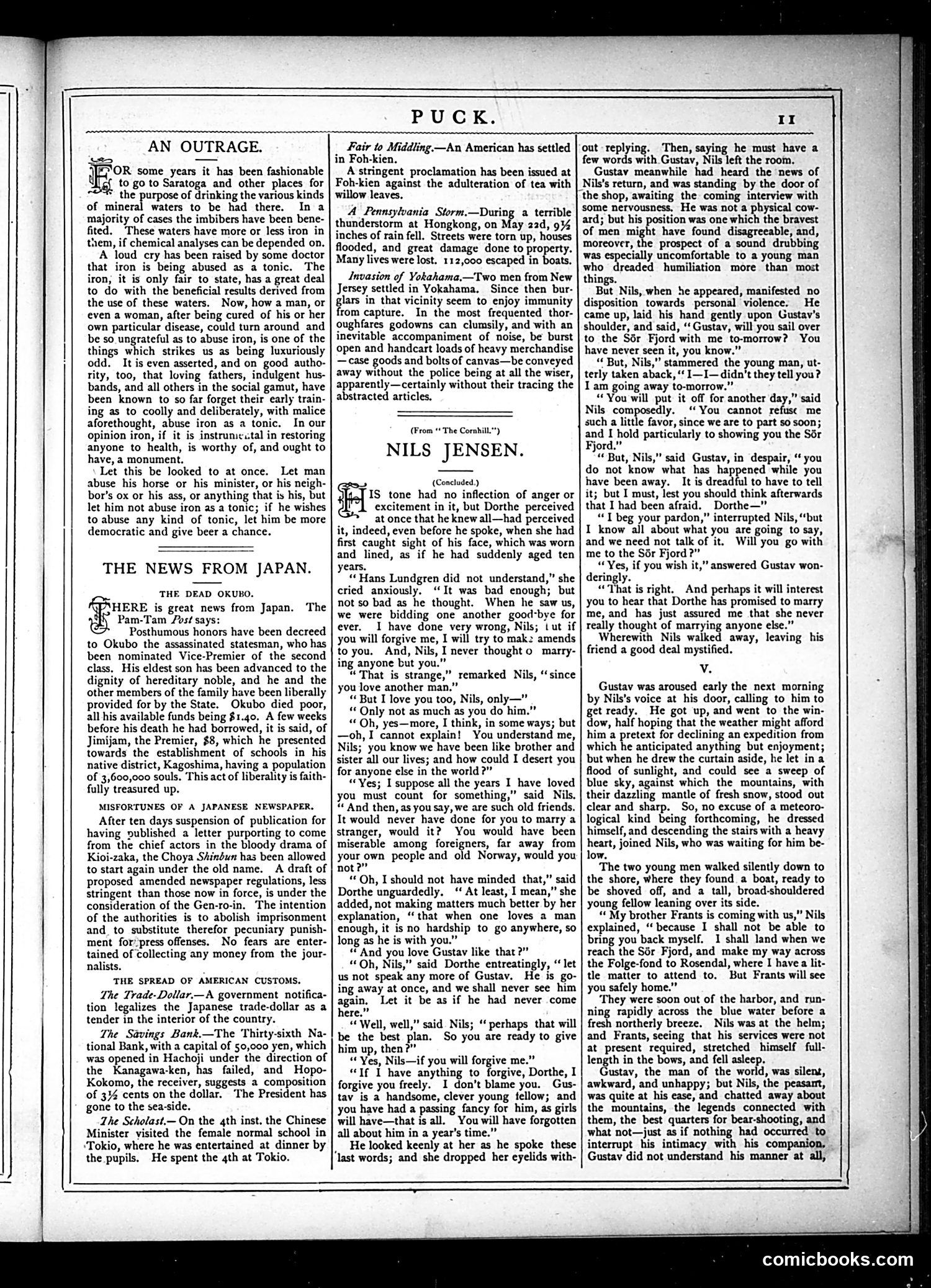
This page contains three separate articles rather than political cartoons: 1. **"An Outrage"** – Satirizes wealthy Americans who traveled to spas and mineral water resorts, claiming miraculous health benefits. The piece mocks both the gullible patients and the dubious medical claims. 2. **"The News From Japan"** – Reports on Japan's execution of assassins who killed Vice-Premier Ii Naosuke, framed as evidence of Japan's "barbaric" justice system compared to Western standards. 3. **"Nils Jensen"** – A serialized story (marked "Concluded") about a romantic conflict, likely continuing from previous issues. The page demonstrates Puck's mix of satirical commentary on American society alongside international news and fiction—typical of 1860s American humor magazines.
📄 Transcribed text from this page (OCR, searchable)
Machine-transcribed from the original scan — historical spelling and the odd misread are preserved.
PUCK. Ir AN OUTRAGE. >) ‘OR some years it has been fashionable to go to Saratoga and other places for Z the:parpase of drinking the various kinds of mineral waters to be had there. In a majority of cases the imbibers have been bene- fited. These waters have more or less iron in them, if chemical analyses can be depended on. A loud cry has been raised by some doctor that iron is being abused as a tonic. The iron, it is only fair to state, has a great deal to do with the beneficial results derived from the use of these waters. Now, how a man, or even a woman, after being cured of his or her own particular disease, could turn around and be so ungrateful as to abuse iron, is one of the things which strikes us as being luxuriously odd. It is even asserted, and on good autho- rity, too, that loving fathers, indulgent hus- bands, and all others in the social gamut, have been known to so far forget their early train- ing as to coolly and deliberately, with malice aforethought, abuse iron as a tonic. In our opinion iron, if it is instruniectal in restoring anyone to health, is worthy of, and ought to have, a monument. Let this be looked to at once. Let man abuse his horse or his minister, or his neigh- bor’s ox or his ass, or anything that is his, but let him not abuse iron as a tonic; if he wishes to abuse any kind of tonic, let him be more democratic and give beer a chance. THE NEWS FROM JAPAN. THE DEAD OKUKO. Fae is great news from Japan. The Pam-Tam Post says: Posthumous honors have been decreed to Okubo the assassinated statesman, who has been nominated Vice-Premier of the second class. His eldest son has been advanced to the dignity of hereditary noble, and he and the other members of the family have been liberally provided for by the State. Okubo died poor, all his available funds being $1.40. A few weeks before his death he had borrowed, it is said, of Jimijam, the Premier, $8, which he presented towards the establishment of schools in his native district, Kagoshima, having a population of 3,600,000 souls. This act of liberality is faith- fully treasured up. MISFORTUNES OF A JAPANESE NEWSPAPER. After ten days suspension of publication for having published a letter purporting to come from the chief actors in the bloody drama of Kioi-zaka, the Choya Shindun has been allowed to start again under the old name. A draft of proposed amended newspaper regulations, less stringent than those now in force, is under the consideration of the Gen-ro-in. The intention of the authorities is to abolish imprisonment and_to substitute therefor pecuniary punish- ment for*/press offenses. No fears are enter- tained of collecting any money from the jour- nalists. THE SPREAD OF AMERICAN CUSTOMS. ‘The Trade-Dollar.—A government notifica- tion legalizes the Japanese trade-dollar as a tender in the interior of the country. The Savings Bank.—The Thirty-sixth Na- tional Bank, with a capital of 50,000 yen, which was opened in Hachoji under the direction of the Kanagawa-ken, has failed, and Hopo- Kokomo, the receiver, suggests a composition of 334 cents on the dollar. ‘The President has gone to the sea-side. The Scholast.— On the 4th inst, the Chinese Minister visited the female normal school in ‘Tokio, where he was entertained at dinner by | the pupils. He spent the 4th at Tokio. Fair to Middling —An American has settled in Foh-kien. A stringent proclamation has been issued at Foh-kien against the adulteration of tea with willow leaves, A Pennsylvania Storm.—During a terrible thunderstorm at Hongkong, on May 22d, 9% inches of rain fell. Streets were torn up, houses flooded, and great damage done to property. Many lives were lost. 112,000 escaped in boats. Invasion of Yokahama,—Two men from New Jersey settled in Yokahama. Since then bur- lars in that vicinity seem to enjoy immunity rom capture. In the most frequented thor- oughfares godowns can clumsily, and with an inevitable accompaniment of noise, be burst open and handcart loads of heavy merchandise —case goods and bolts of canvas—be conveyed away without the police being at all the wiser, apparently—certainly without their tracing the abstracted articles, (From * The Corahill.”) NILS JENSEN. (Coneluded.) IS tone had no inflection of anger or excitement in it, but Dorthe perceived at once that he knew all—had perceived it, indeed, even before he spoke, when she had first caught sight of his face, which was worn and lined, as if he had suddenly aged ten years. “Hans Lundgren did not understand,” she cried anxiously. “It was bad enough; but not so bad as he thought. When he saw us, we were bidding one another good-bye for ever. I have done very wrong, Nils; tut if you will forgive me, I will try to mak: amends to you. And, Nils, I never thought o marry- ing anyone but you.” “That is strange,” remarked Nils, ‘since you love another man.” “But I love you too, Nils, only—” “Only not as much as you do him.” “Oh, yes—more, I think, in some ways; but —oh,I cannot explain! You understand me, Nils; you know we have been like brother and sister all our lives; and how could I desert you for anyone else in the world?” “Yes; I suppose all the years I have loved you must count for something,” said Nils. “ And then, as you say, we are such old friends. It would never have done for you to marry a stranger, would it? You would have been miserable among foreigners, far away from your own people and old Norway, would you not?” “Oh, I should not have minded that,” said Dorthe unguardedly, ‘At least, I mean,” she added, not making matters much better by her explanation, ‘that when one loves a man enough, it isno hardship to go anywhere, so long as he is with you.” “ And you love Gustav like that ?”” «Oh, Nils,” said Dorthe entreatingly, “let us not speak any more of Gustav. He is go- ing away at once, and we shall never see him again, Let it be as if he had never come here.” “Well, well,” said. Nils; “ perhaps that will be the best plan. So you are ready to give him up, then?” “Yes, Nils—if you will forgive me.” “If I have anything to forgive, Dorthe, I forgive you freely. I don’t blame you. Gus- tav is a handsome, clever young fellow; and you have had a passing fancy for him, as girls will have—that is all. You will have forgotten all about him in a year's time.” He looked keenly at her as he spoke these last words; and she dropped her eyelids with- out replying. Then, saying he must have a few words with Gustav, Nils left the room. Gustav meanwhile had heard the news of | Nils’s return, and was standing by the door of the shop, awaiting the coming interview with some nervousness, He was not a physical cow- ard; but his position was one which the bravest of men might have found disagreeable, and, moreover, the prospect of a sound drubbing was especialy uncomfortable to a young man who dreaded humiliation more than most things. But Nils, when he appeared, manifested no disposition towards personal violence. He came up, laid his hand gently upon Gustav's shoulder, and said, ‘Gustav, will you sail over to the Sér Fjord with me to-morrow? You have never seen it, you know.” “But, Nils,” stammered the young man, ut- terly taken aback, ‘‘ 1—I—didn’t they tell you? I am going away to-morrow.” “You will put it off for another day,” said Nils composedly. ‘You cannot refuse me such a little favor, since we are to part so soon; and. a hold particularly to showing you the Sor ‘jord.”” “But, Nils,” said Gustav, in despair, “ you do not know what has happened while you have been away. It is dreadful to have to tell it; but I must, lest you should think afterwards that I had been afraid. Dorthe—” “‘T beg your pardon,” interrupted Nils, “but 1 know all about what you are going to say, and we need not talk of it. Will you go with me to the Sér Fjord?” “Yes, if you wish it,” answered Gustav won- deringly. “That is right. And perhaps it will interest you to hear that Dorthe has promised to marry me, and has just assured me that she never really thought of marrying anyone else.” Wherewith Nils walked away, leaving his friend a good deal mystified. v. Gustav was aroused early the next morning by Nils’s voice at his door, calling to him to et ready. He got up, and went to the win- low, half hoping that the weather might afford him a pretext for declining an expedition from which he anticipated anything but enjoyment; but when he drew the curtain aside, he let in a flood of sunlight, and could see a sweep of blue sky, against which the mountains, with their dazzling mantle of fresh snow, stood out clear and sharp. So, no excuse of a meteoro- logical kind being forthcoming, he dressed himself, and descending the stairs with a heavy heart, joined Nils, who was waiting for him be- low. ‘The two young men walked silently down to the shore, where they found a boat, ready to be shoved off, and a tall, broad-shouldered young fellow leaning over its side. « My brother Frants is coming with us,” Nils explained, ‘ because I shall not be able to ed you back myself. 1 shall land when we reach the Sér Fjord, and make my way across the Folge-fond to Rosendal, where I have a lit- tle matter to attend to. But Frants will see you safely home.” ‘They were soon out of the harbor, and run- ning rapidly across the blue water before a fresh northerly breeze. Nils was at the helm; and Frants, seeing that his services were not at present required, stretched himself full- length in the bows, and fell asleep. Gustav, the man of the world, was silent, awkward, and unhappy; but Nils, the peasamt, was quite at his ease, and chatted away about the mountains, the legends connected with them, the best quarters for bear-shooting, and what not—just as if nothing had occurred to interrupt his intimacy with his companion, Gustav did not understand his manner at all, comicbooks.com