
A complete issue · 16 pages · 1878
Puck — June 5, 1878
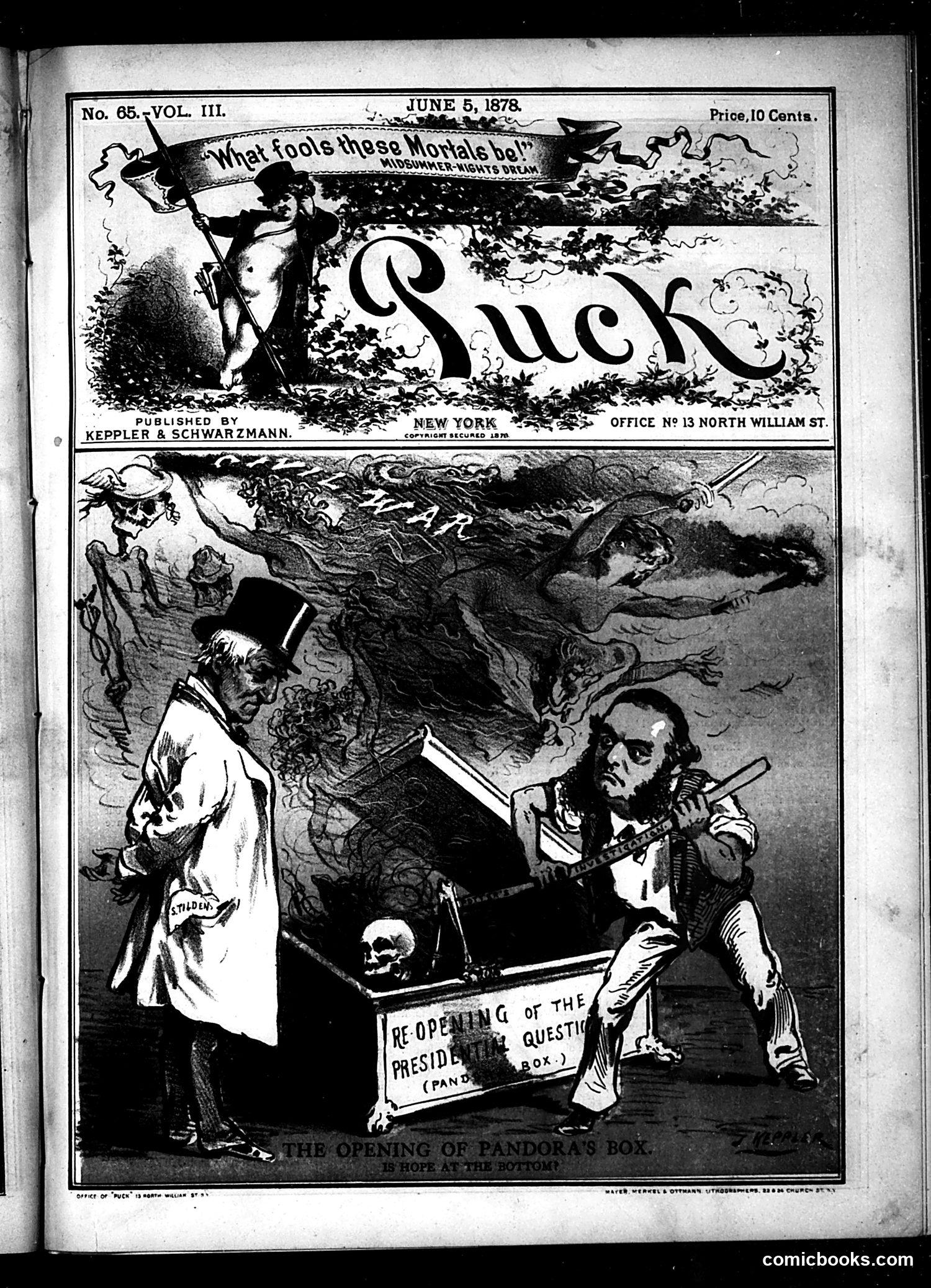
This cartoon, titled "The Opening of Pandora's Box," depicts a classical mythology reference applied to contemporary politics. A figure in formal dress (likely representing a political leader or the presidential office, as indicated by the "Re-opening of the Presidential Question" label) opens a box releasing chaos—represented by demons and troubled spirits emerging upward. The satire suggests that reopening a settled political question (possibly related to the 1878 elections or internal party disputes) will unleash unforeseen negative consequences. The classical allusion to Pandora's Box—where opening it released all human suffering—implies this political action is foolish and dangerous. The smaller figure on the right appears to observe the chaos with concern or resignation, emphasizing the gravity of the mistake.
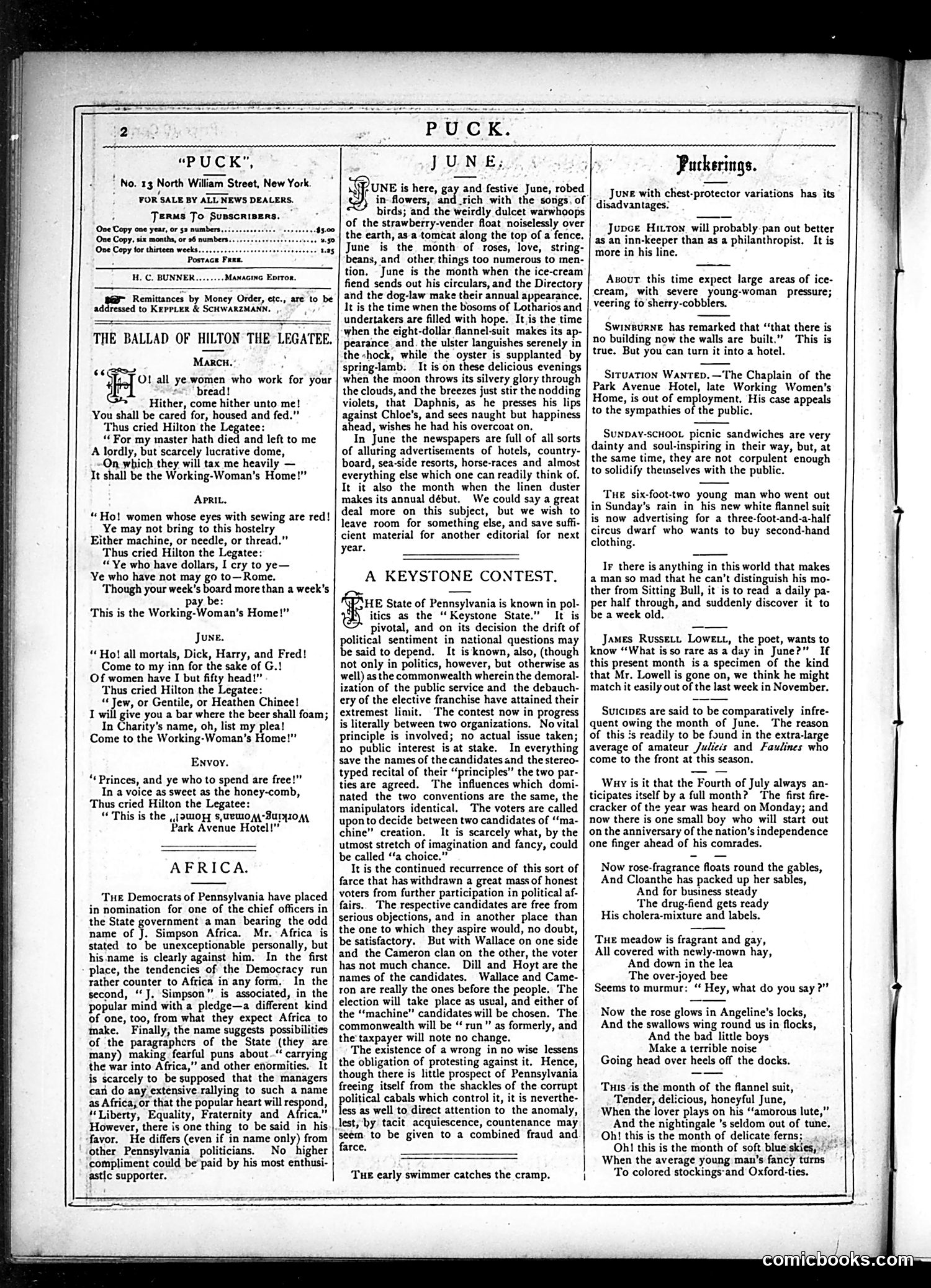
This page contains several satirical pieces rather than a single cartoon. The main content includes: **"The Ballad of Hilton the Legate"** — A poem mocking someone named Hilton (appears to be a religious or diplomatic figure) through verse about his various perceived failures and hypocrisies. **"A Keystone Contest"** — Political satire about Pennsylvania's Democratic Party, discussing internal disputes over candidates and the corrupting influence of "machine" politics. The piece criticizes how party machinery prioritizes control over genuine democratic choice. **"Africa"** — Commentary on Pennsylvania Democrats nominating J. Simpson Africa for office, with Puck suggesting this is a poor choice that exposes party desperation and corruption. The page primarily uses text-based satire rather than visual caricature, targeting 19th-century American political corruption and party dysfunction.
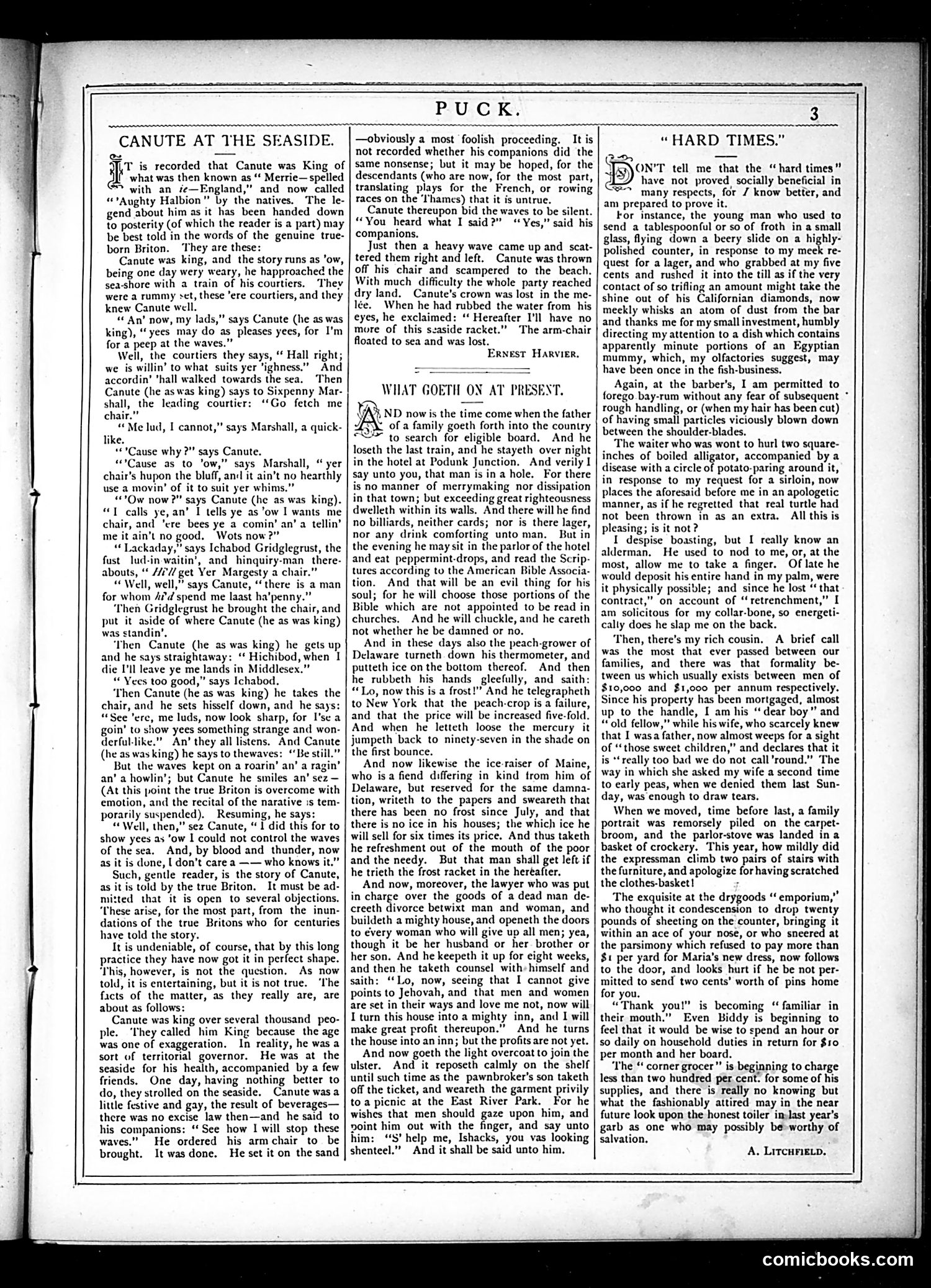
This page contains three satirical articles rather than visual cartoons: 1. **"Canute at the Seaside"** - A humorous retelling of King Canute's famous legend, comparing his futile command to the waves with modern British seaside tourism mishaps. The satire critiques overconfident authority figures. 2. **"What Goeth On at Present"** - Social commentary mocking various contemporary issues: a gossipy goeth (guest) complaining about hotel life during poor harvests, religious hypocrisy among the wealthy, and complaints about servants and household expenses. The piece satirizes upper-class complaints and pretension. 3. **"Hard Times"** - Ernest Harvier's column discussing economic hardship and various failed ventures, including ice-raising schemes and crop failures. The page relies on textual satire rather than illustrations, targeting social pretension and economic foolishness.
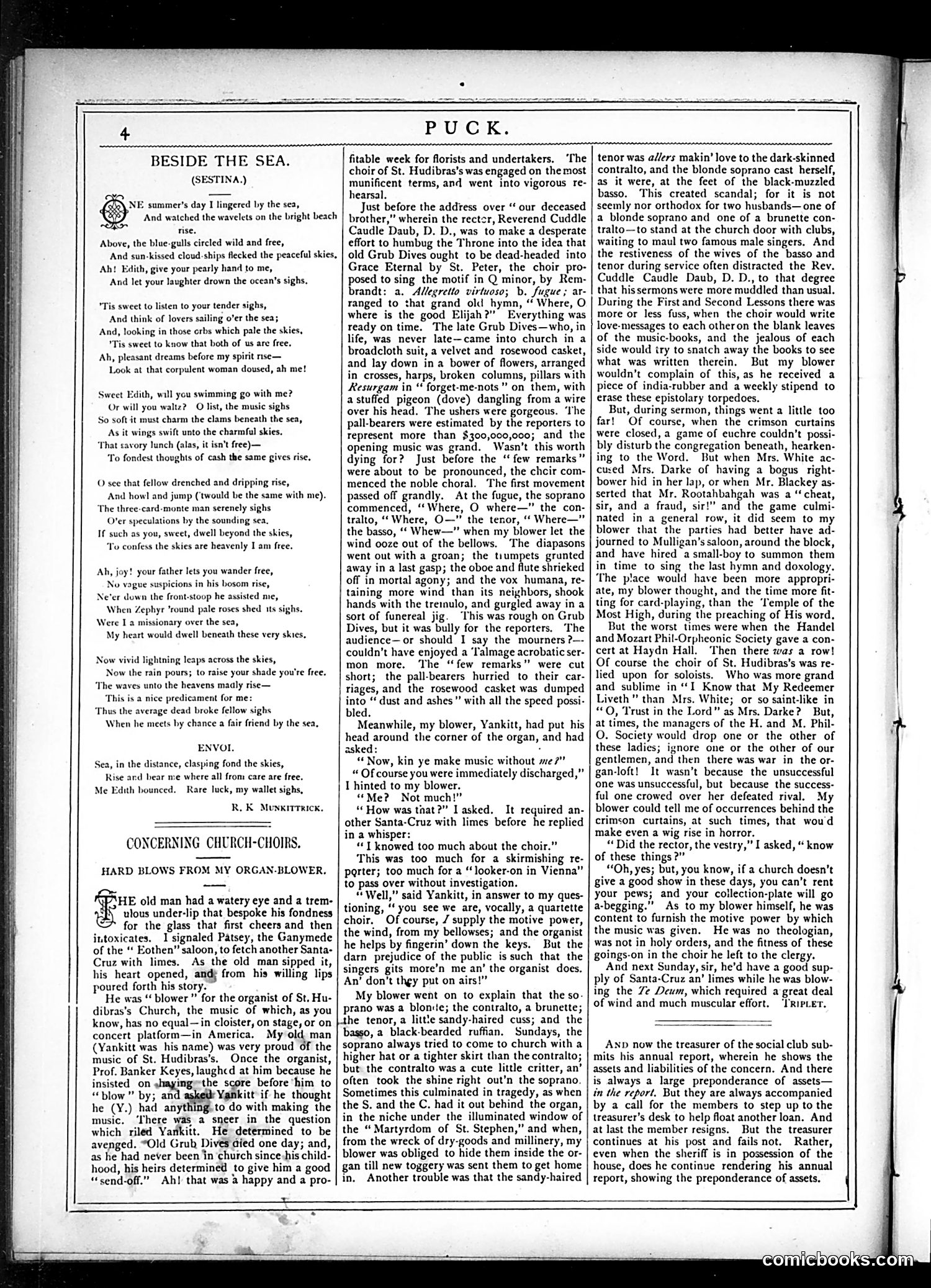
This page contains two distinct pieces: a poem titled "Beside the Sea (Sestina)" and a prose article "Concerning Church-Choirs: Hard Blows From My Organ-Blower." The poetry appears to be sentimental verse about seaside romance. The prose article is satirical commentary on church choir management and musician behavior. The author humorously recounts conflicts with an organ blower, complaints about soloists' vanity, and disputes over musical selections—particularly concerning whether to perform Handel's "Messiah" or Mozart pieces. The satire targets ecclesiastical pretension and the difficulties of managing artistic temperaments in religious settings. The author mocks both the organist's authority and choir members' egos, presenting church music administration as absurdly contentious. No specific political figures or events are referenced; the humor is social rather than topical.
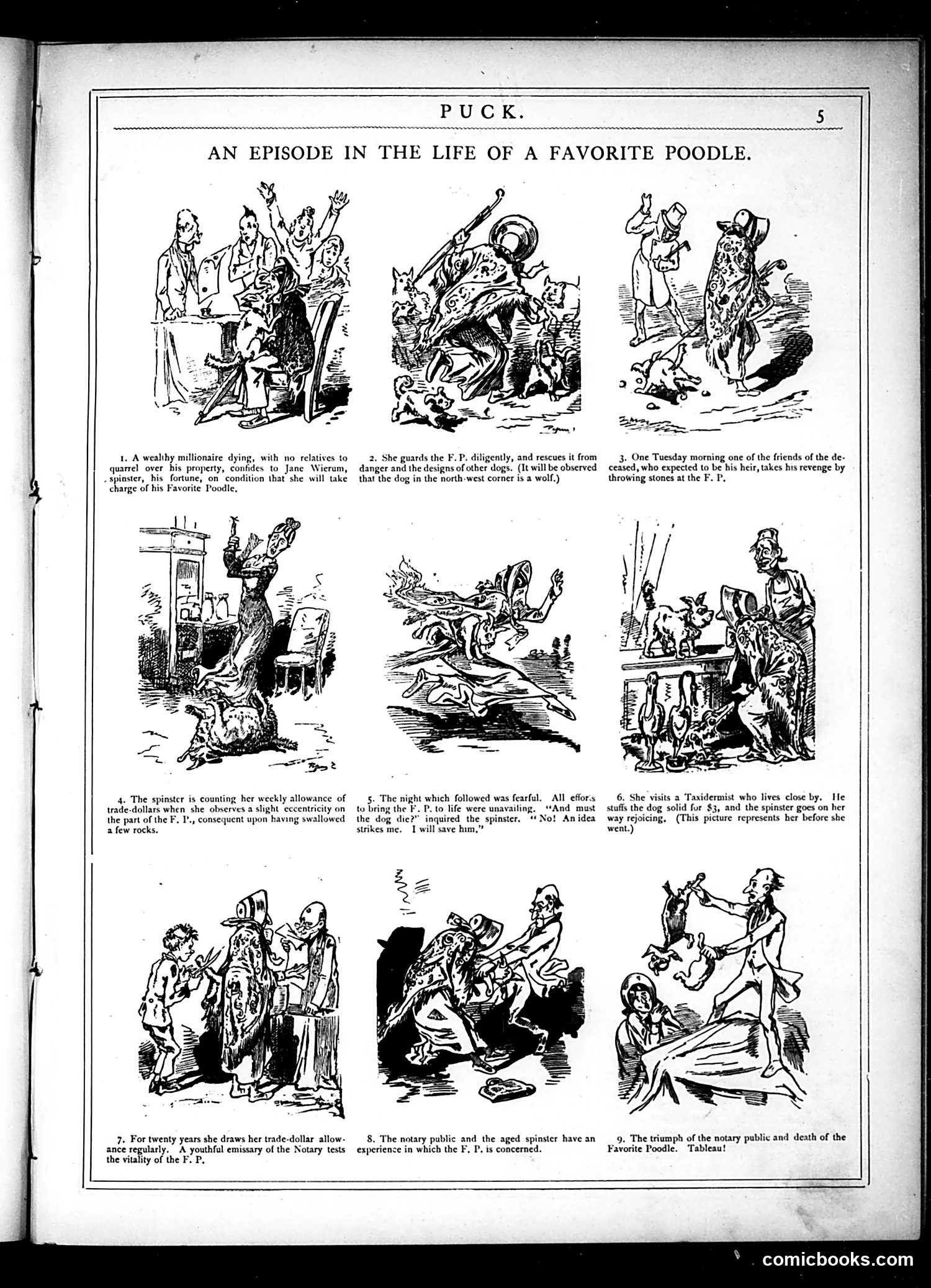
This is a satirical narrative strip following a wealthy man's poodle dog over twenty years. The story mocks the absurdity of aristocratic excess: a dying millionaire leaves his fortune to his dog rather than relatives (panel 1), guards protect the pampered pet (panel 2), and the dog's capricious owner takes revenge on those who displease it (panel 3). The satire escalates through panels showing the spinster drawing a regular "trade-dollar allowance" (panel 7) and culminates in panels 8-9 depicting the notary public's bemused witness to this spectacle and ultimately the dog's death—treating the poodle's life as genuinely consequential. The joke targets wealthy eccentrics who prioritize pets over people and rational inheritance practices.
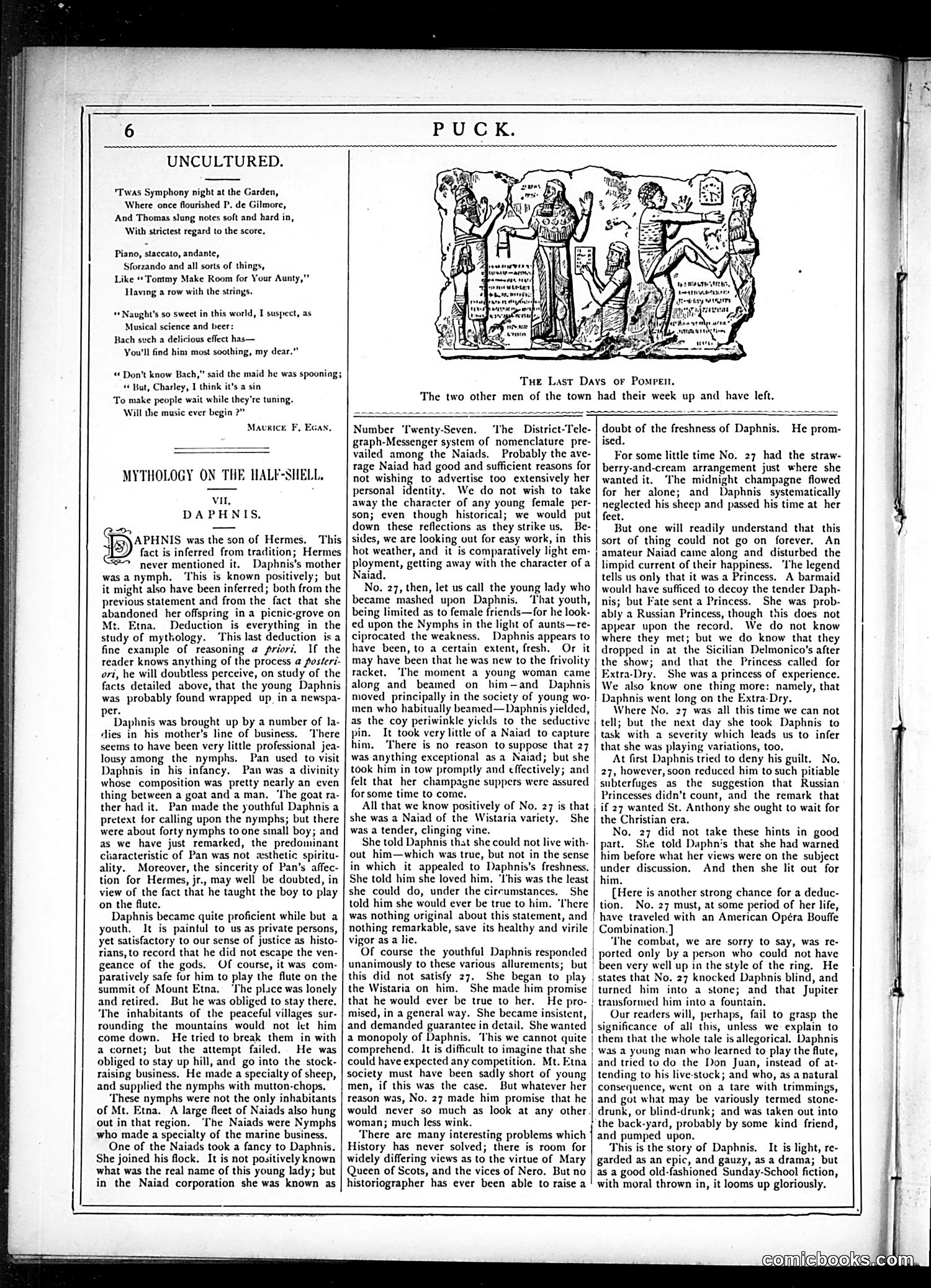
This page contains two separate pieces with no obvious political satire: **"Uncultured"** (left column) is a humorous poem by Maurice F. Egan mocking pretentious music appreciation. It describes a Symphony night where attendees discuss classical pieces while someone spoils the mood by requesting "Tommy Make Room for Your Aunty"—suggesting tension between highbrow and lowbrow entertainment preferences. **"Mythology on the Half-Shell: VI. Daphnis"** (right column) is a mythological essay about the classical shepherd figure, discussing his legend and various historical interpretations. The accompanying illustration shows classical figures in a mythological scene. Neither piece appears to contain political commentary or contemporary social satire—the typical focus of Puck magazine. This page seems to emphasize literary and cultural content rather than satirical cartooning.
This page contains the text and illustrations for a one-act theatrical tragedy titled "Bounded by Moonlight." The narrative follows a romantic plot involving young lovers—particularly Evangeline Seraphina Forrest and Alexander Bartholomew—set in Hoboken. The story satirizes melodramatic theater conventions of the era: improbable coincidences, overwrought emotions, and absurd plot devices (a man growing hair from a mysterious substance, complications from a broken gate). The accompanying section "Mr. Kroeger" introduces a character described as a man of "fixed ideas" with eccentric scientific pursuits. This appears to be a satirical portrait mocking pseudoscientific entrepreneurs and inventors popular during the Gilded Age who made dubious patent claims. The page exemplifies Puck's use of literary parody to mock theatrical conventions and contemporary social figures.
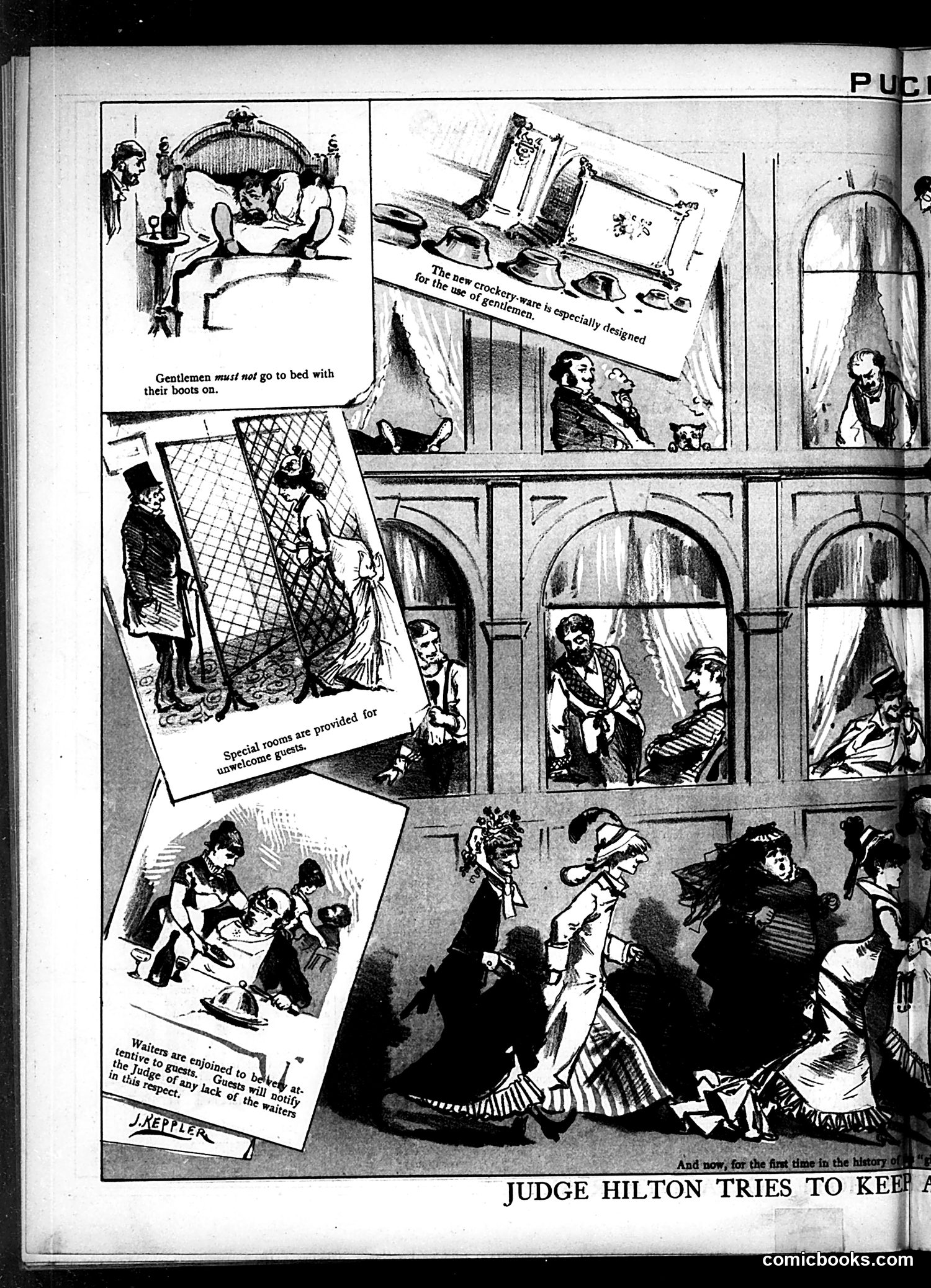
This satirical page appears to mock **Judge Hilton's attempt to enforce gentlemanly conduct standards at a hotel** (the title references "Judge Hilton Tries to Keep"). The cartoons depict various violations of his rules through humorous scenes: - Top left: "Gentlemen must not go to bed with their boots on" - Middle: "Special rooms are provided for unwelcome guests" - Bottom: "Waiters are enjoined to bow, and guests...in the judge's nightly lack of the wallets" The satire suggests that Hilton's elaborate etiquette rules are impractical and unenforceable, with guests and staff flouting his standards. The drawings show the chaos resulting from these unrealistic regulations—implying that real human behavior resists such rigid social control.
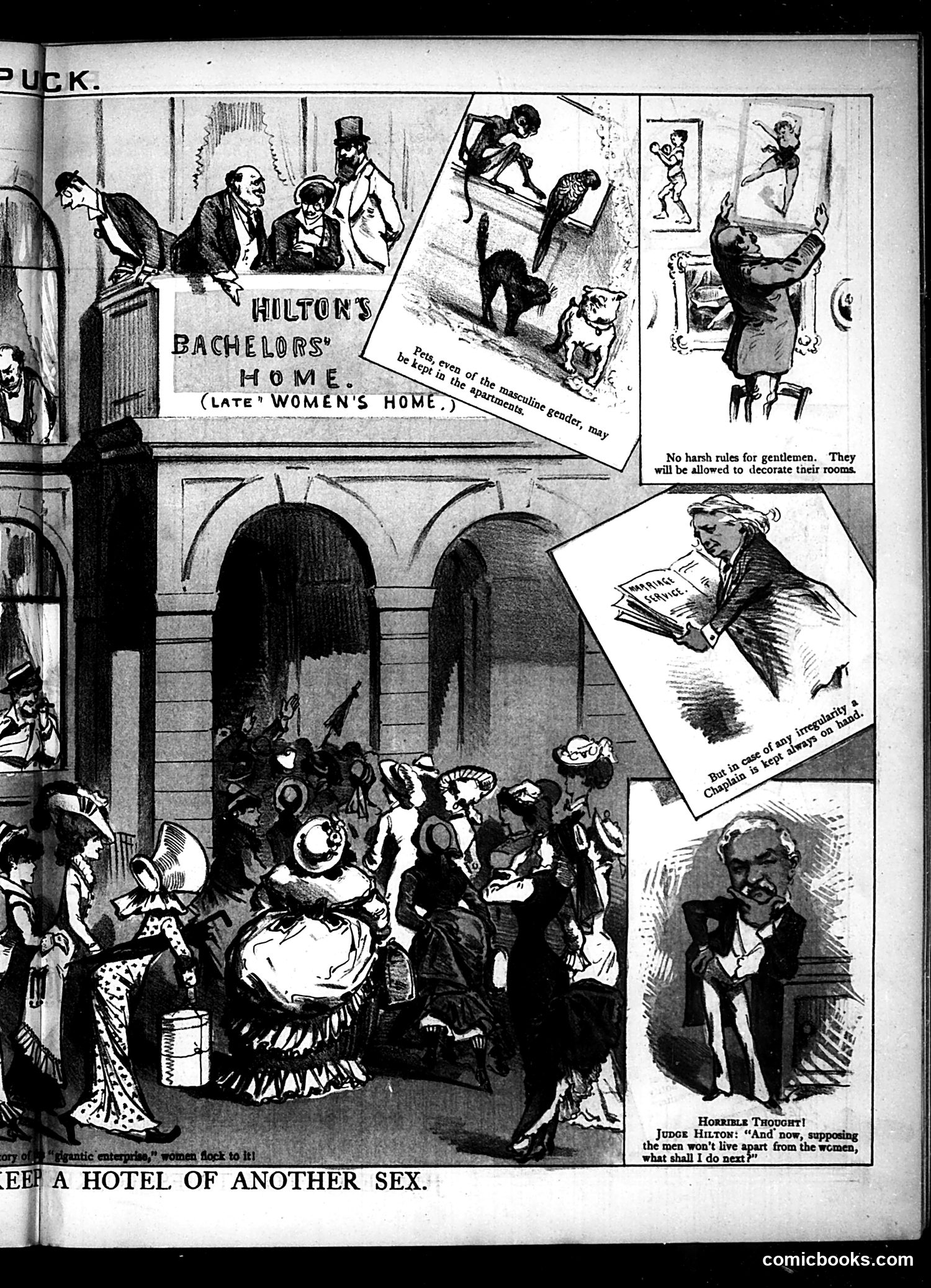
This Puck cartoon satirizes the conversion of a women's residence into a bachelor hotel. The main panel depicts wealthy men enjoying the newly converted space—lounging, decorating with artwork, and generally carousing. The smaller panels mock the transition: one shows "no harsh rules for gentlemen" with a man throwing items around; another depicts a concerned figure (labeled as "Judge Hilton") reading "Standing Rules," worried about maintaining order among male residents. The satire targets gender double standards—while women residents faced strict regulations, men are promised libertine freedom. The title "A Hotel of Another Sex" emphasizes how institutional standards flip based on occupants' gender. The joke relies on contemporary assumptions about male versus female behavior and respectability.
This page is primarily **theatrical and gossip content**, not political satire. It contains "Dramatic Notes" discussing stage productions and cast changes, plus an "Answers for the Curious" advice column. The small illustration at top-left appears to be a theatrical scene, likely accompanying the dramatic notes rather than serving as standalone satire. The main article "The Rights of Suicides" discusses a recent suicide in New York and debates whether suicide victims should be denied bridge access as punishment. It's a **serious ethical discussion**, not satire. The "Answers for the Curious" section is a **humor advice column** with lighthearted responses to readers' questions about theater, family names, and social etiquette. This page reflects Puck's broader content mix: while known for political cartoons, the magazine also published entertainment coverage and humor columns.
This page contains a short story titled "Mrs. Fitzgerald" by Frank Barrett, not a political cartoon. The narrative follows Mary Reid, a young woman who must choose between two suitors: Reginald Fitzgerald (a wealthy gentleman) and George Montey (a poor but virtuous man). The story satirizes Victorian-era social conventions around marriage and class. Mary's parents pressure her toward the rich Fitzgerald despite her affection for Montey, highlighting the era's prioritization of financial security over personal happiness in matrimonial arrangements. The text criticizes society's superficial values while suggesting that genuine character—not wealth—should determine a woman's choice of husband. This reflects Puck's broader satirical commentary on American and British social hypocrisy during the Gilded Age.
This page from *Puck* magazine is primarily **text-based fiction rather than political satire**. It contains two literary pieces: 1. A serialized story about a husband and wife (the Fitzgeralds) dealing with marital conflict over the wife's extravagant spending and the husband's accusations of infidelity. The narrative includes letters and dramatic confrontations. 2. A poem titled "The New Commercial Hotel" describing the rooms and servants of a hotel building designed by Stewart. **No political cartoons or caricatures appear on this page.** The content is domestic drama and descriptive verse—typical of *Puck's* mixed editorial format, which combined satirical illustrations with literary entertainment. Without visible imagery of identifiable public figures or political references, no specific satire can be determined from this page alone.
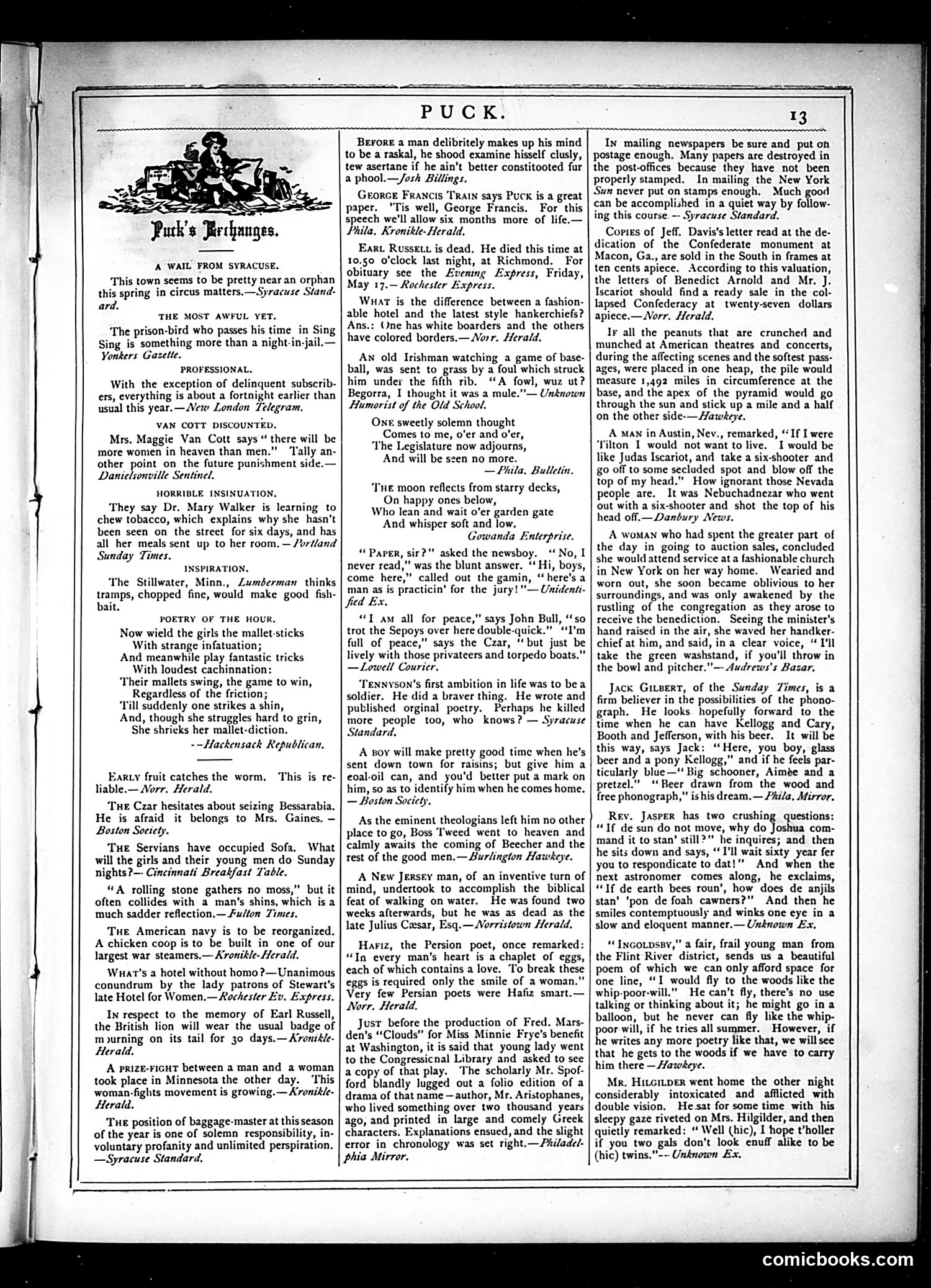
This page consists primarily of **"Puck's Witticisms"** — a humor column containing brief satirical quips and anecdotes rather than illustrated political cartoons. The content targets various social absurdities: a bishop passing his vow in a nightclub, female census-takers discovering more women in heaven than men, a Dr. Mary Walker learning to fence, Tennessee's first soldier-poet, a Persian poet's observations about eggs and love, and various military/naval reorganization jokes. The humor relies on **incongruity and social commentary** — juxtaposing religious figures with frivolous settings, celebrating unconventional women, and mocking bureaucratic inefficiency. Without specific political figures caricatured, this appears to be **general social satire** reflecting Progressive-era concerns about gender roles, military preparedness, and institutional absurdity.
This page is primarily **advertisements and notices** rather than political satire. The main content includes ads for: - **Apollinaris Natural Mineral Water** ("Queen of Table Waters") - **Kurtz Portraits** photography studio in New York - **Sherry Portraits** (also photography) - **Mathesius & Frey Cabinet Furniture** - **German Liederkranz Summernights Festival** (June 13, 1879) There are brief **poetic excerpts** and humorous observations about Canadian summers and nature in the margins, but these appear to be filler rather than targeted satire. One short news item discusses **Governor Rice of Massachusetts**, noting skepticism about the President being "disquieted" — mild political commentary rather than satire. The page reflects Puck's mixed business model: satirical magazine supplemented by paid advertisements to sustain operations.
This page is primarily **advertising and announcements**, not a political cartoon. It contains: 1. **Puck's Pictorial Department announcement** - promoting their new General Designing Office where cartoonist Joseph Keppler provides illustrations for theatrical and other clients 2. **Multiple commercial ads** for period products: Friedrichshall Bitterwater, Dinepa & Co. (general merchandise), Pachtmann & Moelich (watches/jewelry), printing inks, champagne, and a tailor service 3. **Promotion for Puck's Almanac for 1878** - described as "the most remarkable ever published," priced at 15 cents 4. **Back matter** - information about obtaining patent filing covers and back issues The page functions as a business/editorial announcement rather than satirical content, reflecting how 19th-century magazines mixed editorial material with advertising revenue.
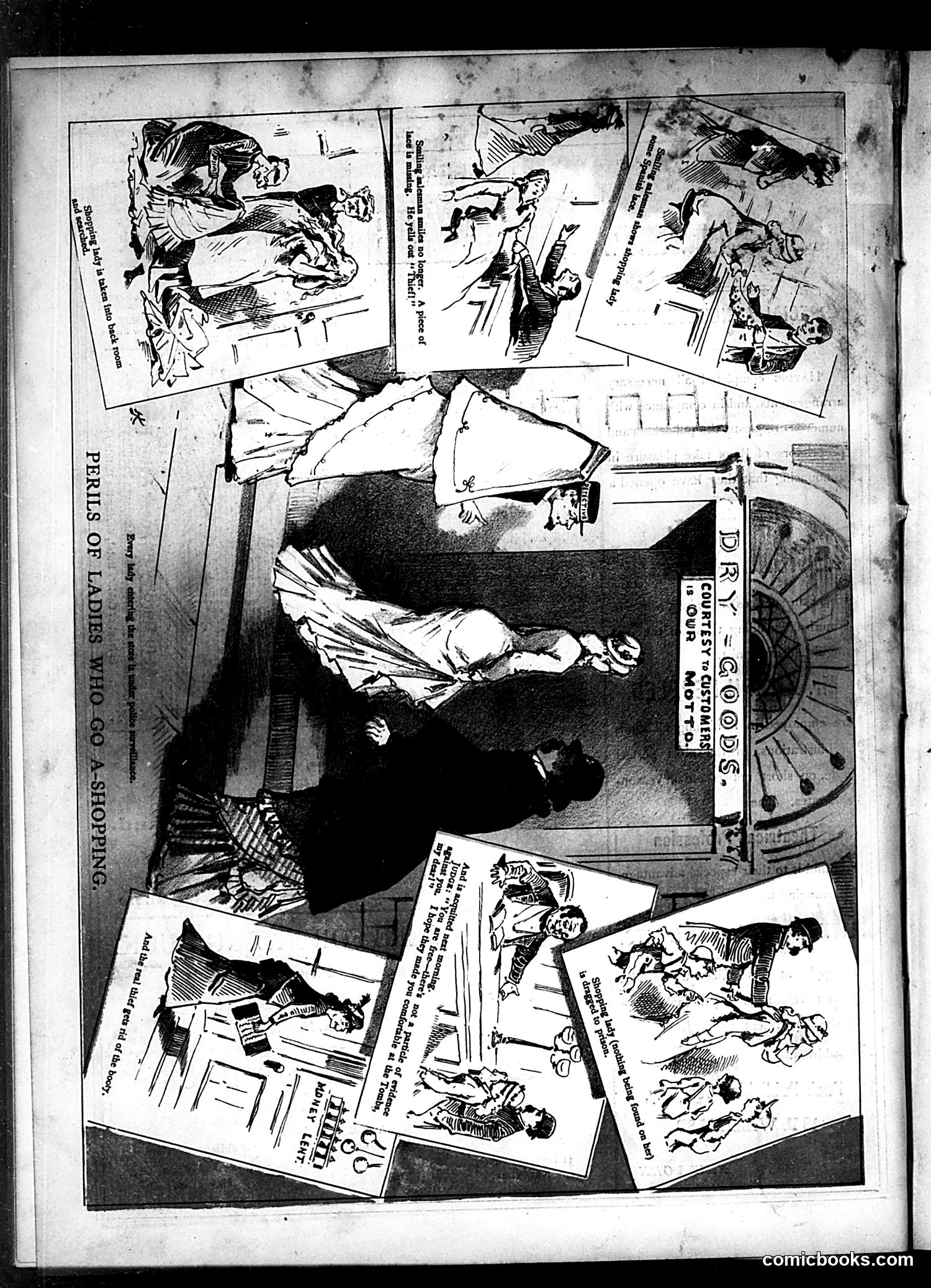
This appears to be a layout page from Puck magazine featuring multiple political cartoons arranged around a central illustration. The text visible includes "PERILS OF LADDER WHO-GOES-A-SHOPPING" on the left side and "DRYS GOODS" on the right, suggesting commercial or consumer-related satire. The central figure appears to be a woman in period dress, surrounded by smaller comic panels depicting various domestic or shopping scenarios. The cartoons likely satirize late 19th or early 20th-century consumer culture, gender roles, or shopping-related social behaviors. However, without clearer OCR text and given the image quality, I cannot definitively identify specific political figures, events, or the precise satirical points intended. The overall theme seems to address women's shopping habits or commercial culture of the era.