
Puck, 1878-06-05 · page 12 of 16
Puck — June 5, 1878 — page 12: what you’re looking at
What you’re looking at
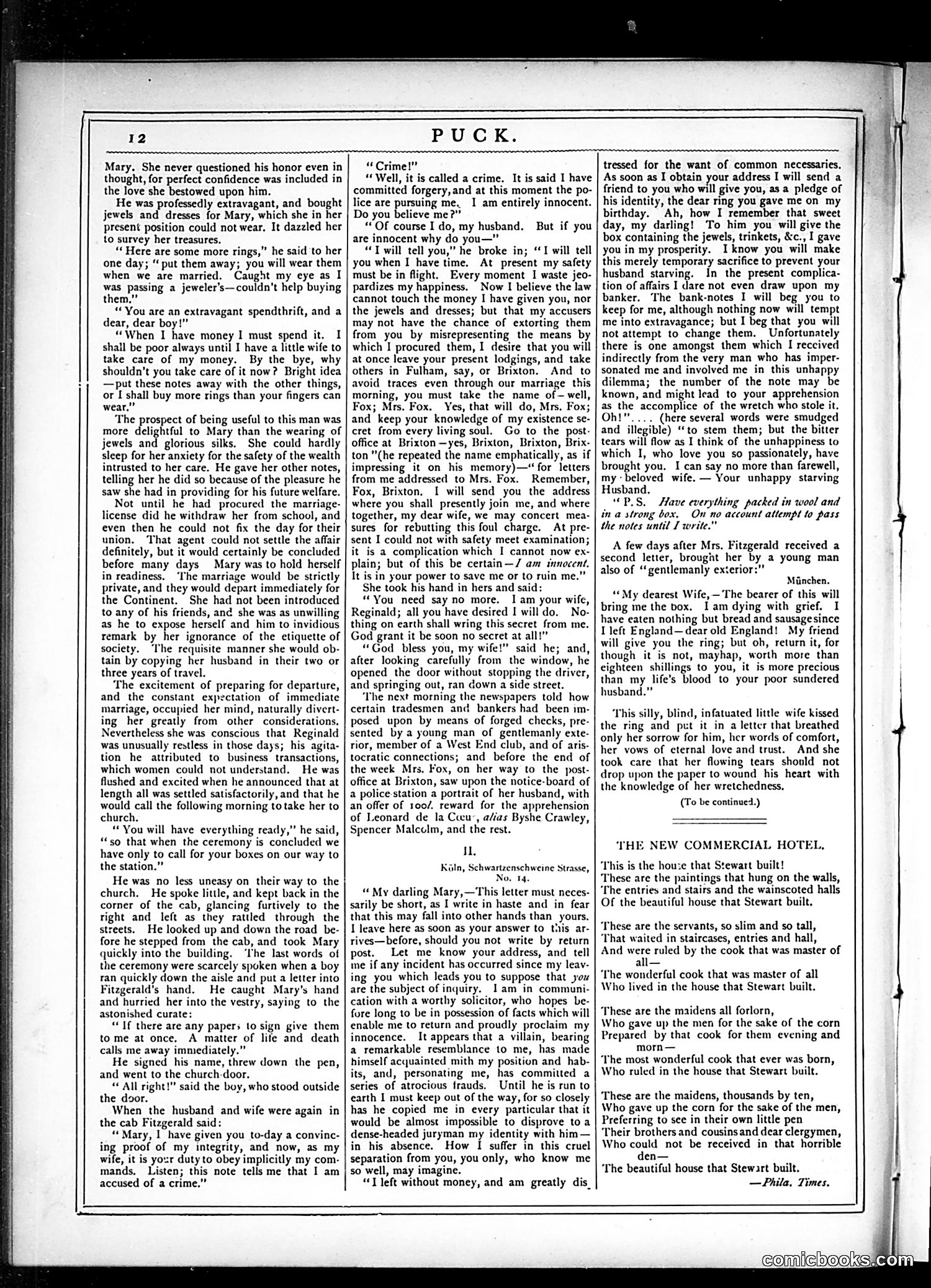
This page from *Puck* magazine is primarily **text-based fiction rather than political satire**. It contains two literary pieces: 1. A serialized story about a husband and wife (the Fitzgeralds) dealing with marital conflict over the wife's extravagant spending and the husband's accusations of infidelity. The narrative includes letters and dramatic confrontations. 2. A poem titled "The New Commercial Hotel" describing the rooms and servants of a hotel building designed by Stewart. **No political cartoons or caricatures appear on this page.** The content is domestic drama and descriptive verse—typical of *Puck's* mixed editorial format, which combined satirical illustrations with literary entertainment. Without visible imagery of identifiable public figures or political references, no specific satire can be determined from this page alone.
📄 Transcribed text from this page (OCR, searchable)
Machine-transcribed from the original scan — historical spelling and the odd misread are preserved.
12 PUCK. Mary. She never questioned his honor even in thought, for perfect confidence was included in the love she bestowed upon him. He was professedly extravagant, and bought jewels and dresses for Mary, which she in her present position could not wear. It dazzled her to survey her treasures. ‘Here are some more rings,” he said to her one day; ‘put them away; you will wear them when we are married. Caught my eye as I was passing a jeweler's—couldn’t help buying them,” “You are an extravagant spendthrift, and a dear, dear boy!” “When I have money I must spend it. I shall be poor always until I have a little wife to take care of my money. By the bye, why shouldn't you take care of it now? Bright idea —put these notes away with the other things, or I shall buy more rings than your fingers can wear.” ‘The prospect of being useful to this man was more delightful to Mary than the wearing of jewels and glorious silks. She could hardly sleep for her anxiety for the safety of the wealth intrusted to her care. He gave her other notes, telling her he did so because of the pleasure he saw she had in providing for his future welfare. Not until he had procured the marriage- license did he withdraw her from school, and even then he could not fix the day for their union. That agent could not settle the affair definitely, but it would certainly be concluded before many days Mary was to hold herself in readiness. ‘I'he marriage would be strictly private, and they would depart immediately for the Continent. She had not been introduced to any of his friends, and she was as unwilling as he to expose herself and him to invidious remark by her ignorance of the etiquette of society, ‘The requisite manner she would ob- tain by copying her husband in their two or three years of travel. ‘The excitement of preparing for departure, and the constant expectation of immediate marriage, occupied her mind, naturally divert- ing her greatly from other considerations. Nevertheless she was conscious that Reginald was unusually restless in those days; his agita- tion he attributed to business transactions, which women could not understand. He was flushed and excited when he announced that at length all was settled satisfactorily, and that he would call the following morning to take her to church, “You will have everything ready,” he said, ‘so that when the ceremony is concluded we have only to call for your boxes on our way to the station.” He was no less uneasy on their way to the church. He spoke little, and kept back in the corner of the cab, glancing furtively to the right and left as they rattled through the streets. He looked up and down the road _be- fore he stepped from the cab, and took Mary quickly into the building. ‘Ihe last words of the ceremony were scarcely spoken when a boy ran quickly down the aisle and put a letter into Fitzgerald’s hand. He caught Mary’s hand and hurried her into the vestry, saying to the astonished curate: “If there are any papers to sign give them to me at once. A matter of life and death calls me away immediately.” He signed his name, threw down the pen, and went to the church-door. “ All right!” said the boy, who stood outside the door. When the husband and wife were again in the cab Fitzgerald said: “Mary, I have given you to-day a convine- ing proof of my integrity, and now, as my wife, it is your duty to obey implicitly my com- mands. Listen; this note tells me that I am accused of a crime.” “Crime!” “Well, it is called a crime. It is said I have committed forgery, and at this moment the po- lice are pursuing me. 1 am entirely innocent. Do you believe me?” “Of course I do, my husband. But if you are innocent why do you—” “I will tell you,” he broke in; ‘1 will tell you when I have time, At present my safety must be in flight. Every moment I waste jeo- pardizes my happiness. Now I believe the law cannot touch the money I have given you, nor the jewels and dresses; but that my accusers may not have the chance of extorting them from you by misrepresenting the means by which I procured them, I desire that you will at once leave your present lodgings, and take others in Fulham, say, or Brixton. And to avoid traces even through our marriage this morning, you must take the name of — well, Fox; Mrs. Fox. Yes, that will do, Mrs. Fox; and keep your knowledge of my existence se- cret from every living soul. Go to the post- office at Brixton —yes, Brixton, Brixton, Brix- ton "(he repeated the name emphatically, as if impressing it on his memory)—* for letters from me addressed to Mrs. Fox. Remember, Fox, Brixton, I will send you the address where you shall presently join me, and where together, my dear wife, we may concert mea- sures for rebutting this foul charge. At pre- sent I could not with safety meet examination; it is a complication which I cannot now ex- plain; but of this be certain—/ am innocent. It is in your power to save me or to ruin me.” She took his hand in hers and said: “You need say no more. I am your wife, Reginald; all you have desired I will do. No- thing on earth shall wring this secret from me. God grant it be soon no secret at all!” “God bless you, my wife!” said he; and, after looking carefully from the window, he opened the door without stopping the driver, and springing out, ran down a side street. ‘The next morning the newspapers told how certain tradesmen and bankers had been im- posed upon by means of forged checks, pre- sented by a young man of gentlemanly exte- rior, member of a West End club, and of aris- tocratic connections; and before the end of the week Mrs, Fox, on her way to the post- office at Brixton, saw upon the notice-board of a police-station a portrait of her husband, with an offer of 100/, reward for the apprehension of Leonard de la Cwu’, alias Byshe Crawley, Spencer Malcolm, and the rest. I Kaln, Schwartzenschweine Strasse, No. 14. “ My darling Mary,—This letter must neces- sarily be short, as I write in haste and in fear that this may fall into other hands than yours. I leave here as soon as your answer to this ar- rives—before, should you not write by return post. Let me know your address, and tell me if any incident has occurred since my leav- ing you which leads you to suppose that you are the subject of inquiry. 1am in commani- cation with a worthy solicitor, who hopes be- fore long to be in possession of facts which will enable me to return and proudly proclaim my innocence. It appears that a villain, bearing a remarkable resemblance to me, has made himself acquainted mith my position and hab- its, and, personating me, has committed a series of atrocious frauds. Until he is run to earth I must keep out of the way, for so closely has he copied me in every particular that it would be almost impossible to disprove toa dense-headed juryman my identity with him— in his absence. How I suffer in this cruel separation from you, you only, who know me so well, may imagine. “T left without money, and am greatly dis. tressed for the want of common necessaries, As soon as I obtain your address I will send a friend to you who will give you, as a pledge of his identity, the dear ring you gave me on my birthday. Ah, how I remember that sweet day, my darling! To him you will give the box containing the jewels, trinkets, &c., I gave you in my prosperity. I know you will make this merely temporary sacrifice to prevent your husband starving. In the present complica- tion of affairs I dare not even draw upon my banker. The bank-notes I will beg you to keep for me, although nothing now will tempt me into extravagance; but I beg that you will not attempt to change them. Unfortunately there is one amongst them which I reccived indirectly from the very man who has imper- sonated me and involved me in this unhappy dilemma; the number of the note may be known, and might lead to your apprehension as the accomplice of the wretch who stole it. Oh!"”.... (here several words were smudged and illegible) “to stem them; but the bitter tears will flow as I think of the unhappiness to which I, who love you so passionately, have brought you. I can say no more than farewell, my «beloved wife. — Your unhappy starving Husband. “PLS, Have everything packed in wool and in a strong box, On no account attempt to pass the notes until I write.” A few days after Mrs. Fitzgerald received a second letter, brought her by a young man also of ‘gentlemanly exterior:” Miinchen. “My dearest Wife, —The bearer of this will bring me the box. I am dying with grief. I have eaten nothing but bread and sausagesince I left England—dear old England! My friend will give you the ring; but oh, return it, for though it is not, mayhap, worth more than eighteen shillings to you, it is more precious than my life's blood to your poor sundered husband.” ‘This silly, blind, infatuated little wife kissed the ring and put it in a letter that breathed only her sorrow for him, her words of comfort, her vows of eternal love and trust. And she took care that her flowing tears should not drop upon the paper to wound his heart with the knowledge of her wretchedness, (To be continued.) ‘THE NEW COMMERCIAL HOTEL, ‘This is the houze that Stewart built! ‘These are the paintings that hung on the walls, ‘The entries and stairs and the wainscoted halls Of the beautiful house that Stewart built. ‘These are the servants, so slim and so tall, ‘That waited in staircases, entries and hall, And were ruled by the cook that was master of all— ‘The wonderful cook that was master of all Who lived in the house that Stewart built. These are the maidens all forlorn, Who gave up the men for the sake of the corn | Prepared by that cook for them evening and morm— ‘The most wonderful cook that ever was born, Who ruled in the house that Stewart built. | i} ‘These are the maidens, thousands by ten, Who gave up the corn for the sake of the men, Preferring to see in their own little pen ‘Their brothers and cousinsand dear clergymen, Who could not be received in that horrible den— ‘The beautiful house that Stewart built. —Phila. Times. comichooks,