
Puck, 1878-06-05 · page 10 of 16
Puck — June 5, 1878 — page 10: what you’re looking at
What you’re looking at
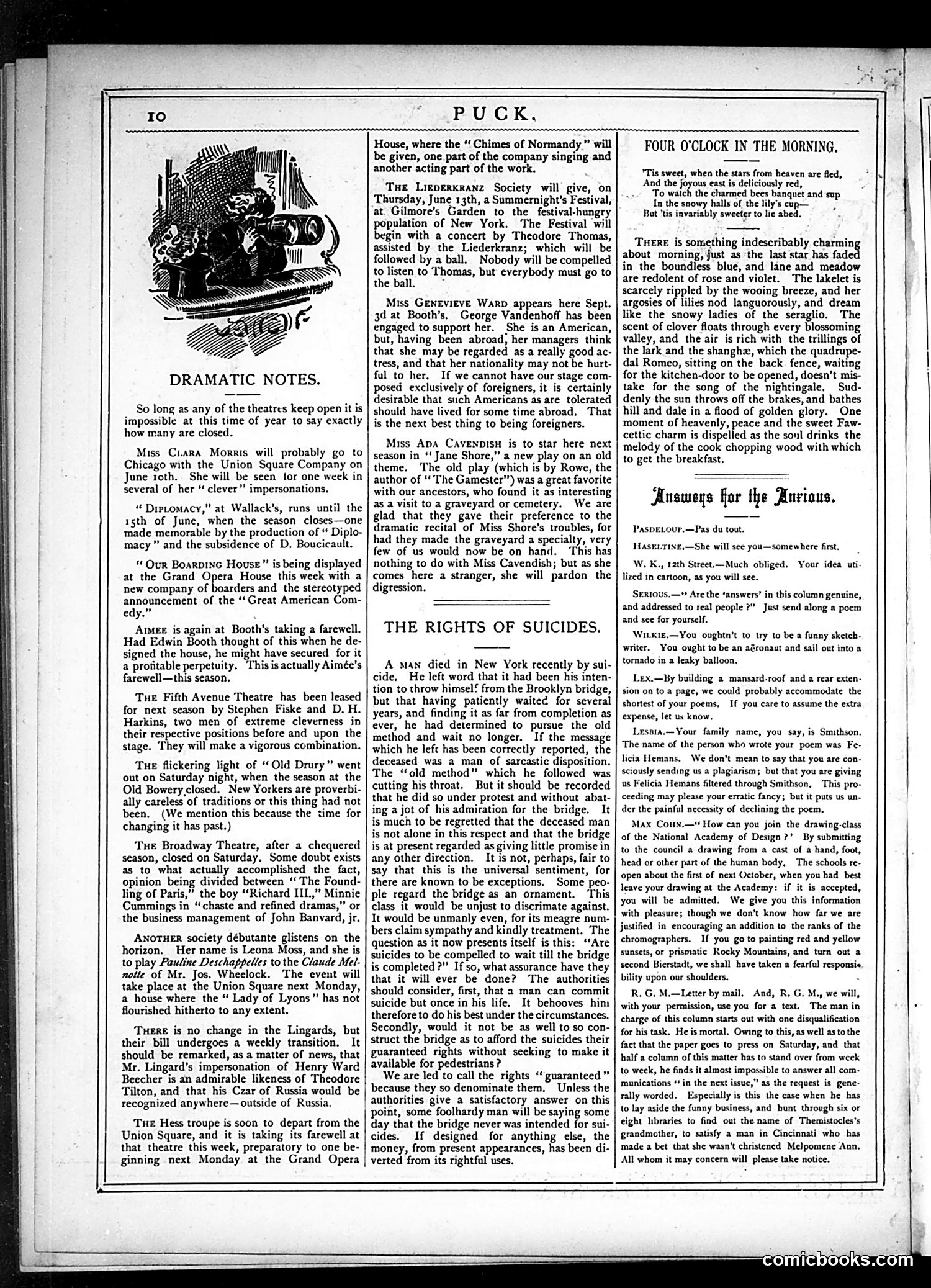
This page is primarily **theatrical and gossip content**, not political satire. It contains "Dramatic Notes" discussing stage productions and cast changes, plus an "Answers for the Curious" advice column. The small illustration at top-left appears to be a theatrical scene, likely accompanying the dramatic notes rather than serving as standalone satire. The main article "The Rights of Suicides" discusses a recent suicide in New York and debates whether suicide victims should be denied bridge access as punishment. It's a **serious ethical discussion**, not satire. The "Answers for the Curious" section is a **humor advice column** with lighthearted responses to readers' questions about theater, family names, and social etiquette. This page reflects Puck's broader content mix: while known for political cartoons, the magazine also published entertainment coverage and humor columns.
📄 Transcribed text from this page (OCR, searchable)
Machine-transcribed from the original scan — historical spelling and the odd misread are preserved.
PUCK. DRAMATIC NOTES. So long as any of the theatres keep open it is impossible at this time of year to say exactly how many are closed. Miss Ciara Morris will probably go to Chicago with the Union Square Company on June roth. She will be seen tor one week in several of her “ clever” impersonations, “ Diptomacy,” at Wallack’s, runs until the rsth of June, when the season closes—one made memorable by the production of “ Diplo- macy" and the subsidence of D. Boucicault. “ Our Boarpinc House” is being displayed at the Grand Opera House this week with a new company of boarders and the stereotyped announcement of the “Great American Com- edy.” Amer is again at Booth’s taking a farewell. Had Edwin Booth thought of this when he de- signed the house, he might have secured for it a profitable perpetuity. ‘This is actually Aimée's farewell—this season. Tue Fifth Avenue Theatre has been leased for next season by Stephen Fiske and D. H. Harkins, two men of extreme cleverness in their respective positions before and upon the stage. They will make a vigorous combination. Tue flickering light of ‘Old Drury” went out on Saturday night, when the season at the Old Bowery closed. New Yorkers are proverbi- ally careless of traditions or this thing had not been. (We mention this because the time for changing it has past.) Tue Broadway Theatre, after a chequered season, closed on Saturday. Some doubt exists as to what actually accomplished the fact, opinion being divided between ‘The Found- ling of Paris,” the boy ‘Richard III.,” Minnie Cummings in “chaste and refined dramas,” or the business management of John Banvard, jr. ANOTHER society débutante glistens on the horizon. Her name is Leona Moss, and she is to play Pauline Deschappelles to the Claude Mel- notte of Mr. Jos. Wheelock. The event will take place at the Union Square next Monday, a house where the “ Lady of Lyons” has not flourished hitherto to any extent. Tere is no change in the Lingards, but their bill undergoes a weekly transition. It should be remarked, as a matter of news, that Mr. Lingard’s impersonation of Henry Ward Beecher is an admirable likeness of Theodore Tilton, and that his Czar of Russia would be recognized anywhere—outside of Russia. Tue Hess troupe is soon to depart from the Union Square, and it is taking its farewell at House, where the ‘ Chimes of Normandy.” will be given, one part of the company singing and another acting part of the work. Tue Lieperxranz Society will give, on ‘Thursday, June 13th, a Summernight’s Festival, at. Gilmore’s Garden to the festival-hungry population of New York. The Festival will begin with a concert by Theodore Thomas, assisted by the Liederkranz; which will be followed by a ball. Nobody will be compelled fe disten to Thomas, but everybody must go to the ball. Miss Genevieve WaRD. appears here Sept. 3d at Booth’s. George Vandenhoff has been engaged to support her. She is an American, but, having been abroad, her managers think that she may be regarded as a really good ac- tress, and that her nationality may not be hurt- ful to her. If we cannot have our stage com- posed exclusively of foreigners, it is certainly desirable that such Americans as are tolerated should have lived for some time abroad. That is the next best thing to being foreigners. Miss ADA CAVENDISH is to star here next season in * Jane Shore,” a new play on an old theme. ‘The old play (which is by Rowe, the author of ‘‘ The Gamester") was a great favorite with our ancestors, who found it as interesting as a visit to a graveyard or cemetery. We are glad that they gave their preference to the dramatic recital of Miss Shore’s troubles, for had they made the graveyard a specialty, very few of us would now be on hand. This has nothing to do with Miss Cavendish; but as she comes here a stranger, she will pardon the digression. THE RIGHTS OF SUICIDES. A man died in New York recently by sui- cide, He left word that it had been his inten- tion to throw himself from the Brooklyn bridge, but that having patiently waitec for several years, and finding it as far from completion as ever, he had determined to pursue the old method and wait no longer. If the message which he left has been correctly reported, the deceased was a man of sarcastic disposition. The “old method” which he followed was cutting his throat. But it should be recorded that he did so under protest and without abat- ing a jot of his admiration for the bridge. It is much to be regretted that the deceased man is not alone in this respect and that the bridge is at present regarded as giving little promise in any other direction. It is not, perhaps, fair to say that this is the universal sentiment, for there are known to be exceptions. Some peo- ple regard the bridge as an ornament. ‘This class it would be unjust to discrimate against. It would be unmanly even, for its meagre num- bers claim sympathy and kindly treatment. The question as it now presents itself is this: “Are suicides to be compelled to wait till the bridge is completed ?” If so, what assurance have they that it will ever be done? The authorities should consider, first, that a man can commit suicide but once in his life. It behooves him therefore to do his best under the circumstances. Secondly, would it not be as well to so con- struct the bridge as to afford the suicides their guaranteed rights without seeking to make it available for pedestrians ? We are led to call the rights “guaranteed” because they so denominate them. Unless the authorities give a satisfactory answer on this point, some foolhardy man will be saying some day that the bridge never was intended for sui- cides. If designed for anything else, the that theatre this week, preparatory to one be- ginning next Monday at the Grand Opera | money, from present appearances, has been di- verted from its rightful uses. FOUR O'CLOCK IN THE MORNING. "Tis sweet, when the stars from heaven are fled, And the joyous east is deliciously red, To watch the charmed bees banquet and sup In the snowy halls of the lily's cup— But 'tis invariably sweeter to lie abed. Tuere is something indescribably charmin, about morning, just as the last star has fad in the boundless blue, and lane and meadow are redolent of rose and violet. The lakelet is scarcely rippled by the wooing breeze, and her argosies of lilies nod languorously, and dream like the snowy ladies of the seraglio. The scent of clover floats through every blossoming valley, and the air is rich with the trillings of the lark and the shangha, which the quadrupe- dal Romeo, sitting on the back. fence, waiting for the kitchen-door to be opened, doesn’t mis- take for the song of the nightingale. Sud- denly the sun throws off the brakes, and bathes hill and dale in a flood of golden glory. One moment of heavenly, peace and the sweet Faw- cettic charm is dispelled as the soul drinks the melody of the cook chopping wood with which to get the breakfast. Answeys for the Aurious. Paspetour.—Pas du tout. HaseLrixe.—She will sce you—somewhere first. W. K., 12th Street.—Much obliged. Your idea uti- lized 1n cartoon, as you will see. Sertous.—“ Arethe ‘answers’ in this column genuine, and addressed to real people 2” Just send along a poem and see for yourself. Winxie.—You oughtn’t to try to be a funny sketch. writer. You ought to be an agronaut and sail out into a tornado in a leaky balloon. Lex,—By building a mansard.roof and a rear exten- sion on toa page, we could probably accommodate the shortest of your poems, If you care to assume the extra expense, let us know, Lesn1a.—Your family name, you say, is Smithson. ‘The name of the person who wrote your poem was Fe- licia Hemans. We don’t mean to say that you are con- sciously sending us a plagiarism; but that you are giving us Felicia Hemans filtered through Smithson, This pro- ceeding may please your erratic fancy; but it puts us un- der the painful necessity of declining the poem, Max Coux.— How can you join the drawing-class of the National Academy of Design?’ By submitting to the council a drawing from a cast of a hand, foot, head or other part of the human body, The schools re- open about the first of next Uctober, when you had best leave your drawing at the Academy: if it is accepted, you will be admitted. We give you this information with pleasure; though we don’t know how far we are justified in encouraging an addition to the ranks of the chromographers. If you go to painting red and yellow sunsets, or prismatic Rocky Mountains, and turn out a second Bierstadt, we shall have taken a fearful responsie bility upon our shoulders. R. G. M.—Letter by mail. And, R. G. M., we will, with your permission, use you for a text. The man in charge of this column starts out with one disqualification for his task. He is mortal. Owing to this, as well astothe fact that the paper goes to press on Saturday, and that half a column of this matter has to stand over from week to week, he finds it almost impossible to answer all com- munications “in the next issue,” as the request is gene- rally worded. Especially is this the case when he has to lay aside the funny business, and hunt through six or eight libraries to find out the name of Themistocles's grandmother, to satisfy a man in Cincinnati who has made a bet that she wasn't christened Melpomene Ann. All whom it may concern will please take notice. —) —___——