
Puck, 1878-06-05 · page 11 of 16
Puck — June 5, 1878 — page 11: what you’re looking at
What you’re looking at
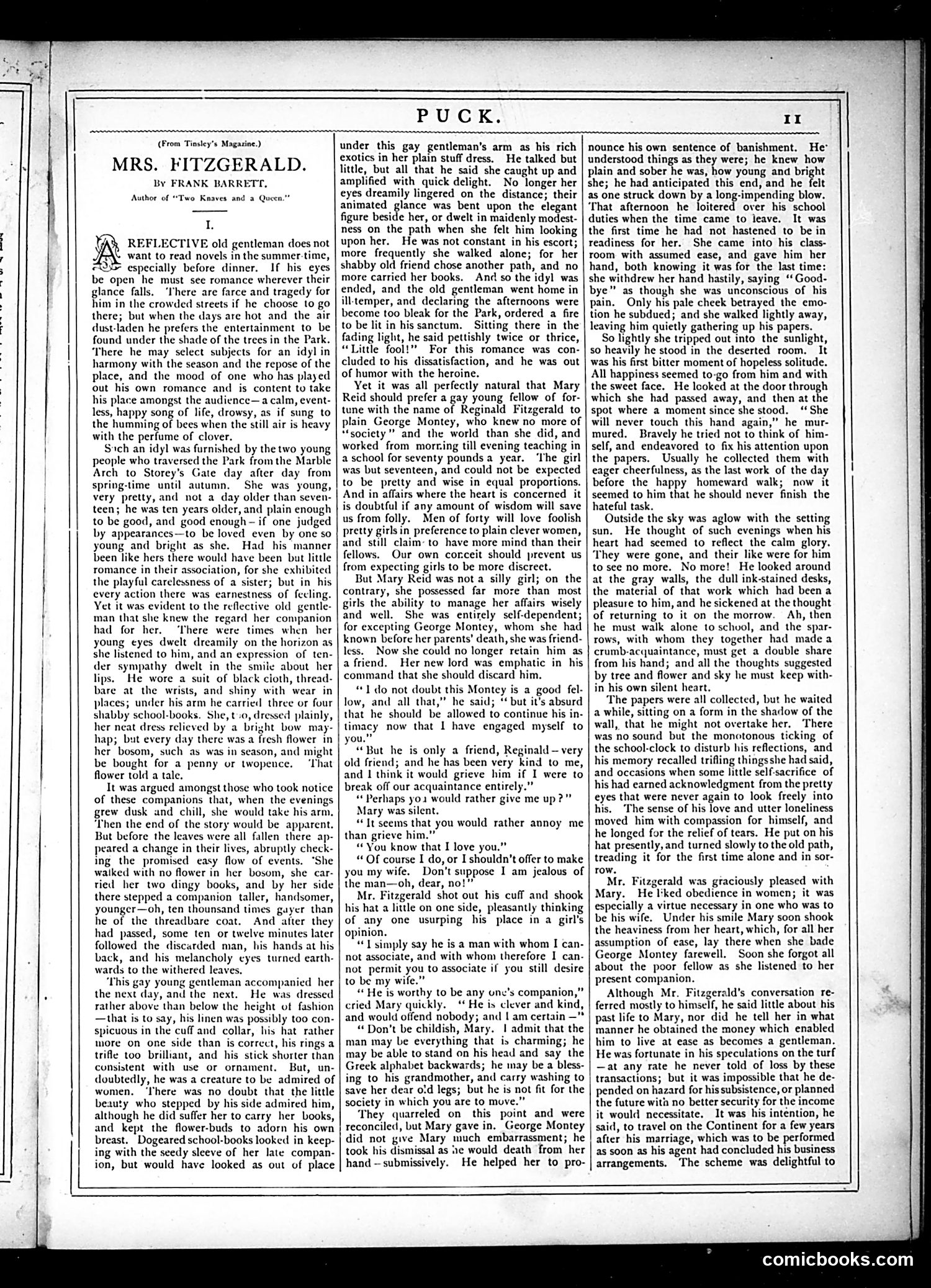
This page contains a short story titled "Mrs. Fitzgerald" by Frank Barrett, not a political cartoon. The narrative follows Mary Reid, a young woman who must choose between two suitors: Reginald Fitzgerald (a wealthy gentleman) and George Montey (a poor but virtuous man). The story satirizes Victorian-era social conventions around marriage and class. Mary's parents pressure her toward the rich Fitzgerald despite her affection for Montey, highlighting the era's prioritization of financial security over personal happiness in matrimonial arrangements. The text criticizes society's superficial values while suggesting that genuine character—not wealth—should determine a woman's choice of husband. This reflects Puck's broader satirical commentary on American and British social hypocrisy during the Gilded Age.
📄 Transcribed text from this page (OCR, searchable)
Machine-transcribed from the original scan — historical spelling and the odd misread are preserved.
—T PUCK. II (From Tinsley’s Magazine.) MRS. FITZGERALD. By FRANK BARRETT, Author of "Two Knaves and a Queen."* I w REFLECTIVE old gentleman does not want to read novels in the summer-time, ©QS especially before dinner. If his eyes be open he must see romance wherever their glance falls. ‘here are farce and tragedy for him in the crowded streets if he choose to go there; but when the days are hot and the air dust-laden he prefers the entertainment to be found under the shade of the trees in the Park. ‘There he may select subjects for an idyl in harmony with the season and the repose of the place, and the mood of one who has played out his own romance and is content to take his place amongst the audience—a calm, event- less, happy song of life, drowsy, as if sung to the humming of bees when the still air is heavy with the perfume of clover. Sich an idyl was furnished by the two young people who traversed the Park fromthe Marble Arch to Storey’s Gate day after day from spring-time until autumn. She was young, very pretty, and not a day older than seven- teen; he was ten years older, and plain enough to be good, and good enough — if one judged by appearances—to be loved even by one so young and bright as she. Had his manner been like hers there would have been but little romance in thei ciation, for she exhibited the playful carelessness of a sister; but in his every action there was earnestness of feeling. Yet it was evident to the reflective old gentle- man that she knew the regard her companion had for her. ‘There were times when her young eyes dwelt dreamily on the horizon as she listened to him, and an expression of ten- der sympathy dwelt in the smile about her lips. He wore a suit of black cioth, thread- bare at the wrists, and shiny with wear in places; under his arm he carried three or four shabby school-books. She, to, dressed plainly, her neat dress relieved by a bright bow may- hap; but every day there was a fresh flower in her bosom, such as was in season, and might be bought for a penny or twopence. ‘That flower told a tale. It was argued amongst those who took notice of these companions that, when the evenings grew dusk and chill, she would take his arm, ‘Then the end of the story would be apparent. But before the leaves were all fallen there ap- peared a change in their lives, abruptly check ing the promised easy flow of events. ‘She walked with no flower in her bosom, she car- tied her two dingy books, and by her side there stepped a companion taller, handsomer, younger—oh, ten thounsand times gayer than he of the threadbare coat. And after they had passed, some ten or twelve minutes later followed the discarded man, his hands at his back, and his melancholy eyes turned earth- wards to the withered leaves, ‘This gay young gentleman accompanied her the next day, and the next. He was dressed rather above than below the height of fashion —that is to say, his linen was possibly too con- spicuous in the cuff and collar, his hat rather more on one side than is correct, his rings a trifle too brilliant, and his stick shorter than consistent with use or ornament. But, un- doubtedly, he was a creature to be admired of women, ‘There was no doubt that the little beauty who stepped by his side admired him, although he did suffer her to carry her books, and kept the flower-buds to adorn his own breast. Dogeared school-books looked in keep- ing with the seedy sleeve of her late compan- ion, but would have looked as out of place under this gay gentleman’s arm as his rich exotics in her plain stuff dress. He talked but little, but all that he said she caught up and amplified with quick delight. No longer her eyes dreamily lingered on the distance; their animated glance was bent upon the elegant figure beside her, or dwelt in maidenly modest- ness on the path when she felt him looking upon her. He was not constant in his escort; more frequently she walked alone; for her shabby old friend chose another path, and no more carried her books. And so the idyl was ended, and the old gentleman went home in ill-temper, and declaring the afternoons were become too bleak for the Park, ordered a fire to be lit in his sanctum. Sitting there in the fading light, he said pettishly twice or thrice, “Little fool!” For this romance was con- cluded to his dissatisfaction, and he was out of humor with the heroine. Yet it was all perfectly natural that Mary Reid should prefer a gay young fellow of for- tune with the name of Reginald Fitzgerald to plain George Montey, who knew no more of “society” and the world than she did, and worked from morning till evening teaching in a school for seventy pounds a year. ‘The girl was but seventeen, and could not be expected to be pretty and wise in equal proportions. And in affairs where the heart is concerned it is doubtful if any amount of wisdom will save us from folly. Men of forty will love foolish pretty girls in preference to plain clever women, and still claim’ to have more mind than their fellows. Our own corceit should prevent us from expecting girls to be more discreet. But Mary Reid was not a silly girl; on the contrary, she possessed far more than most girls the ability to manage her affairs wisely and well. She was entirely self-dependent; for excepting George Montey, whom she had known before her parents’ death, she was friend- less. Now she could no longer retain him as a friend. Her new lord was emphatic in his command that she should discard him. “1 do not doubt this Montey is a good fel- low, and all that,” he said; ‘ but it’s absurd that he should be allowed to continue his in- timacy now that I have engaged myself to you," “But he is only a friend, Reginald — very old friend; and he has been very kind to me, and I think it would grieve him if I were to break off our acquaintance entirely.” “ Perhaps yo. would rather give me up?” Mary was silent. “Tt seems that you would rather annoy me than grieve him.” “You know that I love you.” “Of course I do, or I shouldn’t offer to make you my wife. Don't suppose I am jealous of the man—oh, dear, no!” Mr. Fitzgerald shot out his cuff and shook his hat a little on one side, pleasantly thinking of any one usurping his place in a girl’s opinion. “TL simply say he is a man with whom I can- not associate, and with whom therefore I can- not permit you to associate if you still desire to be my wife.” “He is worthy to be any unc's companion,” cried Mary quickly. “He is clever and kind, and would offend nobody; and | am certain —" “Don't be childish, Mary. | admit that the man may be everything that is charming; he may be able to stand on his head and say the Greek alphabet backwards; he may be a bless- ing to his grandmother, and carry washing to save her dear o:d legs; but he is not fit for the society in which you are to move.” They quarreled on this point and were reconciled, but Mary gave in. George Montey did not give Mary much embarrassment; he took his dismissal as ne would death from her hand —submissively. He helped her to pro- nounce his own sentence of banishment. He" understood things as they were; he knew how plain and sober he was, how young and bright she; he had anticipated this end, and he felt as one struck down by a long-impending blow. ‘That afternoon he loitered over his school duties when the time came to leave. It was the first time he had not hastened to be in readiness for her. She came into his class- room with assumed ease, and gave him her hand, both knowing it was for the last time: she withdrew her hand hastily, saying ‘Good- bye” as though she was unconscious of his pain. Only his pale cheek betrayed the emo- tion he subdued; and she walked lightly away, leaving him quietly gathering up his papers. So lightly she tripped out into the sunlight, so heavily he stood in the deserted room. It was his first bitter moment of hopeless solitude. All happiness seemed to-go from him and with the sweet face. He looked at the door through which she had passed away, and then at the spot where a moment since she stood. ‘She will never touch this hand again,” he mur- mured. Bravely he tried not to think of him- self, and endeavored to fix his attention upon the papers. Usually he collected them with eager cheerfulness, as the last work of the day before the happy homeward walk; now it seemed to him that he should never finish the hateful task. Outside the sky was aglow with the setting sun. He thought of such evenings when his heart had scemed to reflect the calm glory. ‘They were gone, and their like were for him to see no more. No more! He looked around at the gray walls, the dull ink-stained desks, the material of that work which had been a pleasure to him, and he sickened at the thought of returning to it on the morrow. Ah, then he must walk alone to schvol, and the spar- rows, with whom they together had made a crumb-acquaintance, must get a double share from his hand; and all the thoughts suggested by tree and flower and sky he must keep with- in his own silent heart. The papers were all collected, but he waited a while, sitting on a form in the shadow of the wall, that he might not overtake her, There was no sound but the monotonous ticking of the school-clock to disturb his reflections, and his memory recalled trifling thingsshe had said, and occasions when some little self-sacrifice of his had earned acknowledgment from the pretty eyes that were never again to look freely into his. ‘The sense of his love and utter loneliness moved him with compassion for himself, and he longed for the relief of tears. He put on his hat presently, and turned slowly to the old path, treading it for the first time alone and in sor- row. Mr. Fitzgerald was graciously pleased with Mary. He l'ked obedience in women; it was especially a virtue necessary in one who was to be his wife. Under his smile Mary soon shook the heaviness from her heart, which, for all her assumption of ease, lay there when she bade George Montey farewell. Soon she forgot all about the poor fellow as she listened to her present companion. Although Mr. Fitzgerald's conversation re- ferred mostly to himself, he said little about his past life to Mary, nor did he tell her in what manner he obtained the money which enabled him to live at ease as becomes a gentleman. He was fortunate in his speculations on the turf —at any rate he never told of loss by these transactions; but it was impossible that he de- pended on hazard for his subsistence, or planned the future wita no better security for the income it would necessitate. It was his intention, he said, to travel on the Continent for a few years after his marriage, which was to be performed as soon as his agent had concluded his business arrangements. The scheme was delightful to comicbooks.com ee)