
Puck, 1878-06-05 · page 3 of 16
Puck — June 5, 1878 — page 3: what you’re looking at
What you’re looking at
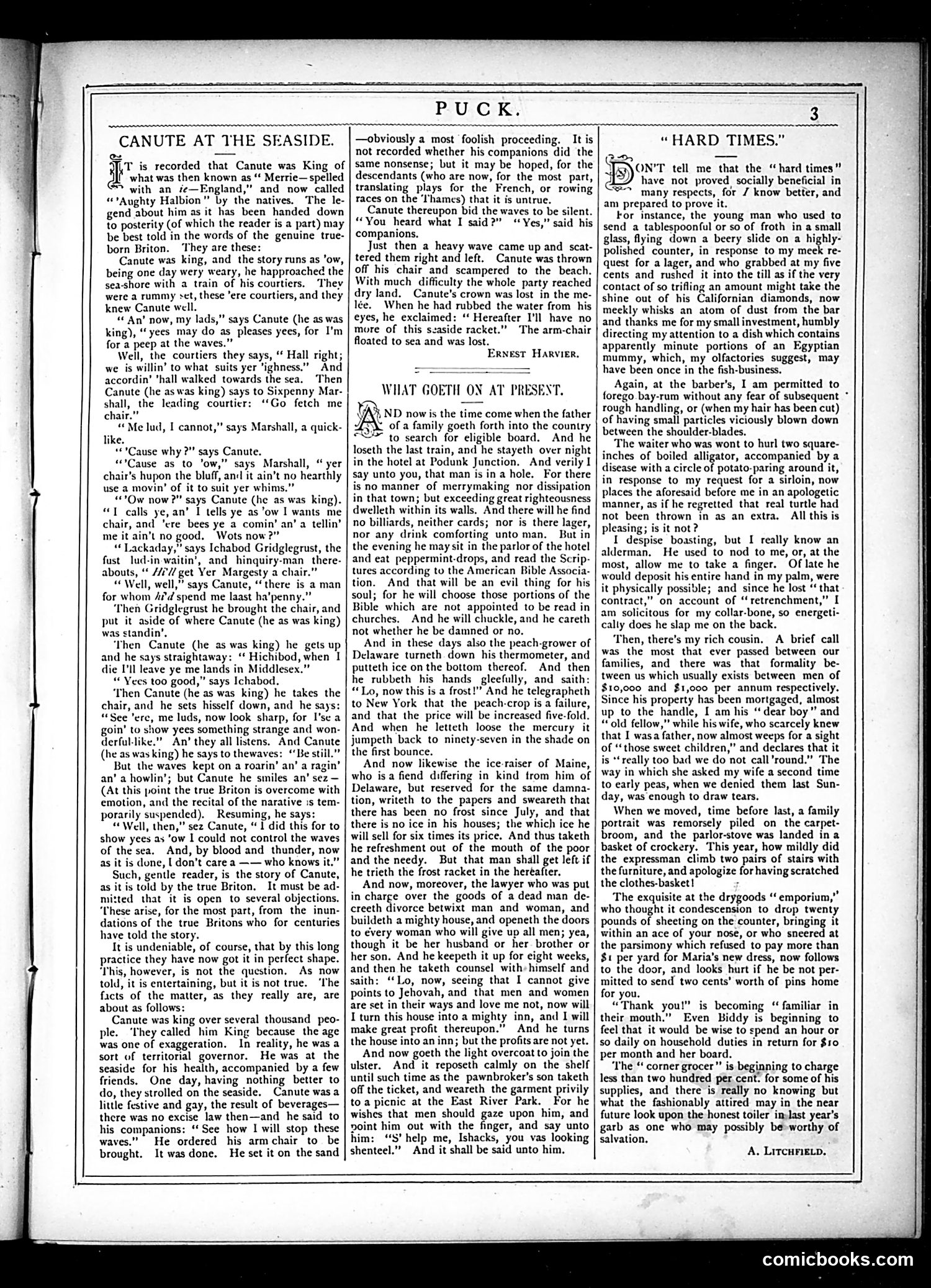
This page contains three satirical articles rather than visual cartoons: 1. **"Canute at the Seaside"** - A humorous retelling of King Canute's famous legend, comparing his futile command to the waves with modern British seaside tourism mishaps. The satire critiques overconfident authority figures. 2. **"What Goeth On at Present"** - Social commentary mocking various contemporary issues: a gossipy goeth (guest) complaining about hotel life during poor harvests, religious hypocrisy among the wealthy, and complaints about servants and household expenses. The piece satirizes upper-class complaints and pretension. 3. **"Hard Times"** - Ernest Harvier's column discussing economic hardship and various failed ventures, including ice-raising schemes and crop failures. The page relies on textual satire rather than illustrations, targeting social pretension and economic foolishness.
📄 Transcribed text from this page (OCR, searchable)
Machine-transcribed from the original scan — historical spelling and the odd misread are preserved.
PUCK. CANUTE AT THE SEASIDE. ee he is recorded that Canute was King of 5 what was then known as “ Merrie— spelled with an #e—England,” and now called “*Aughty Halbion" by the natives. The le- gend about him as it has been handed down to posterity (of which the reader is a part) may be best told in the words of the genuine true- born Briton. ‘They are these: Canute was king, and the story runs as ‘ow, being one day wery weary, he happroached the sea-shore with a train of his courtiers. They were a rummy set, these 'ere courtiers, and they knew Canute well. « An’ now, my lads,” says Canute (he as was king), “yees may do as pleases yees, for I'm for a peep at the waves.”” Well, the courtiers they says, “ Hall right; we is willin’ to what suits yer ‘ighness.” And accordin’ ‘hall walked towards the sea. Then Canute (he as was king) says to Sixpenny Mar- shall, the leading courtier: ‘‘Go fetch me chair.” “Me lud, I cannot,” says Marshall, a quick- like. “*Cause why ?”” says Canute. “Cause as to 'ow,” says Marshall, “ yer chair’s hupon the bluff, and it ain’t no hearthly use a movin’ of it to suit yer whims.” “Ow now?” says Canute (he as was king). “1 calls ye, an’ I tells ye as ‘ow I wants me chair, and ‘ere bees ye a comin’ an’ a tellin’ me it ain't no good. Wots now?” “‘Lackaday,” says Ichabod Gridglegrust, the fust lud-in-waitin', and hinquiry-man_ there- abouts, “ //'// get Yer Margesty a chair.” “Well, well,” says Canute, ‘there is a man for whom Aid spend me laast ha'penny.”” ‘Then Gridglegrust he brought the chair, and put it aside of where Canute (he as was king) was standin’, ‘Then Canute (he as was king) he gets up and he says straightaway: ‘ Hichibod, when I die I'll leave ye me lands in Middlesex.” “ Yees too good,” says Ichabod. ‘Then Canute (he as was king) he takes the chair, and he sets hisself down, and he says: “See 'erc, me luds, now look sharp, for I'se a goin’ to show yees something strange and won- derful-like.” An’ they all listens. And Canute (he as was king) he says to thew: “Be still.” But the waves kept on a roarin’ an’ a ragin’ an’ a howlin’; but Canute he smiles an’ sez — (At this point the true Briton is overcome with emotion, and the recital of the narative is tem- porarily suspended). Resuming, he says: “Well, then,” sez Canute, “1 did this for to show yees as ‘ow | could not control the waves of the sea. And, by blood and thunder, now as it is dune, | don’t care a —— who knows it.” Such, gentle reader, is the story of Canute, as it is told by the true Briton, It must be ad- mitted that it is open to several objections. ‘These arise, for the most part, from the inun- dations of the true Britons who for centuries have told the story, It is undeniable, of course, that by this long practice they have now got it in perfect shape. ‘This, however, is not the question. As now told, it is entertaining, but it is not true. ‘Ihe facts of the matter, as they really are, are about as follows: Canute was king over several thousand peo- ple. ‘They called him King because the age was one of exaggeration. In reality, he was a sort of territorial governor. He was at the seaside for his health, accompanied by a few friends. One day, having nothing better to do, they strolled on the seaside. Canute was a little festive and gay, the result of beverages— there was no excise law then—and he said to his companions: * See how | will stop these waves.” He ordered his armchair to be brought. It wasdone. He set it on the sand —obviously a most foolish proceeding. It is not recorded whether his companions did the same nonsense; but it may be hoped, for the descendants (who are now, for the most part, translating plays for the French, or rowing races on the Thames) that it is untrue. Canute thereupon bid the waves to be silent. “You heard what I said?” “Yes,” said his companions. Just then a heavy wave came up and scat- tered them right and left. Canute was thrown off his chair and scampered to the beach. With much difficulty the whole party reached dry land. Canute’s crown was lost in the me- lée. When he had rubbed the water from his eyes, he exclaimed: ‘ Hereafter I'll have no more of this seaside racket." ‘The arm-chair floated to sea and was lost. Ernest Harvier. WHAT GOETH ON AT PRESENT. m ND now is the time come when the father £3 of a family goeth forth into the country “<*" to search for eligible board. And he loseth the last train, and he stayeth over night in the hotel at Podunk Junction, And verily 1 say unto you, that man is ina hole. For there is no manner of merrymaking nor dissipation in that town; but exceeding great righteousness dwelleth within its walls. And there will he find no billiards, neither cards; nor is there lager, nor any drink comforting unto man. But in the evening he may sit in the parlor of the hotel and eat peppermint-drops, and read the Scrip- tures according to the American Bible Associa- tion. And that will be an evil thing for his soul; for he will choose those portions of the Bible which are not appointed to be read in churches, And he will chuckle, and he careth not whether he be damned or no. And in these days also the peach-grower of Delaware turneth down his thermometer, and putteth ice on the bottom thereof. And then he rubbeth his hands gleefully, and saith: “Lo, now this is a frost!” And he telegrapheth to New York that the peach-crop is a failure, and that the price will be increased five-fold. And when he letteth loose the mercury it jumpeth back to ninety-seven in the shade on the first bounce. And _ now likewise the ice-raiser of Maine, who isa fiend differing in kind trom him of Delaware, but reserved for the same damna- tion, writeth to the papers and sweareth that there has been no frost since July, and that there is no ice in his houses; the which ice he will sell for six times its price. And thus taketh he refreshment out of the mouth of the poor and the needy. But that man shall get left if he trieth the frost racket in the hereafter, And now, moreover, the lawyer who was put in charge over the goods of a dead man de- creeth divorce betwixt man and woman, and buildeth a mighty house, and openeth the doors to every woman who will give up all men; yea, though it be her husband or her brother or her son. And he keepeth it up for eight weeks, and then he taketh counsel with: himself and saith: ‘Lo, now, seeing that I cannot give points to Jehovah, and that men and women are set in their ways and love me not, now will I turn this house into a mighty inn, and I will make great profit thereupon.” And he turns the house into an inn; but the profits are not yet. And now goeth the light overcoat to join the ulster. And it reposeth calmly on the shelf until such time as the pawnbroker’s son taketh off the ticket, and weareth the garment privily toa picnic at the East River Park. For he wishes that men should gaze upon him, and point him out with the finger, and say unto him: “S’ help me, Ishacks, you vas looking shenteel.” And it shall be said unto him. “HARD TIMES.” ON’T tell me that the ‘hard times” have not proved socially beneficial in “> many respects, for / know better, and am prepared to prove it. For instance, the young man who used to send a tablespoonful or so of froth in a small glass, flying down a beery slide on a highly- polished counter, in response to my meek re- quest for a lager, and who grabbed at my five cents and rushed it into the till as if the very contact of so trifling an amount might take the shine out of his Californian diamonds, now meekly whisks an atom of dust from the bar and thanks me for my small investment, humbly directing my attention to a dish which contains apparently minute portions of an Egyptian mummy, which, my olfactories suggest, may have been once in the fish-business. Again, at the barber's, I am permitted to forego bay-rum without any fear of subsequent * rough handling, or (when my hair has been cut) of having small particles viciously blown down between the shoulder-blades. The waiter who was wont to hurl two square- inches of boiled alligator, accompanied by a disease with a circle of potato-paring around it, in response to my request for a sirloin, now places the aforesaid before me in an apologetic manner, as if he regretted that real turtle had not been thrown in as an extra. All this is pleasing; is it not? I despise boasting, but I really know an alderman, He used to nod to me, or, at the most, allow me to take a finger. Of late he would deposit his entire hand in my palm, were it physically possible; and since he lost “that contract,” on account of “retrenchment,” [ am solicitous for my collar-bone, so energeti- cally does he slap me on the back. Then, there’s my rich cousin, A brief call was the most that ever passed between our families, and there was that formality be- tween us which usually exists between men of $10,000 and $1,000 per annum respectively. Since his property has been mortgaged, almost up to the handle, I am his ‘dear boy” and “old fellow,” while his wife, who scarcely knew that I wasa father, now almost weeps for a sight of “‘those sweet children,” and declares that it is “really too bad we do not call’round.” The way in which she asked my wife a second time to early peas, when we denied them last Sun- day, was enough to draw tears, When we moved, time before last, a family portrait was remorsely piled on the carpet- broom, and the parlor-stove was landed ina basket of crockery. This year, how mildly did the expressman climb two pairs of stairs with the furniture, and apologize for having scratched the clothes-basket! The exquisite at the drygoods “emporium,” who thought it condescension to drop twenty pounds of sheeting on the counter, bringing it within an ace of your nose, or who sneered at the parsimony which refused to pay more than $1 per yard for Maria's new dress, now follows to the door, and looks hurt if he be not per- mitted to send two cents’ worth of pins home for you. “Thank you!” is becoming “ familiar in their mouth.” Even Biddy is beginning to feel that it would be wise to spend an hour or so daily on household duties in return for $10 per month and her board. ‘The corner grocer” is beginning to charge less than two hundred per cent. for some of his supplies, and there is really no knowing but what the fashionably attired may in the near future look upon the honest toiler imJlast year’s garb as one who may possibly be»worthy of salvation, A. Litcurigtp. comicbooks.com