
Puck, 1878-06-05 · page 7 of 16
Puck — June 5, 1878 — page 7: what you’re looking at
What you’re looking at
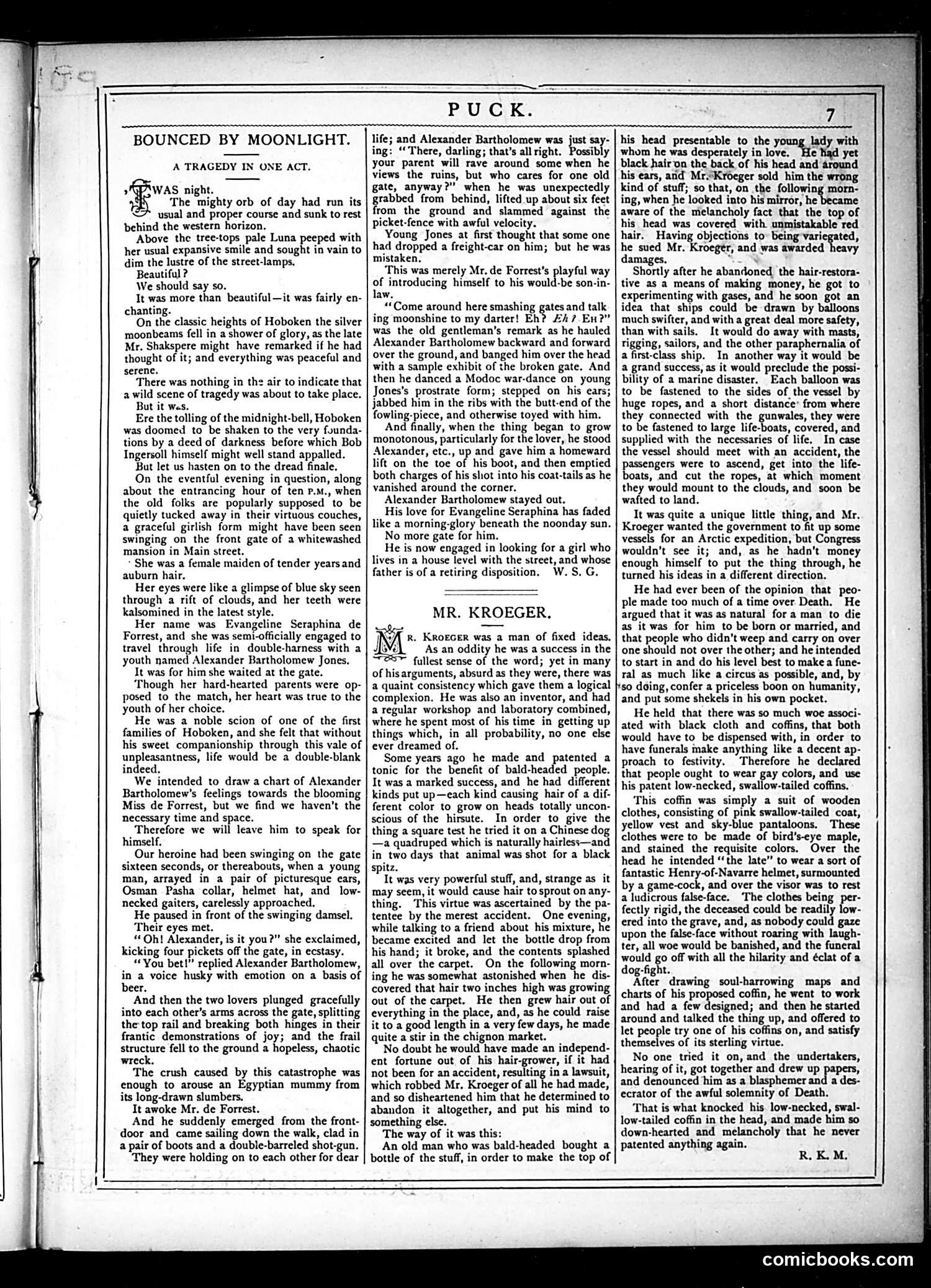
This page contains the text and illustrations for a one-act theatrical tragedy titled "Bounded by Moonlight." The narrative follows a romantic plot involving young lovers—particularly Evangeline Seraphina Forrest and Alexander Bartholomew—set in Hoboken. The story satirizes melodramatic theater conventions of the era: improbable coincidences, overwrought emotions, and absurd plot devices (a man growing hair from a mysterious substance, complications from a broken gate). The accompanying section "Mr. Kroeger" introduces a character described as a man of "fixed ideas" with eccentric scientific pursuits. This appears to be a satirical portrait mocking pseudoscientific entrepreneurs and inventors popular during the Gilded Age who made dubious patent claims. The page exemplifies Puck's use of literary parody to mock theatrical conventions and contemporary social figures.
📄 Transcribed text from this page (OCR, searchable)
Machine-transcribed from the original scan — historical spelling and the odd misread are preserved.
BOUNCED BY MOONLIGHT. A TRAGEDY »Awas night. The mighty orb of day had run its usual and proper course and sunk to rest behind the western horizon. Above the tree-tops pale Luna peeped with her usual expansive smile and sought in vain to dim the lustre of the street-lamps. Beautiful ? We should say so. It was more than beautiful—it was fairly en- chanting. On the classic heights of Hoboken the silver moonbeams fell in a shower of glory, as the late Mr. Shakspere might have remarked if he had thought of it; and everything was peaceful and serene. There was nothing in the air to indicate that a wild scene of tragedy was about to take place, But it wes. Ere the tolling of the midnight-bell, Hoboken was doomed to be shaken to the very founda- tions by a deed of darkness before which Bob Ingersoll himself might well stand appalled. But let us hasten on to the dread finale, On the eventful evening in question, along about the entrancing hour of ten p.m., when the old folks are popularly supposed to be quietly tucked away in their virtuous couches, a graceful girlish form might have been seen swinging on the front gate of a whitewashed mansion in Main street. She was a female maiden of tender years and auburn hair, Her eyes were like a glimpse of blue sky seen through a rift of clouds, and her teeth were kalsomined in the latest style. Her name was Evangeline Seraphina de Forrest, and she was semi-officially engaged to travel through life in double-harness with a youth named Alexander Bartholomew Jones, It was for him she waited at the gate. ‘Though her hard-hearted parents were op- posed to the match, her heart was true to the youth of her choice. He was a noble scion of one of the first families of Hoboken, and she felt that without his sweet companionship through this vale of unpleasantness, life would be a double-blank indeed. We intended to draw a chart of Alexander Bartholomew's feelings towards the blooming Miss de Forrest, but we find we haven't the necessary time and space. Therefore we will leave him to speak for himself. Our heroine had been swinging on the gate sixteen seconds, or thereabouts, when a young man, arrayed in a pair of picturesque ears, Osman Pasha collar, helmet hat, and low- necked gaiters, carelessly approached. He paused in front of the swinging damsel. ‘Their eyes met. “Oh! Alexander, is it you?” she exclaimed, kicking four pickets off the gate, in ecstasy. “You bet!” replied Alexander Bartholomew, in a voice husky with emotion on a basis of beer. And then the two lovers plunged gracefully into each other’s arms across the gate, splitting the top rail and breaking both hinges in their frantic demonstrations of joy; and the frail structure fell to the ground a hopeless, chaotic wreck, The crush caused by this catastrophe was enough to arouse an Egyptian mummy from its long-drawn slumbers. It awoke Mr. de Forrest. And he suddenly emerged from the front- door and came sailing down the walk, clad in a pair of boots and a double-barreled shot-gun. ‘They were holding on to each other for dear ONE ACT. life; and Alexander Bartholomew was just say- ing: “There, darling; that’s allright. Possibly your parent will rave around some when he views the ruins, but who cares for one old gate, anyway?” when he was unexpectedly grabbed from behind, lifted up about six feet from the ground and slammed against the picket-fence with awful velocity. Young Jones at first thought that some one had dropped a freight-car on him; but he was mistaken, ‘This was merely Mr. de Forrest's playful way of introducing himself to his would-be son-in- law. “Come around here smashing gates and talk ing moonshine to my darter! Eh? £/?.En?” was the old gentleman's remark as he hauled Alexander Bartholomew backward and forward over the ground, and banged him over the head with a sample exhibit of the broken gate. And then he danced a Modoc war-dance on young Jones's prostrate form; stepped on his ears; jabbed him in the ribs with the butt-end of the fowling-piece, and otherwise toyed with him, And finally, when the thing began to grow monotonous, particularly for the lover, he stood Alexander, etc., up and gave him a homeward lift on the toe of his boot, and then emptied both charges of his shot into his coat-tails as he vanished around the corner. Alexander Bartholomew stayed out. His love for Evangeline Seraphina has faded like a morning-glory beneath the noonday sun. No more gate for him. He is now engaged in looking for a girl who lives in a house level with the street, and whose father is of a retiring disposition. W. S. G. MR. KROEGER. R. KRogGER was a man of fixed ideas, As an oddity he was a success in the SS~ fullest sense of the word; yet in many of his arguments, absurd as they were, there was a quaint consistency which gave them a logical complexion. He was also an inventor, and had a regular workshop and laboratory combined, where he spent most of his time in getting up things which, in all probability, no one else ever dreamed of. Some years ago he made and patented a tonic for the benefit of bald-headed people. It was a marked success, and he had different kinds put up—each kind causing hair of a dif- ferent color to grow on heads totally uncon- scious of the hirsute. In order to give the thing a square test he tried it on a Chinese dog —a quadruped which is naturally hairless—and in two days that animal was shot for a black spitz. It was very powerful stuff, and, strange as it may seem, it would cause hair to sprout on any- thing. This virtue was ascertained by the pa- tentee by the merest accident. One evening, while talking to a friend about his mixture, he became excited and let the bottle drop from his hand; it broke, and the contents splashed all over the carpet. On the following morn- ing he was somewhat astonished when he dis- covered that hair two inches high was growing out of the carpet. He then grew hair out of everything in the place, and, as he could raise it to a good length in a very few days, he made quite a stir in the chignon market. No doubt he would have made an independ- ent fortune out of his hair-grower, if it had not been for an accident, resulting in a lawsuit, which robbed Mr. Kroeger of all he had made, and so disheartened him that he determined to abandon it altogether, and put his mind to something else. ‘The way of it was this: An old man who was bald-headed bought a bottle of the stuff, in order to make the top of his head presentable to the young lady with whom he was desperately in love. le yet black hair on the back of his head and around his ears, and Mr.“Kroeger sold him the wrong kind of stuff; so that, on the following morn- ing, when he looked into his mirror, he bec aware of the melancholy fact that the top of his head was covered with unmistakable red hair. Having objections to. being variegated, he sued Mr. Kroeger, and was awarded heavy damages, N Shortly after he abandoned, the hair-restora- tive as a means of making money, he got to experimenting with gases, and he soon got an idea that ships could be drawn by balloons much swifter, and with a great deal more safety, than with sails. It would do away with masts, rigging, sailors, and the other paraphernalia of a first-class ship. In another way it would be a grand success, as it would preclude the possi- bility of a marine disaster. Each balloon was to be fastened to the sides of the vessel by huge ropes, and a short distance’ from where they connected with the gunwales, they were to be fastened to large life-boats, covered, and supplied with the necessaries of life. In case the vessel should meet with an accident, the passengers were to ascend, get into the life- boats, and cut the ropes, at which moment they would mount to the clouds, and soon be wafted to land. It was quite a unique little thing, and Mr. Kroeger wanted the government to fit up some vessels for an Arctic expedition, but Congress wouldn't see it; and, as he hadn't money enough himself to put the thing through, he turned his ideas in a different direction. He had ever been of the opinion that peo- ple made too much of a time over Death. He argued that it was as natural for a man to die as it was for him to be born or married, and that people who didn’t weep and carry on over one should not over the other; and he intended to start in and do his level best to make a fune- ral as much like a circus as possible, and, by |'so doing, confer a priceless boon on humanity, and put some shekels in his own pocket. He held that there was so much woe associ- ated with black cloth and coffins, that both would have to be dispensed with, in order to have funerals make anything like a decent ap- proach to festivity. Therefore he declared that people ought to wear gay colors, and use his patent low-necked, swallow-tailed coffins, This coffin was simply a suit of wooden clothes, consisting of pink swallow-tailed coat, yellow vest and sky-blue pantaloons. These clothes were to be made of bird's-eye maple, and stained the requisite colors. Over the head he intended “the late” to wear a sort of fantastic Henry-of-Navarre helmet, surmounted by a game-cock, and over the visor was to rest a ludicrous false-face, ‘The clothes being per- fectly rigid, the deceased could be padi w- ered into the grave, and, as nobody could gaze upon the false-face without roaring with laugh- ter, all woe would be banished, and the funeral would go off with all the hilarity and éclat of a dog-fight. ‘After drawing soul-harrowing maps and charts of his proposed coffin, he went to work and had a few designed; and then he started around and talked the thing up, and offered to let people try one of his coffins on, and satisfy themselves of its sterling virtue. No one tried it on, and the undertakers, hearing of it, got together and drew up . and denounced ‘him as a blasphemer and a des- ecrator of the awful solemnity of Death. ‘That is what knocked his. low-necked, swal- low-tailed coffin in the head, and made him so down-hearted and melancholy that he never atented anythii ain. u rene R.K.M. comicbooks.com