
Puck, 1878-06-05 · page 6 of 16
Puck — June 5, 1878 — page 6: what you’re looking at
What you’re looking at
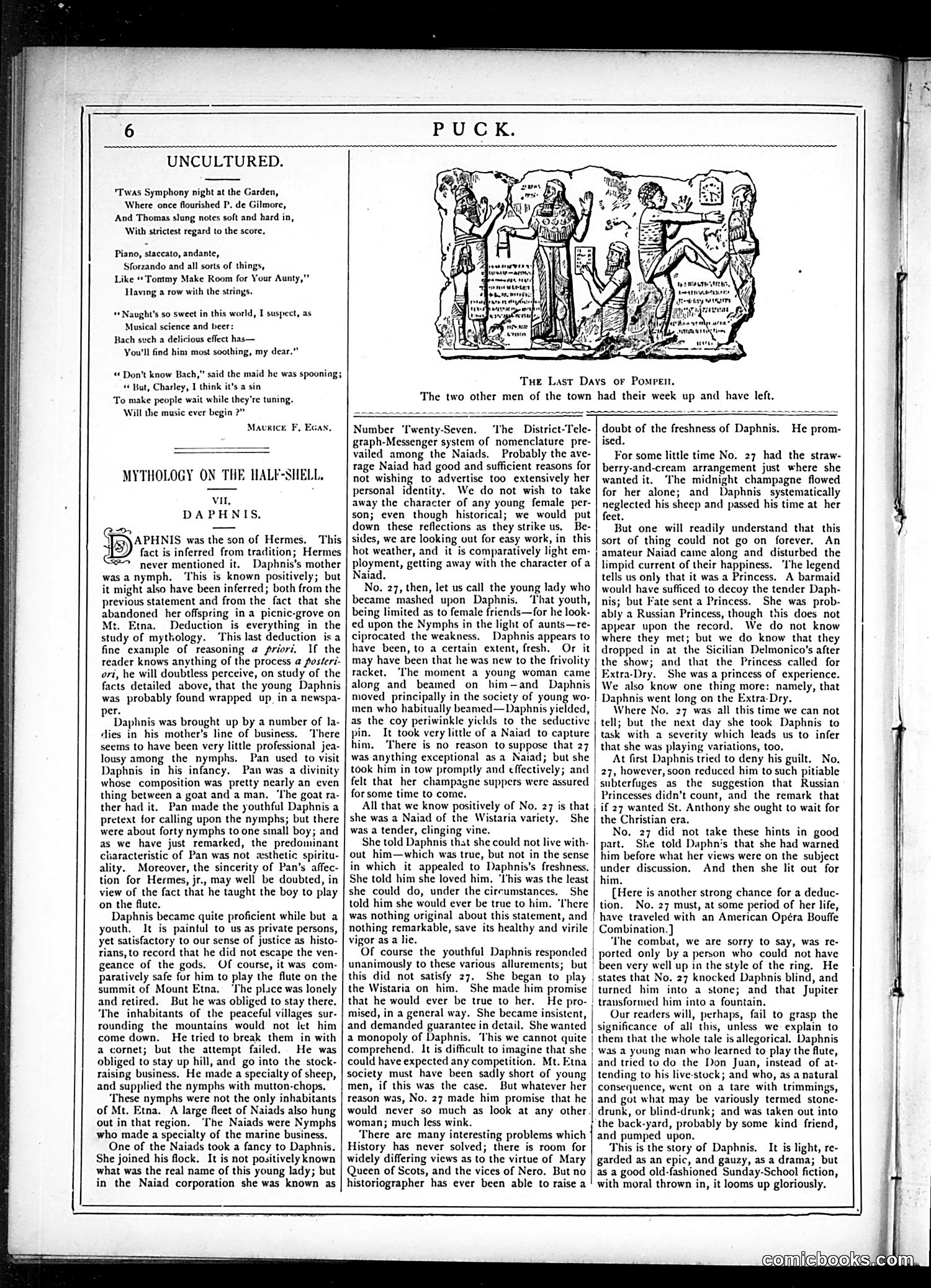
This page contains two separate pieces with no obvious political satire: **"Uncultured"** (left column) is a humorous poem by Maurice F. Egan mocking pretentious music appreciation. It describes a Symphony night where attendees discuss classical pieces while someone spoils the mood by requesting "Tommy Make Room for Your Aunty"—suggesting tension between highbrow and lowbrow entertainment preferences. **"Mythology on the Half-Shell: VI. Daphnis"** (right column) is a mythological essay about the classical shepherd figure, discussing his legend and various historical interpretations. The accompanying illustration shows classical figures in a mythological scene. Neither piece appears to contain political commentary or contemporary social satire—the typical focus of Puck magazine. This page seems to emphasize literary and cultural content rather than satirical cartooning.
📄 Transcribed text from this page (OCR, searchable)
Machine-transcribed from the original scan — historical spelling and the odd misread are preserved.
UNCULTURED. "Twas Symphony night at the Garden, Where once flourished P, de Gilmore, And Thomas slung notes soft and hard in, With strictest regard to the score, Piano, staccato, andante, Sforzando and all sorts of things, Like “Tommy Make Room for Your Aunty,”” Having a row with the strings. + Naught’s so sweet in this world, I suspect, as Musical science and beer: Bach such a delicious effect has— You'll find him most soothing, my dear.” «Don’t know Bach,” said the maid he was spooning; + But, Charley, I think it’s a sin To make people wait while they're tuning. Will the music ever begin ?” Mavrice F, MYTHOLOGY ON THE HALF-SHELL, Vil, DAPHNIS, Gx tee ; Is) APHNIS was the son of Hermes. This i) fact is inferred from tradition; Hermes GE never mentioned it. Daphnis's mother was a nymph. ‘This is known positively; but it might also have been inferred; both from the previous statement and from the fact that she abandoned her offspring ina picnic-grove on Mt. Etna. Deduction is everything in the study of mythology. ‘his last deduction is a fine example of reasoning @ priori, If the reader knows anything of the process @ posteri- ori, he will doubtless perceive, on study of the facts detailed above, that the young Daphnis was probably found wrapped up ina newspa- er. , Daphnis was brought up by a number of la- dies in his mother’s line of business. ‘There seems to have been very little professional jea- lousy among the nymphs. Pan used to visit Daphnis in his infancy. Pan was a divinity whose composition was pretty nearly an even thing between a goat and a man, ‘The goat ra- ther had it. Pan made the youthful Daphnis a pretext for calling upon the nymphs; but there were about forty nymphs to one small boy; and as we have just remarked, the predominant characteristic of Pan was not asthetic spiritu- ality. Moreover, the sincerity of Pan's affec- tion for Hermes, jr., may well be doubted, in view of the fact that he taught the boy to play on the flute. Daphnis became quite proficient while but a youth. It is paintul to us as private persons, yet satisfactory to our sense of justice as histo- rians, to record that he did not escape the ven- geance of the gods. Of course, it was com- paratively safe for him to play the flute on the summit of Mount Etna. ‘The place was lonely and retired, But he was obliged to stay there. ‘The inhabitants of the peaceful villages sur- rounding the mountains would not let him come down. He tried to break them in with a cornet; but the attempt failed. He was obliged to stay up hill, and go into the stock- raising business. He made a specialty of sheep, and supplied the nymphs with mutton-chops. ‘These nymphs were not the only inhabitants of Mt. Etna. A large fleet of Naiads also hung out in that region. ‘The Naiads were Nymphs who made a specialty of the marine business. One of the Naiads took a fancy to Daphnis. She joined his flock. It is not positively known what was the real name of this young lady; but Tue Last Days of Pomrent. The two other men of the town had their week up and have left. Number ‘Twenty-Seven. ‘I'he District-Tele- graph-Messenger system of nomenclature pre- vailed among the Naiads. Probably the ave- rage Naiad had good and sufficient reasons for not wishing to advertise too extensively her personal identity. We do not wish to take away the character of any young female per- son; even though historical; we would put down these reflections as they strike us. Be- sides, we are looking out for easy work, in this hot weather, and it is comparatively light em- ployment, getting away with the character of a Naiad. No. 27, then, let us call the young lady who became mashed upon Daphnis, ‘That youth, being limited as to female friends—for he look- ed upon the Nymphs in the light of aunts—re- ciprocated the weakness. Daphnis appears to have been, to a certain extent, fresh. Or it may have been that he was new to the frivolity racket, ‘The moment a young woman came along and beamed on him—and Daphnis moved principally in the society of young wo- men who habitually beamed—Daphnis yielded as the coy periwinkle yiclds to the seductive pin. It took very little of a Naiad to capture him. There is no reason to suppose that 27 was anything exceptional as a Naiad; but she took him in tow promptly and effectively; and felt that her champagne suppers were assured for some time to come, Alll that we know positively of No. 27 is that | she was a Naiad of the Wistaria variety. She was a tender, clinging vine. She told Daphnis that she could not live with- out him—which was true, but not in the sense in which it appealed to Daphnis’s freshness. She told him she loved him. ‘I'his was the least she could do, under the circumstances. She told him she would ever be true to him. ‘here was nothing original about this statement, and | nothing remarkable, save its healthy and virile vigor as a lie. Of course the youthful Daphnis responded | unanimously to these various allurements; but this did not satisfy 27. She began to play the Wistaria on him. She made him promise that he would ever be true to her. He pro- | mised, in a general way. She became insistent, and demanded guarantec in detail. She wanted a monopoly of Daphnis. ‘This we cannot quite comprehend. It is difficult to imagine that she | could have expected any competition. Mt. Etna | society must have been sadly short of young men, if this was the case. But whatever her reason was, No. 27 made him promise that he would never so much as look at any other woman; much less wink. ‘There are many interesting problems which History has never solved; there is room for widely differing views as to the virtue of Mary Queen of Scots, and the vices of Nero. But no doubt of the freshness of Daphnis. He prom- ised. For some little time No. 27 had the straw- berry-and-cream arrangement just where she wanted it. ‘The midnight champagne flowed for her alone; and Daphnis systematically neglected his sheep and passed his time at her feet. But one will readily understand that this sort of thing could not go on forever. An amateur Naiad came along and disturbed the limpid current of their happiness. ‘The legend tells us only that it was a Princess. A barmaid would have sufficed to decoy the tender Daph- nis; but Fate sent a Princess. She was prob- ably a Russian Princess, though this does not appear upon the record. We do not know where they met; but we do know that they dropped in at the Sicilian Delmonico's after the show; and that the Princess called for Extra-Dry. She was a princess of experience. We also know one thing more: namely, that Daphnis went long on the Extra-Dry. Where No. 27 was all this time we can not tell; but the next day she took Daphnis to task with a severity which leads us to infer that she was playing variations, too, At first Daphnis tried to deny his guilt. No. 27, however, soon reduced him to such pitiable subterfuges as the suggestion that Russian Princesses didn’t count, and the remark that if 27 wanted St. Anthony she ought to wait for the Christian era. No, 27 did not take these hints in good part. She told Daphn‘s that she had warned him before what her views were on the subject under discussion, And then she lit out for im. (Here is another strong chance for a deduc- tion. No. 27 must, at some period of her life, have traveled with an American Opéra Bouffe Combination.] ‘The combat, we are sorry to say, was re- ported only by a person who could not have been very well up in the style of the ring. He states that No. 27 knocked Daphnis blind, and turned him into a stone; and that Jupiter transformed him into a fountain. Our readers will, perhaps, fail to grasp the significance of all this, unless we explain to them that the whole tale is allegorical. Daphnis was a young man who learned to play the flute, and tried to do the Don Juan, instead of at- tending to his livestock; and who, as a natural consequence, went on a tare with trimmings, and got what may be variously termed stone- drunk, or blind-drunk; and was taken out into the back-yard, probably by some kind friend, and pumped upon, This is the story of Daphnis. It is light, re- garded as an epic, and gauzy, as a drama; but as a good old-fashioned Sunday-School fiction, in the Naiad corporation she was known as | historiographer has ever been able to raise a ' with moral thrown in, it looms up gloriously. ( =|