
Puck, 1878-06-05 · page 4 of 16
Puck — June 5, 1878 — page 4: what you’re looking at
What you’re looking at
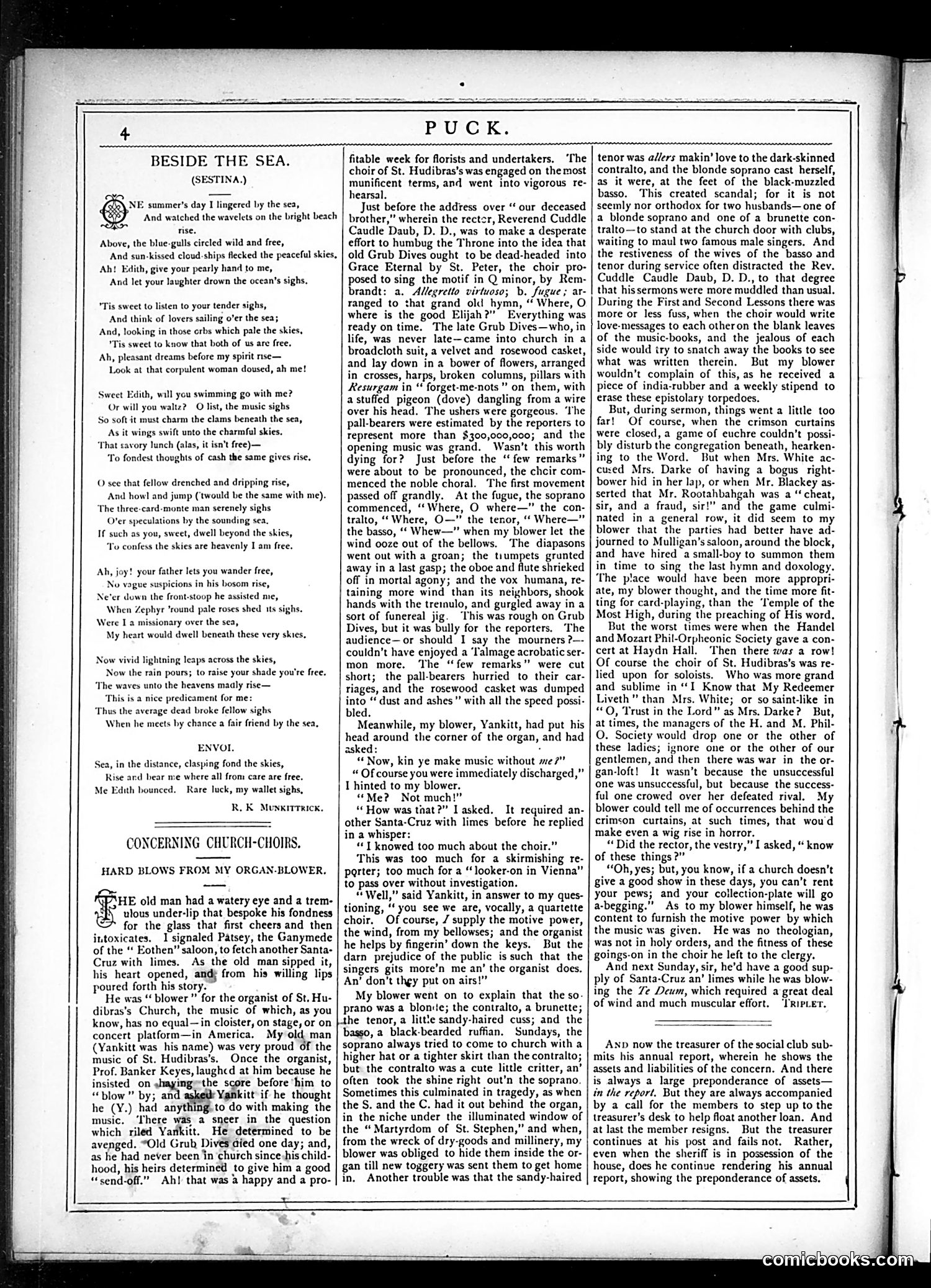
This page contains two distinct pieces: a poem titled "Beside the Sea (Sestina)" and a prose article "Concerning Church-Choirs: Hard Blows From My Organ-Blower." The poetry appears to be sentimental verse about seaside romance. The prose article is satirical commentary on church choir management and musician behavior. The author humorously recounts conflicts with an organ blower, complaints about soloists' vanity, and disputes over musical selections—particularly concerning whether to perform Handel's "Messiah" or Mozart pieces. The satire targets ecclesiastical pretension and the difficulties of managing artistic temperaments in religious settings. The author mocks both the organist's authority and choir members' egos, presenting church music administration as absurdly contentious. No specific political figures or events are referenced; the humor is social rather than topical.
📄 Transcribed text from this page (OCR, searchable)
Machine-transcribed from the original scan — historical spelling and the odd misread are preserved.
PUCK. BESIDE THE SEA. (SESTINA.) yo fat summer's day I lingered by the sea, And watched the wavelets on the bright beach 7 Above, the blue-gulls circled wild and free, ‘And sun-kissed cloud-ships flecked the peaceful skies, Ah! Edith, give your pearly hand to me, ‘And let your laughter drown the ocean’s sighs, rise, "Tis sweet to listen to your tender sighs, And think of lovers sailing o'er the sea; And, looking in those orbs which pale the skies, Tis sweet to know that both of us are free. Ah, pleasant dreams before my spirit nse— Look at that corpulent woman doused, ah met Sweet Edith, will you swimming go with me? Or will you waltz? O list, the music sighs So soft it must charm the clams beneath the sea, As it wings swift unto the charmful skies. ‘That savory lunch (alas, it isn’t free)— ‘To fondest thovghts of cash the same gives rise, O sce that fellow drenched and dripping rise, And howl and jump (twould be the same with me), ‘The three-card-monte man serenely sighs O'er speculations by the sounding sea, If such as you, sweet, dwell beyond the skies, ‘To confess the skies are heavenly I am free. Ah, joy! your father lets you wander free, No vogue suspicions in his bosom rise, Ne‘er down the front-stoop he assisted me, When Zephyr ‘round pale roses shed ts sighs. Were Ia missionary over the sea, My heart would dwell beneath these very skies, Now vivid lightning leaps across the skies, Now the rain pours; to raise your shade you're free. ‘The waves unto the heavens madly rise— his is a nice predicament for me: ‘Thus the average dead broke fellow sighs When he meets by chance a fair friend by the sea, ENVOI. Sea, in the distance, clasping fond the skies, Rise ard bear me where all front care are free. Me Edith bounced. Rare luck, my wallet sighs, R, K Muwxrrrrick, CONCERNING CHURCH-CHOIRS. HARD BLOWS FROM MY ORGAN-BLOWER, HE old man had a watery eye and a trem- ulous under-lip that bespoke his fondness for the glass that first cheers and then intoxicates. I signaled Patsey, the Ganymede of the ‘* Eothen” saloon, to fetch another Santa- Cruz with limes. As the old man sipped it, his heart opened, andy from his willing lips poured forth his story. He was “ blower ” for the organist of St. Hu- dibras'’s Church, the music of which, as you know, has no equal—in cloister, on stage, or on concert platform—in America. My old man (Yankitt was his name) was very proud of the music of St. Hudibras’s. Once the organist, Prof. Banker Keyes, laughed at him because he insisted on ee wethe score before “him to “blow ” by; an Yankitt if he thought he (Y.) had anything. to do with making the music. ‘There was a sneer in the question which riled Yankitt. He determined to be avenged. “Old Grub Dives aied one day; and, as he had never been in church since-his child- hood, his heirs determined to give him a good fitable week for florists and undertakers. ‘The choir of St. Hudibras’s was engaged on the most munificent terms, and went into vigorous re- hearsal. Just before the address over ‘ our deceased brother,” wherein the rectcr, Reverend Cuddle Caudle Daub, D. D., was to make a desperate effort to humbug the Throne into the idea that old Grub Dives ought to be dead-headed into Grace Eternal by St. Peter, the choir pro- posed to sing the motif in Q minor, by Rem- brandt: a. Allegretto virtuoso; b. fugue; ar- ranged to that grand old hymn, “ Where, O where is the good Elijah?” Everything was ready on time. The late Grub Dives—who, in life, was never late—came into church in a broadcloth suit, a velvet and rosewood casket, and lay down in a bower of flowers, arranged in crosses, harps, broken columns, pillars with Resurgam in forget-me-nots” on them, with astufied pigeon (dove) dangling from a wire over his head. The ushers were gorgeous. ‘Ihe pall-bearers were estimated by the reporters to represent more than $300,000,000; and the opening music was grand. | Wasn't this worth dying for? Just before the ‘few remarks” were about to be pronounced, the chcir com- menced the noble choral. The first movement passed off grandly, At the fugue, the soprano commenced, ‘‘ Where, O where—" the con- tralto, “Where, O—” the tenor, “ Where—” the basso, ‘‘ Whew—" when my blower let the wind ooze out of the bellows. The diapasons went out with a groan; the tiumpets grunted away in a last gasp; the oboe and flute shrieked off in mortal agony; and the vox humana, re- taining more wind than its neighbors, shook hands with the tremnulo, and gurgied away in a sort of funereal jig. ‘This was rough on Grub Dives, but it was bully for the reporters. The audience—or should I say the mourners ?—- couldn't have enjoyed a ‘l'almage acrobatic ser- mon more. The ‘few remarks” were cut short; the pall-bearers hurried to their car- riages, and the rosewood casket was dumped into “ dust and ashes” with all the speed possi- bled. Meanwhile, my blower, Yankitt, had put his head around the corner of the organ, and had asked: . “ Now, kin ye make music without me?” “ Of course you were immediately discharged,” L hinted to my blower. “Me? Not much!” “How was that?” I asked, It required an- other Santa-Cruz with limes before he replied in a whisper: “ T knowed too much about the choir.” This was too much for a skirmishing re- porter; too much for a “looker-on in Vienna” to pass over without investigation. “Well,” said Yankitt, in answer to my ques- tioning, ‘‘ you see we are, vocally, a quartette choir. Of course, / supply the motive power, the wind, from my bellowses; and the organist he helps by fingerin’ down the keys. But the darn prejudice of the public is such that the singers gits more’n me an’ the organist does. An’ don’t they put on airs!” My blower went on to explain that the so- prano was a blonie; the contralto, a brunette; the tenor, a little sandy-haired cuss; and the basso, a black-bearded ruffian, Sundays, the soprano always tried to come to church with a higher hat or a tighter skirt than the contralto; but the contralto was a cute little critter, an’ often took the shine right out’n the soprano. Sometimes this culminated in tragedy, as when the S, and the C. had it out behind the organ, in the niche under the illuminated window of the “Martyrdom of St. Stephen,” and when, from the wreck of dry-goods and millinery, my blower was obliged to hide them inside the or- gan till new toggery was sent them to get home “send-off.” Ah! that was @ happy and a pro- in, Another trouble was that the sandy-haired tenor was a//ers makin’ love to the dark-skinned contralto, and the blonde soprano cast herself, as it were, at the feet of the black-muzzled basso. This created scandal; for it is not seemly nor orthodox for two husbands—one of a blonde soprano and one of a brunette con- tralto—to stand at the church door with clubs, waiting to maul two famous male singers. And the restiveness of the wives of the basso and tenor during service often distracted the Rev. Cuddle Caudle Daub, D. D., to that degree that hissermons were more muddled than usual. During the First and Second Lessons there was more or less fuss, when the choir would write love-messages to each otheron the blank leaves of the music-books, and the jealous of each side would iry to snatch away the books to see what was written therein. But my blower wouldn’t complain of this, as he received a piece of india-rubber and a weekly stipend to erase these epistolary torpedoes. But, during sermon, things went a little too far! Of course, when the crimson curtains were closed, a game of euchre couldn't possi- bly disturb the congregation beneath, hearken- ing to the Word. But when Mrs. White ac- cused Mrs. Darke of having a bogus right- bower hid in her lap, or when Mr. Blackey as- serted that Mr. Rootahbahgah was a ‘cheat, sir, and a fraud, sir!” and the game culmi- nated in a general row, it did seem to my blower that the parties had better have ad- journed to Mulligan’s saloon, around the block, and have hired a small-boy to summon them in time to sing the last hymn and doxology. ‘The place would have been more appropri- ate, my blower thought, and the time more fit- ting for card-playing, than the ‘Temple of the Most High, during the preaching of His word. But the worst times were when the Handel and Mozart Phil-Orpheonic Society gave a con- cert at Haydn Hall. Then there was a row! Of course the choir of St. Hudibras’s was re- lied upon for soloists. Who was more grand and sublime in ‘I Know that My Redeemer Liveth” than Mrs. White; or so saint-like in “O, Trust in the Lord” as Mrs. Darke? But, at times, the managers of the H. and M. Phil- Q. Society would drop one or the other of these ladies; ignore one or the other of our gentlemen, and then there was war in the or- gan-loft! It wasn’t because the unsuccessful one was unsuccessful, but because the success- ful one crowed over her defeated rival. My blower could tell me of occurrences behind the crimson curtains, at such times, that woud make even a wig rise in horror. “ Did the rector, the vestry,” I asked, “ know of these things ?” “Oh, yes; but, you know, if a church doesn’t give a good show in these days, you can’t rent your pews; and your collection-plate will go a-begging.” As to my blower himself, he was content to furnish the motive power by which the music was given. He was no theologian, was not in holy orders, and the fitness of these goings-on in the choir he left to the clergy. And next Sunday, sir, he’d have a good sup- ply of Santa-Cruz an’ limes while he was blow- ing the Ze Deum, which required a great deal of wind and much muscular effort. ‘TRipcer. Anp now the treasurer of the social club sub- mits his annual report, wherein he shows the assets and liabilities of the concern. And there always a large preponderance of assets— in the report. But they are always accompanied by a call for the members to step up to the treasurer's desk to help float another loan. And at last the member resigns. But the treasurer continues at his post and fails not. Rather, even when the sheriff is in possession of the house, does he continue rendering his annual report, showing the preponderance of assets. —