
A complete issue · 16 pages · 1878
Puck — May 15, 1878
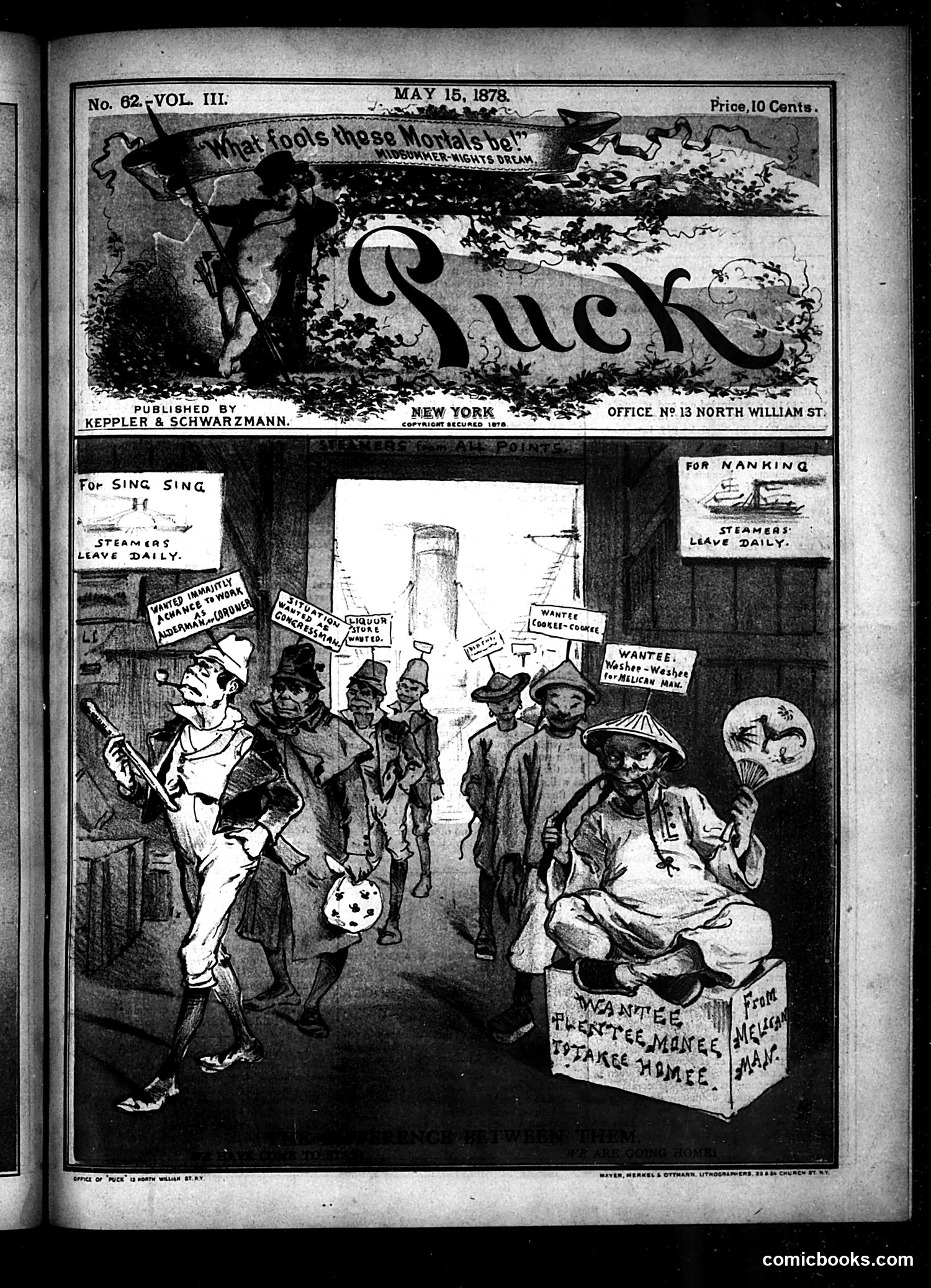
This satirical cartoon depicts a chaotic street scene centered on immigration and labor concerns of the 1870s. A well-dressed white man (left) confronts a diverse group of immigrants holding signs advertising their availability for work—positions like "Sing Sing" (the famous prison), steamer work, and domestic labor appear referenced. The central figure in a box labeled "WANTEE" with text about "Chinee" workers suggests anti-Chinese immigration sentiment, a major political issue of that era. The cartoon satirizes the desperation of immigrant workers competing for menial jobs and the xenophobic attitudes toward them. The title references "Wise Fools" and "Mortals," though the exact meaning requires fuller context. The small inset advertisements for steamers "For Singing" and "For Mankind" leaving daily likely mock the exploitation inherent in labor recruitment schemes.
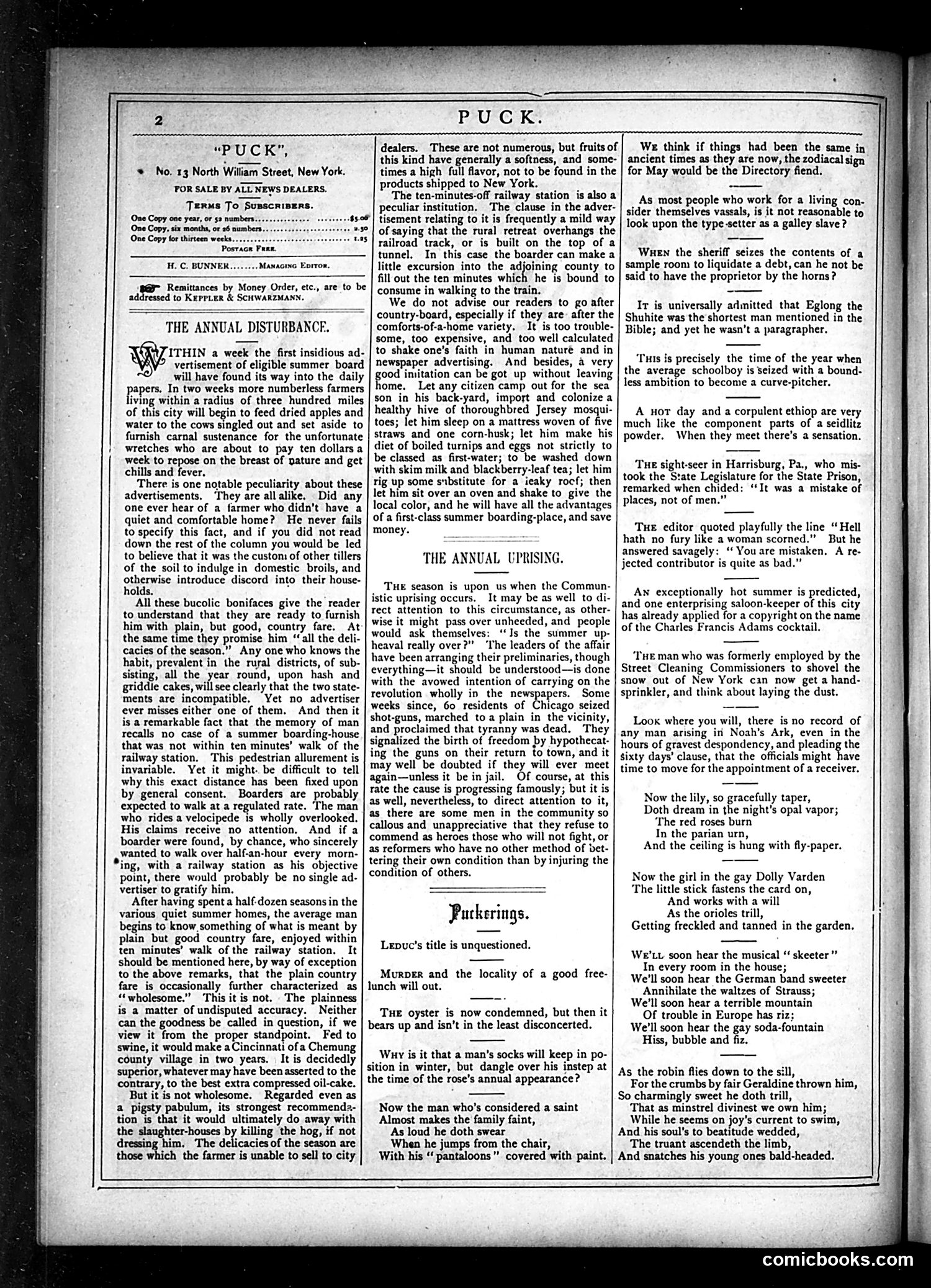
This page is primarily **text-based editorial content** rather than political cartoons. It contains: 1. **"The Annual Disturbance"** - A satirical article mocking summer boardinghouses and rural retreats, criticizing their poor conditions, overpricing, and false advertising to city dwellers seeking respite. 2. **"The Annual Uprising"** - Commentary on a Chicago uprising (appears to reference a recent freedom/anti-tyranny event), suggesting some readers doubt lasting change will occur. 3. **"Puckerings"** - A humor column with brief satirical quips about various topics (Leduc's title, oysters, men's socks in winter, a "saint" swearing). 4. **Poetry** - Verse about summer social activities and romance. The page exemplifies Puck's satirical approach through **written humor** targeting middle-class aspirations and contemporary absurdities rather than visual political cartooning.
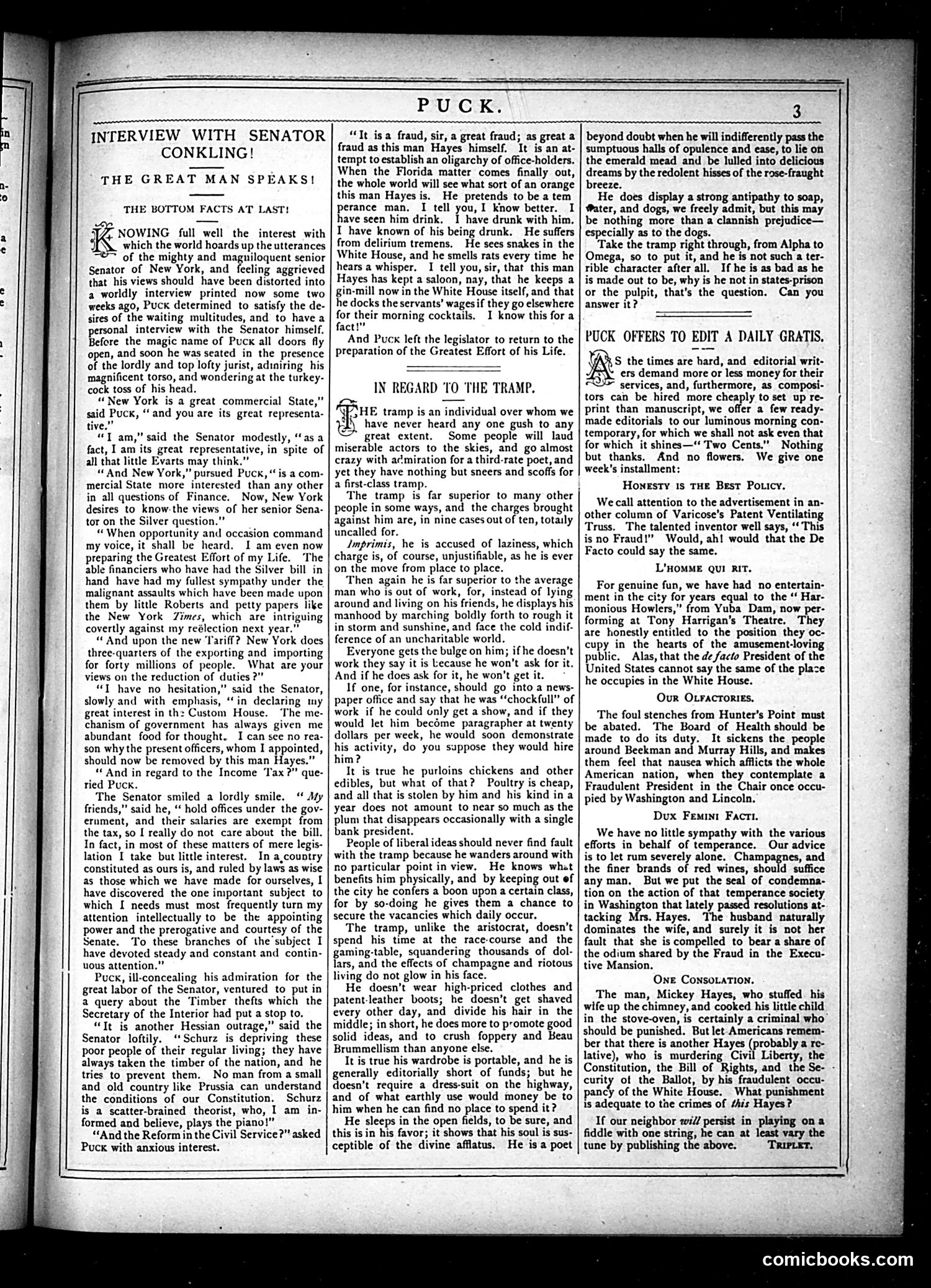
This page features an **interview with Senator Conkling**, a prominent 19th-century Republican politician. The satire mocks Conkling's vanity and corruption while ostensibly praising him as a "great man." The interview criticizes Conkling's alleged drunk behavior, his connections to questionable financiers, and his manipulation of patronage and government positions. The text specifically attacks his involvement in fraudulent schemes and his protection of corrupt officials. The satire also targets the "tramp" problem—unemployed men—suggesting Conkling lacks genuine sympathy for working people despite his rhetoric. Additional sections critique dishonest business practices, fraud in government, and the general moral corruption of the Gilded Age establishment. The overall tone attacks machine politics and the self-serving behavior of powerful politicians like Conkling who enriched themselves while claiming public service.
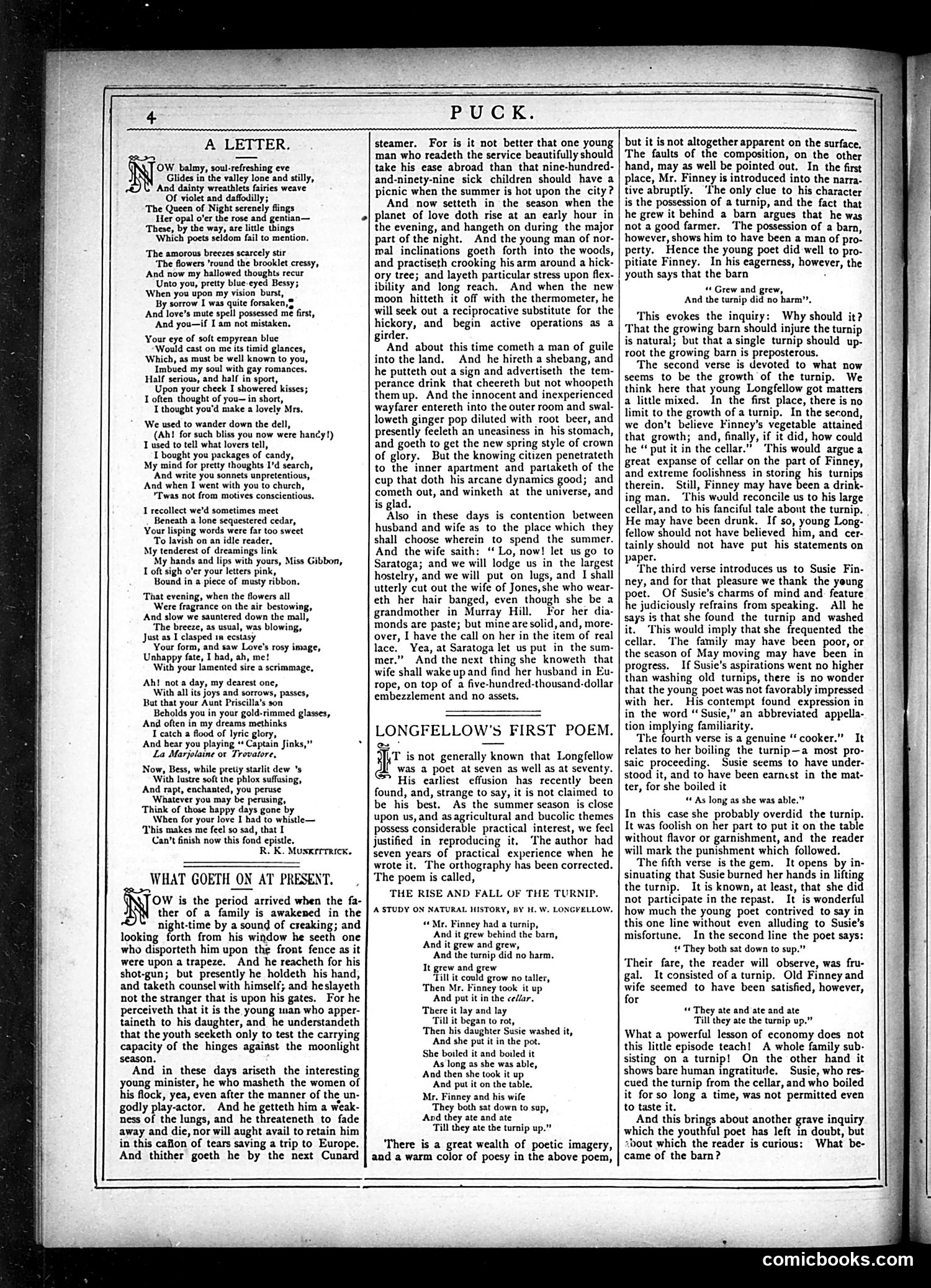
This page contains literary content rather than political cartoons. It features "A Letter" (a poem), "Longfellow's First Poem" (discussing the poet's early work), and "What Goeth On at Present" (a satirical prose piece about family life). "What Goeth On at Present" appears to be domestic satire centering on a family dispute. A father arrives home to find his wife has taken their children to the country without permission. The narrative mocks the husband's indignation and the wife's independent decision-making—she went to Saratoga Springs despite his objection, leaving him to discover the empty house. The piece satirizes marital tensions and shifting household authority, presenting the wife's autonomous choice as both comedic and somewhat scandalous for the era. The overall page emphasizes literary humor over topical political satire.
This page contains a satirical article titled "THE GREAT FENIAN MOVEMENT" by Col. Blather O'Lunderbus, discussing Irish nationalist activities and proposed emigration to Canada. The piece mockingly presents an Irish character's boastful plans to organize Irish people ("Big Bonanzas and Virginia Consolidated Mines") while critiquing their actual effectiveness. The satire targets: - Irish-American organizing and recruitment efforts - Perceived Irish-American ineffectiveness despite grandiose rhetoric - The contrast between bombastic talk and practical results - Irish stereotypes (drinking, poor planning, lack of discipline) The article appears positioned as satirizing both Irish nationalist ambitions and American attitudes toward Irish immigrants during what appears to be a period of Fenian Brotherhood activity (likely 1860s-70s). The humor relies on ethnic caricature typical of Victorian-era Puck.
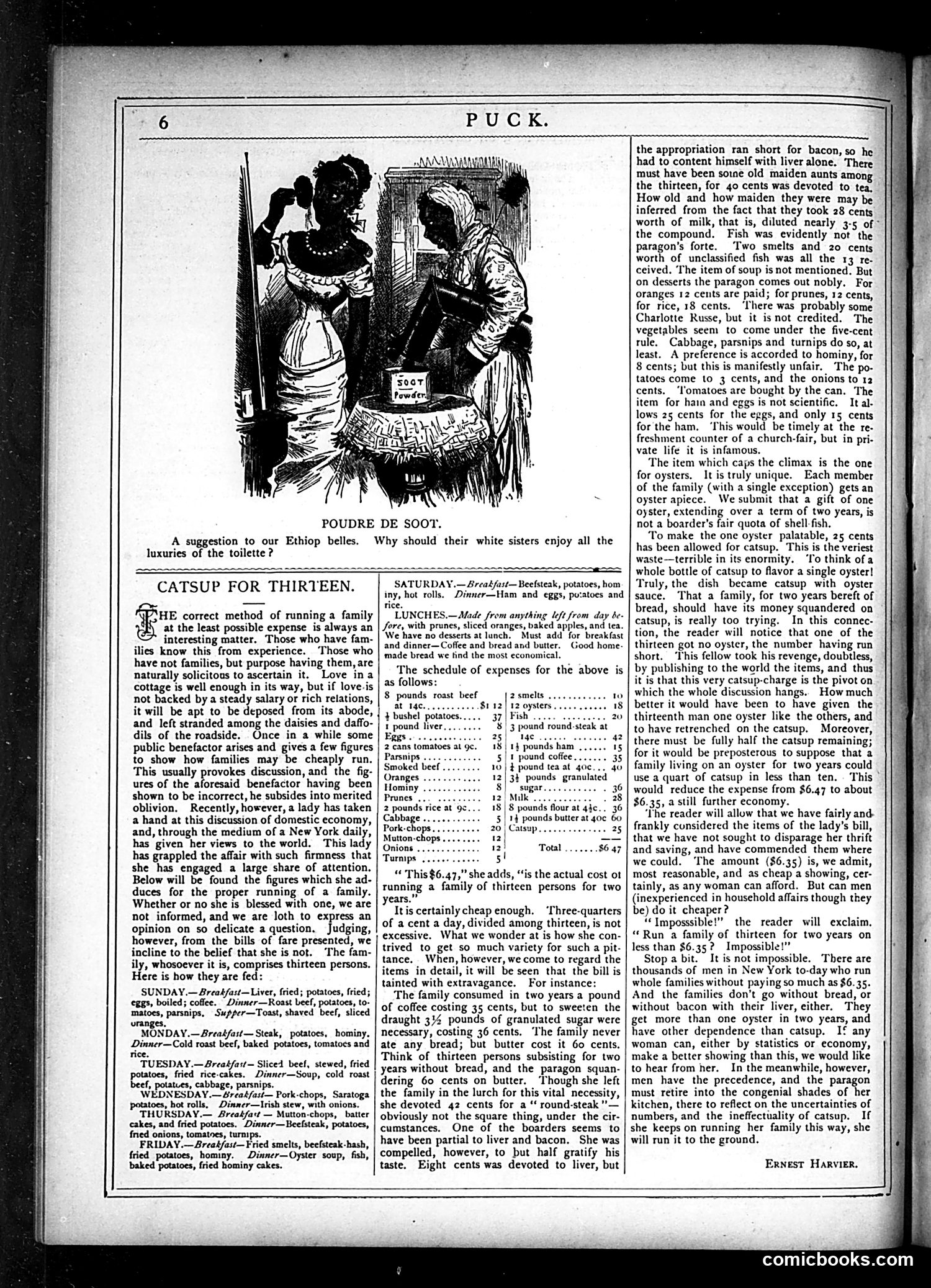
The cartoon depicts two women in period dress examining a box labeled "Soot Powder." The caption reads: "A suggestion to our Ethiop belles. Why should their white sisters enjoy all the luxuries of the toilette?" This is a racist satire mocking Black women ("Ethiop belles" being a dated, derogatory term). The "joke" suggests Black women should use soot as cosmetic powder, implying their dark skin is inferior and should be artificially darkened further—a cruel inversion of the whitening powders fashionable among white women. The article below, "Catsup for Thirteen," addresses domestic economy for families, contrasting sharply with the cartoon's offensive content. This page reflects Puck's era (likely late 1800s) when such racist humor was considered acceptable satirical material.
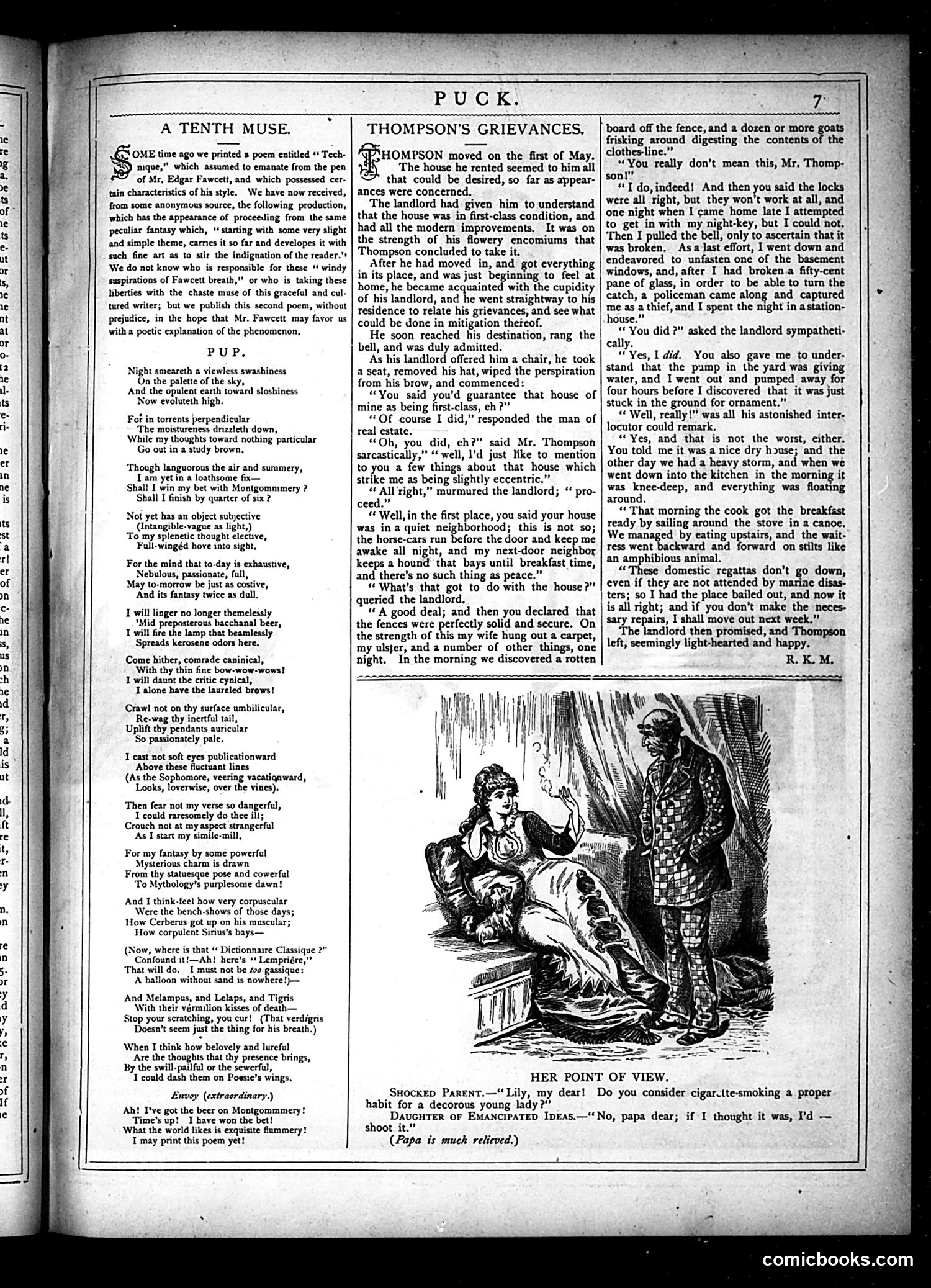
This cartoon illustrates a domestic dispute between a husband and wife. The man appears to be complaining about household management—specifically mentioning issues with the house's condition, the pump in the yard, and general repairs needing attention. The wife's response, titled "Her Point of View," dismisses his grievances by focusing on a trivial matter: she's concerned he's smoking a cigar indoors, which she considers improper behavior for a "decent young lady" to witness. The satire mocks both spouses: the husband for his petty complaints about domestic upkeep, and the wife for her prioritization of social propriety over substantive household problems. It reflects period attitudes about gender roles, domestic responsibility, and the disconnect between husbands' and wives' concerns within Victorian-era households.
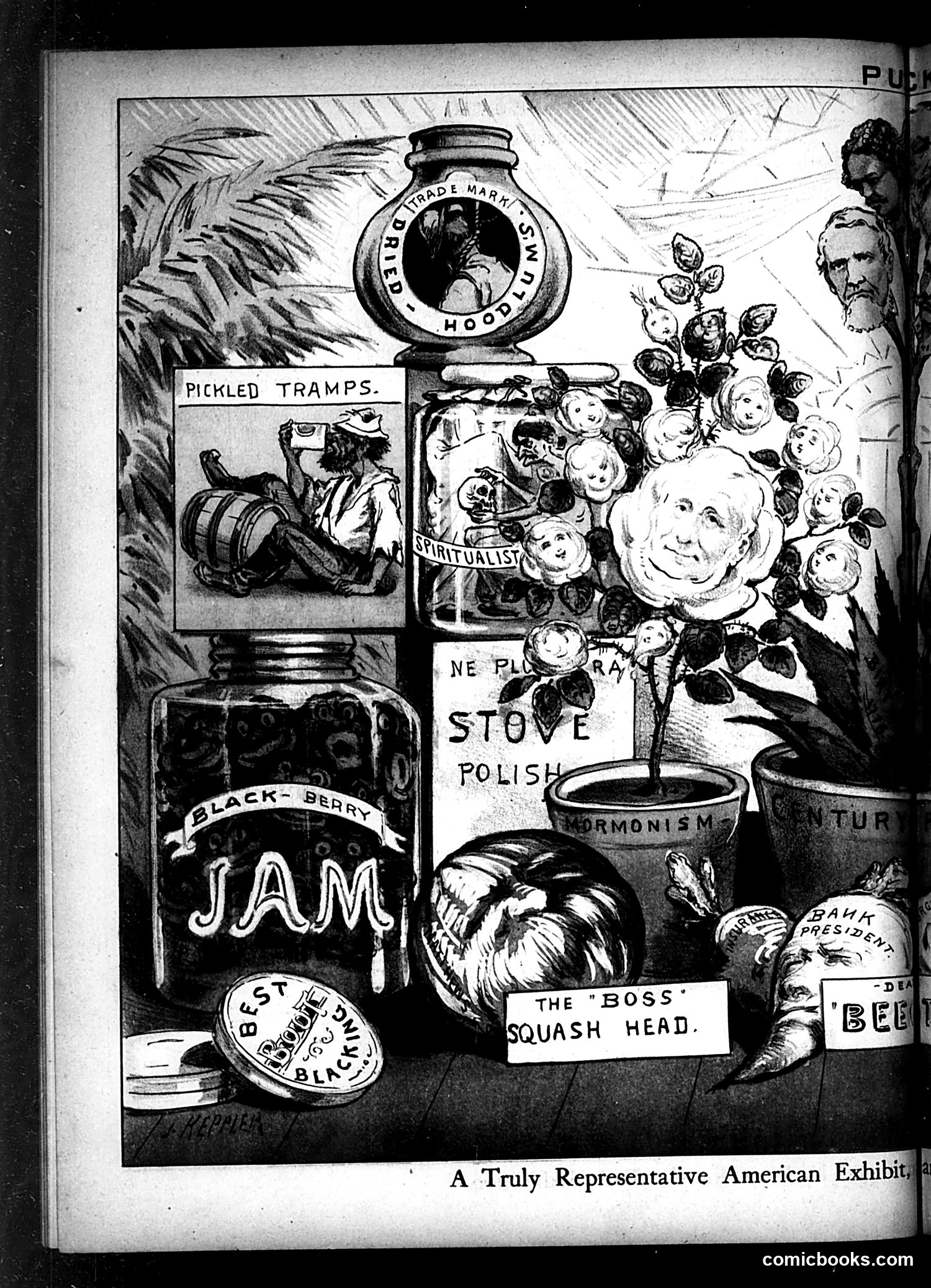
This satirical illustration presents various American products and cultural phenomena as specimens in a display. The central jar labeled "Hood's" contains multiple faces, likely representing spiritualism or false spirituality marketed to consumers. Surrounding items include "Pickled Tramps" (mocking vagrants), "Black Berry Jam," "Stove Polish," and "The Boss Squash Head" (a vegetable caricature). On the right appear portraits labeled with political references—"President" and "Beer," suggesting criticism of American politics and commercial culture. The satirical point appears to be that American popular culture, spiritualism, consumer goods, and politics are all interchangeable commodities—equally fake, mass-produced, and sold to a gullible public. The title emphasizes this critique of American commercialism and cultural shallowness.
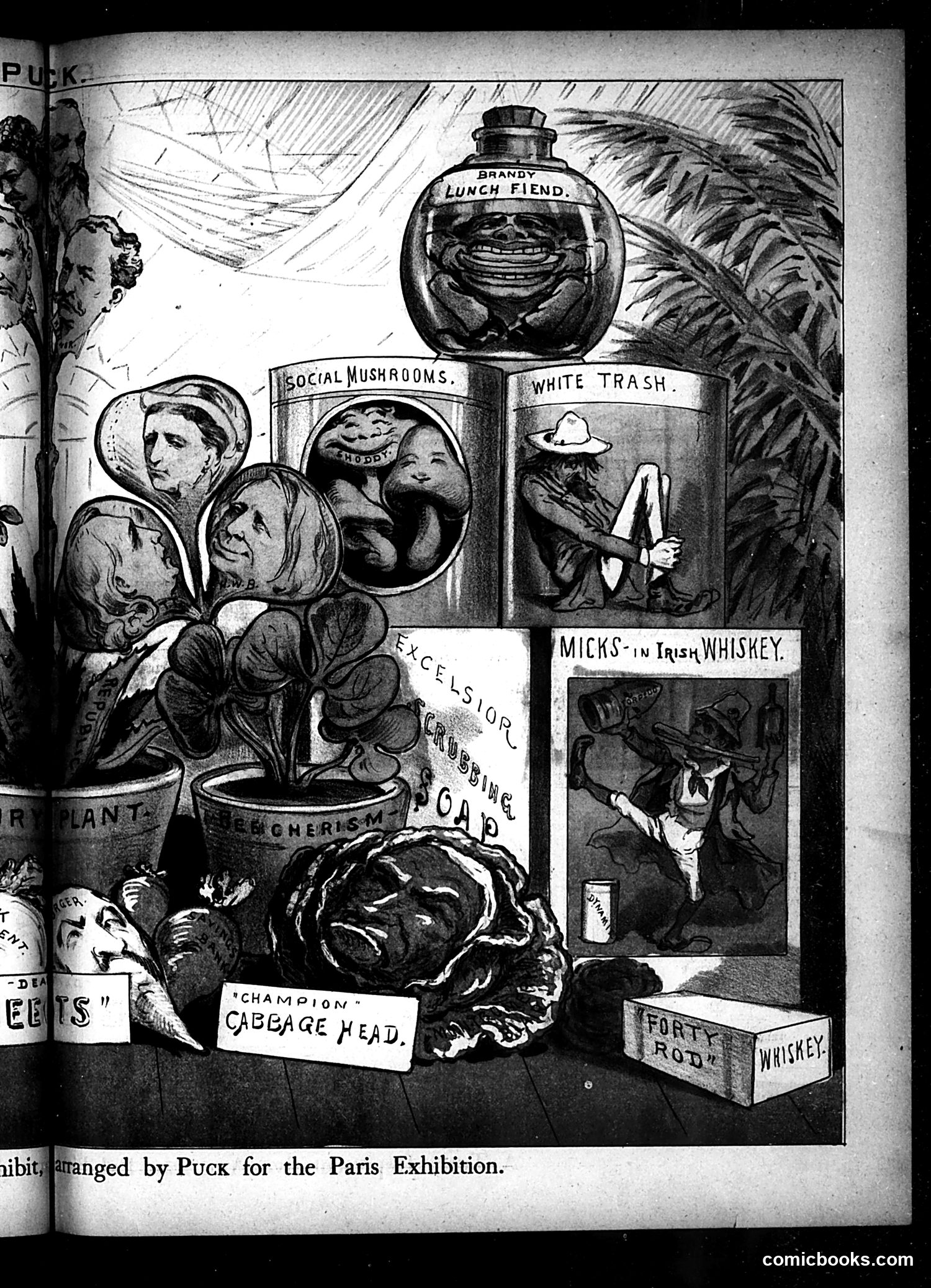
This satirical illustration mocks Irish stereotypes and social problems of the era. The display is arranged like a museum exhibition, with labeled "Irish products": - **"Brandy's Lunch Fiend"** (bottle top) - caricatures Irish alcoholism - **"Social Mushrooms"** - grotesque faces, likely referencing Irish poverty or social outcasts - **"White Trash"** and **"Micks in Irish Whiskey"** - derogatory ethnic slurs depicting Irish immigrants - **"Excelsior Rubbing Soap"** and **"Plant Alchemy"** - appear to be dubious patent medicines, reflecting period quackery - **"Champion Cabbage Head"** - implies Irish backwardness or simple agriculture The cartoon satirizes both Irish stereotypes (drinking, poverty, superstition) and American prejudice against Irish immigrants. "Puck" presents these as ridiculous "exports" worthy of international exhibition, mocking both Irish conditions and American attitudes toward Irish people.
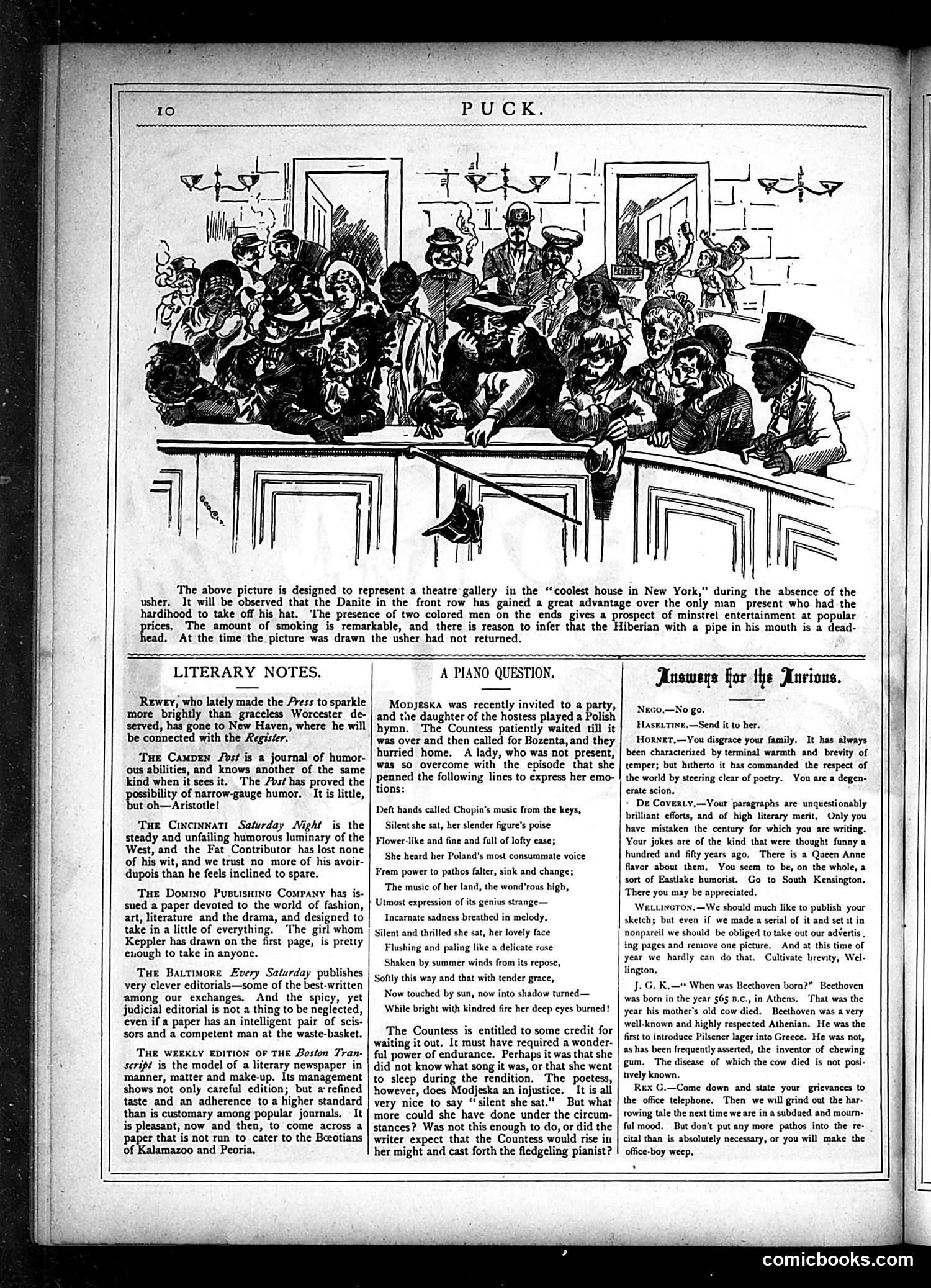
The main illustration depicts a crowded theater gallery—the cheapest seating area—during the absence of the theater's usual water supply. The caption explains that Parisians have discovered they can obtain affordable entertainment by watching this gallery's occupants, who are crowded together in poor conditions and reportedly engaging in heavy smoking. The satire targets both theater economics and public behavior: the irony that working-class theatergoers themselves become the entertainment spectacle for wealthier patrons, and a commentary on the unsanitary, cramped conditions of cheap theater seating. The mention of smoking and lack of water supply suggests commentary on public health and sanitation standards in popular entertainment venues of the era.
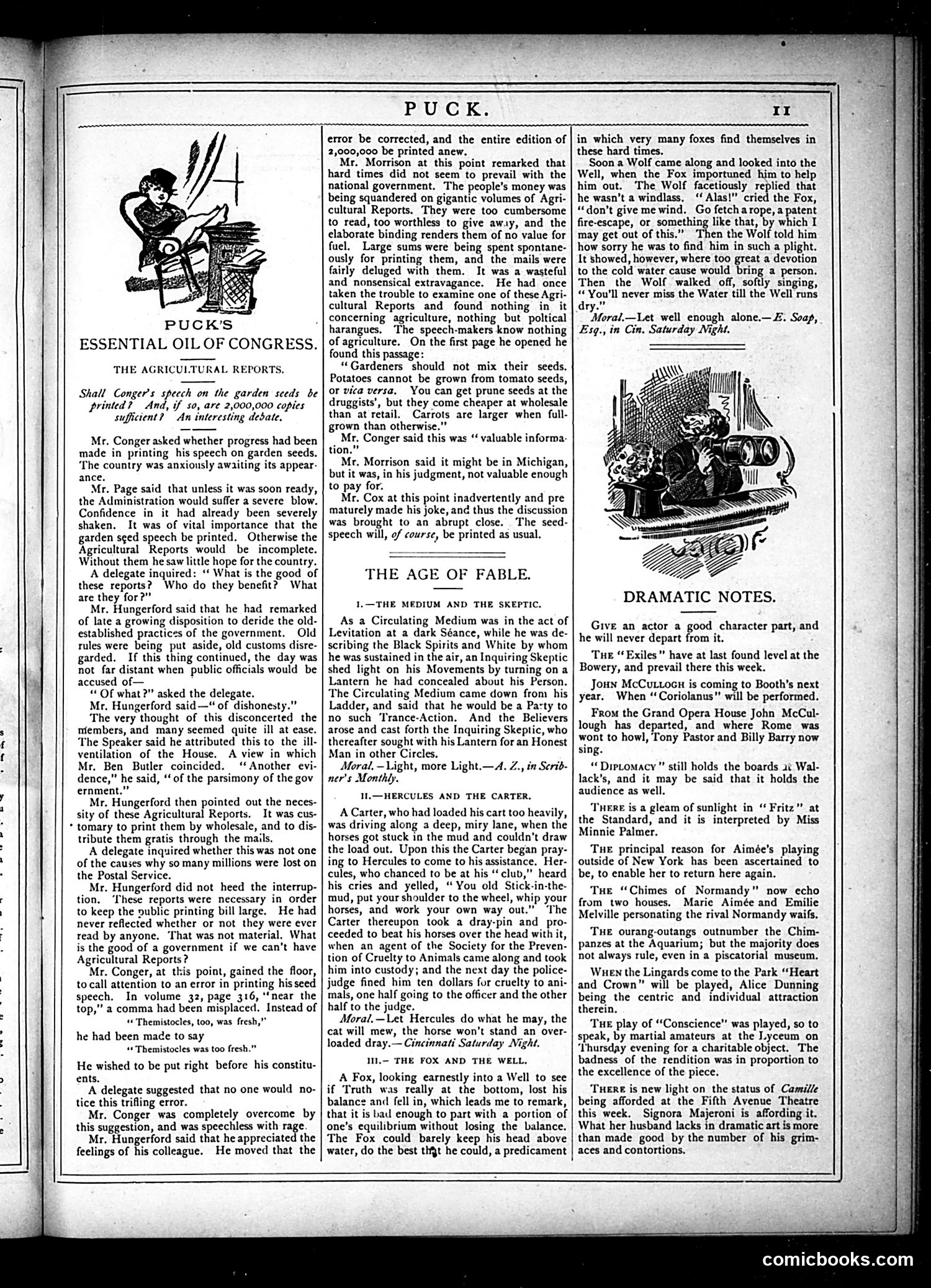
This page contains **two separate sections**: a political satire article titled "Puck's Essential Oil of Congress: The Agricultural Reports" and unrelated theater reviews under "Dramatic Notes." The main cartoon/article mocks Congressional debate over agricultural reports. It features speakers (Conger, Morrison, Cox, Hungerford, and Huller) arguing about whether printing expensive government agricultural reports serves any practical purpose. The satire critiques government waste and inefficiency—the reports are expensive to produce, poorly used, and represent typical Congressional time-wasting on minutiae while broader issues go unaddressed. The illustration shows Puck's trademark mischievous sprite character observing the foolish proceedings, embodying the magazine's satirical stance toward legislative absurdity.
This is a written satirical essay rather than a cartoon. The author recounts his experience as a treasury accountant in a Japanese bank during the Meiji period. The piece satirizes both Japanese and Western banking practices through the narrator's bemused observations of Japanese business culture—particularly their intense attention to security, inspection rituals, and meticulous record-keeping. The title's "near shave" likely refers to a close call or near-disaster in treasury operations. The narrative mocks the Japanese obsession with procedural detail while also gently ribbing Western merchants' assumptions about Oriental business practices. It's an ethnographic humor piece reflecting late 19th-century Western attitudes toward Japanese modernization and business methods.
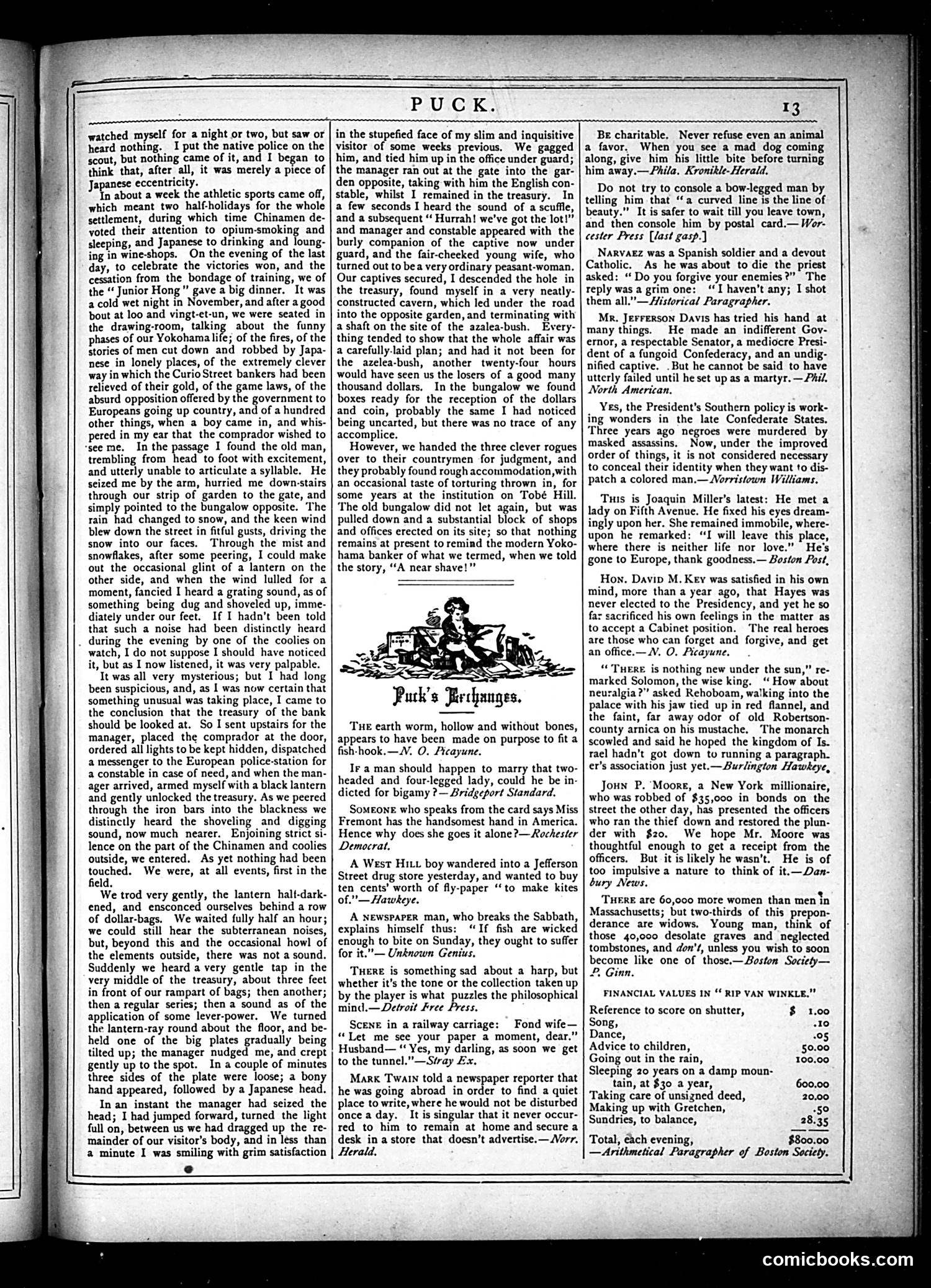
This page consists primarily of **text columns** with brief satirical commentaries on current events, rather than political cartoons. The small illustration titled **"Puck's Birthpanges"** depicts a chaotic scene—likely satirizing some contemporary political or social turmoil, though the specific event is unclear from this reproduction. The text sections mock various targets: Jefferson Davis's failed efforts; President Hayes's Southern policy and the murders of Black citizens three years prior; a man marrying for bigamy; and various human foibles. One entry mocks a newspaper man who breaks the Sabbath fishing. The final section lists "Financial Values in 'Rip Van Winkle'" as satire—assigning monetary amounts to virtues like advice to children ($55) and taking care of unsigned deeds ($20). Without clearer dates or bylines visible, specific political figures remain difficult to identify with certainty.
This page is primarily **advertising and notices** rather than satirical content. The dominant feature is a large advertisement for "Apollinaris Natural Mineral Water," marketed as "The Queen of Table Waters" with endorsements from various doctors and institutions. Secondary advertisements include compressed yeast, dental services, and furniture. The limited editorial content consists of brief satirical notes (labeled "Puck") about current events: a congressman's questionable dam story, disposal of blue ribbon in Gotham (suggesting wasted luxury), and observations about barber regulations and Sunday laws. These short items are typical Puck filler—light social commentary rather than substantial political satire. The page demonstrates how 19th-century magazines blended advertising revenue with editorial content.
This page is primarily **advertising and announcements** for Puck Publishing Company, not political satire. The left column announces Puck's new "General Designing Office" employing cartoonist Joseph Keppler, offering illustration services to theatrical professionals and others at reasonable rates. The right side contains various commercial advertisements: Friedrichshall Bitterwater, D. & Co. Gentlemen's Hats, Otto Stiels' Hat Letter Co., Pachtmann & Moelich (jewelry), Fred'k H. Levey & Co. (printing inks), Nicoll the Tailor, Puck's Almanac for 1878, and a champagne advertisement. There is no significant political cartoon or satire visible on this page—it functions as a business announcement and advertising space.
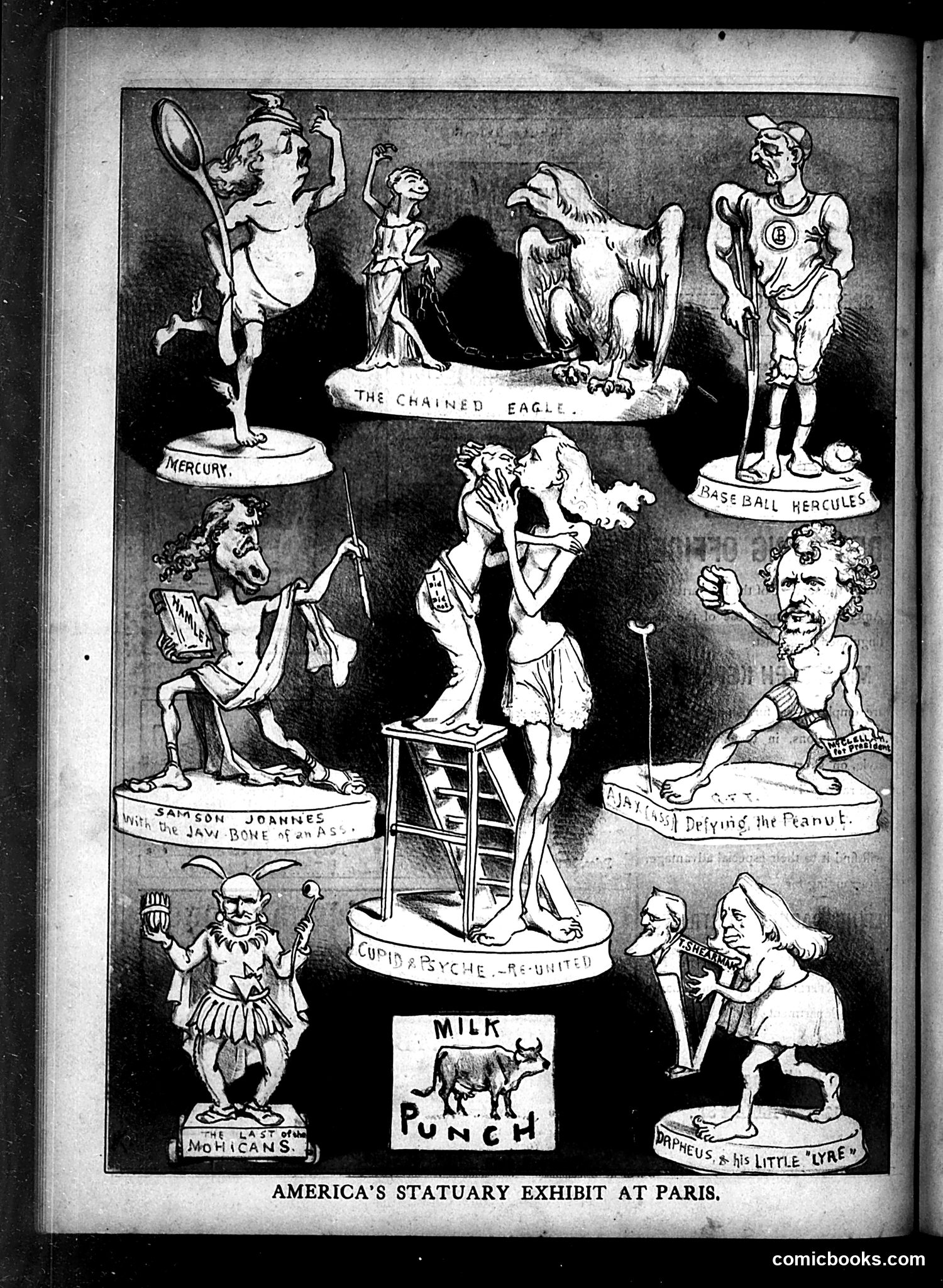
This satirical cartoon mocks American cultural aspirations by presenting grotesque caricatures as if they were classical statues worthy of exhibition. The titled figures include: - **Mercury** (upper left): a portly, undignified figure - **The Chained Eagle** (center): depicting American ideals in chains - **Base Ball Hercules** (upper right): mocking baseball as America's heroic contribution - **Samson Joannes**: suggesting theatrical or entertainment figures - **Cupid & Psyche Re-Unitted** (center): a couple - **The Last of the Mohicans**, **Defying the Peanut**, and **Orpheus & His Little Lyre**: various literary and cultural references The central **Milk Punch** cow emphasizes vulgar commercialism. The satire suggests America lacks refined cultural achievements and instead exports lowbrow entertainment, sports, and commercial products—hardly worthy of Paris's artistic legacy.