
Puck, 1878-05-15 · page 2 of 16
Puck — May 15, 1878 — page 2: what you’re looking at
What you’re looking at
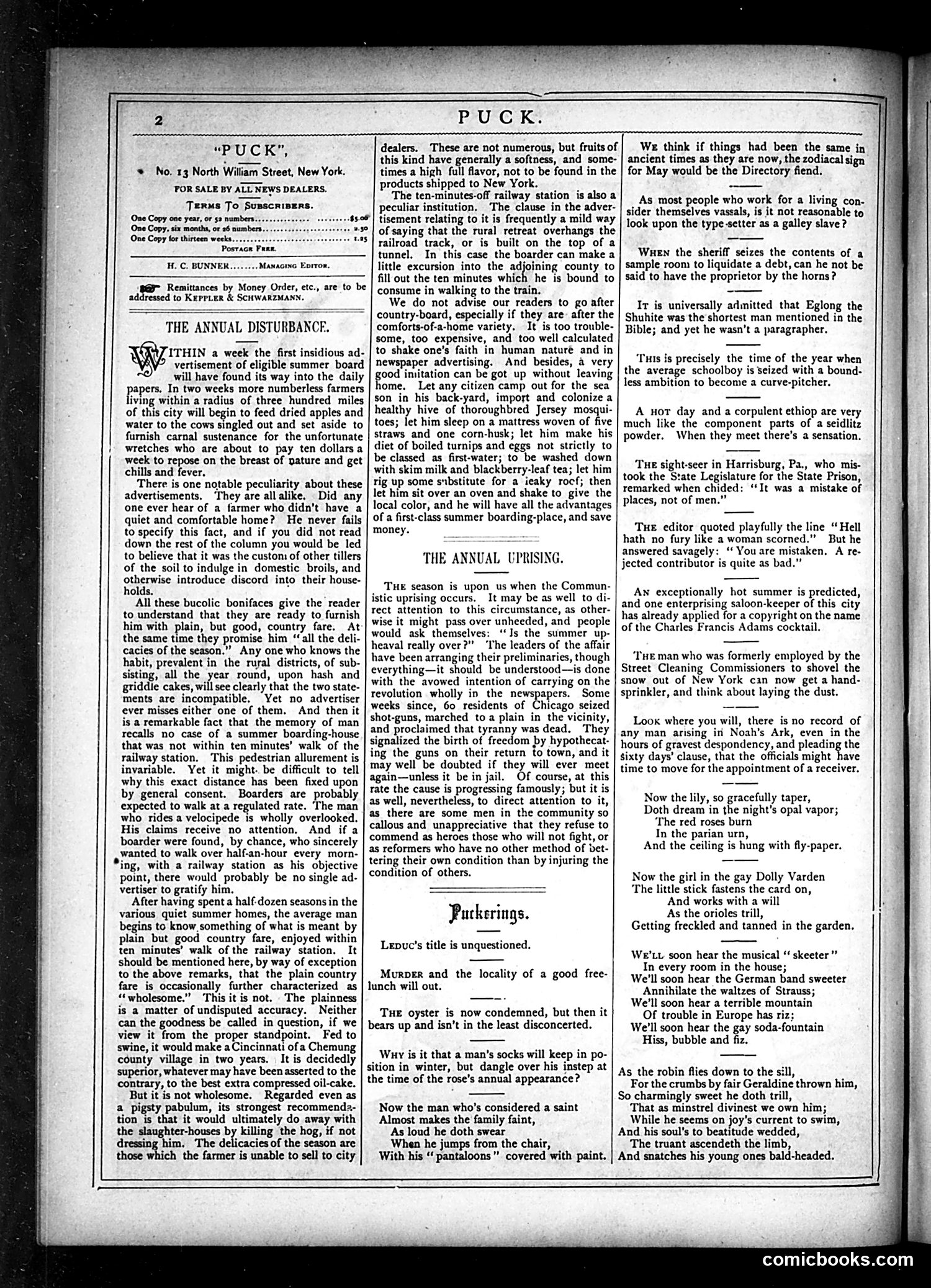
This page is primarily **text-based editorial content** rather than political cartoons. It contains: 1. **"The Annual Disturbance"** - A satirical article mocking summer boardinghouses and rural retreats, criticizing their poor conditions, overpricing, and false advertising to city dwellers seeking respite. 2. **"The Annual Uprising"** - Commentary on a Chicago uprising (appears to reference a recent freedom/anti-tyranny event), suggesting some readers doubt lasting change will occur. 3. **"Puckerings"** - A humor column with brief satirical quips about various topics (Leduc's title, oysters, men's socks in winter, a "saint" swearing). 4. **Poetry** - Verse about summer social activities and romance. The page exemplifies Puck's satirical approach through **written humor** targeting middle-class aspirations and contemporary absurdities rather than visual political cartooning.
📄 Transcribed text from this page (OCR, searchable)
Machine-transcribed from the original scan — historical spelling and the odd misread are preserved.
PUCK. “PUCK”, + No. 13 North William Street, New York. YOR SALE BY ALL NEWS DEALERS. Terms To SUBSCRIBERS. ay Remitances by Money Order, et, are to be addressed to Kerrier & SCHWARZMANN. THE ANNUAL DISTURBANCE. ITHIN a week the first insidious ad- vertisement of eligible summer board will have found its way into the daily apers, In two weeks more numberless farmers living within a radius of three hundred miles of this city will begin to feed dried apples and water to the cows singled out and set aside to furnish carnal sustenance for the unfortunate wretches who are about to pay ten dollars a week to repose on the breast of pature and get chills and fever. There is one notable peculiarity about these advertisements, They are all alike, Did any one ever hear of a farmer who didn’t have a quiet and comfortable home? He never fails to specify this fact, and if you did not read down the rest of the column you would be led to believe that it was the custom of other tillers of the soil to indulge in domestic broils, and otherwise introduce discord into their house- holds. All these bucolic bonifaces give the reader to understand that they are ready to furnish him with plain, but good, country fare. At the same time they promise him ‘all the deli- cacies of the season.” Any one who knows the habit, prevalent in the rural districts, of sub- sisting, all the year round, upon hash and griddle cakes, will see clearly that the two state- ments are incompatible. Yet no advertiser ever misses either one of them. And then it is a remarkable fact that the memory of man recalls no case of a summer boarding-house that was not within ten minutes’ walk of the railway station. This pedestrian allurement is invariable. Yet it might. be difficult to tell why this exact distance has been fixed upon by general consent. Boarders are probably expected to walk at a regulated rate. The man who rides a velocipede is wholly overlooked. His claims receive no attention, And if a boarder were found, by chance, who sincerely wanted to walk over half-an-hour every morn- ‘ing, with a railway station as his objective point, there would probably be no single ad- vertiser to gratify him. After having spent a half-dozen seasons in the various quiet summer homes, the average man begins to know something of what is meant by plain but good country fare, enjoyed within ten minutes’ walk of the railway station. It should be mentioned here, by way of exception to the above remarks, that the plain country fare is occasionally further characterized as “wholesome.” This it is not. The plainness is a matter of undisputed accuracy. Neither can the goodness be called in question, if we view it from the proper standpoint. Fed to swine, it would make a Cincinnati of a Chemung county village in two years. It is decidedly superior, whatever may have been asserted to the contrary, to the best extra compressed oil-cake. But it is not wholesome. Regarded even as a pigsty pabulum, its strongest recommenda- tion is that it would ultimately do away with the slaughter-houses by killing the hog, if not dressing him. The delicacies of the season are those which the farmer is unable to sell to city dealers. These are not numerous, but fruits of this kind have generally a softness, and some- times a high full flavor, not to be found in the products shipped to New York. The ten-minutes-off railway station is also a peculiar institution. The clause in the adver- tisement relating to it is frequently a mild way of saying that the rural retreat overhangs the railroad track, or is built on the top of a tunnel. In this case the boarder can make a little excursion into the adjoining county to fill out the ten minutes which he is bound to consume in walking to the train. We do not advise our readers to go after country-board, especially if they are: after the comforts-of-a-home variety. It is too trouble- some, too expensive, and too well calculated to shake one’s faith in human naturé and in newspaper advertising. And besides, 4 very ‘ood imitation can be got up without leaving ome. Let any citizen camp out for the sea son in his back-yard, import and colonize a healthy hive of thoroughbred Jersey mosqui- toes; let him sleep on a mattress woven of five straws and one corn-husk; let him make his diet of boiled turnips and eggs not strictly to be classed as first-water; to be washed down with skim milk and blackberry-leaf tea; let him rig up some substitute for a ieaky rocf; then let him sit over an oven and shake to give the local color, and he will have all the advantages of a first-class summer boarding-place, and save money. THE ANNUAL UPRISING. THe season is upon us when the Commun- istic uprising occurs. It may be as well to di- rect attention to this circumstance, as other- wise it might pass over unheeded, and people would ask themselves: ‘Is the summer up- heaval really over?” ‘I'he leaders of the affair have been arranging their preliminaries, though everything—it should be understood—is done with the avowed intention of carrying on the revolution wholly in the newspapers. Some weeks since, 60 residents of Chicago seized shot-guns, marched toa plain in the vicinity, and proclaimed that tyranny was dead, They signalized the birth of freedom by hypothecat- ing the guns on their return to town, and it may well be doubted if they will ever meet again—unless it be in jail. Of course, at this rate the cause is progressing famously; but it is as well, nevertheless, to direct attention to it, as there are some men in the community so callous and unappreciative that they refuse to commend as heroes those who will not fight, or as reformers who have no other method of bet- tering their own condition than by injuring the condition of others. Parkerings. Lepuc’s title is unquestioned. Murover and the locality of a good free- lunch will out. THE oyster is now condemned, but then it bears up and isn’t in the least disconcerted. Wuy is it that a man’s socks will keep in po- sition in winter, but dangle over his instep at the time of the rose’s annual appearance? Now the man who's considered a saint Almost makes the family faint, As loud he doth swear When he jumps from the chair, With his “ pantaloons”” covered with paint. We think if things had been the same in ancient times as they are now, the zodiacal sign for May would be the Directory fiend. As most people who work for a living con- sider themselves vassals, is it not reasonable to look upon the type-setter as a galley slave? Wuen the sheriff seizes the contents of a sample room to liquidate a debt, can he not be said to have the proprietor by the horns? Ir is universally admitted that Eglong the Shuhite was the shortest man mentioned in the Bible; and yet he wasn’t a paragrapher. ‘Tits is precisely the time of the year when the average schoolboy is seized with a bound- less ambition to become a curve-pitcher. A nor day and a corpulent ethiop are very much like the component parts of a seidlitz powder. When they meet there's a sensation, Tue sight-seer in Harrisburg, Pa., who mis- took the State Legislature for the State Prison, remarked when chided: ‘It was a mistake of places, not of men.” Tue editor quoted playfully the line “Hell hath no fury like a woman scorned.” But he answered savagely: “You are mistaken. A re- jected contributor is quite as bad.” Aw exceptionally hot summer is predicted, and one enterprising saloon-keeper of this city has already applied for a copyright on the name of the Charles Francis Adams cocktail. ‘THe man who was formerly employed by the Street Cleaning Commissioners to shovel the snow out of New York can now get a hand- sprinkler, and think about laying the dust. Loox where you will, there is no record of any man arising iri Noah’s Ark, even in the hours of gravest despondency, and pleading the sixty days’ clause, that the officials might have time to move for the appointment of a receiver. Now the lily, so gracefully taper, Doth dream in the night's opal vapor; ‘The red roses burn In the parian urn, And the ceiling is hung with fly-paper. Now the girl in the gay Dolly Varden The little stick fastens the card on, And works with a will As the orioles trill, Getting freckled and tanned in the garden. We’tL soon hear the musical ‘ skeeter”” In every room in the house; We'll soon hear the German band sweeter Annihilate the waltzes of Strauss; We'll soon hear a terrible mountain Of trouble in Europe has riz; We'll soon hear the gay soda-fountain Hiss, bubble and fiz. As the robin flies down to the sill, For the crumbs by fair Geraldine thrown him, So charmingly sweet he doth trill, That as minstrel divinest we own him; While he seems on joy's current to swim, And his soul's to beatitude wedded, The truant ascendeth the limb, And snatches his young ones bald-headed. comicbooks.com