
Puck, 1878-05-15 · page 6 of 16
Puck — May 15, 1878 — page 6: what you’re looking at
What you’re looking at
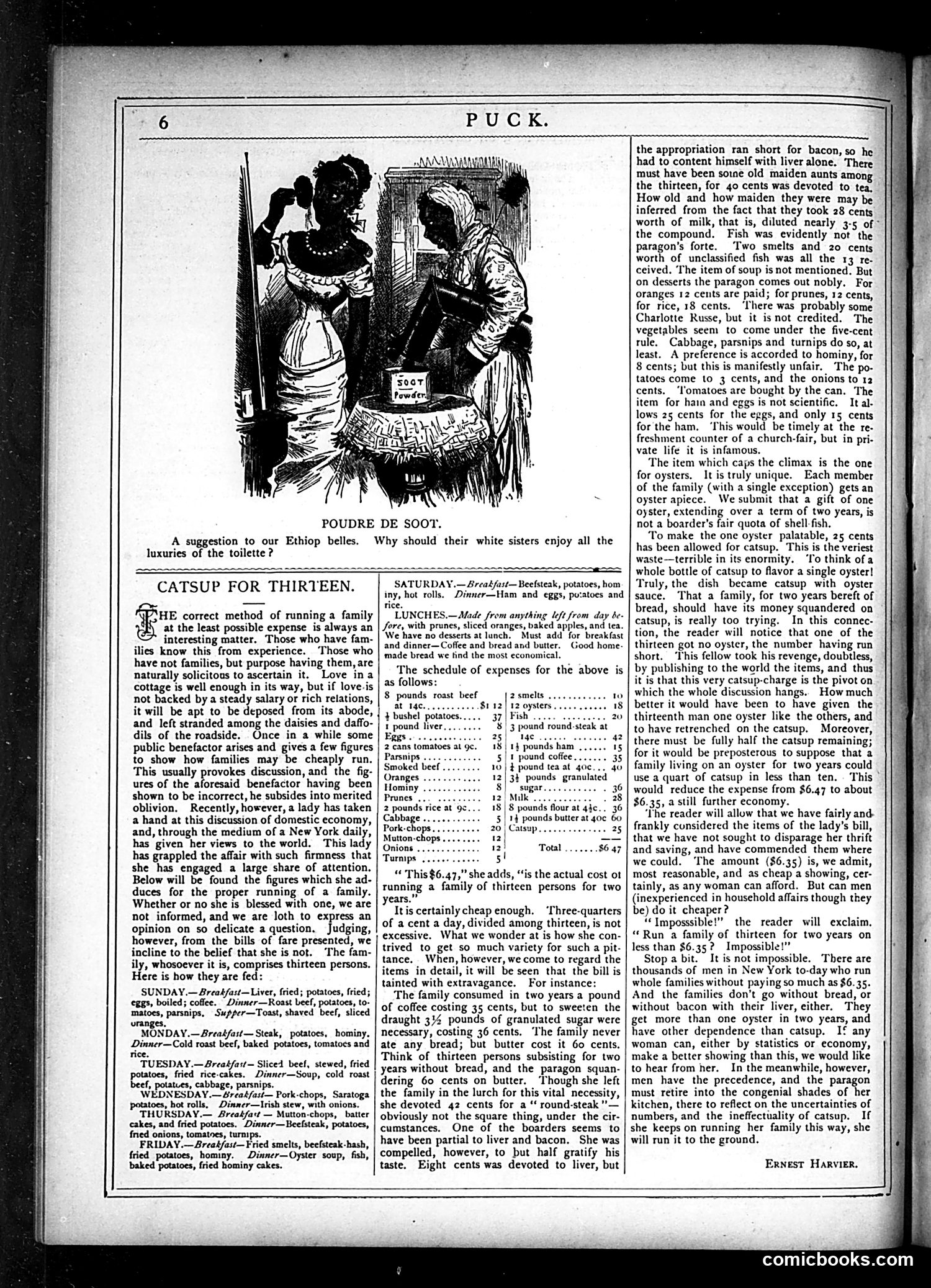
The cartoon depicts two women in period dress examining a box labeled "Soot Powder." The caption reads: "A suggestion to our Ethiop belles. Why should their white sisters enjoy all the luxuries of the toilette?" This is a racist satire mocking Black women ("Ethiop belles" being a dated, derogatory term). The "joke" suggests Black women should use soot as cosmetic powder, implying their dark skin is inferior and should be artificially darkened further—a cruel inversion of the whitening powders fashionable among white women. The article below, "Catsup for Thirteen," addresses domestic economy for families, contrasting sharply with the cartoon's offensive content. This page reflects Puck's era (likely late 1800s) when such racist humor was considered acceptable satirical material.
📄 Transcribed text from this page (OCR, searchable)
Machine-transcribed from the original scan — historical spelling and the odd misread are preserved.
POUDRE DE SOOT. A suggestion to our Ethiop belles. luxuries of the toilette ? Why should their white sisters enjoy all the nr wr Fe correct method of running a family at the least possible expense is always an interesting matter. Those who have fam- ilies know this from experience. Those who have not families, but purpose having them, are naturally solicitous to ascertain it. Love ina cottage is well enough in its way, but if love-is not backed by a steady salary or rich relations, it will be apt to be deposed from its abode, and left stranded among the daisies and daffo- dils of the roadside. Once in a while some public benefactor arises and gives a few figures to show how families may be cheaply run. This usually provokes discussion, and the fig- ures of the aforesaid benefactor having been shown to be incorrect, he subsides into merited oblivion. Recently, however, a lady has taken a hand at this discussion of domestic economy, and, through the medium of a New York daily, has given her views to the world. This lady has grappled the affair with such firmness that she has engaged a large share of attention. Below will be found the figures which she ad- duces for the proper running of a family. Whether or no she is blessed with one, we are not informed, and we are loth to express an opinion on so delicate a question. Judging, however, from the bills of fare presented, we incline to the belief that she is not. ‘The fam- ily, whosoever it is, comprises thirteen persons. Here is how they are fed: SUNDAY.— Breakfast Liver, fried; potatoes, fried; eggs, boiled; coffee. “Dinner—Roast beef, potatoes, to- matoes, parsnips, Supper—Toast, shaved beef, sliced vuranges, MONDAY.—Areak/ast— Steak, potatoes, hominy, Dinner—Cold roast beef, baked potatoes, tomatoes and rice. TUESDAY.—Areakfast— Sliced beef, stewed, fried potatoes, fried rice-cakes. Dinner—Soup, cold roast beef, potatues, cabbage, parsnips. WEDNESDAY.— &reakfast— Pork-chops, Saratoga hot rolls, Dinner—rish stew, with onions. THURSDAY.— Breakfact — Mutton-chops, batter cakes, and fried potatoes. Dinner—Beefsteak, potatoes, fned onions, tomatoes, turnips. FRIDAY.—&reak/ast— Fried smelts, beefsteak-hash, fried potatoes, hominy. Dinner—Oyster soup, fish, baked potatoes, fried hominy cakes. SATURDAY. —Sreakfast—Beefsteak, potatoes, hom iny, hot rolls. Dinner—Ham and eggs, po:atoes and tice. LUNCHES.—Made from anything left from day be- fore, with prunes, sliced oranges, baked apples, and tea. ‘We have no desserts at lunch. Must add for breakfast and dinner—Coffee and bread and butter. Good home made bread we tind the most economical, The schedule of expenses for the above is as follows: 8 pounds roast beef 2 smelts .. vo $1 12 | 12 oysters. “18 . 37 |Fish we. 2. 20 8 | 3 pound round-steak at Bb] ddeeawens, # 18 | 14 pounds ham 15 Parsni 5/1 pound coffee. 35 Smoked beef . + 10) # pound tea at 4oe... 40 Oranges . . 12/34 pounds granulated Hominy ....0...c00. 8)” sugar. Prunes .. 12) Mik, : 2 pounds rice at 9... 18) 8 pounds flour at ic. 5 | 14 pounds butter at 4oc 20 | Catsup : 12| 1 pound liver, 2 cans tomatoes at ge. she adds, ‘tis the actual cost ot running a family of thirteen persons for two years.” Itis certainly cheap enough. ‘Ihree-quarters of a cent a day, divided among thirteen, is not excessive. What we wonder at is how she con- trived to get so much variety for such a pit- tance. When, however, we come to regard the items in detail, it will be seen that the bill is tainted with extravagance. For instance: The family consumed in two years a pound of coffee costing 35 cents, but to sweeten the draught 314 pounds of granulated sugar were necessary, costing 36 cents, ‘The family never ate any bread; but butter cost it 60 cents. Think of thirteen persons subsisting for two years without bread, and the paragon squan- dering 60 cents on butter. ‘Though she left the family in the lurch for this vital necessity, she devoted 42 cents for a ‘‘ round-steak "— obviously not the square thing, under the cir- cumstances. One of the boarders seems to have been partial to liver and bacon. She was compelled, however, to but half gratify his taste. Eight cents was devoted to liver, but the appropriation ran short for bacon, so he had to content himself with liver alone. There must have been sone old maiden aunts amon; the thirteen, for 40 cents was devoted to tea, How old and how maiden they were may be inferred from the fact that they took 28 cents worth of milk, that is, diluted nearly 3-5 of - the compound. Fish was evidently not the paragon’s forte. ‘Two smelts and 20 cents worth of unclassified fish was all the 13 re- ceived. The item of soup is not mentioned. But on desserts the paragon comes out nobly, For. oranges 12 cents are paid; for prunes, 12 cents, for rice, 18 cents. ‘There was probably some Charlotte Russe, but it is not credited. The vegetables seem to come under the five-cent tule. Cabbage, parsnips and turnips do so, at least. A preference is accorded to hominy, for 8 cents; but this is manifestly unfair. The po- tatoes come to 3 cents, and the onions to 12 cents. ‘l'omatoes are bought by the can. The item for hain and eggs is not scientific. It al- lows 25 cents for the eggs, and only 15 cents forthe ham. ‘This would be timely at the re- freshment counter of a church-fair, but in pri- vate life it is infamous. The item which caps the climax is the one for oysters. It is truly unique. Each member of the family (with a single exception) gets an oyster apiece. We submit that a gift of one oyster, extending over a term of two years, is not a boarder’s fair quota of shell-fish. ‘To make the one oyster palatable, 25 cents has been allowed for catsup. This is the veriest waste—terrible in its enormity. ‘To think of a whole bottle of catsup to flavor a single oyster! Truly, the dish became catsup with oyster sauce. That a family, for two years bereft of bread, should have its money squandered on catsup, is really too trying. In this connec- tion, the reader will notice that one of the thirteen got no oyster, the number having run short. This fellow took his revenge, doubtless, by publishing to the world the items, and thus it is that this very catsup-charge is the pivot on which the whole discussion hangs.. How much better it would have been to have given the thirteenth man one oyster like the others, and to have retrenched on the catsup. Moreover, there must be fully half the catsup remaining; for it would be preposterous to suppose that a family living on an oyster for two years could use a quart of catsup in less than ten. . This © would reduce the expense from $6.47 to about $6.35, a still further economy. ‘The reader will allow that we have fairly and- frankly considered the items of the lady’s bill, that we have not sought to disparage her thrift and saving, and have commended them where we could. The amount ($6.35) is, we admit, most reasonable, and as cheap a showing, cer- tainly, as any woman can afford. But can men (inexperienced in household affairs though they be) do it cheaper? “Impossible!” the reader will exclaim, “Run a family of thirteen for two years on less than $6.35? Impossible!” Stop a bit. It is not impossible. There are thousands of men in New York to-day who run whole families without paying so much as $6.35. And the families don’t go without bread, or without bacon with their liver, either. They get more than one oyster in two years, and have other dependence than catsup. If any woman can, either by statistics or economy, make a better showing than this, we would like to hear from her. In the meanwhile, however, men have the precedence, and the paragon must retire into the congenial shades of her kitchen, there to reflect on the uncertainties of numbers, and the ineffectuality of catsup. If she keeps on running her family this way, she will run it to the ground. Ernest Harvie. | comicbooks.com