
Puck, 1878-05-15 · page 10 of 16
Puck — May 15, 1878 — page 10: what you’re looking at
What you’re looking at
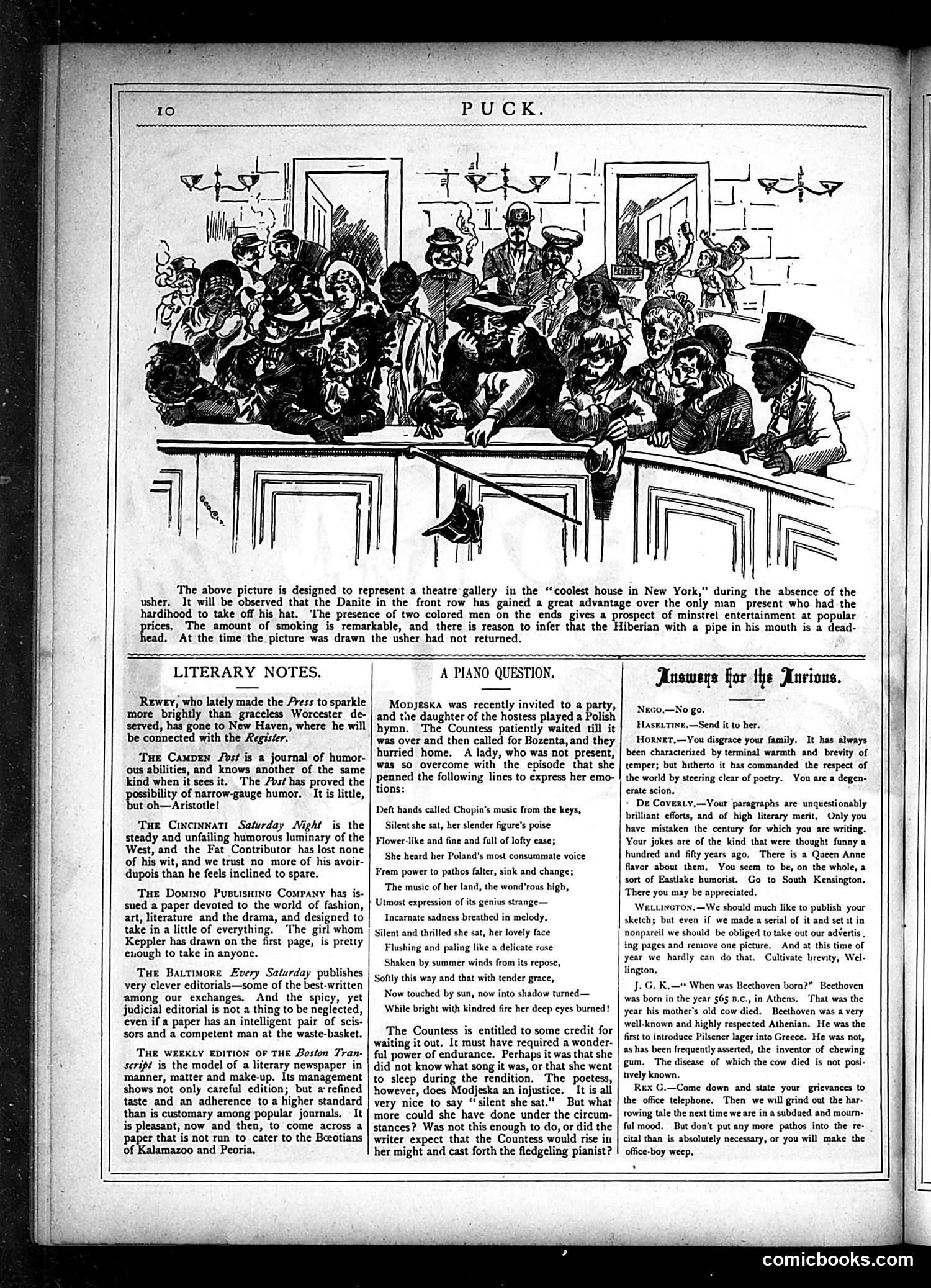
The main illustration depicts a crowded theater gallery—the cheapest seating area—during the absence of the theater's usual water supply. The caption explains that Parisians have discovered they can obtain affordable entertainment by watching this gallery's occupants, who are crowded together in poor conditions and reportedly engaging in heavy smoking. The satire targets both theater economics and public behavior: the irony that working-class theatergoers themselves become the entertainment spectacle for wealthier patrons, and a commentary on the unsanitary, cramped conditions of cheap theater seating. The mention of smoking and lack of water supply suggests commentary on public health and sanitation standards in popular entertainment venues of the era.
📄 Transcribed text from this page (OCR, searchable)
Machine-transcribed from the original scan — historical spelling and the odd misread are preserved.
Tae The above picture is designed to represent a theatre gallery in the ‘coolest house in New York,” during the absence of the usher. It will be observed that the Danite in the front row has gained a great advantage over the only man present who had the hardihood to take off his hat. ‘I'he presence of two colored men on the ends ae The amount of smoking is remarkable, and there is reason to infer tl ead, At the time the picture was drawn the usher had not returned. ‘ives a prospect of minstrel entertainment at popular the Hiberian with a pipe in his mouth is a dead- LITERARY NOTES. Rewey, who lately made the /ress to sparkle more brightly than graceless Worcester de- served, has gone to New Haven, where he will be connected with the Register. Tue Campen fost is a journal of humor- ous abilities, and knows another of the same kind when it sees it. The /vst has proved the possibility of narrow-gauge humor. It is little, ut oh—Aristotle! Tue Cincinnati Saturday Night is the steady and unfailing humorous luminary of the West, and the Fat Contributor has lost none of his wit, and we trust no more of his avoir- dupois than he feels inclined to spare. Tue Domino Pustisninc Company has is- sued a paper devoted to the world of fashion, art, literature and the drama, and designed to take in a little of everything. Keppler has drawn on the first page, is pretty enough to take in anyone. Tue Battimore Every Saturday publishes very clever editorials—some of the best-written among our exchanges. And the spicy, yet judicial editorial is not a thing to be neglected, even if a paper has an intelligent pair of scis- sors and a competent man at the waste-basket. ‘THE WEEKLY EDITION OF THE Boston Tran- script is the model of a literary newspaper in manner, matter and make-up. Its management shows not only careful edition; but a'refined taste and an adherence to a higher standard than is customary among popular journals. It is pleasant, now and then, to come across a paper that is not run to cater to the Beeotians of Kalamazoo and Peoria. ‘The girl whom | A PIANO QUESTION. Mopjeska was recently invited to a party, and the daughter of the hostess played a Polish hymn. The Countess patiently waited till it was over and then called for Bozenta, and they hurried home. A lady, who was not present, was so overcome with the episode that she penned the following lines to express her emo- tions: Deft hands called Chopin's music from the keys, Silent she sat, her slender figure’s poise Flower-like and fine and full of lofty ease; She heard her Poland's most consummate voice From power to pathos falter, sink and change; ‘The music of her land, the wond'rous high, Utmost expression of its genius strange— Incarnate sadness breathed in melody, Silent and thrilled she sat, her lovely face Flushing and paling like a delicate rose Shaken by summer winds from its repose, Softly this way and that with tender grace, Now touched by sun, now into shadow turned— While bright with kindred fire her deep eyes burned! The Countess is entitled to some credit for waiting it out. It must have required a wonder- ful power of endurance. Perhaps it was that she did not know what song it was, or that she went to sleep during the rendition. The poetess, however, does Modjeska an injustice. It is all very nice to say “silent she sat.” But what more could she have done under the circum- stances? Was not this enough to do, or did the writer expect that the Countess would rise in her might and cast forth the fledgeling pianist? Answeys for the Anvions. —No go. Send it to her. You disgrace your family. It has always been characterized by terminal warmth and brevity of temper; but hitherto it has commanded the respect of the world by steering clear of poetry. You are a degen- erate scion, - De Coverty,—Your paragraphs are unquestionably brilliant efforts, and of high literary merit, Only you have mistaken the century for which you are writing. Your jokes are of the kind that were thought funny a hundred and fifty years ago. There is a Queen Anne flavor about them, You seem to be, on the whole, a sort of Eastlake humorist. Go to South Kensington. ‘There you may be appreciated. Wettincrox.—We should much like to publish your sketch; but even if we made a serial of it and set it in nonpareil we should be obliged to take out our advertis . ing pages and remove one picture. And at this time of year we hardly can do that. Cultivate brevity, Wel- lington, J. G. K,—" When was Beethoven born?” Beethoven was born in the year 565 B.C, in Athens, ‘That was the year his mother’s old cow died. Beethoven was a very well-known and highly respected Athenian. He was the first to introduce Pilsener lager into Greece. He was not, ashas been frequently asserted, the inventor of chewing gum. The disease of which the cow died is not posi- tively known. Come down and state your grievances to the office telephone. Then we will grind out the har- rowing tale the next time we are in a subdued and mourn- fal mood. But don’t put any more pathos into the re- cital than is absolutely necessary, or you will make the office-boy weep. comicbooks.com